US Business

King greets world leaders as UK counts down to queen's funeral

King Charles III welcomed world leaders to Buckingham Palace on Sunday ahead of the funeral of Queen Elizabeth II, as US President Joe Biden paid a final tribute to the late monarch.

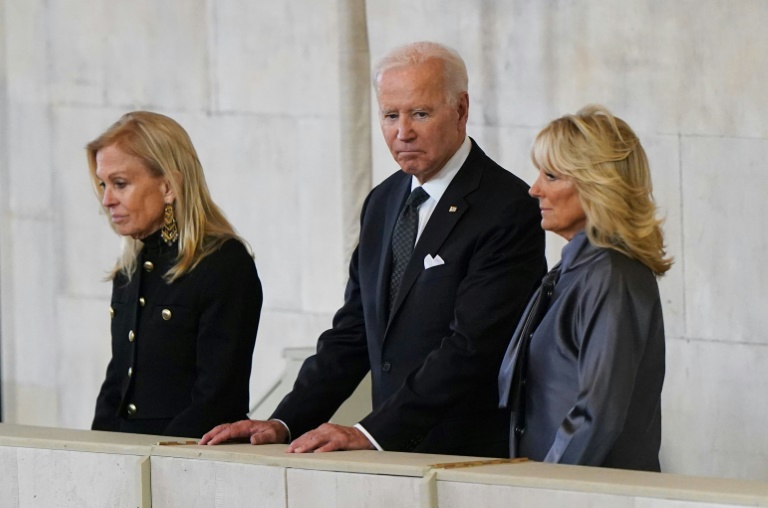
Biden crossed himself and put his hand on his heart while he stood with his wife Jill on a gallery overlooking the flag-draped casket in London’s cavernous Westminster Hall.

Members of the public filed by as time ticked down for them to pay their last respects to the only sovereign most Britons have ever known before she is laid to rest on Monday. 

Biden said the queen, who reigned for a record-breaking 70 years until her death on September 8 aged 96, exemplified the “notion of service”.

“To all the people of England, all the people of the United Kingdom, our hearts go out to you, and you were fortunate to have had her for 70 years, we all were. The world’s better for her,” Biden said after signing a book of condolences.

The US president then headed to Buckingham palace for a reception hosted by Charles for the dozens of leaders from Japan’s reclusive Emperor Naruhito to France’s Emmanuel Macron attending the funeral.   

Australia’s anti-monarchy Prime Minister Anthony Albanese, who viewed the lying-in-state and met Charles on Saturday, told Sky News Australia that the queen was “a constant reassuring presence”.

There was also a private audience at Buckingham Palace for Prime Minister Jacinda Ardern of New Zealand, which like Australia and 12 other Commonwealth realms now counts Charles as its sovereign.

“You could see that it meant a huge amount (to Charles) to have seen the sheer scale and outpouring of people’s love and affection for her late Majesty,” she told BBC television Sunday.

But in a sign of challenges ahead for the new king, Ardern added that she expected New Zealand to ditch the UK monarchy “over the course of my lifetime”.

Members of the public were already camping out in advance to catch a glimpse of Monday’s grand farewell at Westminster Abbey, which is expected to bring London to a standstill and be watched by billions of viewers worldwide.

– Country’s ‘glue’ –

E.J. Kelly, a 46-year-old schoolteacher from Northern Ireland, secured a prime spot with friends on the route the procession will take after the funeral.

“Watching it on television is wonderful but being here is something else,” she told AFP, equipped with camping chairs, warm clothing and extra socks.

“I will probably feel very emotional when it comes to it, but I wanted to be here to pay my respects.”

Crowds also thronged around Windsor Castle, west of London, where the queen’s coffin will be driven after the service for a private burial to lay her to rest alongside her late husband Prince Philip, her parents and her sister.

“I’ve lived here my whole life and I’ve never seen it this busy,” said Donna Lumbard, 32, a manager at a local restaurant. 

Starting with a single toll from Big Ben, British Prime Minister Liz Truss will lead a national minute’s silence at 8:00 pm (1900 GMT) on Sunday to reflect on the “life and legacy” of the queen.

Near the Scottish town of Falkirk, 96 lanterns were to be lowered into a “pool of reflection” at the foot of the Queen Elizabeth II Canal, before wreaths are placed in the water.

Those wanting to view the flag-draped casket have until 6:30 am (0530 GMT) on Monday to make it into Westminster Hall opposite the abbey.

As the queue continued to snake for miles along the River Thames on Sunday, the waiting time stood at more than nine hours, and the line is likely to be closed by the evening.

“To avoid disappointment please do not set off to join the queue,” the government said.

Andy Sanderson, 46, a supermarket area manager, was in the line and finally reaching parliament.

“She was the glue that kept the country together,” he said.

“She doesn’t have an agenda whereas politicians do, so she can speak for the people.”

– Grandchildren’s vigil –

As mourners slowly filed by on Saturday evening, Prince William and his estranged younger brother Prince Harry led the queen’s eight grandchildren in a 12-minute vigil around the coffin.

Harry — who did two tours with the British Army in Afghanistan — wore the uniform of the Blues and Royals cavalry regiment in which he served.

The move appeared to be the latest olive branch offered by Charles towards Harry and his wife Meghan after they quit royal duties and moved to North America, later accusing the royal family of racism.

Queen Elizabeth’s state funeral, the first in Britain since the death of her first prime minister Winston Churchill in 1965, will take place Monday at Westminster Abbey at 11:00 am.

Reflecting on the queen’s wishes for the hour-long ceremony, the former archbishop of York, John Sentamu, said she “did not want what you call long, boring services”.

“The hearts and people’s cockles will be warmed,” he told BBC television.

– Tributes from Camilla, Andrew –

Leaders from Russia, Afghanistan, Myanmar, Syria and North Korea were not invited to join the 2,000 guests.

Moscow’s foreign ministry last week called the decision “deeply immoral”, and “blasphemous” to the queen’s memory. China will attend at the abbey but was barred by parliamentary leaders from the lying-in-state.

As their private grief has played out in the glare of global attention, a fresh opinion poll from YouGov showed the royal family’s popularity has risen in the UK. 

William and his wife Kate topped the ranking of most popular royals while Charles saw his approval ratings rise 16 points since May.

The queen’s second son Prince Andrew, in disgrace over his links to billionaire US paedophile Jeffrey Epstein, paid tribute Sunday to the queen’s “knowledge and wisdom infinite, with no boundary or containment”.

Camilla gave her first public comments as the new queen consort, recalling her mother-in-law’s smile and “wonderful blue eyes”. 

“It must have been so difficult for her being a solitary woman” in a world dominated by men, Charles’s wife said in televised comments.

“There weren’t women prime ministers or presidents. She was the only one, so I think she carved her own role.”
Alaskans assess damage as powerful storm rumbles north

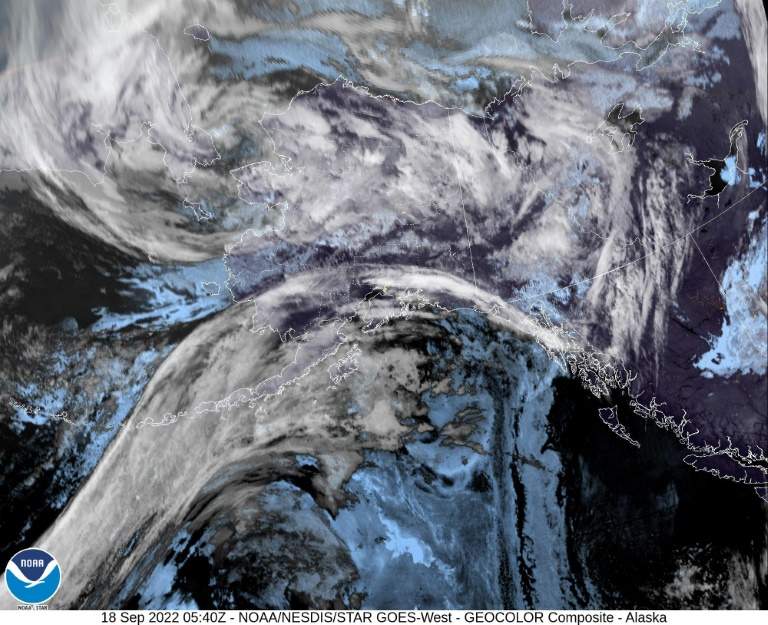
Residents in towns and villages on Alaska’s western coast were beginning Sunday to assess the damage from one of the most powerful storms to hit the region in decades.

The vast remains of Typhoon Merbok battered coastal towns as it rumbled northward, and by Sunday morning it had largely moved into the Chukchi Sea, north of the Bering Strait.

But coastal towns in that northern region remained under flood warnings Sunday, the National Weather Service (NWS) Fairbanks office tweeted.

The storm has hammered a vast stretch of Alaska’s lengthy coastline, bringing powerful winds, tidal surges and what the NWS described as “angry seas,” with waves of 50 feet (15 meters) or more.

Governor Mike Dunleavy has issued a disaster declaration.

Because of the remoteness of many coastal villages, and with communications limited, a full picture of the damage is expected to emerge slowly.

But officials and local residents said the destruction was severe. 

“So many communities I have visited, from Bethel, Unalakleet, Quinahgak, Hooper Bay and up to Nome and Teller, have been inundated by the storm,” Lisa Murkowski, one of Alaska’s US senators, tweeted Sunday.

“I am heartsick at the devastation.”

The state Emergency Operations Center said it had received “reports from multiple communities of power disruptions, damaged homes…flooding and infrastructure damage,” but no reports of injuries. 

Low-lying coastal areas were hardest hit, according to meteorologists and local news reports, with schools and airports flooded and some roads washed away. 

One small town — Golovin, on the Norton Sound — saw houses float away.

“We’ve had flooding in the past a few times, but it was never this severe,” Clarabelle Lewis, a tribal official with the Chinik Eskimo Community, told the Anchorage Daily News. “We’ve never had homes moved from their foundations.”

In Shaktoolik, a village of some 220 people on a gravelly spit between the Tagoomenik River and Norton Sound, Mayor Lars Sookiayak said that a berm built to protect the town from the sea — which had withstood many previous storms — had been wiped out.

“We’re pretty heartbroken,” he told Alaska Public Media News. “We’re almost becoming an island.”

Spielberg's 'The Fabelmans' wins Toronto festival top prize

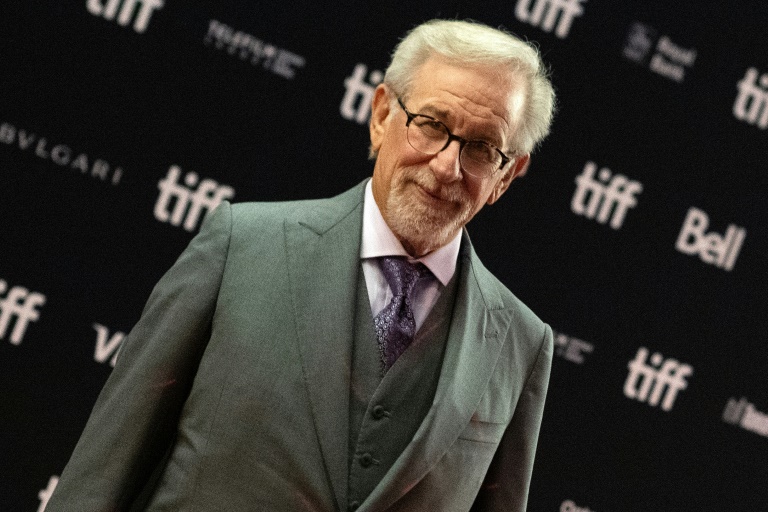
Steven Spielberg’s deeply personal new movie “The Fabelmans” secured its position as an early Oscars frontrunner Sunday by winning the top prize at the Toronto International Film festival.

“The Fabelmans,” out in theaters in November, is a semi-autobiographical drama based on Spielberg’s childhood, covering his parents’ troubled marriage, anti-Semitic bullying and his early efforts directing zero-budget movies with his teenage friends.

It earned a raucous standing ovation from the audience at its world premiere last weekend at the Toronto festival, known as TIFF.

“As I said on stage the other night, above all I’m glad I brought this film to Toronto,” Spielberg said in a statement Sunday.

“This is the most personal film I’ve made and the warm reception from everyone in Toronto made my first visit to TIFF so intimate and personal for me and my entire ‘Fabelman’ family.”

Voted for by audiences, the People’s Choice Award at North America’s biggest film festival has become something of an early Oscars bellwether, predicting eventual Academy Award best-picture winners such as “Nomadland” in 2020.

Spielberg, considered one of Hollywood’s greatest living directors, has won three Academy Awards: best picture and best director for “Schindler’s List,” and best director again for “Saving Private Ryan.”

He has been nominated for 19 Oscars to date, and will be expected to add to that tally at next year’s Academy Awards, on March 12 in Los Angeles.

The last 10 winners of the Toronto People’s Choice Awards were all nominated for best picture at the Academy Awards, with three winning the Oscar, including 2019’s surprise victor “Green Book.”

“12 Years a Slave” (2013), “The King’s Speech” (2010) and “Slumdog Millionaire” (2008) all began their journeys to Oscar glory with the Toronto prize.

At its premiere last weekend, Spielberg told a rapturous audience how he had long wanted to make such a deeply personal movie, but had eventually been motivated by the “fear” of the pandemic.

“I don’t think anybody knew in March or April of 2020 what was going to be the state of the art, the state of life, even a year from then,” said Spielberg.

“I just felt that if I was going to leave anything behind, what was the thing that I really need to resolve and unpack about my mom and my dad and my sisters?” 

“It wasn’t now or never, but it almost felt that way,” said the 75-year-old director.

Toronto runners-up included “Women Talking” by Sarah Polley and “Glass Onion: A Knives Out Mystery” by Rian Johnson.

The top documentary prize went to Hubert Davis’s “Black Ice,” a Canadian movie about historic racism in the world of professional ice hockey.

The Toronto festival, known for its large cinephile crowds and A-list stars, was hit badly by the pandemic, but this year saw the return of packed audiences and red carpets.

Spielberg's 'The Fabelmans' wins Toronto festival top prize

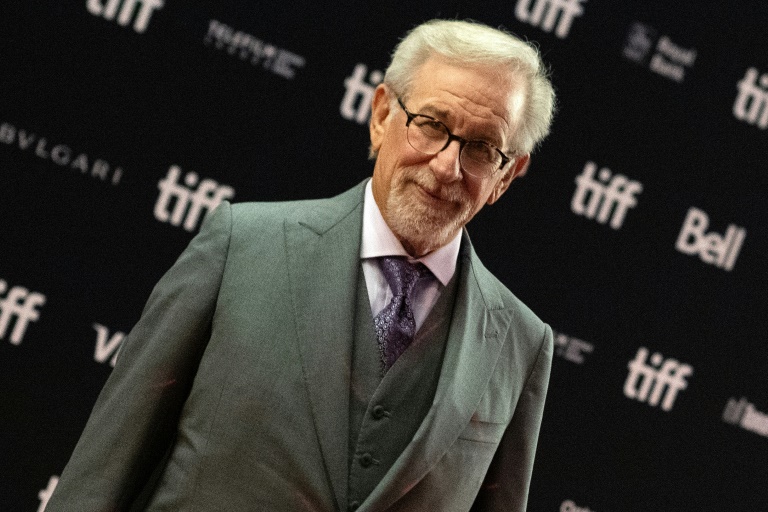
Steven Spielberg’s deeply personal new movie “The Fabelmans” secured its position as an early Oscars frontrunner Sunday by winning the top prize at the Toronto International Film festival.

“The Fabelmans,” out in theaters in November, is a semi-autobiographical drama based on Spielberg’s childhood, covering his parents’ troubled marriage, anti-Semitic bullying and his early efforts directing zero-budget movies with his teenage friends.

It earned a raucous standing ovation from the audience at its world premiere last weekend at the Toronto festival, known as TIFF.

“As I said on stage the other night, above all I’m glad I brought this film to Toronto,” Spielberg said in a statement Sunday.

“This is the most personal film I’ve made and the warm reception from everyone in Toronto made my first visit to TIFF so intimate and personal for me and my entire ‘Fabelman’ family.”

Voted for by audiences, the People’s Choice Award at North America’s biggest film festival has become something of an early Oscars bellwether, predicting eventual Academy Award best-picture winners such as “Nomadland” in 2020.

Spielberg, considered one of Hollywood’s greatest living directors, has won three Academy Awards: best picture and best director for “Schindler’s List,” and best director again for “Saving Private Ryan.”

He has been nominated for 19 Oscars to date, and will be expected to add to that tally at next year’s Academy Awards, on March 12 in Los Angeles.

The last 10 winners of the Toronto People’s Choice Awards were all nominated for best picture at the Academy Awards, with three winning the Oscar, including 2019’s surprise victor “Green Book.”

“12 Years a Slave” (2013), “The King’s Speech” (2010) and “Slumdog Millionaire” (2008) all began their journeys to Oscar glory with the Toronto prize.

At its premiere last weekend, Spielberg told a rapturous audience how he had long wanted to make such a deeply personal movie, but had eventually been motivated by the “fear” of the pandemic.

“I don’t think anybody knew in March or April of 2020 what was going to be the state of the art, the state of life, even a year from then,” said Spielberg.

“I just felt that if I was going to leave anything behind, what was the thing that I really need to resolve and unpack about my mom and my dad and my sisters?” 

“It wasn’t now or never, but it almost felt that way,” said the 75-year-old director.

Toronto runners-up included “Women Talking” by Sarah Polley and “Glass Onion: A Knives Out Mystery” by Rian Johnson.

The top documentary prize went to Hubert Davis’s “Black Ice,” a Canadian movie about historic racism in the world of professional ice hockey.

The Toronto festival, known for its large cinephile crowds and A-list stars, was hit badly by the pandemic, but this year saw the return of packed audiences and red carpets.

King to host world leaders as UK counts down to queen's funeral

US President Joe Biden was to pay his last respects in London to Queen Elizabeth II on Sunday, as ordinary mourners waiting in marathon lines were warned that time was running out to view her coffin lying in state. 

After witnessing the sombre scene in parliament’s Westminster Hall, Biden, Japan’s Emperor Naruhito and other world leaders were due to attend a reception with King Charles III.

Biden, who flew in late Saturday, has said that Charles’s mother “defined an era” after she reigned for a record-breaking 70 years leading up to her death on September 8, aged 96.

Australia’s anti-monarchy Prime Minister Anthony Albanese, who viewed the lying-in-state and met Charles on Saturday, told Sky News Australia that the queen was “a constant reassuring presence”.

There was also a private audience at Buckingham Palace for Prime Minister Jacinda Ardern of New Zealand, which like Australia and 12 other Commonwealth realms now counts Charles as its sovereign.

“You could see that it meant a huge amount (to Charles) to have seen the sheer scale and outpouring of people’s love and affection for her late Majesty,” she told BBC television Sunday.

But in a sign of challenges ahead for the new king, Ardern added that she expected New Zealand to ditch the UK monarchy “over the course of my lifetime”.

Members of the public were already camping out in advance to catch a glimpse of Monday’s grand farewell at Westminster Abbey, which is expected to bring London to a standstill and be watched by billions of viewers worldwide.

– Country’s ‘glue’ –

E.J. Kelly, a 46-year-old school teacher from Northern Ireland, secured a prime spot with friends on the route the procession will take after the funeral.

“Watching it on television is wonderful but being here is something else,” she told AFP, equipped with camping chairs, warm clothing and extra socks.

“I will probably feel very emotional when it comes to it, but I wanted to be here to pay my respects.”

Crowds also thronged around Windsor Castle, west of London, where the queen’s coffin will be driven after the service for a private burial to lay her to rest alongside her late husband Prince Philip, her parents and her sister.

“I’ve lived here my whole life and I’ve never seen it this busy,” said Donna Lumbard, 32, a manager at a local restaurant. 

Starting with a single toll from Big Ben, British Prime Minister Liz Truss will lead a national minute’s silence at 8:00 pm (1900 GMT) on Sunday to reflect on the “life and legacy” of the queen.

Near the Scottish town of Falkirk, 96 lanterns were to be lowered into a “pool of reflection” at the foot of the Queen Elizabeth II Canal, before wreaths are placed in the water.

Those wanting to view the flag-draped casket have until 6:30 am (0530 GMT) on Monday to make it into the cavernous Westminster Hall opposite the abbey.

As the queue continued to snake for miles (kilometres) along the River Thames on Sunday, the waiting time stood at more than nine hours, and the line is likely to be closed by the evening.

“To avoid disappointment please do not set off to join the queue,” the government said.

Andy Sanderson, 46, a supermarket area manager, was in the line and finally reaching parliament.

“She was the glue that kept the country together,” he said.

“She doesn’t have an agenda whereas politicians do, so she can speak for the people.”

– Grandchildren’s vigil –

As mourners slowly filed by on Saturday evening, Prince William and his estranged younger brother Prince Harry led the queen’s eight grandchildren in a 12-minute vigil around the coffin.

Harry — who did two tours with the British Army in Afghanistan — wore the uniform of the Blues and Royals cavalry regiment in which he served.

The move appeared to be the latest olive branch offered by Charles towards Harry and his wife Meghan after they quit royal duties and moved to North America, later accusing the royal family of racism.

Queen Elizabeth’s state funeral, the first in Britain since the death of her first prime minister Winston Churchill in 1965, will take place Monday at Westminster Abbey at 11:00 am.

Reflecting on the queen’s wishes for the hour-long ceremony, the former archbishop of York, John Sentamu, said she “did not want what you call long, boring services”.

“The hearts and people’s cockles will be warmed,” he told BBC television.

– Tributes from Camilla, Andrew –

Leaders from Russia, Afghanistan, Myanmar, Syria and North Korea were not invited to join the 2,000 guests.

Moscow’s foreign ministry last week called the decision “deeply immoral”, and “blasphemous” to the queen’s memory. China will attend at the abbey, but was barred by parliamentary leaders from the lying-in-state.

As their private grief has played out in the glare of global attention, a fresh opinion poll from YouGov showed the royal family’s popularity has risen in the UK. 

William and his wife Kate topped the ranking of most popular royals while Charles saw his approval ratings rise 16 points since May.

The queen’s second son Prince Andrew, in disgrace over his links to billionaire US paedophile Jeffrey Epstein, paid tribute Sunday to the queen’s “knowledge and wisdom infinite, with no boundary or containment”.

Camilla gave her first public comments as the new queen consort, recalling her mother-in-law’s smile and “wonderful blue eyes”. 

“It must have been so difficult for her being a solitary woman” in a world dominated by men, Charles’s wife said in televised comments.

“There weren’t women prime ministers or presidents. She was the only one so I think she carved her own role.”
King to host world leaders as UK counts down to queen's funeral

US President Joe Biden was to pay his last respects in London to Queen Elizabeth II on Sunday, as ordinary mourners waiting in marathon lines were warned that time was running out to view her coffin lying in state.

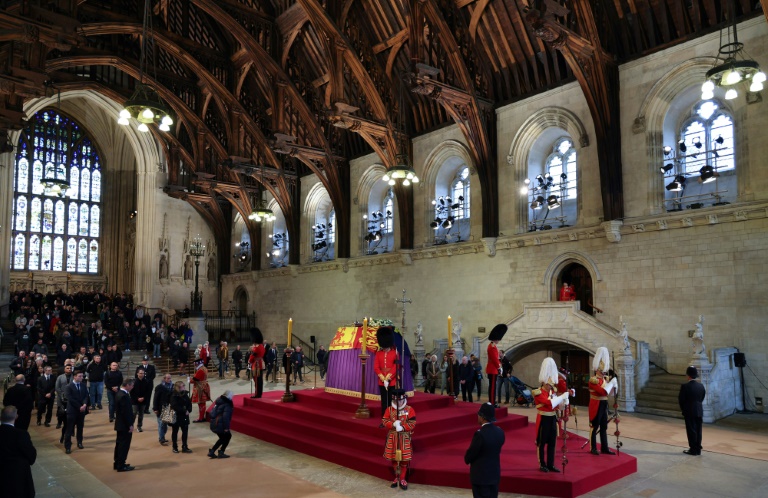
After witnessing the sombre scene in parliament’s Westminster Hall, Biden, Japan’s Emperor Naruhito and other world leaders were due to attend a reception with King Charles III.

Biden, who flew in late Saturday, has said that Charles’s mother “defined an era” after she reigned for a record-breaking 70 years leading up to her death on September 8, aged 96.

Australia’s anti-monarchy Prime Minister Anthony Albanese, who viewed the lying-in-state and met Charles on Saturday, told Sky News Australia that the queen was “a constant reassuring presence”.

There was also a private audience at Buckingham Palace for Prime Minister Jacinda Ardern of New Zealand, which like Australia and 12 other Commonwealth realms now counts Charles as its sovereign.

“You could see that it meant a huge amount (to Charles) to have seen the sheer scale and outpouring of people’s love and affection for her late Majesty,” she told BBC television Sunday.

But in a sign of challenges ahead for the new king, Ardern added that she expected New Zealand to ditch the UK monarchy “over the course of my lifetime”.

The first members of the public were already camping out in advance to catch a glimpse of Monday’s grand farewell at Westminster Abbey, which is expected to bring London to a standstill and be watched by billions of viewers worldwide.

– Country’s ‘glue’  –

E.J. Kelly, a 46-year-old school teacher from Northern Ireland, secured a prime spot with friends on the route the procession will take after the funeral.

“Watching it on television is wonderful but being here is something else,” she told AFP, equipped with camping chairs, warm clothing and extra socks.

“I will probably feel very emotional when it comes to it, but I wanted to be here to pay my respects.”

Fiona Ogilvie, 54, who served in the Royal Air Force, had taken up position outside Westminster Abbey.

“When you join the RAF you swear an allegiance to the queen, and that kind of stays with you,” she said.

“She was still doing her duty up to two days before she died, and you can’t ask more than that,” Ogilvie added, after the queen appointed Liz Truss as her 15th prime minister in one of her last official acts.

Starting with a single toll from Big Ben, Britain will hold a minute’s silence at 8:00 pm (1900 GMT) on Sunday to reflect on the “life and legacy” of the queen.

Near the Scottish town of Falkirk, 96 lanterns were to be lowered into a “pool of reflection” at the foot of the Queen Elizabeth II Canal, before wreaths are placed in the water.

Those wanting to view the flag-draped casket have until 6:30 am (0530 GMT) on Monday to make it into the cavernous Westminster Hall opposite the abbey.

As the queue continued to snake for miles (kilometres) along the River Thames on Sunday, the waiting time stood at more than 13 hours, and the line is likely to be closed by the evening.

“To avoid disappointment please do not set off to join the queue,” the government said.

Andy Sanderson, 46, a supermarket area manager, was in the line and finally reaching parliament.

“She was the glue that kept the country together,” he said.

“She doesn’t have an agenda whereas politicians do, so she can speak for the people.”

– Grandchildren’s vigil –

As mourners slowly filed by on Saturday evening, Prince William and his estranged younger brother Prince Harry led the queen’s eight grandchildren in a 12-minute vigil around the coffin.

Harry — who did two tours with the British Army in Afghanistan — wore the uniform of the Blues and Royals cavalry regiment in which he served.

The move appeared to be the latest olive branch offered by Charles towards Harry and his wife Meghan after they quit royal duties and moved to North America, later accusing the royal family of racism.

Queen Elizabeth’s state funeral, the first in Britain since the death of her first prime minister Winston Churchill in 1965, will take place Monday at Westminster Abbey in London at 11:00 am.

Reflecting on the queen’s wishes for the hour-long ceremony, the former archbishop of York, John Sentamu, said she “did not want what you call long, boring services”.

“The hearts and people’s cockles will be warmed and at the same time, there will be a moment of saying this is a funeral service that is glorious in its setting,” he told BBC television.

– Tributes from Camilla, Andrew –

Leaders from Russia, Afghanistan, Myanmar, Syria and North Korea were not invited to join the 2,000 guests.

Moscow’s foreign ministry last week called the decision “deeply immoral”, and “blasphemous” to the queen’s memory. China will attend at the abbey, but was barred by parliamentary leaders from the lying-in-state.

After the funeral, the queen’s coffin will be driven to Windsor Castle, west of London, for a private burial when she will be laid to rest alongside her late husband Prince Philip, her parents and her sister.

The Queen’s second son Prince Andrew, in disgrace over his links to billionaire US paedophile Jeffrey Epstein, paid tribute Sunday to the queen’s “knowledge and wisdom infinite, with no boundary or containment”.

Camilla gave her first public comments as the new queen consort, recalling her mother-in-law’s smile and “wonderful blue eyes”. 

“It must have been so difficult for her being a solitary woman” in a world dominated by men, Charles’s wife said in televised comments.

“There weren’t women prime ministers or presidents. She was the only one so I think she carved her own role.”
King to host world leaders as UK counts down to queen's funeral

US President Joe Biden was Sunday to pay his last respects in London to Queen Elizabeth II, as ordinary mourners waiting in marathon lines were warned that time was running out to view her coffin lying in state.

After witnessing the sombre scene in parliament’s Westminster Hall, Biden, Japan’s Emperor Naruhito and other world leaders were due to attend a reception with the late queen’s successor, King Charles III.

Biden, who flew in late Saturday, has said that Elizabeth “defined an era” after she reigned for a record-breaking 70 years leading up to her death on September 8, aged 96.

Australia’s anti-monarchy Prime Minister Anthony Albanese, who viewed the lying-in-state and met Charles on Saturday, told Sky News Australia that the queen was “a constant reassuring presence”.

There was also a private audience at Buckingham Palace for Prime Minister Jacinda Ardern of New Zealand, which like Australia and 12 other Commonwealth realms now counts Charles as its sovereign.

“You could see that it meant a huge amount (to Charles) to have seen the sheer scale and outpouring of people’s love and affection for her late Majesty,” she told BBC television Sunday.

Commonwealth leaders were among dozens of heads of state and government in attendance, as Britain stages its biggest-ever policing operation.

The first members of the public were already camping out in advance to catch a glimpse of Monday’s grand farewell at Westminster Abbey, which is expected to bring London to a standstill and be watched by billions of viewers worldwide.

– ‘The nation’s granny’ –

“We wanted to have a good spot to see the procession,” said Royal Navy veteran Bill Parry, 59, as he waited in camping chairs with two other former servicemen.

“It’s not much to ask to sleep outside considering everything the queen did for us: 70 years of duty,” he told AFP.

Britain will hold a minute’s silence at 8:00 pm (1900 GMT) on Sunday to reflect on the “life and legacy” of the queen ahead of her funeral. 

Eurostar said it would observe the moment on its cross-Channel trains.

Near the Scottish town of Falkirk, 96 lanterns were to be lowered into a “pool of reflection” at the foot of the Queen Elizabeth II Canal, before wreaths are placed in the water.

Those wanting to view the flag-draped casket have until 6:30 am (0530 GMT) on Monday to make it into the cavernous Westminster Hall opposite the abbey.

As the queue continued to snake for miles (kilometres) along the River Thames Sunday morning, the waiting time stood at more than 13 hours, and the line is likely to be closed by the evening.

“To avoid disappointment please do not set off to join the queue,” the government said.

IT worker Shaun Mayo, 27, was among those relieved to have made it to Westminster Hall after queueing for 14 hours to pay his respects.

“It was incredibly emotional. She was like the nation’s granny,” he said.

“We’ll all miss her.”

A man who was arrested after approaching the casket on Friday has been charged with a public-order offence, police said.

– Grandchildren’s vigil –

As mourners slowly filed by on Saturday evening, Prince William and his estranged younger brother Prince Harry led the queen’s eight grandchildren in a 12-minute vigil around the coffin.

Harry — who did two tours with the British Army in Afghanistan — wore the uniform of the Blues and Royals cavalry regiment in which he served.

The move appeared to be the latest olive branch offered by Charles towards Harry and his wife Meghan after they quit royal duties and moved to North America, later accusing the royal family of racism.

The king and his eldest son William, the new heir to the throne, had earlier surprised those standing in line along the Thames by staging an unscheduled walkabout to shake their hands and thank them for coming.

Queen Elizabeth’s state funeral, the first in Britain since the death of her first prime minister Winston Churchill in 1965, will take place Monday at Westminster Abbey in London at 11:00 am (1000 GMT).

Reflecting on the queen’s wishes for the hour-long ceremony, the former archbishop of York, John Sentamu, said she “did not want what you call long, boring services”.

“The hearts and people’s cockles will be warmed and at the same time, there will be a moment of saying this is a funeral service that is glorious in its setting,” he told BBC television.

– Russia says ‘immoral’ –

Leaders from Russia, Afghanistan, Myanmar, Syria and North Korea were not invited to join the 2,000 guests.

Moscow’s foreign ministry last week called the decision “deeply immoral”, and “blasphemous” to the queen’s memory. China will attend at the abbey, but was barred by parliamentary leaders from the lying-in-state.

After the funeral, the queen’s coffin will be driven to Windsor Castle, west of London, for a private burial when she will be laid to rest alongside her late husband Prince Philip, her parents and her sister.

Camilla gave her first public comments as the new queen consort, recalling her mother-in-law’s smile and “wonderful blue eyes”. 

“It must have been so difficult for her being a solitary woman” in a world dominated by men, Charles’s wife said in televised comments.

“There weren’t women prime ministers or presidents. She was the only one so I think she carved her own role.”
Oscars Academy makes amends over 1973 Native American protest

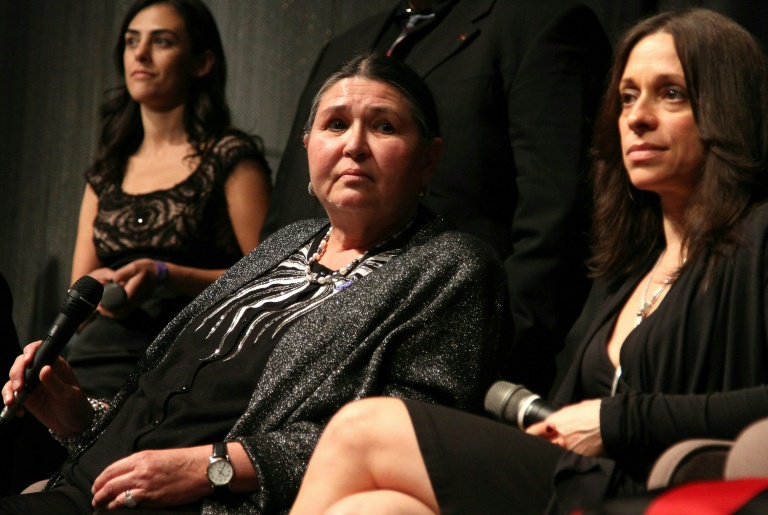
Almost five decades after she refused an Oscar on behalf of Marlon Brando over the treatment of Native Americans by the US film industry, Sacheen Littlefeather was honored Saturday by the Academy of Motion Picture Arts and Sciences.

In a moving ceremony in Los Angeles filled with singing and dancing, the Academy publicly apologized to Littlefeather, who was feted by activists in the wake of her protest, but blackballed by the movie world.

Littlefeather, who is Apache and Yaqui, was booed at the 1973 Academy Awards — the first to be broadcast live around the world — while explaining on Brando’s behalf why he would not accept his best actor Oscar for “The Godfather.” 

On Saturday she told a packed audience at the Academy’s newly-opened museum how she had arrived at the ceremony just minutes before she took the stage because Brando had taken so long writing his non-acceptance speech.

“I went up there, like a proud Indian woman with dignity, with courage, with grace, and with humility,” she said.

“I knew that I had to speak the truth. Some people may accept it. And some people may not.”

She was greeted on stage by Norwegian actress Liv Ullmann and “James Bond” star Roger Moore, who proffered the statuette she refused to accept.

Under strict instructions from Academy managers not to give an acceptance speech longer than 60 seconds, she delivered instead a dignified impromptu address.

“I said okay, and I had made this promise to Marlon (Brando) not to touch the Oscar. And so I wasn’t under any pressure that night,” Littlefeather quipped.

She said veteran Western star John Wayne had to be restrained from physically assaulting her as she left the stage.

Littlefeather, a member of the Screen Actors’ Guild, subsequently found it difficult to get work in Hollywood, with casting directors warned not to employ her.

– ‘Courage’ –

Former Academy president David Rubin, who penned the apology earlier this year, took to the stage to read his words, which invoked “the emotional burden” Littlefeather bore and “the cost to your own career.” 

“For too long the courage you showed has been unacknowledged. For this, we offer both our deepest apologies and our sincere admiration.”

Rubin’s apology comes as the movie industry reckons with what many view as a culture of sexism, racism and impunity.

“The academy and our industry finds itself at an inflection point,” Rubin said on Saturday. “We are actively examining our past and focusing on how best we can facilitate healing.”

The museum, which opened last September, has pledged to confront the Oscars’ “problematic history” including racism. One display already tackles the harassment of Littlefeather.

The Academy has also moved to confront accusations of a lack of racial diversity in recent years.

In 2019, “Last of the Mohicans” star Wes Studi became the first Native American actor to receive an Oscar, with an honorary Academy Award recognizing his career.

Its museum has also previously hosted events on women who achieved historic Oscars milestones including a talk with Buffy Sainte-Marie — the first Indigenous person to win an Oscar, for best original song in 1983.

Asked by reporters ahead of the ceremony how she felt about having to wait so long to hear the word “sorry”, Littlefeather was philosophical. 

“It’s never too late for an apology,” she said.

“It’s never too late for forgiveness.” 

Steep Fed rate hike seen as certainty after ugly inflation data

The Federal Reserve is poised to unleash another massive interest rate increase this week after the latest data showed a worrying US inflation picture, which confirmed the need for the central bank to continue to act aggressively.

Soaring prices have pushed annual inflation to a 40-year high, inflicting pain on American consumers and businesses, despite the welcome drop in gasoline prices at the pump in recent weeks.

The disappointing consumer price report for August, released last week, showed housing, food and medical costs continued to rise. And when volatile food and energy prices are stripped out, so-called core inflation accelerated.

Families have been struggling with rising prices sparked initially by high demand as the world’s largest economy emerged from the pandemic amid supply chain snarls. The situation has been exacerbated by Covid lockdowns in China and surging energy and food prices due to Russia’s war in Ukraine.

It is not just current high inflation that concerns policymakers, but the fear that consumers and businesses begin to expect rising prices will become a permanent feature, which could set off a dangerous spiral and a phenomenon called stagflation.

That fear has driven the Fed to front-load its rate hikes, rather than pursuing the more customary course of small, gradual steps over a longer period. 

The US central bank has cranked up the benchmark lending rate four times this year, including two straight three-quarter-point hikes in June and July.

The aim is to raise the cost of borrowing and cool demand — and it is having an impact: home mortgage rates have now topped six percent for the first time since 2008.

A third massive increase is expected Wednesday at the conclusion of the Fed’s two-day policy meeting. And some people are raising the possibility the US central bank could take an even bigger step.

But concerns are rising that the aggressive action could tip the US economy into recession, which would reverberate around the globe.

“The sizzling-hot, core inflation figures that came out this week for August have upped the pressure on the Federal Reserve to raise rates a full percentage point instead of 0.75% at the upcoming meeting,” Diane Swonk, chief economist at KPMG US, said in an analysis.

“This will be one of the hardest and most politically charged of decisions. It marks the Federal Reserve’s first move toward an actual recession.”

– Avoiding a repeat of the 1970s –

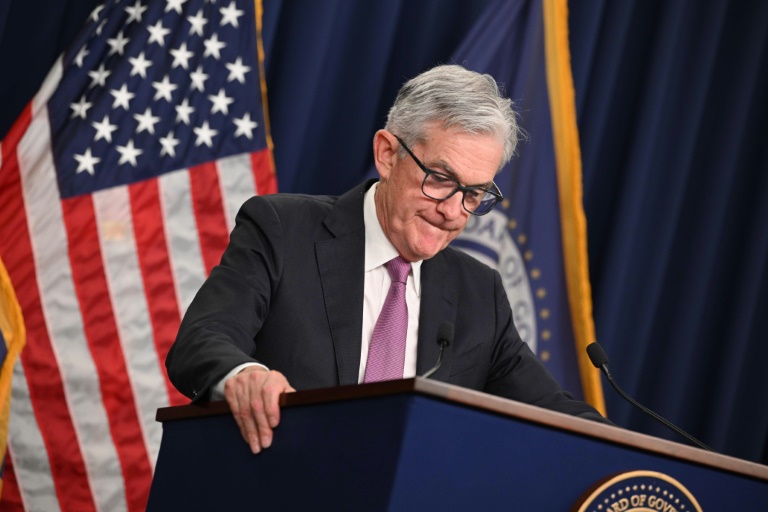
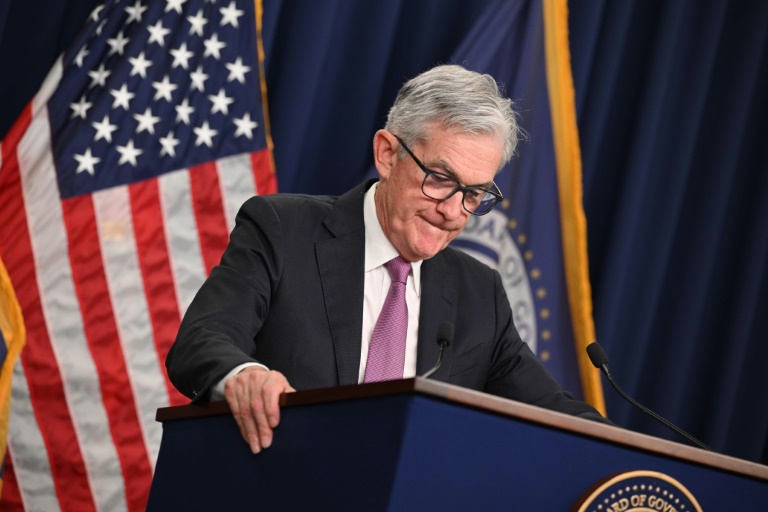
Fed Chair Jerome Powell has made it clear that a recession is a risk he is willing to take. In fact, it is a risk the central bank must take to avoid an even more dire outcome: a repeat of the damaging, runaway inflation of the 1970s and early 1980s.

“We need to act now forthrightly, strongly as we have been doing and we need to keep at it until the job is done,” Powell said in his last public comments before the policy meeting.

Powell’s predecessor from the last high-inflation era, Paul Volcker, had to take extreme measures after rising prices became entrenched, resurging and surpassing the peak of the mid-1970s after repeated failed efforts to tame them.

That led to a deep recession and unemployment over 10 percent.

The Fed’s aim is to avoid “the kind of very high social costs” of the Volcker era, and maintain public confidence in the central bank’s commitment to fighting inflation.

“The clock is ticking,” Powell warned.

While the latest data showed US annual inflation slowed slightly to 8.3 percent in August — from a peak of 9.1 percent in June — prices actually accelerated slightly in the month, reflecting widespread price increases.

Central bankers have the luxury of a strong job market, low unemployment and a resilient US consumer, but many economists now see a recession as likely.

Former US Treasury secretary Lawrence Summers is among those warning that joblessness will have to rise to get inflation under control.

He also favors more aggressive Fed action.

“If I had to choose between 100 basis points in September and 50 basis points, I would choose a 100 basis points move to reinforce credibility,” Summers said in a recent tweet.

Steep Fed rate hike seen as certainty after ugly inflation data

The Federal Reserve is poised to unleash another massive interest rate increase this week after the latest data showed a worrying US inflation picture, which confirmed the need for the central bank to continue to act aggressively.

Soaring prices have pushed annual inflation to a 40-year high, inflicting pain on American consumers and businesses, despite the welcome drop in gasoline prices at the pump in recent weeks.

The disappointing consumer price report for August, released last week, showed housing, food and medical costs continued to rise. And when volatile food and energy prices are stripped out, so-called core inflation accelerated.

Families have been struggling with rising prices sparked initially by high demand as the world’s largest economy emerged from the pandemic amid supply chain snarls. The situation has been exacerbated by Covid lockdowns in China and surging energy and food prices due to Russia’s war in Ukraine.

It is not just current high inflation that concerns policymakers, but the fear that consumers and businesses begin to expect rising prices will become a permanent feature, which could set off a dangerous spiral and a phenomenon called stagflation.

That fear has driven the Fed to front-load its rate hikes, rather than pursuing the more customary course of small, gradual steps over a longer period. 

The US central bank has cranked up the benchmark lending rate four times this year, including two straight three-quarter-point hikes in June and July.

The aim is to raise the cost of borrowing and cool demand — and it is having an impact: home mortgage rates have now topped six percent for the first time since 2008.

A third massive increase is expected Wednesday at the conclusion of the Fed’s two-day policy meeting. And some people are raising the possibility the US central bank could take an even bigger step.

But concerns are rising that the aggressive action could tip the US economy into recession, which would reverberate around the globe.

“The sizzling-hot, core inflation figures that came out this week for August have upped the pressure on the Federal Reserve to raise rates a full percentage point instead of 0.75% at the upcoming meeting,” Diane Swonk, chief economist at KPMG US, said in an analysis.

“This will be one of the hardest and most politically charged of decisions. It marks the Federal Reserve’s first move toward an actual recession.”

– Avoiding a repeat of the 1970s –

Fed Chair Jerome Powell has made it clear that a recession is a risk he is willing to take. In fact, it is a risk the central bank must take to avoid an even more dire outcome: a repeat of the damaging, runaway inflation of the 1970s and early 1980s.

“We need to act now forthrightly, strongly as we have been doing and we need to keep at it until the job is done,” Powell said in his last public comments before the policy meeting.

Powell’s predecessor from the last high-inflation era, Paul Volcker, had to take extreme measures after rising prices became entrenched, resurging and surpassing the peak of the mid-1970s after repeated failed efforts to tame them.

That led to a deep recession and unemployment over 10 percent.

The Fed’s aim is to avoid “the kind of very high social costs” of the Volcker era, and maintain public confidence in the central bank’s commitment to fighting inflation.

“The clock is ticking,” Powell warned.

While the latest data showed US annual inflation slowed slightly to 8.3 percent in August — from a peak of 9.1 percent in June — prices actually accelerated slightly in the month, reflecting widespread price increases.

Central bankers have the luxury of a strong job market, low unemployment and a resilient US consumer, but many economists now see a recession as likely.

Former US Treasury secretary Lawrence Summers is among those warning that joblessness will have to rise to get inflation under control.

He also favors more aggressive Fed action.

“If I had to choose between 100 basis points in September and 50 basis points, I would choose a 100 basis points move to reinforce credibility,” Summers said in a recent tweet.

Close Bitnami banner
Bitnami