US Business

How queen’s death followed a disinformation playbook

The death of Queen Elizabeth II has laid bare a blueprint for how disinformation flourishes around major news events, with bad actors taking advantage to grab attention and sow confusion.

As Britain mourned its longest reigning monarch, social media users shared digitally altered photos and other misleading content, blaming her death at 96 on causes other than old age — including Covid-19 vaccines and Hillary Clinton.

But the misinformation tactics deployed after Buckingham Palace’s announcement on September 8 were mainly old tricks remodeled to fit the current story and make falsehoods stick in people’s minds. 

Similar bogus claims spread after other big stories, such as Russia’s war on Ukraine and Jeffrey Epstein’s death, with the QAnon conspiracy movement also showing its hand.

“Familiarity leads to increased believability,” said Gordon Pennycook, a behavioral scientist at the University of Regina, in Canada.

– Well-worn tactics –

Warning signs of disinformation sprang up as soon as the queen went under medical supervision, when imposter Twitter accounts disguised as news outlets published and relayed false updates on her status. 

The pace accelerated once the palace announced her death.

“People all around the world were aware of and impacted by the queen’s death, giving purveyors of misinformation a virtually limitless range of false narratives to choose from,” said Dan Evon at the nonprofit News Literacy Project (NLP).

Among the deluge: a months-old video of dancers outside Buckingham Palace was passed off as an Irish celebration of the death. A fake social media post purported to show former US president Donald Trump claiming the queen knighted him. A manipulated photo made it look like Meghan Markle wore a T-shirt saying, “The Queen Is Dead.”

Some blamed the queen’s death on Covid-19 shots — an allegation anti-vaccine advocates have made about well-known people who died, including actress Betty White and comedian Bob Saget.

Others named Clinton as the culprit, claiming the queen announced before dying that she had political dirt on the former US presidential candidate and secretary of state.

That made-up statement has been attributed to other world leaders. It is a long-running meme that plays off a conspiracy theory about the Clintons killing political opponents.

“When big events happen, people in different communities, particularly activists, try to figure out if there is an angle for them there,” said Mike Caulfield, a research scientist at the University of Washington’s Center for an Informed Public (CIP).

“For an anti-vaccine activist, they figure out if the death can be mapped to vaccines. For a (New World Order) conspiracy theorist, maybe they map to Clinton or Epstein.”

Supporters of QAnon folded the queen’s death into their beliefs about a cabal of child sex traffickers, floating a range of baseless claims and hailing the event as proof of the legitimacy of their movement.

“The royal family, given Prince Andrew’s heavily reported connections with Jeffrey Epstein, have always been fodder for the QAnon crowd,” said Rachel Moran, a postdoctoral scholar at the CIP.

One video popular in QAnon circles, which some supporters claimed showed a naked boy escaping Buckingham Palace, was actually an old promo for a fictional TV show.

But it spread on TikTok, one of several QAnon-adjacent narratives that reached the mainstream.

In the week after the queen’s death, media intelligence firm Zignal Labs tracked more than 76,000 mentions of the late monarch that referenced Epstein and his accomplice Ghislaine Maxwell — both convicted sex offenders — on social media, websites, broadcast and traditional media.

Narratives linking the queen to pedophilia, Clinton and the vaccines were mentioned 42,000, 8,000 and 7,000 times, respectively.

– Avoiding misinformation –

The rolling news about the queen — and her global influence — explains some of the appeal of conspiracy theories about her death, said Karen Douglas, a social psychology professor at the University of Kent who studies why people believe such theories.

“Accepting mundane explanations for such a big event might be less convincing or appealing,” she said.

But there are ways to resist falling for false information.

Media literacy organizations, including NLP and CIP, recommend cross-referencing online posts against trusted information sources and pausing before sharing.

“Even a few moments of reflection can often make a big difference,” Pennycook said.

Young hacker tricks way into Uber's system: reports

Uber said Friday it was investigating a “cybersecurity incident,” declining to comment on reports a young hacker had gained access to the ride-hailing company’s computer network.

Uber put out word of the breach late Thursday in a tweet, and a hacker claiming to be 18 years old then posted screenshots taken from inside Uber computers.

“He says that he simply — having already determined a valid username and password — tricked an Uber staff member into granting him access to internal systems,” independent cybersecurity analyst Graham Cluley said at his website.

Online comments purported to be by the hacker indicated he targeted an Uber employee with notifications for more than an hour, then reached out to the worker via WhatsApp claiming to be member of the company’s tech support team.

“Many other companies are probably at risk of falling for a similar trick,” Cluley said.

Uber said Friday that its services were all operational and that it had “no evidence that the incident involved access to sensitive data” such as users’ trip history.

Employee software tools shut down as a precaution were being gradually restarted, the San Francisco based company added.

“There’s a reason cybersecurity experts say that the human is often the weakest link,” said Ray Kelly, a fellow at Synopsys Software Integrity Group in Silicon Valley.

“Whether it be phishing/SMS attacks or a simple phone call to get an employee to give up their credentials, ‘social engineering’ is going to be the easiest route for a malicious actor.”

Young hacker tricks way into Uber's system: reports

Uber said Friday it was investigating a “cybersecurity incident,” declining to comment on reports a young hacker had gained access to the ride-hailing company’s computer network.

Uber put out word of the breach late Thursday in a tweet, and a hacker claiming to be 18 years old then posted screenshots taken from inside Uber computers.

“He says that he simply — having already determined a valid username and password — tricked an Uber staff member into granting him access to internal systems,” independent cybersecurity analyst Graham Cluley said at his website.

Online comments purported to be by the hacker indicated he targeted an Uber employee with notifications for more than an hour, then reached out to the worker via WhatsApp claiming to be member of the company’s tech support team.

“Many other companies are probably at risk of falling for a similar trick,” Cluley said.

Uber said Friday that its services were all operational and that it had “no evidence that the incident involved access to sensitive data” such as users’ trip history.

Employee software tools shut down as a precaution were being gradually restarted, the San Francisco based company added.

“There’s a reason cybersecurity experts say that the human is often the weakest link,” said Ray Kelly, a fellow at Synopsys Software Integrity Group in Silicon Valley.

“Whether it be phishing/SMS attacks or a simple phone call to get an employee to give up their credentials, ‘social engineering’ is going to be the easiest route for a malicious actor.”

Migrants flown to Martha's Vineyard moved to US military base

Fifty or so migrants sent to the wealthy island of Martha’s Vineyard in the northeastern United States as part of a political battle over immigration will be temporarily housed at a military base not far from there, the governor of Massachusetts said Friday. 

The migrants, mostly Venezuelans and including children, arrived Wednesday at Martha’s Vineyard, a Democratic stronghold and popular vacation spot for the country’s political elite. 

They had been put on board flights from Texas which the Republican Governor of Florida, Ron DeSantis, says he chartered. 

Despite local mobilization to help the new arrivals, the island is “not equipped to provide sustainable accommodation, and state officials developed a plan to deliver a comprehensive humanitarian response,” said a statement from the administration of Governor Charlie Baker.

On Friday, the state authorities offered to move the migrants, on a voluntary basis, to temporary accommodation at the nearby Joint Base Cape Cod.

“Families will not be separated,” the statement said, noting that the base had previously served as an emergency shelter and that the migrants would have access to care and legal services. 

According to local media, the migrants were on their way to the base by midday Friday. 

Some of them had said they had not known they were being sent to an island. 

Local Democrat legislator Julian Cyr called for an investigation. 

“Whether or not this meets the legal threshold for human trafficking, this meets the moral threshold of human trafficking,” he told local television, adding that he hoped the Department of Justice would look into the incident.

Sending migrants to Democratic strongholds has become a political cudgel for the American right as a means of denouncing President Joe Biden’s immigration policy, which they say has allowed undocumented migrants to cross the border with Mexico in large numbers.

It is also a way to try to place immigration at the center of the campaign for the mid-term elections in November. 

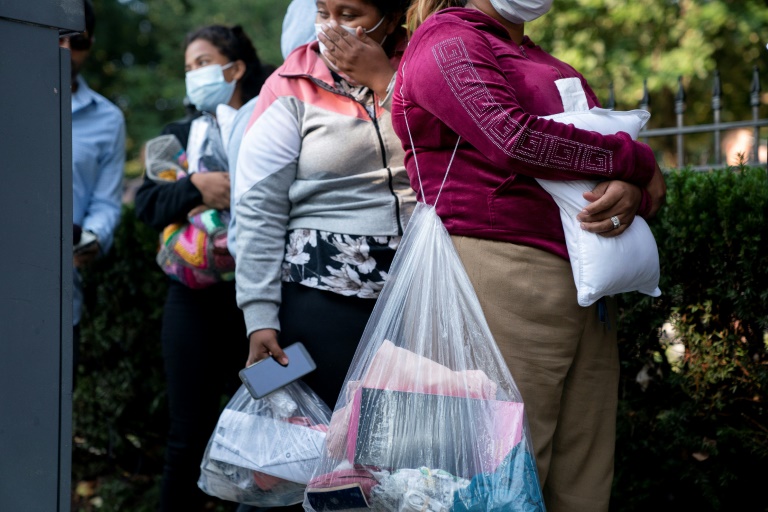
On Thursday morning, two buses carrying migrants arrived near the official residence of Vice President Kamala Harris in Washington, DC, a place chosen on purpose because she is overseeing the explosive issue of immigration for the White House. They had been sent by Texas’ Republican Governor Greg Abbott.

Five bank 'heists' in a day as Lebanese demand their frozen savings

Five Lebanese banks were stormed Friday by depositors seeking to unlock frozen savings, the latest in a string of such “heists” that have garnered wide public support in the crisis-hit country.

Lebanon has been mired in an economic crisis for more than two years, since the value of its currency began plummeting and banks started imposing draconian restrictions on withdrawals.

In the past week, seven bank branches have been targeted by “depositor heists”, prompting lenders to announce a three-day closure starting Monday, according to the Association of Banks in Lebanon.

As the incidents snowballed on Friday, Interior Minister Bassam Mawlawi called an emergency meeting in the afternoon.

“Reclaiming rights in this way… can break the system and make the rest of the depositors lose their rights,” he told reporters after the meeting.

Public Prosecutor Ghassan Oueidat urged police to arrest all those involved in the heists, describing them as “armed robberies on banks with the aim of stopping the banking sector in Lebanon from working, and instigating more financial and economic crises”.

Oueidat also asked police to investigate whether any of the heists were connected to each other, a judicial source told AFP.

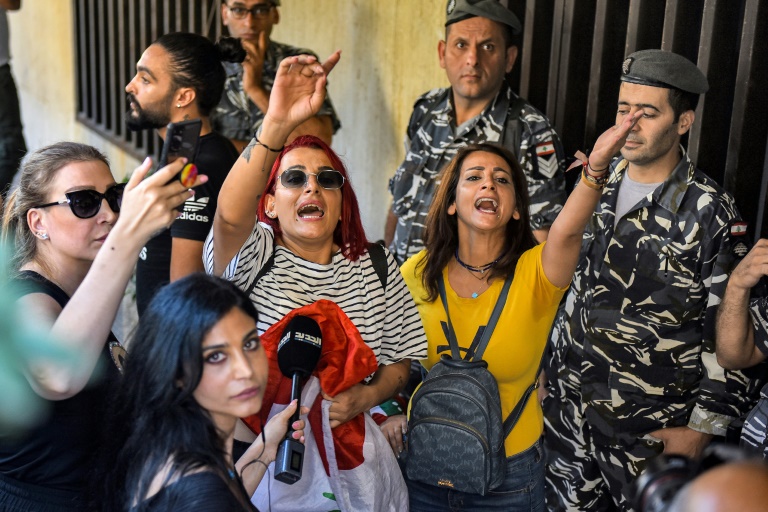
The holdup of a Beirut bank on Wednesday by an activist who filmed herself using a toy gun appears to have sparked a series of copycat raids by angry depositors.

On Friday there were another three such incidents in Beirut and two in south Lebanon, AFP correspondents and a security source said.

– ‘Emptied jerrycan’ –

In one case, a man carrying a gun and jerrycan of fuel demanded staff at a branch of the Byblos bank in the southern town of Ghaziyeh hand over his money.

Accompanied by his son, he threatened bank staff with the gun, which a Lebanese television channel said may have been a toy, before making his demand.

“He emptied a jerrycan of fuel on the floor,” a bank security guard told an AFP correspondent.

The man walked away with about $19,000 in cash but turned himself in to police moments later as a crowd formed in front of the bank to support him.

A few hours later in the Beirut neighbourhood of Tariq al-Jdideh, depositor Abed Soubra held up a branch of Blom Bank, demanding access to his frozen savings.

He eventually surrendered his weapon to police in the early evening but insisted he intended to stay in the bank until he got his money, an AFP correspondent inside the branch reported.

Another man armed with a hunting rifle held up a bank in Beirut’s Ramlet el-Baida neighbourhood, witnesses told an AFP photographer at the scene.

The man was eventually escorted out of the branch by security forces but his siblings were handed $15,000 of his savings, the Depositors Union said.

A man who held up a bank in Chehime in the south was also led away by security forces after pocketing $25,000 of his savings, the group said.

– New budget delay –

The spate of heists comes two days after a young activist stormed a central Beirut bank with fuel and a plastic gun to demand the deposits of her sister, who needed to pay for cancer treatment.

The woman identified as Sali Hafiz made off with around $13,000 and became an instant hero on social media.

“She had every right to do this. I would do the same if I was as brave as her,” said Carla Chehab, a 28-year-old Beirut resident.

“The thieves are the banks, the government and all rich people protecting them,” she added.

The severity of Lebanon’s crisis has been widely blamed on a self-serving political elite and decades of corruption. 

The currency has lost more than 90 percent of its value on the black market in recent years, while poverty and unemployment have soared.

Banks have been widely accused of operating like a cartel and of spiriting large amounts out of the country for senior Lebanese officials at a time when foreign transfers were already blocked for ordinary citizens.

A parliament session to approve the 2022 budget, a key reform needed for Lebanon to unlock billions of dollars from international lenders, was adjourned to September 26 on Friday after quorum was lost when some lawmakers walked out.

Chrissy Teigen reveals 2020 'miscarriage' in fact was life-saving abortion

Model and television personality Chrissy Teigen, who is married to singer John Legend, has revealed that she had an abortion in 2020 to save her life when it became clear her son would not live, not a miscarriage as the couple said.

The 36-year-old Teigen explained that she did not fully process what had happened when she was 20-weeks pregnant until after the US Supreme Court this year overturned Roe v Wade, the decision guaranteeing the nationwide right to the procedure.

“Let’s just call it what it was: It was an abortion,” Teigen said Thursday at an event organized by social impact agency Propper Daley, according to The Hollywood Reporter.

“It became very clear around halfway through that he would not survive, and that I wouldn’t either without any medical intervention,” she explained.

Teigen was hospitalized in September 2020 and later published multiple social media posts recounting her experience of losing a baby, which would have been her third with Legend. The couple share daughter Luna and son Miles.

She said at the time she was “shocked and in the kind of deep pain you only hear about.”

The couple’s posts about the miscarriage triggered an outpouring of responses.

On Thursday, Teigen, who is now pregnant again, said Legend had helped her realize what truly happened.

“I told the world we had a miscarriage, the world agreed we had a miscarriage, all the headlines said it was a miscarriage. 

“And I became really frustrated that I didn’t, in the first place, say what it was, and I felt silly that it had taken me over a year to actually understand that we had had an abortion.”

Teigen and Legend, an entertainer with a rare EGOT of awards — an Emmy, Grammy, Oscar and Tony — met on the set of one of his music videos before marrying in 2013.

Blinken says Russia acting 'horrifically' after mass graves in Ukraine

US Secretary of State Antony Blinken said Friday that Russia was behaving “horrifically” and was likely responsible for war crimes after the discovery of mass graves in Ukraine and hailed what he saw as pressure on Moscow from China and India.

“This is part, horrifically,” Blinken told reporters, “of an ongoing story whenever we see the Russian tide recede from the parts of Ukraine that it’s occupied.”

“We see what’s left in his wake. And this latest discovery of apparently 440 mass graves in Izyum is a reminder of that,” he said, referring to the eastern city where Ukrainian forces have driven out Russian invaders.

Blinken called on Ukrainians to maintain evidence to document atrocities, saying, “There needs to be accountability.”

“In many instances, these will amount to war crimes, which I think is the appropriate frame through which to look at this,” Blinken said.

Blinken also welcomed what he called growing pressure on President Vladimir Putin who met the leaders of China and India at a regional meeting in the Uzbek city of Samarkand.

“I think what you’re hearing from China, from India, is reflective of concerns around the world about the effects of Russia’s aggression on Ukraine, not just on the people of Ukraine,” said Blinken, speaking alongside Jordan’s foreign minister.

“I think it increases the pressure on Russia to end the aggression.”

Prime Minister Narendra Modi of India, a historic partner of Russia which has growing ties with the United States, told Putin on Friday that it was “not a time for war.”

A day earlier, Putin raised eyebrows by noting the “concerns” of Chinese President Xi Jinping, seen as Russia’s most powerful ally on the global stage.

US officials say that China’s support for Moscow has been mostly rhetorical and that Beijing has rebuffed requests for military equipment, forcing Moscow to turn to North Korea and Iran.

Blinken last week met with Ukrainians documenting abuses as he toured Irpin on the capital Kyiv’s outskirts where he was told of indiscriminate attacks during Russia’s 25-day occupation at the start of the war.

But Blinken repeated President Joe Biden’s view against designating Russia to be a state sponsor of terrorism, a major step that has been sought by Ukrainian President Volodymyr Zelensky and US lawmakers across party lines.

Blinken said that the terrorism designation could have “unintended consequences.” US officials have previously voiced worry that it could stop shipments of grain from Ukraine’s ports under a deal brokered with Russia by the United Nations an Turkey.

He said that, even without the designation, Western sanctions were already “having a profound impact on Russia, one that is growing every single day.”

“It’s going to get to be a heavier and heavier burden.”

Ukraine finds graves and 'torture centres' in recaptured east

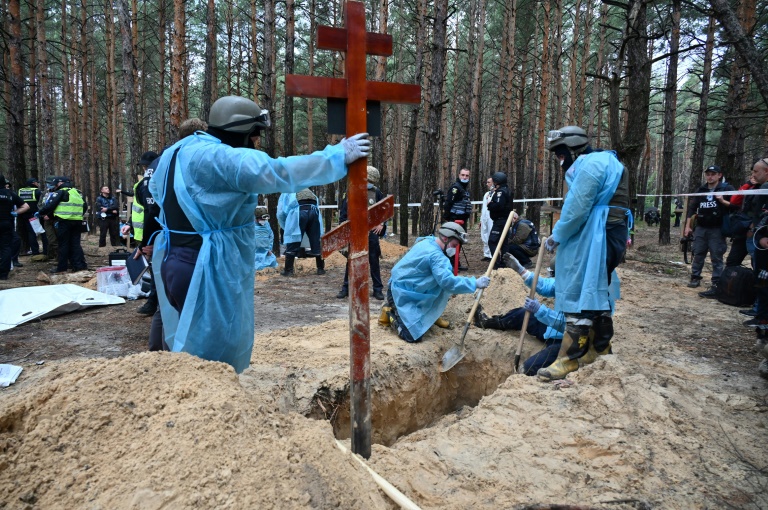
Ukrainian investigators descended on a pine forest outside the recaptured town of Izyum on Friday and began pulling hundreds of hastily buried bodies from the sandy soil.

At least one of the corpses had been buried with bound hands, an AFP journalist saw.

Kyiv officials said they had counted 450 graves at the mass burial site and found 10 alleged “torture centres” after the Kharkiv region was recaptured from Russian invaders. 

In the forest outside Izyum, AFP journalists saw graves topped with makeshift crosses and marked with numbers. One inscription read: “Ukrainian army, 17 people. Izyum morgue.”

“Russia leaves only death and suffering. Murderers. Torturers,” said Ukraine’s President Volodymyr Zelensky. Some of the remains exhumed included children and people who were likely tortured before dying, he added.

Moscow has been roundly condemned internationally for invading its neighbour, but Russian President Vladimir Putin on Friday refused blame for the ongoing fighting. 

“Unfortunately, just the opposing side, the leadership of Ukraine, announced its rejection of the negotiating process, and stated that it wants to achieve its goals by military means, on the battlefield,” he said. 

“We will do our best to end this as soon as possible,” he added.

But later Friday, he said there were no plans to adjust Russia’s military operations in Ukraine despite Kyiv’s counter-offensive.

“We are not in a hurry… there are no changes,” he said.

– ‘Not a time for war’: Modi –

The Russian leader was speaking at a regional summit in Uzbekistan where Indian Prime Minister Narendra Modi — leader of a nation with longstanding ties to Moscow — told Putin that now was “not a time for war”. 

Yet the conflict continues. Kyiv’s forces have recovered a swathe of territory in recent days in a lightning counter-offensive in the east, recapturing several towns from Russian forces but also uncovering what they say is a grim legacy of occupation.

Police chief Igor Klymenko said they had found torture rooms in the town of Balakliya and elsewhere in Karkhiv, while presidential aide Mykhaylo Podolyak said the Izyum mass grave site alone held at least 450 bodies.

“In the occupied territories, rampant terror, violence, torture and mass murders have been reigning for months,” Podolyak said.

On the main road from Izyum to Kharkiv, a small dirt road leads into a pine forest. On the right-hand side of the lane, about 100 metres (330 feet) into the trees, two men in white overalls were digging the sandy soil.

Soon they reached the first body, exhumed it and placed it in a white plastic body bag. As more bodies appeared, the strong smell of decay spread among the trees and rough wooden crosses.

– ‘Witnesses’ –

Where identification was possible, names were attached to the crosses along with dates between early March, when Izyum was still held by Ukraine, and early September, a period of Russian control.

On some of the graves, small offerings of flowers had been placed in homage to the deceased.

According to Oleg Kotenko, the government official in charge of the search for missing persons nationwide, a family with a young child was buried there.

“They were killed. There are witnesses from the same building. They saw what happened and buried these people here,” he said.

According to Kotenko: “The graves without names are for those found dead in the street.”

The United Nations in Geneva said it hopes to send a team to determine the circumstances of the deaths in the forest graves.

Russia has been accused of carrying out attacks on civilians that could amount to war crimes, notably in suburban towns outside the capital of Kyiv after fighting in March.

Dozens of civilians bearing signs of extrajudicial killings were found in places such as Bucha, outside Kyiv, after Ukraine’s forces recaptured the territory earlier this year.

– German military revamp –

The grim discoveries have coincided with fresh developments on the international front, including a White House announcement of a new package of up to $600 million in US military aid for Ukraine.

Since Russia invaded in Ukraine in February, the United States has provided Kyiv with more than $15 billion in military support, including long-range precision rocket systems.

German Chancellor Olaf Scholz warned that Europe must shoulder far more of NATO’s burden. He branded President Vladimir Putin’s Russia the “biggest threat” currently posed to the alliance.

“NATO remains responsible for the collective defence of the entire alliance with a focus on Europe,” Scholz told army officers.

“Credible deterrence remains the core element.” 

Germany was ready to take on a leading role in ensuring Europe’s security, Scholz said, vowing to turn the country’s armed forces into the “best-equipped” on the continent.

Haunted by two world wars, Germany has always trod lightly and quietly on the world stage when it comes to conflicts and armament.

Kyiv gained EU candidacy status in June, angering Moscow which has tried to retain political and military influence since the collapse of the Soviet Union three decades ago.

– Weaning off Russian fuel –

Many European countries have joined the United States in supplying Kyiv with advanced weapons, enabling its forces to push the Russians out of thousands of square kilometres of territory.

EU countries have also hit Russia with economic penalties. 

Berlin, for example, on Friday took control of the German operations of Russian oil firm Rosneft to secure energy supplies disrupted by the invasion.

Rosneft’s German subsidiaries, which account for about 12 percent of oil refining capacity in the country, were placed under the trusteeship of the Federal Network Agency, the economy ministry said.

The seizures come as Germany is scrambling to wean itself off its dependence on Russian fossil fuels. Moscow has stopped natural gas deliveries to Germany via the Nord Stream 1 pipeline.

Stocks extend losses on recession fears

Stock markets fell further on Friday as weak UK retail sales data and a dire warning from global shipping giant FedEx fuelled fears of recession.

Equities were already struggling this week after data showed US inflation slowed but not as much as expected, fuelling fears of aggressive monetary tightening by central banks.

Investors worry that central banks will move too aggressively to tame inflation through rate hikes that could put the brakes on economic growth.

Wall Street stocks slunk lower after FedEx reported on Thursday that its shipped fewer packages than expected over the summer due to weakness in the global economy.

The company said it was closing stores, freezing hiring and parking aircraft, while warning of a big earnings hit, with its CEO Raj Subramaniam telling CNBC he expects a global recession.

“The market is looking weak this morning because of the FedEx warning, but it really goes beyond that,” said Briefing.com analyst Patrick O’Hare.

“There are pressing concerns that the aggressive rate hikes by central banks thus far, and the ones that are yet to come, will drive the global economy into a recession that is not ‘soft’,” O’Hare said.

The Dow was down 1.1 percent in late morning trading, while the broader S&P 500 fell 1.3 percent and the tech-heavy Nasdaq Composite tumbled 1.6 percent.

“These increasing concerns over a global recession, as well as rising US yields are prompting a flight into the US dollar and not much else,” said CMC Markets analyst Michael Hewson.

London’s FTSE 100 stock index ended the day 0.6 percent lower while the British pound tanked to a 37-year low against the dollar at $1.1351 on news that British retail sales tumbled by far more than forecast in August as shoppers faced rampant inflation.

Sales by volume dived 1.6 percent last month, more than triple expectations.

Sterling has hit a series of 1985 lows in recent weeks, also as the US Federal Reserve implements aggressive hikes interest rate hikes.

– ‘Markets in pain’ –

“Markets are in a lot of pain, and the UK’s retail data has made things only worse for traders as it clearly pointed out one thing: an imminent recession,” said AvaTrade analyst Naeem Aslam.

“When you look at the sterling against the dollar, it seems like there are no buyers out there.”

Elsewhere, Frankfurt equities dived 1.7 percent and Paris shed 1.3 percent as investors digested confirmation of record-high inflation in the eurozone.

“Data for August confirm that price pressures are very strong and broad-based” with eurozone inflation at 9.1 percent, said Capital Economics analyst Jack Allen-Reynolds.

“The European Central Bank will need to continue hiking interest rates aggressively at forthcoming meetings.”

The ECB had last week hiked its key rate by a historic 75 basis points, and markets expect a similar-sized move at the October policy meeting.

The Fed and Bank of England are widely expected to ramp up borrowing costs next week.

The US central bank has lifted borrowing costs by 75 basis points at each of its last two meetings. 

– Key figures at around 1530 GMT –

New York – Dow: DOWN 1.1 percent at 30,635.57 points

EURO STOXX 50: DOWN 1.1 percent at 3,500.41

London – FTSE 100: DOWN 0.6 at 7,236.68 (close)

Frankfurt – DAX: DOWN 1.7 percent at 12,741.26 (close)

Paris – CAC 40: DOWN 1.3 percent at 6,077.30 (close)

Tokyo – Nikkei 225: DOWN 1.1 percent at 27,567.75 (close)

Shanghai – Composite: DOWN 2.3 percent at 3,126.40 (close)

Hong Kong – Hang Seng Index: DOWN 0.9 percent at 18,761.69 (close)

Pound/dollar: DOWN at $1.1422 from $1.1467 on Thursday

Euro/pound: UP at 87.72 pence from 87.21 pence 

Euro/dollar: UP at $1.0020 from $1.0001

Dollar/yen: DOWN at 142.98 yen from 143.45 yen

Brent North Sea crude: UP 1.0 percent at $91.76 per barrel

West Texas Intermediate: UP 0.8 at $85.80 per barrel

burs-rl/cdw

London Fashion Week opens in mourning for queen

A scaled-back London Fashion Week opened with catwalk shows on Friday but without after-show parties following the death of Queen Elizabeth II and with a pause planned for her funeral next week.

The twice-yearly event had planned to get fully back on track after two years of Covid disruption that predicated virtual shows.

But the death of the queen, aged 96, on September 8 has seen the industry showpiece scaled-back, with high-fashion brands including Burberry and Raf Simons cancelling their shows.

“We are in a period of national mourning,” Caroline Rush, chief executive of the British Fashion Council, which organises the event, told AFP.

Rush noted the importance of being “very mindful… of what’s happening in the country and of course, recognising the passing of our monarch, who has been a fantastic champion of our industry for so many years”.

Britain will hold a minute’s silence on Sunday at 1900 GMT and LFW plans to take part.

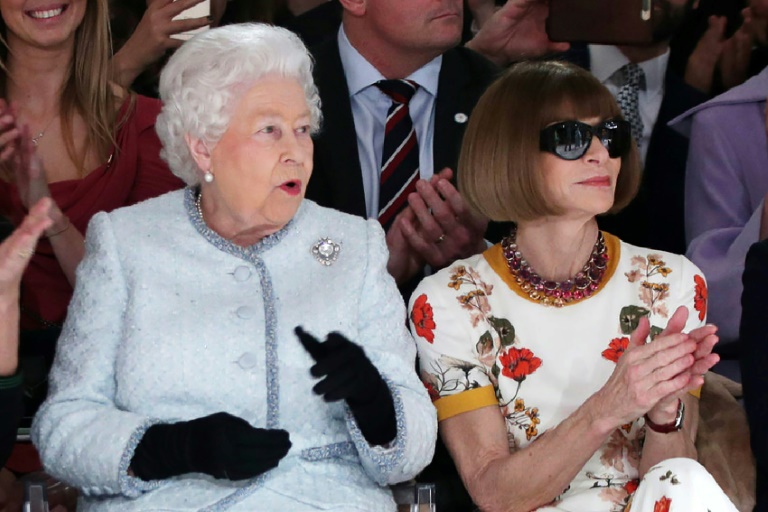
The queen, seen as a fashion icon during her 70 years on the throne, launched the QEII Award for British Design at LFW in 2018, presenting Richard Quinn with the inaugural award.

With parties postponed, this season’s London event will focus on the business side of securing orders for the clothes featured on the runway for next spring.

Shows that had been scheduled for Monday, when Britain will hold a state funeral for the late queen, have, where possible, been postponed until Tuesday.

Quinn will close out the catwalk schedule on Tuesday.

“That image of when the queen came to London Fashion Week was actually at Richard’s first fashion show and it was a fantastic way to celebrate his brilliant creativity and the impact he was already having back then in 2018,” Rush said.

Close Bitnami banner
Bitnami