US Business

Stocks and oil prices rally, as dollar drops

Stock markets and oil prices rallied Friday, with investors largely pricing in more interest rate hikes aimed at taming runaway inflation.

The dollar slid one percent versus the pound and euro after recent hefty gains.

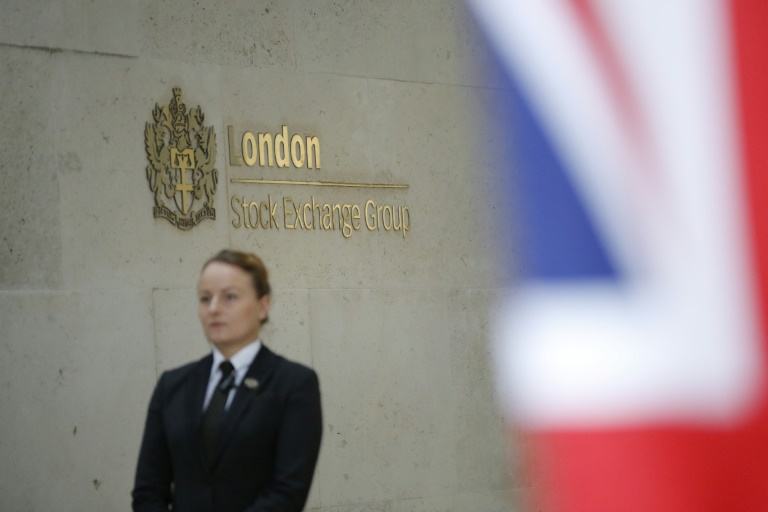
London’s stock market jumped more than 1.5 percent in morning deals, mirroring advances in Paris and Frankfurt, while the British capital’s exchange mourned the death of Queen Elizabeth II.

“We are deeply saddened at the passing of Her Majesty Queen Elizabeth II,” the London Stock Exchange said in a message posted on its website.

“Our sympathies and condolences are with The Royal Family.”

The LSE is expected to shut on the day of the queen’s funeral following her death on Thursday.

“Markets are being very British about the whole thing, carrying on in a fashion that I suspect she would have approved of,” said IG analyst Chris Beauchamp.

– Dollar off highs –

The more confident mood across equity and oil markets was reflected in a cooler dollar, which had surged to multi-decade highs against major peers in recent weeks owing to the Federal Reserve’s hawkish tilt to tighter monetary policy.

The greenback’s softness came even after Federal Reserve chief Jerome Powell reasserted the US central bank’s determination to keep hiking interest rates to fight prices, even at the cost of economic growth.

His warning that “we need to act now forthrightly, strongly” followed comments from his deputy Lael Brainard, who said policymakers would lift borrowing costs for as long as it takes to bring inflation down from 40-year highs.

Still, Wall Street ended in positive territory Thursday, putting markets on course for a weekly gain and easing some pressure after hefty losses in August caused by worries that rising rates would spark a recession.

New York’s rise filtered through to Asia, where Hong Kong rose close to three percent heading into a long weekend.

Edward Moya, analyst at trading platform OANDA, said traders cheered as “Powell stuck to his hawkish script and affirmed the commitment to tighten policy until inflation is back towards their target.

“Wall Street is expecting to see some pricing pressure relief with next week’s inflation report, but that shouldn’t derail the current 75 basis-point pace of tightening.”

There was also some cheer from news that inflation in China had eased slightly in August, giving the government more room to introduce more economy-supporting measures, though the recovery remains hostage to leaders’ strict zero-Covid strategy of growth-sapping lockdowns.

The euro was holding well above parity with the dollar, one day after the European Central Bank announced its own 75 basis-point rise as it warned inflation was “far too high” and likely to stay above target for “an extended period”.

ECB chief Christine Lagarde suggested policy would continue to be tightened for some time.

The yen strengthened as officials began speaking up after the unit approached a 32-year low versus the greenback.

The pick-up came after Bank of Japan chief Haruhiko Kuroda met Prime Minister Fumio Kishida on Friday before saying “the rapid weakening of the yen is undesirable”. 

The talks were used as a sign of intent to act in support of the currency if it continued to weaken. 

– Key figures at around 1045 GMT –

London – FTSE 100: UP 1.6 percent at 7,378.05 points

Frankfurt – DAX: UP 1.5 percent at 13,092.83

Paris – CAC 40: UP 1.8 percent at 6,233.32

EURO STOXX 50: UP 1.8 percent at 3,576.28

Tokyo – Nikkei 225: UP 0.5 percent at 28,214.75 (close)

Hong Kong – Hang Seng Index: UP 2.7 percent at 19,362.25 (close)

Shanghai – Composite: UP 0.8 percent at 3,262.05 (close)

New York – Dow: UP 0.6 percent at 31,774.52 (close)

Euro/dollar: UP at $1.0090 from $1.0001 on Thursday

Pound/dollar: UP at $1.1621 from $1.1500

Euro/pound: DOWN at 86.84 pence from 86.93 pence

Dollar/yen: DOWN at 142.13 yen from 144.07 yen 

Brent North Sea crude: UP 2.0 percent at $90.89 per barrel

West Texas Intermediate: UP 1.5 percent at $84.77 per barrel

burs/bcp/rfj/lth
EU energy ministers plan for 'difficult winter'

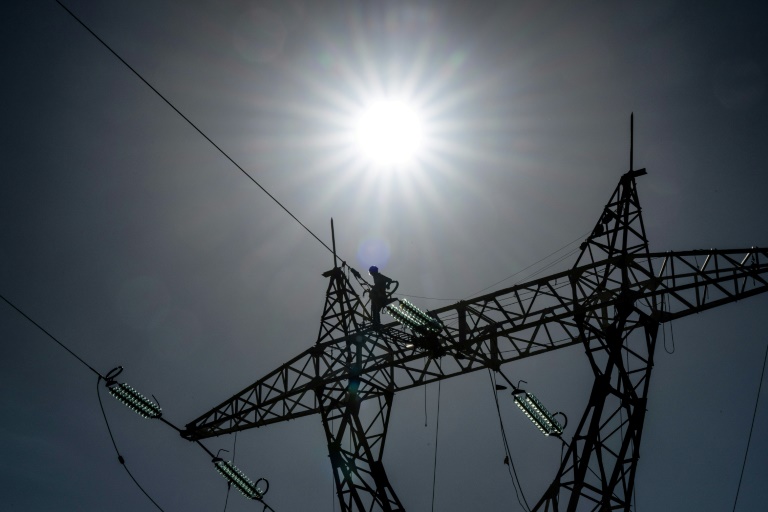
EU energy ministers met on Friday to seek a united response to the energy shock triggered by Russia’s war on Ukraine, which has sent prices for electricity and heating skyrocketing.

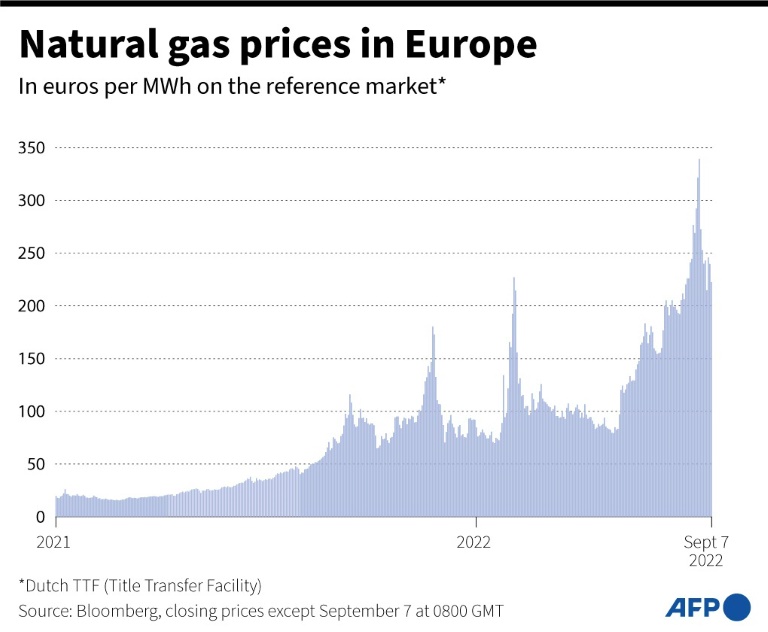
Moscow’s invasion has seen the price of natural gas hit record levels, throwing the EU economy into deep uncertainty, with all eyes on whether Russian President Vladimir Putin will cut off the energy flow entirely.

Before the war, 40 percent of the EU’s gas imports came from Russia, with most of the supply going to Germany, the bloc’s economic powerhouse, now scrambling to come up with new ways to heat homes and power factories.

The European Commission, the EU’s executive, will ask the ministers meeting in Brussels to consider a series of highly complex proposals designed to ease the burden.

“Right now, we need extraordinary intervention measures to address high and very volatile prices,” the EU’s energy commissioner Kadri Simson said, as she arrived for the talks.

“No doubt, ahead of us is a very difficult winter but our energy union is strong and we will prevail.”

The main drive will be to find ways to compensate households and businesses that are struggling to pay their bills and keep activity going.

The EU executive will propose a mechanism that would make non-gas electricity companies, such as nuclear, solar or renewable firms, share windfall revenues won on the back of high prices for electric power.

The market price of electricity in Europe is closely linked to the gas price, meaning non-gas utilities are enjoying a revenue bonanza while companies stuck paying for gas struggle.

Fossil fuel companies would also be levied on their mega profits from the inflated energy prices.

Finding consensus will be difficult with energy policy and dependence on Russia varying greatly across the EU’s 27 countries.

“Today, we are defining a mandate for the European Commission. We have to agree on a series of objectives, a calendar,” French energy minister Agnes Pannier-Runacher said.

– Price cap push stalled –

One proposal that has broad backing is an idea to rescue electricity companies that are struggling to hedge their spending on energy markets that have been extremely volatile.

This would be done by relaxing EU rules on state rescues of companies that are suddenly facing more onerous terms for cash as fears of a crisis spread.

The commission will also ask member states to agree on a united way to cut back on energy demand, with mandatory cuts on usage still considered an option, diplomats said.

“These are proposals where I feel there is quite a large convergence of views among the member states,” a key EU diplomat said.

An idea to cap Russian gas prices, however, is stalled, diplomats warned, amid fears that retribution from Moscow would throw the European economy into even further chaos.

US Secretary of State Antony Blinken, ahead of a visit to Brussels, on Friday urged Europeans to seize the opportunity and finally end the dependence on Russian energy “once and for all”.

But an EU diplomat aware of the state of negotiations warned that there was no majority among the member states in favour of the idea. 

The EU’s energy ministers are set to debate the commission’s ideas, with many countries expected to come to the table with their own proposals.

The commission, which draws up laws that are then ratified by member states and the European Parliament, would then formalise the proposal next week.

Asian markets rally, dollar dips as traders price in policy tightening

Asian markets rallied Friday following a healthy performance on Wall Street, with investors largely pricing in more interest rate hikes aimed at taming runaway inflation.

The more confident mood was reflected in a dip in the dollar, which has surged in recent weeks to multi-decade highs against its major peers owing to the Federal Reserve’s hawkish tilt to tighter monetary policy.

The greenback’s softness came even after Fed chief Jerome Powell reasserted the bank’s determination to keep hiking rates to fight prices, even at the cost of economic growth.

His warning that “we need to act now forthrightly, strongly” followed comments from his deputy Lael Brainard, who said policymakers would lift borrowing costs for as long as it takes to bring inflation down from 40-year highs.

Still, Wall Street ended in positive territory, putting markets on course for a weekly gain and easing some pressure after hefty losses in August caused by worries that rising rates would spark a recession.

“The markets have finally digested the fact that rates are almost certain to go up by 75 basis points when the Fed moves next (on September 21),” JoAnne Feeney, at Advisors Capital Management, told Bloomberg TV.

“What we are seeing though is some recognition that perhaps the sell-off that we saw in the second half of August was a bit overdone,” she said.

New York’s rise filtered through to Asia, where Hong Kong rose close to three percent heading into a long weekend, while Tokyo, Sydney, Shanghai, Singapore, Wellington, Mumbai, Manila and Bangkok were also well up.

London, Paris and Frankfurt also rose in early trading.

OANDA’s Edward Moya said traders cheered as “Powell stuck to his hawkish script and affirmed the commitment to tighten policy until inflation is back towards their target.

“Wall Street is expecting to see some pricing pressure relief with next week’s inflation report, but that shouldn’t derail the current 75 basis-point pace of tightening.”

There was also some cheer from news that inflation in China had eased slightly in August, giving the government more room to introduce more economy-supporting measures, though the recovery remains hostage to leaders’ strict zero-Covid strategy of growth-sapping lockdowns.

On currency markets, the euro was holding well above parity with the dollar after the European Central Bank announced its own 75 basis-point rise as it warned inflation was “far too high” and likely to stay above target for “an extended period”.

ECB chief Christine Lagarde suggested policy would continue to be tightened for some time.

The yen strengthened as officials began speaking up after the unit approached a 32-year low versus the greenback.

The pick-up came after Bank of Japan chief Haruhiko Kuroda met Prime Minister Fumio Kishida on Friday before saying “the rapid weakening of the yen is undesirable”. 

The talks were used as a sign of intent to act in support of the currency if it continued to weaken. 

However, there is an expectation the Japanese unit will see more losses as the BoJ sticks rigidly to its ultra-loose policies despite the Fed’s increasingly hawkish moves.

Oil prices edged up after Thursday’s gains though they remain pressured by ongoing worries about the impact on demand from possible recessions caused by the rate hikes and inflation. 

Weakness in China’s economy and lockdowns in major cities were also cause for concern among commodities traders. 

Reports that President Joe Biden was considering releasing more crude from the US strategic reserves were also weighing on the market.

Washington is concerned that prices could spike in December when European Union sanctions on Russian supplies kick in.

– Key figures at around 0810 GMT –

Tokyo – Nikkei 225: UP 0.5 percent at 28,214.75 (close)

Hong Kong – Hang Seng Index: UP 2.7 percent at 19,362.25 (close)

Shanghai – Composite: UP 0.8 percent at 3,262.05 (close)

London – FTSE 100: UP 1.0 percent at 7,335.91

Euro/dollar: UP at $1.0096 from $1.0001 on Thursday

Pound/dollar: UP at $1.1628 from $1.1500

Euro/pound: DOWN at 86.81 pence from 86.93 pence

Dollar/yen: DOWN at 142.39 yen from 144.07 yen 

West Texas Intermediate: UP 1.2 percent at $84.54 per barrel

Brent North Sea crude: UP 1.3 percent at $90.32 per barrel

New York – Dow: UP 0.6 percent at 31,774.52 (close)

Asian markets rally, dollar dips as traders price in policy tightening

Asian markets rallied Friday following a healthy performance on Wall Street, with investors largely pricing in more interest rate hikes aimed at taming runaway inflation.

The more confident mood was reflected in a dip in the dollar, which has surged in recent weeks to multi-decade highs against its major peers owing to the Federal Reserve’s hawkish tilt to tighter monetary policy.

The greenback’s softness came even after Fed chief Jerome Powell reasserted the bank’s determination to keep hiking rates to fight prices, even at the cost of economic growth.

His warning that “we need to act now forthrightly, strongly” followed comments from his deputy Lael Brainard, who said policymakers would lift borrowing costs for as long as it takes to bring inflation down from 40-year highs.

Still, Wall Street ended in positive territory, putting markets on course for a weekly gain and easing some pressure after hefty losses in August caused by worries that rising rates will spark a recession.

“The markets have finally digested the fact that rates are almost certain to go up by 75 basis points when the Fed moves next (on September 21),” JoAnne Feeney, at Advisors Capital Management, told Bloomberg TV.

“What we are seeing though is some recognition that perhaps the sell-off that we saw in the second half of August was a bit overdone,” she said.

New York’s rise filtered through to Asia, where Hong Kong added more than two percent heading into a long weekend, while Tokyo, Sydney, Shanghai, Singapore, Wellington, Manila and Bangkok were all up.

OANDA’s Edward Moya said traders cheered as “Powell stuck to his hawkish script and affirmed the commitment to tighten policy until inflation is back towards their target.

“Wall Street is expecting to see some pricing pressure relief with next week’s inflation report, but that shouldn’t derail the current 75 basis-point pace of tightening.”

There was also some cheer from news that inflation in China had eased slightly in August, giving the government more room to introduce more economy-supporting measures, though the recovery remains hostage to leaders’ strict zero-Covid strategy of growth-sapping lockdowns.

On currency markets, the euro was holding well above parity with the dollar after the European Central Bank announced its own 75 basis-point rise as it warned inflation was “far too high” and likely to stay above target for “an extended period”.

ECB chief Christine Lagarde suggested policy would continue to be tightened for some time.

The yen was also slightly stronger, having been in danger of hitting a 32-year low versus the greenback, with senior Japanese officials hinting at possible action to curb its losses if the unit fell further.

However, there is an expectation that it will see more losses as the Bank of Japan sticks rigidly to its ultra-loose policies despite the Fed’s increasingly hawkish moves.

Oil prices extended Thursday’s gains though they remain pressured by ongoing worries about the impact on demand from possible recessions caused by the rate hikes and inflation. 

Weakness in China’s economy and lockdowns in major cities were also cause for concern among commodities traders. 

Reports that President Joe Biden was considering releasing more crude from the US strategic reserves were also weighing on the market.

Washington is concerned that prices could spike in December when European Union sanctions on Russian supplies kick in.

– Key figures at around 0320 GMT –

Tokyo – Nikkei 225: UP 0.6 percent at 28,219.70 (break)

Hong Kong – Hang Seng Index: UP 2.2 percent at 19,269.43

Shanghai – Composite: UP 0.7 percent at 3,258.94

Euro/dollar: DOWN at $1.0070 from $1.0001 on Thursday

Pound/dollar: DOWN at $1.1568 from $1.1500

Euro/pound: UP at 87.07 pence from 86.93 pence

Dollar/yen: DOWN at 143.70 yen from 144.07 yen 

West Texas Intermediate: UP 0.4 percent at $83.91 per barrel

Brent North Sea crude: UP 0.7 percent at $89.73 per barrel

New York – Dow: UP 0.6 percent at 31,774.52 (close)

London – FTSE 100: UP 0.3 percent at 7,262.06 (close) 

Asian markets rally, dollar dips as traders price in policy tightening

Asian markets rallied Friday following a healthy performance on Wall Street, with investors largely pricing in more interest rate hikes aimed at taming runaway inflation.

The more confident mood was reflected in a dip in the dollar, which has surged in recent weeks to multi-decade highs against its major peers owing to the Federal Reserve’s hawkish tilt to tighter monetary policy.

The greenback’s softness came even after Fed chief Jerome Powell reasserted the bank’s determination to keep hiking rates to fight prices, even at the cost of economic growth.

His warning that “we need to act now forthrightly, strongly” followed comments from his deputy Lael Brainard, who said policymakers would lift borrowing costs for as long as it takes to bring inflation down from 40-year highs.

Still, Wall Street ended in positive territory, putting markets on course for a weekly gain and easing some pressure after hefty losses in August caused by worries that rising rates will spark a recession.

“The markets have finally digested the fact that rates are almost certain to go up by 75 basis points when the Fed moves next (on September 21),” JoAnne Feeney, at Advisors Capital Management, told Bloomberg TV.

“What we are seeing though is some recognition that perhaps the sell-off that we saw in the second half of August was a bit overdone,” she said.

New York’s rise filtered through to Asia, where Hong Kong added more than two percent heading into a long weekend, while Tokyo, Sydney, Shanghai, Singapore, Wellington, Manila and Bangkok were all up.

OANDA’s Edward Moya said traders cheered as “Powell stuck to his hawkish script and affirmed the commitment to tighten policy until inflation is back towards their target.

“Wall Street is expecting to see some pricing pressure relief with next week’s inflation report, but that shouldn’t derail the current 75 basis-point pace of tightening.”

There was also some cheer from news that inflation in China had eased slightly in August, giving the government more room to introduce more economy-supporting measures, though the recovery remains hostage to leaders’ strict zero-Covid strategy of growth-sapping lockdowns.

On currency markets, the euro was holding well above parity with the dollar after the European Central Bank announced its own 75 basis-point rise as it warned inflation was “far too high” and likely to stay above target for “an extended period”.

ECB chief Christine Lagarde suggested policy would continue to be tightened for some time.

The yen was also slightly stronger, having been in danger of hitting a 32-year low versus the greenback, with senior Japanese officials hinting at possible action to curb its losses if the unit fell further.

However, there is an expectation that it will see more losses as the Bank of Japan sticks rigidly to its ultra-loose policies despite the Fed’s increasingly hawkish moves.

Oil prices extended Thursday’s gains though they remain pressured by ongoing worries about the impact on demand from possible recessions caused by the rate hikes and inflation. 

Weakness in China’s economy and lockdowns in major cities were also cause for concern among commodities traders. 

Reports that President Joe Biden was considering releasing more crude from the US strategic reserves were also weighing on the market.

Washington is concerned that prices could spike in December when European Union sanctions on Russian supplies kick in.

– Key figures at around 0320 GMT –

Tokyo – Nikkei 225: UP 0.6 percent at 28,219.70 (break)

Hong Kong – Hang Seng Index: UP 2.2 percent at 19,269.43

Shanghai – Composite: UP 0.7 percent at 3,258.94

Euro/dollar: DOWN at $1.0070 from $1.0001 on Thursday

Pound/dollar: DOWN at $1.1568 from $1.1500

Euro/pound: UP at 87.07 pence from 86.93 pence

Dollar/yen: DOWN at 143.70 yen from 144.07 yen 

West Texas Intermediate: UP 0.4 percent at $83.91 per barrel

Brent North Sea crude: UP 0.7 percent at $89.73 per barrel

New York – Dow: UP 0.6 percent at 31,774.52 (close)

London – FTSE 100: UP 0.3 percent at 7,262.06 (close) 

'End of an era': Americans mourn Queen Elizabeth's death

The news Thursday of Queen Elizabeth II’s death at the age of 96 reverberated across the pond, with US flags lowered to half-staff in response, the Empire State Building illuminated in royal colors, and many Americans reflecting on her legacy.

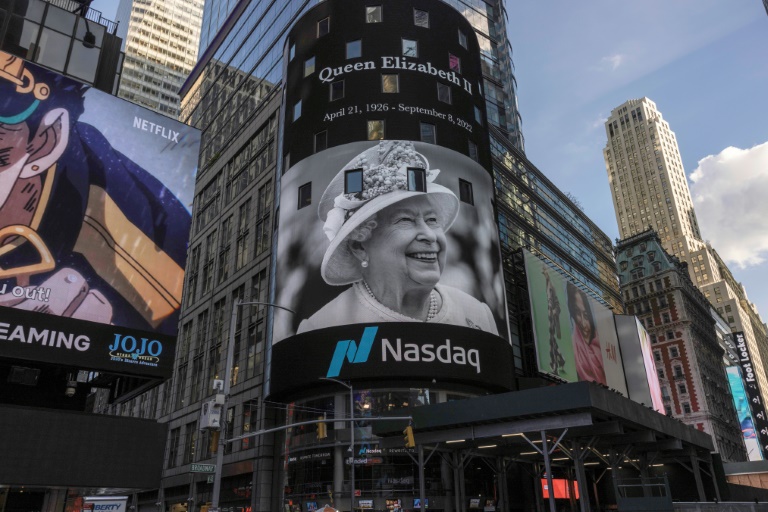
“It’s the end of an era,” remarked Jose Reyes, 37, in New York’s bustling Time Square.

A large digital billboard nearby projected an image of a beaming queen, clad in one of her famous hats.

A few blocks away, the Empire State Building was illuminated after sunset in purple and silver to “honor the life and legacy of Her Majesty,” the historic skyscraper’s official Twitter account said.

The queen had stood at the top of the building over a half-century ago, when it was the tallest building in the world — a reflection of her reign’s historic 70-year length and the technological advances she’s born witness to.

Downtown, close to where George Washington was inaugurated as the first US president following America’s independence from Britain nearly 250 years ago, the New York Stock Exchange on Thursday afternoon observed a minute of silence.

In recognition of the “special relationship” between the United States and Britain, flags at federal buildings all across the country were ordered by President Joe Biden to be lowered to half-staff, where they will remain until the evening of the queen’s burial.

In the US capital, at 5:00 pm local time (2100 GMT), bells at the Washington National Cathedral chimed 96 times, one for every year of the queen’s life.

Speaking to AFP in the Washington suburb of Bethesda, 26-year-old Drew said she saw the queen “in a positive view” due to her public appearances largely being “involved with charity,” despite other “negative aspects to the monarchy.”

“I definitely saw her as kind of a maternal figure” for her country,” Drew added.

“For many people, she’s the only Queen they’ve ever known their entire lives.”

– “A star is dead” –

Others were only slightly aware of the queen’s story, or had just heard about her recent family woes, especially regarding Prince Harry and his wife Meghan, who have made California their new home.

On the West Coast, some remembered the monarch’s trademark noble image, maintained with utmost precision.

“She was an admirable woman, with a real sense of humor. She was always perfect, despite her mobility problems or the arguments within the royal family” said 45-year-old freelance TV producer Corrine Smith, outside an English pub in Santa Monica, where dozens of Brits gathered Thursday evening.

“We’re all gonna miss her,” Smith said, noting that she watches the Netflix series “The Crown,” which has played a major role in the revival of interest around the royal family in recent years.

“A star is dead,” said Gregg Donovan, dressed as a royal valet and carrying flowers to lay beneath the queen’s portrait at the pub.

The 62-year-old actor and tour guide said he thinks Queen Elizabeth II “should get a star on the Hollywood Walk of Fame.”

“She was the most famous person in the world, after all.”

Recycling firm battles Jakarta's plastic waste emergency

As Indonesia’s capital Jakarta grapples with overflowing plastic waste and pollution pours into the sea, one burgeoning business is trying to turn rubbish into revenue.

Tridi Oasis Group, which employs 120 people, has recycled more than 250 million bottles since it was founded six years ago.

“I don’t see discarded plastic as trash. For me, it is a valuable material in the wrong place,” 35-year-old founder Dian Kurniawati told AFP.

Indonesia has pledged to reduce plastic waste by 30 percent over the next three years — a mammoth task in the Southeast Asian nation of nearly 270 million people where plastic recycling is rare.

The country generates approximately 7.8 million tonnes of plastic waste every year, with more than half mismanaged or disposed of improperly, according to the World Bank.

Kurniawati’s company receives plastic from recycling centres across the greater Jakarta area — which has 30 million people — at its factory in Banten province outside the city.

Then the company exports recycled plastic to European countries and also distributes it locally to be processed and used as packaging or textiles. 

Kurniawati resigned from her consultant job to start the firm, tackling head-on the massive challenges faced by the world’s fourth most populous country in dealing with the plastic crisis.

As one of the initiators of the “Beach Clean Up Jakarta” movement, she saw how Jakarta is littered with plastic waste and was frustrated that little was being done to change the situation.

– ‘Our problem’ – 

Hundreds of piles of crushed clear plastic bottles sit piled neatly in the Banten factory, ready to be sorted to make sure no labels or caps are left behind. 

The bottles are then cleaned thoroughly to eliminate contamination before being cut into small flakes, ready to be transported to clients for processing and reuse as packaging or textiles. 

Fajar Sarbini, a 24-year-old employee, hopes more Indonesians will start recycling.

“People throw away their waste mindlessly, they should at least sort out sharp materials so they won’t hurt garbage collectors,” he said.

Jakarta does not have a municipal collection system for household waste and has no incineration facilities.

With green trends rising and the will of younger generations to live more sustainably growing, the country is not without hope. 

“Indonesia is catching up and the acceleration is quite fast because we got help from social media and youth campaigns,” Kurniawati said. 

But she said the waste problem facing the country is enormous and the regulation to encourage plastic to be recycled is lacking.

“Plastic waste is our problem and solving it takes a concerted effort from everybody,” she said.

“It can’t be solved by just the government or recycling companies.” 

EU ministers seek ways to face energy shock

EU energy ministers on Friday will attempt to forge a united response to the energy shock from Russia’s war on Ukraine that has sent prices for electricity and heating skyrocketing.

Moscow’s invasion has seen the price of natural gas hit record levels, throwing the EU economy into deep uncertainty with all eyes on whether Russian President Vladimir Putin will cut off the energy flow entirely.

Before the war, 40 percent of the EU’s gas imports came from Russia, with most of the supply going to Germany, the bloc’s economic powerhouse that is now scrambling to come up with new ways to heat homes and power factories.

The European Commission, the EU’s executive, will ask the ministers meeting in Brussels to consider a series of highly complex proposals designed to ease the burden.

The main drive will be to find ways to compensate households and businesses that are struggling to pay their bills and keep activity going.

The EU executive will propose a mechanism that would see non-gas electricity companies, such as nuclear, solar or renewable firms, share windfall revenues won on the back of high prices for electric power.

The market price of electricity in Europe is closely linked to the gas price, meaning non-gas utilities are enjoying a revenue bonanza while companies stuck paying for gas struggle.

Fossil fuel companies would also be levied on their mega profits from the inflated energy prices.

There needs to be a “discussion without qualms” about a potential solidarity levy on “energy companies that make windfall profits in times of war”, said Austrian Energy Minister Leonore Gewessler ahead of the talks.

– Price cap push stalled –

Another proposal that has broad backing is an idea to rescue electricity companies that are struggling to hedge their spending on the financial markets.

This would be done by relaxing EU rules on state rescues of companies that are suddenly facing more onerous terms for cash as fears of a crisis spread.

The commission will also ask member states to agree on a united way to cut back on energy demand, with mandatory cuts on usage still considered an option, diplomats said.

“These are proposals where I feel there is quite a large convergence of views among the member states,” said a key EU diplomat.

An idea to cap Russian gas prices however is stalled, diplomats warned, with fears rife that the retribution from Russia would throw the European economy into even further chaos.

EU chief Ursula von der Leyen on Wednesday urged member states to agree a price cap on Russian gas, a measure that Putin has warned would be “an absolutely stupid decision”.

But an EU diplomat aware of the state of negotiations warned that there was no majority among the member states in favour of the idea. 

The EU’s energy ministers are set to debate the commission’s ideas, with many countries expected to come to the table with their own proposals.

The commission, which draws up laws that are then ratified by member states and the European Parliament, would then formalise the proposal next week.

US Justice Dept appeals freeze on review of seized Trump documents

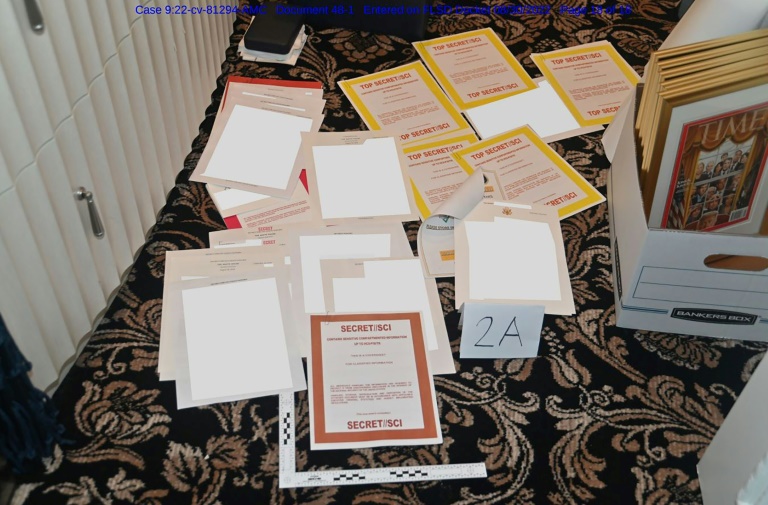
The US Justice Department said Thursday it was appealing a Florida judge’s order to freeze access to thousands of documents, including top secret files, seized from former president Donald Trump’s home.

The department said the order Monday by federal court Judge Aileen Cannon to sequester all the documents for review by an independent “special master” hindered its ability to conduct criminal investigation related to Trump’s possession of the classified documents.

It asked Cannon to set aside her freeze on just over 100 classified documents seized in the August 8 raid on Trump’s Florida home and to keep them from the hands of any special master named to examine the seized materials.

The papers are part of an ongoing FBI criminal investigation into unauthorized possession of national defense information, which comes under the Espionage Act, and Trump has no claim over them, the department said in its filing.

“The classified records are the very subject of the government’s ongoing investigation,” it said.

Last month’s unprecedented FBI raid on Trump’s Palm Beach, Florida Mar-a-Lago home saw thousands of government records, including the highly classified materials, retrieved.

Much of it was mixed together into dozens of boxes with Trump personal records and other things like clothing and media clippings.

Last week Trump asked Cannon to shield all of it from being examined or used in investigations, citing his executive privileges as a former president, attorney-client privileges over any personal legal documents in the trove, and also Constitutional protections from unjustified searches.

Cannon issued a freeze saying a special master could be named for an independent review of what Trump could in fact claim privilege over and what the government could keep.

The government has maintained that Trump has no right to any of the official government records, which belong to the National Archives, and especially not to the classified materials.

It has not detailed what is in the classified documents, but media reports say some are extremely restricted, and the Washington Post reported that one deals with a foreign country’s nuclear program and nuclear defenses.

The Justice Department cited the law on retaining defense materials and the law against destruction of government records for the raid.

It also cited obstruction of justice, after Trump and his attorneys told the FBI in June there were no more government or classified records in Mar-a-Lago.

In a social media posting Trump accused the FBI and Justice department of a “document hoax” and praised Cannon as “brilliant and courageous.”

Biden pays tribute to queen as 'stateswoman of unmatched dignity'

US President Joe Biden paid tribute Thursday to the late Queen Elizabeth II as a “stateswoman of unmatched dignity,” and said he looked forward to working with her son King Charles, noting their already “close friendship.”

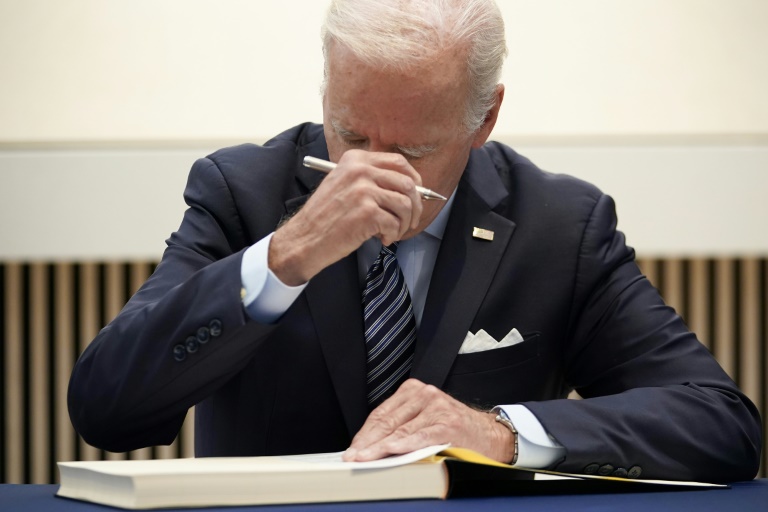
Biden ordered flags at the White House and other federal buildings to be lowered to half-staff, and also visited the British embassy in Washington to sign a condolence book for the queen.

“Queen Elizabeth II was a stateswoman of unmatched dignity and constancy who deepened the bedrock alliance between the United Kingdom and the United States,” Biden and First Lady Jill Biden said in a statement. “She helped make our relationship special.”

At the embassy, Biden told staff the late queen was “a great lady” and that he was “so delighted I got to meet her.”  

Biden, 79, noted deep ties between the monarch and the United States, a former British colony.

“She stood in solidarity with the United States during our darkest days after 9/11, when she poignantly reminded us that ‘Grief is the price we pay for love,'” Biden said in his statement.

The five former living US presidents — Jimmy Carter, Bill Clinton, George W. Bush, Barack Obama, and Donald Trump — together with their wives all issued statements Thursday, paying tribute to the late monarch.

Setting aside their political divisions, now as deep as ever in America, the former US leaders were unanimous in their respect for the queen, praising her historic legacy as well as her personal traits.

Obama hailed “a reign defined by grace, elegance, and a tireless work ethic, defying the odds and expectations placed on women of her generation.”

– ‘Personal and immediate connection’ –

“She listened deeply, thought strategically and was responsible for considerable diplomatic successes,” he said in a statement.

Trump said the queen left an “extraordinary legacy of peace and prosperity for Great Britain.”

“Her leadership and enduring diplomacy secured and advanced alliances with the United States and countries around the world,” Trump said on his social network, Truth Social.

The Clintons remembered the queen for “the kindness she showed us,” while the Bushes noted that “tea with Her Majesty — and her Corgis — is among our fondest memories of the presidency.”

Biden said he first met the queen in 1982 when he was a US senator and last saw her in June 2021 during his first foreign trip as president — the 14th American president she had met.

“She was the first British monarch to whom people all around the world could feel a personal and immediate connection,” the Bidens said. “She, in turn, dedicated her whole life to their service.”

“In the years ahead, we look forward to continuing a close friendship with the king and the queen consort,” they said, referring to Elizabeth’s son and heir King Charles and his wife.

“Today, the thoughts and prayers of people all across the United States are with the people of the United Kingdom and the Commonwealth in their grief.”

Flags will also be lowered on US Navy vessels, at military posts and naval stations, and at all American embassies and other facilities abroad, a proclamation from the White House said. 

Close Bitnami banner
Bitnami