US Business

British cinema chain Cineworld files for US bankruptcy

Britain’s Cineworld, the world’s second biggest cinema chain, announced Wednesday that it has filed for bankruptcy protection in the United States as it seeks to restructure after facing low audience numbers.

The group, which operates hundreds of movie theatres in the United States, said in a statement that it filed for Chapter 11 at a bankruptcy court in Texas.

Chapter 11 of the US bankruptcy code is a court-supervised restructuring process that provides companies time to negotiate with its creditors to reach a settlement on the reduction of debts.

Cineworld said it “will seek to implement a de-leveraging transaction that will significantly reduce the Group’s debt, strengthen its balance sheet and provide the financial strength and flexibility to accelerate, and capitalise on, Cineworld’s strategy in the cinema industry.”

The statement said it hoped to emerge from bankruptcy proceedings in the first quarter of next year, and had $1.94 billion in financing from existing lenders to help it through that period.

The company also warned existing shareholders that their holdings would likely be considerably diluted as part of the bankruptcy process.

Cineworld’s shares had been sliding since the beginning of the year as the company’s position deteriorated when people didn’t return to cinemas in droves after Covid lockdowns were eased.

They plummeted last month when the company acknowledged it was considering filing for bankruptcy.

Cineworld shares rose 10 percent on Wednesday to 4.29 pence, but were still down 87 percent from the start of the year.

Analysts argue that Cineworld’s 2018 takeover of American peer Regal left it saddled with too much debt, putting it in a poor position to weather the pandemic.

British cinema chain Cineworld files for US bankruptcy

Britain’s Cineworld, the world’s second biggest cinema chain, announced Wednesday that it has filed for bankruptcy protection in the United States as it seeks to restructure after facing low audience numbers.

The group, which operates hundreds of movie theatres in the United States, said in a statement that it filed for Chapter 11 at a bankruptcy court in Texas.

Chapter 11 of the US bankruptcy code is a court-supervised restructuring process that provides companies time to negotiate with its creditors to reach a settlement on the reduction of debts.

Cineworld said it “will seek to implement a de-leveraging transaction that will significantly reduce the Group’s debt, strengthen its balance sheet and provide the financial strength and flexibility to accelerate, and capitalise on, Cineworld’s strategy in the cinema industry.”

The statement said it hoped to emerge from bankruptcy proceedings in the first quarter of next year, and had $1.94 billion in financing from existing lenders to help it through that period.

The company also warned existing shareholders that their holdings would likely be considerably diluted as part of the bankruptcy process.

Cineworld’s shares had been sliding since the beginning of the year as the company’s position deteriorated when people didn’t return to cinemas in droves after Covid lockdowns were eased.

They plummeted last month when the company acknowledged it was considering filing for bankruptcy.

Cineworld shares rose 10 percent on Wednesday to 4.29 pence, but were still down 87 percent from the start of the year.

Analysts argue that Cineworld’s 2018 takeover of American peer Regal left it saddled with too much debt, putting it in a poor position to weather the pandemic.

How Bellingcat became Russia's 'biggest nightmare'

Digital investigators from the Bellingcat group have spent eight years exposing the lies of the powerful and gathering evidence of their crimes – work that has a grave human cost, the organisation’s chief told AFP in an interview.

Bulgarian journalist Christo Grozev said he and his colleagues received regular threats but he was driven to continue by “adrenalin” and “the feeling you can do something that law enforcement does not do”.

The investigative group has been closely associated with uncovering misdeeds by Russian agents across Europe, including intelligence involvement in the poisoning of opposition figure Alexei Navalny.

“When you get stopped in the street by Russian citizens, telling you thank you for what you are doing once a day, I think that it is enough to continue,” he said.

During a meeting in Paris earlier this week, he described the organisation as the “Kremlin’s biggest nightmare” though he stressed to AFP that Russia was not the main focus of their work.

“Russia today produces a lot of government crime and that’s why a lot of our investigations are focused on Russia,” he said.

“But we equally try to pay attention to bad actors from wherever they come.”

He cites investigations into the Syrian war, EU border agency Frontex and others focused on Greece, Turkey, Hungary and the far right in the United States and Europe.

– ‘Undesirable’ in Russia –

Bellingcat was founded in July 2014 by a British blogger, Eliot Higgins, along with a band of internet “nerds”, said Grozev, who joined later and brought a wealth of journalism experience from his career in the Bulgarian media.

They used information freely available to the public –- anything from satellite images to telephone directories -– to piece together evidence of wrongdoing.

Their work on the downing of Air Malaysia flight MH17 over Ukraine in 2014 — which killed 298 people and sparked global outrage — won plaudits around the world and brought the group to the attention of the Kremlin.

The investigators pieced together photos, videos and public documents that supported the theory that the plane was shot down by a Russian missile from an area controlled by pro-Russian separatists.

Since then, the group has identified Russian agents responsible for poisoning opposition figure Alexei Navalny and other dissidents, exposed alleged war crimes in Ukraine and helped uncover many more scandals.

One of its main focuses right now is the war in Ukraine, where it has a two-track approach.

Grozev said one approach uses journalistic methods to debunk false information, the other is more judicial, gathering evidence of war crimes for eventual use in the courts.

The Netherlands-based platform, which takes its name from a fable in which mice join forces to hang a bell around a cat’s neck, has rarely been out of the Kremlin’s firing line.

Russia recently described it as a security threat and deemed it “undesirable”.

– Legal challenges –

One of the main lines of attack has been to accuse Bellingcat of being funded by Western governments or NGOs, particularly the US National Endowment for Democracy.

Grozev said in its early years the group took some money from American NGOs for training, but later decided to stop.

He said it had not taken any money from governments since last year and relied instead on smaller funders.

“Most of our funders are individuals who spend 100 euros to 5,000 euros,” he said.

Beyond the financial constraints, Grozev pointed to the difficult legal environment.

“International law is handicapped because it assumes that governments look out for their citizens,” said Grozev.

Even a tribunal like the International Criminal Court, which seeks to hold individuals to account rather than countries, has long been hobbled by disagreements over its remit and powers of investigation.

And national governments are hamstrung by the idea of national sovereignty, so if a poisoning happens on Russian territory, only Russia can investigate.

It is precisely in this legal blackhole that Bellingcat finds the greatest need.

“We investigate generally bad actors, governments who commit crimes, because we think nobody else is investigating them,” said Grozev.

“There are no tribunals, no law enforcement agencies that investigate governments.”

Oil tumbles to pre-war level on recession fears

Oil prices tumbled back to pre-war levels Wednesday as recession fears returned to the forefront.

Stocks were also hit by the negative outlook for the global economy but perked up as energy prices and bond yields fell, while currency markets were gripped by the prospect for interest rate hikes.

Oil prices briefly climbed early on Wednesday as Russia’s President Vladimir Putin said his country would stop delivering oil and gas supplies to countries that introduce price caps.

G7 industrialised powers have vowed to move urgently towards implementing a price cap on Russian oil imports to cut off a major source of funding for Moscow’s military action in Ukraine.

But then oil prices then turned sharply lower, with Brent crude, the main international contract, passing under $90 per barrel for the first time since February.

OPEC and its allies earlier this week cut production targets for the first time in more than a year in a bid to lift prices.

“While the 100,000 barrel cut wasn’t fundamentally significant, it was clearly intended as a warning not to drive the price lower or face further cuts,” said OANDA trading platform analyst Craig Erlam.

“Unfortunately, it seems traders are in no mood to be told what to do and growth fears are instead dictating the price direction.”

Recession concerns also dampened sentiment towards equities, but Briefing.com analyst Patrick O’Hare said those worries were competing for investors’ attention with “the idea that the stock market is oversold on a short-term basis and due for a bounce”.

Recession fears have been driven in large part by central banks moving aggressively to rein in surging inflation.

The dollar continues to gain strength from expectations of a third-straight blockbuster hike to US interest rates later this month.

US Federal Reserve officials have lined up in recent weeks to say their main focus is bringing inflation down from four-decade highs, even if that means tipping the economy into recession.

The different pace in lifting rates taken by central banks is fuelling swings in currency values.

The European Central Bank is Thursday forecast to deliver another bumper rate increase, mirroring aggressive moves by the Fed and Bank of England.

Nevertheless, it has moved slower and the euro remains lodged below parity with the dollar.

Meanwhile, the dollar rose to 144.99 yen — the Japanese currency’s weakest showing since 1998.

“The reason that we are seeing this much strength in the dollar against the yen is purely because of the difference in two central banks’ policies,” noted Naeem Aslam, chief market analyst at AvaTrade. 

“The Fed is as hawkish as it can be, and the BoJ still doesn’t seem to be bothered much about inflation or changing its stance on monetary policy.”

Japan’s finance minister, Shunichi Suzuki, on Wednesday expressed concern about the yen’s drop.

“For now, we’re monitoring with a sense of urgency how it’s developing, but if this continues, it makes sense that we will take necessary measures,” he said, without detailing what the measures might be.

The greenback also struck a 37-year peak against sterling after a Bank of England official said plans by new PM Liz Truss to cap energy bills would reduce inflation pressures, leading markets to believe the central bank may let up on rate hikes. 

– Key figures at around 1530 GMT –

Brent North Sea crude: DOWN 3.4 percent at $89.80 per barrel

West Texas Intermediate: DOWN 3.8 percent at $83.55 per barrel

Dollar/yen: UP at 144.44 yen from 142.80 yen on Tuesday

Euro/yen: UP at 143.66 yen from 141.43 yen

Euro/dollar: UP at $0.9946 from $0.9905 

Pound/dollar: DOWN at $1.1444 from $1.1519

Euro/pound: UP at 86.72 pence from 85.97 pence

New York – Dow: UP 0.8 percent at 31,385.35 points

EURO STOXX 50: UP less than 0.1 percent at 3,502.09

London – FTSE 100: DOWN 0.9 percent at 7,237.83 (close)

Frankfurt – DAX: UP 0.4 percent at 12,915.97 (close)

Paris – CAC 40: FLAT at 6,105.92 (close)

Tokyo – Nikkei 225: DOWN 0.7 percent at 27,430.30 (close)

Hong Kong – Hang Seng Index: DOWN 0.8 percent at 19,044.30 (close)

Shanghai – Composite: UP 0.1 percent at 3,246.29 (close)

burs-rl/jj

UK's new PM vows imminent action on energy crisis

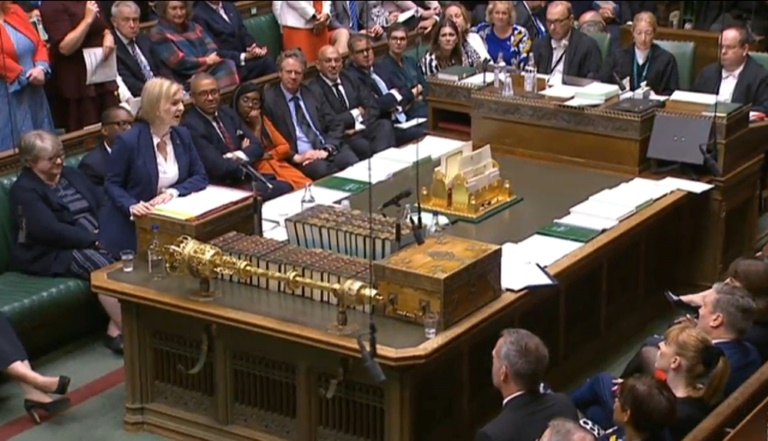
At her first parliamentary grilling as British prime minister, Liz Truss on Wednesday confirmed plans to stem huge rises in the cost of energy that threaten to plunge her new government into a winter of discontent.

Jousting with opposition Labour chief Keir Starmer for the first time since she succeeded Boris Johnson, Truss also revelled in her status as the UK government’s third female prime minister, noting Labour has still to elect a woman leader.

Truss ruled out a windfall tax on energy firms’ gargantuan profits, but said details of her plan would be released on Thursday to ensure consumers and businesses can still afford heating in the coming months.

Whereas Johnson used the weekly session of “Prime Minister’s Questions” to theatrically attack Starmer, Truss was more business-like as she pledged a right-wing programme of tax cuts to revitalise the UK economy.

Starmer cast Truss as the inheritor of 12 years of Tory government leading up to the present crisis in inflation, which is tied to Russia’s war in Ukraine, and said there was “nothing new” about her policies.

“There’s nothing new about a Labour leader who is calling for more tax rises,” Truss retorted, earning roars of approval from Conservative MPs — most of whom had initially backed her leadership rival, Rishi Sunak.

Johnson’s predecessor Theresa May archly asked Truss why only the Conservatives had managed to elect women leaders — May herself, and Margaret Thatcher. One Tory backbencher shouted “3-0!”

Starmer’s deputy Angela Rayner looked on with a pained expression as Truss said it was “extraordinary” that Labour could not find a woman leader, or one who did not live in left-leaning North London.

– Historic diversity –

Earlier Wednesday, Truss convened her new-look cabinet, which includes the most diverse top team in British history: Kwasi Kwarteng as finance minister, James Cleverly as foreign secretary and Suella Braverman as interior minister.

Under the costly plans developed by Truss and Kwarteng, gas and electricity bills for both households and businesses are expected to be capped near current levels for the coming winter at least.

The government would lend or guarantee private-sector loans to energy providers to make up the difference they pay from soaring global wholesale prices, which have driven UK inflation above 10 percent.

The spike in inflation to 40-year highs has stoked a wave of strikes, including by railway workers and criminal lawyers, with more sectors threatening to walk out in an early challenge to Truss’s administration.

On the eve of Truss’s energy plan announcement, the British pound slumped to its lowest dollar level since 1985, tanking to $1.1406 at about 1400 GMT.

Along with the urgent issue of energy prices, Truss’s government must also navigate the combustible problem of post-Brexit trading arrangements in Northern Ireland. 

In her first contacts with foreign leaders, the new Conservative leader spoke late Tuesday by phone to Ukraine’s Volodymyr Zelensky and then US President Joe Biden.

– ‘Imbecile’ –

According to Downing Street, she agreed with Biden “on the importance of protecting” peace in Northern Ireland.

In parliament, Truss said she was “determined” to break through the impasse, and favoured a “negotiated settlement” with the EU.

To Zelensky, Truss vowed to maintain the full-throated support for Ukraine against Russia given by Johnson before he was forced out following a series of scandals.

Truss, 47, won an internal ballot of Tory members on Monday, securing 57 percent of the vote, after a gruelling contest against former finance minister Sunak that began in July.

She now faces a tough challenge reuniting the ruling Tories following the leadership battle, but observers noted that she had expelled almost every Sunak supporter from the cabinet.

Ex-soldier Johnny Mercer said he was “disappointed” to be sacked as veterans affairs minister.

His wife Felicity Cornelius-Mercer went further, calling Truss an “imbecile” as she tweeted a picture mocking the new prime minister as a dim-witted character from “The Muppets”.

The Times quoted one of her incoming ministers as saying: “I doubt she’ll last two years.”

Labour has a double-digit lead in the polls but may have to wait two years to test its popularity.

A general election is due by January 2025 at the latest. Truss on Wednesday again ruled out an early election, mindful perhaps that she needs time to win over a sceptical electorate after Johnson’s defenestration.

A new poll by Ipsos found just a third of people expect Truss to do a good job as prime minister, while another third say she will do a bad job.

US judge lets Musk amend Twitter claims, rejects delaying case

A US judge permitted Elon Musk to amend his complaint against Twitter on Wednesday, but rejected delaying the lawsuit over the disintegration of the billionaire’s deal to acquire the social media company.

In a mixed ruling, Kathaleen McCormick, the chancellor of the Delaware court, said Musk could add whistleblowing revelations from a Twitter ex-security chief that surfaced in August.

But she denied his request to push back the litigation, saying prolonging the suit “would risk further harm to Twitter too great to justify.”

Musk has been locked in a bitter legal battle with Twitter since announcing in July that he was pulling the plug on his $44 billion purchase of the company following a complex, volatile, months-long courtship.

Musk has said he canceled the deal because he was misled by Twitter concerning the number of bot accounts on its platform, allegations rejected by the company.

Revelations from Twitter former security chief Peiter Zatko criticizing Twitter’s security practices first became public in August following a report in the Washington Post.

In a hearing Tuesday, attorneys for Musk sought to amend his appeal and be granted additional time for document discovery to investigate Zatko’s assertions.

Twitter attorneys argued Musk’s request was another delay tactic designed to derail the takeover.

McCormick said Musk had cleared the relatively low legal bar to amend his complaint against Twitter, adding that she was “reticent” to weigh on the merits of Musk’s arguments “before they have been fully litigated.”

But she said Musk’s side would be permitted “only incremental discovery” to follow up on the new allegations in light of the need for a speedy resolution of the case.

“The longer the delay until trial, the greater the risk of irreparable harm to Twitter,” McCormick said, noting the company has suffered employee attrition while it “has been forced for months to manage under the constraints of a repudiated merger agreement.”

The five-day trial is due to go ahead beginning October 17 in the Delaware court. 

US judge lets Musk amend Twitter claims, rejects delaying case

A US judge permitted Elon Musk to amend his complaint against Twitter on Wednesday, but rejected delaying the lawsuit over the disintegration of the billionaire’s deal to acquire the social media company.

In a mixed ruling, Kathaleen McCormick, the chancellor of the Delaware court, said Musk could add whistleblowing revelations from a Twitter ex-security chief that surfaced in August.

But she denied his request to push back the litigation, saying prolonging the suit “would risk further harm to Twitter too great to justify.”

Musk has been locked in a bitter legal battle with Twitter since announcing in July that he was pulling the plug on his $44 billion purchase of the company following a complex, volatile, months-long courtship.

Musk has said he canceled the deal because he was misled by Twitter concerning the number of bot accounts on its platform, allegations rejected by the company.

Revelations from Twitter former security chief Peiter Zatko criticizing Twitter’s security practices first became public in August following a report in the Washington Post.

In a hearing Tuesday, attorneys for Musk sought to amend his appeal and be granted additional time for document discovery to investigate Zatko’s assertions.

Twitter attorneys argued Musk’s request was another delay tactic designed to derail the takeover.

McCormick said Musk had cleared the relatively low legal bar to amend his complaint against Twitter, adding that she was “reticent” to weigh on the merits of Musk’s arguments “before they have been fully litigated.”

But she said Musk’s side would be permitted “only incremental discovery” to follow up on the new allegations in light of the need for a speedy resolution of the case.

“The longer the delay until trial, the greater the risk of irreparable harm to Twitter,” McCormick said, noting the company has suffered employee attrition while it “has been forced for months to manage under the constraints of a repudiated merger agreement.”

The five-day trial is due to go ahead beginning October 17 in the Delaware court. 

Oil tumbles to pre-war level on recession fears

Oil prices tumbled back to pre-war levels Wednesday as recession fears returned to the forefront.

Stocks were also hit by the negative outlook for the global economy, while currency markets were gripped by the prospect for interest rate hikes.

Oil prices briefly climbed on Wednesday as Russia’s President Vladimir Putin said his country would stop delivering oil and gas supplies to countries that introduce price caps.

G7 industrialised powers have vowed to move urgently towards implementing a price cap on Russian oil imports to cut off a major source of funding for Moscow’s military action in Ukraine.

But oil prices then turned sharply lower, with Brent crude, the main international contract, passing under $90 per barrel for the first time since February.

OPEC and its allies earlier this week cut production targets for the first time in more than a year in a bid to lift prices.

“While the 100,000 barrel cut wasn’t fundamentally significant, it was clearly intended as a warning not to drive the price lower or face further cuts,” said OANDA trading platform analyst Craig Erlam.

“Unfortunately, it seems traders are in no mood to be told what to do and growth fears are instead dictating the price direction.”

Recession concerns also dampened sentiment towards equities, with European indices lower, although Wall Street managed small gains at the open.

“Investors appear reluctant to buy anything in this macro environment, where inflation is soaring, global growth is weakening, and central banks are tightening,” said City Index and FOREX.com analyst Fawad Razaqzada. 

“Something must fundamentally change before we see the onset of a serious recovery,” he added.

Recession fears are being driven in large part by central banks moving aggressively to rein in surging inflation.

The dollar continues to gain strength from expectations of a third-straight blockbuster hike to US interest rates later this month.

US Federal Reserve officials have lined up in recent weeks to say their main focus is bringing inflation down from four-decade highs, even if that means tipping the economy into recession.

The different pace in lifting rates taken by central banks is fuelling swings in currency values.

The European Central Bank is Thursday forecast to deliver another bumper rate increase, mirroring aggressive moves by the Fed and Bank of England.

Nevertheless, it has moved slower and the euro remains lodged below parity with the dollar.

Meanwhile, the dollar rose to 144.99 yen — the Japanese currency’s weakest showing since 1998.

“The reason that we are seeing this much strength in the dollar against the yen is purely because of the difference in two central banks’ policies,” noted Naeem Aslam, chief market analyst at AvaTrade. 

“The Fed is as hawkish as it can be, and the BoJ still doesn’t seem to be bothered much about inflation or changing its stance on monetary policy.”

Japan’s finance minister, Shunichi Suzuki, on Wednesday expressed concern about the yen’s drop.

“For now, we’re monitoring with a sense of urgency how it’s developing, but if this continues, it makes sense that we will take necessary measures,” he said, without detailing what the measures might be.

The greenback also struck 37-year peak against sterling, plagued by recession fears on the eve of new Prime Minister Liz Truss’s economic stimulus plan.

– Key figures at around 1330 GMT –

Brent North Sea crude: DOWN 3.1 percent at $89.92 per barrel

West Texas Intermediate: DOWN 3.5 percent at $83.86 per barrel

Dollar/yen: UP at 144.78 yen from 142.80 yen on Tuesday

Euro/yen: UP at 143.44 yen from 141.43 yen

Euro/dollar: UP at $0.9907 from $0.9905 

Pound/dollar: DOWN at $1.1478 from $1.1519

Euro/pound: UP at 86.65 pence from 85.97 pence

London – FTSE 100: DOWN 1.1 percent at 7,222.53 points

Frankfurt – DAX: DOWN 0.4 percent at 12,816.13

Paris – CAC 40: DOWN 0.6 percent at 6,066.06

EURO STOXX 50: DOWN 0.7 percent at 3,477.31

New York – Dow: DOWN 0.1 percent at 31,109.95

Tokyo – Nikkei 225: DOWN 0.7 percent at 27,430.30 (close)

Hong Kong – Hang Seng Index: DOWN 0.8 percent at 19,044.30 (close)

Shanghai – Composite: UP 0.1 percent at 3,246.29 (close)

burs-rl/lth

US military test launches ICBM

The US military tested an unarmed intercontinental ballistic missile on Wednesday, the second in less than a month after a previous launch was delayed twice.

Washington announced the test in advance, an unusual move apparently aimed at heading off an escalation of tensions with Russia that are already heightened due to Moscow’s invasion of Ukraine.

“Air Force Global Strike Command Airmen launched an unarmed Minuteman III intercontinental ballistic missile equipped with three test re-entry vehicles” early on September 7 from the Vandenberg Space Force Base in California, the US Air Force said in a statement.

In a conflict, the re-entry vehicles would be armed with nuclear warheads.

“This test launch is part of routine and periodic activities intended to demonstrate that the United States’ nuclear deterrent is safe, secure, reliable and effective,” the statement said.

“This test is not the result of current world events,” it added.

The US Air Force successfully launched a Minutemen III ICBM on August 16, after having postponed the test twice to avoid stoking tensions over Ukraine and Taiwan.

The Minuteman III has been in service for 50 years, and is currently the only land-based ICBM in the US nuclear arsenal. The missiles are housed in silos on three US military bases in Wyoming, North Dakota and Montana. 

The US arsenal also includes Trident submarine-launched ballistic missiles and nuclear weapons carried by strategic bomber aircraft.

US trade gap drops sharply in July on lower imports

A steep drop in imports, especially of consumer goods, narrowed the US trade deficit in July to its lowest level since October, the government reported Wednesday.

Exports rose only slightly, boosted by an increase in international travel, but the gain was enough to set yet another record, the Commerce Department reported.

The overall trade deficit fell by more than $10 billion to $70.6 billion compared to June, almost entirely due to the decline in imports, the report said.

Companies in recent months rushed to replenish depleted inventories amid strong demand from American shoppers — but sky-high inflation has raised concerns that consumers will pull back, causing firms to become more cautious.

The Federal Reserve is raising interest rates aggressively to dampen demand and cool inflation, and many families are having to spend a greater share of their incomes on staple goods.

Higher interest rates have strengthened the US dollar, making American goods relatively more expensive, which could trim exports, but so far the data are likely to boost growth in the world’s largest economy.

Goods and services exports edged up to $259.3 billion, just enough to beat the record set in June, according to the report.

Imports fell $8.5 billion, including a $3 billion plunge in pharmaceuticals, and $1.8 billion drop in industrial supplies including crude oil, while auto imports jumped $1.8 billion.

Exports are likely to again contribute to economic growth in the third quarter, said Rubeela Farooqi of High Frequency Economics. 

But she cautioned “a strong dollar, dimming global growth prospects, and slowing domestic demand should have implications for trade flows going forward.”

The US deficit with China decreased $3.9 billion to $33.0 billion in July due largely to falling imports, the data showed.

Close Bitnami banner
Bitnami