US Business

US trade gap drops sharply in July on lower imports

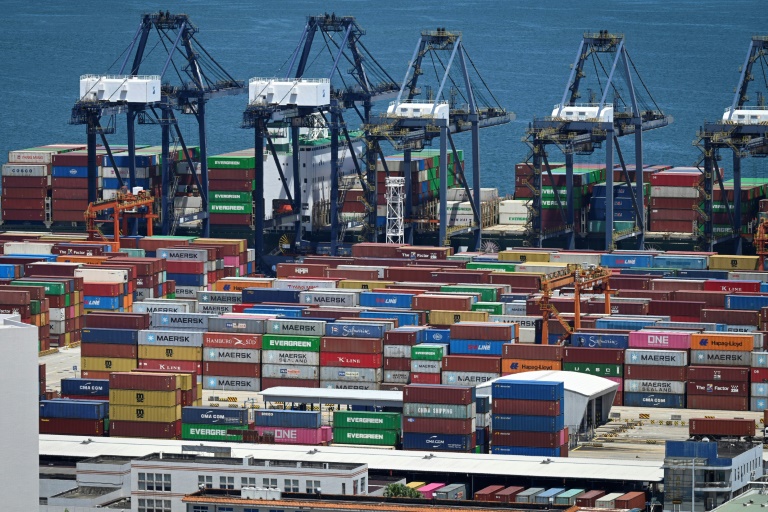
A steep drop in imports, especially of consumer goods, narrowed the US trade deficit in July to its lowest level since October, the government reported Wednesday.

Exports rose only slightly, boosted by an increase in international travel, but the gain was enough to set yet another record, the Commerce Department reported.

The overall trade deficit fell by more than $10 billion to $70.6 billion compared to June, almost entirely due to the decline in imports, the report said.

Companies in recent months rushed to replenish depleted inventories amid strong demand from American shoppers — but sky-high inflation has raised concerns that consumers will pull back, causing firms to become more cautious.

The Federal Reserve is raising interest rates aggressively to dampen demand and cool inflation, and many families are having to spend a greater share of their incomes on staple goods.

Higher interest rates have strengthened the US dollar, making American goods relatively more expensive, which could trim exports, but so far the data are likely to boost growth in the world’s largest economy.

Goods and services exports edged up to $259.3 billion, just enough to beat the record set in June, according to the report.

Imports fell $8.5 billion, including a $3 billion plunge in pharmaceuticals, and $1.8 billion drop in industrial supplies including crude oil, while auto imports jumped $1.8 billion.

Exports are likely to again contribute to economic growth in the third quarter, said Rubeela Farooqi of High Frequency Economics. 

But she cautioned “a strong dollar, dimming global growth prospects, and slowing domestic demand should have implications for trade flows going forward.”

The US deficit with China decreased $3.9 billion to $33.0 billion in July due largely to falling imports, the data showed.

Biden hosts Obamas to unveil portraits snubbed by Trump

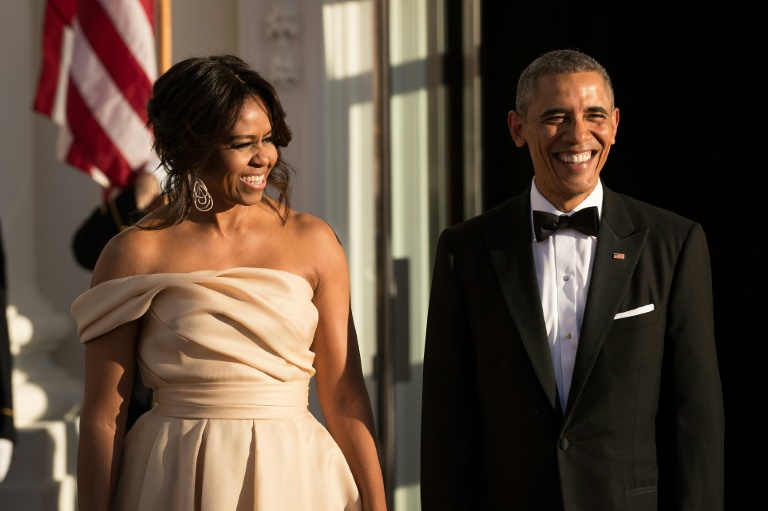
Former US president Barack Obama and first lady Michelle Obama will finally be honored Wednesday with the official unveiling of their portraits in the White House, resuming a tradition that fell by the wayside under Donald Trump.

Biden, who served as vice president throughout Obama’s two terms, is “looking forward to welcoming back president Obama and Michelle Obama,” Press Secretary Karine Jean-Pierre told reporters.

“Over the course of their eight years together in office, a close partnership between the two men grew through the highs and lows of the job and life — and of life.”

Past presidents and first ladies have typically had their portraits hung in the halls and corridors of the White House after ceremonies hosted by successors. Democrat Obama, for example, hosted George W. Bush, a Republican, and his wife Laura Bush at portrait unveilings in 2012.

However, Trump declined to invite the Obamas — amid undisguised contempt between both leaders in the wake of the Republican’s shock 2016 election win — and the tradition ground to a halt.

The norm-shredding Republican even reportedly ordered portraits of Bush and his predecessor Bill Clinton to be taken down from the walls of the White House’s Grand Foyer and put in storage. However, a portrait of Hillary Clinton, the former first lady whom Trump had defeated in the presidential campaign, remained visible in a lower corridor through his tempestuous one term.

Obama’s latest return to the White House comes five months after a high-profile homecoming for a public event on health care spending.

The Obamas’ paintings remained strictly under wraps until the last moment, but there were expectations that the trend-setting ex-first couple would choose a style somewhat different to the often straightforward portraits of the past.

As for Trump, the Biden administration says it has no direct say on whether or when his own portrait could be hung up. It is not clear whether the ex-president, now in deep legal peril after the discovery of top secret documents taken from the White House to his Florida golf club, has even commissioned an official painting.

UK PM rules out windfall tax to fund energy price freeze

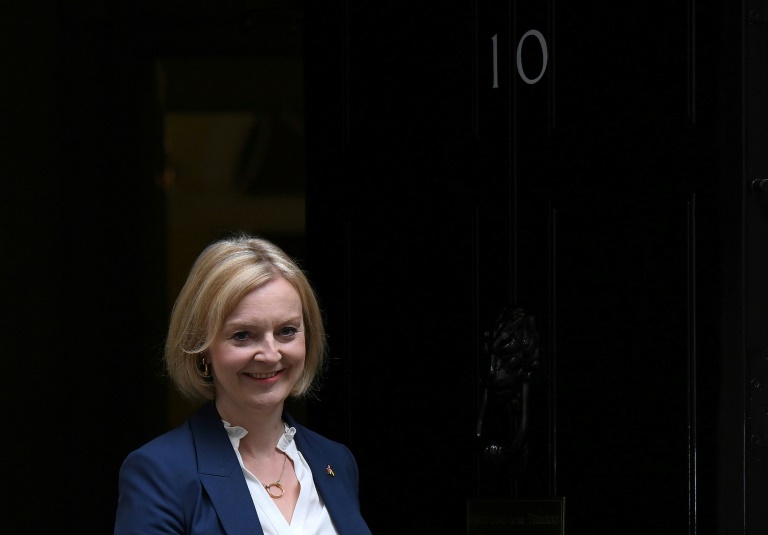
Liz Truss on Wednesday faced her first parliamentary grilling as British Prime Minister, ruling out a windfall tax to fund any freeze on energy bills to offset huge rises in the cost of gas and electricity. 

Truss, who formally took over from Boris Johnson on Tuesday, said she would spell out her plans on Thursday for an economic support package to forestall a growing crisis in the months ahead.

She is preparing measures reportedly worth upwards of £130 billion ($150 billion) to freeze energy bills for hard-pressed households and businesses, many of whom risk going to the wall this winter.

But when asked by opposition Labour leader Keir Starmer if this would be funded by a windfall tax on energy companies’ profits, Truss responded: “I am against a windfall tax.

“I believe it is the wrong thing to be putting companies off investing in the United Kingdom, just when we need to be growing the economy.”

She added: “This country will not be able to tax its way to growth.”

The exchange set the tone for the debate over how to tackle the predicted economic pain ahead, with inflation already in double digits at 40-year highs.

Truss campaigned on a promise to cut taxes, despite warnings that it could further fuel inflation and questions over where funds will come from.

Truss was bullish about the economic outlook as she entered Downing Street for the first time as premier on Tuesday.

“I am confident that together we can ride out the storm,” she said.

But Starmer said that ordinary people faced paying for her policies.

– Biden call –

Truss convened her new-look cabinet earlier Wednesday, which includes the most diverse top team in British history: Kwasi Kwarteng as finance minister, James Cleverly as foreign secretary and Suella Braverman as interior minister.

Along with the urgent issue of energy prices, Truss’s government must also navigate the combustible problem of post-Brexit trading arrangements in Northern Ireland. 

In her first contacts with foreign leaders, the new Conservative leader spoke late Tuesday by phone to Ukraine’s Volodymyr Zelensky and then US President Joe Biden.

According to Downing Street, she agreed with Biden “on the importance of protecting” peace in Northern Ireland.

In parliament, Truss said she was “determined” to break through the impasse, and favoured a “negotiated settlement” with the EU.

To Zelensky, Truss vowed to maintain the full-throated support for Ukraine against Russia given by her scandal-tainted predecessor, Boris Johnson.

Truss, 47, won an internal ballot of Tory members on Monday, securing 57 percent of the vote, after a gruelling contest against former finance minister Rishi Sunak that began in July.

But the initial stage of the contest saw her net the support of less than a third of the parliamentary party.

She now faces a tough challenge reuniting the ruling Tories following a bitter leadership battle, but observers noted that she had expelled almost every Sunak supporter from the cabinet.

Ex-soldier Johnny Mercer said he was “disappointed” to be sacked as veterans affairs minister.

His wife Felicity Cornelius-Mercer went further, calling Truss an “imbecile” as she tweeted a picture mocking the new prime minister as a dim-witted character from “The Muppets”.

Conservative MPs are “almost ungovernable” and have “no appetite to cope with difficult decisions”, one government insider told the Financial Times.

“They did for Boris, and they may do for Liz, too,” the source told the paper.

The Times quoted one of her incoming ministers as saying: “I doubt she’ll last two years.”

Labour has a double-digit lead in the polls but may have to wait two years to test their popularity.

A general election is due by January 2025 at the latest. Truss on Monday vowed to lead the Conservatives to victory “in 2024”.

– ‘Dreadful policy’ –

Truss pitched herself to the Tory grassroots as a tax-cutting free-trade champion ready to slash taxes immediately to turbo-charge growth.

Under her mooted plans, gas and electricity bills for both households and businesses would be capped near current levels for the coming winter at least.

The government would lend or guarantee private sector loans to energy providers to make up the difference they pay with soaring global wholesale prices.

It remains unclear whether the government will pay for the plan through extra borrowing or ask consumers to pick up the tab over the coming years through levies on their energy bills.

Paul Johnson, of the respected Institute for Fiscal Studies think-tank, said it was “a dreadful policy” but likely necessary. 

How Bellingcat became Russia's 'biggest nightmare'

Digital investigators from the Bellingcat group have spent eight years exposing the lies of the powerful and gathering evidence of their crimes – work that has a grave human cost, the organisation’s chief told AFP in an interview.

Bulgarian journalist Christo Grozev said he and his colleagues received regular threats but he was driven to continue by “adrenalin” and “the feeling you can do something that law enforcement does not do”.

The investigative group has been closely associated with uncovering misdeeds by Russian agents across Europe, including intelligence involvement in the poisoning of opposition figure Alexei Navalny.

“When you get stopped in the street by Russian citizens, telling you thank you for what you are doing once a day, I think that it is enough to continue,” he said.

During a meeting in Paris earlier this week, he described the organisation as the “Kremlin’s biggest nightmare” though he stressed to AFP that Russia was not the main focus of their work.

“Russia today produces a lot of government crime and that’s why a lot of our investigations are focused on Russia,” he said.

“But we equally try to pay attention to bad actors from wherever they come.”

He cites investigations into the Syrian war, EU police agency Europol and others focused on Greece, Turkey, Hungary and the far right in the United States and Europe.

– ‘Undesirable’ in Russia –

Bellingcat was founded in July 2014 by a British blogger, Eliot Higgins, along with a band of internet “nerds”, said Grozev, who joined later and brought a wealth of journalism experience from his career in the Bulgarian media.

They used information freely available to the public –- anything from satellite images to telephone directories -– to piece together evidence of wrongdoing.

Their work on the downing of Air Malaysia flight MH17 over Ukraine in 2014 — which killed 298 people and sparked global outrage — won plaudits around the world and brought the group to the attention of the Kremlin.

The investigators pieced together photos, videos and public documents that supported the theory that the plane was shot down by a Russian missile from an area controlled by pro-Russian separatists.

Since then, the group has identified Russian agents responsible for poisoning opposition figure Alexei Navalny and other dissidents, exposed alleged war crimes in Ukraine and helped uncover many more scandals.

One of its main focuses right now is the war in Ukraine, where it has a two-track approach.

Grozev said one approach uses journalistic methods to debunk false information, the other is more judicial, gathering evidence of war crimes for eventual use in the courts.

The Netherlands-based platform, which takes its name from a fable in which mice join forces to hang a bell around a cat’s neck, has rarely been out of the Kremlin’s firing line.

Russia recently described it as a security threat and deemed it “undesirable”.

– Legal challenges –

One of the main lines of attack has been to accuse Bellingcat of being funded by Western governments or NGOs, particularly the US National Endowment for Democracy.

Grozev said in its early years the group took some money from American NGOs for training, but later decided to stop.

He said it had not taken any money from governments since last year and relied instead on smaller funders.

“Most of our funders are individuals who spend 100 euros to 5,000 euros,” he said.

Beyond the financial constraints, Grozev pointed to the difficult legal environment.

“International law is handicapped because it assumes that governments look out for their citizens,” said Grozev.

Even a tribunal like the International Criminal Court, which seeks to hold individuals to account rather than countries, has long been hobbled by disagreements over its remit and powers of investigation.

And national governments are hamstrung by the idea of national sovereignty, so if a poisoning happens on Russian territory, only Russia can investigate.

It is precisely in this legal blackhole that Bellingcat finds the greatest need.

“We investigate generally bad actors, governments who commit crimes, because we think nobody else is investigating them,” said Grozev.

“There are no tribunals, no law enforcement agencies that investigate governments.”

Yen extends slide, oil rises tracking central banks and Putin

The yen slumped to a 24-year low against the dollar and shed more than one percent versus the euro Wednesday as Japan refuses to hike interest rates to combat sky-high inflation.

The European Central Bank is Thursday forecast to deliver another bumper rate increase, mirroring aggressive moves by the US Federal Reserve and Bank of England.

Elsewhere Wednesday, oil prices climbed as Russia’s President Vladimir Putin said his country would stop delivering oil and gas supplies to countries that introduce price caps.

G7 industrialised powers have vowed to move urgently towards implementing a price cap on Russian oil imports to cut off a major source of funding for Moscow’s military action in Ukraine.

In stock market trading, European and Asian indices mostly retreated but Shanghai closed slightly up.

On foreign exchange markets, one dollar was worth 144.38 yen — the Japanese currency’s weakest showing since 1998.

“The reason that we are seeing this much strength in the dollar against the yen is purely because of the difference in two central banks’ policies,” noted Naeem Aslam, chief market analyst at AvaTrade. 

“The Fed is as hawkish as it can be, and the BoJ still doesn’t seem to be bothered much about inflation or changing its stance on monetary policy.”

Japan’s finance minister, Shunichi Suzuki, on Wednesday expressed concern about the yen’s drop.

“For now, we’re monitoring with a sense of urgency how it’s developing, but if this continues, it makes sense that we will take necessary measures,” he added.

The dollar continues to gain strength from expectations of a third-straight blockbuster hike to US interest rates next month.

Several top Fed officials — including head Jerome Powell — have lined up in recent weeks to say their main focus is bringing inflation down from four-decade highs, even if that means tipping the economy into recession.

The euro remained lodged below parity with the dollar, despite the European Central Bank preparing to further ramp up rates.

And the greenback was also pushing towards a 37-year peak against sterling, which saw a brief rally Tuesday on reports new UK Prime Minister Liz Truss was planning a £130 billion ($150 billion) package to freeze a looming surge in household energy costs.

– Key figures at around 1045 GMT –

Dollar/yen: UP at 144.50 yen from 142.80 yen on Tuesday

Euro/yen: UP at 143.10 yen from 141.43 yen

Euro/dollar: DOWN at $0.9902 from $0.9905 

Pound/dollar: DOWN at $1.1475 from $1.1519

Euro/pound: UP at 86.33 pence from 85.97 pence

Brent North Sea crude: UP 0.7 percent at $93.43 per barrel

West Texas Intermediate: UP 0.5 percent at $87.33 per barrel

London – FTSE 100: DOWN 0.7 percent at 7,252.44 points

Frankfurt – DAX: DOWN 0.4 percent at 12,818.98

Paris – CAC 40: DOWN 0.4 percent at 6,077.91

EURO STOXX 50: DOWN 0.5 percent at 3,484.33

Tokyo – Nikkei 225: DOWN 0.7 percent at 27,430.30 (close)

Hong Kong – Hang Seng Index: DOWN 0.8 percent at 19,044.30 (close)

Shanghai – Composite: UP 0.1 percent at 3,246.29 (close)

New York – Dow: DOWN 0.6 percent at 31145.30 (close)

burs-bcp/rfj/lth

Germany can 'survive' winter despite energy turmoil: Scholz

Chancellor Olaf Scholz voiced confidence Wednesday that Germany was well prepared to “survive” the winter despite turmoil in the energy markets in the wake of Russia’s invasion of Ukraine.

In a speech heavily critical of his predecessor chancellor Angela Merkel’s energy policies that left Germany dependent on Russia for power, Scholz said Germany will keep moving “at great speed” to shed the reliance in the wake of Moscow’s invasion of Ukraine.

Germany has not only raced to fill up its gas storage tanks, but also sped up the building of terminals to receive liquefied natural gas, Scholz told parliament.

“Because we started so early, when it wasn’t even such a big awareness of the problem in Germany, we are now in a situation that we can head into the winter courageously and bravely — our country can survive,” he said.

As Germany turns its back on Russian supplies, it was sealing new cooperation with its closest European partners, said Scholz. 

“We have spoken with our friends on the west European coast, with the Netherlands and Belgium for them to expand (LNG) terminals and pipeline capacities with France which will for the first time deliver gas to us.

“What we have achieved with the terminals in the north and with those on the German west European coasts, we will guarantee a secure energy supply for Germany,” he said.

Europe’s biggest economy has also restarted mothballed coal power plants, and this week decided to keep two nuclear plants on stand-by through mid-April instead of completely ending the usage of atomic energy by the end of the year.

But Friedrich Merz, the leader of Merkel’s CDU conservatives, said it was “insanity” to keep the atomic plants only on standby and not on the grid.

The power plants needed to be active “in order for us to bring down prices and costs for companies,” he said.

Merz’s criticisms earned a sharp rebuke from Scholz, who said it was under the conservatives leadership that Germany had failed to make the right decision for its future.

The conservatives, who were in power from 2005 to 2021, are “completely responsible for the fact that Germany made decisions to exit coal and nuclear but without engaging in anything else,” said Scholz, who was finance minister in Merkel’s coalition.

Rather, the conservatives “fought against every wind power installation,” said Scholz, saying it was “irresponsible CDU policies that have brought us to our current situation”.

Dollar rallies, stocks sink as traders prepare for big rate hikes

The dollar surged Wednesday against other major currencies and equities sank after a forecast-beating US economic report gave new life to talk of a third straight blockbuster interest rate hike next month.

The services sector data showed the world’s top economy remained resilient in the face of surging prices and borrowing costs, highlighting the job the Federal Reserve has in taming inflation while trying to prevent a recession — a goal many observers doubt can be achieved.

The reading added to the gloom blanketing trading floors as investors face a range of headwinds including a worsening energy crisis in Europe, Russia’s war in Ukraine and Chinese economic woes caused by Covid-19 lockdowns.

“Overall, the (services) survey paints a picture of solid activity in the services sector of the US economy supported by wages growth suggesting the Fed still has more work to do in order to cool the economy,” said National Australia Bank’s Rodrigo Catril.

All three main indexes on Wall Street finished in the red Tuesday as they reopened after a long weekend, with expectations growing that the Fed will announce a third successive 75 basis-point rate hike later this month.

Several top Fed officials — including head Jerome Powell — have lined up in recent weeks to say their main focus is bringing inflation down from four-decade highs, even if that means tipping the economy into recession.

The prospect of more big rate hikes has sent the dollar soaring this year, and on Wednesday it hit a new 24-year high of 144.38 yen before easing back slightly.

The yen’s losses continued to mount despite comments from government officials hinting at possible intervention to provide support, though there was no sign the Bank of Japan would shift from its ultra-loose monetary policies aimed at kickstarting the economy.

The euro remained lodged below parity with the dollar and at a 20-year low, even as the European Central Bank prepares to ramp up rates, having done so in July for the first time in eight years.

And the greenback was also pushing towards a 37-year peak against sterling, which saw a brief rally Tuesday on reports new UK Prime Minister Liz Truss was planning a £130 billion ($150 billion) package to freeze energy bills.

– China export weakness –

The losses in New York were tracked by Asia, where Hong Kong, Tokyo, Sydney, Seoul, Singapore, Taipei, Wellington, Mumbai, Jakarta and Manila all fell, though Shanghai and Bangkok edged up.

London, Paris and Frankfurt joined the sell-off in early business.

“The September swoon is in play as a resilient economy paves the way for more Fed tightening,” said OANDA’s Edward Moya. 

“Stocks are going to struggle because too much of the (US) economy is doing well. The dovish pivot and the end of interest rate hikes with the December (Fed meeting) is not how this will play out.”

In a sign of the weakness in the global economy and the impact China’s zero-Covid policies are having, Beijing released data showing the country’s exports grew far sharper in August than in July.

The figures, which were also well off forecasts, “merely serve to underscore how weak domestic demand still is, and how far away that end of year GDP target of 5.5 percent is”, said CMC Markets’ Michael Hewson.

“The target may well have been downgraded to an aspiration only last month, but it’s further away than ever after today’s data and we could be lucky to see half that number at this rate.”

China’s lockdown and the stronger dollar and expectations that leading economies will tip into recession continue to push oil prices lower, with both main contracts down more than one percent Wednesday.

Bets on a plunge in demand have seen the commodity tank about 20 percent in recent months, putting them below the levels seen just before Russia invaded Ukraine and sent prices skyrocketing.

And while concerns remain about supplies, OANDA’s Moya added: “The short-term crude demand outlook appears to be poised for another wave of China Covid-related lockdowns.

“Despite some better-than-expected US services data, global growth isn’t looking good at all and that is trouble for crude prices.”

– Key figures at around 0810 GMT –

Tokyo – Nikkei 225: DOWN 0.7 percent at 27,430.30 (close)

Hong Kong – Hang Seng Index: DOWN 0.8 percent at 19,044.30 (close)

Shanghai – Composite: UP 0.1 percent at 3,246.29 (close)

London – FTSE 100: DOWN 0.9 percent at 7,236.86

Euro/dollar: UP at $0.9910 from $0.9905 on Tuesday

Pound/dollar: DOWN at $1.1497 from $1.1519

Dollar/yen: UP at 144.10 yen from 142.80 yen

Euro/pound: UP at 86.14 pence from 85.97 pence

West Texas Intermediate: DOWN 1.6 percent at $85.53 per barrel

Brent North Sea crude: DOWN 1.4 percent at $91.56 per barrel

New York – Dow: DOWN 0.6 percent at 31145.30 (close)

China export growth slows sharply in August: official data

China’s export growth slowed significantly in August, customs authorities said Wednesday, as economic uncertainty is exacerbated by strict Covid-19 lockdowns across the country.

The weakness in trade comes as global demand for Chinese products weakens with energy prices soaring and the United States facing the threat of recession.

At the same time the domestic property sector — which accounts for about a quarter of the world’s number-two economy — continues to struggle with firms staggering under vast amounts of debt.

Overseas shipments increased 7.1 percent on-year, against 18 percent growth in July, China’s General Administration of Customs said, while imports were up only 0.3 percent, compared with a 2.3 percent.

Analysts surveyed by Bloomberg forecast export growth of 13 percent and a 1.1 percent increase in imports.

Sporadic Covid-19 lockdowns around China have dampened consumer enthusiasm and business confidence, while searing temperatures across large parts of the country this summer prompted power rationing for factories.

China’s factory activity shrank for the second month in a row in August, but officials are showing few signs of relaxing strict pandemic curbs, with southwestern megacity Chengdu locking down its 21 million inhabitants last week.

And while officials have announced a range of measures aimed at bolstering the economy, commentators warned that there will not likely be any concerted recovery until the tough Covid measures are removed for good.

“As rising energy prices and monetary policy tightening hit US and Western European households, demand for Chinese manufacturing exports is cooling,” Rajiv Biswas, APAC Chief Economist at S&P Global Market Intelligence told AFP.

Biswas said he expected these factors to continue dampening Chinese exports for the rest of the year, while the country faces “continued weak domestic demand due to the ongoing impact of pandemic-related restrictive measures on consumer spending as well as the residential construction slowdown”.

“Single-digit export growth is more likely for the rest of the year,” Zhang Zhiwei, chief economist at Pinpoint Asset Management, told Bloomberg News.

Chinese leaders had originally set a full-year GDP growth target of around 5.5 percent, but with economic expansion of just 0.4 percent in the second quarter, analysts believe it is unlikely to hit that goal.

Michael Hewson of CMC markets said the latest figures “merely serve to underscore how weak domestic demand still is, and how far away that end of year GDP target of 5.5 percent is”.

“The target may well have been downgraded to an aspiration only last month, but it’s further away than ever after today’s data and we could be lucky to see half that number at this rate.”

Nomura analysts on Tuesday lowered their 2022 growth forecast for China to 2.7 percent from an earlier estimate of 2.8 percent, with nearly every province in the country fighting Covid outbreaks in recent days.

“The picture is not pretty, as China continues to battle the broadest wave of Covid infections thus far,” analysts wrote in a note.

At the same time, China’s property market, a major driver of growth, is struggling with a debt crisis and disruptions to construction.

China’s central bank last month cut the five-year Loan Prime Rate — a benchmark for mortgages — in an effort to boost the flagging sector.

El Salvador marks 1st year of Bitcoin use as confidence wanes

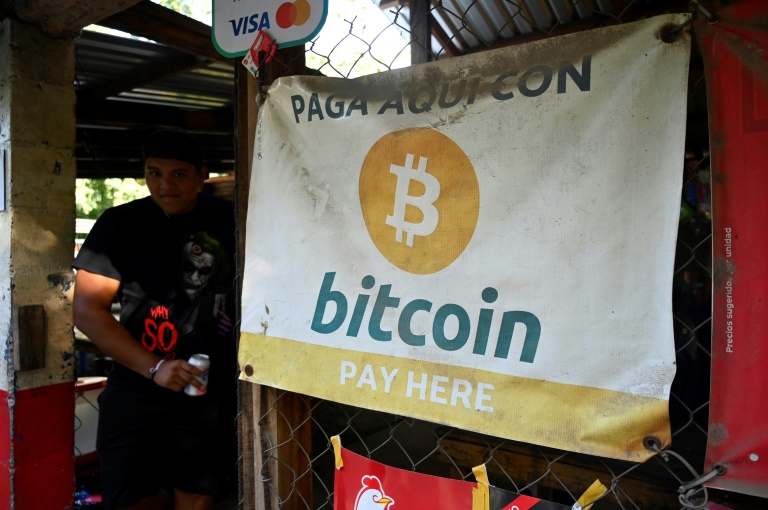
A year ago, El Salvador began accepting Bitcoin as legal tender following a controversial and much criticized decision by President Nayib Bukele.

All seemed rosy for the first few months as citizens enthusiastically embraced the new opportunity, but Bitcoin’s value has plummeted since and some experts say the move has been a failure.

Maria Aguirre, 52, a shopkeeper in the El Zonte seaside resort that has been a major center for Bitcoin use, says things were going well last year as Bitcoin’s value rose from $52,660 at opening on September 7, 2021, to briefly over $68,000 a couple of months later.

“But over the last five months it’s been only falling,” said Aguirre, who continues to accept Bitcoin transactions.

Bitcoin has dipped under $20,000 for most of this September.

In El Zonte, around 60 kilometers southwest of capital San Salvador, Bitcoin was already being used before Bukele’s move, which was designed to encourage a population where only 35 percent of people owned an account at a financial institution in 2021, according to the World Bank.

El Salvador became the first country to accept Bitcoin as legal tender, alongside the US dollar that has been the official currency for two decades.

The government even created the Chivo electronic wallet and granted each user the equivalent of $30.

By January, the application had been downloaded four million times, according to Bukele — an impressive amount in a country of 6.6 million, although with a diaspora of three million living mostly in the United States.

Bukele’s idea was to ensure that remittances, which make up 28 percent of El Salvador’s GDP, be sent by Chivo meaning less money lost in commission to exchange agencies.

However, former central bank president Carlos Acevedo says the body’s records show that “less than two percent of remittances are arriving through digital wallets, which means that this hasn’t been a benefit either.”

University student Carmen Majia, 22, said she used Bitcoin in the beginning “but given how things are going, now I don’t trust it and I uninstalled the application.”

– Volatility –

When Bukele’s plan was launched, Aguirre had already been using Bitcoin for eight months in the Pacific seaside resort that is popular with surfers.

After Bitcoin shot up in value between September and November 2021, Bukele announced a plan to build Bitcoin City — a tax haven for cryptocurrencies and blockchain technology on the Gulf of Fonseca that would be powered by geothermal energy from the Conchagua volcano.

To build it, Bukele was going to issue $1 billion in Bitcoin bonds but those plans were delayed by the volatile cryptocurrency market that saw some less robust currencies crash and Bitcoin take a huge hit.

According to the credit rating company Moody’s, Bukele’s plan has cost El Salvador $375 million.

Taking advantage of the drop in value, Bukele bought 80 Bitcoins at $19,000 each in July, taking El Salvador’s total holdings to 2,381 units of the cryptocurrency, all bought over the last year.

In June he told compatriots to “stop looking at the graph” insisting that Bitcoin is a secure investment that will bounce back up.

“Patience is the key,” he said.

– Little enthusiasm –

But Acevedo insists that the use of Bitcoin “really has not worked” and that “so far it has really been a failed bet.”

But not a total failure “because it could recover and get out of this crypto winter.”

Acevedo says Bitcoin has not produced Bukele’s stated aim of “financial inclusion” and its fall in value has “psychologically influenced people who do not view it with enthusiasm.”

The adoption of Bitcoin has also complicated El Salvador’s attempts to secure a $1.3 billion loan from the International Monetary Fund, which had urged against the move.

Faced with a warning that the country could default over its public debt that has surpassed 80 percent of GDP, Bukele announced in June a plan to buy back bonds due to expire in 2023 and 2025.

He insists the country has the cash to do so.

That reduced the country’s risk from 35 percent to 25 percent but Acevedo says El Salvador will not be able to return to the debt markets until that figure comes down to “at least five percent.”

In El Zonte, Cheetara Hasbún, a hotel employee, still thinks Bitcoin is a “good payment” method and just “needs more time, as was given to the dollar.”

East Timor says China could help fund major pipeline project

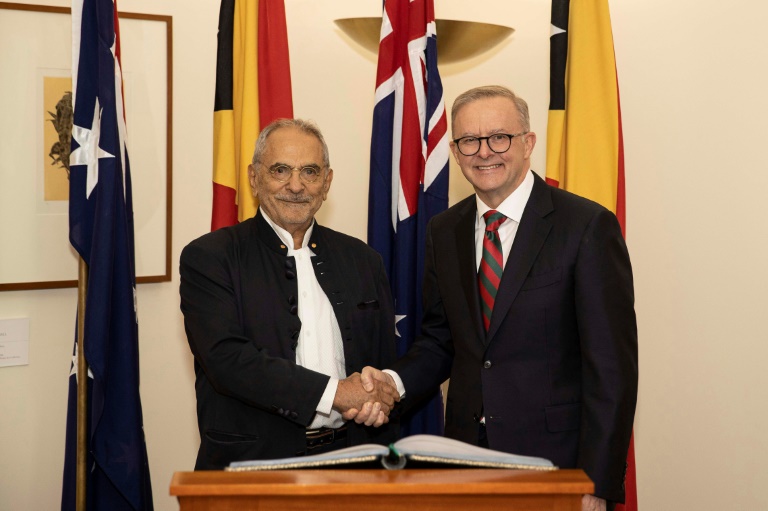
East Timor leader Jose Ramos-Horta on Wednesday said China could help fund a vast fossil fuel project seen as crucial to the nation’s economic future, dismissing Western concerns over Beijing’s growing influence.

Speaking to reporters after a meeting with Australian Prime Minister Anthony Albanese in Canberra, the president and Nobel peace laureate said “of course, China” could be involved in the Greater Sunrise project, which aims to tap trillions of cubic feet of natural gas.

The project, located in waters between East Timor and Australia, has long been touted as a joint venture between the two countries.

But exploration has been stalled for years due to disputes over maritime boundaries and whether the gas should be refined in Australia or East Timor.

Ramos Horta is pushing hard to gain foreign financing and to have LNG facilities built in his country, seeing it as a potential economic game-changer.

He told reporters that a number of Asia-Pacific countries could be involved in the project — including Japan and South Korea — but also mooted Beijing’s involvement, aware it was likely to raise hackles in Canberra.

“Of course China (could be involved). It’s a pipeline, we are not talking about maritime security. It’s just a pipeline. China would just be an investor,” he said.

But policymakers in Canberra are likely to baulk at Chinese involvement in critical infrastructure so close to Australia’s borders.

Australia is already concerned about China’s rapidly expanding regional influence, including in East Timor, which gained independence in 2002 and sits just a few hundred kilometres (miles) off Australia’s northern coast.

China built the country’s parliament, Ramos-Horta’s presidential palace and the foreign ministry.

Revenues from existing fossil fuel projects are soon expected to run dry, and the country’s sovereign wealth fund is rapidly dwindling, leading some to warn of an impending “fiscal cliff.”

Australia’s top diplomat, Penny Wong, recently warned Dili that it faces some “pretty serious economic challenges” and warned against the risks of so-called “debt trap” diplomacy, a term widely used in reference to Chinese investment strategy in countries like Sri Lanka.

“Our debt, our loans, they are in the spirit of wanting East Timor to be more resilient”, she said on a visit to the island nation’s capital. 

“We know that economic resilience can be affected, can be constrained, by unsustainable debt burdens or by lenders who have different objectives.”

Close Bitnami banner
Bitnami