US Business

Irish data watchdog fines Instagram 405 mn euros over children

Ireland’s Data Protection Commission on Monday said it had fined Instagram a record 405 million euros ($402 million) for breaching regulations on the handling of children’s data.

“We adopted our final decision last Friday and it does contain a fine of 405 million euros,” the DPC said in a statement. Full details of the decision will be published next week, it added.

The DPC launched an investigation in late 2020 into concerns about how the image-sharing social media platform handles children’s personal data.

The probe centred on the “appropriateness” of Instagram profile and account settings for children, and the firm’s “responsibility to protect the data protection rights of children as vulnerable persons”.

It was conducted under the General Data Protection Regulation (GDPR) — the EU charter of data rights which came into effect in May 2018.

The GDPR gives data regulators the power to impose stiff fines for breaches.

As Instagram is owned by Meta, which has its European headquarters in Dublin, it falls to the DPC to enforce the regulations.

Last year, it fined WhatsApp, also owned by Meta, a then-record 225 million euros for breaking data protection rules. 

Meta, which also owns Facebook, was in March slapped with a 17-million-euro fine for 12 data breaches.

There was no immediate response from Meta when contacted by AFP.

But a company spokesperson was quoted by Irish state broadcaster RTE as saying the Instagram inquiry “focused on old settings that we updated over a year ago”.

“We’ve since released many new features to help keep teens safe and their information private,” they added.

“Anyone under 18 automatically has their account set to private when they join Instagram, so only people they know can see what they post, and adults can’t message teens who don’t follow them.”

The company disagreed with how the fine was calculated and plans to appeal, they added.

Germany puts two nuclear plants on standby in energy U-turn

Germany said Monday it would keep two nuclear plants on standby beyond the end of the year in a policy U-turn, as the shut-off of Russian gas supplies sends Europe scrambling for energy sources.

Following a new network stress test, two of the three remaining power plants would “remain available until mid-April 2023 in case needed”, Economy Minister Robert Habeck said in a statement.

The move partly delays a nuclear exit planned under former chancellor Angela Merkel.

The plants would be kept in reserve to potentially “make a further contribution to the electricity grid in southern Germany”, where the development of renewable power was lagging the north.

Habeck said such a crisis was still “extremely unlikely” and assured that Germany had a “very high security of supply”.

The Green minister also underlined that Germany was not wavering from its plan to move on from nuclear energy, with all plants being unplugged from the grid at the end of the year. 

“New fuel rods will not be put in and after mid-April 2023 it is also over for the reserve,” Habeck said.

An initial stress test in March had found that the remaining nuclear fleet was not needed to ensure energy security, leading to the conclusion that they could be phased out by year’s end as originally planned. 

But the electricity market has since been upended by Russia’s invasion of Ukraine, with power bills soaring in part because Moscow has slashed energy supplies to Europe.

“War and the climate crisis are having a very concrete impact,” Habeck said, referring to a summer drought that has dried up Germany’s rivers and impeded fuel transport.

– Pipeline cut –

Merkel spectacularly decided to ditch atomic energy in 2011 following the Fukushima nuclear disaster in Japan.

Extending the lifetime of the plants, which account for six percent of the country’s electricity output, has set off a heated debate in Germany, where nuclear power has been a source of controversy stretching back before Merkel’s decision.

The move is especially sensitive for Habeck, whose Green party has its roots in the anti-nuclear movement. 

But Germany has already moved to restart mothballed coal power plants and fill gas storage ahead of the winter to guard against an energy shortfall.

Last week, Russian energy giant Gazprom said it would not restart gas deliveries via the Nord Stream 1 pipeline Saturday as planned after a three-day maintenance, pinning the blame on Western sanctions. 

“Problems with pumping (gas) arose due to sanctions that were imposed against our country,” Kremlin spokesman Dmitry Peskov told reporters Monday.

Germany no longer takes Russian supplies into account in its energy security considerations, said Habeck, saying it was “not a surprise” that Moscow did not restart gas flows via Nord Stream 1.

“The only thing that is reliable from Russia is lies,” he said, adding that “we will have to solve our problems without consideration of (Russian President Vladimir) Putin’s erratic decisions, and that’s what we will do.” 

– Bill squeeze –

Swift government action meant Germany would “get through this winter” with the energy it needed, Chancellor Olaf Scholz said Sunday.

But soaring bills meant “rapid” changes were needed to the electricity market at a European level, he said at the unveiling of a 65-billion-euro ($65-billion) inflation relief package.

Hundreds of demonstrators rallied in the eastern city of Leipzig on Monday evening to protest what they see as the insufficiency of the government’s support measures.

The demonstrations called by the far-left Die Linke party could mark the start of a “hot autumn” of protest in Germany as bill payers feel the squeeze from rising prices.

Earlier Monday, Scholz spoke with French President Emmanuel Macron, who said France was ready to deliver more gas to Germany to allow Berlin to export more electricity.

France, which has long leaned on nuclear power, is itself struggling after a number of its reactors were shut down due to corrosion issues.

Other countries have re-evaluated their stance on nuclear energy in the wake of the Russian invasion, including disaster-struck Japan.

Japanese Prime Minister Fumio Kishida called at the end of August for a push to revive the country’s nuclear power industry, and build new atomic plants.

US judge orders review of material seized at Trump's home

A US judge on Monday granted Donald Trump’s request for the appointment of a “special master” to independently review material seized in an FBI raid on his Florida home, dealing a blow to prosecutors.

Government attorneys had opposed Trump’s request, arguing that the appointment of a special master to screen for privileged material could harm national security, and was also unnecessary as a team had already completed a screening.

The decision could delay the investigation into Trump’s handling of classified materials and is a boost for the former president, who has denounced the August 8 raid as “one of the most egregious assaults on democracy in the history of our country,” and denied all wrongdoing.

Judge Aileen Cannon wrote in her order that “a special master shall be appointed to review the seized property, manage assertions of privilege and make recommendations thereon, and evaluate claims for return of property.”

The ruling — which temporarily blocks the government from reviewing or using materials seized in the raid — made an exception for “intelligence classification and national security assessments.”

The judge gave both sides until Friday to come up with a list of candidates for the role of special master.

The Justice Department “is examining the opinion and will consider appropriate next steps in the ongoing litigation,” spokesman Anthony Coley said in a statement.

Trump is facing mounting legal pressure, with the Justice Department saying top secret documents were “likely concealed” to obstruct an FBI probe into Trump’s potential mishandling of classified materials.

When agents searched Trump’s Mar-a-Lago resort, they found material so sensitive that “even the FBI counterintelligence personnel and DOJ attorneys conducting the review required additional clearances before they were permitted to review certain documents,” a government court filing said.

– ‘Highly classified’ –

The FBI raid came after a review of “highly classified” records that Trump finally surrendered to authorities in January after months of back and forth with the National Archives and Records Administration.

The 15 boxes handed over by Trump were found to contain 184 documents marked as confidential, secret or top secret.

After prompting from the FBI, Trump’s lawyer eventually turned over an additional 38 classified documents — and provide “sworn certification” that they represented the last of the material.

But the FBI went on to uncover “multiple sources of evidence” showing classified documents remained at Mar-a-Lago.

Trump reacted to the judge’s decision Monday by saying on his Truth Social platform: “Now that the FBI and DOJ have been caught in a massive and determinative Election Rigging Scam, are they going to change the results of the 2020 Presidential Election? They should!!!”

Attorney General Merrick Garland said he personally approved the Mar-a-Lago raid, and the decision on whether Trump is charged with a crime ultimately rests with him.

Bill Barr, who held the same post during Trump’s presidency, has said the government appeared justified in raiding Trump’s home, and that he suspected authorities have “good” evidence of obstruction.

In addition to the documents probe, Trump faces investigations in New York into his business practices, as well as legal scrutiny over his efforts to overturn results of the 2020 election, and for the January 6, 2021, attack on the US Capitol by his supporters. 

Trump was impeached for a historic second time by the House of Representatives after the Capitol riot — he was charged with inciting an insurrection — but was acquitted by the Senate.

Germany puts two nuclear plants on standby in energy U-turn

Germany said Monday it would keep two nuclear plants on standby beyond the end of the year in a policy U-turn, as the shut-off of Russian gas supplies sends Europe scrambling for energy sources.

Following a new network stress test, two of the three remaining power plants would “remain available until mid-April 2023 in case needed”, Economy Minister Robert Habeck said in a statement.

The move partly delays a nuclear exit planned under former chancellor Angela Merkel.

The plants would be kept in reserve to potentially “make a further contribution to the electricity grid in southern Germany”, where the development of renewable power was lagging the north.

Habeck said such a crisis was still “extremely unlikely” and assured that Germany had a “very high security of supply”.

The Green minister also underlined that Germany was not wavering from its plan to move on from nuclear energy, with all plants being unplugged from the grid at the end of the year. 

“New fuel rods will not be put in and after mid-April 2023 it is also over for the reserve,” Habeck said.

An initial stress test in March had found that the remaining nuclear fleet was not needed to ensure energy security, leading to the conclusion that they could be phased out by year’s end as originally planned. 

But the electricity market has since been upended by Russia’s invasion of Ukraine, with power bills soaring in part because Moscow has slashed energy supplies to Europe.

“War and the climate crisis are having a very concrete impact,” Habeck said, referring to a summer drought that has dried up Germany’s rivers and impeded fuel transport.

– Pipeline cut –

Merkel spectacularly decided to ditch atomic energy in 2011 following the Fukushima nuclear disaster in Japan.

Extending the lifetime of the plants, which account for six percent of the country’s electricity output, has set off a heated debate in Germany, where nuclear power has been a source of controversy stretching back before Merkel’s decision.

The move is especially sensitive for Habeck, whose Green party has its roots in the anti-nuclear movement. 

But Germany has already moved to restart mothballed coal power plants and fill gas storage ahead of the winter to guard against an energy shortfall.

Last week, Russian energy giant Gazprom said it would not restart gas deliveries via the Nord Stream 1 pipeline Saturday as planned after a three-day maintenance, pinning the blame on Western sanctions. 

“Problems with pumping (gas) arose due to sanctions that were imposed against our country,” Kremlin spokesman Dmitry Peskov told reporters Monday.

Germany no longer takes Russian supplies into account in its energy security considerations, said Habeck, saying it was “not a surprise” that Moscow did not restart gas flows via Nord Stream 1.

“The only thing that is reliable from Russia is lies,” he said, adding that “we will have to solve our problems without consideration of (Russian President Vladimir) Putin’s erratic decisions, and that’s what we will do.” 

– Bill squeeze –

Swift government action meant Germany would “get through this winter” with the energy it needed, Chancellor Olaf Scholz said Sunday.

But soaring bills meant “rapid” changes were needed to the electricity market at a European level, he said at the unveiling of a 65-billion-euro ($65-billion) inflation relief package.

Hundreds of demonstrators rallied in the eastern city of Leipzig on Monday evening to protest what they see as the insufficiency of the government’s support measures.

The demonstrations called by the far-left Die Linke party could mark the start of a “hot autumn” of protest in Germany as bill payers feel the squeeze from rising prices.

Earlier Monday, Scholz spoke with French President Emmanuel Macron, who said France was ready to deliver more gas to Germany to allow Berlin to export more electricity.

France, which has long leaned on nuclear power, is itself struggling after a number of its reactors were shut down due to corrosion issues.

Other countries have re-evaluated their stance on nuclear energy in the wake of the Russian invasion, including disaster-struck Japan.

Japanese Prime Minister Fumio Kishida called at the end of August for a push to revive the country’s nuclear power industry, and build new atomic plants.

'Top Gun' soars back to surprise lead in N.American theaters

In a reflection of Hollywood’s deep late-summer slump, “Top Gun: Maverick,” first released 15 weeks ago, climbed back to the top of the North American box office this weekend despite a relatively slim four-day take of $7.9 million.

The Paramount action thriller, starring a graying but still flight-ready Tom Cruise, has now soared to a domestic total of $701 million and $740 million internationally, industry watcher Exhibitor Relations reported Monday.

That gravity-defying success came amid a generally abysmal patch for Hollywood films, with few major new releases. A lone bright spot was the record 8.1 million US moviegoers who took advantage of $3 tickets on Saturday’s National Cinema Day.

Second place on the long Labor Day weekend — celebrated in both the United States and Canada — went to last weekend’s No. 2: Sony’s action thriller “Bullet Train,” at $7.3 million. Brad Pitt stars.

Seeking to fill the late-summer vacuum, Sony re-released superhero film “Spider-Man: No Way Home,” hoping that 11 minutes of added footage would draw viewers. Nine months after its original release, the Tom Holland vehicle placed a surprising third, earning $6.6 million. 

In fourth place, up two spots from last weekend, was Warner Bros.’ family-friendly animation “DC League of Super-Pets,” at $6.4 million.

And in fifth, slipping from last weekend’s No. 1 spot, was Sony’s horror flick “The Invitation,” at $6 million.

Hollywood’s problems stem partly from Covid-related scheduling chaos, said analyst David A. Gross of Franchise Entertainment Research.

“Moviegoers have shown that they are willing and able, but without big, regular franchise releases to anchor the schedule, the box office is going to drift lower, before climbing back in the fourth quarter.”

He noted that 2022 will finish with 32 franchise films, down from 58 in 2019. Forty-two are set for next year.

Rounding out the weekend’s top 10 were:

“Beast” ($4.7 million)

“Minions: The Rise of Gru” ($4.2 million)

“Jaws” (re-release): ($3.1 million)

“Thor: Love and Thunder” ($3.1 million)

“Dragon Ball Super: Super Hero” ($2.8 million)

OPEC+ agrees oil output cut to prop up prices

The OPEC+ oil cartel agreed Monday to cut production for the first time in more than a year as it seeks to lift prices that have tumbled due to recession fears.

The move could irk the United States as it has pressed the group to increase output in order to bring down energy prices that have fuelled decades-high inflation.

OPEC+, a 23-nation coalition led by Saudi Arabia and Russia, had agreed to huge cuts in output in 2020 when the Covid pandemic sent oil prices crashing, but it began to increase production modestly again last year as the market improved.

Oil prices soared to almost $140 a barrel in March after Russia invaded Ukraine.

But they have since receded below $100 per barrel amid recession fears, Covid lockdowns in major consumer China and Iran nuclear talks that could bring Iranian crude back into the market.

While analysts had expected another modest increase at Monday’s ministerial meeting, OPEC+ said in a statement it decided to reduce output by 100,000 barrels per day in October, returning to the production level of August.

The group also left the door open to holding talks prior to its next scheduled meeting on October 5 “to address market developments, if necessary”.

Saudi Energy Minister Prince Abdulaziz bin Salman told Bloomberg in an interview after the decision that it demonstrated OPEC+ was ready to adjust production in both directions to achieve its objectives.

“The simple tweak shows that we will be attentive, preemptive and pro-active in terms of supporting the stability and the efficient functioning of the market,” he said.

Bjarne Schieldrop, chief commodities analyst at SEB research group, told AFP the decision sent a clear message: “OPEC+ will not allow the oil price to slide. Further cuts will be initiated if necessary.” 

While analysts said the cut was mostly symbolic, oil prices rose by more than three percent following the announcement, with the international benchmark, Brent, exceeding $96 per barrel while the US contract, WTI, reached almost $90.

At its last meeting, OPEC+ agreed to a small rise of 100,000 barrels per day for September after US President Joe Biden travelled to Saudi Arabia to plead for a production bump — although it was six times lower than its previous decisions. 

But after oil prices fell back on growing recession worries, the cartel began to raise the possibility of reversing course.

The United States said after the OPEC+ decision that oil production must be kept up to bolster global economic growth.

President Joe Biden “has been clear that energy supply should meet demand to support economic growth and lower prices for American consumers and consumers around the world”, White House Press Secretary Karine Jean-Pierre said in a statement.

Craig Erlam, analyst at OANDA trading platform, said the cut was “also a blow to President Biden as the hike last month was viewed as a token gesture after his visit.”

“Now it’s clear how valuable that actually was, or wasn’t as it turns out. The political damage it caused was a waste and if anything, it looks worse than if nothing had changed in the first place,” Erlam said.

– Iran talks –

Caroline Bain, commodities expert at Capital Economics, said the cut was not a total surprise and “little more than symbolic” as OPEC+ has struggled to meet its quotas due to lacklustre production in some of its member countries.

“The bigger picture is that OPEC+ is producing well below its output target and this looks unlikely to change given that Angola and Nigeria, in particular, appear unable to return to pre-pandemic levels of production,” Bain said.

In efforts to curb rising oil prices, the United States and its allies have released crude from their emergency reserves.

And in a bid to curb Russia’s war funding, the G7 group of industrialised powers agreed Friday to move “urgently” towards capping the price of Russian oil. 

Moscow has warned it will no longer sell oil to countries that adopt the unprecedented mechanism and called it a destabilising force in the market.

Another geopolitical issue is clouding the outlook.

Negotiations aimed at reviving a landmark nuclear deal between Tehran and world powers could lead to an easing of oil sanctions in return for curbs to the atomic activities.

However, Washington said Thursday that Tehran’s latest response to a European Union draft was “unfortunately… not constructive”.

The EU’s foreign policy chief Josep Borrell, who is shepherding attempts to save the suspended Iran nuclear deal, said Monday that recent exchanges left him “less confident” about reaching an agreement.

burs-rl/raz

US judge orders review of material seized at Trump's home

A US judge on Monday granted Donald Trump’s request for the appointment of a “special master” to independently review material seized in an FBI raid on his Florida home, dealing a blow to prosecutors.

Government attorneys had opposed Trump’s request, arguing that the appointment of a special master to screen for privileged material could harm national security, and was also unnecessary as a team had already completed a screening.

The decision could delay the investigation into Trump’s handling of classified materials and is a boost for the former president, who has denounced the August 8 raid as “one of the most egregious assaults on democracy in the history of our country,” and denied all wrongdoing.

Judge Aileen Cannon wrote in her order that “a special master shall be appointed to review the seized property, manage assertions of privilege and make recommendations thereon, and evaluate claims for return of property.”

The ruling — which temporarily blocks the government from reviewing or using materials seized in the raid — made an exception for “intelligence classification and national security assessments.”

The judge gave both sides until Friday to come up with a list of candidates for the role of special master.

Trump is facing mounting legal pressure, with the Department of Justice saying top secret documents were “likely concealed” to obstruct an FBI probe into Trump’s potential mishandling of classified materials.

When agents searched Trump’s Mar-a-Lago resort, they found material so sensitive that “even the FBI counterintelligence personnel and DOJ attorneys conducting the review required additional clearances before they were permitted to review certain documents,” a government court filing said.

– ‘Highly classified’ –

The FBI raid came after a review of “highly classified” records that Trump finally surrendered to authorities in January after months of back and forth with the National Archives and Records Administration.

The 15 boxes handed over by Trump were found to contain 184 documents marked as confidential, secret or top secret.

After prompting from the FBI, Trump’s lawyer eventually turned over an additional 38 classified documents — and provide “sworn certification” that they represented the last of the material.

But the FBI went on to uncover “multiple sources of evidence” showing classified documents remained at Mar-a-Lago.

Attorney General Merrick Garland said he personally approved the Mar-a-Lago raid, and the decision on whether Trump is charged with a crime ultimately rests with him.

Bill Barr, who held the same post during Trump’s presidency, has said the government appeared justified in raiding Trump’s home, and that he suspected authorities have “good” evidence of obstruction.

In addition to the documents probe, Trump faces investigations in New York into his business practices, as well as legal scrutiny over his efforts to overturn results of the 2020 election, and for the January 6, 2021 attack on the US Capitol by his supporters. 

Trump was impeached for a historic second time by the House of Representatives after the Capitol riot — he was charged with inciting an insurrection — but was acquitted by the Senate.

Eurozone stocks, euro tumble as Russia fuels energy crisis

Eurozone stocks tumbled Monday and the euro hit a new 20-year dollar low on energy crisis fears, after Russia said it would not restart gas flows to Germany and effectively most of the continent.

Natural gas prices spiked almost a third, while oil added to strong gains as OPEC and its Russia-led allies decided at a meeting Monday to lower crude output in a bid to lift prices.

Europe’s fast-moving gas crisis sent Frankfurt equities slumping more than three percent before trimming losses, while Paris shed two percent at one stage.

The gas crisis also hit the pound, which hit a post-pandemic low of $1.1444. It pulled back up to above $1.15 after Liz Truss was confirmed as the successor to Britain’s Prime Minister Boris Johnson. London’s blue-chip FTSE-100 index eked out a gain.

– ‘Weaponization of energy’ –

“Russia’s ongoing weaponization of energy supplies continues to increase downside risks for European economies and the euro,” said Lee Hardman, currency analyst at financial services group MUFG. 

The euro sank Monday to $0.9878, its lowest since December 2002, despite expectations the European Central Bank will hike interest rates again Thursday to combat soaring inflation.

The shared eurozone unit has collapsed by about 13 percent against the dollar since the start of the year, hit also by the US Federal Reserve’s more aggressive monetary tightening.

State gas giant Gazprom announced late Friday the key Nord Stream pipeline would remain shut indefinitely, blaming leaks.

Gazprom’s announcement came the same day as the G7 nations said they would work to quickly implement a price cap on Russian oil exports, a move that would starve the Kremlin of critical revenue for its war on Ukraine.

Resumption of deliveries via the pipeline, which runs from near Saint Petersburg to Germany under the Baltic Sea, had been due to resume on Saturday after what Gazprom had described as three days of maintenance work.

– ‘Grim shadow before winter’ –

The news intensified an energy crisis caused by Europe’s sanctions on Moscow for its invasion of Ukraine in February.

Investors are fearful of an energy supply crunch during the peak-demand northern hemisphere winter.

That could potentially lead to a painful recession.

“Russia’s decision to turn off Europe’s gas hangs over the continent like a grim shadow ahead of winter,” said AJ Bell investment director Russ Mould.

But Michael Hewson at CMC Markets said the surge in gas prices on Monday was “relatively modest in nature, probably because to some extent markets had expected this card to get played at some point, just not as soon as it has.”

At the same time, governments worldwide are grappling with the impact of rocketing domestic energy costs.

Germany on Sunday unveiled a new 65-billion-euro package to help households cope with soaring prices, and eyed windfall profits from energy companies to help fund the move.

That took Berlin’s total relief to almost 100 billion euros since the start of the Ukraine war.

Elsewhere on Monday, Asian bourses experienced mixed trade as last week’s upbeat US jobs report partly offset fears over Europe’s outlook — and China’s new Covid lockdowns.

US markets were closed Monday for a public holiday.

– Key figures at around 1530 GMT –

London – FTSE 100: UP less than 0.1 percent at 7,287.43 points (close)

Frankfurt – DAX: DOWN 2.2 percent at 12,760.78 (close)

Paris – CAC 40: DOWN 1.2 percent at 6,093.22 (close) 

EURO STOXX 50: DOWN 1.5 percent at 3,490.01

Tokyo – Nikkei 225: DOWN 0.1 percent at 27,619.61 (close)

Hong Kong – Hang Seng Index: DOWN 1.2 percent at 19,225.70 (close)

Shanghai – Composite: UP 0.4 percent at 3,199.91 (close)

New York – Dow: Closed Monday for public holiday

Euro/dollar: DOWN at $0.9921 from $0.9954 on Friday

Dollar/yen: UP at 140.53 yen from 140.20 yen

Pound/dollar: DOWN at $1.1507 from $1.1509

Euro/pound: DOWN at 86.22 pence from 86.48 pence

West Texas Intermediate: UP 3.0 percent at $89.44 per barrel

Brent North Sea crude: UP 3.1 percent at $95.93 per barrel

burs-rl/cdw

UN warns famine 'at the door' in Somalia

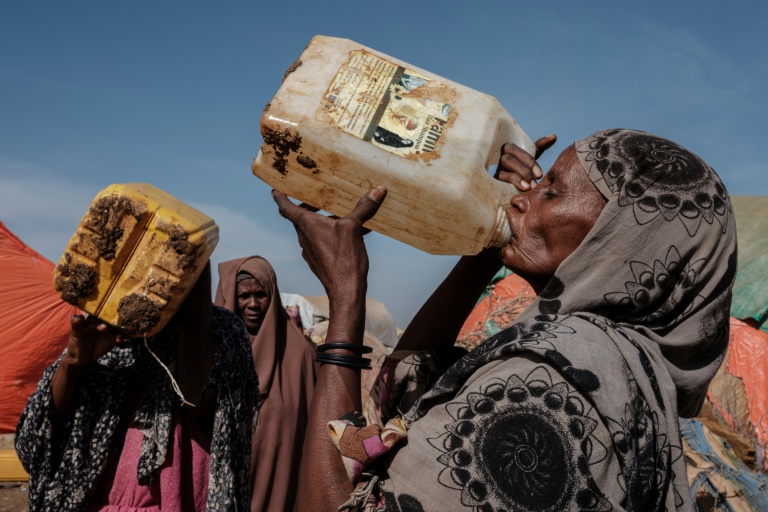
The United Nations warned Monday that Somalia was on the brink of famine for the second time in just over a decade, and that time was running out to save lives in the drought-ravaged country. 

“Famine is at the door and we are receiving a final warning,” UN humanitarian chief Martin Griffiths told a press conference in the Somali capital Mogadishu. 

“The unprecedented failure of four consecutive rainy seasons, decades of conflict, mass displacement, severe economic issues are pushing many people to… the brink of famine.”

Millions of people are at risk of starvation in Somalia and its neighbours in the Horn of Africa including Ethiopia and Kenya which are in the grip of the worst drought in four decades after four failed rainy seasons wiped out livestock and crops.

A food and nutrition report has “concrete indications” that famine will strike Baidoa and Burhakaba in the Bay region of south-central Somalia between October and December, said the head of the UN Office for the Coordination of Humanitarian Affairs (OCHA), who began a visit to the country on Thursday.

“I’ve been shocked to my core these past few days by the level of pain and suffering we see so many Somalis enduring,” he added. 

“We are in the last moment of the 11th hour to save lives.”

Humanitarian agencies have been ringing alarm bells for months and say the situation in the Horn of Africa is likely to deteriorate with a likely fifth failed rainy season in the offing.

– ‘Worst fears now a reality’ –

Griffiths said the situation was worse than during Somalia’s last famine in 2011 when 260,000 people died, more than half of them children under the age of six. 

The UN’s World Food Programme (WFP) last month said the number of people at risk of starvation across the Horn had increased to 22 million.

“Our worst fears for Somalia are now a reality: Famine is imminent if funds do not arrive immediately,” WFP executive director David Beasley said on Twitter.

“The world MUST act now – this is a global call to action.”

In Somalia alone, the number of people facing crisis hunger levels is 7.8 million, or about half the population, while around a million have fled their homes on a desperate quest for food and water, UN agencies say. 

Griffiths described scenes of heart-rending suffering during a visit to Baidoa, describing it as the epicentre of the crisis where he saw “children so malnourished they could barely speak” or cry.

He said 1.5 million children across the country were at risk of acute malnutrition by October if nothing changed. 

Conflict-wracked Somalia is considered one of the most vulnerable to climate change but is particularly ill-equipped to cope with the crisis.

A deadly insurgency by the radical Islamist Al-Shabaab group for more than a decade and a half against the fragile federal government is limiting humanitarian access to many areas.

A long-running political crisis also diverted attention away from the drought, but new President Hassan Sheikh Mohamud used his inauguration speech in June to appeal for international help to stave off disaster.

In recent years, increasingly extreme droughts and floods have added to the devastation caused by a locust invasion and the Covid-19 pandemic.

The UN’s World Meteorological Organization (WMO) has said the Horn was likely facing a fifth straight failed rainy season over the months of October to December.

– ‘Sleepwalking’ to catastrophe – 


At the start of this year, the WFP had put the number of people facing hunger across the Horn at 13 million, and appealed for donors to open their wallets.

Funds were initially slow in coming, with Russia’s invasion of Ukraine among other crises drawing attention from the disaster in the Horn, humanitarian workers said.

The war in Ukraine has also sent global food and fuel prices soaring, making aid delivery more expensive.

In June, British charity Save the Children had issued an alert that the international community was “sleepwalking towards another catastrophic famine” in Somalia.

OCHA has said the March-May 2022 rainy season was the driest on record in the last 70 years, and 2020-2022 had surpassed “the horrific droughts in both 2010-2011 and 2016-2017 in duration and severity”.

“An estimated 2.3 million girls and boys are at imminent risk of violence, exploitation, abuse, neglect, and death from severe acute malnutrition as result of food and nutrition crisis across Somalia,” it said in August.

In 2017, more than six million people in Somalia, more than half of them children, needed aid because of a prolonged drought across East Africa.

But early humanitarian action averted famine that year.

OPEC+ agrees oil output cut to prop up prices

The OPEC+ oil cartel agreed Monday to cut production for the first time in more than a year as it seeks to lift prices that have tumbled due to recession fears.

The move could irk the United States as it has pressed the group to increase output in order to bring down energy prices that have fuelled decades-high inflation.

OPEC+, a 23-nation coalition led by Saudi Arabia and Russia, had agreed to huge cuts in output in 2020 when the Covid pandemic sent oil prices crashing, but it began to increase production modestly again last year as the market improved.

Oil prices soared to almost $140 a barrel in March after Russia invaded Ukraine.

But they have since receded below $100 per barrel amid recession fears, Covid lockdowns in major consumer China and Iran nuclear talks that could bring Iranian crude back into the market.

While analysts had expected another modest increase at Monday’s ministerial meeting, OPEC+ said in a statement that it decided to reduce output by 100,000 barrels per day in October, returning to the production level of August.

The group also left the door open to holding talks prior to its next scheduled meeting on October 5 “to address market developments, if necessary”.

“First and foremost it is a clear message from the group: OPEC+ will not allow the oil price to slide. Further cuts will be initiated if necessary,” Bjarne Schieldrop, chief commodities analyst at SEB research group, told AFP.

While analysts said the cut was mostly symbolic, oil prices rose by more than three percent following the announcement, with the international benchmark, Brent, exceeding $96 per barrel while the US contract, WTI, reached almost $90.

At its last meeting, OPEC+ agreed to a small rise of 100,000 barrels per day for September after US President Joe Biden travelled to Saudi Arabia to plead for a production bump — although it was six times lower than its previous decisions. 

Energy Minister Abdulaziz bin Salman last month had appeared to open the door to the idea of cutting output, which has since received the support of several member states and the cartel’s joint technical committee.

He said “volatility and thin liquidity send erroneous signals to markets at times when clarity is most needed”.

Craig Erlam, analyst at OANDA trading platform, said the cut was “also a blow to President Biden as the hike last month was viewed as a token gesture after his visit.”

“Now it’s clear how valuable that actually was, or wasn’t as it turns out. The political damage it caused was a waste and if anything, it looks worse than if nothing had changed in the first place,” Erlam said.

– Iran talks –

Caroline Bain, commodities expert at Capital Economics, said the cut was not a total surprise and “little more than symbolic” as OPEC+ has struggled to meet its quotas due to lacklustre production in some of its member countries.

“The bigger picture is that OPEC+ is producing well below its output target and this looks unlikely to change given that Angola and Nigeria, in particular, appear unable to return to pre-pandemic levels of production,” Bain said.

In efforts to curb rising oil prices, the United States and its allies have released crude from their emergency reserves.

And in a bid to curb Russia’s war funding, the G7 group of industrialised powers agreed Friday to move “urgently” towards capping the price of Russian oil. 

Moscow has warned that it will no longer sell oil to countries that adopt the unprecedented mechanism.

Another geopolitical issue is clouding the outlook.

Negotiations aimed at reviving a landmark nuclear deal between Tehran and world powers could lead to an easing of oil sanctions in return for curbs to the atomic activities.

However, Washington said Thursday that Tehran’s latest response to a European Union draft was “unfortunately… not constructive”. 

Close Bitnami banner
Bitnami