US Business

Diamond magnate's appeal of Swiss bribery verdict opens

French-Israeli diamond magnate Beny Steinmetz will be back in court in Switzerland on Monday to appeal against a corruption verdict linked to mining rights in Guinea.

The 66-year-old businessman was convicted in January 2021 of setting up a complex financial web to pay bribes to ensure his company could obtain permits in an area estimated to contain the world’s biggest untapped deposits of iron ore.

He was sentenced by a Geneva court to five years in prison and also ordered to pay 50 million Swiss francs ($52 million) in compensation.

Steinmetz, who maintained his innocence throughout that trial, has changed his legal team for the appeal.

“We expect that the tribunal recognises that Beny Steinmetz did not bribe anyone,” his new lawyer Daniel Kinzer told AFP in an email. 

“I am confident the appeals court can be convinced,” he said, adding a deeper look at the case revealed “a totally different picture than the one painted by the first verdict”.

Far from being corrupt, Beny Steinmetz Group Resources (BSGR) had legitimately obtained the mining rights in question, and had striven in difficult and complex circumstances to set up an operation that would have benefited Guinea’s national interests, his team said.

– ‘Pact of corruption’ –

Swiss prosecutors however accuse Steinmetz and two partners of bribing a wife of the then Guinean president Lansana Conte and others in order to win mining rights in the southeastern Simandou region.

The prosecutors said Steinmetz obtained the rights shortly before Conte died in 2008 after about $10 million was paid in bribes over a number of years.

Conte’s military dictatorship ordered global mining giant Rio Tinto to relinquish two concessions to BSGR for around $170 million in 2008.

Just 18 months later, BSGR sold 51 percent of its stake in the concession to Brazilian mining giant Vale for $2.5 billion.

But in 2013, Guinea’s first democratically-elected president Alpha Conde launched a review of permits allotted under Conte and later stripped the VBG consortium formed by BSGR and Vale of its permit.

To secure the initial deal, prosecutors claimed Steinmetz and representatives in Guinea entered a “pact of corruption” with Conte and his fourth wife Mamadie Toure.

Toure, who has admitted to having received payments, has protected status in the United States as a state witness. 

– ‘No crystal ball’ –

She and several other key witnesses in the case failed to appear in the first trial, and Kinzer said he had “no crystal ball as to what they will do for the appeals trial”.

Steinmetz, who lived in Geneva during the years when the bribes were allegedly paid, continues to insist the bribery allegations are “totally false”, according to a document released by his team.

It stresses that Rio Tinto had lost the rights to half of its concessions in Simandou for failing to develop them, and BSGR later legitimately bid for and obtained exploration rights.

“The mining rights were withdrawn from a competitor because it was hoarding them and then awarded to BSGR on the basis of a solid and convincing business case with no need to bribe a public official,” Kinzer said.

Steinmetz, who was granted a legal free-passage guarantee in order to participate in the first trial, left Switzerland without serving his sentence.

He is back in Geneva to argue his case after receiving another free-passage.

The appeal hearings are due to last through September 7. The verdict will come at a later date.

'They made me feel like nothing': Britney Spears addresses conservatorship

Britney Spears on Sunday released a lengthy audio message concerning the controversial guardianship that kept her primarily under her father’s control for more than 13 years.

A Los Angeles judge in November 2021 dissolved the conservatorship long overseen by Spears’ father — an arrangement the singer said had prevented her from having a contraceptive IUD removed despite her desire for more kids.

The audio message was originally tweeted by Spears without comment but the link was then deleted. The 22 minutes of audio of Spears’ voice remain available online, however.

“I woke up this morning and I realized there’s a lot going on in my head that I haven’t shared with anyone,” Spears says in the raw, emotional recording.

She then details the conservatorship, echoing what she told a California court in a bombshell hearing last summer.

The now 40-year-old describes being forced to work and tour, and barred from seeing friends or driving her own car.

Spears says that her phone was tapped, and she felt unsafe asking for help.

“They made me feel like nothing, and I went along with it,” Spears says, describing being fat-shamed.

“It was demoralizing,” Spears says. 

“You also have to understand, it was like 15 years of touring and doing shows. And I’m 30 years old, living under my dad’s rules. And while all of this is going on, my mom’s witnessing this, my brother, my friends — they all go along with it.”

Spears rocketed to fame in her teens on hits like “…Baby One More Time,” becoming one of the world’s reigning pop stars.

But she suffered a highly publicized 2007 breakdown, which included attacking a paparazzo’s car at a gas station.

The conservatorship began in 2008. It didn’t formally end until November 2021, after the pop phenom’s father Jamie Spears was removed from his position in charge of her finances and estate at a hearing in September.

Since gaining her freedom, Spears has married her boyfriend Sam Asghari.

On Friday she released her first new music in six years, a duet with Elton John called “Hold Me Closer,” a dance-inflected take on John’s ballad “Tiny Dancer.”

Japanese bath houses find new ways to stay afloat

Just before it opens each afternoon, elderly residents gather outside one of Tokyo’s last remaining old-style bath houses carrying flannels, soap and shampoo for their regular soak.

With its communal naked tubs, bright mural of Mount Fuji and sliding wooden entrance under a pointed roof, Inariyu is a classic example of a Japanese public bath, or sento.

Once ubiquitous in crowded urban areas, sentos are now closing quickly as more people take baths at home and owners struggle with faltering machinery, high gas prices and a lack of successors, tempting them to sell their valuable land.

Nationwide, the number of bath houses has plunged to around 1,800 from a peak of nearly 18,000 in the late 1960s.

But some such as Inariyu have been given a new lease on life through renovations, while others are reinventing themselves as trendy hangouts or using data analysis to boost business.

One person pushing to save neighbourhood baths is Yasuko Okuno, who discovered them as a way to unwind after working late.

“Day after day, my mind was tired. Even when I went home, I couldn’t forget about work,” said the 36-year-old writer for the Tokyo Sento Association.

“Then I went to a sento for the first time in a while, and it felt like a weight had lifted. There was a large bath, and the regulars greeted me kindly,” she told AFP.

Over time, “it began to feel like a home from home.”

Japan has never imposed a strict Covid-19 lockdown, and places such as gyms and sentos remained open even when many offices switched to home working and restaurants shortened opening hours.

Masks are commonly worn on trains and in other public places, but there is no requirement to wear them in sentos, although social distancing and quiet bathing are encouraged.

For many elderly people, it is a “daily routine” that they did not want to stop during the pandemic, and some feel safer taking a bath with others around in case they fall, Yasuko said.

– ‘Sense of urgency’ –

Bathhouse closures can erode community ties, said Sam Holden, whose organisation Sento & Neighborhood used a grant of around $200,000 from the World Monuments Fund to renovate Inariyu.

The group strived to keep the cosy, welcoming atmosphere of the bathhouse — built in 1930 in a low-rise area of northern Tokyo where narrow walkways snake between homes.

Inariyu has customers of all ages, including “a lot of elderly people, many of whom might live alone and be prone to isolation”, said Holden, a 32-year-old American who has lived in the capital for nearly a decade.

“My colleagues and I had a sense of urgency in wanting to preserve some of these historic structures before they were redeveloped into apartment complexes and other things.”

Bathers pay 500 yen ($3.70) to enter the men’s or women’s bath, a fee set by the Tokyo government.

Leaving their shoes in a small locker, they strip off in the changing room and take a shower before climbing into the tubs for a relaxing soak.

Unlike Japan’s hot springs, known as onsen, the water in sentos is usually heated with gas.

Shunji Tsuchimoto, who runs Inariyu with his wife, told AFP that the bathhouse is paying 50 percent more for energy than it did last year.

But he hopes that holding events in the renovated buildings will raise revenue by drawing younger customers. 

“I want them to know this sento culture,” he said.

– ‘Trendy and modern’ –

One sento that has managed to draw a youthful clientele is Koganeyu in eastern Tokyo, which reopened in 2020 after a full makeover.

On a recent Saturday, the bath house was packed with young customers drinking craft beer and listening to vinyl records.

Tech worker Kohei Ueda, 25, travelled an hour to use Koganeyu’s sauna with a friend.

“I do have the image of sentos being where grandpas and grandmas gather,” he said.

“But a sento like this that’s more trendy and modern is not like that… I feel more comfortable coming here.”

Kom-pal, another sento, may not have hipster appeal, but 36-year-old owner Fumitaka Kadoya has managed to increase footfall using data-crunching skills he acquired in his previous job as a technician for optical equipment maker Olympus.

Kadoya’s family has run the sento since the 1950s and when he took over three years ago, he set up a database to track information about customers and the timing of their visits.

The data has allowed him to make targeted business decisions, such as hiring female staff to encourage more women to visit and opening on Sunday mornings to ease crowds.

“Sentos have always been a part of Japanese culture,” Kadoya told AFP, and nowadays, leaving everything in a locker while you soak can be a kind of “digital detox”.

“That’s exactly what I think young people need these days.”

Bad Bunny, Taylor Swift lead MTV Video Music Awards

Bad Bunny, the Puerto Rican Latin trap and reggaeton artist who’s among the world’s biggest stars, scored MTV’s artist of the year award Sunday at the annual Video Music Awards.

But the performer was conspicuously absent from the show: he was busy with his own blockbuster tour, playing the second night of a sold out concert at Yankee Stadium that over the weekend drew some 100,000 fans.

Bad Bunny, wearing a satin pink suit and white sunglasses, accepted the award via video and also delivered a seismic performance of his smash “Titi Me Pregunto” from the baseball stadium in New York, where the song has soundtracked the streets for months.

“Thank you so much, New York,” the 28-year-old said in Spanish to resounding applause.

“From the beginning I always believed that I could be great, that I could be one of the biggest stars in the world, without changing my culture, my language,” he said. “I’m Benito Antonio Martinez from Puerto Rico — for the whole world.”

In a sure sign that pandemic-stymied touring was back in full swing, another of the year’s biggest stars, Harry Styles, also couldn’t make it to the VMAs — which aired from New Jersey’s Prudential Center — due to his own show at Madison Square Garden.

The artist who dropped “Harry’s House” this year also accepted his award for the year’s best album via video, before heading back to his own global concert run.

– Swift album on the way –

Taylor Swift was also among the night’s big winners, turning heads on the red carpet in a dress dripping with crystals before winning the night’s top prize of music video of the year for her 10-minute-long film “All Too Well.” 

“I’m so proud of what we made,” said the 32-year-old, who has been making good on her vow to re-record her first six albums so she can control the rights to them.

“We wouldn’t have been able to make this short film if it weren’t for you, the fans,” Swift said onstage. “Because I wouldn’t be able to re-record my albums if it weren’t for you. You emboldened me to do that.”

She then gave fans a gift in return, announcing that her new album will come out October 21.

Shortly after the broadcast’s end, the megastar revealed the new project’s name.

“Midnights, the stories of 13 sleepless nights scattered throughout my life, will be out October 21. Meet me at midnight,” she wrote on social media.

Hip hop superstar Nicki Minaj reigned over the evening as the 2022 recipient of the prestigious Video Vanguard Award.

Wearing her signature pink wig, the hip-hop icon from Queens delivered a medley of her hits including “Super Bass” and her most recent single “Super Freaky Girl.”

Brazil’s Anitta also turned heads with a booty-popping performance before winning the award for best Latin video for “Envolver.”

“I was born and raised in the ghetto of Brazil, and for whoever was born there, we would never think this was possible,” she said when accepting the trophy.

– Johnny Depp appears –

Iconic stoner comedy duo Cheech and Chong awarded the Red Hot Chili Peppers with the Global Icon Award, before the California rockers performed and also paid tribute to Taylor Hawkins, the late Foo Fighters drummer.

Eminem and Snoop Dogg opened their performance sitting on a couch as Snoop smoked a giant — albeit fake — blunt, before the pair headed to the metaverse for a trippy, animated performance of their latest collaboration “From the D 2 the LBC.”

Marshmello and Khalid performed “Numb” with neon, disorienting visuals that created a brief but heady rave effect, while South Korea’s Blackpink gave their first show at a US awards night ever.

Lizzo also performed before scoring the Video For Good award — which honors videos with social or political messages — for her song “About Damn Time.”

Wearing a cone-bra corseted dress that recalled Madonna, the superstar thanked fans for voting for her to receive the award before nodding to US politics.

“Vote to change some of these laws that are oppressing us,” the star urged.

And at the awards show that’s historically far better known for its antics than actual prizes, Johnny Depp — fresh off his controversial defamation trial against his ex-partner Amber Heard — appeared as the MTV Moonman, his head digitally superimposed on the flying astronaut.

“You know what? I needed the work,” said the 59-year-old actor.

Ancient Iranian rug tradition gets makeover as sales sink

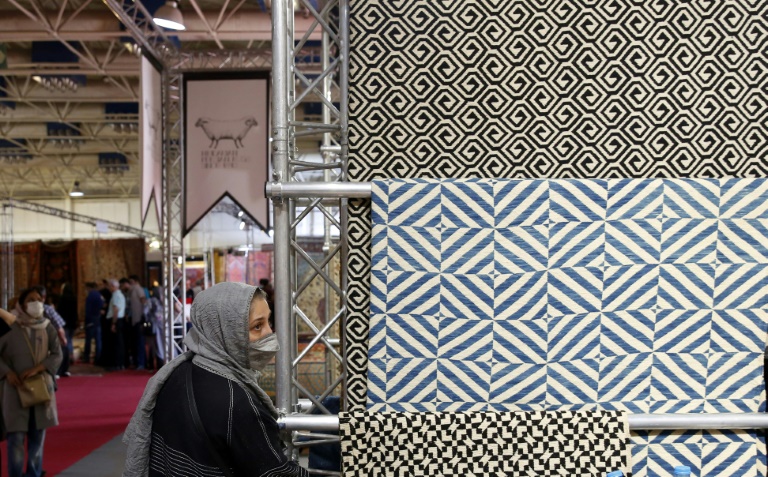
Striking geometric shapes that recall 20th century abstract art are not what you would expect to see adorning a handmade Iranian rug.

But changing tastes and increased competition from Asia have forced some in the trade to redesign and resize a tradition dating back more than 2,000 years.

“A revolution is underway,” said Ahad Azimzadeh, 65, who calls himself “the biggest exporter of Persian carpets in the world”.

Rugs traditionally woven in the Islamic republic are known for dense, curving floral designs in rich colours.

Their beauty and quality have long been recognised worldwide, yet sales have collapsed over the past 30 years.

“In 1994 the value of Iranian carpets sold abroad reached $1.7 billion and represented 40 percent of our non-petroleum exports,” Ahmad Karimi, chief of the Handmade Carpet Manufacturers’ and Exporters’ Union, told AFP.

By 2019-20 that figure had shrunk to $70 million, he said.

By another measure, in 2000 Iran represented 32 percent of global handmade carpet exports. This fell to 7.9 percent by 2019 as exports from China and India rose, Karimi said. 

– ‘New generations’ –

There was “an impact” from international sanctions that targeted Iran over its nuclear programme, human rights and other issues, but he said other factors are more to blame.

“Especially by the big diversity of carpets on the market and the change in the mentality and tastes of the new generations,” Karimi said.

Azimzadeh, the carpet exporter, said “the future is with modern handmade rugs”. 

He spoke at last week’s handmade carpet exhibition in Tehran. The annual event, suspended for two years because of the coronavirus pandemic, features about 400 exhibitors from across Iran.

“The patterns of Iranian carpets are ancient but today there is a strong demand for contemporary styles. They’re more suitable for a modern house,” said Azimzadeh, a big talker who started small — as a seven-year-old weaver. By 14, he had graduated to the commercial side of the trade.

Among the new styles on display at the exhibition which ended Sunday: a rug featuring small squares of hypnotic diagonal blue and white lines.

Another depicts diamond and other geometric patterns in gold silk on a black background. One wool rug looks as if an ink roller has left splashes of gold on it.

“The colours are clear and the sizes smaller,” which is what modern tastes demand, Azimzadeh said.

As an extreme but less typical example of this “revolution”, Azimzadeh stands in front of a woven rug three metres square (3.6 square yards) in size. It depicts global personalities including actor Charlie Chaplin, the physicist Albert Einstein and Soviet dictator Joseph Stalin.

– From art to doormat –

The new style is also cheaper. 

Some sell for $3,000 or $4,000, whereas Azimzadeh has a 2,000 square metre traditional carpet from Tabriz priced at $120 million.

His inventory also holds a 170-year-old piece from Kashan available for about $160,000.

For now, modern designs are still a minority at his stand in the exhibition, but the traditional stock will be gradually withdrawn, he said.

“Next year, 70 percent of the rugs on display will be modern,” Azimzadeh predicts.

Karimi, of the exporters’ union, regrets that Iranian carpets are nowadays seen as “a consumer good to put in front of the door, whereas in the past it was an investment.

“It’s lost its status as an object of art.”

Another trader, Abbas Arsin, was perhaps ahead of his time when he created what he calls the “transitional carpet” 25 years ago.

He took traditional patterns and made the bright colours fade by rubbing them and leaving them in the sun.

“My father and my older brother didn’t understand why I wore myself out making the old rugs fade,” said Arsin, 40, the third generation of his family in the business.

But when he exhibited his first works and customers came, his family encouraged him to “only do that”, he recalls with a smile.

Arsin said India, Pakistan, Turkey and China overtook Iran in the global market because “we Iranians had fewer relations with the rest of the world. We didn’t see the changes that were happening.”

Even now, not everyone is convinced.

“A year ago we began to make carpets in modern designs but they represent only five percent of our production and I don’t think we will go beyond that,” said Mehdi Jamshidi, 42, director of sales for Iran Carpet company.

“Modern carpets will never replace the traditional ones, which are deep-rooted in our culture and regions.”

Hamid Sayahfar, 54, a dealer who spends his time between Tehran and Toronto, said the new geometric styles might be suitable for an office, but not at home.

It’s just a fashion, he said, “and like every fashion it will disappear.”

Asian markets tumble after Powell's rate hike warning

Asian markets sank Monday and the dollar rallied after Fed boss Jerome Powell warned of more interest rate hikes to fight inflation and poured cold water on the prospects of a cut in the new year.

The hefty selling tracked a painful day on Wall Street, where all three main indexes tanked between three and four percent as investors contemplated an extended period of monetary tightening.

In a much-anticipated speech to global finance chiefs Friday, Federal Reserve Chair Powell said his priority was bringing inflation down from four-decade highs, even at the expense of economic growth, adding that failure to act now would cause more pain later.

“Restoring price stability will take some time and requires using our tools forcefully to bring demand and supply into better balance,” he told the symposium at Jackson Hole, Wyoming.

The comments dealt a blow to markets, which had in recent weeks enjoyed a bounce from June lows as weak economic data and a slowdown in price rises fanned hopes the Fed would temper its interest rate hike drive.

Analysts said the chances of a third successive 75 basis-point increase next month had risen, with US Treasury yields — a gauge of future interest rates — surging.

“The game of assessing the Fed outlook has shifted from guessing how high the peak rate might be to also understanding how long it might stay there for,” Yanxi Tan, of Malayan Banking, said.

In Asian trade, investors ran for the hills as they contemplated an era of high borrowing costs with Charles Schwab & Co’s Liz Ann Sonders saying that once the Fed gets to “whatever the final hike is, they’re going to stay there for a while”.

“The market had trouble digesting that,” she told Bloomberg Television.

Tokyo, Sydney, Seoul and Taipei all fell more than two percent. Hong Kong, Shanghai, Singapore, Jakarta and Wellington were also well down.

The dollar jumped against its major peers, closing in on the 140 yen mark not seen since 1998, while an energy crisis in Europe kept the euro depressed.

Still, oil prices extended gains as talk that surging interest rates could choke off the economic recovery was not enough to offset supply concerns.

The commodity has fallen in recent weeks on bets that demand will be hit by an expected drop in economic output, particularly from China as it continues to battle a Covid outbreak with lockdowns.

But fresh unrest in Libya, warnings that an Iran nuclear deal was not imminent and a possible OPEC output cut kept prices elevated.


– Key figures at around 0230 GMT –

Tokyo – Nikkei 225: DOWN 2.8 percent at 27,851.68 (break)

Hong Kong – Hang Seng Index: DOWN 0.9 percent at 19,989.39

Shanghai – Composite: DOWN 0.6 percent at 3,217.78

Dollar/yen: UP at 138.53 yen from 137.38 yen Friday

Euro/dollar: DOWN at $0.9931 from $0.9964

Pound/dollar: DOWN at $1.1672 from $1.1743

Euro/pound: UP at 85.07 pence from 84.85 pence

West Texas Intermediate: UP 1.1 percent at $94.05 per barrel

Brent North Sea crude: UP 0.8percent at $101.79

New York – Dow: DOWN 3.0 percent at 32,283.4 points (close)

London – FTSE 100: DOWN 0.7 percent at 7,427.31 (close) 

'Quiet quitting' raising a din in stressful US workplaces

They are drawing a line at the 40-hour work week, limiting after-hours calls and emails and generally, if softly, saying “no” more often — some American workers are embracing the concept of “quiet quitting” as they push back against what some see as the stifling trap of constant connectivity. 

Maggie Perkins — who lives in Athens, Georgia — was racking up 60-hour weeks as a matter of course in her job as a teacher, but the 30-year-old realized after her first child was born that something was wrong. 

“There’s pictures of me grading papers on an airplane on the way to vacation. I did not have a work-life balance,” Perkins explains in a TikTok video about how she chose — though she did not have a name for it back then — to begin “quiet quitting.” 

Perkins told AFP she eventually left her job to pursue a PhD, but remains an advocate for her former colleagues — producing videos and podcasts with practical tips on making their workload fit inside their workday.

“Adopting this ‘quiet quitting’ mindset really just means that you are establishing a boundary that helps you to do your job when you are paid to do it — and then you can leave that, and go home and be a human with your family,” she says.

– Work-life balance or slacking? –

The buzzword seems to have first surfaced in a July TikTok post.

In the words of user @zaidleppelin, “You’re not outright quitting your job but you’re quitting the idea of going above and beyond. You’re still performing your duties but you’re no longer subscribing to the hustle culture mentality that work has to be your life.”

That post went viral, drawing nearly a half-million likes. Responses bubbled over with a sense of shared resentment — and newspaper columnists spilled ink all summer trying to decipher the phenomenon.

For the debate soon erupted: Are “quiet quitters” merely trying to draw boundaries in pursuit of a reasonable work-life balance, more associated with a European lifestyle than with always-on US work culture? 

Are they slackers with a trendy new name? Or are they people at genuine risk of burnout — who would do best to quit outright?

Data suggests the need for greater balance is real.

On-the-job stress rose from 38 percent of those polled in 2019 to 43 percent the following year as Covid-19 upended the world of work, Gallup found, with women in the United States and Canada facing the most pressure.

Similar dynamics helped fuel the “Great Resignation” — the surge in employees leaving or switching jobs amid pandemic-related pressures.

Many “quiet quitters” say they are perfectly willing to work hard, but only for the hours the job is meant to entail. Their motto: “act your wage.”

Some observers are skeptical, of course, contending that offices have always had their share of clock-watchers and prickly workers claiming certain tasks are not their responsibility.

Going further, Arianna Huffington, founder of the Huffington Post, panned the phenomenon as “a step toward quitting on life.”

But former US labor secretary Robert Reich summed up the — forceful — counterargument, saying “Workers aren’t ‘quiet quitting.’ They’re refusing to be exploited for their labor.”

– ‘Six months of dread’ –

A case in point: the experience of Bess, who asked not to be identified by her real name, illustrates how Covid allowed some jobs to spill far outside their normal boundaries.

She was hired shortly before the pandemic in a job originally meant to involve regular trips to Germany. 

But, she told AFP, Covid left her stuck in her New York apartment, having to take phone calls as early as 3:00 am due to the time difference.

Out of self-preservation, she began to dial back her efforts — which her American friends had trouble understanding.

“There is that stigma — you put your blood, sweat and tears into your job in the US, and if you don’t work, you don’t deserve to be here,” she said.

“After six months of dread,” Bess explains, she simply stopped answering emails for several weeks — and ultimately parted ways with her company.

Philip Oreopoulos, a labor economist at the University of Toronto, said one solution is better communications to clarify employer expectations before accepting a job.

“If you need to be on call at home, then they should clearly state that,” he said.

And if things do get out of hand — and quiet quitting won’t fix the problem — aggrieved workers do have one asset to fall back on: a historically low unemployment rate.

“Come to an employer and say, ‘I have an opportunity with another firm and I’m thinking of taking it,'” Oreopoulos said. “It’s a good time in general to be asking for a raise.”

'Quiet quitting' raising a din in stressful US workplaces

They are drawing a line at the 40-hour work week, limiting after-hours calls and emails and generally, if softly, saying “no” more often — some American workers are embracing the concept of “quiet quitting” as they push back against what some see as the stifling trap of constant connectivity. 

Maggie Perkins — who lives in Athens, Georgia — was racking up 60-hour weeks as a matter of course in her job as a teacher, but the 30-year-old realized after her first child was born that something was wrong. 

“There’s pictures of me grading papers on an airplane on the way to vacation. I did not have a work-life balance,” Perkins explains in a TikTok video about how she chose — though she did not have a name for it back then — to begin “quiet quitting.” 

Perkins told AFP she eventually left her job to pursue a PhD, but remains an advocate for her former colleagues — producing videos and podcasts with practical tips on making their workload fit inside their workday.

“Adopting this ‘quiet quitting’ mindset really just means that you are establishing a boundary that helps you to do your job when you are paid to do it — and then you can leave that, and go home and be a human with your family,” she says.

– Work-life balance or slacking? –

The buzzword seems to have first surfaced in a July TikTok post.

In the words of user @zaidleppelin, “You’re not outright quitting your job but you’re quitting the idea of going above and beyond. You’re still performing your duties but you’re no longer subscribing to the hustle culture mentality that work has to be your life.”

That post went viral, drawing nearly a half-million likes. Responses bubbled over with a sense of shared resentment — and newspaper columnists spilled ink all summer trying to decipher the phenomenon.

For the debate soon erupted: Are “quiet quitters” merely trying to draw boundaries in pursuit of a reasonable work-life balance, more associated with a European lifestyle than with always-on US work culture? 

Are they slackers with a trendy new name? Or are they people at genuine risk of burnout — who would do best to quit outright?

Data suggests the need for greater balance is real.

On-the-job stress rose from 38 percent of those polled in 2019 to 43 percent the following year as Covid-19 upended the world of work, Gallup found, with women in the United States and Canada facing the most pressure.

Similar dynamics helped fuel the “Great Resignation” — the surge in employees leaving or switching jobs amid pandemic-related pressures.

Many “quiet quitters” say they are perfectly willing to work hard, but only for the hours the job is meant to entail. Their motto: “act your wage.”

Some observers are skeptical, of course, contending that offices have always had their share of clock-watchers and prickly workers claiming certain tasks are not their responsibility.

Going further, Arianna Huffington, founder of the Huffington Post, panned the phenomenon as “a step toward quitting on life.”

But former US labor secretary Robert Reich summed up the — forceful — counterargument, saying “Workers aren’t ‘quiet quitting.’ They’re refusing to be exploited for their labor.”

– ‘Six months of dread’ –

A case in point: the experience of Bess, who asked not to be identified by her real name, illustrates how Covid allowed some jobs to spill far outside their normal boundaries.

She was hired shortly before the pandemic in a job originally meant to involve regular trips to Germany. 

But, she told AFP, Covid left her stuck in her New York apartment, having to take phone calls as early as 3:00 am due to the time difference.

Out of self-preservation, she began to dial back her efforts — which her American friends had trouble understanding.

“There is that stigma — you put your blood, sweat and tears into your job in the US, and if you don’t work, you don’t deserve to be here,” she said.

“After six months of dread,” Bess explains, she simply stopped answering emails for several weeks — and ultimately parted ways with her company.

Philip Oreopoulos, a labor economist at the University of Toronto, said one solution is better communications to clarify employer expectations before accepting a job.

“If you need to be on call at home, then they should clearly state that,” he said.

And if things do get out of hand — and quiet quitting won’t fix the problem — aggrieved workers do have one asset to fall back on: a historically low unemployment rate.

“Come to an employer and say, ‘I have an opportunity with another firm and I’m thinking of taking it,'” Oreopoulos said. “It’s a good time in general to be asking for a raise.”

Serena Williams readies farewell as US Open begins

Serena Williams will take centre stage as the US Open gets under way on Monday with the 23-time Grand Slam winner preparing to bid an emotional farewell to tennis.

After announcing earlier this month that the countdown to her retirement had begun, Williams will step on court at Arthur Ashe Stadium at Flushing Meadows for what could be her final appearance in a Grand Slam singles event.

The 40-year-old sporting and cultural icon won the first of her Grand Slam titles at the same venue in 1999, lifting the trophy as a fresh-faced 17-year-old.

In Monday’s sold-out night session, which starts at 7:00 pm (2300 GMT), Williams will face Montenegro’s Danka Kovinic, the world number 80.

Whether Williams is able to extend her US Open campaign beyond that match remains to be seen.

In her last outing at the Cincinnati Masters earlier this month, Williams was thumped 6-4, 6-0 by Britain’s Emma Raducanu — who herself was knocked out of the Australian Open by Kovinic in January.

Win or lose on Monday, Williams won’t be departing the US Open stage immediately.

On Saturday, organisers confirmed that she and elder sister Venus Williams had been given a wild card into the women’s doubles tournament, which starts on Wednesday.

It is the first time the Williams sisters have played doubles since 2018, reuniting a partnership that has yielded 14 Grand Slam titles and three Olympic gold medals.

Whenever Serena Williams does leave the stage, she will do so after a career that has left a lasting legacy on her sport.

“I just think she’s the biggest thing that will ever be in the sport,” said Japan’s Naomi Osaka on Saturday.

“It’s just really an honour just to watch her play. She’s giving us a chance to watch her more.”

– Nadal fitness concern –

Elsewhere in the women’s draw, Poland’s world number one Iga Swiatek will look to claim her second Grand Slam title of 2022. 

The French Open champion won six straight tournaments earlier this season but has struggled to recapture that dominance during the North American hardcourt swing, making early exits at both the Cincinnati Masters and Canadian Open.

Swiatek launches her US Open campaign on Tuesday against Italy’s Jasmine Paolini.

In the men’s draw, Spanish great Rafael Nadal is chasing a fifth US Open crown and 23rd Grand Slam title in a draw that is missing Novak Djokovic.

Djokovic was barred from entry to the United States over his refusal to get vaccinated against Covid-19, putting him at odds with US government travel restrictions for overseas visitors.

With Djokovic out of the picture, Nadal’s biggest opponent over the next fortnight may well be his own injury-prone body.

The Spaniard has had to sit out the US Open four times in his career and there are once again fresh doubts over his physical ability to survive a gruelling two weeks at Flushing Meadows.

Nadal has played just once since an abdominal injury forced him to withdraw from his Wimbledon semi-final with Nick Kyrgios — a first-up loss to Borna Coric in Cincinnati.

Nadal admitted on Friday that he had been protecting his injury in Cincinnati but had been able to practice with intensity in the build-up to the US Open.

“I take it very easy in the Cincinnati, too, in the practices. The match, I try my best without putting all the effort there on the serve,” Nadal said.

“I hope to be ready for the action. That’s the only thing that I can say.”

Nadal begins his US Open campaign against Australia’s Rinky Hijikata on Tuesday.

'Sight to behold': tourists flock to Florida for Moon rocket launch

Seeing a rocket blast off to the Moon is “a once-in-a-lifetime thing to experience,” says Joanne Bostandji. 

The 45-year-old has traveled all the way from northern England to Florida with her husband and two children for a space-themed vacation, and they’re prepared to make sure they don’t miss a second of the action as NASA’s newest and most powerful rocket is scheduled to launch for the first time Monday. 

“The plan is to drive very early in the morning and get a spot” on Cocoa Beach, she said, not far from the Kennedy Space Center. 

“I know it’s going be from a far distance, but I still think it’s going be a sight to behold,” Bostandji told AFP as the family waited to enter a park dedicated to space exploration.  

Between 100,000 and 200,000 visitors are expected to attend the launch of the mission, called Artemis 1, which will propel an empty capsule to the Moon as part of a test for future crewed flights.

The “historic nature” of Monday’s flight, the first of several as the United States returns to the Moon, “certainly has increased public interest,” Meagan Happel of Florida’s Space Coast Office of Tourism told AFP.

Traffic jams are expected to start by 4 am, with the launch scheduled at 8:33 am (1233 GMT). 

And even more people might show up if the launch faces a weather delay, as the make-up date falls on a weekend. 

– Space cruise –

Sabrina Morley was able to find an apartment to rent not far from the beach, and plans to bring her two children and a few dozen other people on a boat chartered for the occasion by a company called Star Fleet Tours. 

For $95 a ticket, “we’ll go out into the ocean as close as they can get to the launch and we’ll watch the launch from the boat,” she said

“I’ve never been this close to a launch before,” said the 43-year-old, who grew up in Orlando, less than an hour away. 

As a child, she could see space shuttles taking off from her backyard, like “an orange ball of smoke” rising into the sky.

“We would hear the sonic booms,” she remembered. 

Morley likes that NASA’s Artemis program aims to land a woman on the Moon for the first time, with a crew to head up in 2025 at the earliest.

“Representation matters,” she said, glancing at her two-year-old daughter, who is already wearing an imitation astronaut helmet on her head. 

– Good for business – 

The return of prestigious space launches is an economic boon for the region. A family of three will spend an average of $1,300 over four or five days, according to the tourism office. 

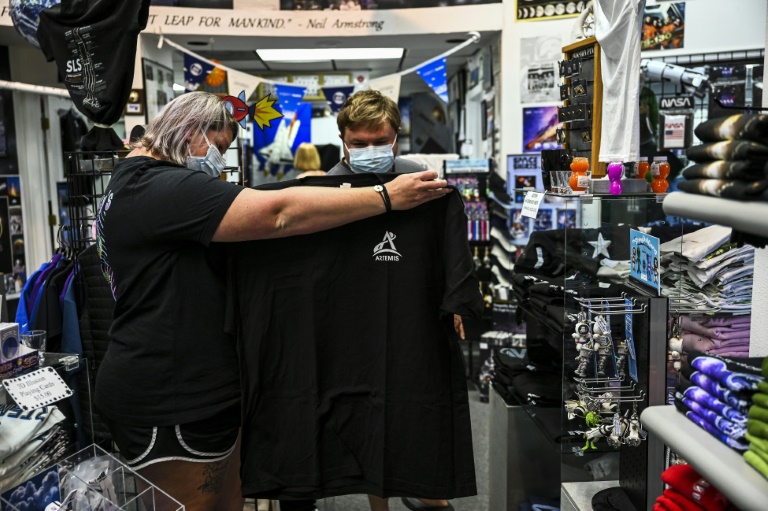
On the main road to Merritt Island, the peninsula where the Kennedy Space Center is located, Brenda Mulberry’s space memorabilia shop is packed with tourists. 

As soon as they enter, visitors are greeted with Artemis T-shirts for sale, printed in-house — there were 1,000 copies made Saturday alone. 

The last few days has seen an influx of customers, Mulberry, who founded “Space Shirts” in 1984, told AFP. 

“They’re just excited I think to see a NASA launch because the private space business is not so motivating to the people,” she said.

This rocket, called the SLS — a large model of which is displayed in front of her shop — “belongs to the people,” Mulberry said. 

“It’s their rocket. It’s not SpaceX rocket,” she added.

There is an air of nostalgia for the Apollo rocket program — it’s been 50 years since the last time a crewed mission went to the Moon, in 1972.

“My family, they had to go to the neighbor’s house to watch (the Apollo missions) because they didn’t have a television,” Bostandji, who was not yet born, said. 

“Now we’re going to see it hopefully for real.”

Close Bitnami banner
Bitnami