US Business

'Sight to behold': tourists flock to Florida for Moon rocket launch

Seeing a rocket blast off to the Moon is “a once-in-a-lifetime thing to experience,” says Joanne Bostandji. 

The 45-year-old has traveled all the way from northern England to Florida with her husband and two children for a space-themed vacation, and they’re prepared to make sure they don’t miss a second of the action as NASA’s newest and most powerful rocket is scheduled to launch for the first time Monday. 

“The plan is to drive very early in the morning and get a spot” on Cocoa Beach, she said, not far from the Kennedy Space Center. 

“I know it’s going be from a far distance, but I still think it’s going be a sight to behold,” Bostandji told AFP as the family waited to enter a park dedicated to space exploration.  

Between 100,000 and 200,000 visitors are expected to attend the launch of the mission, called Artemis 1, which will propel an empty capsule to the Moon as part of a test for future crewed flights.

The “historic nature” of Monday’s flight, the first of several as the United States returns to the Moon, “certainly has increased public interest,” Meagan Happel of Florida’s Space Coast Office of Tourism told AFP.

Traffic jams are expected to start by 4 am, with the launch scheduled at 8:33 am (1233 GMT). 

And even more people might show up if the launch faces a weather delay, as the make-up date falls on a weekend. 

– Space cruise –

Sabrina Morley was able to find an apartment to rent not far from the beach, and plans to bring her two children and a few dozen other people on a boat chartered for the occasion by a company called Star Fleet Tours. 

For $95 a ticket, “we’ll go out into the ocean as close as they can get to the launch and we’ll watch the launch from the boat,” she said

“I’ve never been this close to a launch before,” said the 43-year-old, who grew up in Orlando, less than an hour away. 

As a child, she could see space shuttles taking off from her backyard, like “an orange ball of smoke” rising into the sky.

“We would hear the sonic booms,” she remembered. 

Morley likes that NASA’s Artemis program aims to land a woman on the Moon for the first time, with a crew to head up in 2025 at the earliest.

“Representation matters,” she said, glancing at her two-year-old daughter, who is already wearing an imitation astronaut helmet on her head. 

– Good for business – 

The return of prestigious space launches is an economic boon for the region. A family of three will spend an average of $1,300 over four or five days, according to the tourism office. 

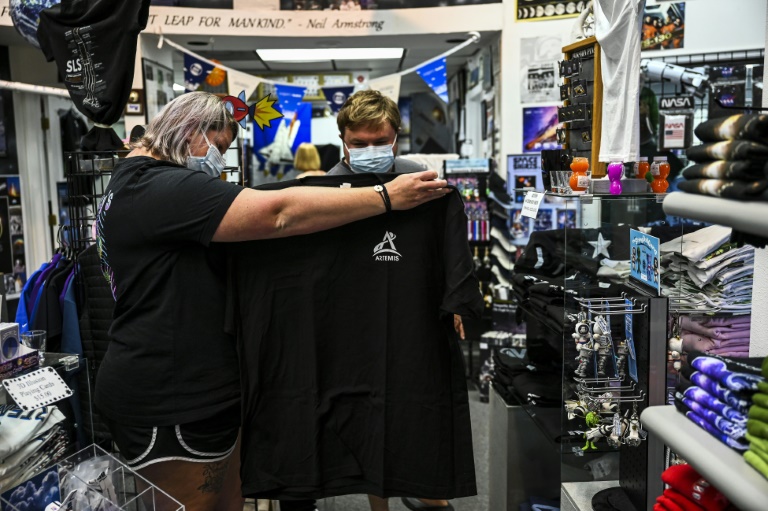
On the main road to Merritt Island, the peninsula where the Kennedy Space Center is located, Brenda Mulberry’s space memorabilia shop is packed with tourists. 

As soon as they enter, visitors are greeted with Artemis T-shirts for sale, printed in-house — there were 1,000 copies made Saturday alone. 

The last few days has seen an influx of customers, Mulberry, who founded “Space Shirts” in 1984, told AFP. 

“They’re just excited I think to see a NASA launch because the private space business is not so motivating to the people,” she said.

This rocket, called the SLS — a large model of which is displayed in front of her shop — “belongs to the people,” Mulberry said. 

“It’s their rocket. It’s not SpaceX rocket,” she added.

There is an air of nostalgia for the Apollo rocket program — it’s been 50 years since the last time a crewed mission went to the Moon, in 1972.

“My family, they had to go to the neighbor’s house to watch (the Apollo missions) because they didn’t have a television,” Bostandji, who was not yet born, said. 

“Now we’re going to see it hopefully for real.”

Williams' legacy spans present and future

Whether it’s in the powerful groundstrokes of players like Coco Gauff or the growing numbers of African-American youngsters surging into tennis camps across the United States each year, Serena Williams’ influence will be felt long after she hangs up her racquet.

The 23-time Grand Slam champion is expected to confirm her retirement at some point during the next US Open fortnight, ending a career that has straddled four decades and yielded a slew of records that may never be beaten.

A sporting and cultural icon, Williams, 40, along with elder sister Venus, has played a transformative role in changing the face of tennis around the world. 

“I think (Serena) as an athlete, not just as a tennis player, has been one of the most important athletes in the history of sport,” was the verdict of Rafael Nadal, the 22-time Grand Slam singles king.

Daniil Medvedev, the reigning US Open men’s singles champion, added: “In 100 years we’re still going to talk about Serena Williams.”

Martin Blackman, the United States Tennis Association’s general manager of player development, has witnessed first-hand the effect that the rise of the Williams sisters has had on the sport.

Blackman, a former tennis professional who is African-American, says Serena and Venus Williams will leave lasting legacies inside and outside of tennis, noting the sisters’ rise from the mean streets of south Los Angeles to the pinnacle of their sport.

“The first level of (Serena’s) legacy will be a woman along with her sister and their family who were able to come out of a tough situation growing up in Compton, not a lot of resources and play a sport that was still traditionally white and quite expensive, and that story of being able to make that journey to be a champion is the first one,” Blackman told AFP.

– Transcending tennis –

Together, Blackman said, the Williams sisters have transcended tennis.

“I happen to be an African-American man. When I saw Serena and Venus come up and I saw them being confident and comfortable in their skin, that was something that showed me they were really grounded, really secure, really confident. That was a shock to the established tennis society,” Blackman said. 

“African-American girls out there wearing braids, being themselves, unapologetically. I think at first there was some resistance. I think the commentating was a little bit different. For them to do that it sent a message to all diverse people -– regardless of whether black, Hispanic, gay or lesbian –- that you can be successful being yourself. 

“That you can be authentic and pave your way without compromising who you are. Over time, that’s probably the biggest cultural transformation that they have driven within the sport of tennis.”

Blackman said the Williams effect is reflected in the increasing numbers of African-American girls entering USTA tennis camps along with the increasing numbers of black players on the WTA Tour.

“Our numbers in terms of diverse youth have gone up consistently in the last two or three years,” Blackman said. 

“We have a network of camps throughout the country and I have seen more and more African-American girls coming into the game through those camps, which means they are the best in the country.”

At the elite level, a record 12 African-American women played in the main draw of the US Open in 2020. 

African-American tennis players have also increasingly graced Grand Slam finals. 

Prior to the Williams sisters’ emergence, Zina Garrison was the only African-American woman to reach a Grand Slam final in the Open era. 

In the past five years, African-American players such as Gauff, Sloane Stephens and Madison Keys have all played in Slam finals, while Japan’s Naomi Osaka, whose father is Haitian-American, has won four Grand Slams.

– ‘We followed her’ –

“If you look at everyone that’s our skin color, clearly we followed her,” Osaka said on Saturday. “I think I’m a product of what she’s done. I wouldn’t be here without Serena, Venus, her whole family.”

Gauff, the 18-year-old from Florida who reached the final of the French Open this year, said Serena Williams had been her role model on and off the court.

“Before Serena came along, there was not really an icon of the sport that looked like me,” Gauff said. 

“So growing up I never thought that I was different because the number one player in the world was somebody who looked like me.

“Sometimes being a woman, a black woman in the world, you kind of settle for less. I feel like Serena taught me that, from watching her. She never settled for less.” 

For Gauff, Williams’ dominance across different decades is enough to settle any debate about whether she ought to be regarded as the G.O.A.T (Greatest of All Time).

“For me she’s always going to be considered the G.O.A.T,” Gauff said. 

“She didn’t dominate one generation. She didn’t dominate for two generations. She dominated for three-plus generations.”

Canada’s Leylah Fernandez, the 2021 US Open finalist, said Williams would be remembered as a champion for both female and male players.

“She’s set out a good path for all of the WTA players, even the ATP players, to reach their own goals, voice their thoughts, keep fighting for what they believe in,” Fernandez said.

“It’s a great way to leave the sport.”

Two US Navy warships transit through Taiwan Strait

Two United States warships sailed through the Taiwan Strait on Sunday, the American navy said, the first such transit since China staged unprecedented military drills around the island.

In a statement, the US Navy said the passage “demonstrates the United States’ commitment to a free and open Indo-Pacific.”

Tensions in the Taiwan Strait soared to their highest level in years this month after US House Speaker Nancy Pelosi visited Taipei.

Beijing reacted furiously, staging days of air and sea exercises around Taiwan. Taipei condemned the drills and missile tests as preparation for an invasion.

Taiwan lives under constant threat of an invasion by China, which claims the self-ruled, democratic island as part of its territory to be seized one day — by force if necessary.

Washington diplomatically recognizes Beijing over Taipei, but maintains de facto relations with Taiwan and supports the island’s right to decide its own future.

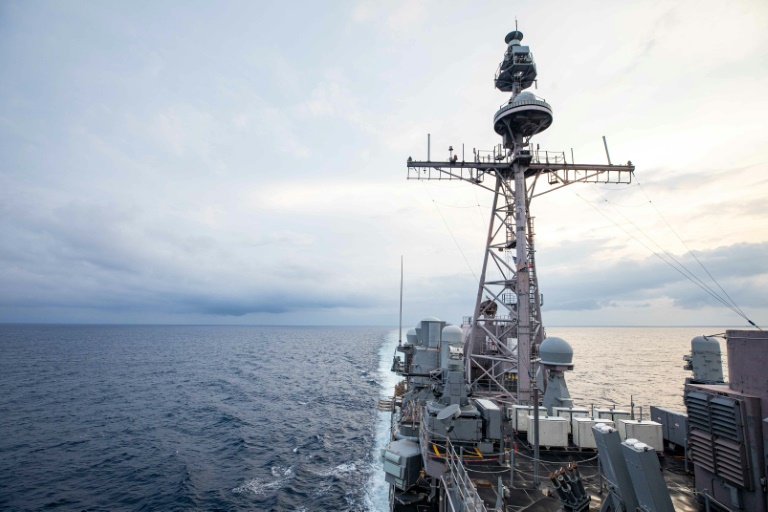
The US Seventh Fleet said the pair of Ticonderoga-class guided-missile cruisers — the USS Antietam and the USS Chancellorsville — conducted the “routine” transit on Sunday “through waters where high seas freedoms of navigation and overflight apply in accordance with international law.”

“These ships transited through a corridor in the Strait that is beyond the territorial sea of any coastal State,” a statement said. 

“It sends a very clear message,” a White House official, National Security Council spokesman John Kirby, said Sunday on CNN. “The US Navy will sail, fly and operate wherever international law allows it to.”

Kirby, a retired navy rear admiral, said the operation had been “planned long ago.”

The Chinese People’s Liberation Army (PLA) said the United States had “openly hyped up” the ships’ passage through the strait.

“The PLA Eastern Theatre Command is following and warning the US vessels throughout their entire journey, and is aware of all movements,” spokesman Senior Colonel Shi Yi said.

“Troops in the (eastern) theatre remain on high alert and are prepared at all times to foil any provocations.”

Taiwan’s defense ministry confirmed a pair of warships sailed from north to south through the channel.

“During their southward journey through the Taiwan Strait, the military is fully monitoring relevant movements in our surrounding sea and airspace, and the situation is normal.”

– ‘Freedom of navigation’ –

The Seventh Fleet is based in Japan and is a core part of the US Navy presence in the Pacific.

The US and Western allies have increased “freedom of navigation” crossings by naval vessels of both the Taiwan Strait and South China Sea to reinforce the concept that those seas are international waterways, sparking anger from Beijing.

Washington has said its position on Taiwan remains unchanged and has accused China of threatening peace in the Taiwan Strait and using the visit by Pelosi as a pretext for military exercises.

China’s drills included firing multiple ballistic missiles into waters off Taiwan — some of the world’s busiest shipping routes — which was the first time Beijing has taken such a step since the mid-1990s.

Taiwan staged its own drills, simulating a defense against invasion and displaying its most advanced fighter jet in a rare nighttime demonstration.

Under President Xi Jinping, China’s tone on Taiwan has grown more aggressive, with increased military activity and more combative messaging in recent years.

Sony issues 'Invitation'; not many filmgoers RSVP

New Sony horror film “The Invitation” topped the North American box office this weekend despite extremely weak ticket sales of just $7 million, industry watcher Exhibitor Relations reported Sunday.

Its estimated total for the Friday-through-Sunday period was the lowest first-place finish in 15 months and came on what Variety called a “catastrophically slow weekend,” as Hollywood’s healthy June and July numbers have dropped off in August. 

Fortunately for Sony, “The Invitation” cost a mere $10 million to produce. “Reviews are poor,” analyst David A. Gross of Franchise Entertainment Research said, “but that isn’t necessarily a deterrent” in the horror genre.

Nathalie Emmanuel and Thomas Doherty star in the Dracula-inspired tale.

In second, up one spot from last weekend, was Sony’s action-thriller “Bullet Train,” at $5.6 million. Brad Pitt stars in the story of a perilous journey on a train overloaded with assassins.

Third place went to action-adventure “Beast,” from Universal Pictures, at $4.9 million. Idris Elba stars as a recently widowed man who takes his daughters on safari only to be hunted by a huge rogue lion.

“Top Gun: Maverick” continued to defy gravity, drawing in $4.8 million in its 14th week out for a fourth-place finish.

But last weekend’s top film, “Dragon Ball Super: Super Hero” from Crunchyroll, seems to have flown into a wall. Its ticket sales dropped 78 percent from its opening weekend, to a fifth-place showing of just $4.6 million.

Rounding out the top 10 were:

“DC League of Super-Pets” ($4.2 million)

“Three Thousand Years of Longing” ($2.9 million)

“Minions: The Rise of Gru” ($2.7 million)

“Thor: Love and Thunder” ($2.7 million)

“Where the Crawdads Sing” ($2.3 million)

Longtime White House pastry chef Roland Mesnier dies at 78

Roland Mesnier, the French-born longtime pastry chef at the White House whose whimsical confections served five American presidents, has died at age 78, relatives told AFP Sunday.

The culinary master — who joined the presidential mansion’s staff in 1979 under Jimmy Carter and worked there until his 2004 retirement during George W. Bush’s tenure — died Friday in the US state of Virginia, his son George and older sister Genevieve Guyez Mesnier said.

“I have such fond memories of Chef Mesnier,” former first lady Hillary Clinton said Saturday in a Twitter post.

“He loved making people smile with his beautiful creations, including his famous gingerbread houses at Christmas,” she added. “He will be missed!”

Mesnier, a French citizen who became a naturalized American, served as White House executive pastry chef for 25 years.

“His passion, commitment, and love for his work will always be remembered,” the Ronald Reagan Presidential Foundation and Institute said.

Mesnier was born in Bonnay, a small village in eastern France, into a modest family of nine children. After serving his apprenticeship in the nearby city of Besancon, he worked in large hotels in Germany, Britain and Bermuda before the Carters hired him.

After hanging up his white hat and chef’s jacket, he published several books and spoke extensively about his White House experience.

– Anecdotes –

In a 2013 television interview he recounted that Rosalynn Carter had asked him what he planned to cook in the kitchens of 1600 Pennsylvania Avenue should he be hired. 

Lots of low-calorie desserts, he replied. “Mrs Carter was a very pretty lady, very slim, so I (thought to myself) this is a trick question.”

His answer was the right one, he figured, “because she said to her secretary: ‘This is the guy I want and I want him as soon as possible.'”

Mesnier was also known to dish about the culinary proclivities of the presidents and their families, to whom he served a broad array of fruit pies, wedding cakes, souffles and cookies.

George W. Bush was a lover of pecan ice cream and “the most impatient man I’ve ever seen,” while Nancy Reagan was a “total perfectionist,” he said.

Bill Clinton was allergic “to sugar, flour and chocolate” but nevertheless a massive dessert fan, according to Mesnier. So the chef struggled to come up with recipes that satisfied the president’s sweet tooth without the offending ingredients.

And while he expressed deep fondness for the Carters, he cringed in recalling a recipe the first lady brought from Georgia: a ring of sticky cheeses mixed with anchovies, with strawberry jam in the center.

“Mrs Carter always checked if the thing was on the table,” he said. “It was, but nobody ever touched it.”

Upon his 2004 retirement, Mesnier, who was married to an American, told AFP he had been torn between his adoptive country and his native land the previous year when tensions spiked over France’s refusal to support Bush’s war in Iraq, which led some Americans to rename french fries “freedom fries.”

“It saddened me a lot,” Mesnier said. “I am still a French patriot at heart, and an American at the same time.”

Two US Navy warships transit through Taiwan Strait

Two United States warships sailed through the Taiwan Strait on Sunday, the American navy said, the first such transit since China staged unprecedented military drills around the island.

In a statement, the US Navy said the passage “demonstrates the United States’ commitment to a free and open Indo-Pacific.”

Tensions in the Taiwan Strait soared to their highest level in years this month after US House Speaker Nancy Pelosi visited Taipei.

Beijing reacted furiously, staging days of air and sea exercises around Taiwan. Taipei condemned the drills and missile tests as preparation for an invasion.

Taiwan lives under constant threat of an invasion by China, which claims the self-ruled, democratic island as part of its territory to be seized one day — by force if necessary.

Washington diplomatically recognizes Beijing over Taipei, but maintains de facto relations with Taiwan and supports the island’s right to decide its own future.

The US Seventh Fleet said the pair of Ticonderoga-class guided-missile cruisers — the USS Antietam and the USS Chancellorsville — conducted the “routine” transit on Sunday “through waters where high seas freedoms of navigation and overflight apply in accordance with international law.”

“These ships transited through a corridor in the Strait that is beyond the territorial sea of any coastal State,” a statement said. 

“It sends a very clear message,” a White House official, National Security Council spokesman John Kirby, said Sunday on CNN. “The US Navy will sail, fly and operate wherever international law allows it to.”

Kirby, a retired navy rear admiral, said the operation had been “planned long ago.”

The Chinese People’s Liberation Army (PLA) said the United States had “openly hyped up” the ships’ passage through the strait.

“The PLA Eastern Theatre Command is following and warning the US vessels throughout their entire journey, and is aware of all movements,” spokesman Senior Colonel Shi Yi said.

“Troops in the (eastern) theatre remain on high alert and are prepared at all times to foil any provocations.”

Taiwan’s defense ministry confirmed a pair of warships sailed from north to south through the channel.

“During their southward journey through the Taiwan Strait, the military is fully monitoring relevant movements in our surrounding sea and airspace, and the situation is normal.”

– ‘Freedom of navigation’ –

The Seventh Fleet is based in Japan and is a core part of the US Navy presence in the Pacific.

The US and Western allies have increased “freedom of navigation” crossings by naval vessels of both the Taiwan Strait and South China Sea to reinforce the concept that those seas are international waterways, sparking anger from Beijing.

Washington has said its position on Taiwan remains unchanged and has accused China of threatening peace in the Taiwan Strait and using the visit by Pelosi as a pretext for military exercises.

China’s drills included firing multiple ballistic missiles into waters off Taiwan — some of the world’s busiest shipping routes — which was the first time Beijing has taken such a step since the mid-1990s.

Taiwan staged its own drills, simulating a defense against invasion and displaying its most advanced fighter jet in a rare nighttime demonstration.

Under President Xi Jinping, China’s tone on Taiwan has grown more aggressive, with increased military activity and more combative messaging in recent years.

Roland Mesnier, White House pastry chef for 25 years, dies at 78

Roland Mesnier, the French-born longtime pastry chef at the White House whose whimsical confections served five American presidents, has died at age 78, a historical association said.

The culinary master — who joined the presidential mansion’s staff in 1979 under Jimmy Carter and worked there until his 2004 retirement during George W. Bush’s presidency — died Friday “following a short illness,” the White House Historical Association said on its website.

“I have such fond memories of Chef Mesnier,” former first lady Hillary Clinton said Saturday in a Twitter post that included a photograph of her and Mesnier standing next to some of his gingerbread holiday pieces.

“He loved making people smile with his beautiful creations, including his famous gingerbread houses at Christmas,” she added. “He will be missed!”

The Ronald Reagan Presidential Foundation and Institute also expressed condolences about Mesnier’s passing, noting he had served as White House executive pastry chef for 25 years.

“His passion, commitment, and love for his work will always be remembered,” the foundation said.

Mesnier, born in Bonnay, a small village in eastern France, died in the US state of Virginia following complications from cancer, according to The Washington Post, which quoted his son George.

Born into a modest family of nine children, he had worked in large hotels in Germany, Britain and Bermuda before first lady Rosalynn Carter hired him in 1979.

Two US Navy warships transit through Taiwan Strait

Two United States warships sailed through the Taiwan Strait on Sunday, the American navy said, the first such transit since China staged unprecedented military drills around the island.

In a statement, the US Navy said the transit “demonstrates the United States’ commitment to a free and open Indo-Pacific.”

Tensions in the Taiwan Strait soared to their highest level in years this month after US House Speaker Nancy Pelosi visited Taipei. 

Beijing reacted furiously, staging days of air and sea exercises around Taiwan. Taipei condemned the drills and missile tests as preparation for an invasion.

Taiwan lives under constant threat of an invasion by China, which claims the self-ruled, democratic island as part of its territory to be seized one day — by force if necessary.

Washington diplomatically recognizes Beijing over Taipei, but maintains de facto relations with Taiwan and supports the island’s right to decide its own future.

The US Seventh Fleet said the pair of Ticonderoga-class guided-missile cruisers — the USS Antietam and the USS Chancellorsville — conducted the “routine” transit on Sunday “through waters where high seas freedoms of navigation and overflight apply in accordance with international law.”

“These ships transited through a corridor in the Strait that is beyond the territorial sea of any coastal State,” a statement said. 

“The United States military flies, sails, and operates anywhere international law allows.”

The Chinese People’s Liberation Army (PLA) said the US had “openly hyped up” the ships’ passage through the Strait.

“The PLA Eastern Theatre Command is following and warning the US vessels throughout their entire journey, and is aware of all movements,” spokesman Senior Colonel Shi Yi said.

“Troops in the (eastern) theatre remain on high alert and are prepared at all times to foil any provocations.”

Taiwan’s defense ministry confirmed a pair of warships sailed from north to south through the channel.

“During their southward journey through the Taiwan Strait, the military is fully monitoring relevant movements in our surrounding sea and airspace, and the situation is normal.”

– ‘Freedom of navigation’ –

The Seventh Fleet is based in Japan and is a core part of Washington’s navy presence in the Pacific.

The US and Western allies have increased “freedom of navigation” crossings by naval vessels of both the Taiwan Strait and South China Sea to reinforce the concept that those seas are international waterways, sparking anger from Beijing.

Washington has said its position on Taiwan remains unchanged and has accused China of threatening peace in the Taiwan Strait and using the visit by Pelosi as a pretext for military exercises.

China’s drills included firing multiple ballistic missiles into waters off Taiwan — some of the world’s busiest shipping routes — which was the first time Beijing has taken such a step since the mid-1990s.

Taiwan staged its own drills, simulating a defense against invasion and displaying its most advanced fighter jet in a rare nighttime demonstration.

Under President Xi Jinping, China’s tone on Taiwan has grown more aggressive, with increased military activity and more combative messaging in recent years.

Egypt dims lights to boost foreign reserves

An economic crisis spurred by the Ukraine war is casting darkness upon Egypt’s streets, as the government dims lights to free up energy for export and bolster hard currency reserves.

Russia’s invasion of Ukraine had an immediate impact on Egypt, the world’s biggest wheat importer which has relied on the ex-Soviet states for over 80 percent of its grain.

Egypt, which turned to the International Monetary Fund for a loan after the war erupted, is pumping more natural gas abroad to increase its foreign currency reserves — a move that has come in for criticism.

And while the government announced electricity rationing this month, signs of wastage elicit scorn.

“I see streetlights still working during daylight hours… and we’re suffering from high electricity bills,” said a disgruntled Cairo resident in his 30s who spoke on condition of anonymity.

The country’s vital tourism sector has also been hit by the Ukraine conflict, cutting the flow of holidaymakers to a country still hurting from the 2011 revolution and Covid-19 pandemic.

Economic growth slowed to 3.2 percent in the fourth quarter of 2021-22 against 7.7 percent last year, although annual expansion was 6.6 percent.

Despite the better-than-expected annual figure, the government said growth had tapered off in the wake of  “global political and economic developments”.

Egypt’s monetary policy has been caught between a rock and a hard place since Russia invaded Ukraine in February.

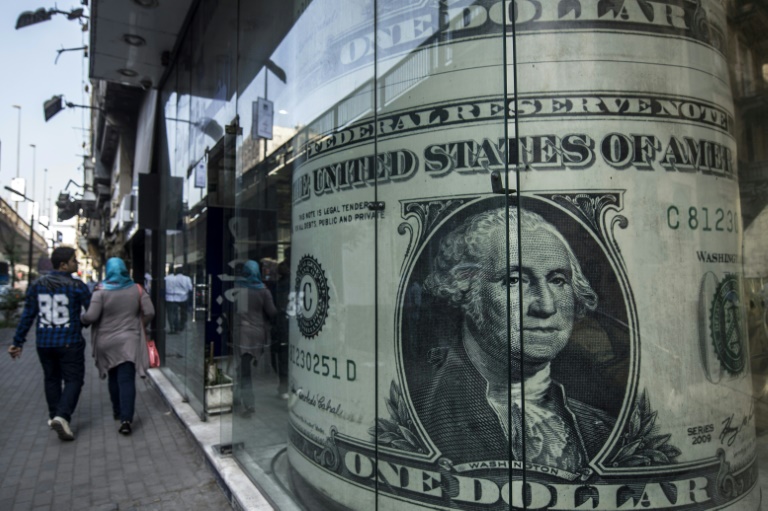
Inflation hit a three-year high of 14.6 percent in July after Egypt devalued the pound, pushing up the price of imports and depleting forex reserves by $7.8 billion since February to $33.1 billion in July.

– Capital flight –

Egypt is negotiating an IMF loan to help mitigate fallout from the Ukraine war on the country, where 30 percent of the 103 million population lives in poverty.

But the talks have stretched out for six months, raising eyebrows among analysts.

“The fact that talks with the IMF have dragged is probably a sign that some officials are reluctant to follow through on the Fund’s demands and would prefer to rely on support from the oil-flush Gulf economies,” London’s Capital Economics said.

“We need to speed up negotiations with the IMF,” said Hany Genena, an economist and lecturer at American University in Cairo.

“Since last week, there has been a severe shortage of dollars provided to importers by banks in various sectors.”

Cairo had previously secured a $12-billion IMF loan in 2016 that required it to slash subsidies and devalue the pound.

In 2020, Egypt received two more loans, including $5.4 billion tied to reforms and $2.8 billion to tackle Covid.

Genena said Egypt needed to undertake more “drastic” reforms to restore its forex reserves, including a full float of the pound.

Last week, as the currency plunged to a near all-time low of 19.1 to the dollar, central bank governor Tarek Amer resigned.

It was unclear why Amer quit, but Egyptian media suggested it was because of his reluctance to implement a full float.

James Swanston of Capital Economics said the currency needed to depreciate to 25 pounds to the dollar by the end of 2024 “to avoid external imbalances rebuilding”.

But $14.6 billion worth of investments has flown out of the country in the first quarter of 2022, reflecting concerns over the Ukraine war.

Capital Economics said, however, that investment pledges worth $22 billion from Gulf countries will “go some way to alleviating external financing concerns”.

– Gas lifeline –

Among Egypt’s slate of measures to preserve foreign currency was a decision to let the pound slip 17 percent against the greenback in March.

The government said electricity rationing seeks to achieve “an additional surplus — at an average of 15 percent of the natural gas pumped to power stations — that can be exported and bring in hard currency.”

Among the measures to conserve energy were “reducing lighting in streets and public squares.”

Since 2018, Egypt has been ramping up its natural gas capacity, now setting its sights on an energy-hungry Europe, which is eager to decrease reliance on Russian gas.

The government announced this month “exceptional aid to nine million families at a cost of $52 million per month,” but for many, the soaring cost of living had already done enough damage. 

Mahmoud al-Saeedy, a fruit salesman in Cairo, has depleted his savings trying to keep up with rising prices.

“I return to my village in the south every 40 or 50 days, with only 600 pounds ($31.3) to give to my family,” he told AFP.

“What can they do with it?”

Ethereum crypto overhaul targets environmental impact

The world’s second biggest cryptocurrency after bitcoin, ethereum, will soon overhaul its blockchain technology to curb the network’s much-criticised environmental impact.

Ethereum, whose digital unit ether tumbled in a crypto crash earlier this year, will in September undergo a major technical revolution.

So what is the backdrop for the looming reset — known as the Merge — and how will it calm prices and cut electricity usage?

– Why does crypto use so much energy? –

Bitcoin, ethereum and other such currencies are “mined” by solving complex puzzles using powerful computers that consume enormous amounts of energy in vast warehouses, often near cheap electricity sources.

A blockchain is the decentralised and secure ledger for recording those transactions, which occur when encrypted codes are passed across a computer network.

Users validate their success via a so-called “proof of work” mechanism that rewards them with cyber currency — but only after they have proved their participation in such energy-intensive mining.

The lucrative crypto industry is worth about $1.0 trillion, despite crashing in the first half of 2022.

However, ethereum is still down by a hefty 55 percent in value so far this year.

– Why is ethereum popular? –

Ethereum is nevertheless regarded as vital because it is where most virtual assets, including headline-grabbing non-fungible tokens (NFTs), are bought and sold.

That is partly because users can create “smart contracts” or algorithmic computer code, which carry out customised transactions for different functions.

“The ethereum blockchain is the base layer infrastructure of the majority of the whole crypto ecosystem,” summarised Lennart Ante, CEO and co-founder of the Blockchain Research Lab.

“Everything relies on ethereum,” he told AFP.

“In the last few years, there have been other similar platforms such as Solana or Cadano, but none of these have this huge network and this huge amount of developers and projects, and historical success.”

– Why is it changing? –

Ethereum’s broad adoption makes it even more important to address environmental concerns and change tack, as those worries had sparked a partial boycott.

“Proof-of-work mining is environmentally destructive, expensive, and inefficient,” summarised digital currency specialist Eswar Prasad, a professor at Cornell University.

Yet the carbon footprint of a decentralised blockchain system is difficult to assess because electricity sources are not always identified.

– What is the switch? –

Ethereum creator Vitalik Buterin has planned for a switch to a so-called “proof of stake” mechanism from the middle of September.

This means that participation no longer requires proof of electricity usage, and instead relies on staking blocks of ether.

Users will then validate, or effectively bet their currency, in order to try and win more ether.

Ethereum currently consumes about 45 terawatt hours of power per year.

Bitcoin in contrast is estimated to use 95 terawatt hours of power per year, equivalent to Pakistan’s annual consumption.

– What are pros and cons? –

Experts estimates the upgrade will use 99 percent less energy than the current set-up.

It would therefore allow users to execute quicker and more efficient transactions.

“The energy consumption would be close to zero,” Ante told AFP.

“You do not need any of the hardware anymore, only the software.”

At the same time, the new approach is not without risks.

Some users might decide to switch to rival networks where they can still able to use enormous amounts of energy to mine currency.

Prasad also cautioned that the proof-of-stake method was “not perfect” owing to liquidity and governance concerns.

Close Bitnami banner
Bitnami