US Business

Markets looking for clarity but tuning out Fed message

US central bankers have been hammering home a single message: Interest rates will rise until inflation begins to come down. But financial markets keep hoping to hear a different tune, one indicating the pace of rate hikes will slow.

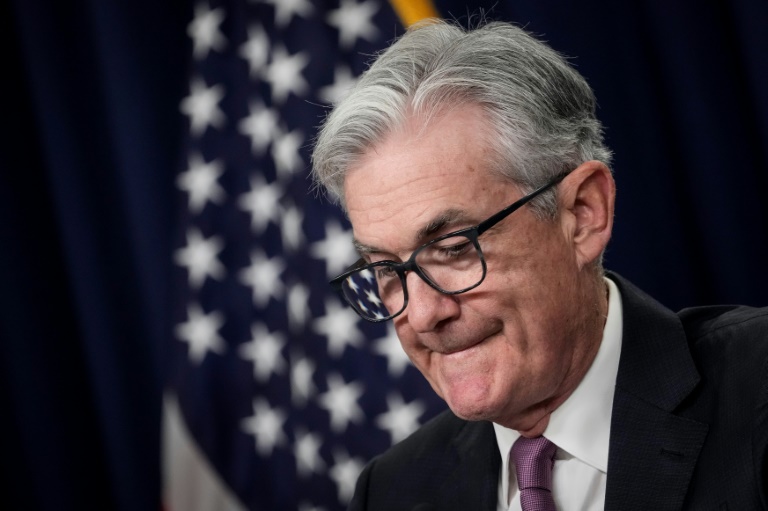
All eyes will be on this week’s annual gathering of policymakers in Jackson Hole, Wyoming to hear Federal Reserve Chair Jerome Powell explain his stance — again — with market watchers hoping to get something more to their liking.

The Fed could be a victim of its own success. 

After keeping the benchmark borrowing rate at zero throughout the pandemic, the steep spike in prices, which surged to a 40-year high following Russia’s invasion of Ukraine, prompted the central bank to take aggressive action.

In the battle to contain red-hot inflation, which topped nine percent in June, the Fed has hiked rates four times, including massive, three-quarter point increases in June and July — steep moves unheard of since the early 1980s.

But in recent weeks signs of easing price pressures and a slowing economy, along with falling energy costs and indications global supply chain snarls have lessened, caused financial markets to become optimistic the Fed will dial back or even pause rate increases — and even begin to cut next year.

Stocks on Wall Street have risen for four straight weeks, despite a string of officials repeating the message that rates will continue to rise, even though annual inflation slowed in July as oil prices fell.

While the annual gathering often becomes a place for global central bankers to signal shifting policy, Powell is expected to repeat that message Friday — though he may acknowledge that a slowdown will come later in the year.

“It does seem like what we’ve heard from Powell so far suggests there’s quite a high bar for them to transition from aggressive hikes” to a slower pace of 25 basis point steps, said Jonathan Millar of Barclays.

Millar, who served as a Fed economist and forecaster under four central bank chiefs, told AFP that markets are looking further ahead, anticipating the rate hikes will be successful in slowing inflation.

But for policymakers “One thing they definitely want to communicate is that they remain very much focused on issues with price stability and that they will react very cautiously to any signs of improvements in the inflation data.”

That means indications prices are coming down more broadly, not just because of falling oil.

Managing the market’s expectations “is really job one,” Millar said. “They have to enforce that credibility.”

But like other economists he believes the Fed’s policy-setting Federal Open Market Committee (FOMC) at its September meeting will step down to a 0.5 percentage point increase, taking the range of the key lending rate up to 2.75 to 3.0 percent, to be followed up with quarter-point hikes in November and December

– Walking a narrow line –

Kathy Bostjancic of Oxford Economics said the dilemma for Powell is to recognize the progress towards achieving a soft landing — bringing inflation back down towards the two percent target, without derailing economic growth — while confirming the Fed’s resolve.

He “continues to have to walk kind of a narrow line,” she told AFP. “You don’t want to be too pessimistic.”

And with housing prices and sales cooling from their torrid pace along with other encouraging data “he has the wind at his back.”

But she said, “The message he really has to give is that we’re still going to be looking to raise rates to a restrictive level to really make sure inflation is still our number one priority.”

The annual monetary policy symposium hosted by the Kansas City Federal Reserve Bank runs August 25-27. It often is a place for officials from around the world to come to discuss policy changes in the works, but Powell is virtually the only major global central bank chief confirmed to speak at the event.

European Central Bank chief Christine Lagarde is not planning to attend, Bank of England governor Andrew Bailey is expected to be there but not speak. Francois Villeroy de Galhau, governor of the Bank of France, is due to give a speech on Saturday.

Markets looking for clarity but tuning out Fed message

US central bankers have been hammering home a single message: Interest rates will rise until inflation begins to come down. But financial markets keep hoping to hear a different tune, one indicating the pace of rate hikes will slow.

All eyes will be on this week’s annual gathering of policymakers in Jackson Hole, Wyoming to hear Federal Reserve Chair Jerome Powell explain his stance — again — with market watchers hoping to get something more to their liking.

The Fed could be a victim of its own success. 

After keeping the benchmark borrowing rate at zero throughout the pandemic, the steep spike in prices, which surged to a 40-year high following Russia’s invasion of Ukraine, prompted the central bank to take aggressive action.

In the battle to contain red-hot inflation, which topped nine percent in June, the Fed has hiked rates four times, including massive, three-quarter point increases in June and July — steep moves unheard of since the early 1980s.

But in recent weeks signs of easing price pressures and a slowing economy, along with falling energy costs and indications global supply chain snarls have lessened, caused financial markets to become optimistic the Fed will dial back or even pause rate increases — and even begin to cut next year.

Stocks on Wall Street have risen for four straight weeks, despite a string of officials repeating the message that rates will continue to rise, even though annual inflation slowed in July as oil prices fell.

While the annual gathering often becomes a place for global central bankers to signal shifting policy, Powell is expected to repeat that message Friday — though he may acknowledge that a slowdown will come later in the year.

“It does seem like what we’ve heard from Powell so far suggests there’s quite a high bar for them to transition from aggressive hikes” to a slower pace of 25 basis point steps, said Jonathan Millar of Barclays.

Millar, who served as a Fed economist and forecaster under four central bank chiefs, told AFP that markets are looking further ahead, anticipating the rate hikes will be successful in slowing inflation.

But for policymakers “One thing they definitely want to communicate is that they remain very much focused on issues with price stability and that they will react very cautiously to any signs of improvements in the inflation data.”

That means indications prices are coming down more broadly, not just because of falling oil.

Managing the market’s expectations “is really job one,” Millar said. “They have to enforce that credibility.”

But like other economists he believes the Fed’s policy-setting Federal Open Market Committee (FOMC) at its September meeting will step down to a 0.5 percentage point increase, taking the range of the key lending rate up to 2.75 to 3.0 percent, to be followed up with quarter-point hikes in November and December

– Walking a narrow line –

Kathy Bostjancic of Oxford Economics said the dilemma for Powell is to recognize the progress towards achieving a soft landing — bringing inflation back down towards the two percent target, without derailing economic growth — while confirming the Fed’s resolve.

He “continues to have to walk kind of a narrow line,” she told AFP. “You don’t want to be too pessimistic.”

And with housing prices and sales cooling from their torrid pace along with other encouraging data “he has the wind at his back.”

But she said, “The message he really has to give is that we’re still going to be looking to raise rates to a restrictive level to really make sure inflation is still our number one priority.”

The annual monetary policy symposium hosted by the Kansas City Federal Reserve Bank runs August 25-27. It often is a place for officials from around the world to come to discuss policy changes in the works, but Powell is virtually the only major global central bank chief confirmed to speak at the event.

European Central Bank chief Christine Lagarde is not planning to attend, Bank of England governor Andrew Bailey is expected to be there but not speak. Francois Villeroy de Galhau, governor of the Bank of France, is due to give a speech on Saturday.
British cinema chain mulls US bankruptcy filing

British-based cinema chain Cineworld confirmed Monday that a US bankruptcy filing is among options for the debt-laden group, which has been slammed by dwindling audience numbers.

The group, which operates hundreds of cinemas mainly in the United States, revealed last week that it was “evaluating various strategic options” to boost liquidity and potentially restructure, with demand below expectations since reopening from the pandemic.

Cineworld said in an update on Monday that those options “include a possible voluntary Chapter 11 filing in the United States and associated ancillary proceedings in other jurisdictions”.

The London-listed group added it was holding talks with “many of its major stakeholders including its secured lenders”.

A Chapter 11 filing “would be expected to allow the group to access near-term liquidity and support the orderly implementation of” debt reduction, it noted.

Cineworld would maintain its normal operations with “no significant impact” on staff, under such an outcome.

However, it also warned of a “very significant dilution of existing equity interests”.

Further announcements would be made when appropriate, it added.

Cineworld’s share price has collapsed since the start of this year to stand at just three pence on Monday.

Analysts argue that its 2018 takeover of American peer Regal left it saddled with too much debt.

The chain, whose second biggest market is Britain, was then hit hard by pandemic fallout and the booming popularity of streaming.

“Cineworld’s problems stem from an overly aggressive growth strategy which relied on using huge amounts of debt to buy US chain Regal,” said AJ Bell analyst Russ Mould.

“This may have made Cineworld one of the largest cinema operators in the world, but bigger isn’t necessarily better — and the pandemic swiftly exposed the company’s strained balance sheet.”

UK dock workers' union threatens further strikes

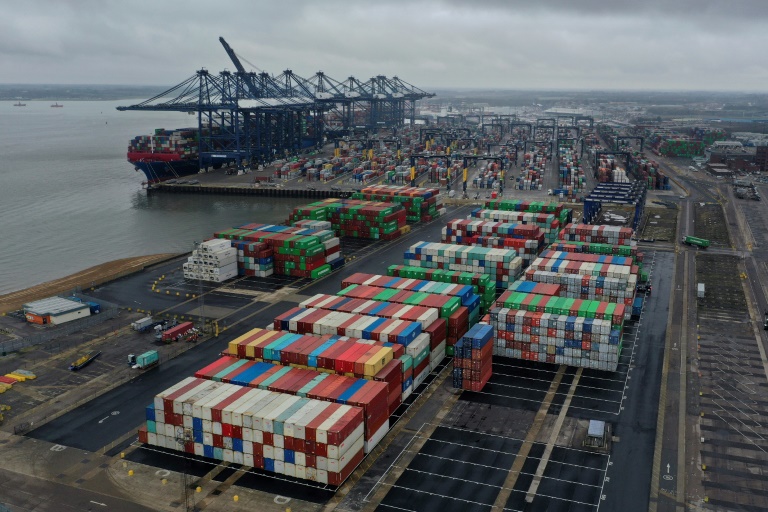
A trade union on Monday warned of more strikes at the UK’s largest container port if pay demands are not met, threatening to cause further disruptions to the supply chain.

Workers at Felixstowe port in southeastern England began an eight-day strike over pay on Sunday, in the latest industrial action as decades-high inflation intensifies the country’s cost-of-living crisis.

They say the pay offer they received does not keep up with inflation — which has surged above 10 percent — and includes a one-off lump sum payment.

“If we don’t achieve what we’re trying to achieve, there will be more strikes,” Robert Morton, national officer for the Unite union, told Sky News.

“We’ve been asking for a minimum of the rate of inflation,” Morton said.

Nearly 2,000 unionised employees at the port in eastern England, including crane drivers, machine operators and stevedores, are involved in the first strike at Felixstowe since 1989.

It comes amid stoppages over pay and working conditions across various UK industries, with railway workers just the latest to strike on Thursday and Saturday this week.

The strike comes after Covid and post-Brexit labour shortages have already hit the UK supply chain.

Morton said he accepted that further strikes at Felixstowe would mean “the supply chain will be severely disrupted”, while saying the strike will end as soon as the port agrees to meet for negotiations.

The Port of Felixstowe said in a statement Friday that it was “disappointed” the walkout had gone ahead and called its offer of salary increases of on average eight percent “fair”.

It said it “regrets the impact this action will have on UK supply chains”.

Pal Davey, head of corporate affairs at the port, told Sky News on Monday that average pay at the port is “40 percent higher than national average” and workers had been given a “very fair offer”.

“Our workers have been much better placed to weather the cost-of-living storm than the majority of workers in the rest of the country,” he said.

Strike action over pay matching inflation is taking place in a wide range of sectors.

Even criminal lawyers who represent clients in court have launched strike action.

On Monday, their union, The Criminal Bar Association announced its members had voted to escalate their action and will stop taking on any new cases indefinitely from September 6.

Markets mostly drop as traders mull Fed outlook, gas price spike

World stocks mostly sank Monday and the dollar rallied on concern the Federal Reserve will stick to its interest rate-hiking plans to combat runaway inflation.

Eurozone equities also tanked as spiking natural gas prices sparked fears that winter energy shortages could spark recession, helping push the euro back under parity against the greenback.

Oil dipped on speculation over an Iran nuclear deal that could ease a supply crunch caused by producer Russia’s invasion of Ukraine.

All eyes are on this week’s symposium in Jackson Hole, Wyoming, where Fed boss Jerome Powell will deliver a speech that traders will follow for an idea about the US central bank’s next moves.

– ‘Critical moment’ –

Stocks “began Monday in downbeat mood ahead of what could prove to be a critical moment for markets at the end of this week”, said AJ Bell investment director Russ Mould.

“The Jackson Hole summit of central bankers and finance ministers is widely expected to see Powell take to the floor — and puncture optimism which has built up over hopes the Fed may be nearing the point at which it pivots away from rate hikes.”

A dip in price rises and signs of economic slowdown had raised hopes policymakers would ease up — and possibly cut rates next year — after two successive, 75-basis-point hikes, helping equities rally globally.

But that optimism has slowly been eroded in recent weeks as Fed officials, including Powell, have warned that the battle against inflation was far from won, particularly as the jobs market remained resilient.

The euro is under additional pressure after Russia’s Gazprom said late Friday that the Nord Stream pipeline would be closed for maintenance at the end of the month, cutting Europe’s daily gas deliveries.

As a result, Europe’s Dutch TTF Gas Futures contract soared on Monday to almost 293 euros per megawatt hour, not far from record highs hit after Russia launched its assault on Ukraine.

– ‘Recessionary risk’ –

“European gas prices pushed higher again … on renewed concerns about flows through Nord Stream 1,” Rabobank analyst Jane Foley told AFP.

“This focussed attention on recessionary risk for the eurozone. A clear break of parity risks a moves towards $0.95,” she added.

In early morning London deals, the euro dipped as low as $0.9990 before clawing its way back above the psychological barrier.

Surging energy prices have this year driven inflation to 40-year peaks in nations including Britain and the United States, in turn prompting tighter monetary policy.

US banking group Citi has forecast that UK inflation would peak at 18.6 percent next January on the back of rocketing domestic energy prices.

Before the weekend, all three main Wall Street indices had fallen and Asia mostly followed suit on Monday.

However, Shanghai stocks rose after China’s central bank cut prime loan rates as it tries to bolster the world’s second-biggest economy, which has been ravaged by lockdowns as part of a zero-Covid strategy.

The prospect of more US hikes also sent the dollar rallying versus the yen, and it is nearing the 140 yen mark for the first time in 24 years.

– Key figures at around 1100 GMT –

London – FTSE 100: DOWN 0.3 percent at 7,530.80 points

Frankfurt – DAX: DOWN 1.6 percent at 13,327.85 

Paris – CAC 40: DOWN 1.2 percent at 6,418.13

EURO STOXX 50: DOWN 1.3 percent at 3,680.84

Tokyo – Nikkei 225: DOWN 0.5 percent at 28,794.50 (close)

Hong Kong – Hang Seng Index: DOWN 0.6 percent at 19,656.98 (close)

Shanghai – Composite: UP 0.6 percent at 3,277.79 (close)

New York – Dow: DOWN 0.9 percent at 33,706.74 points (close)

Euro/dollar: DOWN at $1.0009 from $1.0037 Friday

Pound/dollar: DOWN at $1.1808 from $1.1829

Euro/pound: DOWN at 84.76 pence from 84.86 pence

Dollar/yen: DOWN at 136.91 yen from 136.97 yen

West Texas Intermediate: DOWN 0.1 percent at $90.68 per barrel

Brent North Sea crude: DOWN 0.2 percent at $96.53

Shanghai's Bund to go dark as China heatwave prompts power cuts

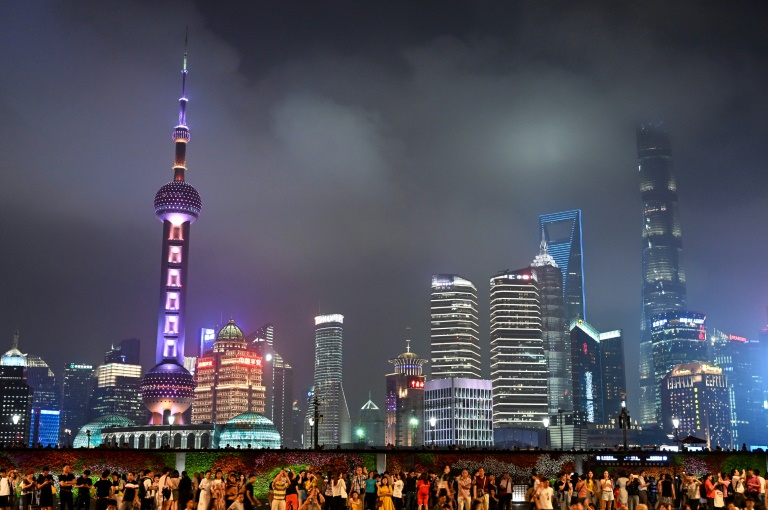
Shanghai will switch off decorative lights along its famed Bund riverfront for two days from Monday, city authorities said, in response to a nationwide heatwave that has sent power demands soaring.

Multiple provinces have announced power cuts to cope with a surge in demand, driven partly by people cranking up the air conditioning to cope with temperatures as high as 45 degrees Celsius (113 degrees Fahrenheit).

China has been hit by extreme weather this summer, including record temperatures, flash floods and droughts — phenomena that scientists have warned are becoming more frequent and intense due to climate change.

To save power, Shanghai authorities said in a notice Sunday that they would switch off “landscape lighting” at the Bund, the city’s most famous landmark.

Ornamental lights, billboards and video screens on both sides of the Huangpu River would be turned off on Monday and Tuesday, according to the notice.

The heatwave has reduced stretches of the Yangtze River, China’s most vital inland waterway, to unprecedented drought levels, according to official data.

That has resulted in high pressure on hydroelectric plants that supply power to some of the country’s key economic zones.

In the southwestern megacity of Chongqing, home to 31 million, authorities on Monday declared that all shopping malls must only operate between 4:00pm and 9:00pm daily to cut power costs until the “temperature and supply-demand situation” changes.

The city last week announced industrial power cuts lasting until Wednesday and reduced scenic lighting at tourist attractions.

In neighbouring Sichuan, authorities on Sunday extended industrial power cuts and activated their highest level of emergency response to deal with the heatwave.

“Since July this year, the province has faced the most extreme high temperatures, the lowest rainfall in the corresponding period in history… (and) the highest power load in history,” local authorities said.

Some of the world’s biggest automakers — including Japanese giant Toyota and Elon Musk’s Tesla — operate factories in Sichuan.

The province is also home to parts manufacturers that are crucial to global auto supply chains.

Many major factories were forced to halt work because of the Sichuan power cuts, which were supposed to end on Saturday but were extended to Thursday, Chinese news outlet Caixin reported.

Analysts have warned that Sichuan’s power woes could have ripple effects on the wider Chinese economy and international supply chains.

Hydropower generated in the province supplies domestic consumers and factories, but also industrial powerhouse provinces Jiangsu and Zhejiang.

UK dock workers' union threatens further strikes

A trade union on Monday warned of more strikes at the UK’s largest container port if pay demands are not met, threatening to cause further disruptions to the supply chain.

Workers at Felixstowe port in southeastern England began an eight-day strike over pay on Sunday, in the latest industrial action as decades-high inflation intensifies the country’s cost-of-living crisis.

They say the pay offer they received does not keep up with inflation — which has surged above 10 percent — and includes a one-off lump sum payment.

“If we don’t achieve what we’re trying to achieve, there will be more strikes,” Robert Morton, national officer for the Unite union, told Sky News.

“We’ve been asking for a minimum of the rate of inflation,” Morton said.

Nearly 2,000 unionised employees at the port in eastern England, including crane drivers, machine operators and stevedores, are involved in the first strike at Felixstowe since 1989.

It comes amid stoppages over pay and working conditions across various UK industries, with railway workers just the latest to strike on Thursday and Saturday this week.

The strike comes after Covid and post-Brexit labour shortages have already hit the UK supply chain.

Morton said he accepted that further strikes at Felixstowe would mean “the supply chain will be severely disrupted”, while saying the strike will end as soon as the port agrees to meet for negotiations.

The Port of Felixstowe said in a statement Friday that it was “disappointed” the walkout had gone ahead and called its offer of salary increases of on average eight percent “fair”.

It said it “regrets the impact this action will have on UK supply chains”.

Pal Davey, head of corporate affairs at the port, told Sky News on Monday that average pay at the port is “40 percent higher than national average” and workers had been given a “very fair offer”.

“Our workers have been much better placed to weather the cost-of-living storm than the majority of workers in the rest of the country,” he said.

Strike action over pay matching inflation is taking place in a wide range of sectors.

Even criminal lawyers who represent clients in court have launched strike action.

On Monday, their union, The Criminal Bar Association announced its members had voted to escalate their action and will stop taking on any new cases indefinitely from September 6.

Most markets down as traders eye key Powell speech

Stocks sank Monday and the dollar rallied on renewed concerns about Federal Reserve plans to ramp up interest rates to combat runaway inflation.

All eyes are on a symposium in Jackson Hole, Wyoming where Fed boss Jerome Powell will deliver a speech that traders will follow for an idea about the bank’s next moves.

A dip in price rises and signs of economic slowdown had raised hopes policymakers would ease up — and possibly cut rates next year — after two successive, 75-basis-point hikes, helping equities rally globally.

But that optimism has slowly been eroded in recent weeks as Fed officials, including Powell, have warned that the battle against inflation was far from won, particularly as the jobs market remained resilient.

One of the latest was Richmond Fed boss Thomas Barkin, who reasserted his commitment to bringing inflation back to two percent from the four-decade high of around nine percent.

He said on Friday the policy board would “do what it takes to get there”, but warned: “There’s a path to getting inflation under control but a recession could happen in the process.”

Jonathan Millar of Barclays said it was unlikely Powell would signal a slowdown in rate hikes this week.

“It does seem like what we’ve heard from Powell so far suggests there’s quite a high bar for them to transition from aggressive hikes” to 25 basis points.

“One thing they definitely want to communicate is that they remain very much focused on issues with price stability and that they will react very cautiously to any signs of improvements in the inflation data.”

And National Australia Bank’s Rodrigo Catril added that the Fed chief will likely say that “while we may be close to the end of the beginning of the current tightening cycle, we are still a long way from the end”.

All three main indexes on Wall Street fell Friday and Asia followed suit.

Hong Kong, Tokyo, Sydney, Seoul, Mumbai, Taipei, Manila and Jakarta dropped.

But Shanghai rose after China’s central bank cut prime loan rates as it tries to bolster the world’s second-biggest economy, which has been ravaged by lockdowns as part of a zero-Covid strategy.

Singapore, Bangkok and Wellington also edged up.

London, Paris and Frankfurt all fell in early trade.

The prospect of more US hikes to come has given another boost to the dollar, which rallied against the yen and is approaching the 140 yen mark for the first time in 24 years. 

It also broke parity with the euro again — after having done so last month for the first time in nearly 20 years.

The stronger greenback was helping to keep oil prices down, while downward pressure was being enhanced by speculation rising about a possible Iran nuclear deal that could ease a supply crisis caused by Russia’s invasion of Ukraine.

Both main contracts tumbled Monday and wiped out all the gains seen in reaction to the start of conflict in eastern Europe.

“The global balance for the remainder of the year is not as tight as many were expecting, with Russian supply holding up well,” said Warren Patterson, of ING Groep NV.

“While it may take several months for Iran to get production back to pre-sanction levels in the event of a deal, in the short term, they should still be able to boost exports by relying on storage.”

– Key figures at around 0810 GMT –

Tokyo – Nikkei 225: DOWN 0.5 percent at 28,794.50 (close)

Hong Kong – Hang Seng Index: DOWN 0.6 percent at 19,656.98 (close)

Shanghai – Composite: UP 0.6 percent at 3,277.79 (close)

London – FTSE 100: DOWN 0.6 percent at 7,508.61

Euro/dollar: DOWN at $0.9994 from $1.0034 Friday

Pound/dollar: DOWN at $1.1790 from $1.1827

Euro/pound: DOWN at 84.80 pence from 84.81 pence

Dollar/yen: UP at 136.77 yen from 136.93 yen

West Texas Intermediate: DOWN 2.0 percent at $89.00 per barrel

Brent North Sea crude: DOWN 1.8 percent at $95.01 per barrel

New York – Dow: DOWN 0.9 percent at 33,706.74 points (close)

China central bank cuts lending rates to boost economy

China’s central bank on Monday cut benchmark loan rates in an attempt to boost an economy battered by the government’s strict zero-Covid policy and a slump in the property market.

The world’s second-biggest economy saw an improvement after some coronavirus restrictions eased in June, but consumer and business sentiment remains weaker than usual.

The one-year Loan Prime Rate, which serves as a benchmark for corporate loans, was reduced from 3.7 percent to 3.65 percent, the People’s Bank of China (PBOC) said in a statement.

The five-year LPR, which is used to price mortgages, was cut from 4.45 percent to 4.3 percent, it added.

The PBOC slashed key interest rates last week, bringing its seven-day reverse repurchase rate — a key rate at which it provides short-term liquidity to banks — to a new low.

Analysts had expected cuts to the LPR rates, but said they may not be enough to rescue the property sector — which is estimated to account for as much as a quarter of China’s GDP.

“The much larger cut to the five-year rate suggests the PBOC is particularly concerned about problems in the housing market,” Capital Economics said in a note on Monday.

“However, homebuyers with existing mortgages will have to wait until the start of next year for the change to affect them.”

China’s housing market was shaken by frustrated homebuyers in dozens of cities who boycotted mortgage payments as cash-strapped developers struggled to complete the units they had sold in advance.

With property firms struggling to manage mountains of debt, fears have swirled since last year that the sector’s troubles could spread to the rest of the economy.

“Most home mortgages are linked to the (five-year) loan prime rate. So this rate cut is obviously to reduce the burden on borrowers,” Iris Pang, chief economist for Greater China at ING, in a note.

“When the market sees progress in the construction of uncompleted projects, we may see an improvement in home buying sentiment and home prices should stabilise.”

China’s economic growth came in at just 0.4 percent on-year in the second quarter — its slowest rate since the Covid crisis began in 2020.

Most Asian markets down as traders eye key Powell speech

Asian markets were broadly lower Monday as the rally from June’s lows runs out of steam owing to renewed concerns about Federal Reserve plans to ramp up interest rates to combat runaway inflation.

All eyes are on a symposium in Jackson Hole, Wyoming where Fed boss Jerome Powell will deliver a speech that will be followed for an idea about the bank’s next moves.

A dip in price rises and signs of economic slowdown had raised hopes policymakers would ease up — and possibly cut next year — after two successive, 75-basis-point hikes, helping equities rally globally.

But that optimism has slowly been eroded in recent weeks as Fed officials, including Powell, have warned that the battle against inflation was far from won, particularly as the jobs market remained resilient.

One of the latest was Richmond Fed boss Thomas Barkin, who reasserted his commitment to bringing inflation back to two percent from the four-decade high of around nine percent.

He said on Friday the policy board would “do what it takes to get there”, but warned: “There’s a path to getting inflation under control but a recession could happen in the process.”

Jonathan Millar of Barclays said it was unlikely Powell would signal a slowdown in rate hikes this week.

“It does seem like what we’ve heard from Powell so far suggests there’s quite a high bar for them to transition from aggressive hikes” to 25 basis points.

“One thing they definitely want to communicate is that they remain very much focused on issues with price stability and that they will react very cautiously to any signs of improvements in the inflation data.”

And National Australia Bank’s Rodrigo Catril added that the Fed chief will likely say that “while we may be close to the end of the beginning of the current tightening cycle, we are still a long way from the end”.

All three main indexes on Wall Street fell Friday and Asia followed suit in early trade.

Hong Kong, Tokyo, Sydney, Seoul, Taipei, Manila and Jakarta dropped.

However, Shanghai rose after China’s central bank cut prime loan rates as it tries to bolster the world’s second-biggest economy, which has been ravaged by lockdowns across the country as part of leaders’ zero-Covid strategy.

Singapore and Wellington also edged up.

The prospect of more US hikes to come has given another boost to the dollar, which rallied against the yen and is approaching the 140 yen mark for the first time in 24 years.

The stronger greenback was helping to keep oil prices down, while downward pressure was being enhanced by speculation rising about a possible Iran nuclear deal that could ease a supply crisis caused by Russia’s invasion of Ukraine.

“The global balance for the remainder of the year is not as tight as many were expecting, with Russian supply holding up well,” said Warren Patterson, of ING Groep NV.

“While it may take several months for Iran to get production back to pre-sanction levels in the event of a deal, in the short term, they should still be able to boost exports by relying on storage.”

– Key figures at around 0230 GMT –

Tokyo – Nikkei 225: DOWN 0.4 percent at 28,805.52 (break)

Hong Kong – Hang Seng Index: DOWN 0.1 percent at 19,755.48

Shanghai – Composite: UP 0.4 percent at 3,270.83

Euro/dollar: DOWN at $1.0032 from $1.0034 Friday

Pound/dollar: DOWN at $1.1822 from $1.1827

Euro/pound: UP at 84.86 pence from 84.81 pence

Dollar/yen: UP at 137.30 yen from 136.93 yen

West Texas Intermediate: DOWN 1.2 percent at $89.69 per barrel

Brent North Sea crude: DOWN 1.1 percent at $95.68 per barrel

New York – Dow: DOWN 0.9 percent at 33,706.74 points (close)

London – FTSE 100: UP 0.1 percent at 7,550.37 (close)

Close Bitnami banner
Bitnami