US Business

US tests ICBM after Ukraine, China-linked delays

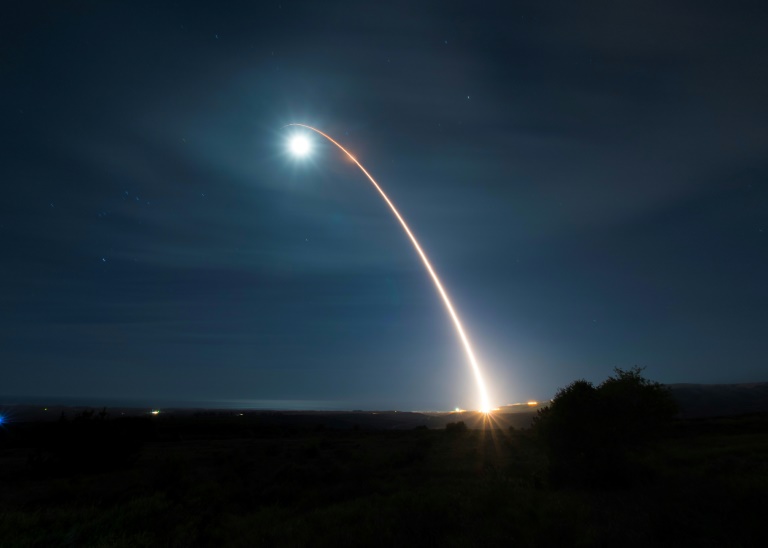
The United States successfully tested a long-range, nuclear-capable ballistic missile Tuesday after twice postponing the launch to avoid stoking tensions over Ukraine and Taiwan, the Air Force announced.

The Air Force Global Strike Command launched the unarmed Minuteman III intercontinental ballistic missile over the Pacific from Vandenberg Space Force Base in California just after midnight local time.

The missile carried a test re-entry vehicle, which in a strategic conflict could be armed with a nuclear warhead.

The reentry vehicle traveled about 4,200 miles (6,760 kilometers) to the Kwajalein Atoll in the Marshall Islands in the western Pacific.

“This test launch is part of routine and periodic activities intended to demonstrate that the United States’ nuclear deterrent is safe, secure, reliable and effective,” the Air Force said in a statement.

“Such tests have occurred more than 300 times before, and this test is not the result of current world events.”

The test was originally scheduled in March but was put off to avoid adding to tensions over Russia’s February 24 invasion of Ukraine.

It was postponed a second time at the beginning of August as military tensions soared over China’s test launches of multiple ballistic missiles and live-fire exercises in reaction to the visit of the top US lawmaker, Nancy Pelosi, to Taiwan.

“As China engages in destabilizing military exercises around Taiwan, the United States is demonstrating instead the behavior of a responsible nuclear power by reducing the risks of miscalculation and misperception,” White House national security spokesman John Kirby said at the time, explaining the postponement.

US industrial output jumps in July on solid manufacturing gain

A solid rebound in American manufacturing, especially vehicles, following two months of declines, help push overall industrial production up in July, the Federal Reserve said Tuesday.

A massive 6.6 percent surge in motor vehicle and parts production was a key driver the 0.7 percent rise in manufacturing, which was the biggest gain since March, the data showed. 

That boosted total industrial output by 0.6 percent last month, which was double the consensus forecast among economists.

The gain contrasted with the massive decline in a regional survey by the New York Fed for the first week of August, which briefly spooked investors on Monday.

“Manufacturing activity is cooling, but retains some momentum; no indications of a massive pullback,” said Gregory Daco, chief economist of EY Parthenon. 

“I’d downplay the huge drop in the Empire State survey & focus on the ISM readings pointing to cooling activity,” Daco said on Twitter, referring to a nationwide survey that showed a slowdown but continued growth last month.

Mining production also rose 0.7 percent, on “gains in coal mining and in oil and gas well drilling,” while utilities fell 0.8 percent, the Fed said.

Overall production was 3.9 percent higher compared to July 2021, while manufacturing has risen 3.2 percent, the report said.

Industrial capacity in use edged back over 80 percent, to 80.3 percent, after slipping below that threshold in June.

US industrial output jumps in July on solid manufacturing gain

A solid rebound in American manufacturing, especially vehicles, following two months of declines, help push overall industrial production up in July, the Federal Reserve said Tuesday.

A massive 6.6 percent surge in motor vehicle and parts production was a key driver the 0.7 percent rise in manufacturing, which was the biggest gain since March, the data showed. 

That boosted total industrial output by 0.6 percent last month, which was double the consensus forecast among economists.

The gain contrasted with the massive decline in a regional survey by the New York Fed for the first week of August, which briefly spooked investors on Monday.

“Manufacturing activity is cooling, but retains some momentum; no indications of a massive pullback,” said Gregory Daco, chief economist of EY Parthenon. 

“I’d downplay the huge drop in the Empire State survey & focus on the ISM readings pointing to cooling activity,” Daco said on Twitter, referring to a nationwide survey that showed a slowdown but continued growth last month.

Mining production also rose 0.7 percent, on “gains in coal mining and in oil and gas well drilling,” while utilities fell 0.8 percent, the Fed said.

Overall production was 3.9 percent higher compared to July 2021, while manufacturing has risen 3.2 percent, the report said.

Industrial capacity in use edged back over 80 percent, to 80.3 percent, after slipping below that threshold in June.

China factories ration power as heatwave sends demand soaring

Chinese lithium hub Sichuan province will ration electricity supply to factories until Saturday, state media reported, as a heatwave sends power demands soaring and dries up reservoirs.

Temperatures in the province — home to nearly 84 million people — have hovered above 40-42 degrees Celsius (104-108 degrees Fahrenheit) since last week, according to data from China’s Meteorological Administration, increasing the demand for air conditioning.

The region relies on dams to generate 80 percent of its electricity, but rivers in the area have dried up this summer, Beijing’s Water Resources Ministry said. 

The province in China’s southwest produces half the nation’s lithium, used in batteries for electric vehicles, and its hydropower projects provide electricity to industrial hubs along the country’s east coast. 

But the local government has decided to prioritise residential power supply, ordering industrial users in 19 out of 21 cities in the province to suspend production until Saturday, according to a notice issued Sunday.

Several companies including aluminium producer Henan Zhongfu Industrial and fertiliser producers Sichuan Meifeng Chemical Industry said in stock exchange statements they were suspending production.

A plant operated by Taiwanese giant and Apple supplier Foxconn in the province has also suspended production, Taipei’s Central News Agency reported. 

Some companies will be permitted to operate at a limited capacity, depending on their production needs.

“Sources estimate at least 1,200 tonnes of lithium output will be cut due to the operations disruptions in these five days,” Susan Zou, an analyst at Rystad Energy, told AFP, adding the cost of lithium carbonate had jumped since Monday.

A summer of extreme weather in China has seen multiple major cities record their hottest days ever.

China’s national observatory reissued a red alert for high temperatures on Monday, state media reported, as the mercury soared past 40 degrees Celsius (104 Fahrenheit) across swathes of the country.

Provinces including Zhejiang, Jiangsu and Anhui that rely on power from western China have also issued electricity curbs for industrial users to ensure homes had enough power, according to local media reports. 

Scientists say extreme weather across the world has become more frequent due to climate change, and will likely grow more intense as global temperatures rise.

Net zero, Russia war driving nascent hydrogen economy

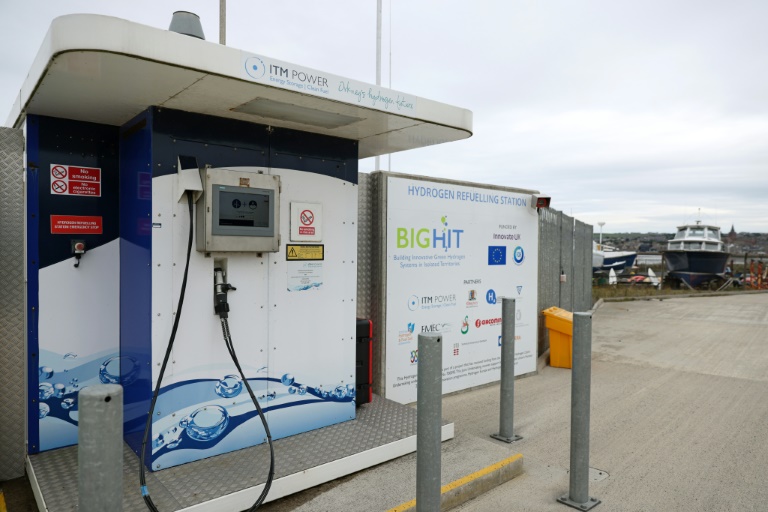
Kevin Kendall pulls up at the only green hydrogen refuelling station in Birmingham, Britain’s second-biggest city, and swiftly fills his sedan with clean gas.

Green hydrogen is in sharp focus as governments seek to slash carbon emissions amid record-high temperatures and to safeguard energy supplies hit by the invasion of Ukraine by oil and gas producer Russia.

But the “hydrogen economy” has not fully kicked into gear awaiting significant uptake from high-polluting sectors like steel and aviation.

For Kendall, being an early user of green hydrogen means he does not have to queue during his lunchtime trip to what resembles a petrol pump.

“There is very little green hydrogen being produced in Britain at the moment,” the professor of chemical engineering tells AFP. “It needs now to move forward.”

In Birmingham, central England, it costs about £50 ($60) to fill Kendall’s Toyota Mirai with the green hydrogen that is produced at a plant next to the refuelling station.

That is around half the bill for a similar-sized diesel car after the Ukraine war sent fossil fuel prices rocketing.

Despite the price benefit, Britain is home to around only a dozen hydrogen refuelling stations.

While hydrogen is the most abundant element on Earth, it is locked in water and hydrocarbons such as natural gas, meaning “it’s difficult to make”, according to Kendall’s daughter, Michaela Kendall.

Together they founded Adelan, a small-sized business producing box-shaped fuel cells similar to the metal-encased devices used to help power the Toyota Mirai.

Set up 26 years ago, Adelan is the longest-running maker of fuel cells in Britain — which work also with liquefied petroleum gas (LPG) — while the company also offers a leasing service for the Japanese automaker’s hydrogen cars.

– ‘Increasingly attractive’ –

“Since the Russian invasion of Ukraine, the economics of green hydrogen have become increasingly attractive,” Minh Khoi Le, head of hydrogen research at Rystad Energy, told AFP.

“Coupled with many incentives in the second half of 2022 globally, green hydrogen looks to satisfy the trilemma of the energy system: energy security, affordability, and sustainability.”

Fallout from the war has caused the European Union to bolster its gas reserves by slashing consumption 15 percent.

The bloc is also seeking to significantly increase supplies of green hydrogen, which is made from water via electrolysis and with renewable energy. 

This is in contrast to the more available blue hydrogen, which environmentalists oppose as it is produced from natural gas in a process that releases carbon dioxide into the atmosphere.

– £9-billion investment –

At Adelan’s Birmingham workshop, a quaint brick building surrounded by houses, staff are testing the company’s so-called solid oxide fuel cells that are replacing diesel generators.

Overseeing the work, company chief executive Michaela Kendall says she expects “hydrogen capacity to really increase but it will take time”.

“Hydrocarbons will still be used for the foreseeable future,” she predicts “because the hydrogen economy has not really evolved, it’s just at the early stage”.

Britain’s government says £9 billion of investment is needed “to make hydrogen a cornerstone of the UK’s greener future” as it targets net zero carbon emissions by mid-century.

In Birmingham, the plan is for about 10 hydrogen refuelling stations in the next few years following the arrival of 120 hydrogen buses to the city in 2023. Other UK cities, including Aberdeen in Scotland, are travelling the same road.

However, “only Los Angeles has been reasonably successful with something like 9,000 hydrogen vehicles and 40 hydrogen stations”, says Kevin. 

“That’s what we’d like Birmingham to be.”

– Electric surge –

The Toyota, resembling a standard vehicle inside and out, is powered by electricity. This has been produced by green hydrogen combining with oxygen in a fuel cell.

The only waste emitted from the vehicle, which has a range of 400 miles (640 kilometres), is water vapour.

Adelan’s solid oxide fuel cell, so-called because its electrolyte is ceramic, is described as “an electric device”, generating power for batteries.

“It’s hydrogen-ready, but we tend to use hydrocarbon fuels because they’re easier to get right now,” says Michaela.

“We use fuel that is sourced in a low-carbon way” such as BioLPG.

A lack of hydrogen infrastructure means motorists wanting a greener alternative to petrol or diesel are expected to continue purchasing electric vehicles.

Despite lengthy charge times for electric car batteries and big rises in electricity prices this year, Britons are fast ditching polluting automobiles ahead of a UK ban on sales of new diesel and petrol vehicles from 2030.

It comes as oil and gas giant BP recently unveiled plans for green hydrogen production facilities in the UK.

Academy apologizes to indigenous star for historic Oscars abuse

Nearly 50 years after she was booed off the Oscars stage for declining Marlon Brando’s award on his behalf in protest at the film industry’s treatment of Native Americans, Sacheen Littlefeather has received an apology from the Academy of Motion Picture Arts and Sciences, the group said Monday.

Littlefeather, who is Apache and Yaqui, was heckled at the 1973 Academy Awards while explaining at his behest why an absent Brando could not accept his best actor Oscar for “The Godfather.” 

She later said veteran Western star John Wayne had to be restrained from physically assaulting her, in an incident that has since drawn comparisons with Will Smith’s infamous attack on Chris Rock at this year’s ceremony.

“The abuse you endured because of this statement was unwarranted and unjustified,” said the apology letter sent in June from then-Academy president David Rubin.

“The emotional burden you have lived through and the cost to your own career in our industry are irreparable.

“For too long the courage you showed has been unacknowledged. For this, we offer both our deepest apologies and our sincere admiration.”

The Academy released the letter as it announced that Littlefeather has been invited to speak at its film museum in Los Angeles next month.

The museum, which opened last September, has pledged to confront the Oscars’ “problematic history” including racism. One display already tackles the harassment of Littlefeather.

“Regarding the Academy’s apology to me, we Indians are very patient people — it’s only been 50 years!” Littlefeather said in a statement.

“We need to keep our sense of humor about this at all times. It’s our method of survival,” said Littlefeather, describing the upcoming event as “a dream come true.”

“It is profoundly heartening to see how much has changed since I did not accept the Academy Award 50 years ago. I am so proud of each and every person who will appear on stage,” she added.

– ‘Healing’ –

The Academy has moved to confront accusations of a lack of racial diversity in recent years.

In 2019, “Last of the Mohicans” star Wes Studi became the first Native American actor to receive an Oscar, with an honorary Academy Award recognizing his career.

Its museum has also hosted virtual events on women who achieved historic Oscars milestones including a talk with Buffy Sainte-Marie — the first Indigenous person to win an Oscar, for best original song in 1983.

“We didn’t want to erase films and artists and moments that may be uncomfortable. We wanted to confront them and contextualize them, throughout all of our core gallery spaces,” Bill Kramer, then the museum’s director, told AFP ahead of its opening last year.

The Academy faced criticism for its handling of Smith’s assault on comedian Rock during this year’s ceremony.

Smith — who went on to win the best actor award — marched on stage and hit Rock for making a joke about his wife, in an incident that overshadowed the March ceremony, being broadcast live around the world.

The upcoming event with Littlefeather, dubbed a “very special program of conversation, reflection, healing, and celebration,” will take place September 17.

Oil prices tumble on possible Iran deal, stuttering China economy

Oil prices fell Monday on the prospects of a return of Iranian oil to the market and data showing China’s economic recovery stuttering under Covid-19 restrictions.

Stock markets were broadly steady and the dollar traded mixed as investors digested the latest developments, including the surprise move by China’s central bank Monday to slash interest rates as a raft of data showed industrial production and retail sales growth for July came in lower than expected. 

“The risk of stagflation in the world economy is rising, and the foundation for domestic economic recovery is not yet solid,” China’s National Bureau of Statistics warned.

Stagflation refers to long-running high inflation combined with rising unemployment and weak growth.

Beijing’s rigid adherence to a zero-Covid strategy has held back economic recovery as snap lockdowns and long quarantines batter business activity and a recovery in consumption.

Wall Street stocks initially fell following the Chinese data and a gloomy reading from the New York Federal Reserve Bank on regional manufacturing activity. But stocks had turned around by midday.

“The risk of a global recession is pretty high at the moment,” said FHN Financial’s Chris Low, adding that a silver lining of the weakening outlook is the expectation that the Federal Reserve could pivot more quickly and slow its efforts to raise interest rates to quell red-hot prices.

“The Fed will stop sooner if inflation goes away and it’s more likely to go away sooner with the global economy slowing,” Low said.

But the weakened Chinese economy weighed on oil prices, as did speculation that a revived nuclear deal could add Iranian crude to global markets.

US oil futures dropped nearly three percent to finish below $90 a barrel.

Iran’s foreign minister said Tehran would deliver its “final” proposal later Monday on talks to revive its 2015 nuclear accord with world powers, after Washington had accepted key demands.

A deal would mean that Iran’s crude output of 2.5 million barrels per day would no longer be subject to international sanctions, which would help relieve supply constraints that have been pushing up prices.

“Iran would flood the market,” said analyst Aditya Saraswat at energy research firm Rystad, who added the country could ramp up production by another million barrels per day. 

– Key figures at around 2030 GMT –

Brent North Sea crude: DOWN 3.1 percent at $95.10 per barrel

West Texas Intermediate: DOWN 2.9 percent at $89.41 per barrel

New York – Dow: UP 0.5 percent at 33,912.44 (close)

New York – S&P 500: UP 0.4 percent at 4,297.14 (close)

New York – Nasdaq: UP 0.6 percent at 13,128.05 (close)

London – FTSE 100: UP 0.1 percent at 7,509.15 (close)

Frankfurt – DAX: UP 0.2 percent at 13,816.61 (close)

Paris – CAC 40: UP 0.3 percent at 6,569.95 (close)

EURO STOXX 50: UP 0.3 percent at 3,789.62 (close) 

Tokyo – Nikkei 225: UP 1.1 percent at 28,871.78 (close)

Hong Kong – Hang Seng Index: DOWN 0.7 percent at 20,040.86 (close)

Shanghai – Composite: FLAT at 3,276.09 (close)

Euro/dollar: DOWN at $1.0166 from $1.0259 Friday

Pound/dollar: DOWN at $1.2055 from $1.2138 

Euro/pound: DOWN at 84.29 pence from 84.53 pence

Dollar/yen: DOWN at 133.33 yen from 133.42 yen

burs-jmb/hs

Global business travel won't see full recovery until 2026: report

Inflation, supply chain problems and ongoing Covid-19 lockdowns in China are among the factors conspiring to delay a full recovery in business travel to its pre-pandemic level, according to an industry forecast released Monday.

The Global Business Travel Association now projects business travel will regain its 2019 level of $1.43 trillion in mid-2026, 18 months later than predicted in the group’s last forecast in November.

“Recovery has hit some headwinds,” GBTA said in a statement that outlined a gradual improvement from a 2020 low of $661 billion until reaching $1.47 trillion in 2026.

“The factors impacting many industries around the world are also anticipated to impact global business travel recovery into 2025,” said Suzanne Neufang, the association’s chief executive. 

The group said recovery was “short-circuited” in late 2021 and early 2022 by the Omicron variant of Covid-19, but that trips surged after that once Covid cases fell. 

Major obstacles to a full recovery include high energy prices, labor shortages, Covid lockdowns, regional impacts due to the war in Ukraine and sustainability concerns.

Greek phone-hacking scandal: investigative media's key role

Investigative journalism has emerged as a powerful force during Greece’s phone-hacking scandal, rocking a government that tries to “control” the media landscape, experts say.

The long-rumbling “Predatorgate” affair reignited at the end of July when Nikos Androulakis, leader of the opposition Socialists, told journalists about the attempted surveillance of his mobile phone via spyware Predator, having filed a legal complaint.

The spyware can hack into a target’s phone and access messages and conversations.

Greek Prime Minister Kyriakos Mitsotakis acknowledged last week that the intelligence service’s surveillance had been “politically unacceptable”, claiming he had not been informed.

He was speaking three days after two key members of his conservative government resigned over the matter.

Earlier this year two Greek journalists launched legal action, saying they had fallen prey to similar attacks on their phones.

Months-long probes by Greek investigative media have played a crucial part in shedding light on the phone-hacking.

Eliza Triantafyllou, a journalist with the Inside Story website, began investigating the case in January after the publication of two reports by the University of Toronto’s Citizen Lab and Meta (Facebook) referring to a new spyware, Predator, with clients and targets in Greece. 

“These reports went unnoticed by the (mainstream) Greek media at the time, though they revealed that the Greek government had probably bought Predator,” she wrote in a recent article.

Last April, Inside Story published “the first confirmed case of Predator use in 2021 against a European citizen” — Greek journalist Thanasis Koukakis, who specialises in reporting on corruption.

Online investigative news site Reporters United followed up by reporting that the journalist’s phone was monitored by the Greek intelligence service, EYP, in 2020.

Stories first published online by investigative journalists are now making headlines in Greek newspapers.

The country’s media landscape is marked by the connivance of traditional media groups with public authorities in line with political and financial interests. 

The Reporters Without Borders (RSF) non-profit gives Greece the lowest press freedom rank in Europe. 

RSF and the Media Freedom Rapid Response NGO have said the ruling party is “obsessed with controlling the message” and “minimising critical and dissenting voices”.

But investigative outlets are “a hope for freedom of expression” in Greece, according to Katerina Batzeli, a member of the Pasok-Kinal central committee, former minister and MEP.

“These innovative media have taken risks and done an extraordinary job” she said.

Greek investigative media, including Inside Story, Solomon and Reporters United, have been on the rise in recent years, using subscriptions to promote “independent and analytical information”.

With disinformation rife, “investigative media dare to control the power”, said media analyst Georges Tzogopoulos. 

He said investigative sites had played a “key role” and called for support through crowdfunding.

Germans face big energy levy but government vows aid

German households face an energy surcharge reaching hundreds of euros in the wake of the Ukraine war, according to the rate published Monday, prompting the government to promise relief measures.

The charge has been set at 2.419 cents per kilowatt hour, said Trading Hub Europe, a non-profit company of energy network operators in Germany.

For a family of four with an annual average energy usage of 20,000 kwh, this would come to about 483.80 euros ($493.70) before goods and services taxes.

The surcharge is aimed at sharing out the soaring costs borne by energy importers after Russia drastically curtailed gas supplies to Germany following its invasion of Ukraine.

Gas importers have so far taken on the additional costs themselves, but a new rule agreed by the government allows them to pass on ballooning costs via the levy to households from October 1.

“It is by no means an easy step to take, but it is necessary to maintain the heating and energy supply in households and the economy,” said Economy Minister Robert Habeck.

He promised that the “levy will be accompanied by another relief package”, details of which are still being discussed.

Germany has been scrambling to find alternative energy sources to plug the gap left by Russia.

Europe’s export giant had based its economic model on “dependence on cheap Russian gas”, noted Habeck.

“It is a political mistake to make oneself dependent on a potentate who tramples on people and citizens … and to free oneself from this and regain” control is worthwhile, stressed the minister. 

The Kiel Institute for the World Economy estimates that the surcharge will send Germany’s already soaring inflation rate up by another 0.9 percentage points. 

Chemical and pharmaceutical companies would have to fork out three billion euros more for the levy, said industry association VCI, which acknowledged it as a necessary but “extremely bitter pill” to swallow. 

The state has had to inject billions of euros in energy giant Uniper to prevent it from going under after it was hit by Russia’s energy cuts.

Major energy group RWE has however said that as a “financially strong and robust company”, it will waive the surcharge and continue to bear the additional import costs itself.

The group last week reported profits reaching 1.57 billion euros for the first half of the year.

Close Bitnami banner
Bitnami