US Business

Joint centre for Ukraine grain exports opens in Istanbul

Turkey on Wednesday formally opened a joint coordination centre for Ukrainian grain exports under a UN-backed deal aimed at resuming shipments for the first time since Russia’s February invasion of its neighbour.

Turkish Defence Minister Hulusi Akar unveiled the centre at a ceremony held five days after Moscow and Kyiv put their names on a deal designed to deliver wheat and other grain across the Black Sea from three designated Ukrainian ports.

But a Russian missile strike Saturday on Ukraine’s Black Sea port of Odessa threatened to immediately unravel the first deal signed up to by the warring parties since the war started.

“The staff working at this centre are aware that the eyes of the world are upon them,” Akar told reporters in his opening address.

“It is our hope that the centre will make the greatest contribution possible to humanitarian needs and peace.”

The centre will be staffed by civilian and military officials from the two warring parties and delegates from Turkey and the UN.

Their primary assignment involves monitoring the safe passage of Ukrainian grain ships along established routes and overseeing their inspection for banned weapons on the way into and out of the Black Sea.

Akar said ships will be inspected by “joint teams” and monitored by satellite from the centre at an Istanbul military academy.

Ukraine announced the resumption of operations at the three Black Sea ports designated by the deal at the same time as Akar formally unveiled the Istanbul centre.

Officials in Kyiv said they hope to send the first grain ships to world markets later this week.

– ‘We were worried’ –

The blockage of deliveries from two of the world’s biggest grain exporters has contributed to a spike in prices that has made food imports prohibitively expensive for some of the world’s poorest countries.

UN estimates say nearly 50 million people began to face “acute hunger” around the world as a direct consequence of the war.

NATO member Turkey has taken pride in being able to maintain open diplomatic relations with both Moscow and Kyiv throughout the conflict.

The deal came together just days after Turkish President Recep Tayyip Erdogan discussed Ukraine with his Russian counterpart Vladimir Putin in Tehran.

Erdogan is due to meet Putin again in the Russian leader’s Black Sea retreat in Sochi on August 5.

But Ankara has also issued measured criticism of Russia’s strike on Odessa last Saturday.

“The Odessa attack worried everyone. We were worried too,” Foreign Minister Mevlut Cavusoglu said in an online interview on Wednesday.

“At the end, this was not an attack that could have blocked the harbour’s functioning. But this kind of attack should not be repeated. We hope that the agreement might function without any issues.”


Boeing profit falls as 787 deliveries still halted

Boeing reported a drop in second-quarter profits Wednesday on the continued halt to deliveries of the 787, in results that missed analyst expectations.

The aviation giant reported a 67 percent plunge in quarterly profits to $193 million, as revenues declined 1.9 percent to $16.7 billion.

But shares rose after the report, as Boeing confirmed it still expects to have positive cash flow in 2022. 

The company said it was working with US air safety officials on “final actions” to resume 787 deliveries. 

The halt on the widebody plane has been a drag on Boeing’s financial performance for more than a year. 

The company has been working with the Federal Aviation Administration to address a series of manufacturing issues uncovered in 2020 and since.

The enhanced regulatory scrutiny of the 787 and other Boeing planes comes on the heels of a pair of crashes in 2018 and 2019 on the 737 MAX, which led to a lengthy global grounding of the plane.

But the MAX has since returned to service, enabling Boeing to ramp up production of the planes, collect meaningful revenues and announce significant new orders at the Farnborough Airshow earlier this month.

“We made important progress across key programs in the second quarter and are building momentum in our turnaround,” said Chief Executive Dave Calhoun.

“As we begin to hit key milestones, we were able to generate positive operating cash flow this quarter and remain on track to achieve positive free cash flow for 2022. While we are making meaningful progress, we have more work ahead.”

Shares climbed 2.0 percent to $159.01 in pre-market trading.

Boeing profit falls as 787 deliveries still halted

Boeing reported a drop in second-quarter profits Wednesday on the continued halt to deliveries of the 787, in results that missed analyst expectations.

The aviation giant reported a 67 percent plunge in quarterly profits to $193 million, as revenues declined 1.9 percent to $16.7 billion.

But shares rose after the report, as Boeing confirmed it still expects to have positive cash flow in 2022. 

The company said it was working with US air safety officials on “final actions” to resume 787 deliveries. 

The halt on the widebody plane has been a drag on Boeing’s financial performance for more than a year. 

The company has been working with the Federal Aviation Administration to address a series of manufacturing issues uncovered in 2020 and since.

The enhanced regulatory scrutiny of the 787 and other Boeing planes comes on the heels of a pair of crashes in 2018 and 2019 on the 737 MAX, which led to a lengthy global grounding of the plane.

But the MAX has since returned to service, enabling Boeing to ramp up production of the planes, collect meaningful revenues and announce significant new orders at the Farnborough Airshow earlier this month.

“We made important progress across key programs in the second quarter and are building momentum in our turnaround,” said Chief Executive Dave Calhoun.

“As we begin to hit key milestones, we were able to generate positive operating cash flow this quarter and remain on track to achieve positive free cash flow for 2022. While we are making meaningful progress, we have more work ahead.”

Shares climbed 2.0 percent to $159.01 in pre-market trading.

Markets mixed as traders await US rate decision

Stock markets traded mixed and the dollar retreated Wednesday as attention switched to the Federal Reserve and the size of its upcoming interest rate hike.

Following Tuesday’s steep drop on Wall Street, Asia and Europe diverged as traders pored over more company earnings that pointed to fallout caused by decades-high inflation.

Central banks are seeking to combat runaway prices by hiking interest rates.

Fed officials are widely tipped to announce a 0.75-percentage-point raise later Wednesday.

“This increase in the interest rate is already very much priced in,” noted Naeem Aslam, chief market analyst at Avatrade.

He added that should the Fed indicate a plan to raise rates by another 75 basis points at its next meeting, “that would be highly bullish for the dollar”. 

Focus was also on gas prices as Russian energy giant Gazprom slashed deliveries of the fuel to Europe via the Nord Stream pipeline.

EU states have accused Russia of squeezing supplies in retaliation for Western sanctions over Moscow’s war in Ukraine.

The price of natural gas reference, Dutch TTF, surged nine percent to 218.13 euros per megawatt hour, building on similar gains Tuesday.

On the corporate front, Switzerland’s scandal-hit banking giant Credit Suisse appointed a new chief executive as higher litigation costs and financial market volatility pushed it deeper into the red.

Ulrich Koerner, head of asset management at the bank, takes the reins from Thomas Gottstein on Monday.

The bank has been hit by a series of scandals and crises including the implosions of financial services firms Greensill and Archegos last year.

After starting the day lower on the Swiss stock exchange, Credit Suisse shares rallied more than one percent.

– Key figures at around 1045 GMT –

London – FTSE 100: UP 0.6 percent at 7,347.47 points

Frankfurt – DAX: UP 0.3 percent at 13,138.51 

Paris – CAC 40: UP 0.5 percent at 6,242.18

EURO STOXX 50: UP 0.7 percent at 3,598.73

Tokyo – Nikkei 225: UP 0.2 percent at 27,715.75 (close)

Hong Kong – Hang Seng Index: DOWN 1.1 percent at 20,670.04 (close)

Shanghai – Composite: DOWN 0.1 percent at 3,275.76 (close)

New York – Dow: DOWN 0.7 percent at 31,761.54 (close)

Euro/dollar: UP at $1.0150 from $1.0126 Tuesday

Pound/dollar: UP at $1.2061 from $1.2030 

Euro/pound: UP at 84.13 pence from 84.09 pence

Dollar/yen: DOWN at 136.68 yen from 136.95 yen

Brent North Sea crude: UP 0.3 percent at $104.75 per barrel

West Texas Intermediate: UP 0.6 percent at $95.51 per barrel

Ukraine strikes key bridge in Russian-held Kherson

Ukrainian artillery on Wednesday struck a key bridge in Moscow-controlled territory in south Ukraine, damaging an important supply route as Kyiv’s forces look to wrest back the Kherson region.

The strike on the Antonivskiy bridge over the Dnipro river came hours ahead of the opening in Istanbul of a joint observation centre to monitor Ukrainian grain exports that have been blocked by the Kremlin’s warships.

German authorities said Russian energy giant Gazprom had drastically cut gas deliveries to Europe via the Nord Stream pipeline to about 20 percent of capacity, after the European Union agreed a plan to slash its usage this winter.

Kirill Stremousov, the deputy head of the Russian-installed regional administration in Kherson, confirmed the bridge had been hit overnight and traffic had been halted.

But he sought to downplay the damage, insisting that the attack would not affect the outcome of the hostilities “in any way.”

“The special military operation is continuing,” Stremousov said in a video posted on social media, using the Kremlin’s preferred term to refer to their invasion.  

Ukrainian forces in recent weeks have been clawing back territory in the Kherson region, which fell to Russian forces easily and early after their invasion launched on February 24.

Their counter-offensive supported by Western-supplied long-range artillery has seen its forces push closer to Kherson city, which had a pre-war population of under 300,000 people.

– ‘Leave Kherson’ –

Ukrainian officials in the region have said their forces in the Black Sea region have changed tack, from defensive to offensive and that Kherson will “definitely” be liberated by the end of September.

Russian forces “should leave Kherson while it is still possible. There may not be a third warning,” Ukrainian presidential advisor Mykhaylo Podolyak said on Twitter after the attack.

Later Wednesday, the United Nations and Turkey are due to open a joint centre with Russia and Ukraine in Istanbul to coordinate the resumption of grain deliveries across the Black Sea.

The two sides agreed a mechanism last week to unblock millions of tonnes of grain trapped by a Russian blockade of Ukrainian ports — an accord called into question by Russian strikes on Ukraine’s Odessa port within 24 hours.

Kyiv insists it is still preparing for the first ships to leave and said Monday that it hopes to restart exports “this week”.

The blockage of deliveries from two of the world’s biggest grain exporters has contributed to a spike in prices that has made food imports prohibitively expensive for some of the world’s poorest countries.

Erdogan wants Turkey — on good terms with both Kyiv and Moscow — at the centre of diplomatic efforts to halt the five-month war.

Russian news agencies — citing Moscow’s embassy in Ankara — said Wednesday that a previously announced meeting between Erdogan and Russian leader Vladimir Putin would take place next Friday at the Russian Black Sea resort city of Sochi.

– ‘Thrown into the barn’ –

While Ukrainian forces have been piling pressure on Russian positions in the south, the eastern Donbas region has seen intense fighting.

AFP journalists in Bakhmut, one of the remaining towns in Donbas under Ukrainian control, heard sporadic artillery fire and saw a house on the outskirts that had been hit by a Russian shell.

“I was in the barn and was going to go out. I heard a whistle. And I don’t remember anything. It exploded and I was thrown into the barn by explosion wave, 51-year-old Roman told AFP.

The head of the Donetsk region in Donbas, said on social media that Russian artillery had hit a hotel and initial reports suggested the strikes had left people dead and injured.

Deepening an energy crisis in Europe sparked by the war, Germany’s energy regulator said gas flows via the key Nord Stream pipeline had dropped to 20 percent of capacity on Wednesday from 40 percent.

EU states have rejected Gazprom’s claims of technical problems and accuse the Kremlin of squeezing supplies in retaliation for Western sanctions over Moscow’s war in Ukraine.

The 27-nation bloc in response on Tuesday agreed a plan to reduce gas consumption by 15 percent this winter to break its dependence on Russia.

Most markets rise as traders prepare for Fed meeting

Stocks mostly rose Wednesday, rebounding from an early sell-off thanks to earnings from top US tech giants that eased concerns about consumer demand.

The reports from Wall Street titans including Microsoft and Alphabet helped soothe anxiety ahead of an expected Federal Reserve interest rate hike.

The day started slowly following a steep drop on Wall Street fuelled by concerns that four-decade high inflation and rising borrowing costs were keeping Americans from spending, and pushing the economy towards a recession.

That was backed up by a profit warning by retail titan Walmart and a closely watched consumer confidence gauge sinking for the third month in a row, while the International Monetary Fund slashed its global growth forecasts.

Still, US futures rallied — helping drag much of Asia — after earnings releases from Microsoft and Texas Instruments provided upbeat forecasts, while Google parent Alphabet recorded better-than-expected revenues.

The reports gave a much-needed boost to investors ahead of announcements by Apple, Amazon and Intel.

Dan Morgan, at Synovus Trust, said Alphabet’s results would allow for “a sigh of relief”.

“You’re looking at an environment where the overall ad spend rates are definitely slowing down, yet Google still was able to deliver above and beyond.”

Tokyo, Sydney, Seoul, Singapore, Mumbai, Taipei, Manila, Jakarta and Bangkok all rose, while London, Paris and Frankfurt advanced in the morning.

But Hong Kong and Shanghai dropped after enjoying big gains Tuesday.

While equities are enjoying a broadly positive day, there remains a lot of caution about the outlook for markets.

There had been hope that a recent rally across markets indicated the long-running sell-off may have come to an end, and that signs of an economic slowdown could allow the Fed to ease off its tightening by next year and start cutting rates in 2023.

But observers warned there was still a lot of volatility to come as the bank was still hiking, prices were soaring, Russia’s war in Ukraine showed no sign of ending and China was still battling Covid with lockdowns.

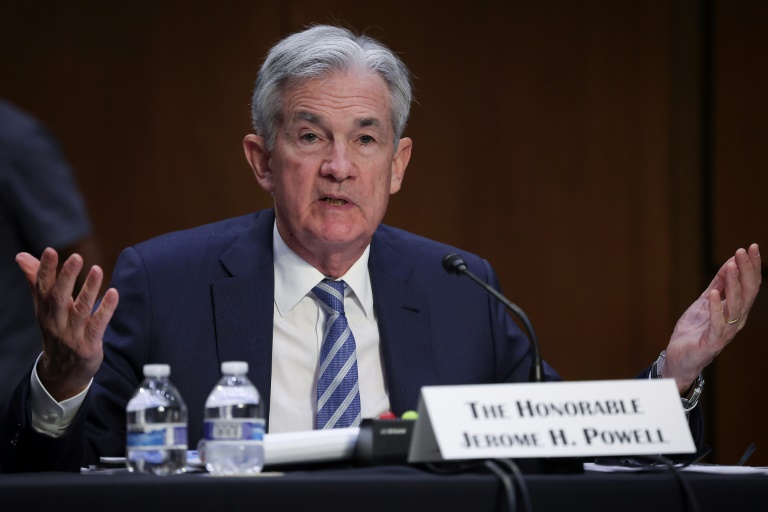
“The Fed hasn’t even gotten to neutral yet,” Jason England, of Janus Henderson Investors, told Bloomberg Television.

“For them to start easing already or for them to start seeing eases priced in is, I think, a little premature.”

– Oil on the rise –

All eyes are now on the Fed meeting later in the day, which is followed Thursday by second-quarter economic growth figures.

Officials are widely tipped to announce a second successive three-quarter point increase but the main focus will be their outlook for the economy and clues about future moves as it begins to falter.

“Markets are pricing at a slower pace of tightening before the Fed pivots to an easing stance in 2023,” said SPI Asset Management’s Stephen Innes.

“However, Fed Chair Jerome Powell has been pushing back against a recession outcome while highlighting an outsized focus on combating inflation.”

And CMC Markets analyst Michael Hewson added: “Anyone thinking that in light of recent data that the Fed is likely to soften its tone is probably going to be disappointed.

“The last thing the Fed wants to do now is to allow the market to think it’s about to embark on a dovish pivot, despite increasing evidence that the economy is slowing.”

Oil prices edged up as recession worries were offset by data showing a big drop in US stockpiles, which pointed to strong demand at a time when supplies remain weak.

– Key figures at around 0810 GMT –

Tokyo – Nikkei 225: UP 0.2 percent at 27,715.75 (close)

Hong Kong – Hang Seng Index: DOWN 1.1 percent at 20,670.04 (close)

Shanghai – Composite: DOWN 0.1 percent at 3,275.76 (close)

London – FTSE 100: UP 0.4 percent at 7,338.70

Euro/dollar: UP at $1.0138 from $1.0126 Tuesday

Pound/dollar: UP at $1.2058 from $1.2030 

Euro/pound: DOWN at 84.08 pence from 84.09 pence

Dollar/yen: DOWN at 136.89 yen from 136.95 yen

West Texas Intermediate: UP 1.3 percent at $96.19 per barrel

Brent North Sea crude: UP 0.9 percent at $105.38 per barrel

New York – Dow: DOWN 0.7 percent at 31,761.54 (close)

— Bloomberg News contributed to this story —

Eye-popping: Saudi prince unveils mirrored skyscraper eco-city

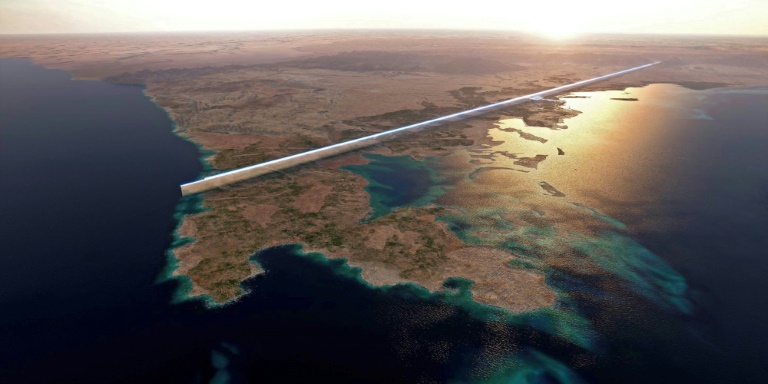
A futuristic Saudi megacity is to feature two skyscrapers extending across a swathe of desert and mountain terrain, according to the latest disclosures on the project by the kingdom’s de facto ruler.

The parallel structures of mirror-encased skyscrapers extending over 170 kilometres (more than 100 miles), known collectively as The Line, form the heart of the Red Sea megacity NEOM, a plank of Crown Prince Mohammed bin Salman’s bid to diversify the Gulf state’s oil-dependent economy.

First announced in 2017, NEOM has consistently raised eyebrows for proposed flourishes like flying taxis and robot maids, even as architects and economists have questioned its feasibility.

In a presentation Monday night, Prince Mohammed sketched out an even more ambitious vision, describing a car-free utopia that would become the planet’s most liveable city “by far”.

Analysts noted, though, that plans for NEOM have changed course over the years, fuelling doubts about whether The Line will ever become reality.

NEOM was once touted as a regional “Silicon Valley”, a biotech and digital hub spread over 26,500 square kilometres (10,000 square miles).

Now it’s a vehicle for reimagining urban life on a footprint of just 34 square kilometres, and addressing what Prince Mohammed describes as “liveability and environmental crises”.

“The concept has morphed so much from its early conception that it’s sometimes hard to determine its direction: scaling down, scaling up, or making an aggressive turn sideways,” said Robert Mogielnicki of the Arab Gulf States Institute in Washington.

– Population boom –

Officials had earlier said NEOM’s population would top one million, but Prince Mohammed said the number would actually hit 1.2 million by 2030 before climbing to nine million by 2045.

The eye-popping total is part of a hoped-for nationwide population boom that Prince Mohammed said would be necessary to make Saudi Arabia, the world’s biggest crude exporter, an economic powerhouse.

The goal for 2030 is to have 50 million people — half Saudis and half foreigners — living in the kingdom, up from roughly 34 million today.

By 2040 the target is 100 million people, he said.

“That’s the main purpose of building NEOM, to raise the capacity of Saudi Arabia, get more citizens and more people in Saudi Arabia. And since we are doing it from nothing, why should we copy normal cities?”

The site will be powered by 100 percent renewable energy and feature “a year-round temperate micro-climate with natural ventilation”, a promotional video released Monday said.

Past environmental pledges by the kingdom, such as a vow to achieve net zero carbon emissions by 2060, have sparked scepticism from environmentalists.

NEOM is well-positioned to harness solar and wind energy, and plans are also afoot for the city to host the world’s largest green hydrogen plant, said Torbjorn Soltvedt of risk intelligence company Verisk Maplecroft.

“But the feasibility of NEOM as a whole is still unclear given the unprecedented scale and cost of the project,” he said.

– Finding funds –

At just 200 metres (yards) wide, The Line is intended to be Saudi Arabia’s answer to unchecked and wasteful urban sprawl, layering homes, schools and parks on top of each other in what planners term “Zero Gravity Urbanism”.

Residents will have “all daily needs” reachable within a five-minute walk, while also having access to other perks like outdoor skiing facilities and “a high-speed rail with an end-to-end transit of 20 minutes”, according to a statement.

Though NEOM will operate under its own founding law, which is still being prepared, Saudi officials say they have no plans to waive the kingdom’s alcohol ban.

An airport is already operational at NEOM, and authorities announced in May it would begin receiving regular flights from Dubai, but it is unclear whether major construction of the megacity itself has commenced.

NEOM said Tuesday it would create 380,000 jobs by the end of the decade “whilst providing the ultimate work-life balance”.

The “first phase” of the project, lasting until 2030, will cost 1.2 trillion Saudi riyals (roughly $319 billion), Prince Mohammed said.

Besides government subsidies, potential sources of funding include the private sector and an initial public offering for NEOM expected in 2024, he said.

Securing the necessary financing remains a potential challenge, though the current climate is more favourable than during the coronavirus pandemic that lowered oil prices.

“But funding is only part of the equation… demand is harder to buy, especially when you’re asking people to be part of an experiment on living and working in the future,” Mogielnicki said.

Drought threatens Spain's 'green gold' harvest

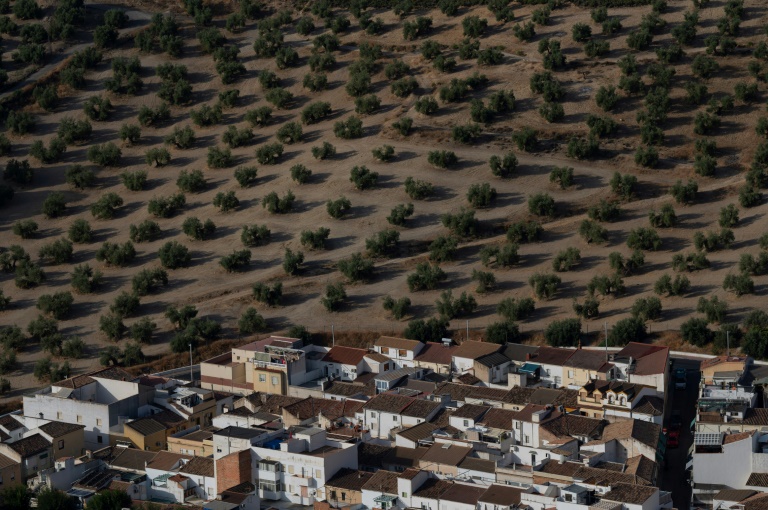
In the scorching heat, Felipe Elvira inspects the branches of his olive trees, planted as far as the eye can see on a dusty hillside in southern Spain.

“There are no olives on these. Everything is dry,” the 68-year-old said.

He and his son own a 100-hectare (250-acre) olive farm in the southern province of Jaen in sun-drenched Andalusia, a region which produces the bulk of the country’s olive oil.

But a severe drought gripping much of Spain threatens to shrivel their harvest this year.

“We are used to a lack of water, but not to this point,” said Elvira.

The region used to get 800 litres (210 gallons) of rainfall per square metre, but is set to get around half that amount this year, he said. 

“Every year it’s worse,” Elvira said.

Global warming is hitting Spain harder than most European nations. 

The country has suffered three intense heatwaves since May, damaging crops already grappling with an unusually dry winter.

“Olive trees are very resistant to water scarcity,” said Juan Carlos Hervas, an expert with the COAG farmers’ union.

But when droughts become extreme, the trees “activate mechanisms to protect themselves. They don’t die but no longer produce anything,” he added.

– ‘Absolutely dramatic’ –

Hervas predicts the olive harvest from unirrigated land will come in at less than 20 percent of the average of the last five years.

The harvest from irrigated land will be just 50 to 60 percent of this average, he said.

But water reserves are dwindling.

The Guadalquivir river, which provides Andalusia with a large part of its water, is in “an absolutely dramatic situation” due to the lack of rain, said Rosario Jimenez, a hydrology professor at the University of Jaen.

Reservoirs fed by the river are at just 30 percent of their capacity, according to Spain’s ecological transition ministry.

“Some are even at 10 percent capacity — that is practically dried up,” said Jimenez.

Farmers have also noticed changes in recent years.

“Not only does it rain less, but when it falls, it does so torrentially. The water flows without penetrating the earth,” said Hervas.

Parts of Portugal and Spain are the driest they have been in a thousand years due to an atmospheric high-pressure system driven by climate change, according to a study published this month in the journal Nature Geoscience.

The phenomenon is set to increase, jeopardising crops like olives and grapes.

At stake is a key export: Spain supplies nearly half of the world’s olive oil. Its exports of this “green gold” are worth some 3.6 billion euros ($3.7 billion) per year.

– Olive dependence –

Olive oil has been an essential part of the Mediterranean diet for thousands of years and olive trees cover many hillsides in southern Spain, which are often unsuitable for other crops.

“Many villages here depend entirely on olive trees. Without olives, there is no more revenue,” said Hervas.

Seven out of 10 hectares of olive farmland in Spain are not irrigated, according to the COAG farmers’ union.

With the rise in temperatures, 80 percent of Andalusia’s unirrigated olive tree plantations may no longer be suitable to grow olives, or at least some varieties of the crop, it added.

The quality could also decline because farmers will have to pick the fruit early, before it is fully mature, the union said in a recent report.

Some farmers may be tempted to start irrigating their plots, but this would deplete stretched reservoirs even further.

Agriculture already consumes up to four-fifths of Spain’s water resources, said Jimenez.

“Not all land can be irrigated,” she said.

Back at his farm, Elvira is all too aware of the problem.

“We can’t exhaust resources, everyone needs water. Honestly, I don’t know how we are going to manage,” he said.

Bitter harvest: Malaysian palm oil farmers face labour crunch

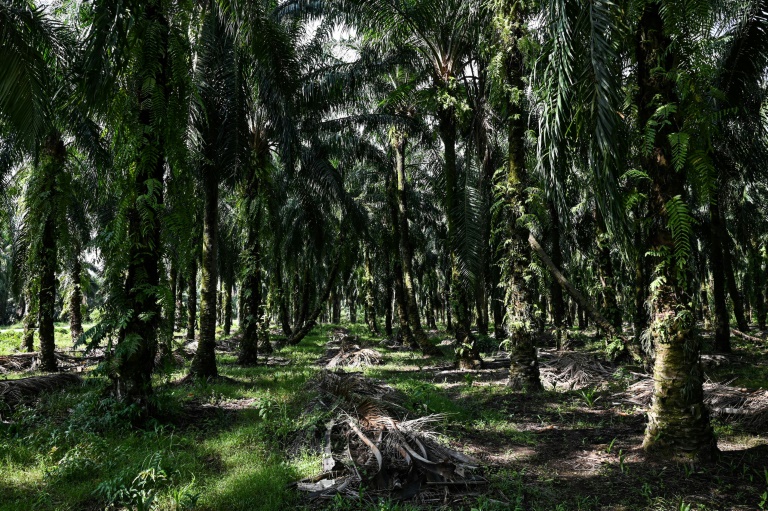
Overripe palm oil fruits hang untouched in trees while others lie rotting scattered around a plantation, as Malaysian farmers reap the bitter harvest of a severe labour shortage.

The tropical country is the world’s second-biggest producer of the edible vegetable oil, which is found in many everyday goods from chocolate to cosmetics. 

The sector has long been reliant on migrants from neighbouring Indonesia for back-breaking plantation work, which is shunned by most in more affluent Malaysia. 

Lengthy Covid border closures had already reduced the foreign labour force, but now bureaucratic hurdles and a ban by Indonesia on sending new workers have dramatically worsened the problems.

“A lot of bunches of fruit are rotting on the trees,” Suzaidee Rajan, 47, who owns a 300-acre (120-hectare) plantation in Ijok, central Selangor state, told AFP. 

“We usually harvest twice a month. But now due to the labour shortage, we can (do so) just once a month. Our income has plunged and locals are angry.”

With just four foreign workers — two fewer than the number he needs — Suzaidee now has to drive into his plantation and load the fruit onto a lorry himself.

Palm oil is a controversial commodity, blamed by environmentalists for fuelling the destruction of rainforest in Malaysia and Indonesia, which together produce 85 percent of global output. 

Green groups say rapid expansion of plantations has destroyed rare animals’ habitats, while there have been allegations of foreign workers being abused and mistreated on some estates. 

The sector nevertheless remains a major contributor to Malaysia’s economy, and has continued to attract foreign workers who can earn higher wages than back home. 

Agricultural firms run large estates, while there are also numerous small-scale farmers like Suzaidee.

– ‘Darkness on horizon’ –

Other Malaysian industries, including construction and manufacturing, also rely on migrant workers from across Asia, and suffered as a result of lengthy pandemic border closures.

While authorities ended a freeze on hiring foreigners in February, labourers have been slow to return because of red tape and difficult negotiations with countries of origin. 

Problems in the plantation sector have been particularly acute, however, and look set to get worse after Indonesia banned sending new workers to Malaysia earlier this month.

Hermono — Indonesia’s ambassador in Kuala Lumpur, who goes by one name — said Jakarta took the decision as Malaysia was not abiding by an agreement aimed at protecting his compatriots.  

The Malaysian estate owners’ association says there is currently a shortage of about 120,000 workers. 

And this month Minister Zuraida Kamaruddin, who oversees the plantation sector, said the industry lost 10.46 billion ringgit ($2.35 billion) in the first five months of 2022 as palm oil fruit was left unharvested. 

“I can see only darkness on the horizon unless migrant workers are brought into the country immediately,” farmer Sahman Duriat, who has a plantation in Ijok, told AFP. 

“My earnings are falling while inflation and production costs are rising.”

After the Indonesian ban was announced, Malaysia’s human resources ministry vowed to address Jakarta’s concerns quickly to ensure it is reversed. 

For Indonesian plantation workers still in Malaysia, there is now much more to do.

“Usually we work in a group of five… but now there are just two of us,” said Zan, who goes by one name, as he cut fruit from a tree while a second man loaded it into a wheelbarrow.

“We harvest 200 tonnes a month with five people but now only 80 tonnes with just two of us.”

Eye-popping: Saudi prince unveils mirrored skyscraper eco-city

A futuristic Saudi megacity is to feature two skyscrapers extending across a swathe of desert and mountain terrain, according to the latest disclosures on the project by the kingdom’s de facto ruler.

The parallel structures of mirror-encased skyscrapers extending over 170 kilometres (more than 100 miles), known collectively as The Line, form the heart of the Red Sea megacity NEOM, a plank of Crown Prince Mohammed bin Salman’s bid to diversify the Gulf state’s oil-dependent economy.

First announced in 2017, NEOM has consistently raised eyebrows for proposed flourishes like flying taxis and robot maids, even as architects and economists have questioned its feasibility.

In a presentation Monday night, Prince Mohammed sketched out an even more ambitious vision, describing a car-free utopia that would become the planet’s most liveable city “by far”.

Analysts noted, though, that plans for NEOM have changed course over the years, fuelling doubts about whether The Line will ever become reality.

NEOM, a biotech and digital hub spread over 26,500 square kilometres (10,000 square miles), was once touted as a regional “Silicon Valley”.

Now it’s a vehicle for reimagining urban life on a footprint of just 34 square kilometres, and addressing what Prince Mohammed describes as “liveability and environmental crises”.

“The concept has morphed so much from its early conception that it’s sometimes hard to determine its direction: scaling down, scaling up, or making an aggressive turn sideways,” said Robert Mogielnicki of the Arab Gulf States Institute in Washington.

– Population boom –

Officials had earlier said NEOM’s population would top one million, but Prince Mohammed said the number would actually hit 1.2 million by 2030 before climbing to nine million by 2045.

The eye-popping total is part of a hoped-for nationwide population boom that Prince Mohammed said would be necessary to make Saudi Arabia, the world’s biggest crude exporter, an economic powerhouse.

The goal for 2030 is to have 50 million people — half Saudis and half foreigners — living in the kingdom, up from roughly 34 million today.

By 2040 the target is 100 million people, he said.

“That’s the main purpose of building NEOM, to raise the capacity of Saudi Arabia, get more citizens and more people in Saudi Arabia. And since we are doing it from nothing, why should we copy normal cities?”

The site will be powered by 100 percent renewable energy and feature “a year-round temperate micro-climate with natural ventilation”, a promotional video released Monday said.

Past environmental pledges by the kingdom, such as a vow to achieve net zero carbon emissions by 2060, have sparked scepticism from environmentalists.

NEOM is well-positioned to harness solar and wind energy, and plans are also afoot for the city to host the world’s largest green hydrogen plant, said Torbjorn Soltvedt of risk intelligence company Verisk Maplecroft.

“But the feasibility of NEOM as a whole is still unclear given the unprecedented scale and cost of the project,” he said.

– Finding funds –

At just 200 metres (yards) wide, The Line is intended to be Saudi Arabia’s answer to unchecked and wasteful urban sprawl, layering homes, schools and parks on top of each other in what planners term “Zero Gravity Urbanism”.

Residents will have “all daily needs” reachable within a five-minute walk, while also having access to other perks like outdoor skiing facilities and “a high-speed rail with an end-to-end transit of 20 minutes”, according to a statement.

Though NEOM will operate under its own founding law, which is still being prepared, Saudi officials say they have no plans to waive the kingdom’s alcohol ban.

An airport is already operational at NEOM, and authorities announced in May it would begin receiving regular flights from Dubai, but it is unclear whether major construction of the megacity itself has commenced.

The “first phase” of the project, lasting until 2030, will cost 1.2 trillion Saudi riyals (roughly $319 billion), Prince Mohammed said.

Besides government subsidies, potential sources of funding include the private sector and an initial public offering for NEOM expected in 2024, he said.

Securing the necessary financing remains a potential challenge, though the current climate is more favourable than during the coronavirus pandemic that lowered oil prices.

“But funding is only part of the equation… demand is harder to buy, especially when you’re asking people to be part of an experiment on living and working in the future,” Mogielnicki said.

Close Bitnami banner
Bitnami