US Business

China lockdown worries hit equities, oil prices

Stock markets and oil prices slid Monday with a fresh Covid flare-up in Shanghai fanning fears of another painful lockdown in China’s biggest city.

European equities headed south following hefty losses for most main Asian markets, with all eyes on how Wall Street would react at the US reopening.

A forecast-busting US jobs report Friday indicated the world’s top economy was coping with Federal Reserve interest rate hikes, giving the central bank further room for more tightening as it battles soaring inflation.

“This week sees three catalysts which could shake investors out of their torpor as we get the latest reading of US inflation, GDP (gross domestic product) figures from China and the big US banks kick-off the second quarter earnings season across the Atlantic,” said AJ Bell investment analyst Danni Hewson.

Traders were keeping tabs on US President Joe Biden as he weighs removing some of the tariffs on Chinese goods worth hundreds of billions of dollars that were imposed by predecessor Donald Trump.

– China growth fears –

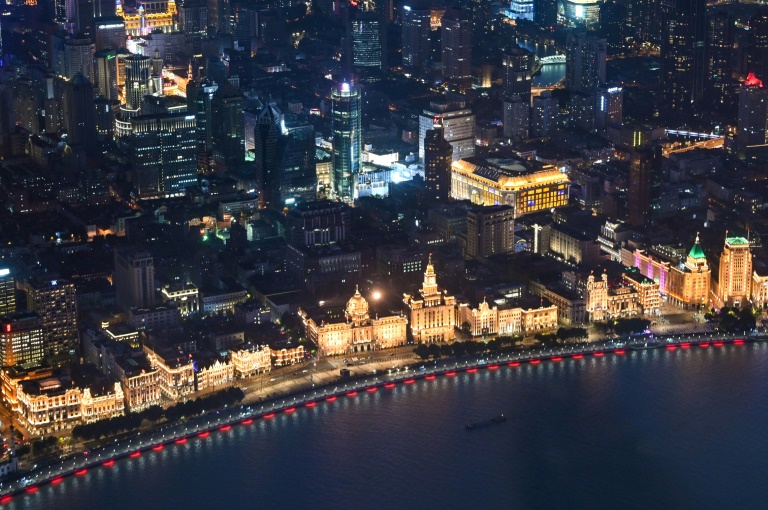
The prospect of another lockdown sparked an equities sell-off in Hong Kong and Shanghai on Monday.

Chinese tech firms took a battering after authorities fined giant Tencent and Alibaba over not properly reporting past deals.

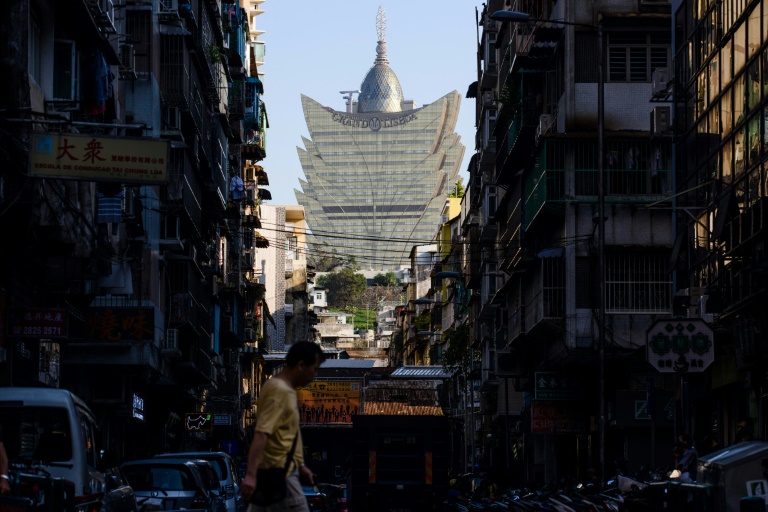
Hong Kong-listed casino operators were also sharply lower after officials in Macau embarked on a week-long lockdown to curb its worst coronavirus outbreak.

There were also losses in Sydney, Seoul, Taipei, Manila, Mumbai, Jakarta and Wellington.

However, there Tokyo rose as traders welcomed Japan’s ruling bloc securing a strong win in Sunday’s upper house election, held days after the assassination of former premier Shinzo Abe.

The result should provide the government with some stability, while there were also hopes for a cabinet reshuffle and economic stimulus.

Shanghai recorded more than 120 virus cases at the weekend, having seen its first one of the highly contagious BA.5 Omicron strain, forcing officials to launch another mass testing drive.

With China fixated on its zero-Covid strategy of wiping out the disease, there is increasing concern that authorities will revert to another painful lockdown, with Shanghai residents having only emerged from a two-month confinement in June.

There have meanwhile been new infections uncovered in other parts of the country, including Beijing.

Data this week will provide a fresh update on the economic impact of those measures, as well as similar strict controls in Beijing.

– Key figures at around 1030 GMT –

London – FTSE 100: DOWN 0.5 percent at 7,158.48 points

Frankfurt – DAX: DOWN 0.8 percent at 12,917.93

Paris – CAC 40: DOWN 0.7 percent at 5,993.76

EURO STOXX 50: DOWN 0.6 percent at 3,485.82

Tokyo – Nikkei 225: UP 1.1 percent at 26,812.80 (close)

Hong Kong – Hang Seng Index: DOWN 2.8 percent at 21,124.20 (close)

Shanghai – Composite: DOWN 1.3 percent at 3,313.58 (close)

New York – Dow: DOWN 0.2 percent at 31,338.15 (close)

West Texas Intermediate: DOWN 2.3 percent at $102.36 per barrel

Brent North Sea crude: DOWN 1.9 percent at $105.01 per barrel

Euro/dollar: DOWN at $1.0102 from $1.0183 on Friday

Pound/dollar: DOWN at $1.1938 from $1.2034 

Euro/pound: UP at 84.62 pence from 84.59 pence

Dollar/yen: UP at 137.05 yen from 136.10 yen

500 New York couples attend mass celebration after pandemic-hit weddings

About 500 couples celebrated their unions under a blue sky Sunday in a New York event aimed at healing the wounds of the Covid-19 pandemic. 

Garlands on their heads, the couples, many of them already married, walked in procession before a symbolic ceremony by an imam, a rabbi and a pastor. 

Some could hardly hold back their tears. 

“We were supposed to get engaged on March 24, 2020 in Hawaii, but obviously the pandemic canceled everything,” Erica Hackman told AFP, hanging on her husband Richard’s arm in the festive atmosphere at Damrosch Park. 

The couple, who are expecting a child, got married the following year on a rooftop with just immediate family members in attendance. 

“Everybody wore masks,” recalled 35-year-old Erica. 

“It was a very small wedding… so now this feels like a really big deal to come and celebrate with other people who went through the same thing,” said Richard, 37. 

— ‘Just celebrating love’ —

Hit hard by the pandemic, New York came to a standstill in 2020, with images of a deserted Times Square and makeshift morgues becoming emblems of the crisis.

Hosted by the Lincoln Center — the famed arts complex on Manhattan’s Upper West Side — the event was billed as a celebration for couples whose weddings had been disrupted.

But everyone was welcome.

Some, like Esther Friesner Stutzman and her husband Walter Stutzman, had been married for decades. 

“He promised me a trip to Paris,” she said, smiling. 

Wonderful Lloyd-Kline, who married her spouse Anisa in 2008 in Toronto, Canada was happy “to have a day that’s just celebrating love. 

“We’re a same-sex couple, it’s very important for us to come out and celebrate and show ourselves out here public as much as we can,” the 56-year-old said, before referring to the US Supreme Court, which some fear will undermine marriage equality after its recent decision to roll back abortion rights. 

Anne-Marie Colon, 59, strolled among the couples with a photo of her fiance Louis Steven, a professor from the Bronx neighborhood who died of Covid in April 2020. 

“The week that he passed away, we were supposed to be in Aruba getting married. And so I thought coming today would be a nice celebration for the life that he and I had together for 11 years,” she said.

Macron under pressure over Uber links

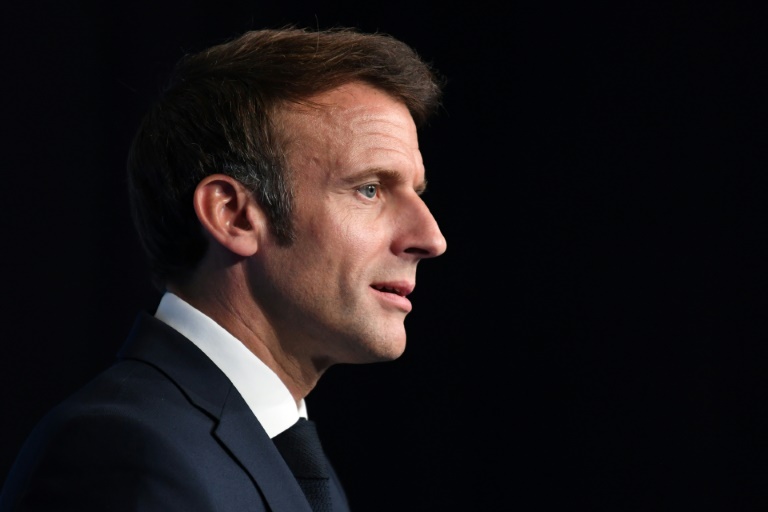
French President Emmanuel Macron was under pressure Monday to explain his past support for taxi app Uber while he was economy minister, following media revelations that have been seized on by critics. 

Investigations by media including France’s Le Monde newspaper and Britain’s The Guardian claimed Macron held several undeclared meetings with Uber executives while minister from 2014-2016.

Citing leaked internal documents and text messages, Le Monde also alleged that Uber struck a secret “deal” with Macron on regulation of the company’s services at a time when it was upending the traditional taxi market.

Opposition MPs on the left and far-right slammed the president, a former investment banker who positioned himself as a pro-enterprise, pro-innovation politician when he emerged as a national figure in 2014. 

Macron was “a lobbyist at the service of foreign private economic interests,” senior far-right MP Sebastien Chenu told France Info radio on Monday morning.

The 44-year-old president was “an ideologue for deregulation, for globalisation,” Chenu added.

Hard-left MP Alexis Corbiere from the France Unbowed party suggested a parliamentary enquiry, which could prove embarrassing for the 44-year-old leader who lost his majority in the National Assembly last month.

“It’s very serious the idea that with this secret pact Mr Macron de-regulated the regulation of the taxi industry,” he told Public Senat television. “What lessons should be drawn?

“Obviously we’ll ask the questions to the government when we can, and a parliamentary enquiry as well,” he added.

As announced last week, France Unbowed is set to table a no-confidence motion against the government later Monday which is not expected to pass.

– Uber ‘partner’? –

According to the reports, the “secret deal” entailed Macron promising to help Uber work around legislation introduced in 2014, which sought to regulate the new app-based taxi hailing services.

Le Monde described Macron as “more than a supporter, almost a partner” for Uber over the course of 17 meetings held by him or his staff with company executives at a time when the firm faced multiple legal enquiries.

Macron rarely responds to public criticism and his agenda on Monday includes a meeting with the heads of multinational investors in France at the annual “Choose France” summit at the Versailles chateau outside Paris.

Around 180 executives are expected, an increase from previous years which demonstrated “the very strong interest by foreign bosses after the president’s re-election,” an aide said. 

Macron beat far-right veteran Marine Le Pen to win a second term in April, promising tax cuts and welfare reform to boost employment, as well as major public investments in key industries of the future.

But his party failed to secure a parliamentary majority last month when Le Pen’s far-right and the hard-left made major gains.

On Monday, his office announced a major investment worth 5.7 billion euros ($5.8 billion) for a new semiconductor factory in southeast France by French-Italian chipmaker STMicroelectronics and US-based GlobalFoundries.

– Employment –

Contacted by AFP, Uber France confirmed that the company had been in contact with Macron during his time as minister. 

The meetings had been in the normal course of his ministerial duties, which covered the private-hire sector, it said.

The president’s office told AFP that at that time Macron had “naturally” been in contact with “many companies involved in the profound change in services that has occurred over the years mentioned, which should be facilitated by unravelling certain administrative or regulatory locks”.

Macron was a vocal and public supporter of Uber when it arrived in France — contrary to many colleagues in the Socialist government of the time.

He defended it as providing employment for people in low-income areas and as a means of breaking the monopoly held by taxi companies. 

“Go to Stains (a deprived area north of Paris) and tell young people there who are willingly working for Uber that it would be better to do nothing or deal drugs,” Macron argued in an interview with Mediapart in 2016. 

He also found support on Monday among people who remembered the long waits for taxis in Paris and other cities, as well as drivers who refused to take bank cards as payment.

“Fortunately there were ministers and elected figures who questioned all this,” Herve Joly, a sociologist from the CNRS research group, wrote on Twitter.

The Uber Files investigation is based on a leak of tens of thousands of documents to Britain’s Guardian newspaper from an anonymous source, and has been coordinated by the International Consortium of Investigative Journalists.

The ICIJ is working with 42 media partners around the world on the story.

burs-adp/tgb/rl

Europe frets over reduced Russia gas supplies

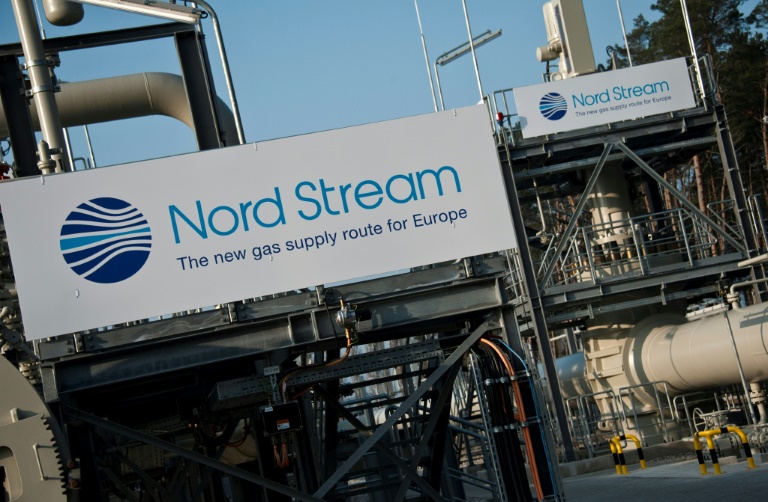
Russian energy giant Gazprom began 10 days of maintenance on its Nord Stream 1 pipeline on Monday — with Germany and other European countries watching anxiously to see if the gas comes back on.

The annual work on the gas link was scheduled long in advance. But the fear is that — with relations between Russia and the West at their lowest in years because of the invasion of Ukraine — Gazprom might take the opportunity to simply shut off the valves.

“Putin is going to turn off the gas tap… but will he turn it back on one day?” German mass-market daily Bild asked on Sunday on its website.

After the Nord Stream stop on Monday morning, Italian energy company Eni and Austrian Group OMV both reported their supplies from Gazprom had also been reduced.

“There are a number of scenarios in which we could end up in an emergency,” Klaus Mueller, the head of Germany’s federal gas network regulator, told public broadcaster ZDF on Monday.

– ‘Unprecedented’ –

“We are confronted with an unprecedented situation — anything is possible,” German vice-chancellor Robert Habeck told public radio over the weekend.

“It is possible that the gas will flow once more, even at a higher volume level than before.”

But, he warned, “it is possible that nothing comes through, and we still have to prepare for the worst” as Europe scrambles to transition away from Russia for energy supplies.

Moscow had already wound down supplies by 60 percent in recent weeks, blaming the absence of a turbine even as Berlin denounced what it calls a “political” decision.

Those cuts had a knock-on effect on supplies to a number of EU states, while Poland and Bulgaria have also seen theirs stopped altogether.

One issue at least was resolved over the weekend, when Canada agreed to return to Germany the turbine, which had been undergoing maintenance, despite the objections of Ukraine.

German Chancellor Olaf Scholz, via his spokesman, on Sunday welcomed “the decision of our Canadian friends” to grant what Ottawa termed a time-limited and revocable permit for Siemens Canada to allow the machine’s return.

Berlin has also speculated that for technical reasons it would be difficult for Gazprom to stop deliveries via Nord Stream entirely.

As Habeck put it, “it is not like a water tap” that can simply be turned on or off, with gas extracted in Siberia not able to be stored indefinitely.

– Ration fears –

Following Russia’s invasion of Ukraine in February, Germany suspended certification of a second pipeline, Nord Stream 2, as fears grew over Europe’s massive dependence on Russian gas supplies.

But even now, a long-term shutdown of the pipeline would hit Germany and its EU neighbours hard, deepening an energy crisis in which uncertain supplies have pushed prices up ahead of Europe’s winter.

Germany imports some 35 percent of its gas from Russia compared with 55 percent before the Ukraine conflict started.

In France, Economy Minister Bruno Le Maire said Sunday the country should ready itself for a “complete cut” in supplies from Russia.

“That is currently the most likely outcome,” he said. 

German industry is very vulnerable to shortages, with authorities discussing the possibility of having to ration supplies.

Chemical trade group VCI president Christian Kullmann told the Sueddeutsche Zeitung daily Monday an end to supplies would amount to a “heart attack for the economy”.

If deliveries cease altogether, German multinational chemical firm BASF is considering furloughing part of its roughly 100,000 workforce.

“We need to do everything to start saving gas now. Optimising heating, discussing it among families, preparing industry. We are not powerless,” gas network regulator boss Mueller said Monday.

On Thursday, the German parliament adopted a plan which includes limiting winter heating on its premises to a maximum 20 Celsius (68 degrees Fahrenheit) and cutting hot water supplies in individual offices.

STMicro and GlobalFoundries plan 5.7 bn euro French factory

French-Italian chipmaker STMicroelectronics and US-based GlobalFoundries will plough 5.7 billion euros ($5.8 billion) into a new semiconductor factory in France, the firms and President Emmanuel Macron’s office said Monday.

The two firms aim “to create a new, jointly-operated semiconductor manufacturing facility adjacent to ST’s existing 300mm facility in Crolles,” STMicroelectronics said in a statement, referring to its plant outside Grenoble in southeastern France.

Expected to employ around 1,000 people, the factory should reach full capacity by 2026, the company added, with the factory seen as part of efforts to reduce European dependency on Asian manufacturing.

Chip factories like STMicroelectronics’s produce integrated circuits on 300-millimetre (12-inch) circular “wafers” of silicon.

GlobalFoundries and STMicroelectronics plan to produce their latest designs at the plant, with some elements as tiny as 18 nanometres — around 5,000 times smaller than the thickness of a sheet of paper.

Such chips “are expected to remain in high demand for automotive, internet of things and mobile applications for the next few decades,” STMicroelectronics said.

The company added that the factory would receive “significant financial support from the state of France”.

“This is the biggest industrial investment of recent decades outside of the nuclear industry,” French Finance Minister Bruno Le Maire wrote on Twitter.

“It’s a big step for our industrial sovereignty.”

– Push for European supply –

President Macron plans to visit the existing factory on Tuesday to outline government plans to support chip manufacturing with “more than five billion euros” as part of an industrial programme dubbed “France 2030”, his office said.

He was one of the loudest voices pushing for more chipmaking capacity in the EU, where the European Commission earlier this year proposed a 43-billion-euro “Chips Act” to boost the field.

Disruption to supply chains during the Covid-19 pandemic has focused policymakers’ minds on diversifying sources of key components.

Shortages of chips mostly produced in Asia have held up vital European industries like carmaking even after health restrictions were relaxed.

US chip giant Intel said in March it would pump up to 80 billion euros into its EU operations over the coming decade, especially in Germany, France and Ireland.

In France, the new Crolles factory would “strongly contribute to the objectives of the European Chips Act, including the goal of Europe reaching 20 percent of worldwide semiconductor production by 2030,” STMicroelectronics said.

The Elysee said Crolles “will become France’s biggest semiconductor production site and one of the largest in Europe”.

Monday’s announcement of the new factory was a top prize for Macron on the day of his annual “Choose France” summit.

The president invites top businesspeople and financiers each year to the sumptuous Versailles palace outside Paris in a bid to attract foreign investment.

Finance minister Le Maire said on Twitter this year’s haul totalled 6.7 billion euros of investment and more than 4,000 new jobs.

In 2021, France claimed to be Europe’s top destination for foreign investment, with 1,222 individual projects — although a study by consultancy EY found that most of them were small in scale.

China detains alleged bank fraud 'gang' after rare mass protests

Members of a “criminal gang” accused of taking control of local banks have been arrested in central China after rare protests over alleged financial corruption sparked violent clashes between customers and authorities.

China’s rural banking sector has been hit hard by Beijing’s efforts to rein in a property bubble and spiralling debt, in a financial crackdown that has had ripple effects across the world’s second largest economy.

The slowdown forced four banks in Henan province to freeze all cash withdrawals since mid-April, leaving thousands of small savers without funds and sparking sporadic demonstrations.

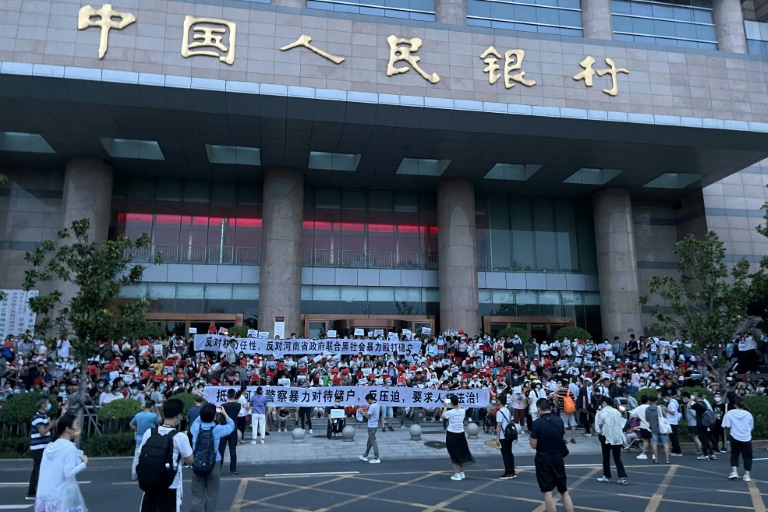
In one of the largest such rallies yet, hundreds gathered Sunday outside a branch of the People’s Bank of China in Henan’s capital Zhengzhou demanding their money, according to multiple witnesses who declined to be named.

Protesters held banners accusing local officials and police of corruption, calling on the central government to “give severe punishment” to those responsible, video footage verified by AFP showed.

Footage of Sunday’s rally showed protesters throwing objects, while one participant told AFP that demonstrators were hit and injured by unidentified men.

Another video verified by AFP showed a man with a swollen eye saying he had been beaten by “gangsters” and dragged onto a bus by police.

Some demonstrators accused officials of colluding with local banks to suppress rallies, and provincial authorities were suspected last month of abusing the country’s mandatory Covid-19 health code to effectively bar protesters from public spaces.

The pass has become a ubiquitous part of life in China under Beijing’s strict Covid-zero strategy, and is required to access the vast majority of buildings, shopping centres, public places and also certain public transport.

Protests are relatively rare in the tightly controlled country, where authorities enforce social stability at all cost and where opposition is swiftly repressed.

But desperate citizens have occasionally succeeded in organising mass gatherings, usually when their targets are local governments or individual corporations.

– Deepening crisis – 

Local authorities did not immediately comment on the unrest, but police in neighbouring Xuchang city said they had arrested members of an alleged “criminal gang” for their suspected involvement in a scheme to gain control of local banks.

The gang made illegal transfers through fictitious loans and used their shareholdings — as well as “manipulation of executives” — to effectively take over several local banks starting in 2011, police said late Sunday.

Henan province’s banking and insurance regulator also said it was “accelerating” plans to tackle the local financial crisis and “protect the legal rights and interests of the broader public”.

But analysts expect the economic crisis to deepen and the fallout from last year’s collapse of property giant Evergrande to continue.

The issues “appear to be the tip of the iceberg of serious systemic and financial risks with small- and medium-sized banks in China,” a report by risk consultancy SinoInsider found last week.

“Other small- and medium-sized banks could soon be found to be facing similar problems, particularly as financial contagion from Evergrande’s debt crisis spreads further and the Chinese economy markedly deteriorates,” it added.

– ‘Why are you treating people like this?’ –

The demonstrators in Henan largely drew sympathy on Chinese social media on Monday, with many on the Weibo platform pointing the finger at local officials.

“Why are you treating ordinary people like this?” one Weibo user asked in a post on Monday. 

“Please strictly investigate the Henan government.”

Online discourse surrounding the protest remained tightly controlled, however, with Weibo disabling the hashtag for “the incident of Zhengzhou police hitting the public”, which some people posting about Sunday’s violent clashes had used.

Meanwhile, a report that said protesters had been beaten at the Zhengzhou protest was removed from the English-language website of state-backed outlet Sixth Tone just hours after it was published.

China lockdown worries hit Asian equities, crude prices

Asian markets and oil prices fell Monday with a fresh Covid flare-up in Shanghai fanning fears of another economically painful lockdown in China’s biggest city.

The news came after a forecast-busting US jobs report last week indicated the world’s top economy was coping so far with the Federal Reserve interest rate hikes, giving it room for more as it battles soaring inflation.

Traders are also keeping tabs on developments in Washington as President Joe Biden weighs removing some of the Donald Trump-era tariffs on Chinese goods worth hundreds of billions of dollars.

Shanghai recorded more than 120 virus cases at the weekend, having seen its first case of the highly contagious BA.5 Omicron strain, forcing officials to launch another mass testing drive.

With China fixated on its zero-Covid strategy of wiping out the disease, there is increasing concern that authorities will revert to another painful lockdown, with Shanghai residents having only emerged from a two-month confinement in June.

There have also been new infections uncovered in other parts of the country, including Beijing.

Data this week will provide a fresh update on the economic impact of those measures, as well as similar strict controls in Beijing.

The prospect of another lockdown sparked a sell-off in Hong Kong and Shanghai, with Chinese tech firms also taking a battering after authorities fined giant Tencent and Alibaba over not properly reporting past deals.

Hong Kong-listed casino operators were also sharply lower after officials in Macau embarked on a week-long lockdown to curb its worst coronavirus outbreak.

There were also losses in Sydney, Seoul, Taipei, Manila, Mumbai, Jakarta and Wellington.

However, there Tokyo rose as traders welcomed Japan’s ruling bloc securing a strong win in Sunday’s upper house election, held days after the assassination of former premier Shinzo Abe.

The result should provide the government with some stability, while there were also hopes for a cabinet reshuffle and economic stimulus.

London, Paris and Frankfurt were all sharply lower in the morning.

– Fed ‘must be resolute’ –

The weak start to the week followed a tepid lead from Wall Street, where the strong jobs reading ramped up bets on further big Fed rate hikes after officials said the economy was strong enough to withstand them.

“The resilience of the US labour market, with the unemployment rate at 3.6 percent, as well as jobs markets elsewhere, helps to offer a compelling narrative to those who think recession concerns are overblown,” said CMC Markets analyst Michael Hewson.

The central bank is predicted to announce a second successive 0.75 percentage point lift at its next meeting this month, while further big increases are also expected before the end of the year.

Policymakers have said they are determined to bring inflation down from four-decade highs, even if that means hurting growth.

On Friday, New York Fed president John Williams reiterated its determination, saying in a speech: “Inflation is sky-high, and it is the number one danger to the overall health and stability of a well-functioning economy.

“I want to be clear: this is not an easy task. We must be resolute, and we cannot fall short.”

Worries about another shock to the Chinese economy from possible shutdowns also dented oil markets as concerns about a hit to demand outweighed ongoing concerns about tight supplies.

Still, there is a view that prices will remain elevated for now.

“Covid numbers are ticking up again,” said SPI Asset Management’s Stephen Innes.

“Although the possible demand impact of a recession continues to weigh on sentiment, the prevailing view, at least for now, is that the longer-term structural issues facing the oil market will support prices.”

Investors will be keeping watch on Biden’s visit this week to Saudi Arabia, where he is expected to push for the crude giant to ramp up production to make up for the output lost to sanctions against Russia.

– Key figures at around 0810 GMT –

Tokyo – Nikkei 225: UP 1.1 percent at 26,812.80 (close)

Hong Kong – Hang Seng Index: DOWN 2.8 percent at 21,124.20 (close)

Shanghai – Composite: DOWN 1.3 percent at 3,313.58 (close)

London – FTSE 100: DOWN 1.2 percent at 7,113.73

West Texas Intermediate: DOWN 1.9 percent at $102.79 per barrel

Brent North Sea crude: DOWN 1.7 percent at $105.33 per barrel

Euro/dollar: DOWN at 1.0123 from 1.0183 on Friday

Pound/dollar: DOWN at 1.1967 from 1.2034 

Euro/pound: UP at 84.60 pence from 84.59 pence

Dollar/yen: UP at 136.80 yen from 136.10 yen

New York – Dow: DOWN 0.2 percent at 31,338.15

Ex-Trump advisor Bannon agrees to testify at Capitol riot hearings: reports

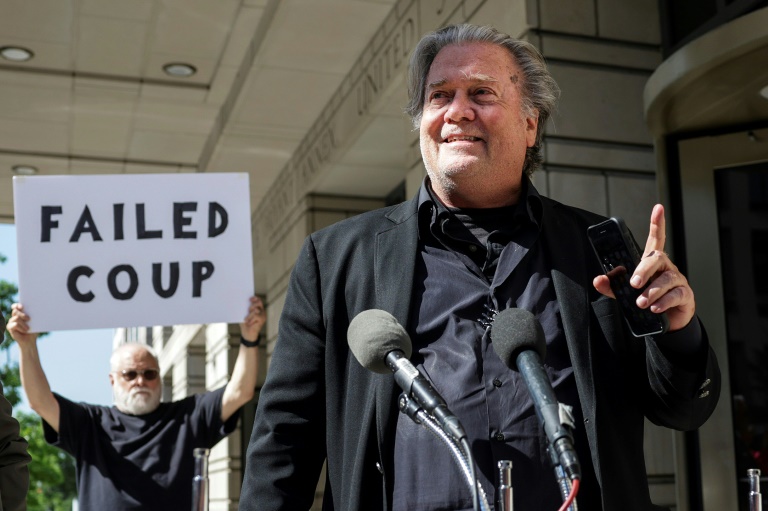
Former Trump advisor Steve Bannon has agreed to testify in the Capitol riot hearings, days before he was to face trial for defying a subpoena from the committee investigating the attack on Congress, US media reported Sunday.

“Mr. Bannon is willing to, and indeed prefers, to testify at your public hearing,” his lawyer Robert Costello wrote in a letter to the House Select Committee on Saturday, which was initially reported by The Guardian and cited by US media.

Bannon was among dozens of people called to testify on last year’s assault on the Capitol aimed at shutting down Congress over former president Donald Trump’s baseless claims that Joe Biden won the 2020 election due to voter fraud.

Investigators believe Bannon and other Trump advisors could have information on links between the White House and the mob that invaded the Capitol on the day it was due to certify Biden as winner.

Although he was not a White House employee or official Trump aide, Bannon’s attorneys had previously claimed he was protected by presidential executive privilege and did not have to cooperate with the committee.

According to the letter explaining his about-face, Bannon told the House Select Committee that “circumstances have now changed.”

“President Trump has decided that it would be in the best interests of the American people to waive executive privilege for Stephen K. Bannon, to allow Mr. Bannon to comply with the subpoena issued by your Committee.” 

In November last year, Bannon turned himself in to the FBI to face charges of contempt of Congress after refusing to testify on the January 6 Capitol assault.

“I’m never going to back down,” he told reporters at the time after appearing before a judge to hear the charges.

“We’re going on the offense on this. And stand by,” he said, repeating the phrase Trump used during the election in 2020 to encourage supporters of a far-right militia group.

Bannon, 68, was indicted by a grand jury with two misdemeanor counts of contempt, each one carrying a penalty of one month to one year in jail, and a fine of up to $100,000.

The attack, which left five people dead, succeeded in delaying the joint House-Senate election certification session for several hours.

Macau lockdown begins, Hong Kong mulls health code app

Macau casino shares plunged on Monday as the Chinese city embarked on a week-long lockdown to curb its worst coronavirus outbreak while neighbouring Hong Kong said it was mulling a mainland-style health code system.

Share prices of six gaming conglomerates — Sands China, Galaxy Entertainment, SJM Holdings, Melco International, MGM China and Wynn Macau — dropped by between six and nearly nine percent in Monday morning trade.

It is the first casino lockdown in more than two years, overriding a previous deal between the industry and the Macau government that only those found with infections would need to close temporarily.

Macau, the world’s biggest gambling hub, is the only place in China where casinos are legal but the pandemic has hammered the city’s fortunes as it sticks to Beijing’s zero-Covid model.

While casinos have remained open throughout most of the pandemic they have seen a fraction of pre-Covid business.

A Bloomberg gauge of the city’s six licensed casino operators is down 20 percent this year.

Authorities announced a week of lockdowns starting Monday after recording more than 1,500 infections in the past three weeks despite multiple rounds of compulsory mass testing of the city’s 650,000 people.

All residents must stay home except to go shopping for daily necessities and to get tested for the virus, with rule-breakers facing up to two years in jail.

Some public services and businesses such as supermarkets and pharmacies can stay open, and only people with special permission or a low-risk health code can use public transport.

China uses mandatory health code apps to trace people’s movements and coronavirus outbreaks. Only those with green codes can move freely.

It is a system that Hong Kong’s government is now considering employing, new health minister Lo Chung-mau said Monday.

“So-called freedom can sometimes be easily confused with selfishness,” Lo told RTHK radio.

“Infected people should not have the freedom to go wherever they want and affect our health.”

Hong Kong is being remoulded in the authoritarian mainland’s image after huge democracy protests three years ago.

The business hub has hewed to a lighter version of the zero-Covid model, which has battered the economy and left the city internationally cut off for more than two years.

The newly installed administration of chief executive John Lee, a former security official, has vowed to stamp out infections and restart travel to both the mainland and outside world.

To do that, authorities may need to deploy more mainland-style mass monitoring of the population.

Hong Kong currently uses a less restrictive mobile phone app than the mainland one, which keeps a resident’s vaccination record and is used to check into businesses and venues.

Europe frets over reduced Russia gas supplies

Russian gaz giant Gazprom begins 10 days of routine maintenance on its Nord Stream 1 pipeline on Monday — with Germany and other European countries watching anxiously to see if the gas comes back on.

The annual work on the two pipelines was scheduled long in advance. The fear is however that — with relations between Russia and the West at their lowest in years because of the invasion of Ukraine — Gazprom might take the opportunity to simply shut off the valves.

“Putin is going to turn off the gas tap… but will he turn it back on one day?” German mass daily Bild asked on Sunday on its website.

“We are confronted by an unprecedented situation — anything is possible,” German vice-chancellor, Robert Habeck, told public radio over the weekend.

“It is possible that the gas will flow once more, even at a higher volume level than before.”

But, he warned, “it is possible that nothing comes through, and we still have to prepare for the worst” as Europe scrambles to transition away from Russia for energy supplies.

– Turbines row –

One issue at least, was resolved over the weekend, when Canada agreed to return to Germany turbines needed to maintain the Nord Stream 1 gas pipeline, despite the objections of Ukraine.

German Chancellor Olaf Scholz, via his spokesman, on Sunday “saluted the decision of our Canadian friends” to grant what Ottawa termed a time-limited and revocable permit for Siemens Canada to allow the machine’s return.

Russia had insisted it needed the machine’s return before it could ramp supplies back up after several weeks of significant cuts.

Ukraine, however, last week accused Berlin of having given in to Russian “blackmail” after Moscow blamed reduced supplies on the repairs, not market conditions caused by the Ukraine war.

Moscow had wound down supplies by 60 percent in recent weeks, blaming the absence of the turbine even as Berlin denounced what it terms a “political” decision.

Those cuts had a knock-on effect on supplies to a number of EU states, including Poland and Bulgaria, who have seen theirs stopped altogether.

Berlin has explained that for technical reasons it would be difficult for Gazprom entirely to stop deliveries via Nord Stream.

As Habeck put it, “it is not like a water tap” that can simply be turned on or off.

Nord Stream 1 is the longest subsea pipeline in the world, running under the Baltic Sea from Russia to Germany and has been in operation for a decade.

Following Russia’s invasion of Ukraine in February, Germany suspended certification of a second pipeline, Nord Stream 2, as fears grew over Europe’s massive dependence on Russian gas supplies.

But even now, a long-term shutdown of the pipeline would hit Germany and its EU neighbours hard, deepening an energy crisis in which uncertain supplies have pushed prices up ahead of Europe’s winter.

– Ration fears –

Germany imports some 35 percent of its gas from Russia compared with 55 percent before the Ukraine conflict started.

The website of Nord Stream indicates that gas arriving in the German town of Lubmin continues to be sent on to Belgium, Denmark and France as well as Britain and the Netherlands.

German industry is very vulnerable to shortages and chemical trade group VCI says it is preparing “for the worst” with authorities discussing the possibility of having to ration supply.

If deliveries cease altogether, German multinational chemical firm BASF is considering furloughing part of its roughly 100,000 workforce.

And Klaus Mueller, the head of Germany’s energy regulator, warned: “If we no longer receive Russian gas… current stocks will only last for one or two months.”

On Thursday, parliament adopted a plan which includes limiting winter heating to a maximum 20 Celsius (68 degrees Fahrenheit) and cutting hot water supplies in individual offices.

Habeck warned of “difficult societal choices” ahead.

Close Bitnami banner
Bitnami