US Business

China detains alleged bank fraud 'gang' after rare mass protests

Members of a “criminal gang” accused of taking control of local banks have been arrested in central China after rare protests over alleged financial corruption sparked violent clashes between customers and authorities.

Hit hard by the country’s economic slowdown, four banks in Henan province have since mid-April frozen all cash withdrawals, leaving thousands of small savers without funds and sparking sporadic demonstrations.

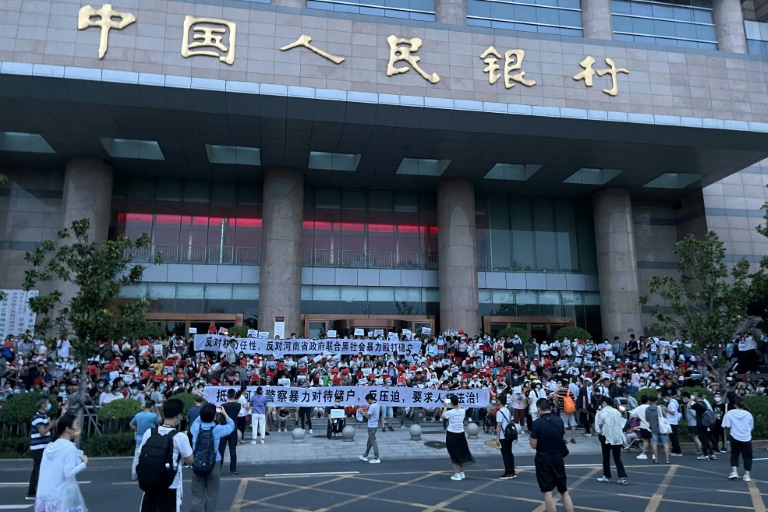
In one of the largest such rallies yet, hundreds gathered Sunday outside a branch of the People’s Bank of China in Henan’s capital Zhengzhou demanding their money, according to multiple witnesses who declined to be named.

Protesters held banners accusing local officials and police of corruption, calling on the central government to “give severe punishment to Henan”, video footage verified by AFP showed.

Local authorities did not immediately comment on the protests, but police in nearby Xuchang city said late Sunday that they had arrested members of an alleged “criminal gang” for their suspected involvement in a scheme to gain control of local banks.

The gang made illegal transfers through fictitious loans and used their shareholdings — as well as “manipulation of executives” — to effectively take over several local banks starting in 2011, police said.

The province’s banking and insurance regulator also said late Sunday that it was “accelerating” plans to tackle the local financial crisis and “protect the legal rights and interests of the broader public.”

Footage of Sunday’s rally showed the protestors throwing objects, while one participant told AFP on Sunday that demonstrators were hit and injured by unidentified men.

Another video verified by AFP showed a crying woman complaining about her lost money being forced onto a bus by police.

Another man with a swollen eye said he had been beaten by “gangsters” and dragged onto the bus by police.

Some demonstrators accused officials of colluding with local banks to suppress rallies, and provincial authorities were suspected last month of abusing the country’s mandatory health code to effectively bar protestors from public spaces.

Demonstrations are relatively rare in tightly controlled China, where authorities enforce social stability at all cost and where opposition is swiftly repressed.

But desperate citizens have occasionally succeeded in organising mass gatherings, usually when their targets are local governments or individual corporations rather than the Communist Party itself.

The demonstrators in Henan largely drew sympathy on Chinese social media on Monday, with many on the Weibo platform pointing the finger at local officials.

“Why are you treating ordinary people like this?” one Weibo user asked in a post on Monday. 

“Please strictly investigate the Henan government.”
Russian shelling in east Ukraine kills at least 15

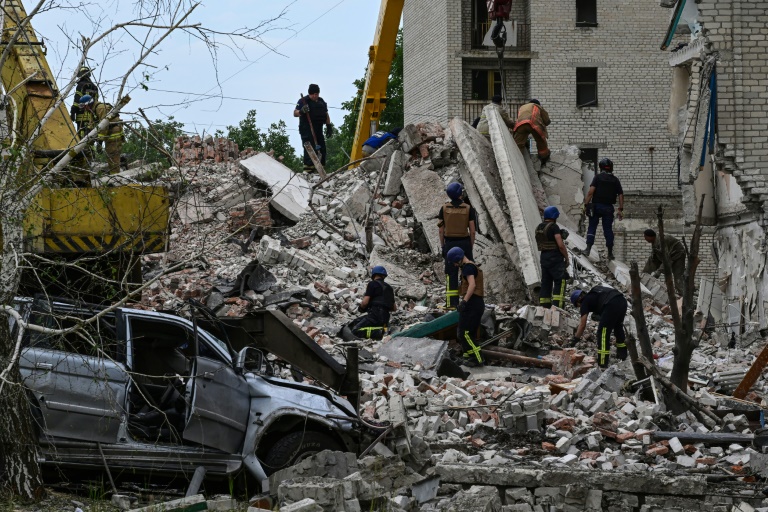
Ukrainian rescuers were hoping Monday to find survivors under the rubble of an apartment building hit by a Russian missile strike which killed at least 15 people, as Moscow’s forces seek to consolidate their control over the Donbas region. 

The building was partially destroyed by the strike, AFP correspondents saw at the scene, where dozens of rescuers were sifting through the rubble with a mechanical digger on Sunday.

“During the rescue operation, 15 bodies were found at the scene and five people were pulled out of the rubble” alive in the town of Chasiv Yar, the local emergency service said on Facebook on Sunday.

“At least 30 others are under the rubble” of the four-storey building after it was hit by a Russian Uragan missile, Donetsk regional governor Pavlo Kyrylenko said earlier on Telegram.

Rescuers had so far been able to establish contact with three people under the rubble, emergency services said.

“Everyone who gives orders for such strikes, everyone who carries them out targeting our ordinary cities, residential areas, kills absolutely deliberately,” President Volodymyr Zelensky said in his nightly address, vowing that the perpetrators would be brought to justice. 

One Chasiv Yar resident, who did not give her name, showed AFP journalists around the wreckage of her apartment.

“Yesterday, 11 or 10 o’clock in the evening, I was in the bedroom, and when I was leaving, everything started thundering and cracking…,” she said.

“The only thing that saved me was when I ran here, because immediately afterwards all of this crashed down.”

Another woman who had ventured inside to see what she could salvage from her apartment retrieved a bluebird, still perched in its cage.

Looking down from her balcony, where her pet had escaped the blast, she lifted up the cage with a brief, triumphant flourish.

– Ground attacks paused –

Having fought long battles to capture areas of the neighbouring region of Lugansk, Russian troops are now turning their focus to Donetsk as they look to take control of the whole Donbas region.

But though the region was under persistent shelling, Russian ground attacks were all but paused, the Ukrainian army general staff said Sunday.

Ukraine’s forces had hit a Russian base in the occupied southern region of Kherson, they added, without elaborating.

“The enemy in our operational zone keeps behind the lines of defense, does not advance by land, does not have the opportunities and capacities to create new strike groups,” Operational Command South said early Monday. 

Successful attacks on ammunition depots by Ukrainian forces meant “Lugansk region still stands”, its governor said on Telegram. 

“The number of attacks and shelling has decreased, without their artillery the invaders are almost helpless,” Sergiy Gaiday said. 

However, elsewhere, the bombing continued. 

On Saturday, three people were killed and 23 wounded by shelling in Donetsk, governor Kyrylenko said.

Strikes were also reported in Kharkiv, Ukraine’s second city in the northeast, where a “teaching establishment” and a house were hit, wounding one, according to regional governor Oleg Sinegubov.

“The Ukrainian army is holding on firmly, repelling attacks in various directions,” said Zelensky. “But, of course, a lot still needs to be done so that Russian losses really cause such pause.” 

– Wheat harvest –

Russian officials in the eastern Ukrainian region of Kharkiv meanwhile announced the start of the harvest “in the liberated territories of the region”, Russian news agency RIA Novosti announced Sunday.

Ukraine has repeatedly accused Russia of having stolen its wheat harvest in the occupied eastern regions, to illegally sell it on the international market.

On Sunday, US Secretary of State Antony Blinken said Russia’s restriction on Ukrainian grain exports may have contributed to turmoil in Sri Lanka triggered by severe shortages of food and fuel.

“We’re seeing the impact of this Russian aggression playing out everywhere,” Blinken told reporters in Bangkok.

Renewing a demand that he has made repeatedly, Blinken called on Russia to let an estimated 20 million tonnes of grain leave Ukraine, which Moscow invaded in February.

Russia continued its crackdown on news coverage critical of its conduct in the war, blocking the website of the German daily Die Welt Sunday, the latest in a growing list.

Since the start of the Russian military operation in Ukraine, the German newspaper has published content in Russian.

burs-jj/imm/reb/ssy

China lockdown worries hit Asian equity, crude markets

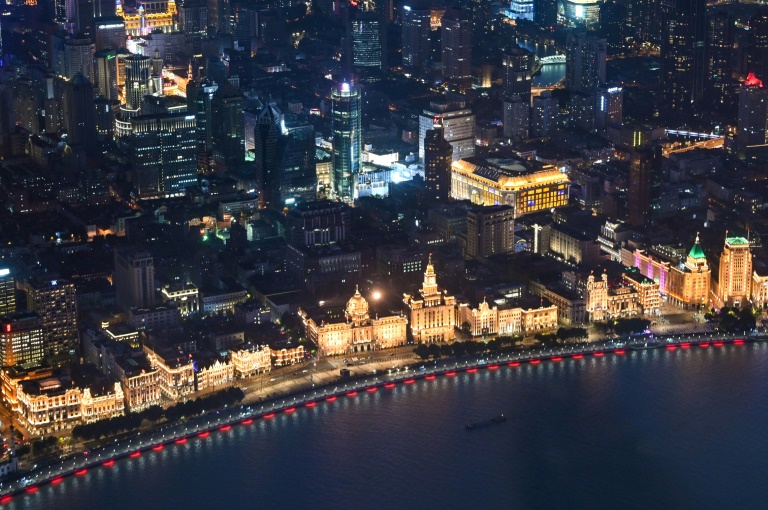
Asian markets and oil prices mostly fell Monday with a fresh Covid flare-up in Shanghai fanning fears of another economically painful lockdown in China’s biggest city.

The news came after a forecast-busting US jobs report last week indicated the world’s top economy was coping so far with the Federal Reserve interest rate hikes, giving it room for more as it battles soaring inflation.

Traders are also keeping tabs on developments in Washington as President Joe Biden weighs removing some of the Donald Trump-era tariffs on Chinese goods worth hundreds of billions of dollars.

Shanghai recorded more than 120 virus cases at the weekend, having seen its first case of the highly contagious BA.5 Omicron strain, forcing officials to launch another mass testing drive.

With China fixated on its zero-Covid strategy of wiping out the disease, there is increasing concern that authorities will revert to another painful lockdown, with Shanghai residents having only emerged from a two-month confinement in June.

There have also been new infections uncovered in other parts of the country, including Beijing.

Data this week will provide a fresh update on the economic impact of those measures, as well as similar strict controls in Beijing.

The prospect of another lockdown sparked a sell-off in Hong Kong and Shanghai, while there were also losses in Sydney, Seoul, Taipei, Manila, Jakarta and Wellington.

However, there were gains in Tokyo as traders welcomed Japan’s ruling bloc securing a strong win in Sunday’s upper house election, held days after the assassination of former premier Shinzo Abe.

The result should provide the government with some stability, while there were also hopes for a cabinet reshuffle and economic stimulus.

– Fed ‘must be resolute’ –

The weak start to the week followed a tepid lead from Wall Street, where the strong jobs reading ramped up bets on further big Fed rate hikes after officials said the economy was strong enough to withstand them.

The central bank is predicted to announce a second successive 0.75 percentage point lift at its next meeting this month, while further big increases are also expected before the end of the year.

Policymakers have said they are determined to bring inflation down from four-decade highs, even if that means hurting growth.

On Friday, New York Fed president John Williams reiterated its determination, saying in a speech: “Inflation is sky-high, and it is the number one danger to the overall health and stability of a well-functioning economy.

“I want to be clear: this is not an easy task. We must be resolute, and we cannot fall short.”

Worries about another shock to the Chinese economy from possible shutdowns also dented oil markets as concerns about a hit to demand outweighed ongoing concerns about tight supplies.

Still, there is a view that prices will remain elevated for now.

“Covid numbers are ticking up again,” said SPI Asset Management’s Stephen Innes.

“Although the possible demand impact of a recession continues to weigh on sentiment, the prevailing view, at least for now, is that the longer-term structural issues facing the oil market will support prices.”

Investors will be keeping watch on Biden’s visit this week to Saudi Arabia, where he is expected to push for the crude giant to ramp up production to make up for the output lost to sanctions against Russia.

– Key figures at around 0230 GMT –

Tokyo – Nikkei 225: UP 1.0 percent at 26,787.00 (break)

Hong Kong – Hang Seng Index: DOWN 2.4 percent at 21,194.75

Shanghai – Composite: DOWN 1.2 percent at 3,314.43

West Texas Intermediate: DOWN 0.7 percent at $104.07 per barrel

Brent North Sea crude: DOWN 0.4 percent at $106.63 per barrel

Euro/dollar: DOWN at 1.0148 from 1.0183 on Friday

Pound/dollar: DOWN at 1.1990 from 1.2034 

Euro/pound: UP at 84.65 pence from 84.59 pence

Dollar/yen: UP at 137.03 yen from 136.10 yen

London – FTSE 100: UP 0.1 percent at 7,196.24 (close)

New York – Dow: DOWN 0.2 percent at 31,338.15

James Webb Space Telescope opens its eyes on the Universe

Space enthusiasts are holding their breath.

The James Webb Space Telescope, the most powerful ever sent into orbit, is set Tuesday to unveil breathtaking new views of the Universe with a clarity that’s never been seen before.

Distant galaxies, bright nebulae and a faraway giant gas planet are among the observatory’s first targets, US space agency NASA said Friday.

But the images themselves have been jealously guarded to build suspense ahead of the big reveal.

“I’m looking very much forward to not having to keep these secrets anymore, that will be a great relief,” Klaus Pontoppidan, an astronomer at the Space Telescope Science Institute (STSI) that oversees Webb, told AFP.

NASA chief Bill Nelson has promised the “deepest image of our Universe that has ever been taken.”

Webb’s infrared capabilities are what make it uniquely powerful — allowing it to both pierce through cosmic dust clouds and detect light from the earliest stars, which has been stretched into infrared wavelengths as the Universe expanded.

This lets it peer further back in time than any previous telescope, to the period shortly after the Big Bang, 13.8 billion years ago.

“When I first saw the images… I suddenly learned three things about the Universe that I didn’t know before,” Dan Coe, an STSI astronomer and expert on the early Universe, told AFP. “It’s totally blown my mind.”

– First targets –

An international committee decided the first wave of images would include the Carina Nebula, an enormous cloud of dust and gas 7,600 light years away.

Carina Nebula is famous for its towering pillars that include “Mystic Mountain,” a three-light-year-tall cosmic pinnacle captured in an iconic image by the Hubble Space Telescope, until now humanity’s premier space observatory.

Webb has also carried out a spectroscopy — an analysis of light that reveals detailed information — on a faraway gas giant called WASP-96 b, which was discovered in 2014.

Nearly 1,150 light-years from Earth, WASP-96 b is about half the mass of Jupiter and zips around its star in just 3.4 days.

Nestor Espinoza, an STSI astronomer, told AFP that previous exoplanet spectroscopies carried out using existing instruments were very limited compared to what Webb could do.

“It’s like being in a room that is very dark and you only have a little pinhole you can look through,” he said of the prior technology. Now, with Webb, “You’ve opened a huge window, you can see all the little details.”

Perhaps most enticing of all, Webb has gathered an image using foreground galaxy clusters called SMACS 0723 as a kind of cosmic magnifying glass for the extremely distant and faint objects behind it.

– Million miles from Earth –

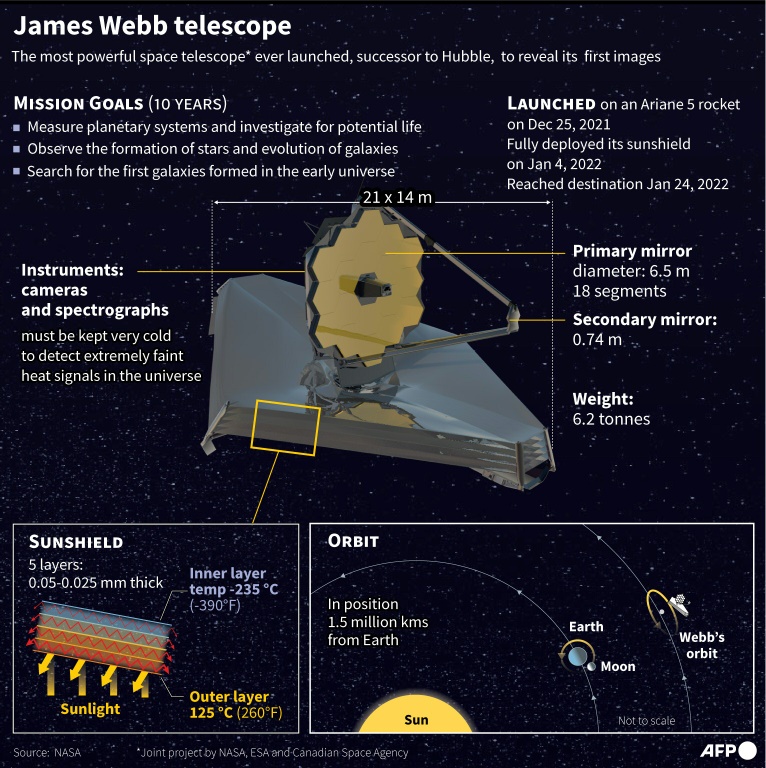
Launched in December 2021 from French Guiana on an Ariane 5 rocket, Webb is orbiting the Sun at a distance of a million miles (1.6 million kilometers) from Earth, in a region of space called the second Lagrange point.

Here, it remains in a fixed position relative to the Earth and Sun, with minimal fuel required for course corrections. 

A wonder of engineering, the total project cost is estimated at $10 billion, making it one of the most expensive scientific platforms ever built, comparable to the Large Hadron Collider at CERN.

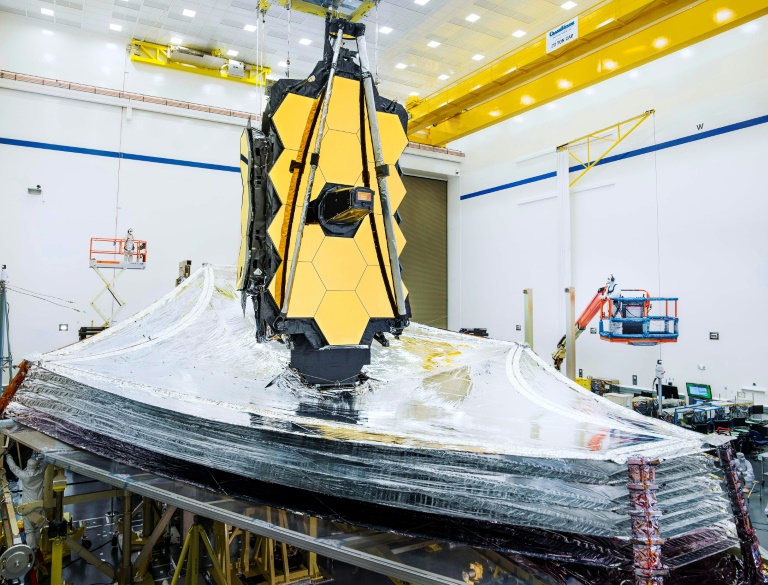
Webb’s primary mirror is over 21 feet (6.5 meters) wide and is made up of 18 gold-coated mirror segments. Like a camera held in one’s hand, the structure must remain as stable as possible to achieve the best shots.

Charlie Atkinson, chief engineer on the James Webb Space Telescope program at lead contractor Northrop Grumman, told AFP that it wobbles no more than 17 millionths of a millimeter.

Atkinson, who has been working on the program since 1998, said: “We knew it was going to require some of the best talents across the world, but it was doable.”

After the first images, astronomers around the globe will get shares of time on the telescope, with projects selected competitively through a process in which applicants and selectors don’t know each others’ identity, to minimize bias.

Thanks to an efficient launch, NASA estimates Webb has enough propellant for a 20-year life, as it works in concert with the Hubble and Spitzer space telescopes to answer fundamental questions about the cosmos.

James Webb Space Telescope opens its eyes on the Universe

Space enthusiasts are holding their breath.

The James Webb Space Telescope, the most powerful ever sent into orbit, is set Tuesday to unveil breathtaking new views of the Universe with a clarity that’s never been seen before.

Distant galaxies, bright nebulae and a faraway giant gas planet are among the observatory’s first targets, US space agency NASA said Friday.

But the images themselves have been jealously guarded to build suspense ahead of the big reveal.

“I’m looking very much forward to not having to keep these secrets anymore, that will be a great relief,” Klaus Pontoppidan, an astronomer at the Space Telescope Science Institute (STSI) that oversees Webb, told AFP.

NASA chief Bill Nelson has promised the “deepest image of our Universe that has ever been taken.”

Webb’s infrared capabilities are what make it uniquely powerful — allowing it to both pierce through cosmic dust clouds and detect light from the earliest stars, which has been stretched into infrared wavelengths as the Universe expanded.

This lets it peer further back in time than any previous telescope, to the period shortly after the Big Bang, 13.8 billion years ago.

“When I first saw the images… I suddenly learned three things about the Universe that I didn’t know before,” Dan Coe, an STSI astronomer and expert on the early Universe, told AFP. “It’s totally blown my mind.”

– First targets –

An international committee decided the first wave of images would include the Carina Nebula, an enormous cloud of dust and gas 7,600 light years away.

Carina Nebula is famous for its towering pillars that include “Mystic Mountain,” a three-light-year-tall cosmic pinnacle captured in an iconic image by the Hubble Space Telescope, until now humanity’s premier space observatory.

Webb has also carried out a spectroscopy — an analysis of light that reveals detailed information — on a faraway gas giant called WASP-96 b, which was discovered in 2014.

Nearly 1,150 light-years from Earth, WASP-96 b is about half the mass of Jupiter and zips around its star in just 3.4 days.

Nestor Espinoza, an STSI astronomer, told AFP that previous exoplanet spectroscopies carried out using existing instruments were very limited compared to what Webb could do.

“It’s like being in a room that is very dark and you only have a little pinhole you can look through,” he said of the prior technology. Now, with Webb, “You’ve opened a huge window, you can see all the little details.”

Perhaps most enticing of all, Webb has gathered an image using foreground galaxy clusters called SMACS 0723 as a kind of cosmic magnifying glass for the extremely distant and faint objects behind it.

– Million miles from Earth –

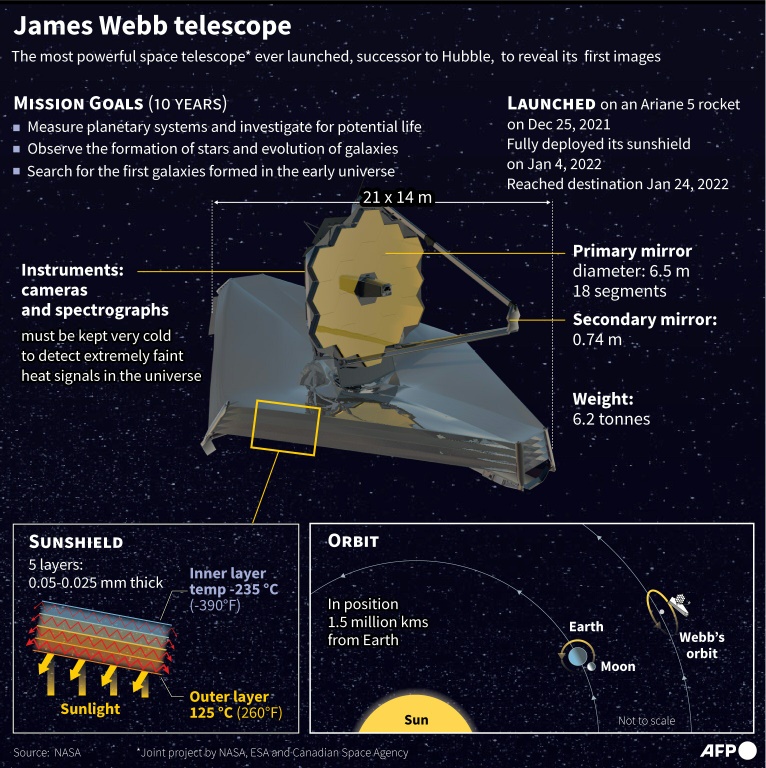
Launched in December 2021 from French Guiana on an Ariane 5 rocket, Webb is orbiting the Sun at a distance of a million miles (1.6 million kilometers) from Earth, in a region of space called the second Lagrange point.

Here, it remains in a fixed position relative to the Earth and Sun, with minimal fuel required for course corrections. 

A wonder of engineering, the total project cost is estimated at $10 billion, making it one of the most expensive scientific platforms ever built, comparable to the Large Hadron Collider at CERN.

Webb’s primary mirror is over 21 feet (6.5 meters) wide and is made up of 18 gold-coated mirror segments. Like a camera held in one’s hand, the structure must remain as stable as possible to achieve the best shots.

Charlie Atkinson, chief engineer on the James Webb Space Telescope program at lead contractor Northrop Grumman, told AFP that it wobbles no more than 17 millionths of a millimeter.

Atkinson, who has been working on the program since 1998, said: “We knew it was going to require some of the best talents across the world, but it was doable.”

After the first images, astronomers around the globe will get shares of time on the telescope, with projects selected competitively through a process in which applicants and selectors don’t know each others’ identity, to minimize bias.

Thanks to an efficient launch, NASA estimates Webb has enough propellant for a 20-year life, as it works in concert with the Hubble and Spitzer space telescopes to answer fundamental questions about the cosmos.

Reaching out without walking back? Biden begins delicate Saudi trip

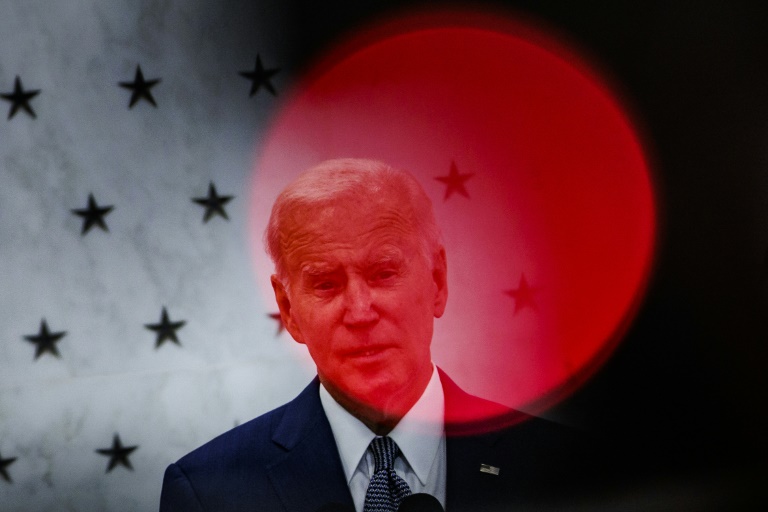
Having branded Saudi Arabia a “pariah” over the murder of a dissident, US President Joe Biden is now readying to meet the country’s leaders on a delicate visit to the Middle East. 

Biden begins his tour in Israel on Wednesday, but all eyes are on his trip to Jeddah in Saudi Arabia on Friday. 

Air Force One will make an unprecedented direct flight between the Jewish state and the conservative Gulf kingdom that does not recognize its existence. Donald Trump had made a historic trip, in 2017, in the other direction.

As a presidential candidate, Biden said the 2018 murder and dismemberment of Jamal Khashoggi — a Saudi-born US resident known for writing critical articles about the kingdom’s rulers for The Washington Post — had made the country a “pariah.”

After winning the election, the Biden administration released US intelligence findings that identified the kingdom’s de facto leader Crown Prince Mohammed bin Salman, often referred to as MBS, as the mastermind of the operation. 

– ‘Blank check’ –

But now Biden appears ready to re-engage with a country that has been a key strategic ally of the United States for decades, a major supplier of oil and an avid buyer of weapons.

“In Saudi Arabia, we reversed the blank-check policy we inherited” from former president Donald Trump, Biden wrote in an op-ed published Saturday in the Washington Post. 

“From the start, my aim was to reorient — but not rupture — relations,” he added.

“I know that there are many who disagree with my decision to travel to Saudi Arabia,” the 79-year-old Democrat went on, promising “fundamental freedoms are always on the agenda” when he makes foreign visits.

Jon Alterman, senior vice president at the Center for strategic and International Studies (CSIS) in Washington, said the Biden administration “discovered what US administrations have discovered for decades: that doing a lot of things in the Middle East and around the world are much easier if the Saudis are trying to help you and much harder if they aren’t.”

In his op-ed, Biden said Saudi Arabia was “working with (his) experts to help stabilize oil markets.” 

Washington wants the world’s largest exporter of crude to open the floodgates to bring down soaring gasoline prices, which threaten Democratic chances in November elections. 

– Strategic interests over values –

“Strategic interests and the well-being of someone driving around in a Ford Expedition have always come first at the expense of brave activists in the region who want to live in more open and democratic systems,” said Steven Cook, Middle East and Africa expert at the Council on Foreign Relations, referring to gas-guzzling SUVs popular with Americans. 

Saudi Arabia is also key to Washington’s efforts to contain Iran.

Beyond possible announcements, the White House knows the stakes of Biden’s trip are also about the optics of meeting with MBS, who will be part of the delegation when Biden sits down with King Salman. 

Marti Flacks, human rights expert at CSIS, said the White House would have put a lot of time into orchestrating “how that interaction is staged” — whether it’s public or behind closed doors, a handshake or an exchange of pleasantries.

“The X factor is, of course, the other party can always disrupt those plans if they’re determined to,” Flacks added.

Biden doesn’t want to appear as a cynic who reneges on principles for a few barrels of oil, but MBS may be tempted to turn the spotlight on his interaction with the “leader of the free world.”

To counter accusations of horse-trading, the US president is trying to give himself an above-the-fray role, as he has so far been much less concerned with the Middle East than with Russia or China. 

He presents himself as a facilitator of “promising trends” in the region and as a strategist in the face of challenges, such as Iran’s nuclear program, the war in Yemen and upheavals in Syria, Libya, Iraq and Lebanon.

– Journalist’s death –

Biden aims in particular to “deepen and expand” the process of normalizing relations between Israel and Arab states, initiated under Trump.

Aside from the symbolic Air Force One flight, analysts anticipate announcements on Saudi-Israeli relations.

The Jewish state is keen to receive Biden with great pomp, even in the midst of political turmoil as Israel prepares to hold its fifth election in less than four years in November.

Biden is due to meet Prime Minister Yair Lapid, but his advisers insist he also meet Palestinian president Mahmud Abbas, as Trump had more or less ignored the Palestinians during his term.

The recent death of another journalist will also cast a shadow over the visit: that of the American-Palestinian Al Jazeera reporter Shireen Abu Akleh, killed in May in an Israeli raid. 

Her family has asked to meet Biden. The White House has so far declined to comment on this request.

The James Webb Space Telescope, by the numbers

The most powerful space telescope ever built, James Webb is set to deliver its first full-color scientific images to the world Tuesday. 

Here is an overview of this feat of human ingenuity, in five key figures.

– More than 21 feet –

The centerpiece of the observatory is its huge main mirror, measuring more than 21 feet (6.5 meters) in diameter and made up of 18 smaller, hexagonal-shaped mirrors.

The observatory also has four scientific instruments: cameras to take pictures of the cosmos, and spectrographs, which break down light to study which elements and molecules make up objects.

The mirror and the instruments are protected from the light of our Sun by a tennis-court sized thermal shield, made up of five superimposed layers.

Each layer is hair thin, and together they ensure the telescope operates in the darkness needed to capture faint glimmers from the far reaches of the Universe.

– Million miles away –

Unlike the Hubble telescope which revolves around the Earth, Webb orbits around the Sun, nearly a million miles (1.6 million kilometers) from us, or four times the distance from our planet to the Moon. 

It took the spacecraft almost a month to reach this region, called Lagrange Point two, where it remains in a fixed position behind the Earth and Sun to give it a clear view of the cosmos.

Here, the gravity from the sun and Earth balance the centrifugal motion of a satellite, meaning it needs minimal fuel for course correction.

– 13.8 billion years –

In astronomy, the farther out you see, the deeper back in time you’re looking.

Webb’s infrared capabilities are what make it uniquely powerful — allowing it to detect light from the earliest stars, which has been stretched into infrared wavelengths as the Universe expanded.

This lets it peer further back in time than any previous telescope, to within a few hundred million years after the Big Bang, 13.8 billion years ago.

– Three-decade wait –

The project was first conceived in the 1990s, but construction did not begin until 2004. 

Then Webb’s launch date was repeatedly postponed. Initially set for 2007, it finally took place on December 25, 2021, aboard an Ariane 5 rocket, from French Guiana.

– $10 billion –

Webb is an international collaboration between US space agency NASA, the European Space Agency (ESA), and the Canadian Space Agency (CSA), involving more than 10,000 people.

The lifetime cost to NASA alone will be approximately $9.7 billion, according to an analysis by the Planetary Society, or $10.8 billion adjusted for inflation to 2020 dollars.

Leaked Uber docs reveal bare-knuckle expansion tactics: investigation

A leaked cache of confidential files from ride-sharing company Uber illustrates ethically dubious and potentially illegal tactics it used to fuel its frenetic global expansion beginning nearly a decade ago, a joint media investigation showed Sunday.

Dubbed the “Uber Files,” the investigation involving dozens of news organizations found that company officials leveraged the sometimes violent backlash from the taxi industry against drivers to garner support and evaded regulatory authorities as it looked to conquer new markets early in its history.

Culled from 124,000 documents from 2013-2017 initially obtained by British daily the Guardian and shared with the International Consortium of Investigative Journalists, the revelations are the latest hit for a company dogged by controversy as it exploded into a disruptive force in local transportation. 

The cache includes unvarnished text and email exchanges between executives, with standouts from co-founder and former chief executive Travis Kalanick, who was forced to resign in 2017 following accusations of brutal management practices and multiple episodes of sexual and psychological harassment at the company.

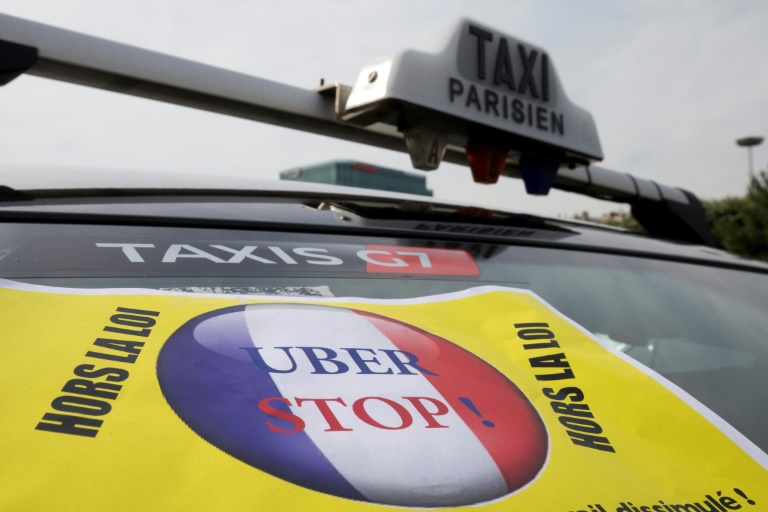
“Violence guarantee(s) success,” Kalanick messaged other company leaders as he pushed for a counter protest amid sometimes heated demonstrations in Paris in 2016 against Uber’s arrival in the market.

Uber’s rapid expansion leaned on subsidized drivers and discounted fares that undercut the taxi industry, and “often without seeking licenses to operate as a taxi and livery service,” reported The Washington Post, one of the media outlets involved in the probe.

Drivers across Europe had faced violent retaliation as taxi drivers felt their livelihoods threatened. The investigation found that “in some instances, when drivers were attacked, Uber executives pivoted quickly to capitalize” to seek public and regulatory support, the Post said.

According to the Guardian, Uber has adopted similar tactics in European countries including Belgium, the Netherlands, Spain and Italy, mobilizing drivers and encouraging them to complain to the police when they were victims of violence, in order to use media coverage to obtain concessions from the authorities.

A spokesperson for Kalanick strongly denied the findings as a “false agenda,” saying he “never suggested that Uber should take advantage of violence at the expense of driver safety.”

Uber, however, placed the blame Sunday on previously publicized “mistakes” made by leadership under Kalanick. 

“We’ve moved from an era of confrontation to one of collaboration, demonstrating a willingness to come to the table and find common ground with former opponents, including labor unions and taxi companies,” it said, noting that his replacement, Dara Khosrowshahi, “was tasked with transforming every aspect of how Uber operates.”

– ‘Kill switch’ –

The investigation also found that Uber worked to evade regulatory probes by leveraging a technological edge, the Post wrote.

It described an instance when Kalanick implemented a “kill switch” to remotely cut off access of devices in an Amsterdam office to Uber’s internal systems during a raid by authorities. 

“Please hit the kill switch ASAP,” he wrote in an email to an employee. “Access must be shut down in AMS (Amsterdam).”

Kalanick spokesperson Devon Spurgeon said the former chief executive “never authorized any actions or programs that would obstruct justice in any country.”

Kalanick “did not create, direct or oversee these systems set up by legal and compliance departments and has never been charged in any jurisdiction for obstruction of justice or any related offense,” she said.

But the investigation charged that Uber’s actions flouted laws and that executives were aware, citing one joking that they had become “pirates.”

The reports say the files reveal Uber also lobbied governments to aid its expansion, finding in particular an ally in France’s Emmanuel Macron, who was economy minister from 2014 to 2016 and is now the country’s president.  

The company believed Macron would encourage regulators “to be ‘less conservative’ in their interpretation of rules limiting the company’s operations,” the Post said.

Macron was an open supporter of Uber and the idea of turning France into a “start-up nation” in general, but the leaked documents suggest that the minister’s support even sometimes clashed with the leftist government’s policies. 

The revelations sparked indignation among leftist politicians, who denounced the Uber-Macron links as against “all our rules, all our social rights and against workers’ rights,” and condemned the “pillage of the country.” 

Leaked Uber docs reveal bare-knuckle expansion tactics: investigation

A leaked cache of confidential files from ride-sharing company Uber illustrates ethically dubious and potentially illegal tactics it used to fuel its frenetic global expansion beginning nearly a decade ago, a joint media investigation showed Sunday.

Dubbed the “Uber Files,” the investigation involving dozens of news organizations found that company officials leveraged the sometimes violent backlash from the taxi industry against drivers to garner support and evaded regulatory authorities as it looked to conquer new markets early in its history.

Culled from 124,000 documents from 2013-2017 initially obtained by British daily the Guardian and shared with the International Consortium of Investigative Journalists, the revelations are the latest hit for a company dogged by controversy as it exploded into a disruptive force in local transportation. 

The cache includes unvarnished text and email exchanges between executives, with standouts from co-founder and former chief executive Travis Kalanick, who was forced to resign in 2017 following accusations of brutal management practices and multiple episodes of sexual and psychological harassment at the company.

“Violence guarantee(s) success,” Kalanick messaged other company leaders as he pushed for a counter protest amid sometimes heated demonstrations in Paris in 2016 against Uber’s arrival in the market.

Uber’s rapid expansion leaned on subsidized drivers and discounted fares that undercut the taxi industry, and “often without seeking licenses to operate as a taxi and livery service,” reported The Washington Post, one of the media outlets involved in the probe.

Drivers across Europe had faced violent retaliation as taxi drivers felt their livelihoods threatened. The investigation found that “in some instances, when drivers were attacked, Uber executives pivoted quickly to capitalize” to seek public and regulatory support, the Post said.

According to the Guardian, Uber has adopted similar tactics in European countries including Belgium, the Netherlands, Spain and Italy, mobilizing drivers and encouraging them to complain to the police when they were victims of violence, in order to use media coverage to obtain concessions from the authorities.

A spokesperson for Kalanick strongly denied the findings as a “false agenda,” saying he “never suggested that Uber should take advantage of violence at the expense of driver safety.”

Uber, however, placed the blame Sunday on previously publicized “mistakes” made by leadership under Kalanick. 

“We’ve moved from an era of confrontation to one of collaboration, demonstrating a willingness to come to the table and find common ground with former opponents, including labor unions and taxi companies,” it said, noting that his replacement, Dara Khosrowshahi, “was tasked with transforming every aspect of how Uber operates.”

– ‘Kill switch’ –

The investigation also found that Uber worked to evade regulatory probes by leveraging a technological edge, the Post wrote.

It described an instance when Kalanick implemented a “kill switch” to remotely cut off access of devices in an Amsterdam office to Uber’s internal systems during a raid by authorities. 

“Please hit the kill switch ASAP,” he wrote in an email to an employee. “Access must be shut down in AMS (Amsterdam).”

Kalanick spokesperson Devon Spurgeon said the former chief executive “never authorized any actions or programs that would obstruct justice in any country.”

Kalanick “did not create, direct or oversee these systems set up by legal and compliance departments and has never been charged in any jurisdiction for obstruction of justice or any related offense,” she said.

But the investigation charged that Uber’s actions flouted laws and that executives were aware, citing one joking that they had become “pirates.”

The reports say the files reveal Uber also lobbied governments to aid its expansion, finding in particular an ally in France’s Emmanuel Macron, who was economy minister from 2014 to 2016 and is now the country’s president.  

The company believed Macron would encourage regulators “to be ‘less conservative’ in their interpretation of rules limiting the company’s operations,” the Post said.

Macron was an open supporter of Uber and the idea of turning France into a “start-up nation” in general, but the leaked documents suggest that the minister’s support even sometimes clashed with the leftist government’s policies. 

The revelations sparked indignation among leftist politicians, who denounced the Uber-Macron links as against “all our rules, all our social rights and against workers’ rights,” and condemned the “pillage of the country.” 

French opposition denounces Uber-Macron 'secret deal'

Opposition deputies on Sunday denounced reports of a secret deal between French President Emmanuel Macron — when he was a minister under a socialist government — and online transport giant Uber.

The allegations come in the latest data-based investigation by leading international news outlets based on leaked files, announced on social media as #UberFiles.

The report in France’s Le Monde daily, citing documents, text messages and witnesses, alleges that Uber came to a secret “deal” with Macron when he was economy minister between 2014 and 2016.

Le Monde’s report highlights what it says was help from Macron’s ministry intended to help Uber consolidate its position in France, such as suggesting that the company present “ready-made” amendments to deputies to help their case.

Opposition deputies have denounced what they say appears to have been close collaboration between Macron and Uber at a time when the company was trying to get around tight government regulation of their sector.

Contacted by AFP, Uber France confirmed that the two sides had been in contact. The meetings with Macron had been in the normal course of his ministerial duties, which covered the private-hire sector.

The president’s office told AFP that at that time Macron had, as economy minister, “naturally” been in contact with “many companies involved in the profound change in services that has occurred over the years mentioned, which should be facilitated by unravelling certain administrative or regulatory locks”.

But Mathilde Panot, parliamentary leader of the hard-left opposition France Unbowed party, denounced on Twitter what she described as the “pillage of the country” during Macron’s time as minister under president Francois Hollande.

She described Macron as a “lobbyist” for a “US multinational aiming to permanently deregulate labour law”.

– ‘Against all our rules’ –

Communist Party leader Fabien Roussel described Le Monde’s story as “damning revelations about the active role played by Emmanuel Macron, then minister, to facilitate the development of Uber in France. 

“Against all our rules, all our social rights and against workers’ rights,” he posted on Twitter.

Communist deputy Pierre Dharreville called for a parliamentary inquiry into the affair.

Jordan Bardella, president of the far-right National Rally party, tweeted that the revelations showed that Macron’s career had “a common thread: to serve private interests, often foreign, before national interests”.

The Uber Files investigation is based on a leak of tens of thousands of documents to Britain’s Guardian newspaper from an anonymous source, and has been coordinated by the International Consortium of Investigative Journalists.

The ICIJ is working with 42 media partners around the world on the story.

sb-cgc-vl-reb/jj/imm

Close Bitnami banner
Bitnami