US Business

Euro closes in on dollar parity, yen up after Abe murder

The euro neared parity with the dollar on Friday, as traders bet on the prospect of a eurozone recession caused by soaring inflation.

The haven yen firmed against the dollar following the assassination of Japan’s former prime minister, Shinzo Abe.

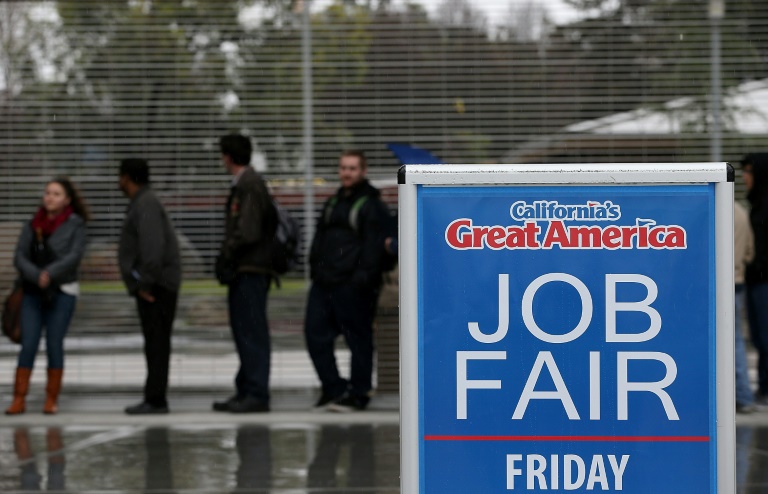
Stock markets were mixed ahead of key US jobs data due on Friday that should provide more clues on the outlook for interest rates in the world’s biggest economy.

“A firm payroll… will reinforce the view that financial conditions are not tight enough, drive the dollar higher and send euro/dollar hurtling towards parity,” said independent analyst Stephen Innes.

The euro on Friday slumped to $1.0072, a fresh 20-year low, before recovering back above $1.01.

The European single currency is suffering also from the Federal Reserve hiking US interest rates more aggressively than the European Central Bank, traders said.

In commodities trading on Friday, world oil prices steadied at the end of yet another volatile week for crude and assets in general.

Asian stock markets closed higher, boosted by hopes that US President Joe Biden would remove some tariffs from Chinese goods.

Equities won a lift also from reports Beijing was considering a huge stimulus push to the struggling Chinese economy by allowing local governments to raise billions of dollars through bond issuance for infrastructure projects.

But surging inflation, rising interest rates and a fresh flare-up of Covid infections in Shanghai continued to keep investor sentiment grounded.

Traders were handed a strong lead from Wall Street overnight, where all three main indices climbed for a fourth straight day, helped by two top Federal Reserve officials who said the economy could withstand sharper rate hikes and maintain growth.

There has been growing talk that the fast pace of monetary tightening by the bank will tip the world’s top economy into recession.

– Political upheaval –

Markets are also tracking political unrest in Britain and Japan.

London’s benchmark FTSE 100 index was down about half-a-percent in early afternoon deals — and the pound retreated — one day after Prime Minister Boris Johnson said he was stepping down later this year following a string of scandals.

In Japan, Abe was assassinated on Friday by a gunman who opened fire at close range as the hugely influential politician delivered a campaign speech ahead of upper house elections. 

The murder of the 67-year-old, who had been Japan’s longest-serving leader, stunned the nation and prompted an international outpouring of grief and condemnation.

The killing “could be negative for markets if the government’s policy, including its stance on monetary easing, is affected, as it was evident that he was pulling the strings behind the scenes in many ways”, noted Masahiro Yamaguchi at SMBC Trust Bank.

“If it becomes possible for (current Prime Minister Fumio) Kishida to carry out policies he wanted to, such as financial tax and regulations on share buy-back, that would be negative for markets.”

– Key figures at around 1115 GMT –

Euro/dollar: DOWN at $1.0149 from $1.0162 Thursday

Pound/dollar: DOWN at $1.1994 from $1.2024 

Euro/pound: UP at 84.60 pence from 84.49 pence

Dollar/yen: DOWN at 135.84 yen from 136.01 yen

London – FTSE 100: DOWN 0.5 percent at 7,150.76 points

Frankfurt – DAX: UP 0.7 percent at 12,938.75

Paris – CAC 40: UP 0.1 percent at 6,014.49

EURO STOXX 50: FLAT at 3,488.57

Tokyo – Nikkei 225: UP 0.1 percent at 26,517.19 (close)

Hong Kong – Hang Seng Index: UP 0.4 percent at 21,725.78 (close)

Shanghai – Composite: DOWN 0.4 percent at 3,356.08 (close)

New York – Dow: UP 1.1 percent at 31,384.55 (close)

Brent North Sea crude: UP 0.1 percent at $104.77 per barrel

West Texas Intermediate: DOWN 0.3 at $102.41 per barrel
Lavrov walks out of G20 talks as West presses Moscow on Ukraine

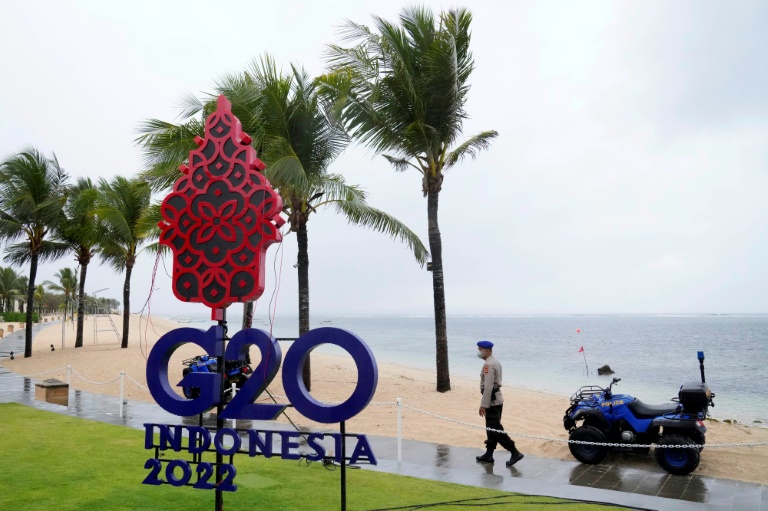
Russia’s top diplomat stormed out of talks with G20 foreign ministers meeting in Indonesia on Friday as Western powers criticised Moscow over its invasion of Ukraine.

Washington and allies condemned Russia’s assault ahead of the meeting before Foreign Minister Sergei Lavrov faced what US Secretary of State Antony Blinken called a barrage of Western criticism at the closed-door talks.

“What we’ve heard today already is a strong chorus from around the world… about the need for the aggression to end,” Blinken said from the meeting on the resort island of Bali.

Blinken and Lavrov had joined colleagues for day-long talks in their first meeting since the outbreak of war, with the host immediately telling them the conflict must end through negotiations.

But Lavrov walked out of a morning session as German counterpart Annalena Baerbock criticised Moscow over its invasion, diplomats said.

He also left an afternoon session before Ukrainian Foreign Minister Dmytro Kuleba addressed the ministers virtually and was not present as Blinken condemned Russia.

“Our Western partners are trying to avoid talking about global economic issues,” Lavrov told reporters outside the Mulia hotel. “From the moment they speak, they launch into fevered criticism of Russia.”

Blinken shunned a meeting with Lavrov and instead accused Russia of triggering a global food crisis, demanding Moscow allow grain shipments out of war-battered Ukraine.

“To our Russian colleagues: Ukraine is not your country. Its grain is not your grain. Why are you blocking the ports? You should let the grain out,” Blinken said in the closed-door talks, according to a Western official present.

Lavrov earlier told reporters he would not “go running” after Washington for talks.

“It was not us who abandoned contact, it was the United States,” he said.

– Abe killing overshadows meet –

Before the meeting, Blinken met his French and German counterparts and a senior British official to discuss “Russia’s unprovoked and unjustifiable war of choice” in Ukraine, the State Department said in a statement.

But the gathering was soon overshadowed by the killing of former Japanese Prime Minister Shinzo Abe at a campaign event on Friday.

After news of his death, Blinken mourned the longtime ally of Washington as a “leader with great vision” who boosted US-Japan relations.

“It is a shock. It’s profoundly disturbing,” he said.

Before the news of the attack emerged, Indonesian Foreign Minister Retno Marsudi addressed the Ukraine war in a speech to the ministers including Lavrov.

“It is our responsibility to end the war sooner than later and settle our differences at the negotiating table, not the battlefield,” Marsudi said.

In closing remarks, she said “participants expressed deep concern about the humanitarian impacts of the war” and “some members expressed condemnation” of the invasion.

She did not comment on Lavrov walking out of the sessions.

– No family photo –

A US official indicated Washington did not want to embarrass Indonesia at the meeting by walking out on Lavrov, who last met Blinken in July.

But there will be no family photo of the G20 ministers as is customary, an Indonesian government official told AFP.

The hosts have addressed US concerns about Lavrov attending in part by inviting Ukrainian President Volodymyr Zelensky to the G20 summit in November.

In his address, Kuleba told ministers to “remember about 344 families who have lost their children when listening to Russian lies”.

“The minister of the country responsible for their deaths appears in front of you today to share his thoughts on how Russia views cooperation in our globalised world,” he added. 

– British FM leaves –

Blinken’s efforts to have a powerful Western stance against Russia at the meeting were diluted after British Foreign Minister Liz Truss pulled out following Prime Minister Boris Johnson’s resignation as leader of his party on Thursday.

She flew out of Indonesia on Friday morning and was replaced by former British ambassador to the European Union Sir Tim Barrow, a British official told AFP.

While in Bali, Blinken will also seek to reopen dialogue with Beijing in talks on Saturday with his Chinese counterpart Wang Yi, the first in months after tensions became strained over issues including Taiwan.

The meeting comes as US President Joe Biden voices hope for a conversation in the coming weeks with Chinese President Xi Jinping, with whom he last spoke in March.

Lavrov met Wang on Thursday to discuss Russia’s invasion, which Moscow says it launched to stop Ukraine from joining the NATO military alliance.

The United States has condemned Beijing’s support for Russia, and Blinken is expected to reiterate those warnings in talks with Wang.

Cameroon's mushroom growers looking beyond the kitchen

Grilled on skewers, dried or used in hair oil: farmers at Bafoussam in western Cameroon are seeking to take the lowly mushroom, grown on agricultural waste, beyond the kitchen.

Fungiculture, or the cultivation of edible mushrooms, is long-developed in the West, while China has become by far the world’s largest producer. 

But it remains very rare in Africa, despite the advantages of being almost free and supplying “clean” food by recycling waste.

Cameroonians are particularly fond of mushrooms but have to wait for the rainy season to identify and gather the edible fungi in the wilds of the west-central African country.

In Bafoussam, capital of the Western region and fifth largest city, Jean-Claude Youbi saw an opportunity to exploit, like other small farmers around the nation of 28 million inhabitants.

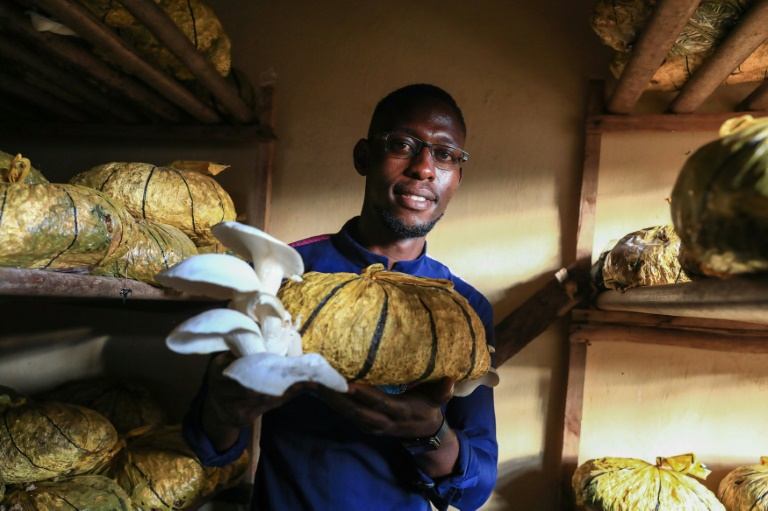
Youbi grows thousands of oyster mushrooms in a darkened room of the Common Initiatives Group — GIC Champignon — which he launched with associates in Maetur, a district of Bafoussam, four years ago.

“We are in the mushroom house of our GIC,” Youbi announces proudly amid the rows on rows of fungi growing on shelves on agricultural waste packaged in plastic bags.

“Some, like these, have passed the harvest period,” says one of his associates, Patrick Yaptieu, pushing aside a pile of mushrooms which have turned from the desired white colour to a yellowish hue. He then puts the good harvest of the day in bags headed for the GIC shop, near the city centre.

A kilo of oyster mushrooms sells in Bafoussam for 2,000 CFA francs (just over three euros / $3.11), while it costs up to 3,500 CFA in Yaounde, the capital, or Douala, the main port and economic capital.

— ‘Corn cobs … and ox blood’ —

The lack of official national data on the production and consumption of mushrooms makes it hard to gain an idea of the market value and extent of the sector.

Activity in the GIC Champignon premises is punctuated by constant comings and goings, while two young trainees in a little side room are shovelling a pile of agricultural residue.

To obtain the soil-free culture, “we mixed corn cobs with nutrients such as bran flour, wheat and ox blood,” explains production manager Brice Nono Djomo.

“We added a fungicide to it to avoid the bad mushrooms,” he says, adding that the effects of this precautionary treatment fade away after two weeks, well before the good crop grows.

Once the substrate mixture is ready, it is sterilised, placed in barrels and heated over a wood fire, then cooled down and placed in the plastic bags. Once the spores are introduced, the bags are placed in the mushroom house, where it takes 30 days to see the first stems appear.

“I was amazed to discover this way of cultivating mushrooms,” says Junior Leogip, a boy of 12 who is devoting his school holidays to do an internship at GIC Champignon.

“I learned to prepare the substrate… I want to know everything,” Leogip adds, his heart set on winning a place in an agricultural college after his baccalaureate.

“My ambition is to launch my own production and be independent,” says Lea Tona, another trainee who comes from Yaounde.

– ‘Mushroom whisky’ –

Every three months, the time it takes for a full growth cycle, the business in Bafoussam produces from 300 to 400 kilos (660 to 880 pounds) of mushrooms, 80 percent of which are sold directly to customers to be eaten.

The remainder is transformed into body and hair oils, soap, juice and even a liqueur that Youbi presents as “mushroom whisky”.

In a small laboratory at the GIC, Youbi grinds part of the harvest in a blender to obtain a juice which will be combined with other elements for the range of by-products.

“For beauty oils, we can add snail slime and a perfume to give a pleasant smell,” he says, guarding his secrets close his chest.

“We’re in a promotional phase. For the hair oil, we give boxes to some hairstylists to experiment with.”

“It softens the hair and makes it grow back, it treats dandruff, breakage,” says Josiane Sogo in her hairdressing salon.

Some people prefer simply to taste the fungi.

“I am a very big consumer of mushrooms, especially for their virtues. It is a vegetable meat that helps me steer clear of several risks,” affirms Barthelemy Tchoumtchoua, noting that his skewer is rich in protein and vitamins B2, B3, B5 and D.

Thanks to fungiculture, “we can eat them all year round”, he adds enthusiastically.

Lavrov walks out of G20 talks as West presses Moscow on Ukraine

Russia’s top diplomat stormed out of talks with G20 foreign ministers meeting in Indonesia on Friday as Western powers criticised Moscow over its invasion of Ukraine.

Washington and allies condemned Russia’s assault ahead of the meeting before Foreign Minister Sergei Lavrov faced what US Secretary of State Antony Blinken called a barrage of Western criticism at the closed-door talks.

“What we’ve heard today already is a strong chorus from around the world… about the need for the aggression to end,” Blinken said from the meeting on the resort island of Bali.

Blinken and Lavrov had joined colleagues for day-long talks in their first meeting since the outbreak of war, with the host immediately telling them the conflict must end through negotiations.

But Lavrov walked out of a morning session as German counterpart Annalena Baerbock criticised Moscow over its invasion, diplomats said.

He also left an afternoon session before Ukrainian Foreign Minister Dmytro Kuleba addressed the ministers virtually and was not present as Blinken condemned Russia.

“Our Western partners are trying to avoid talking about global economic issues,” Lavrov told reporters outside the Mulia hotel. “From the moment they speak, they launch into fevered criticism of Russia.”

Blinken shunned a meeting with Lavrov and instead accused Russia of triggering a global food crisis, demanding Moscow allow grain shipments out of war-battered Ukraine.

“To our Russian colleagues: Ukraine is not your country. Its grain is not your grain. Why are you blocking the ports? You should let the grain out,” Blinken said in the closed-door talks, according to a Western official present.

Lavrov earlier told reporters he would not “go running” after Washington for talks.

“It was not us who abandoned contact, it was the United States,” he said.

– Abe killing overshadows meet –

Before the meeting, Blinken met his French and German counterparts and a senior British official to discuss “Russia’s unprovoked and unjustifiable war of choice” in Ukraine, the State Department said in a statement.

But the gathering was soon overshadowed by the killing of former Japanese Prime Minister Shinzo Abe at a campaign event on Friday.

After the shooting, Blinken voiced alarm over the attack on a longtime ally of Washington and Japan’s longest-serving premier, calling it a “very sad moment”.

Before the news of the attack emerged, Indonesian Foreign Minister Retno Marsudi addressed the Ukraine war in a speech to the ministers including Lavrov.

“It is our responsibility to end the war sooner than later and settle our differences at the negotiating table, not the battlefield,” Marsudi said.

– No family photo –

A US official indicated Washington did not want to embarrass Indonesia at the meeting by walking out on Lavrov.

But there will be no family photo of the G20 ministers as is customary, an Indonesian government official told AFP.

The hosts have addressed US concerns about Lavrov attending in part by inviting Ukrainian President Volodymyr Zelensky to the G20 summit in November.

In his address, Kuleba told ministers to “remember about 344 families who have lost their children when listening to Russian lies”.

“The minister of the country responsible for their deaths appears in front of you today to share his thoughts on how Russia views cooperation in our globalised world,” he added. 

Blinken arrived at the Mulia hotel on Friday where he could be seen talking with South Africa’s foreign minister before entering the same room as Lavrov, who he last met in January.

Russia’s top diplomat was seated between the Saudi Arabian and Mexican foreign ministers as the meeting began.

– British FM leaves –

Blinken’s efforts to have a powerful Western stance against Russia at the meeting were diluted after British Foreign Minister Liz Truss pulled out following Prime Minister Boris Johnson’s resignation as leader of his party on Thursday.

She flew out of Indonesia on Friday morning and was replaced by former British ambassador to the European Union Sir Tim Barrow, a British official told AFP.

While in Bali, Blinken will also seek to reopen dialogue with Beijing in talks on Saturday with his Chinese counterpart Wang Yi, the first in months after tensions became strained over issues including Taiwan.

The meeting comes as US President Joe Biden voices hope for a conversation in the coming weeks with Chinese President Xi Jinping, with whom he last spoke in March.

Lavrov met Wang on Thursday to discuss Russia’s invasion, which Moscow says it launched to stop Ukraine from joining the NATO military alliance.

The United States has condemned Beijing’s support for Russia, and Blinken is expected to reiterate those warnings in talks with Wang.

Asian stocks up as recession fears ease, yen rises after Abe shooting

Asian markets rose Friday on easing recession fears with optimism boosted by hopes that Joe Biden will remove some Trump-era tariffs from Chinese goods, while the euro extended losses and headed close to parity with the dollar.

The safe-haven yen also picked up following news of Japan’s former prime minister Shinzo Abe being shot during a campaign rally. He is still fighting for his life. 

Equities were also boosted by reports that Beijing was considering a huge stimulus push to the struggling economy by allowing local governments to raise billions of dollars through bond issuance for infrastructure projects.

But surging inflation, rising interest rates and a fresh flare-up of Covid infections in Shanghai continued to keep investor sentiment grounded.

Traders were handed a strong lead from Wall Street, where all three main indexes climbed for a fourth straight day, helped by two top Federal Reserve officials who said the economy could withstand sharper rate hikes and maintain growth.

There has been growing talk that the fast pace of monetary tightening by the bank will tip the world’s top economy into recession.

But Christopher Waller, a member of the board of governors, said worries were overblown and that a strong jobs market would provide a buffer, adding that rates needed to go up sharply and quickly. St Louis Fed president James Bullard also said there was “a good chance of a soft landing”.

Asian equities advanced with Hong Kong, Shanghai, Sydney, Seoul, Singapore, Wellington, Mumbai, Taipei, Manila and Jakarta all in the green. Shanghai closed slightly down.

Tokyo’s Nikkei 225 ended up but saw its early big gains wiped out after news filtered through of Abe’s shooting.

Some observers said that because he still held sway over his ruling LDP party, it continued to stick with his ultra-loose monetary policy known as Abenomics. 

The yen briefly strengthened to 135.34 per dollar, compared with 136.08 in the morning, as analysts speculated on how the possible loss of Abe’s still-strong influence in Japan could see changes in policy. 

Masahiro Yamaguchi, of SMBC Trust Bank, said: “It could be negative for markets if the government’s policy, including its stance on monetary easing, is affected as it was evident that he was pulling the strings behind the scenes in many ways.

“If it becomes possible for (current Prime Minister Fumio) Kishida to carry out policies he wanted to, such as financial tax and regulations on share buy-back, that would be negative for markets.”

– US jobs in focus –

The Fed’s policy plans will be in focus later Friday when US employment data is released, with a strong reading providing the central bank with evidence to stick to its hawkish line.

But Matt Simpson at StoneX Financial said there were indications the jobs market could be showing signs of weakness.

The report “is unlikely to deter the Fed from a 75 basis points hike this month. But when the precious non-farm payroll numbers begin to crumble, so does the Fed’s argument that the US economy is robust”, he said.

“And we’re seeing early signs of that across multiple employment metrics.”

“When we do see unemployment begin to rise and headline employment growth lose momentum it will be hard for the Fed to ignore,” he added. 

Biden is also reported to be holding a meeting later Friday with top advisers to discuss whether or not to lift some of the Trump-era tariffs imposed on around $300 billion of Chinese imports.

While he is also said to be considering another probe into other facets of Beijing’s trade policy, analysts said the removal of the levies could boost China’s export growth to the United States by about 20 percent.

The move could also help ease upward pressure on US inflation, which is running at a four-decade high.

The euro extended its losing streak, falling to $1.0072 for the first time in 20 years, a day after minutes from the European Central Bank’s most recent meeting indicated that, unlike the Fed, it was happy to hike rates at a slower pace despite surging inflation.

And sterling continued to rise after Boris Johnson resigned Thursday as leader of the ruling Conservatives, paving the way for a new prime minister and bringing an end to weeks of political uncertainty in the United Kingdom.

Stocks in London, Paris and Frankfurt were flat in the morning.

– Key figures at around 0810 GMT –

Tokyo – Nikkei 225: UP 0.1 percent at 26,517.19 (close)

Hong Kong – Hang Seng Index: UP 0.4 percent at 21,725.78 (close)

Shanghai – Composite: DOWN 0.4 percent at 3,356.08 (close)

London – FTSE 100: FLAT at 7,191.92

Dollar/yen: DOWN at 135.80 yen from 136.01 yen Thursday

Euro/dollar: DOWN at $1.0100 from $1.0162

Pound/dollar: DOWN at $1.1941 from $1.2024 

Euro/pound: UP at 84.60 pence from 84.49 pence

West Texas Intermediate: DOWN 0.7 at $101.99 per barrel

Brent North Sea crude: DOWN 0.5 percent at $104.17 per barrel

New York – Dow: UP 1.1 percent at 31,384.55 (close)

Pipeline uncertainty leaves Germany with energy jitters

The Nord Stream pipeline, which supplies Germany with most of its Russian gas, will be shut down for routine maintenance from Monday — with fears rising that it may remain off for good.

Germany is already feeling the effects of the energy squeeze caused by the war in Ukraine, with many households and businesses turning down the thermostat or dimming the lights.

Economy Minister Robert Habeck has even made headlines for extolling the virtues of shorter, colder showers.

Now, nervousness abounds as the scheduled 10-day pause in deliveries via the vital Nord Stream pipeline threatens to make things even worse.

“No scenario can be ruled out,” Habeck has warned. 

Confronted with the risk that supplies may never return to previous levels, many businesses and local authorities have come up with contingency plans.

“It is possible that we will return to working from home, as we did during the pandemic — but this time to save energy in the national interest,” Carsten Knobel, head of consumer chemicals group Henkel, told local media.

The VCI, a trade group representing the heavily gas-dependent German chemicals industry, has said it is preparing for “the worst-case scenario”.

Chemicals giant BASF, meanwhile, has raised the possibility of putting its employees on furlough, a system already used during the coronavirus pandemic from 2020.  

Perfume producer Symrise is falling back on an oil-powered furnace at its factory in Holzminden.

– ‘One or two months’ –

Russia has already cut supplies via the Nord Stream pipeline by 60 percent in recent weeks, citing technical issues — which Berlin dismisses as cover for a “political” decision.

As a result, Germany’s gas storage facilities are being filled at a slower pace than usual, leaving the country at risk of running into a  “gas shortage”, according to Habeck.

“If we stop receiving gas from Russia… the quantities currently stored will only be sufficient for one or two months,” said Klaus Mueller, president of the Federal Network Agency.

Consumers “will be shocked when they receive a letter from their energy supplier” with a bill some three times higher than usual, Mueller said.

On Thursday, Germany’s lower house of parliament or Bundestag passed a plan to turn off the hot water in its offices and keep the air temperature no higher than 20 degrees Celsius (68 degrees Fahrenheit) in the winter.

Several local authorities have also put energy-saving plans in motion.

The Bavarian city of Augsburg has turned off its fountains, dimmed the facades of public buildings at night and is debating switching off some under-used traffic lights.

– Chilly nights –

A housing cooperative in the eastern city of Dresden made national headlines when it announced it would limit hot water to certain times of day. 

And Vonovia, Germany’s largest property group, said on Thursday it plans to limit the temperature in its 350,000 homes to 17 degrees Celsius at night.

Since the outbreak of the war in Ukraine, Germany has managed to reduce the share of its natural gas supplied by Russia from 55 percent to around 35 percent. 

The country relies on gas for more than 50 percent of its heating needs. 

In a bid to further reduce its reliance on Russian gas, Germany has put aside billions of euros (dollars( to buy liquefied natural gas from other producers such as Qatar or the United States.

But in the event of a total supply cut-off from Russia, the country “will have to make very difficult societal choices,” according to Habeck.

The end of Russian gas deliveries would most likely plunge the country into a painful recession, with the economy shrinking by 6.5 percent between 2022 and 2023, according to a recent forecast by the country’s top economic think tanks.

Already, the surge in energy prices created the first monthly trade deficit in the country in three decades in June, perhaps the first tremor of a bigger upheaval to come.

'Sacred duty': Inflation eats into Turkey's Muslim feast

With inflation in Turkey galloping, the sheep Gul Er buys every year for the Muslim festival of sacrifice in Istanbul looks agonisingly out of reach.

Prices have doubled or even tripled since President Recep Tayyip Erdogan began an unorthodox economic experiment last year that has seen Turks’ living standards suffer.

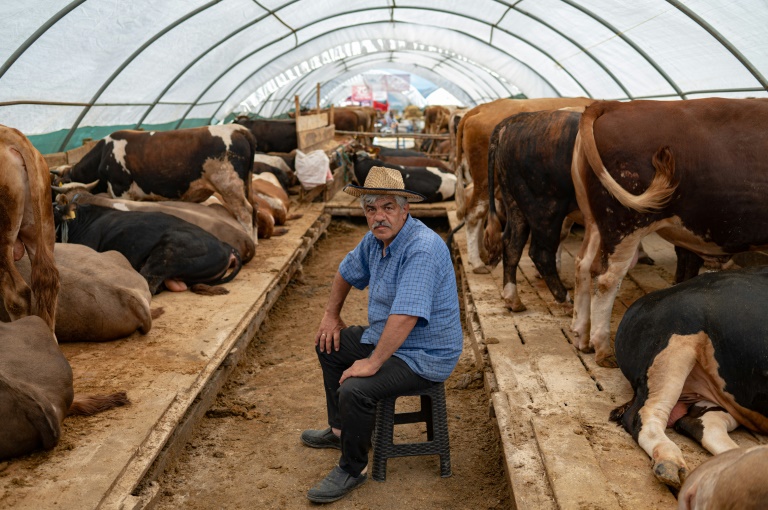
The young mother hopes to bargain down the price on one of the skimpiest-looking animals at a livestock fair held under white tents in a conservative corner of the city before the Kurban Bayrami (Eid al-Adha in Arabic) holiday.

“It is a sacred duty,” she said of buying a sheep, which along with oxen and goats are sacrificed in the name of Allah, with the meat traditionally shared with the poor, friends and neighbours.

“But this year, prices are unaffordable,” Er said, the stench of thousands of animals mixing with the sounds of haggling in the heavy summer air, ahead of Saturday’s first full day of festivities.

Annual inflation in Turkey has officially reached 78.6 percent, although economists and many ordinary Turks doubt government data.

Even if the official figures are to be believed, that is higher than in any other emerging market and nearly 10 times the record levels rocking the European Union, where the cost of living is unleashing political crises.

An independent survey prepared by the ENAG group — and believed by most Turks — puts the annual inflation rate at 175 percent.

Besides clouding Erdogan’s chances in next year’s election, these figures spell trouble for the merchants at the Istanbul animal fair.

– Snowballing problems –

Turkey’s agricultural chambers union chief Semsi Bayraktar expects sales to fall by a quarter this year.

Galip Toklu, a breeder who came to the 40,000-square-metre (10-acre) fair from the Black Sea city of Samsun, listed the ways inflation snowballs into seemingly endless problems.

The cost of animal feed has quadrupled while the amount he pays to drive his livestock to Istanbul has tripled since the last Kurban Bayrami, forcing Toklu to double the price of his meat.

“Last year, I sold 500 kilos (1,100 pounds) of beef for 20,000 liras. This year, I set my prices at 45,000 liras,” he said.

Yet few can now afford Toklu’s beef, while selling it any cheaper could put him out of business.

“Customers are unavoidably upset,” he said, his face sullen under a wide-brimmed hat.

– ‘Erdonomics’ –

While this year’s animal fair looks huge, its 160 tents are a fraction of the 500 erected in past years.

As the fair winds down, breeder Sinas Ates looks despondent, having failed to make a single sale in two days. Livestock farming in Turkey is “finished”, he grumbled.

Just like the sacrifice of sheep, Erdogan’s economic experiment — dubbed “Erdonomics” by sceptical global markets — is also linked to his faith.

Erdogan cites Islamic proscriptions on usury to justify his refusal to raise interest rates to fight inflation. 

High interest rates cause prices to rise, according to Erdogan’s logic, which contradicts accepted economic orthodoxy. 

So Erdogan has pushed the central bank to set interest rates even lower. Analysts at Capital Economics in London see the possibility of a crash of the lira as “a major risk”.

– ‘Allah’s orders’ –

At the market, Salih Yeter has responded to the crisis by coming out to look for the perfect sheep with seven friends, who will all contribute to the purchase.

“People usually can’t afford to eat meat,” the 57-year-old said, adding that giving away meat to the poor is particularly important in times of trouble.

The price of food has soared by 93 percent in the past year, according to official data, with meat prices pushing even higher.

This is especially painful for Er, whose daughter has a metabolic condition that restricts her to a meat diet.

“I can’t even respect my daughter’s diet,” the mother whispered.

But respect for the holy holiday’s traditions is binding, said Selahattin Kose, a “hajji” (one who has made the pilgrimage to Mecca), from the eastern city of Erzurum.

“Prices have doubled, but we have to deal with it,” Kose said. “It’s Allah’s orders.”

Argentina turmoil sparks panic buying and price hikes

A political crisis in inflation-ravaged Argentina that was sparked by the economy minister’s resignation has spooked markets and generated fears resulting in panic buying and hasty price hikes, as the informal exchange rate soars.

“Every day it’s like going out to hunt a lion,” Luis Sacco told AFP in front of his electronics store in the capital Buenos Aires.

Since Monday, prices have risen dramatically at shops and businesses across the country.

On Saturday, economy minister Martin Guzman resigned following months of pressure from inside President Alberto Fernandez’s center-left Frente de Todos (Everyone’s Front) governing coalition.

Guzman was the chief negotiator in Argentina’s haggling with the International Monetary Fund to restructure a $44 billion debt.

But he was collateral damage in a power struggle between Fernandez and his vice-president, the former president Cristina Kirchner.

Opposition to Guzman’s fiscal policies from the former president’s influential faction within the coalition resulted in him quitting and being replaced by Kirchner loyalist Silvina Batakis.

She is the one who must now steer agricultural powerhouse Argentina through its years-long economic crisis.

Inflation, which surpassed 60 percent in the last 12 months, is hurting ordinary Argentines, who have been gripped by the political soap opera.

“It was the longest Sunday of my life,” said Sacco, the electronics store owner who spent an anxious weekend “not knowing whether or not to lift the shutters, (and) a Monday thinking about catastrophe.”

The black market peso briefly dropped from 239 to the US dollar to 280 on Monday before stabilizing at 250. The official exchange rate is 132.

– ‘Prices not set by costs’ –

But amidst the uncertainty and panic, sales actually soared for many businesses with consumers afraid prices would soon increase.

That is a major concern in a country struggling with years of high inflation.

“There was no earthquake. There are sales, more than ever,” said Sacco.

But “people are also buying because they know that if they wait, the price will increase. It’s the time to sell stock.”

He pushed up his prices by 15 percent a few weeks ago, with another five percent increase this week, while he has now hiked prices on his imported goods by 30 percent.

Fernando Agote, who owns a hardware store, says “things are calming down” after some initial panic buying despite little change in prices.

But conversely, many suppliers have suspended their sales, waiting to see what happens to prices before taking new orders, so they do not get left short-changed.

“There was a lot of anxiety, a lot of speculation. No one knows where the real prices are, they’re not set by costs,” said Agote.

Luckily for him, only one of his suppliers suspended their sales on Monday.

At a paint shop in the Floresta neighborhood, prices were pushed up 20 percent with no drop in sales volume.

“Everything was sold,” said the manager, Leo. However, supplies were not replenished.

“Only one company delivered.”

Leo expects that next week suppliers “will change all their price and payment conditions.”

After 20 years in the business, Leo has lived through several economic crises in Argentina.

“This is unusual because people have money, they are consuming, these days we’ve been selling like crazy, online orders have exploded,” he added.

– Time for caution –

The change in government comes at a time when workers are receiving a biyearly salary bonus, leaving them flush with cash.

Even so, “you have to be cautious and not change things more than they are so you don’t spark an unnecessary inflation snowball. We’ve already had enough of those,” said Alberto Sorrentino, 60, who runs a construction materials company.

He expects prices of “domestic products will rise between six and 10 percent, and imports between 10 and 20 percent.”

The biggest price hikes have been in the food industry.

“What comes from abroad like banana, papaya and melon increased 30 percent since Monday,” said John Quinteros, who runs a fruit and vegetable shop in Floresta.

“People are still buying, but less.”

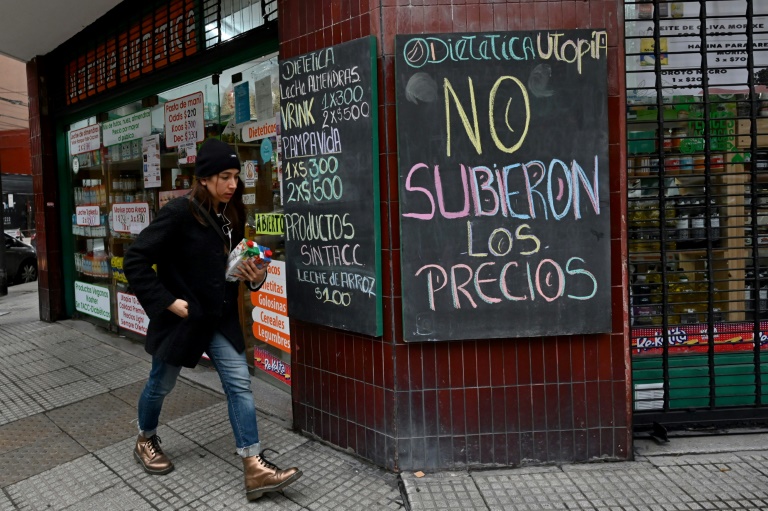
In the Villa Crespo neighborhood a shop selling natural products has a sign informing customers it had not pushed up prices.

“We’ve decided to maintain them for as long as we can,” said Liliana de los Santos, admitting that “it’s a risk.”

Argentina turmoil sparks panic buying and price hikes

A political crisis in inflation-ravaged Argentina that was sparked by the economy minister’s resignation has spooked markets and generated fears resulting in panic buying and hasty price hikes, as the informal exchange rate soars.

“Every day it’s like going out to hunt a lion,” Luis Sacco told AFP in front of his electronics store in the capital Buenos Aires.

Since Monday, prices have risen dramatically at shops and businesses across the country.

On Saturday, economy minister Martin Guzman resigned following months of pressure from inside President Alberto Fernandez’s center-left Frente de Todos (Everyone’s Front) governing coalition.

Guzman was the chief negotiator in Argentina’s haggling with the International Monetary Fund to restructure a $44 billion debt.

But he was collateral damage in a power struggle between Fernandez and his vice-president, the former president Cristina Kirchner.

Opposition to Guzman’s fiscal policies from the former president’s influential faction within the coalition resulted in him quitting and being replaced by Kirchner loyalist Silvina Batakis.

She is the one who must now steer agricultural powerhouse Argentina through its years-long economic crisis.

Inflation, which surpassed 60 percent in the last 12 months, is hurting ordinary Argentines, who have been gripped by the political soap opera.

“It was the longest Sunday of my life,” said Sacco, the electronics store owner who spent an anxious weekend “not knowing whether or not to lift the shutters, (and) a Monday thinking about catastrophe.”

The black market peso briefly dropped from 239 to the US dollar to 280 on Monday before stabilizing at 250. The official exchange rate is 132.

– ‘Prices not set by costs’ –

But amidst the uncertainty and panic, sales actually soared for many businesses with consumers afraid prices would soon increase.

That is a major concern in a country struggling with years of high inflation.

“There was no earthquake. There are sales, more than ever,” said Sacco.

But “people are also buying because they know that if they wait, the price will increase. It’s the time to sell stock.”

He pushed up his prices by 15 percent a few weeks ago, with another five percent increase this week, while he has now hiked prices on his imported goods by 30 percent.

Fernando Agote, who owns a hardware store, says “things are calming down” after some initial panic buying despite little change in prices.

But conversely, many suppliers have suspended their sales, waiting to see what happens to prices before taking new orders, so they do not get left short-changed.

“There was a lot of anxiety, a lot of speculation. No one knows where the real prices are, they’re not set by costs,” said Agote.

Luckily for him, only one of his suppliers suspended their sales on Monday.

At a paint shop in the Floresta neighborhood, prices were pushed up 20 percent with no drop in sales volume.

“Everything was sold,” said the manager, Leo. However, supplies were not replenished.

“Only one company delivered.”

Leo expects that next week suppliers “will change all their price and payment conditions.”

After 20 years in the business, Leo has lived through several economic crises in Argentina.

“This is unusual because people have money, they are consuming, these days we’ve been selling like crazy, online orders have exploded,” he added.

– Time for caution –

The change in government comes at a time when workers are receiving a biyearly salary bonus, leaving them flush with cash.

Even so, “you have to be cautious and not change things more than they are so you don’t spark an unnecessary inflation snowball. We’ve already had enough of those,” said Alberto Sorrentino, 60, who runs a construction materials company.

He expects prices of “domestic products will rise between six and 10 percent, and imports between 10 and 20 percent.”

The biggest price hikes have been in the food industry.

“What comes from abroad like banana, papaya and melon increased 30 percent since Monday,” said John Quinteros, who runs a fruit and vegetable shop in Floresta.

“People are still buying, but less.”

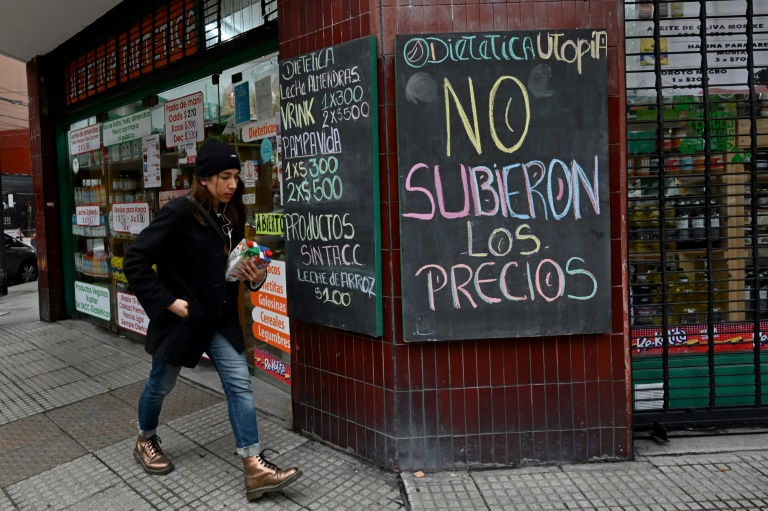
In the Villa Crespo neighborhood a shop selling natural products has a sign informing customers it had not pushed up prices.

“We’ve decided to maintain them for as long as we can,” said Liliana de los Santos, admitting that “it’s a risk.”

TikTok sued in US after girls die in 'Blackout Challenge'

Video-sharing sensation TikTok is being sued in California after children died while taking part in a “Blackout Challenge” that makes a sport of choking oneself until passing out.

The lawsuit filed in state court in Los Angeles last week accuses TikTok software of “intentionally and repeatedly” pushing the Blackout Challenge that led to the deaths of an eight-year-old girl in Texas and a nine-year-old girl in Wisconsin last year.

“TikTok needs to be held accountable for pushing deadly content to these two young girls,” said Matthew Bergman, an attorney at the Social Media Victims Law Center, which filed the suit.

“TikTok has invested billions of dollars to intentionally design products that push dangerous content that it knows are dangerous and can result in the deaths of its users.”

TikTok, owned by China-based ByteDance, did not immediately respond to a request for comment.

The suit alleges that  TikTok’s algorithm promoted the Blackout Challenge to each of the girls, who died from self-strangulation — one using rope and the other a dog leash.

It additionally listed children in Italy, Australia and elsewhere whose deaths have been linked to the TikTok Blackout Challenge.

TikTok has featured and promoted an array of challenges in which users film themselves taking part in themed acts that are sometimes dangerous.

Among the litany of TikTok challenges described in court documents was the “Skull Breaker Challenge” in which people have their legs kicked out from under them while jumping so they flip and hit their heads.

The “Coronavirus Challenge” involves licking random items and surfaces in public during the pandemic, and the “Fire Challenge” involves dousing things with flammable liquid and setting them ablaze, court documents said.

The suit calls for a judge to order TikTok to stop hooking children via its algorithm and promoting dangerous challenges, and to pay unspecified cash damages.

Close Bitnami banner
Bitnami