US Business

US Supreme Court strikes down right to abortion

The US Supreme Court on Friday struck down the right to abortion in a seismic ruling that shredded five decades of constitutional protections and prompted several right-leaning states to impose immediate bans.

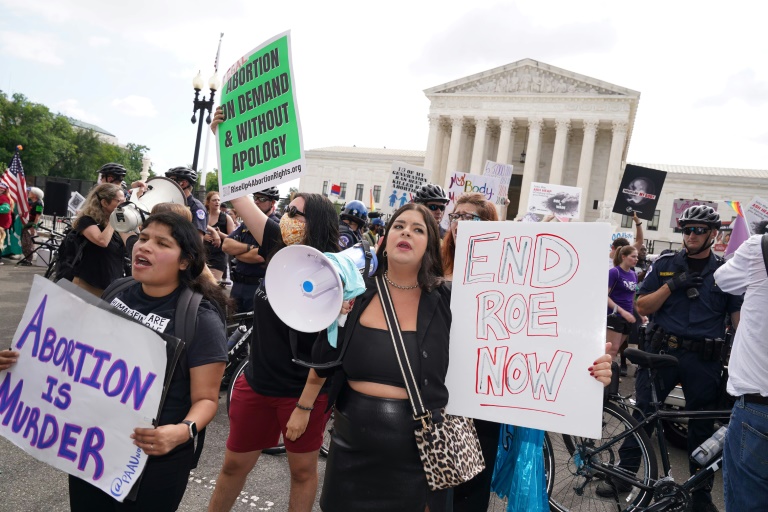
Protests broke out almost immediately in Washington and elsewhere, with dozens of demonstrations under way or planned across the country Friday evening.

The conservative-dominated court overturned the landmark 1973 “Roe v. Wade” decision enshrining a woman’s right to an abortion, saying individual states can restrict or ban the procedure themselves.

“The Constitution does not confer a right to abortion,” the court said in a 6-3 ruling on one of America’s most bitterly divisive issues. “The authority to regulate abortion is returned to the people and their elected representatives.”

A somber President Joe Biden called the ruling a “tragic error” stemming from “extreme ideology” and said it was a “sad day for the court and the country.”

“The health and life of women in this nation are now at risk,” Biden said, warning that other rights could be threatened next, such as same-sex marriage and contraception.

The Democratic president urged Congress to restore abortion protections as federal law and said Roe will be “on the ballot” in November’s midterm elections.

– ‘You have failed us’ –

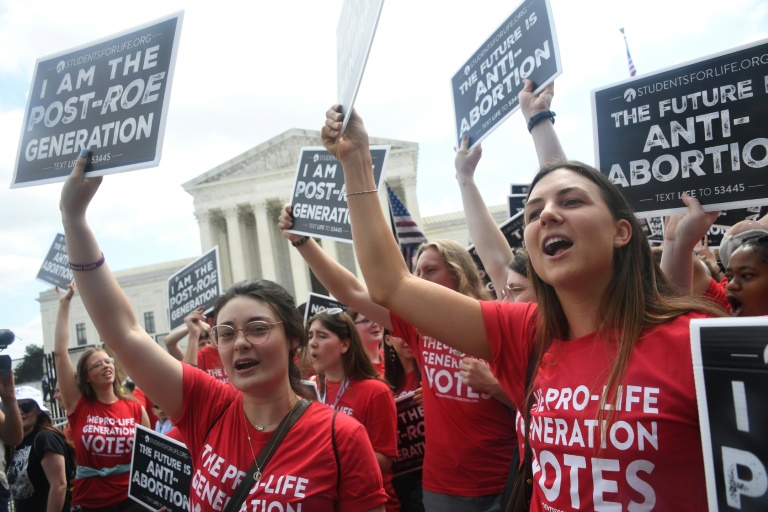
Hundreds of people — some weeping for joy and others with grief — gathered outside the fenced-off Supreme Court as the ruling came down.

“It’s hard to imagine living in a country that does not respect women as human beings and their right to control their bodies,” said Jennifer Lockwood-Shabat, 49, a mother of two daughters who was choking back tears.

“You have failed us,” read a sign held up by one protester. “Shame,” said another.

But Gwen Charles, a 21-year-old opponent of abortion, was jubilant.

“This is the day that we have been waiting for,” Charles told AFP. “We get to usher in a new culture of life in the United States.”

Just hours after the ruling, Missouri banned abortion — making no exception for rape or incest — and so did South Dakota, except where the life of the mother is at risk.

“This is a monumental day for the sanctity of life,” Missouri attorney general Eric Schmitt said.

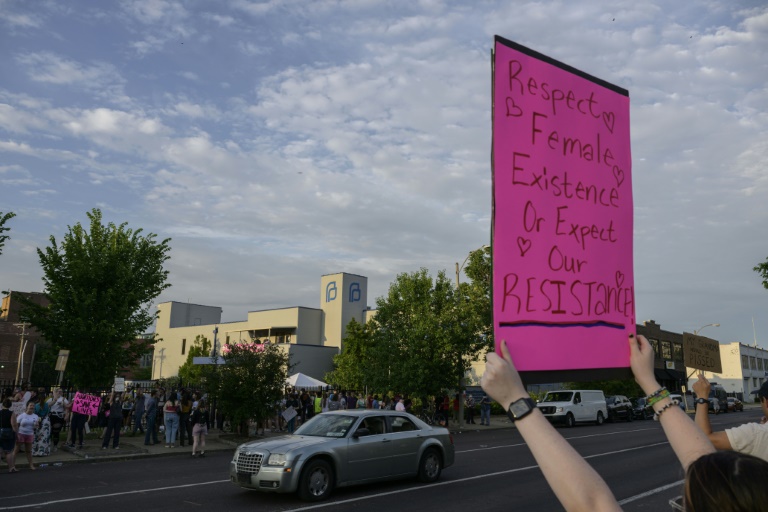
Protesters took to the streets in St. Louis to decry the ban, gathering at what had been Missouri’s last abortion clinic.

“It’s absolutely disturbing,” said Lilian Dodenhoff, 32, standing outside the facility. 

“It doesn’t feel good. You’re just… you know that you have to call on your friends. So I just immediately reached out to people that I knew shouldn’t be alone right now.”

As of Friday evening, at least seven states had already banned abortion — Alabama, Arkansas, Kentucky, Louisiana, Missouri, Oklahoma, and South Dakota.

Many more are expected to follow suit or severely restrict the procedure. 

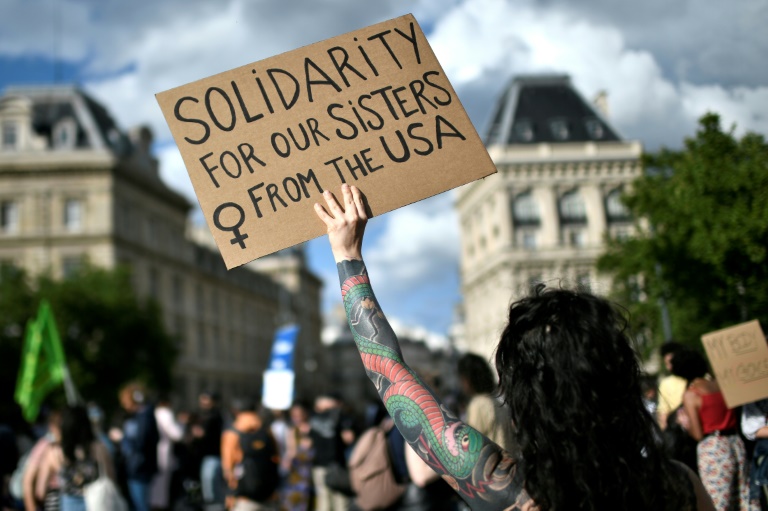
Protesters also marched in New York and Boston as anger over the Supreme Court decision grew. 

“Abortion is a human right, not just for the rich and white,” protesters in New York chanted on Friday.

Democratic Governor Kathy Hochul met the crowd at Union Square, telling reporters that New York would be a “safe harbor” for those unable to receive abortions in their own states.

“This is the most reactionary, most reactionary Supreme Court, probably in the history of our nation,” she said, adding that abortion rights were “secure” in New York. 

“We took action already, we allocated $35 million to support our abortion providers to be able to help our sisters across this nation find their way here. This is their safe harbor.”

Criticism of the move also came from abroad, including from US allies including Britain, whose Prime Minister Boris Johnson called it “a big step backwards.”

Canada’s leader Justin Trudeau said it was “horrific” and French President Emmanuel Macron voiced his “solidarity with women whose freedoms are today challenged.”

Acknowledging the international concerns, US Secretary of State Antony Blinken insisted his department would “remain fully committed to helping provide access to reproductive health services and advancing reproductive rights around the world.”

– ‘Egregiously wrong’ –

In the majority opinion, Justice Samuel Alito said Roe v. Wade was “egregiously wrong.”

“Abortion presents a profound moral issue on which Americans hold sharply conflicting views,” he said. “The Constitution does not prohibit the citizens of each State from regulating or prohibiting abortion.”

The court tossed out the legal argument in Roe v. Wade that women had the right to abortion based on the constitutional right to privacy with regard to their own bodies.

While the ruling represents a victory in the struggle against abortion by the religious right, leaders of the Christian conservative movement said it does not go far enough and they will push for a nationwide ban.

“While it’s a major step in the right direction, overturning Roe does not end abortion,” said the group March for Life.

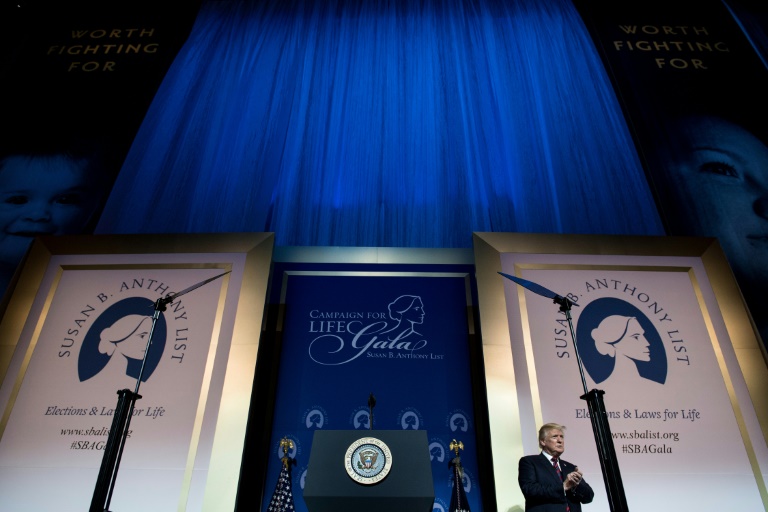
“God made the decision,” said former Republican president Donald Trump while praising the ruling.

The decision was made possible by Trump’s nomination to the court of three conservative justices — Neil Gorsuch, Brett Kavanaugh and Amy Coney Barrett.

– ‘Will not stop there’ –

The three liberal justices on the court dissented from the ruling, which came a day after the court ushered in a major expansion of US gun rights.

“One result of today’s decision is certain: the curtailment of women’s rights, and of their status as free and equal citizens,” they said.

Abortion providers could now face criminal penalties and “some States will not stop there,” they warned.

“Perhaps, in the wake of today’s decision, a state law will criminalize the woman’s conduct too, incarcerating or fining her for daring to seek or obtain an abortion,” they said.

According to the Guttmacher Institute, 13 states have adopted so-called “trigger laws” that will ban abortion virtually immediately.

Ten others have pre-1973 laws that could go into force or legislation that would ban abortion after six weeks, before many women know they are pregnant.

Women in states with strict anti-abortion laws will either have to continue with their pregnancy, undergo a clandestine abortion, obtain abortion pills, or travel to another state where it remains legal.

Several Democratic-led states, anticipating an influx, have taken steps to facilitate abortion and three of them — California, Oregon and Washington — issued a joint pledge to defend access in the wake of the court’s decision.
'A tragedy': Missouri's last abortion clinic draws protesters decrying ban

Standing outside what had been the last remaining abortion clinic in Missouri on Friday, Pamela Lukehart choked back tears as she recalled how things were before the landmark 1973 Supreme Court decision enshrining a woman’s right to the procedure.

“Women died getting abortions back then,” the 68-year-old told AFP, her voice breaking as she stood alongside scores of other protesters. 

“We were trying to protect women’s rights, women’s lives, and now they’ve taken all that away from us.”

The conservative-dominated Supreme Court on Friday overturned its monumental decision in Roe v. Wade, putting an end to the federal right to abortions it established nearly 50 years ago. 

The seismic ruling immediately triggered a wave of right-leaning states to impose new bans on the procedure — with Missouri being the first. 

Less than two hours after the court’s decision, the state’s attorney general Eric Schmitt tweeted a photo of himself signing off on the prohibition, calling the occasion “a monumental day for the sanctity of life”.

The swift ban forced the Planned Parenthood clinic on St. Louis’ Forest Park Avenue –- which had been the last facility providing abortions in the state -– to immediately stop offering the procedure.

“Today, for me, it’s tragic because we fought so hard to get this law passed in 1973,” said Lukehart, who was accompanied by her granddaughter Audrey at the protest outside the Planned Parenthood clinic. 

“Now 50 years later, they have jerked this away from us. This is wrong. It’s totally wrong,” she said.

– ‘We cannot stand by’ –

While Midwestern, conservative Missouri was the first state to ban abortions after the ruling, it was not the last.

As of Friday evening, at least six other states had imposed bans: Alabama, Arkansas, Kentucky, Louisiana, Oklahoma, and South Dakota. 

Indiana also announced it would take steps to do the same, and abortion providers in Wisconsin said the procedure was now banned there as well.

Hundreds of protesters took to the streets in St. Louis following the ban, chanting “My body, my choice,” and carrying signs bearing slogans like “Abortion is Healthcare.”

Addressing the crowd through a megaphone, one speaker said: “We cannot stand by while our rights are taken away from us.”

Back at the Planned Parenthood clinic, protester Alec Ryan, 31, said the new bans on abortion would have tangible consequences.

“So there are going to be women and pregnant people who are trapped in abusive marriages because they can’t get an abortion. There are going to be people who are put in situations that they shouldn’t be put into,” he told AFP. 

“It’s going to be a tragedy.”

Linda Locke, who sits on the Planned Parenthood’s board in St Louis, worried about the impact of Friday’s decision on younger generations.

“I have granddaughters, right?” she said. “And they all grew up thinking their body was under their control. And today, it’s just shocking to me and disappointing that the Supreme Court just told them that, ‘No, you don’t… We don’t trust you to make decisions about your own body.'”

'Deepest shipwreck': US WWII ship found off Philippines

A US navy destroyer sunk during World War II has been found nearly 7,000 metres (23,000 feet) below sea level off the Philippines, making it the world’s deepest shipwreck ever located, an American exploration team said.

The USS Samuel B Roberts went down during a battle off the central island of Samar on October 25, 1944 as US forces fought to liberate the Philippines — then a US colony — from Japanese occupation.

A crewed submersible filmed, photographed and surveyed the battered hull of the “Sammy B” during a series of dives over eight days this month, Texas-based undersea technology company Caladan Oceanic said.

Images showed the ship’s three-tube torpedo launcher and gun mount.

“Resting at 6,895 meters, it is now the deepest shipwreck ever located and surveyed,” tweeted Caladan Oceanic founder Victor Vescovo, who piloted the submersible.

“This small ship took on the finest of the Japanese Navy, fighting them to the end,” he said.

According to US Navy records, Sammy B’s crew “floated for nearly three days awaiting rescue, with many survivors perishing from wounds and shark attacks”. Of the 224 crew, 89 died.

The battle was part of the larger Battle of Leyte, which saw intense fighting over several days between US and Japanese forces.

Sammy B was one of four US ships sunk in the October 25 engagement.  

The USS Johnston, which at nearly 6,500 metres was previously the world’s deepest shipwreck identified, was reached by Vescovo’s team in 2021. 

In the latest search, the team also looked for the USS Gambier Bay at more than 7,000 metres below sea level, but was unable to locate it. 

It did not search for the USS Hoel due to the lack of reliable data showing where it may have gone down.

The wreck of the Titanic lies in about 4,000 metres of water.

Summer travel misery ahead as industry workers in revolt

A spiral of worker strikes in Europe’s crucial aviation sector and cancelled flights at a time when millions of travellers are looking to escape for the summer, threaten the sector’s tentative recovery.

Airports and airlines are buckling under the pressure of demand pent up during the pandemic that has been unleashed on understaffed and stretched operations across Europe.

– Cabin crew –

A coordinated strike by Ryanair flight attendants in five European countries has thrown a spotlight on volatile labour relations at low cost airlines. 

“It’s June and colleagues are already exhausted,” said Damien Mourgues, SNPNC trade union representative at Ryanair. 

“Our basic salary is 854 euros ($900) with variables of 8.50 euros per hour” flown, he said. 

In Spain, “we have a basic salary of only 950 euros” and “when you don’t fly, you earn 950 euros, that’s all,” complained Pier Luigi Copellon, a steward based in Barcelona for 14 years. 

At France’s Transavia and Spain’s Volotea the prospect of summer strikes is a growing possibility. 

At Brussels Airlines, which is on strike on Friday, “a crew member works between 50-60 hours over five days on average,” said Claudia de Coster, a cabin purser and a representative of Belgium’s Setca-FGTB union. 

– Airport security officers –

Frontline airport security is suffering more than any other aviation workforce from understaffing as traffic picks up. 

Baggage and passenger screening  officers at inspection points are being forced to manage massive footfall with fewer hands on deck than before. 

“We end up with two or three instead of five per security checkpoint,” said Said Abdou, a Securitas employee at Paris Orly airport and a representative of the CGT union. 

“The pace is so fast. Securitas had hired 17 people recently, they did a day and they didn’t come back — it was too hard,” he said. 

Eight of his colleagues suffered burn-out, he said, because they were refused leave this summer. 

Said Abdou earns 1,500 euros after taxes and deductions, paid 13 times a year, and an individual performance bonus of 500 euros per year after 18 years of service. 

On Monday, a strike by security staff at Brussels’ Zaventem airport led to the cancellation of all the day’s flights. 

– Baggage handlers –

“Among the baggage handlers, there are those who put the luggage on the carousel, those who are squatting in the aircraft hold to pack it up, it’s very tiring,” said Luc Atlan, an organiser in the airport branch of France’s Unsa union. 

Baggage handling companies, which depend on major contracts from the likes of Air France, massively reduced staff at the height of the pandemic. 

The sudden rise in the rate of growth leads to “working under pressure. And with the lack of personnel you go fast and you get hurt. There’s going to be an increasing rate of absences”, said Atlan. 

– Chaperones –

They are less prominent than other front-line workers in the aviation ecosystem, but vital to the smooth running of the airport.

The people charged with accompanying people with reduced mobility are no less essential to the travelling public. 

“We have a lot of delays, a lot of mistakes,” said Ali Khiati, a member of the SUD union’s aviation section. 

“There are people waiting for an hour on the plane,” forcing the plane to remain grounded. 

“When you arrive after an hour, you are shouted at by the captain, by the customers, even though you only got the order five minutes previously,” said Khiati.

“I feel the summer will be catastrophic,” he said, adding that he had never seen anything like it in his 18-year career. 

“A week ago, 21 people in the same day missed their plane. There were 16 who were leaving for Algiers, we put them in a (waiting area) — but there was so much work that the dispatcher forgot about them,” he said . 

US bucks global trend, hit by criticism on abortion

The US Supreme Court’s historic end to nationwide abortion rights on Friday drew unusual criticism from some of America’s closest allies and bucks a global trend to more liberal reproductive rights.

The decision came one day after the Supreme Court also struck down some of the modest restrictions on guns — an issue that, along with the US embrace of the death penalty, has long shocked other Western nations.

British Prime Minister Boris Johnson — a Conservative who worked closely with former president Donald Trump, whose judicial nominations paved the way for Friday’s decision — said the Supreme Court decision will have “massive impacts” worldwide.

“I think it’s a big step backwards. I’ve always believed in a woman’s right to choose and I stick to that view, and that’s why the UK has the laws that it does,” Johnson said on a visit to Rwanda.

Canadian Prime Minister Justin Trudeau denounced the decision across the border as “horrific.”

“No government, politician, or man should tell a woman what she can and cannot do with her body,” Trudeau wrote on Twitter.

French President Emmanuel Macron voiced his “solidarity with women whose freedoms are today challenged” by the US Supreme Court, while Swedish Foreign Minister Ann Linde said that legal and safe abortion was a fundamental right.

“Depriving women of their individual rights is a backlash against decades of hard-fought work,” Linde said.

Among the few world leaders who may be heartened by the ruling is Brazilian President Jair Bolsonaro, an ally of Trump and his own country’s evangelical Christians, who took to Twitter hours before the decision to denounce an 11-year-old girl’s abortion of a fetus that was the result of rape.

– US ‘outlier’ –

US President Joe Biden himself deplored that the top court has “made the United States an outlier among developed nations in the world” as he vowed to keep up efforts to secure legal abortion.

Biden made his remarks on the eve of flying to a summit in Germany, which just Friday repealed a Nazi-era law that limits the information that doctors and clinics can provide about abortion.

And US Secretary of State Antony Blinken made a point of stressing in a statement Friday night that his agency remains “fully committed” to helping provide access to reproductive health services both around the world and among its employees.

Traditionally Catholic Ireland overturned an abortion ban in a 2018 referendum and Latin America, long a stronghold against abortion, has also been moving to liberalize its laws.

Colombia in February legalized abortion up to 24 weeks into pregnancy and Chile shortly afterward said it would enshrine the decriminalization of abortion in its constitution. 

Mexico last year had its own historic Supreme Court decision — declaring the prohibition of abortion unconstitutional.

The United States was one of the first countries to grant a nationwide right to abortion with the 1973 Roe v Wade decision that was overturned Friday after years of mobilization by opponents.

But the United States was also an outlier in its sweeping right to abortion until fetal viability, although advocates stress that few doctors perform late-term abortions except in exceptional circumstances.

Representative Mike Waltz, a Republican, said that the United States had been “one of only a handful of countries in the world that allow abortion on demand, comparable to authoritarian regimes such as China and North Korea.”

“Even most European nations maintain some restrictions for abortions,” he said in a statement.

The Supreme Court decision, he said, “will save millions of innocent, unborn lives.”

But drawing the anger of Republican administrations, a number of aid groups have advocated for legal abortion on the grounds that banning it would only make the procedure less safe and put women’s lives at risk.

David Miliband, president of the International Rescue Committee and a former British foreign secretary, said the Supreme Court decision “marks a dark day for reproductive rights and bodily autonomy not just within the United States but the world over.”

US Supreme Court strikes down right to abortion

The US Supreme Court on Friday struck down the right to abortion in a seismic ruling that shredded five decades of constitutional protections and prompted several right-leaning states to impose immediate bans.

Protests broke out almost immediately in Washington and elsewhere, with dozens of demonstrations under way or planned across the country Friday evening.

The conservative-dominated court overturned the landmark 1973 “Roe v. Wade” decision enshrining a woman’s right to an abortion, saying individual states can restrict or ban the procedure themselves.

“The Constitution does not confer a right to abortion,” the court said in a 6-3 ruling on one of America’s most bitterly divisive issues. “The authority to regulate abortion is returned to the people and their elected representatives.”

A somber President Joe Biden called the ruling a “tragic error” stemming from “extreme ideology” and said it was a “sad day for the court and the country.”

“The health and life of women in this nation are now at risk,” Biden said, warning that other rights could be threatened next, such as same-sex marriage and contraception.

The Democratic president urged Congress to restore abortion protections as federal law and said Roe will be “on the ballot” in November’s midterm elections. 

– ‘You have failed us’ –

Hundreds of people — some weeping for joy and others with grief — gathered outside the fenced-off Supreme Court as the ruling came down.

“It’s hard to imagine living in a country that does not respect women as human beings and their right to control their bodies,” said Jennifer Lockwood-Shabat, 49, a mother of two daughters who was choking back tears.

“You have failed us,” read a sign held up by one protestor. “Shame,” said another.

But Gwen Charles, a 21-year-old opponent of abortion, was jubilant.

“This is the day that we have been waiting for,” Charles told AFP. “We get to usher in a new culture of life in the United States.”

Just hours after the ruling, Missouri banned abortion — making no exception for rape or incest — and so did South Dakota, except where the life of the mother is at risk.

“This is a monumental day for the sanctity of life,” Missouri attorney general Eric Schmitt said.

As of Friday evening, at least seven states had banned abortion — Alabama, Arkansas, Kentucky, Louisiana, Missouri, Oklahoma, and South Dakota.

Altogether about two dozen states are expected to severely restrict or outright ban and criminalize abortions, forcing women to travel long distances to states that still permit the procedure. 

Protesters marched in New York, Boston and elsewhere as anger over the decision grew. 

“Abortion is health care, health care is a right,” people in a crowd in New York chanted as they marched in Manhattan, NBC news reported.

Criticism of the move came from abroad, including from US allies like Britain, whose Prime Minister Boris Johnson called it “a big step backwards.”

Canada’s Justin Trudeau said it was “horrific,” and French President Emmanuel Macron voiced his “solidarity with women whose freedoms are today challenged.”

– ‘Egregiously wrong’ –

In the majority opinion, Justice Samuel Alito said Roe v. Wade was “egregiously wrong.”

“Abortion presents a profound moral issue on which Americans hold sharply conflicting views,” he said. “The Constitution does not prohibit the citizens of each State from regulating or prohibiting abortion.”

The court tossed out the legal argument in Roe v. Wade that women had the right to abortion based on the constitutional right to privacy with regard to their own bodies.

While the ruling represents a victory in the struggle against abortion by the religious right, leaders of the largely Christian conservative movement said it does not go far enough and they will push for a nationwide ban.

“While it’s a major step in the right direction, overturning Roe does not end abortion,” said the group March for Life.

“God made the decision,” said former Republican president Donald Trump in praising the court’s ruling.

The ruling was made possible by Trump’s nomination of three conservative justices — Neil Gorsuch, Brett Kavanaugh and Amy Coney Barrett.

– ‘Will not stop there’ –

The three liberal justices on the court dissented from the ruling — which came a day after the court ushered in a major expansion of US gun rights.

“One result of today’s decision is certain: the curtailment of women’s rights, and of their status as free and equal citizens,” they said.

Abortion providers could now face criminal penalties and “some States will not stop there,” they warned.

“Perhaps, in the wake of today’s decision, a state law will criminalize the woman’s conduct too, incarcerating or fining her for daring to seek or obtain an abortion,” they said.

According to the Guttmacher Institute, 13 states have adopted so-called “trigger laws” that will ban abortion virtually immediately.

Ten others have pre-1973 laws that could go into force or legislation that would ban abortion after six weeks, before many women even know they are pregnant.

Women in states with strict anti-abortion laws will either have to continue with their pregnancy, undergo a clandestine abortion, obtain abortion pills, or travel to another state where it remains legal.

Several Democratic-ruled states, anticipating an influx, have taken steps to facilitate abortion and three of them — California, Oregon and Washington — issued a joint pledge to defend access in the wake of the court’s decision.

With end of abortion rights, Trump achieves holy grail for supporters

When Donald Trump was elected president in 2016, some evangelical Christians held their noses over his louche lifestyle and manners in a belief he would be a champion on their key battlefield — the judiciary.

Their bet paid off. Trump is no longer in power but his nominations have led America’s Christian right to its holy grail — the Supreme Court ending the nationwide right to abortion.

If there is one point of unanimity among Trump’s supporters and critics both inside and outside the Republican Party, it is that reshaping the judiciary will be one of his most lasting legacies.

Trump over his four-year term was able to nominate three justices, or one-third, of the Supreme Court — all of whom sided with the majority Friday in striking down the 1973 Roe v. Wade decision.

Trump — who in 1999, as a celebrity realtor flirting with politics, called himself “very pro-choice” — said in a statement that the historic ruling was “only made possible because I delivered everything as promised.”

Asked in a Fox News interview if he deserved credit, Trump, who rarely goes to church and is seldom known for modesty, said, “God made the decision.”

Mary Frances Berry, a history professor at the University of Pennsylvania, said that, with the relative youth of his appointees, Trump will likely have an enduring legacy on the courts for years to come.

“One thing we know about Trump is even though some of the promises he makes are outrageous, he usually tries to keep his promises — unlike many politicians.”

The decision comes at a key moment for Trump, who slipped in a recent poll of Republicans as he contemplates a 2024 rematch against President Joe Biden. Trump has also come under new scrutiny in congressional hearings over his attempts to stay in power after his loss which culminated in the January 6, 2021 attack on the US Capitol.

Trump’s secretary of state Mike Pompeo, an evangelical who recently backed a rival candidate in a key primary, wrote on Twitter to Trump that “historians will write about you.”

“Americans, born and unborn, will benefit for decades,” Pompeo said.

– A ‘transaction’ –

Caleb Verbois, a political scientist at Grove City College, a conservative Christian institution in Pennsylvania, said he received a text message from a friend after the abortion decision saying, “My transaction with Trump has finally come due.”

“If you’re a strong political conservative, I think it’s undeniable that the three most important things were his three Supreme Court nominations,” Verbois said.

On his legacy, decades later “you’re going to remember four years of mayhem and social media uproar and January 6 — and then you’re going to remember this.”

Trump took the unprecedented step during his 2016 campaign of releasing a list of people he would nominate to the Supreme Court after initially struggling to solidify support among church-going evangelical Republicans.

“They didn’t like Trump’s personality, they didn’t like his language, they didn’t like his attitude. But they said, it’s justified because of the court,” Verbois said.

Senate Republican leader Mitch McConnell — who has sparred with the former president, notably over January 6 — worked hand in glove with the Trump White House to push through court picks, who require confirmation by the Senate.

Trump’s first Supreme Court justice, Neil Gorsuch, was nominated after McConnell broke precedent by blocking then president Barack Obama from filling an empty seat.

Trump’s second justice, Brett Kavanaugh, survived allegations of sexual harassment and his third, Amy Coney Barrett, was confirmed in just one month, after the death of Ruth Bader Ginsburg, an icon of the left and committed defender of abortion rights.

– Galvanizing opposition? –

Federal judges serve for life and Trump, by virtue of lucky timing and unity in the Republican Senate, was able to name an unusually large number of justices — prompting calls, but no action, to reform the courts.

In four years, Trump filled 28 percent of available seats on the federal bench, almost as many as were chosen over two terms by Obama, who was only able to pick two Supreme Court justices.

House Speaker Nancy Pelosi, a Democrat, cast blame on Trump and McConnell for a decision that gives American women in 2022 “less freedom than their mothers” and, like Biden, vowed to campaign on abortion in November congressional elections.

Some Democrats rued that the abortion ruling proved that elections have consequences and that the party was too complacent in 2016, when Trump narrowly beat Hillary Clinton.

But Mark Bayer, a former chief of staff to a Democratic senator and president of Bayer Strategic Consulting, said the decision could galvanize opposition.

“Donald Trump may expect a political payoff, but this disastrous ruling also will energize voters across the political spectrum who support women’s rights,” Bayer said.

Abortion access threatened in half of US states

The US Supreme Court’s overturning of America’s constitutional right to abortion gives all 50 states the freedom to ban the procedure, with nearly half expected to do so in some form.

– Automatic bans –

Thirteen states, mostly in the conservative and religious south of the country, have in recent years adopted so-called “trigger” laws to come into force virtually automatically after the decision was handed down.

And as of Friday evening, at least seven states had banned the procedure: Alabama, Arkansas, Kentucky, Louisiana, Missouri, Oklahoma, and South Dakota. 

Other states, such as Mississippi, require the attorney general to first confirm that the court has changed the legal framework. 

Texas and Tennessee have set a period of 30 days between the release of the judgment and a new ban coming into force. 

The states differ in how they ban abortions. Idaho provides exceptions for rape or incest but Kentucky only does so if the pregnant woman’s life is in danger.

Laws in Louisiana could see health professionals jailed for up to ten years for carrying out abortions. In Missouri, it’s 15 years.

– Restrictions –

Iowa, Georgia, Ohio and South Carolina are among states that have passed laws restricting abortion after six weeks of pregnancy, before many women even know they are expecting.

The laws have been blocked in the courts, but a federal judge in Ohio gaveled it into law Friday. Similarly, other laws could also take effect soon.

– Complex patchwork –

Ten states, including Arizona and Michigan, have pre-1973 laws banning abortion on the books that they could theoretically revive, though their path forward is uncertain.

In Wisconsin — where the Democratic governor supports abortion rights, but the majority Republican lawmakers do not — Planned Parenthood has said it does not plan to carry out abortions from the end of June, citing a legal risk.

In Michigan, Democratic Attorney General Dana Nessel has added to the confusion by promising not to prosecute people who violate its 1931 law banning abortion.

But local prosecutors will still be able to do so, and the state risks becoming a complex patchwork of laws.

In Arizona, Republican Governor Doug Ducey believes that a law passed this year to ban abortions after 15 weeks of pregnancy will override previous rules. 

Senators in his party do not see it that way and Ducey is expected to go to court to get clarity.

– Others to watch –

According to the Guttmacher Institute, four states have signaled that they are unfavorable to abortion but do not currently have laws prohibiting it.

Lawmakers in Nebraska and Indiana have failed to pass abortion bans. Officials in Montana and Florida have reduced deadlines for terminating a pregnancy, but supreme courts in those states have protected the right to abortion. 

– Liberal states –

Twenty-two states — mostly in the northeast and on the West Coast — will retain the right to abortion and are preparing for an influx of women seeking abortions.

Connecticut and Delaware, for example, have expanded the categories of professionals who are authorized to carry out abortions to include nurses and midwives.

Lawmakers in California have allocated $152 million to assist access to abortion and the governor of New York has pledged $35 million.

US sports stars shocked by 'terrifying' abortion decision

Sports stars across the United States reacted with shock and anger on Friday after the Supreme Court’s decision to scrap the right to abortion after nearly five decades.

WNBA players and teams led a chorus of outrage over the seismic decision which threatens to result in abortion becoming illegal in nearly half of the 50 US states.

The WNBA noted that the conservative-leaning Supreme Court’s abortion decision had come just a day after another bombshell ruling that decreed Americans have a right to carry a handgun in public.

“Are we in a democracy where guns have more rights than women?” the WNBA statement asked.

“This decision shows a branch of government that is out of touch with the country and any sense of human dignity.”

The league said the decision would create a “treacherous pathway” to abortion bans that “reinforce economic, social and political inequalities.”

Many WNBA players and teams took to social media to register disgust at the decision.

WNBA icon and five-time Olympic gold medalist Sue Bird wrote simply: “Gutted.”

Bird’s club, the Seattle Storm, meanwhile declared themselves “furious and ready to fight.”

“People have won the freedom to buy guns with impunity while women have lost the freedom to decide their own future,” the Storm wrote on Twitter. 

Los Angeles Sparks star Lexie Brown added: “How did we get here? So much happening in this country and this is what they want to focus on. It’s really terrifying actually.”

– ‘Cruelty is the point’ –

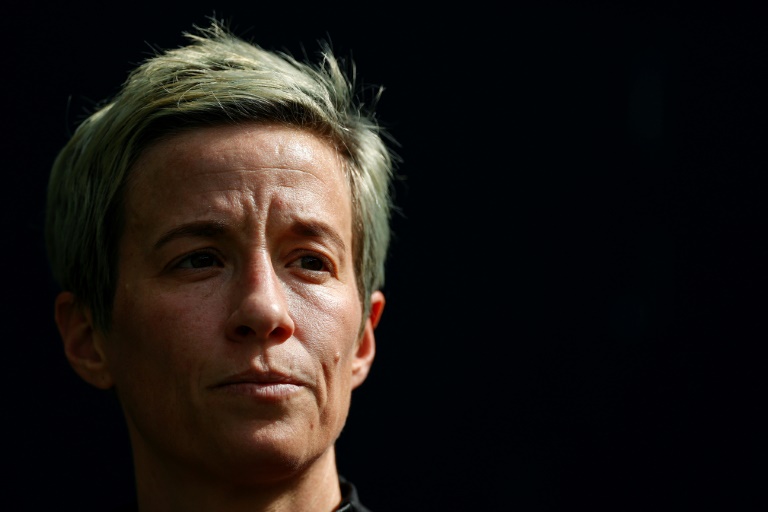
US women’s soccer icon Megan Rapinoe, her voice cracking with emotion, spoke of her sadness in comments to reporters ahead of an international friendly against Colombia this weekend.

“It’s hard to put into words how sad a day this is,” Rapinoe said. “I just can’t understate how sad and how cruel this is.

“The cruelty is the point, because this is not pro-life, by any means.

“It will completely exacerbate so many of the existing inequalities that we have in our country. The right to freedom and the pursuit of happiness and liberty is being assaulted in this instance.”

Rapinoe, who is gay, said she also feared that US constitutional protections on same-sex marriage would eventually be in jeopardy.

“We live in a country that forever tries to chip away what you have innately, what you have been privileged enough to feel your entire life,” Rapinoe said.

US tennis legend Billie Jean King, who wrote in her memoir “All In” of her harrowing experience seeking an abortion in the days before it became a right in the United States, said Friday’s ruling “will not end abortion.”

“What it will end is safe and legal access to this vital medical procedure,” King wrote on Twitter. “It is a sad day for the United States.”

King’s fellow tennis great Martina Navratilova said simply: “The March to Gilead is here”, in a reference to the novel and television drama “The Handmaid’s Tale”, which portrays a dystopian future where women are subjugated and enslaved by men.

Several male sports stars also spoke out against the decision.

NBA icon LeBron James said on Twitter the decision was “absolutely about power & control.”

Seattle Sounders goalkeeper Stefan Frei also contrasted the ruling with the court’s decision on gun control a day earlier.

“Impose a constitutional right to concealed carry of firearms, and following day end the fundamental constitutional protection of reproductive rights!? Our country is actively moving in the wrong direction,” Frei wrote on Twitter. 

“What’s next? This is crazy.”

US passes first major gun bill in decades

US lawmakers broke a decades-long stalemate on firearms control Friday, passing the first major safety regulations in almost 30 years, less than 24 hours after the Supreme Court bolstered the right to bear arms.

Gun regulation is a touchstone issue for both conservatives and liberals in the United States that has consumed national politics amid multiple mass shootings in recent years.

The Democratic-led House of Representatives voted to rubber-stamp a bipartisan Senate gun bill that — while modest — amounts to the first significant piece of legislation to regulate firearms since 1994.

“Let us not judge this legislation for what is not in it, but respect it for what it does. And what it does is save lives. And we are very, very proud of that,” the top Democrat Nancy Pelosi said on the House floor. 

Fourteen Republicans defied their leader Kevin McCarthy to cross the aisle and approve the 80-page package, which advanced from the evenly-divided upper chamber with cross-party backing late Thursday.

That vote came hours after the Supreme Court’s conservative majority had struck down a century-old New York law requiring permits for concealed-carry handguns.

The gun legislation includes enhanced background checks for younger buyers and federal cash for states introducing “red flag” laws that allow courts to temporarily remove weapons from those considered a threat.

Billions of dollars have been allocated to crack down on “straw purchasers” who buy firearms for people who are not allowed them and to curb gun trafficking.

– ‘Long-sought triumph’ –

The deeply-divisive issue of gun control was reignited by two massacres in May that saw 10 Black supermarket shoppers gunned down in upstate New York and 21 people, mostly young children, slain at a school in Texas.

The Supreme court had voted along party lines, with the six Republican appointees in favor of bolstering the constitutional right to bear arms and the three Democratic appointees dissenting.

The ruling was hailed by campaigners for boosted gun rights, but took the shine off what was expected to be a day of jubilation for weapons control activists.

Liberals had been celebrating the congressional action despite disappointment at the limited scope of the legislation, which doesn’t include universal background checks and omits any ban on semi-automatic weapons or high-capacity magazines.

“This decision won’t stop our grassroots army from doing what we’ve done for a decade: fighting to keep our families safe,” added Shannon Watts, founder of gun safety group Moms Demand Action, said after the Supreme Court ruling was announced.

“Just as we’re breaking the logjam in Congress, we’re going to work day-in, day-out to mitigate the fallout in New York and any other states impacted by this decision and elect gun-sense lawmakers up and down the ballot.”

Eric Tirschwell, chief litigation counsel at legal non-profit Everytown Law, said the Supreme Court had misapplied fundamental constitutional principles, and added that the group was “ready to go to court” to defend restrictions.

Top Republicans celebrated the court’s decision.

“This is not just a long-sought triumph for lawful gun owners across America, it is a victory for all citizens and our constitutional order itself,” said Senate Minority Leader Mitch McConnell.

McCarthy hailed the ruling as a victory that “rightfully ensures the right of all law-abiding Americans to defend themselves without unnecessary government interference.”

“The decision comes at an important time — as the Senate considers legislation that undermines Second Amendment freedom,” Wayne LaPierre, the National Rifle Association’s executive vice president, said in a statement.

“This decision unequivocally validates the position of the NRA and should put lawmakers on notice: no law should be passed that impinges this individual freedom.”

Close Bitnami banner
Bitnami