US Business

US justice officials outline Trump's 'brazen' takeover bid

Lawmakers investigating the attack on the US Capitol on Thursday detailed Donald Trump’s efforts to recruit the Justice Department into his scheme to overturn his defeat to Joe Biden — attempting to replace its head with a loyalist who was “meddling in the outcome of a presidential election.”

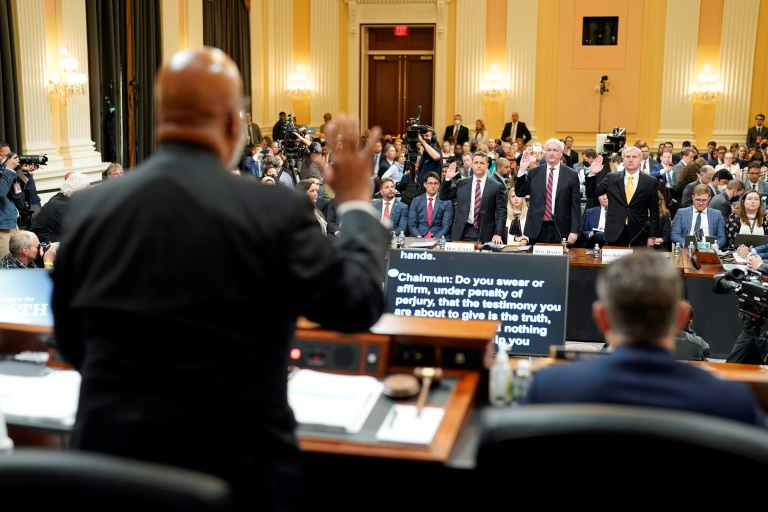
At the fifth hearing into its year-long probe of the January 2021 insurrection, the House of Representatives panel described Trump’s pressure on officials to amplify his false claims that his presidency had been stolen by widespread voter fraud.

“Donald Trump didn’t just want the Justice Department to investigate. He wanted the Justice Department to help legitimize his lies, to baselessly call the election corrupt,” committee chairman Bennie Thompson said.

Lawmakers revisited tensions among government attorneys in the days leading to the violence, when Trump tried to install his own man at the top of the department.

“It was a brazen attempt to use the Justice Department to advance the president’s personal political agenda,” Thompson said.

Underscoring the intensity of Trump’s pressure on the department, acting attorney general Jeffrey Rosen said that in late December 2020 and early January 2021, the president contacted him almost daily.

“At one point, he had raised the question of having a special counsel for election fraud…. he raised whether the Justice Department would file a lawsuit in the Supreme Court,” Rosen said.

“At a couple of junctures, there were questions about making public statements or about holding a press conference.”

The DOJ pursued a deluge of Trump’s election fraud claims, but Rosen said officials were presented with no evidence. 

– Oval Office showdown –

At that point Trump began elevating a little-known mid-level department official named Jeffrey Clark, who embraced the outgoing president’s debunked theories.

Clark prepared a letter to the Georgia state assembly, the hearing was told, stating falsely that the department had found evidence of widespread voter fraud, but other officials refused to sign it. Other letters had also been prepared for other states.

Trump White House lawyer Eric Herschmann told the committee in a videotaped deposition that he had informed Clark that his plan would amount to “committing a felony.”

Trump pushed to install Clark as attorney general over Rosen, and having Clark reverse the department’s conclusion that there was no evidence of fraud that could sway the election.

But Trump was forced to back off by a rebellion in the department’s senior ranks at a January 4 Oval Office meeting outlined in detail by the witnesses.

Rosen, his deputy Richard Donoghue, another high-ranking official named Steven Engel and White House counsel Pat Cipollone threatened to resign en masse, warning that they would take “hundreds and hundreds” of top federal prosecutors with them if Trump went ahead with his plan.

“I made the point that Jeff Clark is not even competent to serve as the attorney general. He’s never been a criminal attorney. He’s never conducted a criminal investigation in his life,” Donoghue recalled telling Trump.

Donoghue said he told Clark: “You’re an environmental lawyer. How about you go back to your office, and we’ll call you when there’s an oil spill?”

He also recalled warning Clark that his mission to push Trump’s election fraud claims was “nothing less than the United States Justice Department meddling in the outcome of a presidential election.”

– ‘Facts, evidence and law’ –

Under live questioning, Donoghue confirmed that he had rebuffed Trump when the then-president insisted the department could simply “say that the election was corrupt” and “leave the rest to me.”

Rosen said Trump had asked him during a December 31 meeting to seize voting machines from state governments and again Rosen refused, explaining that there was no justification for doing so.

Donoghue recalled Trump being agitated and telling both officials he had been advised to fire them and promote Clark.

“I responded, as I think I had earlier… ‘Mr. President, you should have the leadership that you want, but understand the United States Justice Department functions on facts, evidence and law. And those are not going to change.'”

Clark didn’t appear before the committee and asserted his Fifth Amendment right to avoid incriminating himself more than 100 times during his deposition. 

In a headline-grabbing coda to the affair, federal investigators searched Clark’s home on Wednesday.

The US attorney in Washington did not comment on the reason for the action but the Center for Renewing America, where Clark works, confirmed the search, calling it a “weaponization of government.”

Adding to the drama, Hollywood actor Sean Penn was at Thursday’s hearing as a guest of former police officer Michael Fanone, who was seriously injured on January 6 and testified last year about his ordeal.

Covid vaccines saved 20 million lives in first year: study

Covid vaccines prevented nearly 20 million deaths in the first year after they were introduced, according to the first large modelling study on the topic released Friday.

The study, published in The Lancet Infectious Diseases, is based on data from 185 countries and territories collected from December 8, 2020 to December 8, 2021. 

It is the first attempt to estimate the number of deaths prevented directly and indirectly as a result of Covid-19 vaccinations. 

It found that 19.8 million deaths were prevented out of a potential 31.4 million deaths that would have occurred if no vaccines were available.

It was a 63 percent reduction, the study found.  

The study used official figures — or estimates when official data was not available — for deaths from Covid, as well as total excess deaths from each country. 

Excess mortality is the difference between the total number of people who died from all causes and the number of deaths expected based on past data. 

These analyses were compared with a hypothetical alternative scenario in which no vaccine was administered. 

The model accounted for variation in vaccination rates across countries, as well as differences in vaccine effectiveness based on the types of vaccines known to have been primarily used in each country.  

China was not included in the study because of its large population and strict containment measures, which would have skewed the results, it said.

The study found that high- and middle-income countries accounted for the largest number of deaths averted, 12.2 million out of 19.8 million, reflecting inequalities in access to vaccines worldwide. 

Nearly 600,000 additional deaths could have been prevented if the World Health Organization’s (WHO) goal of vaccinating 40 percent of each country’s population by the end of 2021 had been met, it concluded.  

“Millions of lives have probably been saved by making vaccines available to people around the world,” said lead study author Oliver Watson of Imperial College London. 

“We could have done more,” he said.  

Covid has officially killed more than 6.3 million people globally, according to the WHO. 

But the organisation said last month the real number could be as high as 15 million, when all direct and indirect causes are accounted for. 

The figures are extremely sensitive due to how they reflect on the handling of the crisis by authorities around the world.

The virus is on the rise again in some places, including in Europe, which is seeing a warm-weather resurgence blamed in part on Omicron subvariants. 

Acquitted US protest shooter to launch video game

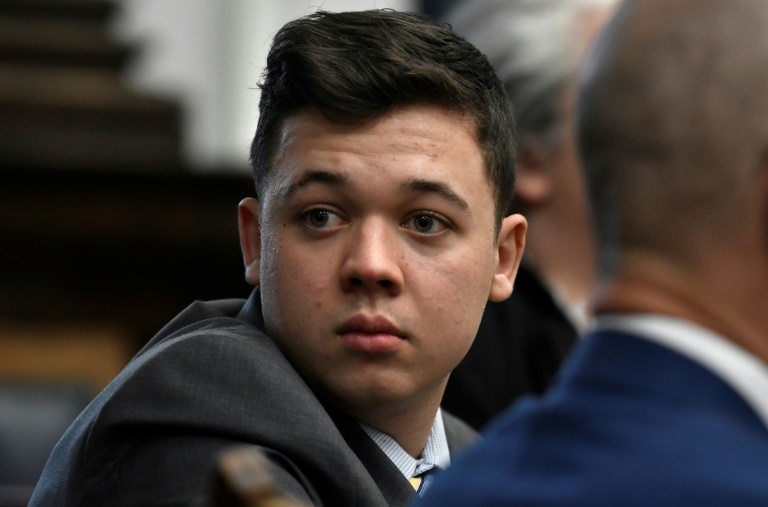
A US teen cleared in court after killing people amid unrest over police mistreatment of African-Americans unveiled Thursday a video game centered on shooting targets representing journalists.

Kyle Rittenhouse said in online posts that money raised from sales of the game will be used to sue “leftwing media organizations” for defamation over their coverage of his 2020 case.

He did not specify which news outlets he intended to sue, nor was it clear when the game would be available for play.

“It’s time to fight back against the fake news machine,” Rittenhouse said in a video posted on Twitter.

“This is why I am launching the Kyle Rittenhouse fake news turkey shoot video game.”

A trailer for the game, priced at $10, shows a cartoon version of Rittenhouse blasting away, arcade-style, at turkey characters labeled “fake news” from behind cover.

Rittenhouse was acquitted late last year by a jury in the August 2020 shootings in Kenosha, Wisconsin.

Rittenhouse, 17 at the time, shot dead two white men and wounded another with his AR-15 semi-automatic rifle during riots that followed anti-police protests in Kenosha.

With Rittenhouse accused of homicide, the jury accepted his argument that he was defending himself from attack by the three men.

Rittenhouse said he had traveled to Kenosha from neighboring Illinois to help protect private property from damage in riots that erupted after Kenosha police shot and paralyzed a Black man, Jacob Blake.

Before the incident, on his Facebook page Rittenhouse had endorsed a “Blue Lives Matter” campaign to support police. This came in response to heavy criticism of law enforcement officers for killings of Black suspects, in particular the murder of George Floyd in Minnesota in May 2020.

US Supreme Court on guns: what happens next?

The US Supreme Court ruling in the most important gun rights case in more than a decade does not mean a New Yorker can now openly carry an AR-15 rifle into a movie theater.

But they may be able to eventually bring in a concealed and loaded handgun.

In a 6-3 decision in a case brought against New York’s gun licensing requirements, the conservative-dominated court ruled that Americans have a fundamental right to carry a concealed handgun in public.

The ruling represents a major legal shift on the issue of gun control, but it will likely take time for the real impact on the streets and citizens of US cities to make itself felt: 

– New York vows to fight back –

New York Governor Kathy Hochul called the Supreme Court decision “reprehensible” and pledged to enact new state gun control legislation.

“We do not need people entering our subways, our restaurants, our movie theaters with concealed weapons,” Hochul said.

New York City police commissioner Keechant Sewell warned New Yorkers that nothing has changed yet.

“If you carry a gun illegally in New York City, you will be arrested,” she said.

New York City Mayor Eric Adams vowed to use “every legal resource available” to ensure that “New Yorkers are not put in greater danger of gun violence.”

New York, the nation’s fourth-largest state with a population of 19.3 million, has some of the strictest gun laws in the country.

Illegally possessing a loaded firearm outside one’s home or place of business has been a felony punishable by up to 15 years in prison.

Adams, the mayor, said the city will start identifying sensitive places where guns may legally be banned. 

– ‘Sensitive places’ –

In its ruling, the Supreme Court said it was “settled” law that guns may be prohibited in some “sensitive places” such as schools, government buildings, polling places and courthouses.

But they left it to lower courts to determine exactly what other places may be added to the list.

Jeffrey Fagan, a law professor at Columbia University, said the court had “created a precedent that there are extremely limited circumstances where one cannot carry a firearm.”

Fagan predicted a “cat-and-mouse game” between municipal governments seeking to restrict the right to carry on one hand and the gun lobby and constitutional conservatives who want to expand that right.

“Can one carry a firearm into a church? Can one carry a firearm onto mass transit? Can one carry a firearm into a movie theater?” he asked. “I think it’s going to be an interesting period of experimentation.”

– Impact on other states –

About half of the 50 US states allow permitless carry of concealed firearms in public while the other half allow it in some form but with restrictions, according to the gun control group Giffords.

A number of US states also allow the open carrying of rifles, including semi-automatics, and several recent protests in the United States have featured heavily-armed demonstrators.

The Supreme Court ruling will have an immediate impact on the five states with laws similar to New York’s — California, New Jersey, Maryland, Massachusetts, and Hawaii — and the nation’s capital, Washington.

Joseph Blocher, a law professor at Duke University, said he expected those states to “attempt to distinguish their laws from New York.”

They may argue that their laws are less stringent and involve less discretion in the licensing authority, said Blocher, co-director of the Center for Firearms Law.

“But I would expect there to be strong pressure in litigation for their laws to be revamped or struck down,” he added.

Big Oil meeting with US govt cordial but no miracle gas price fix

Biden administration officials and oil industry executives huddled in Washington on Thursday to discuss potential steps to address runaway gasoline prices, and while both sides called the talks constructive, no concrete plans for relief emerged.

High prices at the pump are weighing on American consumers — and damaging President Joe Biden’s approval rating.

Heading into the gathering, Energy Secretary Jennifer Granholm said she hoped the meeting would result in refiners boosting gasoline supplies to lower prices for the summer vacation driving season.

Afterwards, the Energy Department said the talks had had a “productive focus on dissecting the current global problems of supply and refining,” and promised “ongoing dialogue” to “alleviate the current supply and price challenges.” 

Similarly, the American Petroleum Institute and American Fuel & Petrochemical Manufacturers called the meeting a “constructive discussion about ways to address rising energy costs and create more certainty for global energy markets.”

Chevron, Phillips 66 and Shell all released upbeat statements, with Shell US President Gretchen Watkins praising Granholm for setting a “collaborative tone” by noting that Shell and others had shifted some refining capacity to produce biofuels.

But no practical steps to immediately boost supply were revealed.

White House press secretary Karine Jean-Pierre called the gathering a “first step.”

“Clearly we want to come up with solutions,” Jean-Pierre told a press briefing. “There’s going to be other steps to get there.”

– Uneasy ties –

Biden and the oil industry have an uneasy relationship, in part over the White House’s efforts to restrict drilling in some federal areas due to environmental concerns, and decisions like canceling the Keystone pipeline project on his first day in office.

The US president has also blasted industry leaders in recent days over skyrocketing profits and their reluctance to boost capital spending. 

Industry leaders released a letter to Biden ahead of Thursday’s meeting that alluded to his upcoming trip to Saudi Arabia, urging him to visit US refineries and other industry sites to understand the potential for “American-made energy solutions.”

But with Biden’s approval ratings plunging due to soaring inflation, the president has turned to the industry for relief.

– Short-term solutions? –

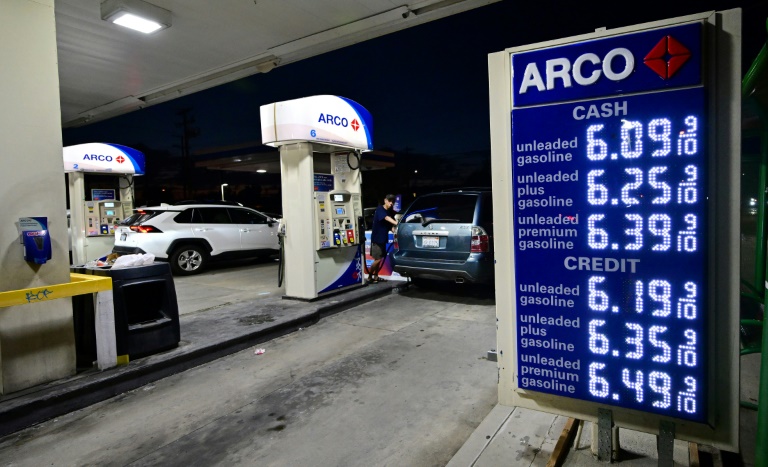
Gasoline prices currently stand at $4.94 a gallon, a bit below all-time highs, but up more than 60 percent from the year-ago level.

In a letter earlier this month to oil giants, Biden said high fuel prices were a key factor in the “intense financial pain the American people and their families are bearing.”

He urged ExxonMobil, Chevron and other industry players to “provide concrete, near-term solutions that address the crisis.”

In response, Chevron Chief Executive Mike Wirth pledged to work with the administration, but faulted Biden’s comments that “at times vilify” the industry — drawing a Biden quip that Wirth was being “mildly sensitive.”

The price surge follows Russia’s invasion of Ukraine, which exacerbated an already tight energy supply situation, sending crude oil prices sharply higher. 

The rise in prices also reflects the diminished state of refining capacity after the industry mothballed some plants during Covid-19 lockdowns, and did not reopen them amid uncertain long-term growth prospects with the buildup of electric vehicles.  

Biden’s policy thus far has centered on a huge increase in crude oil from the Strategic Petroleum Reserve. 

On Wednesday, the US president proposed a temporary fuel tax break, a measure that received a lukewarm reception on Capitol Hill.

For energy specialist Andrew Lebow of the Commodity Research Group consultancy, “there is very little refiners can do at this point.”

“If they could produce more, certainly they would be given that the margins are incredible,” he said.

On Wednesday, Granholm acknowledged that building new refineries could not be done overnight, but said the administration wanted answers about plants that had been taken offline.

She also wanted to talk about supply chain issues, questioning if the industry could help on that front.

Kevin Book, head of research at Clearview Energy Partners, said there were areas where the government could provide aid, such as facilitating procurement of truck drivers and sand for fracking. 

Adopting a broadly constructive tone on regulation could also boost investment, he said.

Big Oil meeting with US govt cordial but no miracle gas price fix

Biden administration officials and oil industry executives huddled in Washington on Thursday to discuss potential steps to address runaway gasoline prices, and while both sides called the talks constructive, no concrete plans for relief emerged.

High prices at the pump are weighing on American consumers — and damaging President Joe Biden’s approval rating.

Heading into the gathering, Energy Secretary Jennifer Granholm said she hoped the meeting would result in refiners boosting gasoline supplies to lower prices for the summer vacation driving season.

Afterwards, the Energy Department said the talks had had a “productive focus on dissecting the current global problems of supply and refining,” and promised “ongoing dialogue” to “alleviate the current supply and price challenges.” 

Similarly, the American Petroleum Institute and American Fuel & Petrochemical Manufacturers called the meeting a “constructive discussion about ways to address rising energy costs and create more certainty for global energy markets.”

Chevron, Phillips 66 and Shell all released upbeat statements, with Shell US President Gretchen Watkins praising Granholm for setting a “collaborative tone” by noting that Shell and others had shifted some refining capacity to produce biofuels.

But no practical steps to immediately boost supply were revealed.

White House press secretary Karine Jean-Pierre called the gathering a “first step.”

“Clearly we want to come up with solutions,” Jean-Pierre told a press briefing. “There’s going to be other steps to get there.”

– Uneasy ties –

Biden and the oil industry have an uneasy relationship, in part over the White House’s efforts to restrict drilling in some federal areas due to environmental concerns, and decisions like canceling the Keystone pipeline project on his first day in office.

The US president has also blasted industry leaders in recent days over skyrocketing profits and their reluctance to boost capital spending. 

Industry leaders released a letter to Biden ahead of Thursday’s meeting that alluded to his upcoming trip to Saudi Arabia, urging him to visit US refineries and other industry sites to understand the potential for “American-made energy solutions.”

But with Biden’s approval ratings plunging due to soaring inflation, the president has turned to the industry for relief.

– Short-term solutions? –

Gasoline prices currently stand at $4.94 a gallon, a bit below all-time highs, but up more than 60 percent from the year-ago level.

In a letter earlier this month to oil giants, Biden said high fuel prices were a key factor in the “intense financial pain the American people and their families are bearing.”

He urged ExxonMobil, Chevron and other industry players to “provide concrete, near-term solutions that address the crisis.”

In response, Chevron Chief Executive Mike Wirth pledged to work with the administration, but faulted Biden’s comments that “at times vilify” the industry — drawing a Biden quip that Wirth was being “mildly sensitive.”

The price surge follows Russia’s invasion of Ukraine, which exacerbated an already tight energy supply situation, sending crude oil prices sharply higher. 

The rise in prices also reflects the diminished state of refining capacity after the industry mothballed some plants during Covid-19 lockdowns, and did not reopen them amid uncertain long-term growth prospects with the buildup of electric vehicles.  

Biden’s policy thus far has centered on a huge increase in crude oil from the Strategic Petroleum Reserve. 

On Wednesday, the US president proposed a temporary fuel tax break, a measure that received a lukewarm reception on Capitol Hill.

For energy specialist Andrew Lebow of the Commodity Research Group consultancy, “there is very little refiners can do at this point.”

“If they could produce more, certainly they would be given that the margins are incredible,” he said.

On Wednesday, Granholm acknowledged that building new refineries could not be done overnight, but said the administration wanted answers about plants that had been taken offline.

She also wanted to talk about supply chain issues, questioning if the industry could help on that front.

Kevin Book, head of research at Clearview Energy Partners, said there were areas where the government could provide aid, such as facilitating procurement of truck drivers and sand for fracking. 

Adopting a broadly constructive tone on regulation could also boost investment, he said.

New Yorkers slam 'stupid' high court gun ruling, Republicans celebrate

From the streets of New York to the corridors of Congress, Americans expressed both outrage and delight at the Supreme Court’s striking down of a gun law Thursday, reflecting the country’s bitter divide.

The 6-3 court decision throws out a more than century-old New York law that required a person to prove they had a legitimate self-defense need, or “proper cause,” to receive a permit to carry a handgun outside the home.

Several other states, including California, have similar laws and the court’s ruling will curb their ability to restrict people from carrying guns in public.

New York Governor Kathy Hochul said the decision marked a “dark day,” while Big Apple mayor Eric Adams said it “may have opened an additional river feeding the sea of gun violence.”

“It’s stupid. It’s just stupid,” Sushmita Peters, a 23-year-old emergency room worker, told AFP in Hunter’s Point, in the New York City borough of Queens.

“People look at people in power to feel safe. And that’s not something you feel when they’re making decisions like this.”

Nearby, 38-year-old Laurent Baud said the decision was particularly perplexing coming so soon after deadly mass shootings in Buffalo, New York and Uvalde, Texas.

“It’s a little worrisome that more and more people can carry guns,” he said.

Christy, a 32-year-old security guard in Manhattan who declined to give her surname, said she feared it would bring “high crime to the area.”

“Honestly, people are not that mentally stable out here,” she told AFP.

New York officials lined up to slam the ruling, warning that it would undermine public safety and pledging to introduce legislation to temper its effects.

Hochul, a Democrat, branded it “absolutely shocking” and accused the six judges in the majority of acting “recklessly.”

“We can have restrictions on speech — you can’t yell ‘fire’ in a crowded theater but somehow there are no restrictions allowed on the Second Amendment,” she said, referring to the constitutional amendment guaranteeing Americans the right to bear arms.

Adams, who was elected late last year on a platform to make New York City safer, said the ruling “will put New Yorkers at further risk of gun violence.”

He and Hochul both vowed to review their options.

“We will work together to mitigate the risks this decision will create once it is implemented, as we cannot allow New York to become the Wild West,” said Adams, also a Democrat.

– ‘Legitimacy crisis’ –

The court’s ruling will curb the ability of other states with laws similar to New York’s, such as California, from enforcing them.

“This is a dangerous decision from a court hell bent on pushing a radical ideological agenda and infringing on the rights of states to protect our citizens from being gunned down in our streets, schools, and churches. Shameful,” tweeted California Governor Gavin Newsom.

Fellow Democrats in the federal government echoed those concerns.

House speaker Nancy Pelosi said it was “unfathomable” that justices had “chosen to endanger more American lives.”

Congresswoman Pramila Jayapal described the Supreme Court as “out of touch with America” and facing “a legitimacy crisis.”

Republicans praised the decision, with House minority leader Kevin McCarthy tweeting that the ruling “rightfully ensures the right of all law-abiding Americans to defend themselves without unnecessary government interference.”

“The right of the people to keep and bear arms, shall not be infringed,” said Markwayne Mullin, citing the text of the Second Amendment.

The Second Amendment Foundation, which campaigns for gun rights, said it was “gratified” by the “long-overdue affirmation that the right to bear arms exists outside the home.”

There was also some support on the streets of New York City, whose nine million residents overwhelmingly lean liberal.

“It’s a good idea. Self-defense, you can save yourself. Somebody knows you have a gun, they will be careful,” 75-year-old Sam, who declined to give his surname, told AFP.

pdh-af-dd-ft/des

Major US banks can weather severe economic downturn: Fed

The largest banks operating in the US market have sufficient resources to withstand a severe economic downturn and continue providing financing to American families and firms, the Federal Reserve said Thursday.

The Fed subjected 33 banks to its annual “stress test” exercise, to gauge whether they would be able to weather a steep global recession.

In the hypothetical crisis, financial markets plummet, commercial real estate and corporate debt markets face substantial strain, US unemployment reaches 10 percent and the economy contracts by 3.5 percent.

The results “showed that banks continue to have strong capital levels, allowing them to continue lending to households and businesses during a severe recession,” the Fed said. 

The scenario for this year’s test was even bleaker than the one used last year, but the outcome was the same, showing all the banks would maintain a sufficient “cushion” despite total projected losses of $612 billion, according to the report.

“Despite the larger post-stress decline this year… capital ratios remain well above the required minimum levels throughout the projection horizon” of nine quarters, the report said.

The stress tests, implemented in the wake of the 2008 global financial crisis, apply to banks with at least $100 billion in total assets, including the top tier designated as “global systemically important banks.”

Smaller banks are only subjected to the stress tests every two years, so the results are not directly comparable to 2021, which tested 23 institutions.

Among the banks examined in both years, there were an additional $50 billion in losses under the tougher scenario, a Fed official told reporters.

However, the official stressed that the dire case applied is only hypothetical and not a forecast.

With the results in hand, banks can announce any plans for dividend payments and share buybacks starting Monday at 2030 GMT, the official said.

The Fed ordered limits to such distributions in June 2020 as the coronavirus pandemic caused a sharp economic downturn, but relaxed the restrictions in December 2020 before removing them following last year’s tests.

Apple, Android phones targeted by Italian spyware: Google

An Italy-based firm’s hacking tools were used to spy on Apple and Android smartphones in Italy and Kazakhstan, Google said Thursday, casting a light on a “flourishing” spyware industry.

Google’s threat analysis team said spyware made by RCS Lab targeted the phones using a combination of tactics including unusual “drive-by downloads” that happen without victims being aware.

Concerns over spyware were fueled by media outlets reporting last year that Israeli firm NSO’s Pegasus tools were used by governments to surveil opponents, activists and journalists.

“They claim to only sell to customers with legitimate use for surveillanceware, such as intelligence and law enforcement agencies,” mobile cybersecurity specialist Lookout said of companies like NSO and RCS.

“In reality, such tools have often been abused under the guise of national security to spy on business executives, human rights activists, journalists, academics and government officials,” Lookout added.

Google’s report said the RCS spyware it uncovered, and which was dubbed “Hermit”, is the same one that Lookout reported on previously.

Lookout researchers said that in April they found Hermit being used by the government of Kazakhstan inside its borders to spy on smartphones, just months after anti-government protests in that country were suppressed.

“Like many spyware vendors, not much is known about RCS Lab and its clientele,” Lookout said. “But based on the information we do have, it has a considerable international presence.”

– Growing spyware industry –

Evidence suggests Hermit was used in a predominantly Kurdish region of Syria, the mobile security company said.

Analysis of Hermit showed that it can be employed to gain control of smartphones, recording audio, redirecting calls, and collecting data such as contacts, messages, photos and location, Lookout researchers said.

Google and Lookout noted the spyware spreads by getting people to click on links in messages sent to targets.

“In some cases, we believe the actors worked with the target’s ISP (internet service provider) to disable the target’s mobile data connectivity,” Google said.

“Once disabled, the attacker would send a malicious link via SMS asking the target to install an application to recover their data connectivity.”

When not masquerading as a mobile internet service provider, the cyber spies would send links pretending to be from phone makers or messaging applications to trick people into clicking, researchers said.

“Hermit tricks users by serving up the legitimate webpages of the brands it impersonates as it kickstarts malicious activities in the background,” Lookout researchers said.

Google said it has warned Android users targeted by the spyware and ramped up software defenses. Apple told AFP it has taken steps to protect iPhone users.

Google’s threat team is tracking more than 30 companies that sell surveillance capabilities to governments, according to the Alphabet-owned tech titan.

“The commercial spyware industry is thriving and growing at a significant rate,” Google said.

Germany raises gas alert level after Russia cuts supply

Germany moved closer to rationing natural gas on Thursday as it raised the alert level under an emergency plan after Russia slashed supplies to the country.

“Gas is now a scarce commodity in Germany,” Economy Minister Robert Habeck told reporters at a press conference.

Russia was using gas “as a weapon” against Germany in retaliation for the West’s support for Ukraine following Moscow’s invasion, Habeck said, with the aim of “destroying” European unity.

But the Kremlin dismissed Germany’s suggestion there were political motives behind the limits to supply as “strange”.

Germany, like a number of other European countries, is highly reliant on Russian energy imports to meet its needs.

Triggering the “alarm” level — the second of three steps under the emergency plan — brings Germany a step closer to the final stage that could see gas rationing in Europe’s top economy.

The increased level reflected a “significant deterioration of the gas supply situation”, Habeck said.

“If we do nothing now, things will get worse,” Habeck said.

– Russian rebuttal –

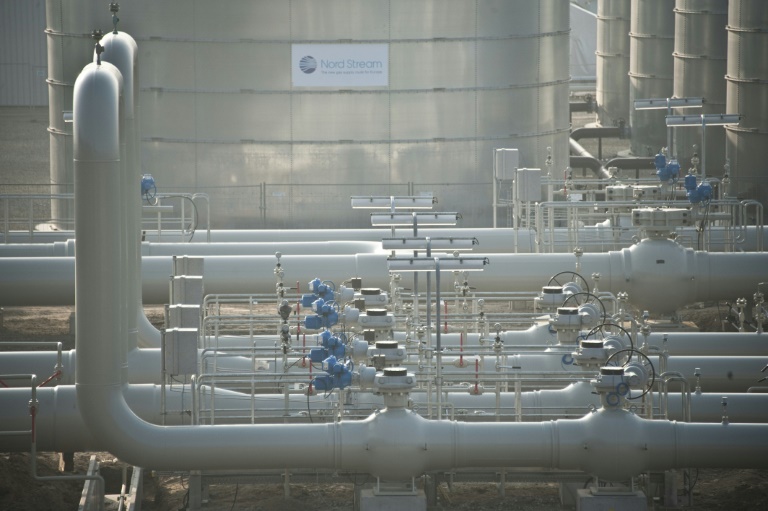
Russian energy giant Gazprom cut supplies to Germany via the Nord Stream pipeline by 60 percent last week, blaming the new limits on delayed repairs.

Germany has dismissed the technical justification provided by Gazprom, instead calling the move a “political decision”. 

Kremlin spokesman Dmitry Peskov said Thursday there was “no double meaning” in the supply decision.

“Our German partners are well aware of the technological servicing cycles of a pipeline,” he said.

“It’s strange to call it politics.”

In recent weeks, Gazprom has stopped deliveries to a number of European countries, including Poland, Bulgaria, Finland and the Netherlands.

Supplies of gas to Europe’s largest economy were “secure”, Habeck said, but action was still required to prepare for the winter ahead.

To mitigate the risks from a supply cut, the government mandated gas storage facilities be filled to 90 percent by the beginning of December.

Currently, the country’s stores stand just under 60 percent full, above the average level of previous years.

In France, the government said Thursday it aimed to fill its natural gas reserves by autumn as it too braces for a drop in supply from Russia.

France will also build a new floating terminal to receive more liquefied natural gas (LNG) supplies by ship, Prime Minister Elisabeth Borne announced.

“We can do without Russian gas,” French Energy Transition Minister Agnes Pannier-Runacher said later on BFM Business TV.

That depends on the floating terminal beginning operating as planned and France filling its strategic reserve, she added.

The European Bank for Reconstruction and Development (EBRD) meanwhile said it would lend 300 million euros to Moldova to for gas purchases.

– Supply stoppage –

The German government expects supply to stop between July 11 and July 25 for annual maintenance on the Nord Stream pipeline.

If deliveries do not resume after the service period, Germany could face a shortage of gas as soon as “mid-December”.

Since the outbreak of the war in Ukraine, Germany has managed to reduce the share of its natural gas supplied by Russia from 55 percent to around 35 percent.

The government has found new sources of supply, accelerated plans to import gas in the form of LNG by sea, and put aside 15 billion euros ($15.8 billion) to buy gas to fill storage facilities.

Germany also decided to reactivate mothballed coal-fired power plants to take the burden for electricity generation off gas.

In contrast, the government shrugged off calls to extend the operational lifetime of its nuclear power plants.

Prolonging the use of the final reactors set to be taken off the grid at the end of the year was “not an option”, it said Wednesday.

Germany had to look to see what “energy saving potential” existed, Habeck said Thursday. 

Households could “make a difference” by conserving energy, after Germany launched a campaign to encourage fuel-saving measures, he said, while industry could also make a further contribution.

Close Bitnami banner
Bitnami