US Business

Instagram trials AI tool to verify age of users

Photo sharing platform Instagram said on Thursday it was starting to trial a tool that relies on artificial intelligence (AI) to confirm the age of users in the United States.

Lawmakers across the world have been vocal in demanding that the social media service, owned by US tech giant Meta, protect young people from adult content and invasions of their privacy.

It’s a thorny issue that tech companies say is not easily solved, but could be tackled with broader technological changes like birthdates being tied to a person’s cell phone.

Meta announced testing of new verification tools for anyone trying to change their age from under 18 to over 18 on the platform, including recording a video selfie or asking friends to verify their age.

“We’re testing this so we can make sure teens and adults are in the right experience for their age group,” Meta said.

The video selfies will be sent to British firm Yoti, which has developed an AI tool that it says can work out the age of under-20s to within 1.5 years.

Though Yoti’s own data suggests its tool is generally worse at verifying the ages of women and girls, and people with darker skin.

Both Yoti and Meta said the selfies would be deleted after the check.

Last year, Instagram boss Adam Mosseri told US lawmakers he felt it was not Instagram’s job to check the age of users.

“I believe it would be much more effective to have age verification at the device level,” he said.

He suggested parents should make sure the child’s phone knew the age “as opposed to having every app, and there’s millions of apps out there, trying to verify age on their own”.

Instagram was rocked last year by revelations from whistleblower Frances Haugen that suggested executives were aware the platform could harm the mental health of young people, particularly teenage girls.

It has since rolled out several features aimed at protecting younger users.

Instagram trials AI tool to verify age of users

Photo sharing platform Instagram said on Thursday it was starting to trial a tool that relies on artificial intelligence (AI) to confirm the age of users in the United States.

Lawmakers across the world have been vocal in demanding that the social media service, owned by US tech giant Meta, protect young people from adult content and invasions of their privacy.

It’s a thorny issue that tech companies say is not easily solved, but could be tackled with broader technological changes like birthdates being tied to a person’s cell phone.

Meta announced testing of new verification tools for anyone trying to change their age from under 18 to over 18 on the platform, including recording a video selfie or asking friends to verify their age.

“We’re testing this so we can make sure teens and adults are in the right experience for their age group,” Meta said.

The video selfies will be sent to British firm Yoti, which has developed an AI tool that it says can work out the age of under-20s to within 1.5 years.

Though Yoti’s own data suggests its tool is generally worse at verifying the ages of women and girls, and people with darker skin.

Both Yoti and Meta said the selfies would be deleted after the check.

Last year, Instagram boss Adam Mosseri told US lawmakers he felt it was not Instagram’s job to check the age of users.

“I believe it would be much more effective to have age verification at the device level,” he said.

He suggested parents should make sure the child’s phone knew the age “as opposed to having every app, and there’s millions of apps out there, trying to verify age on their own”.

Instagram was rocked last year by revelations from whistleblower Frances Haugen that suggested executives were aware the platform could harm the mental health of young people, particularly teenage girls.

It has since rolled out several features aimed at protecting younger users.

Ukraine hopes for EU nod as Russia warns resistance 'futile'

EU leaders met on Thursday to discuss Ukraine’s bid to join the bloc, even as tensions between Brussels and Moscow deepened over gas and Russia closed in on key cities in the embattled Donbas.

“This is a decisive moment for the European Union… A choice must be made today that will determine the future of the union, our stability, our security and our prosperity,” EU council president Charles Michel told journalists ahead of the talks.

Ukrainian President Volodymyr Zelensky said he conducted a “telephone marathon” ahead of the meeting, and approval is likely even though actual membership in the bloc remains years away.

“We are waiting for the green light, Ukraine has earned candidate status,” the head of the Ukrainian presidency Andriy Yermak said on Telegram.

But the potential consequences for Ukraine’s allies loomed large over the talks, and ahead of the G7 and NATO meetings in the following days.

Western officials denounced Moscow’s “weaponising” of its key gas and grain exports in the conflict, with a US official warning of further retaliatory measures at the G7 summit in Germany starting Sunday.

Germany ratcheted up an emergency gas plan to its second alert level, just one short of the maximum that could require rationing in Europe’s largest economy after Russia slashed its supplies.

“Gas is now a scarce commodity,” Economy Minister Robert Habeck told reporters, urging households to cut back on use.

A Kremlin spokesman called Berlin’s statements “strange,” insisting that the supply cut was to carry out maintenance and that necessary equipment from abroad had not arrived.

In Ankara meanwhile, British Foreign Secretary Liz Truss accused Russian President Vladimir Putin of “weaponising hunger” by preventing grain shipments from leaving Ukraine ports, raising the spectre of shortages worldwide.

“We are very clear that this grain crisis is urgent, that it needs to be solved within the next month. Otherwise we could see devastating consequences,” Truss said after talks with her Turkish counterpart Mevlut Cavusoglu.

Moscow and Ankara have negotiated for weeks on getting millions of tonnes of desperately needed grain out of the war zone and on to Africa and the Middle East, so far to no avail.

– Russia presses gains –

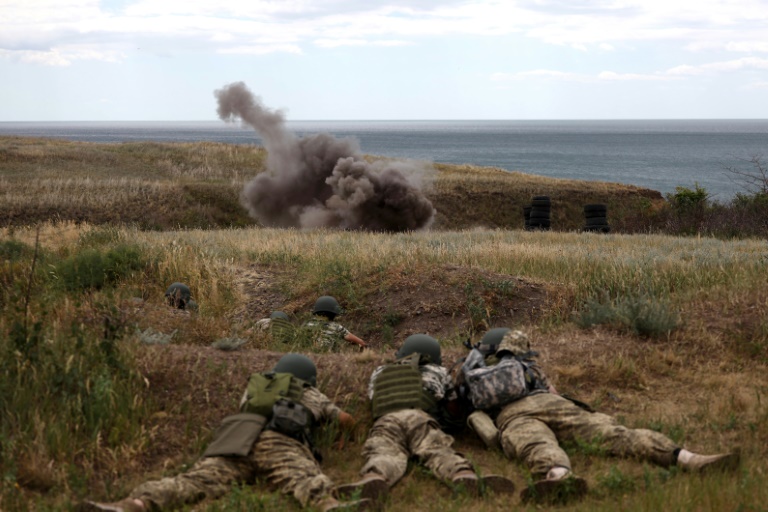
On the ground in the Donbas, the situation was becoming increasingly urgent as Russian forces tightened their grip on the strategically important cities of Severodonetsk and twin Lysychansk across the Donets river.

Taking the two cities would give Moscow control of the whole of Lugansk, allowing Russia to press further into Donbas and potentially farther west.

Ukraine acknowledged Thursday that it had lost control of two areas from where it was defending the cities, with Russian forces now closer to encircling the industrial hubs.

Britain’s defence ministry said some Ukrainian units had probably been forced to withdraw “to avoid being encircled” as troops advanced slowly but steadily toward Lysychansk.

“Russia’s improved performance in this sector is likely a result of recent unit reinforcement and heavy concentration of fire,” it said in its latest intelligence update.

A representative of pro-Russian separatists in Ukraine told AFP the resistance of Ukrainian forces trying to defend Lysychansk and Severodonetsk was “pointless and futile.”

“At the rate our soldiers are going, very soon the whole territory of the Lugansk People’s Republic will be liberated,” said Andrei Marochko, a spokesman for the army of Lugansk.

– ‘Only grannies left’ –

After being pushed back from Kyiv and other parts of Ukraine in the initial weeks of the invasion launched on February 24, Moscow is seeking to seize a vast eastern swathe of the country.

But daily bombardments also continue elsewhere.

The northeastern city of Kharkiv near the Russian border was near empty on Wednesday, AFP reporters said, a day after shelling by Moscow’s forces killed five people there.

“Last night the building next to mine collapsed from the bombardment while I was sleeping,” said Leyla Shoydhry, a young woman in a park near the opera house.

Roman Pohuliay, a 19-year-old in a pink sweatshirt, said most residents had fled the city.

“Only the grannies are left,” he said.

Zelensky again pressed allies Wednesday for the rapid supply of more arms, having earlier accused the Russian army of “brutal and cynical” shelling in the eastern Kharkiv region, where the governor said 15 people had been killed in a day.

In the central city of Zaporizhzhia, meanwhile, women were training to use Kalashnikov assault rifles in urban combat as Russian forces edged nearer.

“When you can do something, it’s not so scary to take a machine gun in your hands,” said Ulyana Kiyashko, 29, after moving through an improvised combat zone in a basement.

– Lithuania in cross-hairs –

Away from the battlefield, Moscow this week summoned Brussels’ ambassador in a dispute with EU member Lithuania over the country’s restrictions on rail traffic to the Russian outpost of Kaliningrad.

The coastal territory, annexed from Germany after World War II, is about 1,000 miles (1,600 kilometres) from Moscow, and borders Lithuania and Poland but has no land border with Russia.

By blocking goods arriving from Russia, Lithuania says it is simply adhering to European Union-wide sanctions on Moscow.

The United States made clear its commitment to Lithuania as a NATO ally, while Germany urged Russia not to “violate international law” by retaliating.

burs-sr/js/ech/gw

As Russia cuts gas, coal makes a comeback in Europe

Russia’s gas cuts to Europe have prompted a clutch of countries to revert to burning coal, raising concerns as the EU seeks to become climate neutral by 2050.

Here is a look at the situation:

– Coal still here, but declining –

Globally, coal is the main source of energy for electricity production, but it is also the top producer of greenhouse gases.

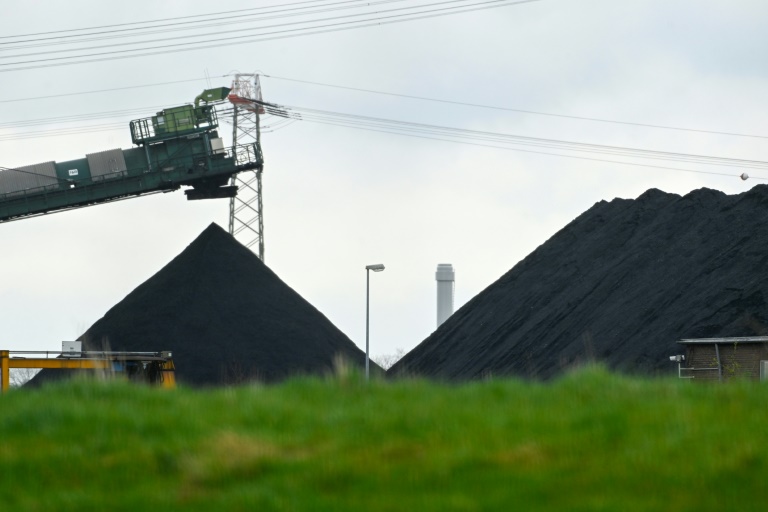
Its use is declining in the European Union, where 202 coal-fired plants with production capacity of 111 gigawatts were in operation earlier this year, according to the Global Energy Monitor, a US-based non-governmental organisation.

Germany is home to the most plants with 63, followed by 44 in neighbouring Poland and 24 in the Czech Republic.

But their use is falling in the 27-nation EU, with coal behind 13 percent of electricity production in 2020, compared to 25 percent in 2013, thanks in part to the rising cost of CO2 emission permits.

“Since 2015, all European countries have gradually pledged to abandon coal, including Poland which was very opposed to that,” noted Nicolas Berghmans at the Paris-based Institute for Sustainable Development and International Relations.

There are no new coal projects underway in Europe, unlike other regions such as Asia.

Some countries, like Portugal, have completely eliminated the use of the fossil fuel.

– A temporary reprieve –

Russia’s halt in natural gas deliveries threatens to rapidly create shortages, so several countries have announced temporary measures in favour of coal.

One such country is Germany, where coal-fired electricity plants will operate longer than planned. Berlin has insisted this does not change its plans to exit coal in 2030.

Austria, Italy and the Netherlands have made similar announcements.

Germany has already stepped up coal use: in the first five months of the year, electricity produced by coal jumped 20 percent, according to Rystad Energy, a research and business intelligence firm.

The EU has decided to ban Russian coal from the month of August, so it will need to import hard coal supplies from elsewhere. Europe is nearly sufficient in brown coal, which is the most polluting.

The German association of hard coal importers estimated in March that Russian imports could be quickly replaced by supplies from countries such as the United States, Colombia, South Africa, Australia, Mozambique and Indonesia.

– A bit of elbow room –

EU officials have called for using the crisis to push forward in the transition to clean energy rather than reverting to dirty fuels.

Berghmans noted that using coal plants would cause a temporary rise in carbon emissions.

“Nevertheless, the advantage of calling upon these plants that were due to close is that there is no investment in new capacity,” he said.

Europe is thus in a completely different situation than Asia, where projects for new coal-fired electricity plants are still being undertaken. These facilities will likely be in operation for decades.

The International Energy Agency (IEA) has flagged a worrying increase in investment in coal projects, a 10 percent rise in 2021 centred in Asia. A similar gain is expected in 2022.

EU members are currently discussing a plan called RepowerEU that would accelerate the push towards renewable energy sources and reduce overall demand.

Berghmans expressed confidence that renewables and demand reduction would allow Europe to “turn the corner” and achieve its climate objectives.

The IEA, which has presented a plan to help Europe reduce its dependence upon Russian gas, believes there is a bit of room for the continent to revert to coal use without increasing carbon emissions.

According to its calculations, Europe can replace about 14 percent of imported Russian gas with coal-fired electricity without producing more pollution.

Germany raises gas alert level after Russia cuts supply

Germany moved closer to rationing natural gas on Thursday as it raised the alert level under an emergency plan after Russia slashed supplies to the country.

“Gas is now a scarce commodity in Germany,” Economy Minister Robert Habeck told reporters at a press conference.

Russia was using gas “as a weapon” against Germany in retaliation for the West’s support for Ukraine following Moscow’s invasion, Habeck said, with the aim of “destroying” European unity.

But the Kremlin dismissed Germany’s suggestion there were political motives behind the limits to supply as “strange”.

Germany, like a number of other European countries, is highly reliant on Russian energy imports to meet its needs.

Triggering the “alarm” level — the second of three steps under the emergency plan — brings Germany a step closer to the final stage that could see gas rationing in Europe’s top economy.

The increased level reflected a “significant deterioration of the gas supply situation”, Habeck said.

“If we do nothing now, things will get worse,” Habeck said.

– Russian rebuttal –

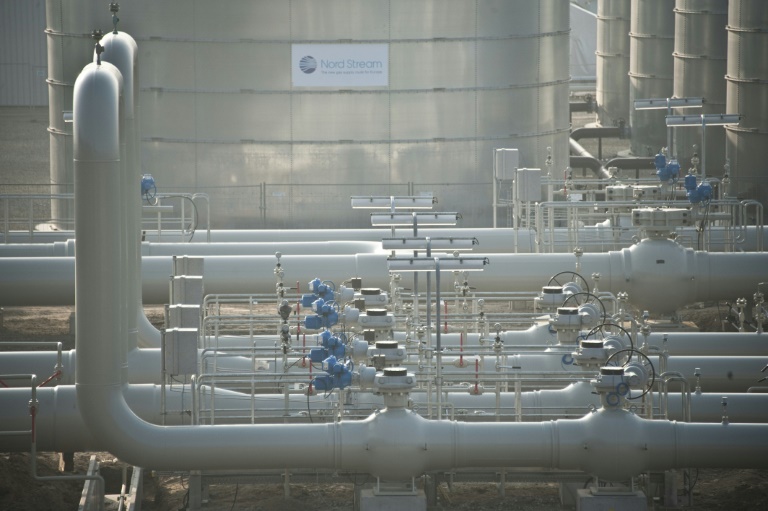
Russian energy giant Gazprom cut supplies to Germany via the Nord Stream pipeline by 60 percent last week, blaming the new limits on delayed repairs.

Germany has dismissed the technical justification provided by Gazprom, instead calling the move a “political decision”. 

Kremlin spokesman Dmitry Peskov said Thursday there was “no double meaning” in the supply decision.

“Our German partners are well aware of the technological servicing cycles of a pipeline,” he said.

“It’s strange to call it politics.”

In recent weeks, Gazprom has stopped deliveries to a number of European countries, including Poland, Bulgaria, Finland and the Netherlands.

Supplies of gas to Europe’s largest economy were “secure”, Habeck said, but action was still required to prepare for the winter ahead.

To mitigate the risks from a supply cut, the government mandated gas storage facilities be filled to 90 percent by the beginning of December.

Currently, the country’s stores stand just under 60 percent full, above the average level of previous years.

The targets would, however, be hard to hit if exports onwards to other countries were not limited — a move that could prove difficult within Europe.

Were these to return to the level they were at before the most recent supply squeeze, Germany could face an acute gas shortage in February 2023. A further supply cut could make the situation even worse.

– Supply stoppage –

The German government expects supply to stop between July 11 and July 25 for annual maintenance on the Nord Stream pipeline.

If deliveries do not resume after the service period, Germany could face a shortage of gas as soon as “mid-December”.

Since the outbreak of the war in Ukraine, Germany has managed to reduce the share of its natural gas supplied by Russia from 55 percent to around 35 percent.

The government has found new sources of supply, accelerated plans to import gas in the form of LNG by sea, and put aside 15 billion euros ($15.8 billion) to buy gas to fill storage facilities.

Germany also decided to reactivate mothballed coal-fired power plants to take the burden for electricity generation off gas.

In contrast, the government shrugged off calls to extend the operational lifetime of its nuclear power plants.

Prolonging the use of the final reactors set to be taken off the grid at the end of the year was “not an option”, it said Wednesday.

Germany had to look to see what “energy saving potential” existed, Habeck said Thursday. 

Households could “make a difference” by conserving energy, after Germany launched a campaign to encourage fuel-saving measures, he said, while industry could also make a further contribution.

Trump bid to 'corrupt' Justice Department under spotlight

Lawmakers investigating last year’s attack on the US Capitol were set Thursday to lay out Donald Trump’s efforts to turn the Justice Department into his “own personal” law firm in his bid to overturn his presidential election defeat to Joe Biden.

At the fifth hearing into its year-long probe of the violence, the House of Representatives panel will highlight Trump’s attempts “to corrupt the country’s top law enforcement body, the Justice Department, to support his attempt to overturn the election,” chairman Bennie Thompson said.

Lawmakers will revisit tensions at the department the weekend before the January 6, 2021 insurrection, when Trump was faced with a revolt as he tried to install his own man at the top of the department.

“We’ll look specifically at how the president was trying to misuse the department to advance his own agenda to stay in power at the end of his term,” an aide to the committee said.

“And we’ll look at how that really is different from historical precedent and how the president was using the DOJ for his own personal means.”

The witnesses will be Jeffrey Rosen, an acting attorney general in the dying days of the Trump administration, his deputy Richard Donoghue and Steven Engel, a former assistant attorney general for the Office of Legal Counsel. 

Rosen took over the department after Bill Barr resigned, but soon found himself at the center of Trump’s efforts to undermine confidence in the integrity of the election. 

Trump began supporting a little-known mid-level department official named Jeffrey Clark, who embraced the outgoing president’s debunked theories of a stolen election. 

Clark pushed colleagues to issue letters to multiple states that Biden won, encouraging officials to consider overturning their election results.

– ‘New streams of evidence’ –

Trump considered installing Clark as attorney general over Rosen, and having Clark reverse the department’s conclusion that there was no evidence of fraud that could sway the election.

But Trump was forced to back off by a rebellion in the department’s senior ranks that the committee said it would relive as it takes the public “into the Oval Office” for the dramatic showdown.

In that January 4 meeting Rosen, Donoghue, Engel and White House counsel Pat Cipollone threatened to resign en masse, warning that they would take a raft of top federal prosecutors with them, if Trump went ahead with his plan.

The panel says it will also reveal how Trump sought to appoint an independent special counsel to pursue his fraud claims, which was resisted by the department.

“And we’ll also look at how the former president threatened to replace or fire leadership within the DOJ and how, again, a few senior Republican officials within the DOJ stood up to Trump’s pressure campaign,” the aide said.

The committee is reportedly planning a break from public hearings, meaning Thursday’s will be the last until hearings resume in July, after Congress’s Independence Day recess.

Thompson told reporters “significant new streams of evidence have necessitated a change to the panel’s hearing schedule, including the potential for additional hearings.”

The new evidence includes footage from documentary filmmaker Alex Holder, who had access to Trump and his family before and after January 6. 

A new Politico/Morning Consult poll offered an insight into how much the hearings are resonating with the public, with 58 percent of respondents saying they’d heard about the June 13 and 16 sessions, and 38 percent saying they watched or listened to at least some of them. 

But while 56 percent of Democratic voters have tuned in, just 25 percent of Republicans have watched.

Euro, pound drop as recession prospects grow

The euro and pound retreated against the dollar Thursday as economic data pointed to increased prospects of recession in Europe.

Global stock markets recovered some ground after another battering this week, while oil prices extended losses.

Economic growth in the eurozone plummeted in June, a key survey showed, as high prices took the wind out the strong recovery from the deep lows of the coronavirus pandemic.

The closely-watched monthly purchasing managers’ index by S&P Global slumped to 51.9 from 54.8 in May. A figure above 50 indicates growth.

PMI data also revealed that Britain’s private sector business activity is languishing at its lowest level for more than a year on decades-high inflation.

The surveys weighed on Europe’s major currencies, with foreign exchange markets seen as a clearer indicator of a country’s economic health compared with stock markets that feature many multinationals.

“The global economy continues to be afflicted by severe supply shocks, which are pushing up inflation and driving down growth,” noted Citi analyst Nathan Sheets, adding the likelihood of recession had reached 50 percent. 

Commentators have warned for some time that the world economy could be heading for contracting growth owing to the sharp increase in global interest rates aimed at cooling inflation.

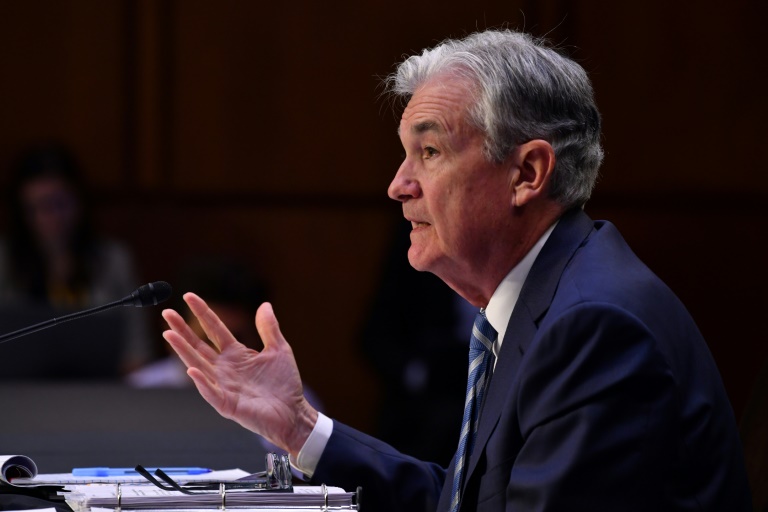
Federal Reserve boss Jerome Powell on Wednesday said recession in the short term was “certainly a possibility”.

He said “inflation has obviously surprised to the upside over the past year, and further surprises could be in store”.

The Fed this month hiked US interest rates by 75 basis points and is expected to do the same in July, with some observers predicting two more such moves after that.

Deutsche Bank CEO Christian Sewing also said there was a 50 percent chance of a contraction next year.

Elon Musk, JP Morgan boss Jamie Dimon and economist Nouriel Roubini are among several others to have made similar forecasts.

The prospect of a retreat in the global economy continued to drag on oil prices as traders fretted over slowing demand. 

Brent and WTI have slumped over the past week, even with sanctions on Russian crude exports and China’s gradual reopening from lockdowns.

Adding to the selling of crude was data Wednesday indicating a jump in US stockpiles.

“A slowdown in global growth is a risk to oil demand, which could help ease some of the tightness in the market,” said Warren Patterson of ING Group. 

“Already, we have seen demand estimates revised lower.”

– Key figures at around 1115 GMT –

London – FTSE 100: UP 0.2 percent at 7,105.32 points

Frankfurt – DAX: DOWN 0.4 percent at 13,089.22

Paris – CAC 40: UP 0.4 percent at 5,941.75

EURO STOXX 50: UP 0.2 percent at 3,472.03

Euro/dollar: DOWN at $1.0499 from $1.0570 late Wednesday

Pound/dollar: DOWN at $1.2204 from $1.2263

Euro/pound: DOWN at 86.02 pence from 86.17 pence

Dollar/yen: DOWN at 135.34 yen from 136.22 yen 

Tokyo – Nikkei 225: UP 0.1 percent at 26,171.25 (close)

Hong Kong – Hang Seng Index: UP 1.3 percent at 21,273.87 (close)

Shanghai – Composite: UP 1.6 percent at 3,320.15 (close)

New York – Dow: DOWN 0.2 percent at 30,483.13 (close)

Brent North Sea crude: DOWN 0.3 percent at $111.44 per barrel

West Texas Intermediate: DOWN 0.4 percent at $105.77 per barrel

Pfizer sets sights on elimination of blinding disease trachoma by 2030

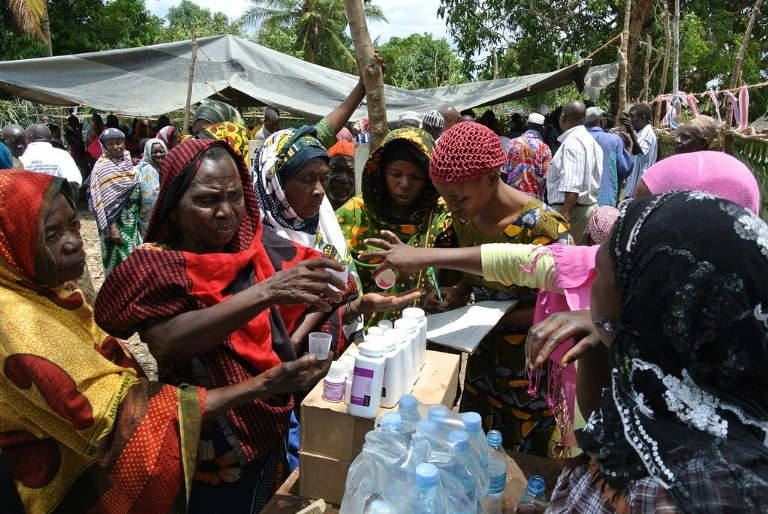
Pfizer on Thursday said it would extend until 2030 a drug donation programme aimed at eliminating trachoma, an eye disease responsible for blinding or visually impairing nearly two million people worldwide.

The US pharmaceutical company co-founded the International Trachoma Initiative (ITI) in 1998, and has already donated nearly a billion doses of the antibiotic Azithromycin, contributing to a 90 percent reduction in the number of people impacted.

“We are so close to getting where we need to be with the elimination of this disease that we couldn’t give up now,” Pfizer chief sustainability officer and senior vice president Caroline Roan told AFP.

The announcement was made in Kigali, Rwanda at the Summit on Malaria and Neglected Tropical Diseases.

Trachoma is caused by infection with the bacterium Chlamydia trachomatis, and is spread through personal contact (such as through hands, clothes or bedding), and by flies that have been in contact with discharge from the eyes or nose of an infected person, according to the World Health Organization. 

Africa is the most affected continent, and women are blinded up to four times more often than men, likely as a result of greater contact with infants. Repeated infections draw the eyelashes inward where they rub against the eye, causing pain and permanent damage to the cornea, says the WHO.

Some 136 million people live in trachoma-endemic areas and are at risk.

The ITI had initially hoped to eliminate the disease by 2020, but is now setting its sights on 2030. Thanks to the progress already made, trachoma no longer represents a public health problem in 13 countries (including China, Morocco, Ghana and elsewhere). 

Individual districts are assessed and if more than 5 percent of the children are infected, then the antibiotic is offered to the entire local population, once a year, for both treatment and prevention.

“Some of the campaigns will literally treat 10 million people in a week, and that really knocks down that infectious reservoir,” ITI director Paul Emerson told AFP.

The challenge today is to reach isolated populations, including nomadic people, as well as combining the drug with the promotion of hygiene measures such as frequent washing of the face in areas where water may be scarce. 

Today, the disease persists in 44 countries.

“Conflicts are a big factor,” said Emerson. “In a perfect world, where there was no interruption in available funds, and there was no war, we probably could have eliminated trachoma by 2020.”

Of the new 2030 goal, Roan said: “We think it is realistic and ambitious.”

EU weighs Ukraine candidacy as Russia inflicts 'hell' in east

EU leaders met in Brussels on Thursday to discuss making Ukraine a candidate to join the bloc, a “decisive” moment likely to infuriate Russia as its forces battled stiff resistance to advance in the embattled eastern Donbas region.

Western officials also denounced Moscow’s “weaponising” of its key gas and grain exports, with a US official warning of further retaliation measures at a G7 summit in Germany starting Sunday.

Germany ratcheted up an emergency gas plan to its second alert level, just one short of the maximum that could require rationing in Europe’s largest economy after Russia slashed its supplies.

“Gas is now a scarce commodity,” Economy Minister Robert Habeck told reporters, urging households to cut back on use.

In Ankara meanwhile, British Foreign Secretary Liz Truss accused Russian President Vladimir Putin of “weaponising hunger” by preventing grain shipments from leaving Ukraine ports, raising the spectre of shortages worldwide.

“We are very clear that this grain crisis is urgent, that it needs to be solved within the next month. Otherwise we could see devastating consequences,” Truss said after talks with her Turkish counterpart Mevlut Cavusoglu.

Moscow and Ankara have negotiated for weeks on getting millions of tonnes of desperately needed grain out of the war zone and on to Africa and the Middle East, so far to no avail.

The potential consequences for Ukraine’s allies loomed large over the country’s EU candidate status talks in Brussels, and the G7 and NATO meetings in the following days.

Ukrainian President Volodymyr Zelensky said he had conducted a “telephone marathon” ahead of the meeting, making his case to 11 European leaders on Wednesday alone.

“This is a decisive moment for the European Union, this is also a geopolitical choice that we will make today,” EU council president Charles Michel told journalists ahead of the summit.

– Russian gains –

While the European Commission-backed candidacy is widely expected to be approved, some members have been lukewarm about Ukraine’s status, and any accession process is likely to take years if not decades.

On the ground in the Donbas, the situation was becoming increasingly urgent as Russian forces tightened their grip on the strategically important city of Severodonetsk, as well as its twin city of Lysychansk across the Donets river.

Taking the two cities would give Moscow control of the whole of Lugansk, allowing Russia to press further into Donbas.

Britain’s defence ministry said some Ukrainian units had probably withdrawn “to avoid being encircled” as Russian troops advanced slowly but steadily toward Lysychansk.

“Russia’s improved performance in this sector is likely a result of recent unit reinforcement and heavy concentration of fire,” it said in its latest intelligence update.

“The Russian army is… just destroying everything” in Lysychansk, said Sergiy Gaiday, governor of the Lugansk region.

“It’s just hell out there,” after four months of shelling in Severodonetsk, he wrote later, vowing that “Our boys are holding their positions and will continue to hold on as long as necessary.”

– ‘Only grannies left’ –

After being pushed back from Kyiv and other parts of Ukraine in the initial weeks of the invasion launched on February 24, Moscow is seeking to seize a vast eastern swathe of the country.

But daily bombardments also continue elsewhere.

The northeastern city of Kharkiv near the Russian border was near empty on Wednesday, AFP reporters said, a day after shelling by Moscow’s forces killed five people there.

“Last night the building next to mine collapsed from the bombardment while I was sleeping,” said Leyla Shoydhry, a young woman in a park near the opera house.

Roman Pohuliay, a 19-year-old in a pink sweatshirt, said most residents had fled the city.

“Only the grannies are left,” he said.

Zelensky again pressed allies Wednesday for the rapid supply of more arms, having earlier accused the Russian army of “brutal and cynical” shelling in the eastern Kharkiv region, where the governor said 15 people had been killed in a day.

In the central city of Zaporizhzhia, meanwhile, women were training to use Kalashnikov assault rifles in urban combat as Russian forces edged nearer.

“When you can do something, it’s not so scary to take a machine gun in your hands,” said Ulyana Kiyashko, 29, after moving through an improvised combat zone in a basement.

– Lithuania in cross-hairs –

Away from the battlefield, Moscow this week summoned Brussels’ ambassador in a dispute with EU member Lithuania over the country’s restrictions on rail traffic to the Russian outpost of Kaliningrad.

The coastal territory, annexed from Germany after World War II, is about 1,000 miles (1,600 kilometres) from Moscow, and borders Lithuania and Poland but has no land border with Russia.

By blocking goods arriving from Russia, Lithuania says it is simply adhering to European Union-wide sanctions on Moscow.

The United States made clear its commitment to Lithuania as a NATO ally, while Germany urged Russia not to “violate international law” by retaliating.

burs-sr/js/sjw/dl

Inflation 'shock' punishes Eurozone economy in June: survey

Economic growth in the eurozone plummeted in June, a key survey showed on Thursday, as high prices took the wind out the strong recovery from the deep lows of the coronavirus pandemic.

The closely-watched monthly purchase managers’ index (PMI) by S&P Global fell from 54.8 in May to 51.9. A figure above 50 indicates growth.

The slowdown, caused by a “cost-of-living shock”, is “the most abrupt recorded by the survey since the height of the global financial crisis in November 2008”, excluding the pandemic lockdown, said Chris Williamson, Chief Business Economist at S&P Global.

Since the beginning of the year, the European economy has recovered strongly from the lifting of restrictions linked to the Covid-19 pandemic, which revived tourism to countries like Spain and Greece as well as transport. 

It also benefited from household spending, as consumers burned through savings accumulated during many months of confinement, offsetting the negative impact of the war in Ukraine. 

But in June, the “tailwind” of this pent-up demand “is already fading”, Williamson warned.

The latest data “is now consistent with Gross Domestic Product (GDP) growth of just 0.2 percent for the second quarter, compared to quarterly growth of 0.6 percent at the start of the year”, he said.

“The situation is likely to deteriorate in the second half of the year”, he added, raising the spectre of negative growth and recession.

Close Bitnami banner
Bitnami