US Business

US Fed announces biggest interest rate hike since 1994

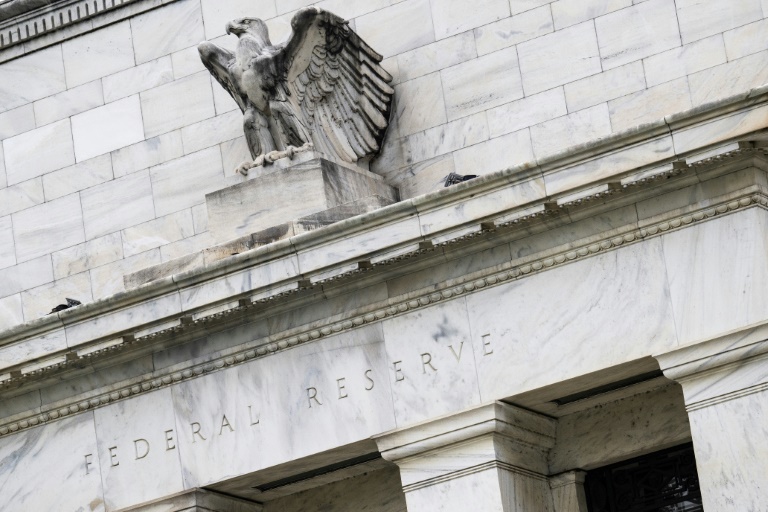
The Federal Reserve announced the most aggressive interest rate increase in nearly 30 years, raising the benchmark borrowing rate by 0.75 percentage points on Wednesday as it battles against surging inflation.

The Fed’s policy-setting Federal Open Market Committee reaffirmed that it remains “strongly committed to returning inflation to its 2 percent objective” and expects to continue to raise the key rate.

Until recently, the central bank seemed set to approve a 0.5-percentage-point increase, but economists say the rapid surge in inflation put the Fed behind the curve, meaning it needed to react strongly to prove its resolve to combat inflation

The super-sized move was the first 75-basis-point increase since November 1994.

Fed Chair Jerome Powell will hold a press conference after the meeting to provide more details on the central bank’s plans, which will be closely watched for signals on how aggressive policymakers will be in coming meetings.

Committee members now see the federal funds rate ending the year at 3.4 percent, up from the 1.9 percent projection in March, according to the median quarterly forecast.

They also expect the Fed’s preferred inflation index to rise to 5.2 percent by the end of the year, with GDP growth slowing to 1.7 percent in 2022 from the previous 2.8 percent forecast.

The FOMC noted that effects of Russia’s invasion of Ukraine are “creating additional upward pressure on inflation and are weighing on global economic activity.”

And ongoing Covid-19 lockdowns in China “are likely to exacerbate supply chain disruptions.”

Kansas City Federal Reserve Bank President Esther George, a noted inflation-hawk, dissented from the committee vote, preferring a smaller, half-point increase.

– Caught off guard –

US central bankers began raising interest rates off zero in March as buoyant demand from American consumers for homes, cars and other goods clashed with transportation and supply chain snarls in parts of the world where Covid-19 remained — and remains — a challenge.

That fueled inflation, which got dramatically worse after Russia invaded Ukraine in late February and Western nations imposed steep sanctions on Moscow, sending food and fuel prices up at a blistering rate.

US gasoline prices have topped $5.00 a gallon for the first time ever and are setting new records daily.

Economists thought March was the peak for consumer price hikes, but the rate spiked again in May, jumping 8.6 percent in the latest 12 months, and wholesale prices surged as well, almost entirely due to soaring costs for energy, especially gasoline.

The Fed was caught off guard with the speed of the price increases, and while policymakers usually prefer to clearly telegraph any policy shift to financial markets, the latest data changed the calculus.

Powell had indicated policymakers were poised to implement another half-point increase in the benchmark borrowing rate this week and a similar move next month, aiming to douse red-hot inflation without tipping the economy into recession and avoid a bout of 1970s-style stagflation.

However, the central bank cannot influence supply issues, and rate hikes only work by cooling demand and slowing the economy — meaning policymakers are walking a fine line between having an impact and doing too much.

And the impact won’t be immediate.

“Monetary policy operates with lags, today’s inflation reflects decisions taken a year ago,” said Adam Posen, head of the Peterson Institute for International Economics and a former central banker.

“Had Fed hiked in 2021Q2/Q3, then inflation now would be different — not least (because) the current global shocks wouldn’t be piling on already high inflation,” he said on Twitter.
US Fed announces biggest interest rate hike since 1994

The Federal Reserve announced the most aggressive interest rate increase in nearly 30 years, raising the benchmark borrowing rate by 0.75 percentage points on Wednesday as it battles against surging inflation.

The Fed’s policy-setting Federal Open Market Committee reaffirmed that it remains “strongly committed to returning inflation to its 2 percent objective” and expects to continue to raise the key rate.

Until recently, the central bank seemed set to approve a 0.5-percentage-point increase, but economists say the rapid surge in inflation put the Fed behind the curve, meaning it needed to react strongly to prove its resolve to combat inflation

The super-sized move was the first 75-basis-point increase since November 1994.

Fed Chair Jerome Powell will hold a press conference after the meeting to provide more details on the central bank’s plans, which will be closely watched for signals on how aggressive policymakers will be in coming meetings.

Committee members now see the federal funds rate ending the year at 3.4 percent, up from the 1.9 percent projection in March, according to the median quarterly forecast.

They also expect the Fed’s preferred inflation index to rise to 5.2 percent by the end of the year, with GDP growth slowing to 1.7 percent in 2022 from the previous 2.8 percent forecast.

The FOMC noted that effects of Russia’s invasion of Ukraine are “creating additional upward pressure on inflation and are weighing on global economic activity.”

And ongoing Covid-19 lockdowns in China “are likely to exacerbate supply chain disruptions.”

Kansas City Federal Reserve Bank President Esther George, a noted inflation-hawk, dissented from the committee vote, preferring a smaller, half-point increase.

– Caught off guard –

US central bankers began raising interest rates off zero in March as buoyant demand from American consumers for homes, cars and other goods clashed with transportation and supply chain snarls in parts of the world where Covid-19 remained — and remains — a challenge.

That fueled inflation, which got dramatically worse after Russia invaded Ukraine in late February and Western nations imposed steep sanctions on Moscow, sending food and fuel prices up at a blistering rate.

US gasoline prices have topped $5.00 a gallon for the first time ever and are setting new records daily.

Economists thought March was the peak for consumer price hikes, but the rate spiked again in May, jumping 8.6 percent in the latest 12 months, and wholesale prices surged as well, almost entirely due to soaring costs for energy, especially gasoline.

The Fed was caught off guard with the speed of the price increases, and while policymakers usually prefer to clearly telegraph any policy shift to financial markets, the latest data changed the calculus.

Powell had indicated policymakers were poised to implement another half-point increase in the benchmark borrowing rate this week and a similar move next month, aiming to douse red-hot inflation without tipping the economy into recession and avoid a bout of 1970s-style stagflation.

However, the central bank cannot influence supply issues, and rate hikes only work by cooling demand and slowing the economy — meaning policymakers are walking a fine line between having an impact and doing too much.

And the impact won’t be immediate.

“Monetary policy operates with lags, today’s inflation reflects decisions taken a year ago,” said Adam Posen, head of the Peterson Institute for International Economics and a former central banker.

“Had Fed hiked in 2021Q2/Q3, then inflation now would be different — not least (because) the current global shocks wouldn’t be piling on already high inflation,” he said on Twitter.

Deadly heatwaves threaten economies too

More frequent and intense heatwaves are the most deadly form of extreme weather made worse by global warming, with death tolls sometimes in the thousands, but they can also have devastating economic impacts too, experts say. 

The prolonged and unseasonable scorchers gripping the central United States and rolling northward across western Europe, sending the thermometer above 40 degrees Celsius (104 degrees Fahrenheit), are likely to cause both.   

Deadly and costly

Very high temperatures caused nearly 10 percent of the two million deaths attributed to extreme weather events from 1970 to 2019, according to the World Meteorological Organization. 

Virtually all that heat-related mortality, moreover, has been since 2000, especially the last decade: from 2010 to 2019 scorching heat was responsible for half of 185,000 extreme weather deaths registered.

In Europe, heatwaves accounted for about 90 percent of weather-related mortality between 1980 and 2022, the European Environment Agency (EEA) has reported. 

Heatwaves rack up economic costs as well, but they are harder to quantify than damage from a storm or flood, and more difficult to insure. 

But extended bouts of great heat can result in more hospital visits, a sharp loss of productivity in construction and agriculture, reduced agricultural yields, and even direct damage to infrastructure. Excess mortality has an economic cost too.

The EAA estimates that heatwaves in 32 European countries between 1980 and 2000 cost 27 to 70 billion euros. The damages over the last 20 years — which included the deadly heatwave of 2003, with 30,000 excess deaths — would almost certainly be higher.

Premature death

The national public health agency in France, which will be blanketed by extreme conditions over the coming days, has called heatwaves “a mostly invisible and underestimated social burden.”  

In France alone, heatwaves from 2015 to 2020 cost 22 to 37 billion euros due to health expenses, loss of well-being and especially “intangible costs stemming from premature deaths”.  

Reduced productivity

The heatwaves of 2003, 2010, 2015 and 2018 in Europe caused damages totalling 0.3 to 0.5 percent of GDP across the continent, and up to two percent of GDP in southern regions, according to a peer-reviewed study in Nature. 

This level of impact could be multiplied by five by 2060 compared to a 1981-2010 baseline without a sharp reduction in greenhouse gas emissions and measures to adapt to high temperatures, the study warned.

At sustained temperatures of around 33C or 34C, the average worker “loses 50 percent of his or her work capacity”, according to the International Labor Organization (ILO).

The ICO estimates by 2030 heatwaves could reduce the total number of hours worked globally by more than two percent — equivalent to 80 million fulltime jobs — at a cost of 2.4 trillion dollars, nearly 10 times the figure for 1995.

“Climate change-related heat stress will reduce outdoor physical work capacity on a global scale,” The UN’s Intergovernmental Panel on Climate Change (IPCC) said in its most recent synthesis report, noting that in some tropical regions outdoor work may become impossible by the end of the century for 200 to 250 days each year.

Drought and agriculture

Both heatwaves and drought are a major threat to agriculture, and thus food security.

Long-term drought is agriculture’s worst enemy when it comes to extreme weather, but heatwaves can provoke major damage as well.

In 2019, a heatwave caused a nine percent drop in drop in maize yields across France, and a 10 percent decline in wheat, according to the French agricultural ministry.

A 2012 scorcher in the United States led to a 13 percent drop in maize production, and a sharp jump in global prices.

Heatwaves also have a negative impact on livestock production and on milk production, according to the IPCC.

US supermarket shooter charged with federal hate crimes

The US Justice Department announced federal hate crimes charges Tuesday against Payton Gendron, the 18-year-old who shot dead 10 African Americans at a Buffalo, New York supermarket in May.

The charges say Gendron was motivated by racist hate when, on May 14, he took a semi-automatic assault weapon to a grocery store in a largely Black neighborhood of Buffalo and killed 10 people, while wounding three others.

They said he was driven by belief in a conspiracy theory called “The Great Replacement” — that white people’s lives and communities are threatened by minorities — a view Gendron espoused in a lengthy document posted online before his attack.

“Gendron’s motive for the mass shooting was to prevent Black people from replacing white people and eliminating the white race, and to inspire others to commit similar attacks,” the charges said.

He planned his attack in detail for months, according to the charges, and he specifically targeted a heavily African-American community, mapping out the popular Tops supermarket there.

He said in his manifesto that he intended to “Kill as many Blacks as possible.”

The federal hate crime charges carry the death penalty or up to life in prison.

Attorney General Merrick Garland announced the charges on a visit to Buffalo, where he met with family members of those killed.

“Hate-fuelled acts of violence terrorize not only the individuals who are all attacked but entire communities,” Garland said.

“We fully recognize the threat that hatred and violent extremism pose to the safety of the American people and American democracy,” he said.

On June 1, Gendron was charged by New York state with domestic terrorism and ten counts of first degree murder.

RIP Explorer: Microsoft's web browser retired

Internet Explorer, Microsoft’s once dominant web browser that some users love to hate, was retired Wednesday after 27 years on the world’s computer screens.

The tech giant will no longer offer fixes or updates to the existing version of Explorer and users will be directed to its replacement, Microsoft Edge.

It was a moment marked with some genuine nostalgia — and plenty of jokes at the expense of what was many people’s first gateway to the internet.

“You took long to download stuff, you kept freezing, and you got replaced pretty easily by other browsers,” tweeted @Zytrux_1, under the hashtag #ripinternetexplorer.

“But there goes one of the first browsers I’ve ever used, and got plenty of good memories thanks to it.”

Twitter was flooded with Explorer memes, including tombstones or coffins bearing the browser’s signature blue “e,” and the occasional screenshot of error messages saying the app had stopped working.

Microsoft announced the change last year, and in a blog post Wednesday explained the need to start fresh with a different browser — Microsoft Edge.

“Internet Explorer (IE) is officially retired and out of support as of today,” the firm wrote.

“The web has evolved and so have browsers. Incremental improvements to Internet Explorer couldn’t match the general improvements to the web at large, so we started fresh,” it added.

– Antitrust battle –

Internet Explorer’s first version came out in 1995, in a challenge to the then rising early internet star Netscape Navigator.

The ubiquity of Microsoft’s operating system became a route also for Explorer to steadily become the default for many users.

In 1997 US authorities contended Microsoft, by incorporating its Internet Explorer in the Windows operating system for the first time, was trying to crush competition from Netscape.

The case was concluded with a settlement in November 2001 that imposed no financial penalty, but forced billionaire Bill Gates’s software giant to disclose more technical information and barred anti-competitive agreements on Microsoft products.

However, users gradually got more alternatives to the browser many loved to hate for its slowness and tech glitches.

Microsoft’s market share in the browser business plunged from more than 90 percent in the 2000s to the low single digits this year.

Google’s Chrome, with nearly 65 percent, is the market leader, according to Statcounter, a web traffic analysis site.

RIP Explorer: Microsoft's web browser retired

Internet Explorer, Microsoft’s once dominant web browser that some users love to hate, was retired Wednesday after 27 years on the world’s computer screens.

The tech giant will no longer offer fixes or updates to the existing version of Explorer and users will be directed to its replacement, Microsoft Edge.

It was a moment marked with some genuine nostalgia — and plenty of jokes at the expense of what was many people’s first gateway to the internet.

“You took long to download stuff, you kept freezing, and you got replaced pretty easily by other browsers,” tweeted @Zytrux_1, under the hashtag #ripinternetexplorer.

“But there goes one of the first browsers I’ve ever used, and got plenty of good memories thanks to it.”

Twitter was flooded with Explorer memes, including tombstones or coffins bearing the browser’s signature blue “e,” and the occasional screenshot of error messages saying the app had stopped working.

Microsoft announced the change last year, and in a blog post Wednesday explained the need to start fresh with a different browser — Microsoft Edge.

“Internet Explorer (IE) is officially retired and out of support as of today,” the firm wrote.

“The web has evolved and so have browsers. Incremental improvements to Internet Explorer couldn’t match the general improvements to the web at large, so we started fresh,” it added.

– Antitrust battle –

Internet Explorer’s first version came out in 1995, in a challenge to the then rising early internet star Netscape Navigator.

The ubiquity of Microsoft’s operating system became a route also for Explorer to steadily become the default for many users.

In 1997 US authorities contended Microsoft, by incorporating its Internet Explorer in the Windows operating system for the first time, was trying to crush competition from Netscape.

The case was concluded with a settlement in November 2001 that imposed no financial penalty, but forced billionaire Bill Gates’s software giant to disclose more technical information and barred anti-competitive agreements on Microsoft products.

However, users gradually got more alternatives to the browser many loved to hate for its slowness and tech glitches.

Microsoft’s market share in the browser business plunged from more than 90 percent in the 2000s to the low single digits this year.

Google’s Chrome, with nearly 65 percent, is the market leader, according to Statcounter, a web traffic analysis site.

Biden fires culture war salvo with big LGBTQ celebration

US President Joe Biden hosts a major White House reception Wednesday in honor of LGBTQ rights, striking a counter blow in the heating culture wars ahead of November midterm elections.

Biden, Vice President Kamala Harris and several cabinet members — including openly gay Transport Secretary Pete Buttigieg — were to join hundreds of representatives from the LGBTQ community in the White House East Room to celebrate Pride Month.

Just ahead of the bash, Biden signed an executive order aimed at providing federal support on a variety of rights in the LGBTQ community that the White House sees as under attack from Republican state-level leaders — especially in Florida, where potential presidential candidate Governor Ron DeSantis has put combating “woke” culture at the heart of his agenda.

The executive order addresses “discriminatory legislative attacks against LGBTQI+ children and families, directing key agencies to protect families and children.”

It seeks to prevent so-called “conversion therapy,” boost health care programs against youth suicide, support LGBTQ foster families and protect against homelessness in the community.

The high profile intervention by Biden aims to counter an “onslaught of hateful… legislation that we’re seeing in the states,” a senior official told reporters.

The official, speaking on condition of anonymity, said there had been more than 300 laws introduced at state level this year alone that infringe on LGBTQ people and their parents.

Among those invited to the White House were “kids and families from across the country who have been personally impacted by these discriminatory bills,” the official said. These included 18-year-old Javier Gomez, who gained renown as an activist while still at school in Florida.

“We’ve had to stand up to their governors and state lawmakers as they advance discriminatory legislation,” the official said.

“These attendees represent the best of America. They are diverse, passionate advocates who are fighting to ensure that the promise of freedom and equality is made real for all you can expect the president today to celebrate the historic progress of his administration.”

Biden is targeting an important layer of the Democratic voter base ahead of midterm elections where Republicans are widely seen as on track to win back control of Congress.

For Republicans, the issue is equally potent, with activists accusing Democrats of moving too far to the left, especially on transgender rights.

The standard bearer on the right is DeSantis, seen by many as a natural heir to former president Donald Trump’s populist brand in the 2024 presidential election.

In March, he signed a controversial law banning lessons on sexual orientation and gender identity in Florida elementary schools, a step some Republicans say protects young children from what they term indoctrination. Biden and other critics say it will hurt the LGBTQ community and stoke bullying.

Debate over what opponents dubbed the “Don’t Say Gay” law quickly went national, even drawing in entertainment giant Disney, which criticized the measure and found itself in open conflict with DeSantis.

Equities rebound as central banks in focus

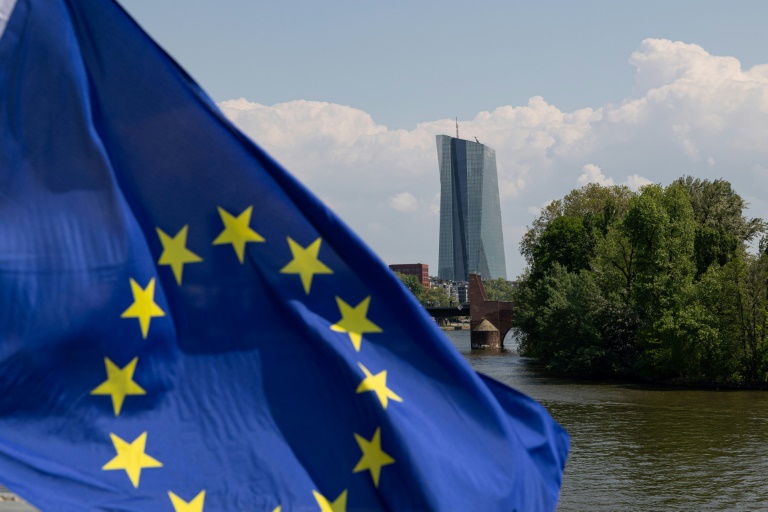
Europe’s equities pushed higher Wednesday as the European Central Bank pledged to ease the stress in volatile eurozone bond markets, while US stocks advanced ahead of a major US rate hike.

Frankfurt, London and Paris stocks rallied, as investors were reassured by news of an emergency ECB meeting.

All three main indices had slid Tuesday, joining a global slide in equities on growing expectations that the US Federal Reserve will move aggressively to combat inflation at the conclusion of its latest scheduled monetary policy meeting on Wednesday.

Bitcoin extended this week’s precipitous slide to approach the key level of $20,000 as investors continued to shun risky crypto assets, while oil prices retreated further on lower energy demand expectations.

– ECB move ‘somewhat underwhelming’ –

The ECB said after its surprise meeting that it would use “flexibility” to ease stress on in sovereign debt markets and design a new instrument to ward off a fresh crisis in the eurozone.

The borrowing costs of some eurozone countries have risen faster than those of others as the ECB tightens its monetary policy. The bank has vowed to prevent such “fragmentation” which occured during the eurozone debt crisis a decade ago.

The yield on 10-year Italian bonds fell on Wednesday.

The euro rose against the dollar before giving up gains after the ECB announcement.

Markets.com analyst Neil Wilson called the announcement “somewhat underwhelming” and did not merit a special meeting.

Earlier, Wilson had said the emergency meeting “smacks of panic and a lack of control — but the market is happy to see it happen”.

The ECB is due to raise eurozone interest rates and end its massive bond-buying stimulus programme in July.

Asian stock markets closed mixed Wednesday with investors on edge over the looming Fed decision that has taken on greater significance since forecast-busting US inflation recently sent shockwaves through world markets.

Wall Street’s major stock indices advanced ahead of the Fed announcement.

Traders’ screens were awash with red at the start of the week after data on Friday revealed that US consumer prices had soared at the fastest pace in four decades.

That confounded hopes that US inflation was stabilising and intensified pressure on policymakers to act.

The news ramped up bets that the Fed would hike interest rates at a steeper and faster pace than expected as it struggles to retain credibility.

Before Friday’s data, the Fed had been tipped to lift borrowing costs by half a percentage point at Wednesday’s meeting, but investors are now widely anticipating a three-quarter point increase, with some even suggesting one percentage point.

The moves fuelled worries that the tighter monetary conditions will deal a blow to the US economy and potentially send it into recession next year.

Data released Wednesday showed US retail sales declined by 0.3 percent in May, confounding analysts who had expected a modest rise.

“These numbers were worse than expected and point to a US economy that appears to be weaker than thought,” said CMC Markets analyst Michael Hewson. 

“This should give the Fed pause if it is considering an outsized hike of” three-quarters of a percentage point, he added.

– Key figures at around 1530 GMT –

New York – Dow: UP 0.5 percent at 30,502.35 points

EURO STOXX 50: UP 1.2 percent at 3,444.49

London – FTSE 100: UP 1.3 percent at 7,280.53 (close)

Frankfurt – DAX: UP 1.4 percent at 13,485.29 (close)

Paris – CAC 40: UP 1.4 percent at 6,030.13 (close)

Tokyo – Nikkei 225: DOWN 1.1 percent at 26,326.16 (close)

Hong Kong – Hang Seng Index: UP 1.1 percent at 21,308.21 (close)

Shanghai – Composite: UP 0.5 percent at 3,305.41 (close)

Euro/dollar: DOWN at $1.0405 from $1.0416 late Tuesday

Pound/dollar: UP at $1.20659 from $1.1997

Euro/pound: DOWN at 86.27 pence from 86.83 pence

Dollar/yen: DOWN at 134.48 yen from 135.47 yen

Brent North Sea crude: DOWN 0.3 percent at $120.80 per barrel

West Texas Intermediate: DOWN 0.7 percent at $118.12 per barrel

Berlin blasts 'political decision' in Gazprom's gas squeeze

Russia on Wednesday stepped up the energy pressure on Europe, slashing gas supplies to the continent for the second day in a row in a move blasted as “political” by Germany.

A day after Gazprom said it was cutting deliveries via the Nord Stream pipeline by around 40 percent, the Russian state-owned energy giant said it was further snuffing out its daily deliveries by a third.

The energy company blamed the cut on “repair” work on compressor units by German company Siemens, but Berlin slapped down the excuse.

Gazprom’s move was “a political decision and not a technically justifiable decision”, Economy Minister Robert Habeck said at a press conference.

The minister said Wednesday’s move to further dwindle flows showed “it is obviously a strategy to unsettle and drive up prices”.

Separately, Italian energy giant Eni said it was informed by Gazprom that it was reducing its gas supplies by 15 percent for Wednesday without explanation.

Several European countries, including Germany, are highly reliant upon Russian gas for their energy needs.

But since Russia’s invasion of Ukraine, they have been battling to wean themselves off Russian power.

In a race for alternative sources of energy, the European Union signed gas deals with Egypt and Israel during a Cairo visit Wednesday by the bloc’s chief Ursula von der Leyen.

– Save energy –

The Nord Stream pipeline, commissioned in 2012, runs from Russia to Germany under the Baltic Sea and is the main conduit for gas from Russia to Europe’s biggest economy.

A second underwater pipeline, Nord Stream 2, that was set to double deliveries was halted by Germany in the run up to Russia’s invasion of Ukraine.

Habeck said Germany was aware of the need to service the Nord Stream pipeline but added that “the first set of maintenance works where this would have become relevant will not take place until autumn.”

At the same time, those works would not warrant a reduction “on the order of 40 percent”, Habeck said.

Gazprom said Tuesday that the delayed return of components meant only three gas-pumping units were currently operational at the Portovaya compression station near the Russian city Vyborg, where the pipeline begins.

Germany was monitoring the impact on the gas market, but there was “no supply problem in Germany”, Habeck said.

He stressed that saving energy was the “order of the day”, and that Germany was ready to “take government action, if necessary”. 

Since the start of the war, European countries have sought to reduce their reliance on imports from Russia, but are divided about how quickly to impose an embargo on gas.

Moscow has already cut off several European clients after they failed to comply with a Russian demand that all “unfriendly” countries pay for natural gas in rubles in response to a barrage of Western sanctions over Ukraine.

Poland, Bulgaria, Finland and the Netherlands have had their deliveries suspended after refusing the arrangement.

Eni said in May it has opened accounts in euros and in rubles to pay for Russian gas, thus complying with Moscow’s demands, but insisted the move was taken in compliance with the sanctions.

West pledges more arms for Ukraine, as Russia and China renew ties

US Defense Secretary Lloyd Austin urged European allies to step up arms shipments to Ukraine on Wednesday, as Russia and China renewed their mutual support in the face of Western sanctions.

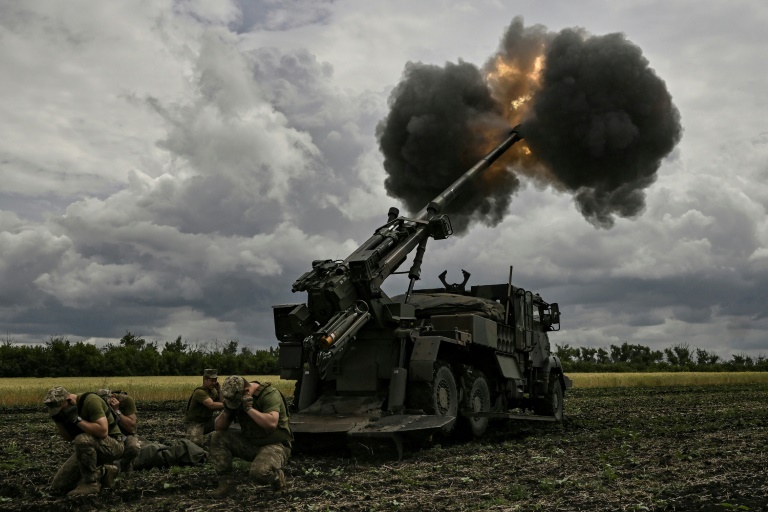
In eastern Ukraine, troops fired a volley of shells from French-supplied Caesar howitzers towards Russian positions, even as Western ministers met at NATO headquarters in Brussels.

Britain announced that its delivery of the advanced Multiple Launch Rocket System to Ukraine was now “imminent” — but still Kyiv pleaded that it is outgunned on the frontline and in need of quicker support.

“We can’t afford to let up and we can’t lose steam. The stakes are too high. Ukraine is facing a pivotal moment on the battlefield,” Austin told a meeting of allies in Brussels.

“We must intensify our shared commitment to Ukraine’s self-defence, and we must push ourselves even harder to ensure that Ukraine can defend itself, its citizens and its territory.”

Austin said that Moscow’s attack on its pro-Western neighbour “isn’t just a danger to Ukraine — it’s a menace to European security”. 

“So we must continue to rise to meet this challenge,” he said, sitting next to Ukraine’s defence minister Oleksiy Reznikov.

While the western allies debate how best to help Ukraine, China’s President Xi Jinping assured his Russian counterpart Vladimir Putin of Beijing’s support for Moscow.

China has refused to condemn Moscow’s invasion of Ukraine and has been accused of providing diplomatic cover for Russia by criticising Western sanctions and arms sales to Kyiv.

State media reported that China is “willing to continue to offer mutual support (to Russia) on issues concerning core interests and major concerns such as sovereignty and security”.

And the Kremlin said that, in a call, Xi and Putin had agreed to ramp up economic cooperation in the face of “unlawful” Western sanctions.

Earlier, Ukraine had delivered a message to the meeting on behalf of its embattled troops struggling to hold back a Russian offensive. 

“Brussels, we are waiting for a decision,” Mykhaylo Podolyak, senior aide to President Volodymyr Zelensky said, warning that Ukraine’s artillery is outgunned by 10 to one. 

“Daily, I receive a message from the defenders: ‘We are holding on, just say: when to expect the weapons?'” he said.

The industrial city of Severodonetsk is under intense bombardment as Russia focuses its offensive on the Donbas region in an effort to secure a swathe of eastern and southern Ukraine.

– ‘Critical situation’ –

But NATO chief Jens Stoltenberg, hosting the meeting of around 50 allies and partners, warned it would take time to get the latest hardware into service with trained Ukrainian troops.

“Ukraine is really in a very critical situation and therefore, it’s an urgent need to step up,” Stoltenberg told journalists ahead of a gathering of NATO ministers. 

The West has poured arms into Ukraine, but Kyiv complains it has only received a tenth of what it needs and is clamouring for heavier weaponry.

Stoltenberg said the allies had moved from sending older equipment to delivering “more long-range, more advanced air defence systems, more advanced artillery, more heavy weapons”.   

But he added “there will also be some time needed to just make the Ukrainians ready to use and operate these systems”.  

He said NATO members, such as the Netherlands, plan to offer training to Ukrainian forces to get them up to speed on the new heavy guns going in. 

Stoltenberg said alliance leaders should agree a “comprehensive assistance package” for Ukraine at a summit in Madrid later this month.

About 500 civilians are taking shelter in Severodonetsk’s Azot chemical plant, according to the head of the city’s administration.

At another location in eastern Ukraine, AFP reporters watched as Ukrainian forces paraded — and fired — their new French-supplied truck-mounted Caesar howitzers.

The commander of the system, who gave his name only as Glib, said it would help make Ukraine’s defences more agile, as gunners loosed three shells in the direction of Russian lines.

“This system is primarily very manoeuvrable and mobile,” the officer from the 55th brigade said. “In modern warfare, this is a crucial factor. 

“Our old systems are stationary, so to speak. This is truck-mounted artillery to put in the field,” he added. 

After its February invasion, Russia was driven back from Kyiv, prompting it to focus its offensive on Donbas, a mainly Russian-speaking region partly held by pro-Kremlin separatists since 2014.

Capturing Severodonetsk has become a key goal, as it would open the road to Sloviansk and another major city, Kramatorsk.

– NATO urges heavy weapons –

Kyiv’s forces face an increasingly desperate situation in Severodonetsk, with Ukrainian authorities estimating the Russians now control up to 80 percent of the city as they seek to encircle it. 

From an elevated position in Lysychansk, an AFP team saw black smoke rising from the Azot factory in Severodonetsk and another area in the city.

The Ukrainian military is using the high ground to exchange fire with Russian forces fighting for control of Severodonetsk, just across the water.

Lysychansk pensioner Valentina sat on the porch of her ground-floor apartment, where she lives alone, her two walking sticks to hand.

“It’s scary, very scary,” said the 83-year-old former farm worker. “Why can’t they agree at last, for God’s sake, just shake hands?”

Close Bitnami banner
Bitnami