US Business

EU takes legal action against UK for breaching N.Ireland agreement

The European Commission launched new legal action against Britain on Wednesday, accusing London of putting peace in Northern Ireland at risk by trying to overhaul the post-Brexit trade deal.

“The UK government tabled legislation confirming its intention to unilaterally break international law,” EU commission vice-president Maros Sefcovic said.

“More precisely to break an agreement that protects peace and stability in Northern Ireland,” he said.

“Opening the door to unilaterally changing an international agreement is a breach of international law, as well. So let’s call a spade a spade. This is illegal.”

On Monday, the British government introduced legislation to rip up post-Brexit trading rules for Northern Ireland, in an attempt to override the EU withdrawal treaty that it had signed.

Prime Minister Boris Johnson’s government insists it is not breaking international law, citing a “necessity” to act to restore Northern Ireland’s power-sharing institutions.

But Brussels rejects this argument, and Sefcovic said that legal action would be taken, with two new cases joining those the commission had suspended.

Sefcovic said the EU would revive a case is launched last year to control the export of certain food products from Great Britain to Northern Ireland.

“If the UK doesn’t reply within two months, we may take them to the Court of Justice,” he warned.

“Second, we are launching two new infringements against the UK,” he said, announcing cases that could see the British government brought before the European Court of Justice.  

“One for failing to carry out the necessary controls at the border control posts in Northern Ireland by ensuring adequate staffing and infrastructure.

“And one for failing to provide the EU with essential trade statistics data to enable the EU to protect its single market.”

– ‘Grave peril’ –

The cases brought by the EU do not directly tackle the proposed UK legislation, but rather seek to compel Britain to implement the existing agreements.

Johnson’s government has said it would still prefer a negotiated outcome with the European Union to reform the Northern Ireland Protocol.

But it accuses Brussels of failing to engage on its concerns about measures to control goods moving from Great Britain to Northern Ireland.

Brussels counters that, with Northern Ireland remaining in the EU single market, European law must ultimately apply to goods arriving in the territory.

And Sefcovic says that attempts to negotiate a compromise with Britain within the terms of the agreement Johnson himself hailed and signed have been mate with “radio silence” since February.

The spat comes at a bad time for the UK economy, with inflation at 40-year highs and rising household bills that have left many Britons struggling to make ends meet.

But there are economic headwinds in the European Union too, and warnings that the West must not fall out over trade when trying to present a united front against Russia’s invasion of Ukraine.

Irish Minister for Foreign Affairs Simon Coveney said Wednesday’s EU action is “the result of a deliberate UK Government strategy of provocation over partnership”.

“Reckless UK decisions this week have forced the EU into responding to a threatened breach of international law with serious consequences.”

Jonathan Jones, the former head of the UK government legal service scoffed at Number 10’s argument.

Jones resigned after Northern Ireland minister Brandon Lewis admitted that unilaterally breaking the deal would “break international law in a very specific and limited way”. 

“The concept of ‘necessity’ is an extremely high test. It applies only where a state must act to safeguard its essential interests against ‘grave and imminent peril’,” Jones said.

“How can an agreement willingly entered into only in 2020, at what the Prime Minister described as a ‘fantastic moment’, be already proving so disastrous as to represent ‘grave peril’ to the country?”

Meanwhile, the Democratic Unionist Party argues the protocol’s creation of an effective border in the Irish Sea jeopardises Northern Ireland’s status in the wider UK.

The pro-British party is boycotting the local government in Belfast until the deal is scrapped or dramatically overhauled, putting at risk the power-sharing agreement that underlies the Northern Ireland peace agreement.

Tanzania targets internet giants with new tax

Tanzania will introduce a digital tax this year, the country’s finance minister said, in a move targeting global internet giants offering services in the East African nation.

The two-percent tax will come into effect in July and follows similar attempts by other countries to force US multinational tech companies to pay at least a portion of their revenues in local tax.

Tanzania’s Minister for Finance and Planning, Mwigulu Nchemba, announced the measure on Tuesday as he presented the nation’s annual budget.

“Tanzania Revenue Authority shall establish a simplified registration process to accommodate digital economy operators who have no presence in Tanzania,” Nchemba told lawmakers.

“This measure is intended to keep pace with rapid growth in the digital economy,” he added.

The tax needs to be approved by Tanzania’s parliament, which will vote on the budget before July.

The tax announcement follows talks in April between officials from the Tanzania Revenue Authority and US social media giant Meta — the parent company to Facebook, Instagram and WhatsApp.

Nearly 140 countries signed up to a 15-percent global minimum corporate tax last October under the auspices of the Organization for Economic Co-operation and Development (OECD).

Since then more countries, including Turkey and India, have signed up to the deal, which is expected to come into effect in 2023.

The historic agreement aims to put an end to corporations sheltering profits in low-tax haven countries.

ECB calls surprise meeting as borrowing costs rise

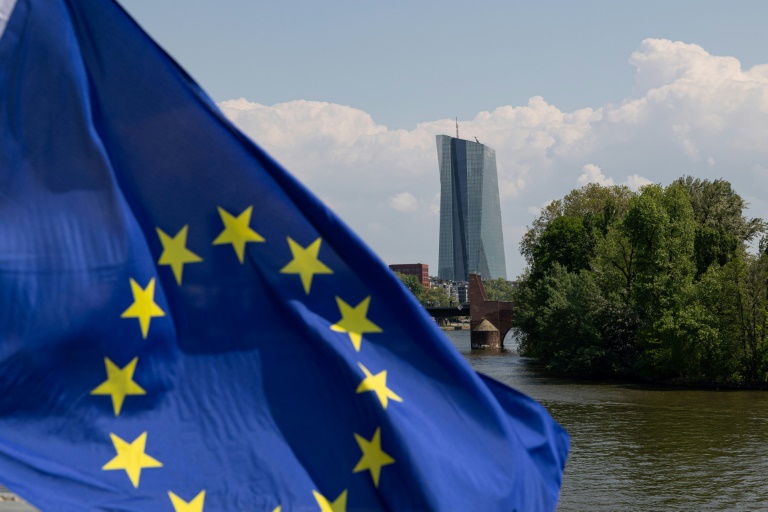
European Central Bank policymakers called an emergency meeting on Wednesday, as more indebted eurozone states have come under pressure from rising borrowing costs.

A week after a regular gathering, the governing council will hold an “ad-hoc meeting” to discuss “current market conditions,” an ECB spokesperson said.

The ECB drew a line under years of ultra-loose monetary policy at last week’s meeting, calling an end to its massive bond-buying stimulus programme at the beginning of July.

Under pressure from soaring inflation in the eurozone, the ECB also announced its first planned interest rate hike in over a decade for the same month.

Consumer prices rose at an 8.1-percent pace in May, an all-time high for the currency club and well above the ECB’s own two-percent target.

The switch in the central bank’s policy has raised the spectre of “fragmentation” in the eurozone, where the borrowing costs for some, more indebted members rise faster than for others.

Following the meeting last week, the so-called spread between the yields for 10-year Italian bonds and those of Germany — seen as a benchmark for stability — climbed even further, reaching levels not seen since the very start of the pandemic in 2020.

Yields on Italian 10-year bonds fell following the announcement of the ECB meeting, reducing the spread with German government debt.

Eurozone stock markets also rose after falling this week ahead of a regular US Federal Reserve meeting where policymakers could hike rates even higher than expected to combat decades-high inflation.

Speaking at an event in Paris on Tuesday, ECB executive board member Isabel Schnabel said the bank would “not tolerate” unwarranted increases in borrowing costs that would “undermine” the bank’s policy. 

Schnabel said the ECB’s response to the risks of fragmentation would “depend on the situation we are facing”, but insisted that the bank’s commitment had “no limits”.

“There can be no doubt that, if and when needed, we can and will design and deploy new instruments to secure monetary policy transmission and hence our primary mandate of price stability,” she said.

– ‘Flexibility’ –

The ECB was prepared to respond in a “very short period of time” if necessary, Schnabel said.

“In that case, reinvestments from maturing securities under the PEPP can be adjusted flexibly across time,” she said.

PEPP is the ECB’s pandemic-era stimulus programme to stoke economic growth and keep credit flowing in the 19-nation currency club.

The ECB brought an end to net purchases under the 1.85-trillion-euro ($1.94-trillion) scheme in March this year.

Another option would be to design a new “tool”, Schnabel said, though its scope would depend on “the situation we are facing”.

Schnabel is only the latest senior ECB figure to intone on the risks of rising spreads.

President Christine Lagarde said the ECB would show “flexibility” in response to pressure on borrowing costs at the ECB’s regular meeting last week in Amsterdam.

– ‘Flexibility’ –

“Some spread widening amid an overall rise in yields is normal,” said Holger Schmieding, chief economist at Berenberg Bank.

“As long as it remains consistent with the inflation backdrop and the pace of nominal growth, it should not present an imminent risk even for fiscally challenged Italy,” Schmieding said.

Policymakers will meet to discuss the developments in markets from 11:00 am Frankfurt time (0900) GMT.

Normally members of the governing council meet roughly every six weeks to set the course for the ECB, with their next regular meeting planned for July 21.

Flights resume after computer glitch shuts Swiss airspace

Swiss airspace reopened Wednesday morning after a computer glitch grounded flights across the country for several hours, officials said.

“Swiss airspace is now open again,” the Alpine nation’s air traffic control service Skyguide said on Twitter, adding “the technical malfunction at Skyguide has been resolved”.

It did not say what had caused the problem that shut Swiss airspace for hours Wednesday morning, but said that “air traffic over Switzerland and operations at the national airports of Geneva and Zurich are resuming”.

Those airports too announced that flights had begun taking off.

“Good news! Air traffic has gradually resumed since 8:30 am (0630 GMT),” Geneva airport said in a tweet, warning that a number of flights had been cancelled and urging passengers to check with their airlines.

Zurich airport also said flight operations were “running again” at full capacity by 10:00 am (0800 GMT).

But it warned that “delays are to be expected today. We still recommend passengers to check with their airline about the status of their flight.”

– ‘Vacation could fall through’ –

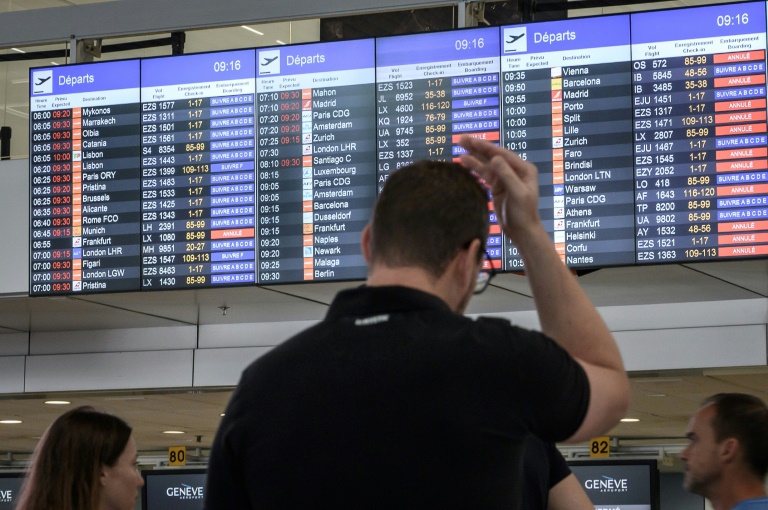
At Geneva airport, where the first morning flights were delayed by more than three hours, dozens of travellers crowded around the information screens, with phones stuck to their ears.

Airport spokesman Ignace Jeannerat told AFP that around 2,000 people had seen their flights affected, adding that while flights were resuming, there would not be a return to normal before early Thursday.

“We are trying to find a solution,” Sandrine Vert, 52, told AFP, after her family’s easyJet flight to Split in Croatia was cancelled.

She, her husband and teenage daughter, who drove to the airport from Annecy in France, had been told there were now no flights from Geneva to Split until Friday, putting their one-week holiday plans on the line.

“Our vacation could fall through,” she said.

The chaos erupted when Skyguide announced it had “experienced a technical malfunction in the early hours of this morning, which is why Swiss airspace has been closed to traffic for safety reasons”.

It said it regretted “this incident and its consequences for its customers, partners and passengers.”

The closure blocked all overflight of the country, and forced a number of flights to be rerouted to airports in neighbouring countries.

The Swiss news agency ATS said some international flights to Switzerland had been re-routed to Milan in northern Italy.

Zurich airport’s website meanwhile showed that a United Airlines flight from New York had been rerouted to Frankfurt in western Germany, while a Singapore Airlines flight from the city state had been sent to the southern German city of Munich. 

Zurich is Switzerland’s largest airport, with more than 10.2 million passengers going through its terminals in 2021.

But with Covid restrictions lifted, air traffic has picked up significantly since then, with 1.9 million passengers registered there in May alone. For this summer season, it is serving flights to 191 destinations.

Geneva airport saw 5.9 million passengers pass through during the Covid pandemic year of 2021. There too, traffic has been rapidly picking up, and it now sees around one million passengers a month.

Flights resume after computer glitch shuts Swiss airspace

Swiss airspace reopened Wednesday morning after a computer glitch grounded flights across the Alpine nation for several hours, officials said.

“Swiss airspace is now open again,” Swiss air traffic control service Skyguide said in a tweet, adding “the technical malfunction at Skyguide has been resolved”.

It did not say what had caused the problem that shut Swiss airspace for hours Wednesday morning, but said that “air traffic over Switzerland and operations at the national airports of Geneva and Zurich are resuming”.

Those airports too announced that flights had begun taking off.

“Good news! Air traffic has gradually resumed since 8:30 am (0630 GMT),” Geneva airport said in a tweet, warning that a number of flights had been cancelled and urging passengers to check with their airlines.

At the airport, where the first morning flights were delayed by more than three hours, dozens of travellers crowded around the information screens, with phones plastered to their ears.

Zurich airport also said flight operations were “running again”, although flight operations would be at 50-percent capacity until 9:30 am, and 75-percent after that.

“We recommend passengers to pay attention to the flight information of the airline.”

The chaos erupted when Skyguide announced it had “experienced a technical malfunction in the early hours of this morning, which is why Swiss airspace has been closed to traffic for safety reasons”.

It said it regretted “this incident and its consequences for its customers, partners and passengers.”

The Swiss news agency ATS-Keystone said international flights to Switzerland had been re-routed to Milan in northern Italy.

The Zurich airport website meanwhile showed that a United Airlsines flight from New York had been rerouted to Frankfurt in western Germany, while a Singapore Airlines flight from the city state had been sent to the southern German city of Munich. 

Zurich is Switzerland’s largest airport, with more than 10.2 million passengers going through its terminals in 2021.

But with Covid restrictions lifted, air traffic has picked up significantly since then, with 1.9 million passengers registered there in May alone.

Markets see post-rout calm as traders await Fed hike

Equities were mixed Wednesday with investors nervously awaiting a Federal Reserve interest rate decision that has taken on greater significance since a forecast-busting inflation report sent shockwaves through world markets.

Trading floors saw a sea of red at the start of the week after data showed US consumer prices soared at their fastest pace in four decades last month, confounding hopes they were stabilising and putting pressure on officials to act.

The news ramped up bets that the central bank would hike interest rates at a steeper and faster pace than expected as it struggles to retain credibility.

Before Friday’s data, the Fed had been tipped to lift borrowing costs by half a point when its policy meeting ends Wednesday but investors are now widely anticipating a three-quarter point increase, with some even suggesting one percentage point.

The moves fuelled worries that the tighter monetary conditions will deal a blow to the US economy and potentially send it into recession next year.

Still, many observers say acting now is the only option available to policymakers if they want to rein in prices and prevent stagflation.

“The sooner they are going to be clear about how quickly they are going to raise rates and what is an acceptable rate of inflation for them, the sooner markets will calm down,” Wincrest Capital’s Barbara Ann Bernard told Bloomberg Television.

And StoneX Financial’s Matt Simpson added: “A bullish outcome for risk-appetite is the well-telegraphed 75-basis-point hike, conviction from the Fed that they’ll manage a soft landing, alongside a downwardly revised CPI forecast for good measure”.

But he warned that a half-point increase “could inadvertently weigh on sentiment as markets are concerned the Fed aren’t taking inflation seriously enough”.

While most of Wall Street and Europe ended down, they saw less turbulent action than Friday and Monday.

In Asia markets were mixed with some seeing a pick-up on bargain-buying.

Hong Kong and Shanghai enjoyed some healthy buying after data showed an improvement in Chinese retail sales and factory output last month thanks to an easing of Covid restrictions in major cities.

The readings lifted hopes that government support can help lift the world’s number two economy out of its torpor.

Singapore and Mumbai were also in positive territory, while Tokyo, Sydney, Seoul, Taipei, Manila, Bangkok and Jakarta slipped.

London, Paris and RFrankfurt rose at the open, with traders following The European Central Bank after it said policymakers would hold an exceptional meeting Wednesday to “discuss current market conditions”.

The announcement saw the euro rally against the dollar on hopes for details on how officials will tackle the eurzone’s embattled bond market. Observers are predicting the single currency could rise back above $1.05. 

While there is a little calm ahead of the Fed announcement, commentators warn that uncertainty will continue to course through trading floors for some time.

Strategist Louis Navellier said markets could go one of two ways after the meeting.

“The big unknown is will the market have a relief rally thinking that inflation is finally being seriously addressed and will therefore be tamed sooner than feared?

“Or will the move create new sellers from fears that the Fed is panicking and may hasten a recession by overshooting as it chases inflation?

“Either way, rates will be rising in an attempt to slow demand in order to slow inflation and further volatility is almost guaranteed.”

In company news, the management agency of K-pop supergroup BTS plunged by a quarter in Seoul after the band announced they were taking an indefinite break.

The seven members, who have generated billions of dollars for South Korea’s economy, made the shock announcement on Tuesday.

On Wednesday morning the band’s label HYBE collapsed about 27 percent, wiping $1.6 billion off its market valuation.

– Key figures at around 0720 GMT –

Tokyo – Nikkei 225: DOWN 1.1 percent at 26,326.16 (close)

Hong Kong – Hang Seng Index: UP 1.0 percent at 21,271.14

Shanghai – Composite: UP 0.5 percent at 3,305.41 (close)

London – FTSE 100: UP 0.5 percent at 7,221.50

Euro/dollar: UP at $1.0469 from $1.0420 late Tuesday

Pound/dollar: UP at $1.2028 from $1.1993

Dollar/yen: DOWN at 134.66 yen from 135.33 yen 

Euro/pound: DOWN at 87.03 pence from 86.84 pence

Brent North Sea crude: UP 0.3 percent at $121.54 per barrel

West Texas Intermediate: UP 0.3 percent at $119.25 per barrel

New York – Dow: DOWN 0.5 percent at 30,364.83 (close)

China factory output, retail sales weak as Covid shadow persists

China’s factory output and retail sales remained weak in May, official data showed Wednesday, with tepid demand and lingering Covid restrictions putting a damper on growth in the world’s second-largest economy.

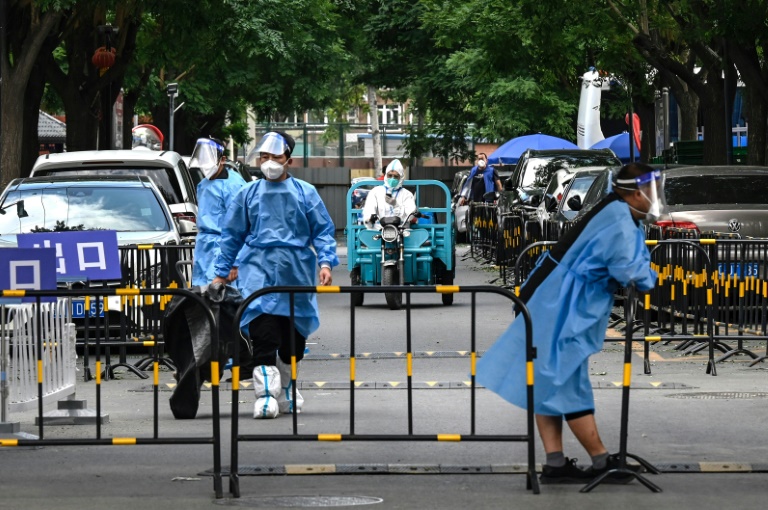
The government is persisting with a zero-Covid strategy to stamp out clusters as they emerge, but this has placed companies and consumers at the mercy of snap, economically damaging lockdowns.

Retail sales sank 6.7 percent on-year in May, the National Bureau of Statistics (NBS) said, though that was an improvement from April’s 11.1 percent drop.

The figure was also slightly better than forecasts from analysts polled by Bloomberg.

“In May, our economy gradually overcame the adverse impact of the pandemic,” NBS spokesman Fu Linghui told reporters.

“But we also have to see that the international environment has become more complex and severe, and the domestic economic recovery still faces many difficulties and challenges.”

It was the third straight month of contraction in retail sales, according to official data, suggesting nervous consumers are tightening their purse strings with the persistent threat of lockdowns.

But industrial production was up 0.7 percent after falling 2.9 percent in April, while the urban unemployment rate ticked down to 5.9 percent.

Shanghai, China’s most populous city, started emerging from a gruelling two-month lockdown in June, providing a boost to economic sentiment.

Tommy Wu, lead China economist at Oxford Economics, speculated that “the worst of lockdowns is probably behind us.”

However, he added that it will be “difficult for household consumption to recover strongly” while China’s zero-Covid strategy remains in place.

Meanwhile, concerns are mounting over the trend in unemployment as millions of students graduate in the summer, Zhiwei Zhang, of Pinpoint Asset Management, said.

Unemployment among rural migrant workers remained elevated, data showed, while home sales in the first five months dropped 34.5 percent.

Observers remain cautious in part because of a property sector slump and the government’s reluctance to transition away from zero-Covid despite recent fine-tuning.

“There is no guarantee that a new wave will not hit in coming months,” Nomura analysts said Wednesday.

US panel weighs authorizing Covid vaccines for youngest children

After months of anxious wait for some parents, a panel of experts convened by the US Food and Drug Administration will meet Wednesday to weigh recommending Covid vaccines for the nation’s youngest children.

Children under five are the only age group not yet eligible for Covid immunization in the United States and most other countries. If, as expected, panelists vote in favor of greenlighting the Pfizer and Moderna vaccines, formal authorizations should follow quickly, with the first shots in arms expected by next week.

Ahead of the meeting, the FDA posted its independent analyses of the two drugs, deeming both safe and effective. It also said there was a pressing unmet need to inoculate children in the age group since their rates of hospitalization and death “are higher than among children and adolescents 5-17 years of age.”

Both vaccines are based on messenger RNA technology, which delivers genetic code for the coronavirus spike protein to human cells, training the immune system to be ready for when it encounters the real virus.

Pfizer is seeking authorization for three doses at three micrograms given to ages six months through four years, while Moderna has asked for the FDA to approve its vaccine as two doses of a higher 30 micrograms, for ages six months through five years.

They were tested in trials of thousands of children where they were found to have similar levels of mild effects to older age groups and triggered similar levels of antibodies.

Efficacy against infection was higher for Pfizer, with the company placing it at 80 percent compared to Moderna’s estimates of 51 percent in the six-month-old to age two group and 37 percent in the two to five years age group. 

But the figures are provisional and Moderna is studying adding a third dose later that may increase its figures.

There are some 20 million US children aged four years and under. If the FDA-appointed experts recommend the two vaccines, then the matter will go to another committee convened by the Centers for Disease Control and Prevention for a final say.

White House officials last week said the rollout of millions of shots at pharmacies and doctors’ offices could begin as soon as June 21, following the Juneteenth holiday on June 20.

Of the total US Covid deaths, 480 have come in children under five, according to the latest official data. 

Obesity, neurological disorders and asthma are associated with increased risk of severe disease, “however, a majority of children hospitalized for Covid-19 have no underlying medical conditions,” the FDA said in a document.

Children can also go on to contract multisystem inflammatory syndrome in children (MIS-C), a rare but serious post-viral condition. 

Data on long Covid in children is sparse, but the FDA’s document cited a national survey in the United Kingdom which found that “among children ages two to 11 years who tested positive for COVID-19, 7.2 percent reported continued symptoms at 12 weeks.”

Russia plans evacuations from chemical plant in battleground Ukraine city

Russia said it would establish a humanitarian corridor to evacuate civilians from a chemical plant in Severodonetsk starting Wednesday as Ukrainian forces wage a desperate battle for control of the city.

The industrial hub is under intense bombardment as Russia focuses its offensive on the eastern Donbas region in an effort to seize a swathe of Ukraine.

Moscow’s forces have intensified efforts to cut off Ukrainian troops remaining in the city, destroying all three bridges which connect it across a river to the twin city of Lysychansk.

NATO chief Jens Stoltenberg meanwhile urged allies to send more heavy weapons to Ukraine, and said officials from the alliance would be discussing the subject at talks Wednesday. 

About 500 civilians are taking shelter in Severodonetsk’s Azot chemical plant, according to the head of the city’s administration.

The Russian defence ministry announced a humanitarian corridor would be established on Wednesday for evacuations from the plant, saying it was “guided by the principles of humanity”.

Evacuees would be transported to the city of Svatovo in the separatist-held region of Lugansk, Moscow said, urging those holding out at the plant to cease their “senseless resistance”.

There was no response from Kyiv to the announcement, and in a video address Tuesday evening, Ukrainian President Volodymyr Zelensky lamented “painful losses” in the ongoing fighting. 

“But we must stay strong. This is our nation… Hanging in there in Donbas is crucial. Donbas is the key to deciding who will dominate in the coming weeks.”

Following its February invasion, Russia was repelled from Kyiv and other parts of Ukraine, prompting it to focus its offensive on Donbas, a mainly Russian-speaking region partly held by pro-Kremlin separatists since 2014.

Capturing Severodonetsk has become a key goal, as it would open the road to Sloviansk and another major city, Kramatorsk.

– NATO urges heavy weapons –

Speaking in The Hague, NATO chief Stoltenberg urged Western countries to send the Ukrainians more heavy armaments, as they “absolutely depend on that to be able to stand up against the brutal Russian invasion”.

Addressing a press conference after meeting the leaders of seven European NATO allies, he added that NATO officials would discuss coordinating further support including heavy weaponry at a meeting in Brussels Wednesday.  

Zelensky meanwhile told reporters that he regretted what he called “the restrained behaviour of some leaders” which, he said, had “slowed down arms supplies very much”.

Ukraine has only received 10 percent of the arms it had requested from the West, Kyiv’s deputy defence minister said.

Kyiv’s forces face an increasingly desperate situation in Severodonetsk, with Ukrainian authorities estimating the Russians now control up to 80 percent of the city as they seek to encircle it. 

From an elevated position in Lysychansk, an AFP team saw black smoke rising from the Azot factory in Severodonetsk and another area in the city.

The Ukrainian military is using the high ground to exchange fire with Russian forces fighting for control of Severodonetsk, just across the water.

Lysychansk pensioner Valentina sat on the porch of her ground floor apartment, where she lives alone, her two walking sticks to hand.

“It’s scary, very scary,” said the 83-year-old former farm worker. 

“Why can’t they agree at last, for God’s sake, just shake hands?”

Along the road from Lysychansk to Kramatorsk, Ukrainian forces were transporting more weapons systems to the front, while specialist vehicles carried tanks for repair.

In the town of Novodruzhesk, close to Lysychansk, there was still a smell of burning and smoke from houses that had been destroyed by fire from shelling at the weekend.

“It’s not safe anywhere, it just depends on the time of day, that’s all,” said a soldier standing at a fire station with a skull logo on his sleeve.

– Britons blacklisted –

As tensions soar with the West, Russia announced it was blacklisting 49 British citizens, including defence officials and prominent reporters and editors from the BBC, The Financial Times and The Guardian.

The Russian foreign ministry said that the journalists targeted were “involved in the deliberate dissemination of false and one-sided information”.

In New York, a senior UN official warned Tuesday that Ukrainian children should not be adopted in Russia, where several thousand young people are believed to have been moved since Moscow’s February invasion.

“We’re reiterating, including to the Russian Federation, that adoption should never occur during or immediately after emergencies,” Asfhan Khan, the UN Children’s Fund (UNICEF) regional director for Europe and Central Asia, told reporters.

Such children cannot be assumed to be orphans and their movement must be voluntary, Khan added.

The Kremlin, meanwhile, said it had not received a request from London to intervene in the case of two Britons sentenced to death by pro-Moscow separatist authorities in eastern Ukraine.

Aiden Aslin and Shaun Pinner, along with Moroccan Brahim Saadun, were convicted of acting as mercenaries for Ukraine by the self-proclaimed Donetsk People’s Republic.

China's middle class looks to flee as Covid policies bite

Alan Li no longer sees any future for his family in China after harsh Covid rules decimated his business, upended his son’s education and left his country out of step with the rest of the world.

He has given up hope of a return to normal after months of lockdowns in Shanghai, and now plans to close his firm and move to Hungary, where he sees better opportunities and his 13-year-old son can attend an international school.

“Our losses this year mean that it’s over for us,” he told AFP wearily, asking to withhold his real name.

“We have been using our own cash savings to pay 400 workers (during the lockdown). What if it happens again this winter?”

Shanghai’s long shutdown, which brought food shortages and protests, has driven some to reconsider staying in a country where livelihoods and lifestyles can vanish at the whim of the state.

Schools have been closed and exams called off, including assessments for applying to American universities.

Li is frustrated that his son’s expensive bilingual schooling has been mostly online for two years, and he is anxious about the way Beijing has tightened oversight of the curriculum.

“This is a waste of our children’s youth,” Li said.

Being fairly well off, he has been able to take advantage of a European investment scheme that grants him and his family residency in Budapest.

“Many people know that if they sold all their assets they could ‘lie flat’ in a European country,” he said, using a slang phrase meaning to take it easy.

Beijing-based immigration consultant Guo Shize told AFP his company has seen an explosion of enquiries since March, including a threefold increase in Shanghai clients.

Even after the lockdown eased, requests continued flooding in at more than double the usual level.

“Once that spark has been lit in people’s minds, it doesn’t die down quickly,” he said. 

– Exit ban –

Censors have sought to suppress discussion of emigration, prompting nimble internet users to adopt the term “run” instead.

Searches for the term on messaging app WeChat peaked during Shanghai’s shutdown.

But as more people consider ways to leave, Beijing has doubled down on strict exit policies for Chinese citizens.

All “unnecessary” travel out of the country has been banned. Passport renewals have been all but halted, with authorities blaming the risk of Covid being carried into the country.

In the first half of 2021, immigration authorities issued only two percent of the passports given out in the same period in 2019.

One woman who emigrated to Germany told AFP she receives dozens of messages from Chinese people looking for tips on escaping.

Emily, who did not want to use her real name, tried to help a relative obtain a new passport to take up a job in Europe, but the application was denied.

“It’s like being a child who wants to go to their friend’s house to play but their parents won’t let them leave,” she said, adding that she has heard of passports being sold for up to 30,000 yuan ($4,500) on the black market.

– ‘Absolutely insane’ –

A Chinese freelancer told AFP he was turned back by immigration officers while attempting to fly to Turkey for work last October, despite having already checked in.

“My itinerary sounded too suspicious to them. They took my passport into an office and 15 minutes later told me I do not meet the requirements” for leaving, he said on condition of anonymity. “It was absolutely insane.”

He managed to leave weeks later by entering semi-autonomous Macau on a different travel document, before catching an onward flight.

Some are disillusioned with Beijing’s growing controls, which have been ramped up during the pandemic.

“I just want to live in a country where the government won’t crudely interfere in my personal life,” said Lucy, a 20-year-old student at an elite Beijing university involved in LGBTQ and Marxist activism.

The virus policies had “allowed the government to control and monitor everything”, she said.

“Perhaps rather than accepting and adapting to this system, we must go elsewhere and create a new life.”

Close Bitnami banner
Bitnami