US Business

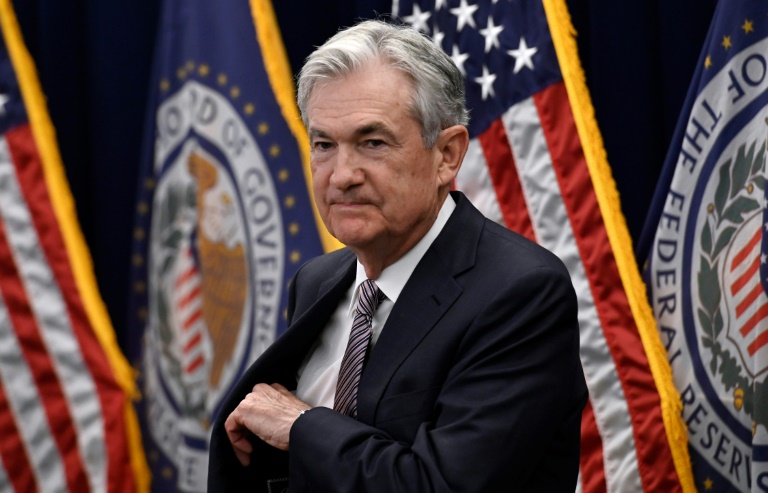
Fed begins meeting with massive hike possible amid price surge

US central bankers opened their two-day policy meeting Tuesday amid a blistering inflation surge that has ignited predictions the Federal Reserve will approve the biggest interest rate hike in more than 27 years.

Fed Chair Jerome Powell has signaled that policymakers were poised to implement another half-point increase in the benchmark borrowing rate this week and another next month.

But a growing number of voices are now calling for a more aggressive three-quarter point hike in response to the big, unexpected jump in the consumer price index in May, which defied widespread expectations the data would show inflation pressures easing.

A Fed spokesperson confirmed the meeting of the policy-setting Federal Open Market Committee began as scheduled at 1500 GMT. Markets will get the rate decision on Wednesday at 1800 GMT.

Officials will debate how high to raise borrowing costs amid surging prices and fears of a bout of 1970s-style stagflation if their efforts to cool the economy clamp down on growth as well.

After dropping the rate to zero since March 2020 in a successful bid to help the world’s largest economy avoid a devastating downturn and recover quickly from the impact of the Covid-19 pandemic, the Fed has raised rates twice, including a big, half-point increase last month.

Low lending rates and the boost from massive federal stimulus caused demand to outstrip supply amid global supply chain snarls, pushing prices higher, and the Russian invasion of Ukraine added more fuel to the inflation fires, sending food and fuel prices soaring.

– Credibility boost or negative surprise? –

Economists thought March was the peak of CPI, but the rate spiked in May, jumping 8.6 percent in the latest 12 months.

“Given the latest information on inflation, we believe that risk-management considerations call for aggressive action to reinforce the Fed’s inflation-fighting credibility,” Barclays analysts said in a commentary.

If policymakers decide on a giant step, it would be the first 75-basis-point increase since November 1994.

But other analysts say the massive step would be unnecessary and could be viewed as panicky, and instead project an additional half-point hike in September.

“With supply improving and demand for goods falling relative to services, margins will compress and inflation will fall much faster than markets and the Fed expect,” Ian Shepherdson of Pantheon Macroeconomics said in an analysis.

He noted that many of the factors driving the price spikes are “outside the Fed’s control, like oil prices.”

The consensus remains for policymakers to stick to the plan, and central bankers are typically loath to surprise markets, although they insist their decisions are “data dependent” and will adjust to evolving situations.

Karl Haeling of LBBW said markets are pricing in at least one 75-basis-point increase in the next three meetings, but chances of that happening this week are “50-50.”

“We believe they will probably avoid raising by 75 bps to reduce risk of an even bigger stock market plunge. But the coming barrage of Fed officials giving public comments after Wednesday will probably suggest that 75 bps is certainly possible at July’s FOMC,” he said.

Barclays said despite the element of surprise, “an aggressive move in June would provide the committee with the biggest bang for its buck, sending a resounding signal of the Fed’s resolve to guide inflation back to its 2 percent target.”
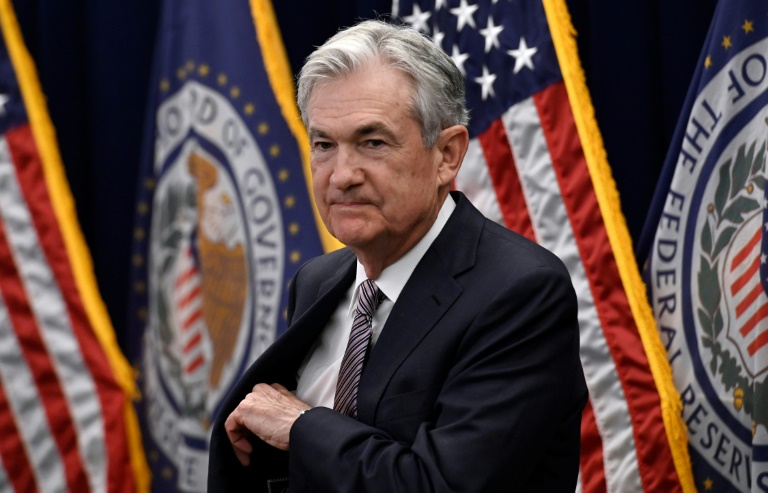
Fed begins meeting with massive hike possible amid price surge

US central bankers opened their two-day policy meeting Tuesday amid a blistering inflation surge that has ignited predictions the Federal Reserve will approve the biggest interest rate hike in more than 27 years.

Fed Chair Jerome Powell has signaled that policymakers were poised to implement another half-point increase in the benchmark borrowing rate this week and another next month.

But a growing number of voices are now calling for a more aggressive three-quarter point hike in response to the big, unexpected jump in the consumer price index in May, which defied widespread expectations the data would show inflation pressures easing.

A Fed spokesperson confirmed the meeting of the policy-setting Federal Open Market Committee began as scheduled at 1500 GMT. Markets will get the rate decision on Wednesday at 1800 GMT.

Officials will debate how high to raise borrowing costs amid surging prices and fears of a bout of 1970s-style stagflation if their efforts to cool the economy clamp down on growth as well.

After dropping the rate to zero since March 2020 in a successful bid to help the world’s largest economy avoid a devastating downturn and recover quickly from the impact of the Covid-19 pandemic, the Fed has raised rates twice, including a big, half-point increase last month.

Low lending rates and the boost from massive federal stimulus caused demand to outstrip supply amid global supply chain snarls, pushing prices higher, and the Russian invasion of Ukraine added more fuel to the inflation fires, sending food and fuel prices soaring.

– Credibility boost or negative surprise? –

Economists thought March was the peak of CPI, but the rate spiked in May, jumping 8.6 percent in the latest 12 months.

“Given the latest information on inflation, we believe that risk-management considerations call for aggressive action to reinforce the Fed’s inflation-fighting credibility,” Barclays analysts said in a commentary.

If policymakers decide on a giant step, it would be the first 75-basis-point increase since November 1994.

But other analysts say the massive step would be unnecessary and could be viewed as panicky, and instead project an additional half-point hike in September.

“With supply improving and demand for goods falling relative to services, margins will compress and inflation will fall much faster than markets and the Fed expect,” Ian Shepherdson of Pantheon Macroeconomics said in an analysis.

He noted that many of the factors driving the price spikes are “outside the Fed’s control, like oil prices.”

The consensus remains for policymakers to stick to the plan, and central bankers are typically loath to surprise markets, although they insist their decisions are “data dependent” and will adjust to evolving situations.

Karl Haeling of LBBW said markets are pricing in at least one 75-basis-point increase in the next three meetings, but chances of that happening this week are “50-50.”

“We believe they will probably avoid raising by 75 bps to reduce risk of an even bigger stock market plunge. But the coming barrage of Fed officials giving public comments after Wednesday will probably suggest that 75 bps is certainly possible at July’s FOMC,” he said.

Barclays said despite the element of surprise, “an aggressive move in June would provide the committee with the biggest bang for its buck, sending a resounding signal of the Fed’s resolve to guide inflation back to its 2 percent target.”
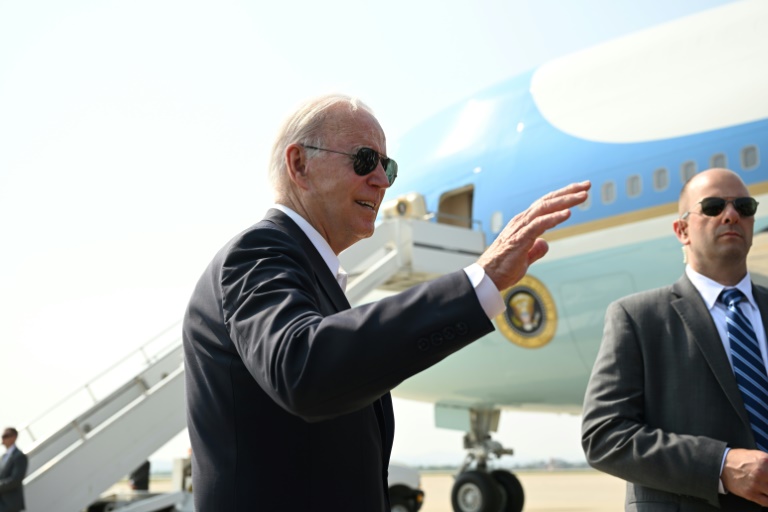
Biden signals US-Saudi thaw with prince meeting on Mideast trip

US President Joe Biden will meet with Saudi Arabian Crown Prince Mohammed bin Salman next month, abandoning efforts to ostracize the kingdom’s de facto leader over the horrific murder of a dissident.

The White House ended weeks of speculation Tuesday, announcing that Biden will travel to Israel, the Palestinian West Bank, and Saudi Arabia from July 13-16 — his first trip to the Middle East since taking office.

In addition to meetings with individual leaders in all three places, he will attend a regional Gulf Cooperation Council summit in Saudi Arabia.

Biden is expected to press for increased Saudi oil production, in the hope of taming spiraling fuel costs and inflation at home ahead of midterm congressional elections in which his Democratic party risks a drubbing.

But his meeting with the crown prince, often referred to as MBS, will mark a controversial shift.

As a presidential candidate, Biden said the 2018 murder and dismemberment of Jamal Khashoggi — a Saudi-born US resident known for writing critical articles about the kingdom’s rulers for The Washington Post — had made the country a “pariah.”

US intelligence findings released by the Biden administration identified MBS as the mastermind of the operation.

The White House sought to play down the encounter, not specifically mentioning MBS in its statement.

Pressed by reporters, White House Press Secretary Karine Jean-Pierre said “the president is going to see over a dozen leaders on this trip… We can expect the president to see the crown prince as well.”

Saudi Arabia’s statement was more direct, noting simply that Biden would meet with King Salman and then the young heir to the throne.

– Oil and inflation –

US inflation is at 8.6 percent, the highest rate in 40 years, with high fuel costs largely to blame. Political fallout has been swift as voters vent over Biden’s inability to change global oil markets.

John Kirby, a White House foreign policy spokesman, told MSNBC on Tuesday that oil production “absolutely… is going to be part of” Biden’s discussions in Saudi Arabia.

But while the White House also confirmed that “energy security” will be a topic, officials stressed that the whole trip has broader aims.

Jean-Pierre emphasized that “this visit to the Middle East region culminates months of diplomacy,” as opposed to being driven by recent domestic political concerns.

Biden’s multiple leader-level engagements during the brief yet intense journey will demonstrate “the return of American leadership” to the region, a senior US official told reporters.

– Re-establishing Palestinian links –

The tour starts with meeting Prime Minister Naftali Bennett in Israel, with emphasis on the lavish US support for Israel’s armed forces. That includes the Iron Dome anti-rocket system at a time of tension over ongoing failure to resurrect an international pact curtailing Iran’s nuclear development.

“While in Israel, the president will likely visit an area where these defensive systems are utilized, as well as discuss new innovations between our countries that use  laser technologies to defeat missiles and other airborne threats,” the official said, speaking on condition of anonymity.

“The president will reaffirm the ironclad commitment to Israel’s security.”

Biden will meet Palestinian president Mahmud Abbas, likely in Bethlehem, the US official said.

Biden will stress “his lifelong commitment to a two state solution” for Palestinians and Israelis and restore US ties with Palestinians that were “nearly severed” under his predecessor Donald Trump.

– History and controversy –

The part of the trip that will make history — and generate the most chatter — comes last.

Biden’s flight from Israel to Jeddah will be the first by a US president from Israel to an Arab state that does not recognize the country. In 2017, Trump made the journey in reverse.

Once there, Biden will attend the Gulf Cooperation Council meeting with leaders from Bahrain, Kuwait, Oman, Qatar, Saudi Arabia and the United Arab Emirates, as well as being joined by the leaders of Egypt, Iraq and Jordan, the US official said.

A priority for Biden will be maintaining the recently extended truce in Yemen, as well as deterring Iran, “advancing human rights, and ensuring global energy and food security,” the official said.

Biden will also join a virtual summit of the so-called I2-U2 diplomatic group of India, Israel, the UAE and the United States, with focus on “the food security crisis” sparked by Russia’s invasion of major agricultural exporter Ukraine.

However, the most closely watched meeting will be between Biden and MBS.

The senior official said that despite the Khashoggi murder, the US-Saudi relationship goes back eight decades and while there had been a “recalibration,” there was no desire for “rupture.”

Heard stands by 'every word' of defamation trial testimony

Amber Heard stands by “every word” of her testimony during the defamation trial against former husband Johnny Depp, she said in an interview released Tuesday.

After a six-week legal tussle between the former Hollywood power couple, a US jury awarded Depp more than $10 million in damages, in contrast to just $2 million for Heard, who had counter-sued.

During the trial, which was live-streamed to millions, the two traded claims of violent domestic abuse, and Heard was targeted by countless social media posts and internet memes throughout.

“To my dying day (I) will stand by every word of my testimony,” Heard told NBC News.

Depp sued Heard over a Washington Post op-ed in which she did not name him, but described herself as a “public figure representing domestic abuse.”

Heard counter-sued after Depp’s lawyer described her abuse claims as a “hoax.”

Online public opinion during the trial appeared to come down heavily on Depp’s side, and Heard’s lawyers accused his legal team of working to “demonize” her.

Heard said the trial was “the most humiliating and horrible thing I’ve ever been through.”

“I have never felt more removed from my own humanity,” she said, describing the sea of Depp supporters she passed through to get to court.

Heard also told NBC that she did not instigate violence with Depp, as his team argued.

“I never had to instigate it. I responded to it. When you’re living in (violence) and it becomes normal, as I testified to, you have to adapt,” she said.

But she also has regrets about her behavior during her relationship with Depp.

“I behaved in horrible, almost unrecognizable, to myself, ways,” said Heard, adding: “I have so much regret.”

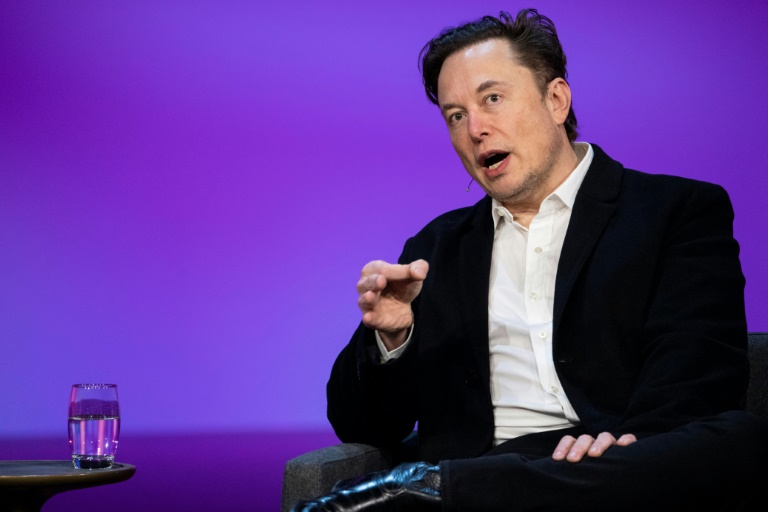
Musk to face Twitter employees at meeting

Billionaire Elon Musk will address Twitter employees at a meeting this week, the company confirmed Tuesday, in a first since launching his troubled $44 billion bid for the social media platform.

The meeting is set for Thursday and comes as Musk is in a standoff with Twitter’s leadership over the service’s user numbers that have put the buyout in doubt.

Twitter, referring to the gathering, said “We can confirm this is true and happening.”

Since Musk’s takeover move became public in April, Twitter has been roiled by uncertainty over its future but also by concerns about being led by the mercurial Tesla chief.

Musk has advocated a less restrictive approach to what users can post on Twitter and is on record saying he would lift the ban the platform slapped on former US president Donald Trump — a highly polarizing decision.

The idea of Musk taking over Twitter has also stoked protest from critics who warn his stewardship will embolden hate groups and disinformation campaigns.

Musk has threatened to withdraw his bid, accusing Twitter of failing to provide data on fake accounts, but the company has since reportedly agreed to provide him access.

Some observers have seen Musk’s questioning of Twitter bots as a means to end the takeover process, or to pressure Twitter into lowering the price.

Musk to face Twitter employees at meeting

Billionaire Elon Musk will address Twitter employees at a meeting this week, the company confirmed Tuesday, in a first since launching his troubled $44 billion bid for the social media platform.

The meeting is set for Thursday and comes as Musk is in a standoff with Twitter’s leadership over the service’s user numbers that have put the buyout in doubt.

Twitter, referring to the gathering, said “We can confirm this is true and happening.”

Since Musk’s takeover move became public in April, Twitter has been roiled by uncertainty over its future but also by concerns about being led by the mercurial Tesla chief.

Musk has advocated a less restrictive approach to what users can post on Twitter and is on record saying he would lift the ban the platform slapped on former US president Donald Trump — a highly polarizing decision.

The idea of Musk taking over Twitter has also stoked protest from critics who warn his stewardship will embolden hate groups and disinformation campaigns.

Musk has threatened to withdraw his bid, accusing Twitter of failing to provide data on fake accounts, but the company has since reportedly agreed to provide him access.

Some observers have seen Musk’s questioning of Twitter bots as a means to end the takeover process, or to pressure Twitter into lowering the price.

UK airport chaos due to Brexit 'shambles': Ryanair boss

Air travel chaos in Britain is purely down to Brexit “shambles” by hobbling recruitment at airports, Ryanair boss Michael O’Leary said on Tuesday.

The CEO of Europe’s biggest airline also dismissed threats of summer strike action by what he called “Mickey Mouse” unions in Belgium and Spain covering some Ryanair workers.

And he said his company has dropped a controversial pre-boarding questionnaire for South African passport holders requiring them to answer questions in Afrikaans — a language commonly used by just 12 percent of South Africans, many of them white.

O’Leary told AFP that “100 percent” of the woes experienced by air passengers in the UK — including massively long lines and cancelled flights — was because “Brexit has been a shambles”.

“It was delivered by a government led by Boris Johnson that is also a shambles. It was inevitable that Brexit would constrain the labour market, you see,” he said.

O’Leary said Britain’s decision to pursue a hardline departure from the European Union that put a halt to EU workers filling jobs is largely why it was difficult to quickly ramp up recruitment for ground and security staff at UK passports.

Airports and airlines in several countries, including in the EU and the US, have struggled to cope with surging numbers of travellers, many of them keen to fly after months or years of being grounded because of Covid restrictions.

O’Leary said that unlike European rivals Air France and Lufthansa, low-cost Ryanair had fully bounced back from the pandemic and was flying 115 percent of the passenger loads recorded before the coronavirus hit.

Rising inflation was only pushing more passengers into Ryanair seats, he argued, while acknowledging that the airline was raising ticket prices by around 9 percent.

He said the company’s hedging on fuel prices through to March next year was keeping it competitive.

– Strike threats –

But unions in Belgium and Spain are threatening to clip Ryanair’s peak summer revenues with strikes later this month to demand better pay and conditions.

O’Leary shrugged off the walk-out warnings.

“We think there will be very few strikes, if any, and those strikes will be meaningless and won’t be noticed by anybody,” he said.

“We operate two and half thousand flights every day. Most of those flights will continue to operate even if there is a strike in Spain by some Mickey Mouse union or if the Belgian cabin crew unions want to go on strike over here,” he added in a media conference.

O’Leary said that, in Belgium, the airline had “reached agreement with the unions representing over 90 percent of our pilots and cabin crew” and was continuing negotiations.

On the controversial Afrikaans test, the Ryanair boss said the company had tried to respond to a rise in detection of false South African passports.

“We suffer a fine of 2,000 euros for every passenger who arrives in Dublin from Bodrum (in Turkey) with a false South African passport,” he said.

He added that, while the airline had been asking South African passport holders to answer local general knowledge and geographical questions in Afrikaans, it got rid of the questionnaire.

“We didn’t think it was appropriate either. So we have ended the Afrikaans test, because it doesn’t make any sense,” he said, adding that “South Africa needs to fix its problems”.

South Africa’s government had called the test “backward profiling”. 

Afrikaans is just one of 11 official languages in South Africa, and it played a role in the oppression of black citizens during apartheid.

WTO floats fund to help net sustainable fishing deal

The WTO tried to net a long-sought deal on curbing harmful fishing subsidies by promising Tuesday an implementation fund it hopes will reel in wavering developing countries.

Negotiations have been going on at the World Trade Organization for more than 20 years towards banning subsidies that threaten the sustainability of the planet’s fish stocks by encouraging overfishing.

The global trade body’s leader, Ngozi Okonjo-Iweala, wants to pull off a major coup by finally concluding a deal at the WTO’s first ministerial conference in nearly five years, being held in Geneva this week.

There are hopes that a financing fund to help developing countries implement the new rules may help soothe lingering concerns.

“We’ve been discussing and progressively refining this idea with a sizable group of members on both sides — both potential donors and potential beneficiaries,” Okonjo-Iweala explained.

The idea is to provide members with the means to build up their capacities to integrate the new rules, involving adopting systems to manage their fisheries and provide catch data.

The fund is targeting around $20 million in contributions, with a starting amount of around $10 million — of which $5 million has already been pledged.

– ‘Historic opportunity’ –

“While work is continuing on the last remaining issues, we have never been so close to concluding,” said Colombia’s WTO ambassador Santiago Wills, who chairs the fisheries negotiations at the organisation.

However, a Geneva-based diplomat said the financing mechanism was helpful but was not a major issue in the negotiations, which still revolve around the carve-outs for certain developing countries and whether they would apply to China and India.

“It’s a nice thing to have and will help in the implementation of the agreement but it’s not going to make the deal — sadly,” the diplomat said.

“That would be an extraordinary deliverable for this week if we could actually get there,” but “right now, people aren’t sure we’re going to”.

Special treatment for the poorest countries is widely accepted, but demands from some self-identified developing countries for exemption from subsidy constraints, including large fishing nations like India, have met resistance.

New Zealand’s trade minister Damien O’Connor is facilitating the fisheries talks in Geneva.

He told his counterparts that there was an “historic opportunity for the WTO to do something that will massively benefit the world for many generations to come, and that we simply cannot, and must not, miss this opportunity,” WTO spokesman Daniel Pruzin told reporters.

– Indian intransigence –

Besides fisheries, the WTO is trying to strike deals on e-commerce, agriculture, food security, Covid-19 vaccine patents and WTO reform.

Okonjo-Iweala warned countries against trying to do trade-offs between the different tracks.

Agreements at the WTO are reached by consensus, meaning objections from any one of the 164 members can stymie talks towards a deal.

Okonjo-Iweala — who turned 68 on Monday — took over as WTO director-general in March 2021, and has staked her reputation on breathing new life into the crippled organisation.

“We all have dreams and sometimes not all of those dreams can be fulfilled,” she said Tuesday.

“My own dream for my birthday is to get a successful ministerial.

“One or two packages passed… I think that would do.”

But several diplomats have indicated that India is proving the main obstacle in securing any agreements at the conference.

“India is being obstructive across the piece,” said one Geneva-based diplomat.

“In no negotiation are they playing a constructive part.”

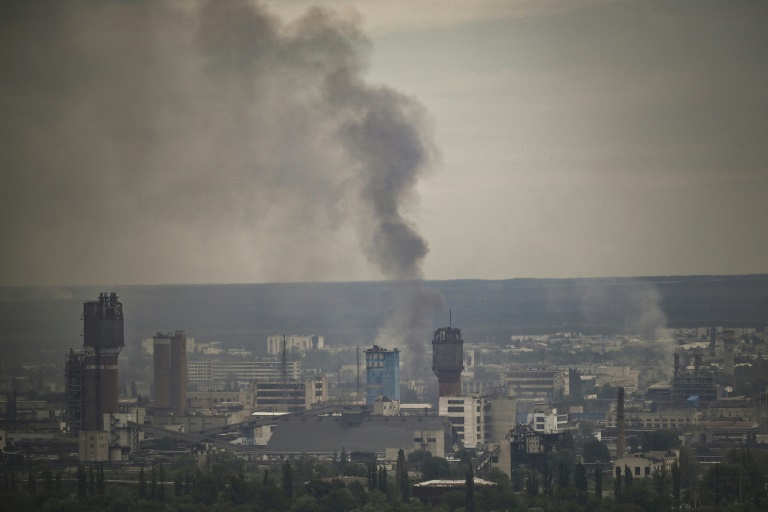
Russians bid to encircle Severodonetsk, Zelensky pleads for arms

Russian forces on Tuesday stepped up efforts to cut off Ukrainian troops in the key industrial city of Severodonetsk in the east of the country despite Ukrainians insisting they were holding on.

Moscow has laid siege for weeks to the cities of Severodonetsk and Lysychansk, which are separated by a river, as the last areas in the eastern Donbas region of Lugansk still under Ukrainian control.

The head of Severodonetsk’s administration said “massive shelling” had destroyed a third bridge linking the twin cities, but insisted his city was “not isolated”.

“There are communication channels even if they are quite complicated,” Oleksandr Stryuk told Ukrainian television. Ukraine’s “continue to defend the city” but that the situation on the ground “changes every hour,” he added.

On Monday, Sergiy Gaiday, governor of Lugansk, told Radio Free Europe that Russian forces had “destroyed all the bridges and getting into the city is no longer possible. Evacuation is also not possible”. 

Ukrainian President Volodymyr Zelensky has branded the human cost of the battle for east “simply terrifying,” urging Western allies to speed arms deliveries to shore up Ukraine’s ability to reclaim territory.

“We just need enough weapons to ensure all of this. Our partners have them.”

His presidential advisor, Mikhaylo Podolyak, has listed hundreds of howitzers, tanks and armoured vehicles as among items needed by the Ukrainian army.

– ‘Tear off their arms’ –

“To end the war we need heavy weapons,” he tweeted.

Last week, Ukraine’s defence minister said up to 100 Ukrainian troops were being killed and 500 sustaining injuries every day.

The capture of Severodonetsk would open the road to Sloviansk and another major city, Kramatorsk, in Moscow’s push to conquer Donbas, a mainly Russian-speaking region partly held by pro-Kremlin separatists since 2014.

AFP team in Lysychansk saw massive damage after months of shelling, with no water, electricity or phone signal.

The Ukrainian military is using high ground in the city to exchange fire with Russian forces fighting for control of Severodonetsk, just across the water.

Lysychansk resident Maksym Katerin buried his mother and stepfather in his garden on Monday after a shell ripped through his yard, killing them instantly.

“I don’t know who did this, but if I knew, I would tear off their arms,” he said.

Neighbour Yevgeniya Panicheva wept. 

– ‘Surrender or die’ –

Katerin’s mother was lying on the ground, “her stomach was ripped and her guts were falling out. She was a very good, kind and helpful woman. Why did they do this to her?” Panicheva said.

“They bomb and they bomb, and we don’t know what to do.”

The Lugansk governor said Ukraine’s forces had been pushed back from Severodonetsk’s centre with the Russians controlling 70 to 80 percent of the city in their attempt to “encircle it”.

With Russia turning the screw on Severodonetsk, Ukrainian forces have two choices: “to surrender or die”, said Eduard Basurin, a representative for pro-Russian separatists.

On Monday, Amnesty International accused Russia of war crimes in Ukraine, saying that attacks on the north-eastern city of Kharkiv — including banned cluster bombs — had killed hundreds of civilians. 

“The repeated bombardments of residential neighbourhoods in Kharkiv are indiscriminate attacks which killed and injured hundreds of civilians, and as such constitute war crimes,” the rights group said in a report about Ukraine’s second-biggest city.

– ‘Hands tied’ –

In Bucha, a town near Kyiv that has become synonymous with allegations of Russian war crimes, police said Monday they had discovered another seven bodies in a grave.

“Several victims had their hands tied and knees bound,” Kyiv regional police chief Andriy Nebytov said on Facebook.

Dozens of bodies in civilian clothing were found in the town in April after Russian troops withdrew from the area following a month-long occupation.

Away from the battlefield, Russia’s war in Ukraine has posed a threat to global food security. Ukraine’s deputy agriculture minister said Monday that a quarter of his country’s arable land had been lost but insisted national food security was not threatened.

On a farm near the southern Ukrainian city Mykolaiv, the harvest has been delayed by the need to undo damage by Russian troops who passed through the area in March.

“We planted really late because we needed to clear everything beforehand,” including bombshells, Nadiia Ivanova, 42, told AFP.

The farm’s warehouses currently hold 2,000 tonnes of last season’s grain but with normal export routes blocked or damaged by the war, there are no buyers for the harvest.

burs-sea/jm

Biden to visit Mideast, meet controversial Saudi leader

US President Joe Biden will make history next month with a direct flight between Israel and Saudi Arabia where he will meet Crown Prince Mohammed bin Salman, abandoning efforts to ostracize the oil kingdom’s de facto leader over the murder of a dissident.

The White House ended weeks of speculation Tuesday, announcing that Biden will travel to Israel, the Palestinian West Bank and Saudi Arabia from July 13-16.

This will be Biden’s first trip to the Middle East as president and in addition to meetings with individual leaders in all three places, he will attend a regional Gulf Cooperation Council summit in Saudi Arabia.

There is widespread expectation that Biden hopes to secure a boost in Saudi oil production, in an attempt to tame spiralling fuel costs and inflation at home ahead of midterm congressional elections in which his Democratic party risks a drubbing.

Whatever the outcome, his meeting with the crown prince, often referred to as MBS, will mark a controversial policy shift.

As a presidential candidate, Biden said the 2018 murder and dismemberment of Jamal Khashoggi — a Saudi-born US resident known for writing critical articles about Saudi rulers in The Washington Post — had made the country a “pariah.”

US intelligence findings released by the Biden administration identified MBS as the mastermind of the operation.

While the White House confirmed that “energy security” will be a topic in Saudi Arabia, officials stressed that the whole trip has broader diplomatic aims.

Press Secretary Karine Jean-Pierre emphasized that “this visit to the Middle East region culminates months of diplomacy,” as opposed to being driven by recent domestic political concerns.

Biden will engage with nearly a dozen leaders during the brief yet intense journey, demonstrating “the return of American leadership,” a senior US official told reporters.

– Re-establishing Palestinian links –

The tour starts with meeting Prime Minister Naftali Bennett in Israel, a country Biden first visited nearly 50 years ago as a young senator.

There will be emphasis on the lavish US support for Israel’s armed forces, including the Iron Dome anti-missile defense system, at a time of tension over the ongoing failure to resurrect an international pact curtailing Iran’s nuclear development.

“While in Israel, the president will likely visit an area where these defensive systems are utilized, as well as discuss new innovations between our countries that use  laser technologies to defeat missiles and other airborne threats,” the official said, speaking on condition of anonymity.

“The president will reaffirm the ironclad commitment to Israel’s security.”

Biden will meet Palestinian president Mahmud Abbas, likely in Bethlehem, the US official said.

Biden will stress “his lifelong commitment to a two state solution” for Palestinians and Israelis and restore US ties with Palestinians that were “nearly severed” under his predecessor Donald Trump.

– History and controversy –

The part of the trip that will make history — and generate the most chatter — comes at the end.

Biden’s flight from Israel to Jeddah will be the first by a US president from Israel to an Arab state that does not recognize the country. In 2017, Trump made the journey in reverse.

Once there, Biden will attend the Gulf Cooperation Council with leaders from Bahrain, Kuwait, Oman, Qatar, Saudi Arabia and the United Arab Emirates, as well as being joined by the leaders of Egypt, Iraq and Jordan, the US official said.

A priority for Biden will be maintaining the recently extended truce in Yemen, as well as deterring Iran, “advancing human rights, and ensuring global energy and food security,” the official said.

Biden will also join a virtual summit of the so-called I2-U2 diplomatic group of India, Israel, the UAE and the United States, with focus on “the food security crisis” sparked by Russia’s invasion of major agricultural exporter Ukraine.

However, the most closely watched meeting will be between Biden and MBS.

“We can expect the president to see the crown prince,” the US official said, while rejecting the notion that Biden was retreating from his principles.

“US policy demanded recalibration of relations” after the Khashoggi murder, “not a rupture,” the official said.

The official pointed out that Saudi Arabia has been a strategic US partner for eight decades and is home to some 70,000 Americans.

The visit, according to the official, is “the smart thing to do at the right time and offers opportunity for significant gains for the United States, for Saudi Arabia, for the Middle East region.”

Close Bitnami banner
Bitnami