US Business

Stocks mostly extend losses as recession fears linger

Stock markets across Europe and Asia on Tuesday mostly extended recent sharp losses on lingering worries about possible recession for major economies.

Panic has swept through trading floors since data on Friday showed US consumer prices rising at their fastest pace in decades on surging energy and food costs caused by the Ukraine war and supply chain snarls.

The pain has been felt across all assets, with bitcoin threatening to fall below $20,000 for the first time since December 2020, currencies retreating against the dollar, and safe havens including the yen and gold feeling the squeeze.

Investors are bracing for the Federal Reserve’s interest rate decision Wednesday as it struggles to walk a fine line between reining in inflation and trying to keep the economy on track.

“While there is no doubt that inflation is a considerable challenge for the US at this point, slamming on the brakes too hard risks pushing the economy off its track,” said Tai Hui of JP Morgan Asset Management. 

Fears that the world’s top economy is heading for a recession sent Wall Street plunging Monday, with the broad-based S&P 500 stocks index sinking into a bear market after dropping more than 20 percent from its recent peak.

Elsewhere, data Tuesday confirmed annual inflation in Germany, Europe’s biggest economy, hit a record 7.9 percent in May.

It comes as confidence among German investors remains subdued despite picking up for the second month in a row.

The ZEW institute’s economic expectations index climbed in June by 6.3 points to minus 28 points compared with May, but it is still well below pre-pandemic levels.

“The economy is still exposed to numerous risks, such as the effects of the sanctions against Russia, the unclear pandemic situation in China and the gradual change of course in monetary policy,” said ZEW president Achim Wambach.

On the upside, UK transport giant Go-Ahead saw its share price surge after the group agreed to a takeover from a global consortium.

Shares in Go-Ahead, which operates London’s famous red buses on behalf of the capital’s transport authority, jumped 14 percent to £15.50 ($18.75).

The cash bid, pitched at £15 per share including a special dividend, is worth the equivalent of $793 million.

– Key figures at around 1045 GMT –

London – FTSE 100: DOWN 0.9 percent at 7,140.71 

Frankfurt – DAX: DOWN 0.7 percent at 13,328.29 

Paris – CAC 40: DOWN 1.2 percent at 5,948.94 

EURO STOXX 50: DOWN 0.7 percent at 3,476.64 

Tokyo – Nikkei 225: DOWN 1.3 percent at 26,629.86 (close)

Hong Kong – Hang Seng Index: FLAT at 21,067.99 (close)

Shanghai – Composite: UP 1.0 percent at 3,288.91 (close)

New York – Dow: DOWN 2.8 percent at 30,516.74 (close)

Euro/dollar: UP at $1.0439 from $1.0412 late Monday

Pound/dollar: DOWN at $1.2111 from $1.2136

Euro/pound: UP at 86.18 pence from 85.76 pence

Dollar/yen: DOWN at 134.27 yen from 134.42 yen 

Brent North Sea crude: UP 0.9 percent at $123.37 per barrel

West Texas Intermediate: UP 0.8 percent at $121.86 per barrel
Britney Spears' ex charged with stalking over his gatecrash of wedding

A US court charged Britney Spears’ ex-husband with a felony count of stalking on Monday after he attempted to gatecrash the pop princess’ wedding in southern California, which he had live-streamed on Instagram.

Spears and her longtime partner Sam Asghari were preparing to wed Thursday in her home in Thousand Oaks, California, when the proceedings were interrupted. 

Jason Allen Alexander, a childhood friend the 40-year-old singer was very briefly married to in 2004, crashed the sun-soaked event, sparking a police response. 

According to court filings in Ventura County’s court, Alexander was charged with a felony count of stalking, as well as misdemeanors counts of trespassing, vandalism and battery. 

The 40-year-old Louisiana native — who had appeared in court via Zoom from jail — pled not guilty to the charges, and the judge issued a restraining order requiring Alexander to stay 100 yards from Spears. 

His bail was also set at $100,000, and a hearing is next scheduled for Wednesday. 

Spears’ attorney Mathew Rosengart told reporters he was “pleased” by how the sheriff’s office responded to Alexander’s intrusion. 

“This is a serious matter, this is not a ‘wedding crash’ — this was an infiltration, as we all shockingly saw,” Rosengart said outside the courthouse. 

According to Ventura County Sheriff’s Office, Alexander also has an open warrant for grand theft embezzlement and possession of stolen property.

Spears’ wedding to Asghari was not widely trailed, with news of the nuptials appearing on specialist publications only hours earlier.

The star-studded affair was attended by celebrities like Madonna, Selena Gomez, Drew Barrymore, Paris Hilton, and Donatella Versace — who had designed her dress. 

“Fairytales are real,” the pop princess had posted on Instagram, along with a video of the preparations showing Spears posing in a horse-drawn carriage decorated in pink roses. 

In November, a Los Angeles judge dissolved a controversial conservatorship overseen by Spears’ father, an arrangement that has seen her life and multimillion-dollar estate under his control for 13 years. 

The singer had said her father Jamie Spears had prevented her from having a contraceptive IUD removed despite her desire for more children — an allegation he has denied. 

Russians bid to encricle Severodonetsk, Zelensky pleads for arms

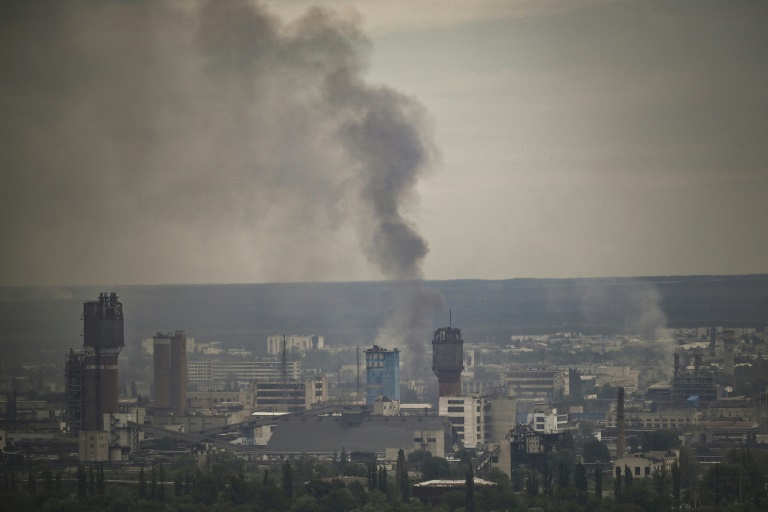
Russian forces on Tuesday stepped up efforts to cut off Ukrainian troops in the key industrial city of Severodonetsk in the east of the country despite Ukrainians insisting they were holding on.

Moscow has laid siege for weeks to the cities of Severodonetsk and Lysychansk, which are separated by a river, as the last areas in the eastern Donbas region of Lugansk still under Ukrainian control.

The head of Severodonetsk’s administration said “massive shelling” had destroyed a third bridge linking the twin cities, but insisted his city was “not isolated”.

“There are communication channels even if they are quite complicated,” Oleksandr Stryuk told Ukrainian television. Ukraine’s “continue to defend the city” but that the situation on the ground “changes every hour,” he added.

On Monday, Sergiy Gaiday, governor of Lugansk, told Radio Free Europe that Russian forces had “destroyed all the bridges and getting into the city is no longer possible. Evacuation is also not possible”. 

Ukrainian President Volodymyr Zelensky has branded the human cost of the battle for east “simply terrifying,” urging Western allies to speed arms deliveries to shore up Ukraine’s ability to reclaim territory.

“We just need enough weapons to ensure all of this. Our partners have them.”

His presidential advisor, Mikhaylo Podolyak, has listed hundreds of howitzers, tanks and armoured vehicles as among items needed by the Ukrainian army.

– ‘Tear off their arms’ –

“To end the war we need heavy weapons,” he tweeted.

Last week, Ukraine’s defence minister said up to 100 Ukrainian troops were being killed and 500 sustaining injuries every day.

The capture of Severodonetsk would open the road to Sloviansk and another major city, Kramatorsk, in Moscow’s push to conquer Donbas, a mainly Russian-speaking region partly held by pro-Kremlin separatists since 2014.

AFP team in Lysychansk saw massive damage after months of shelling, with no water, electricity or phone signal.

The Ukrainian military is using high ground in the city to exchange fire with Russian forces fighting for control of Severodonetsk, just across the water.

Lysychansk resident Maksym Katerin buried his mother and stepfather in his garden on Monday after a shell ripped through his yard, killing them instantly.

“I don’t know who did this, but if I knew, I would tear off their arms,” he said.

Neighbour Yevgeniya Panicheva wept. 

– ‘Surrender or die’ –

Katerin’s mother was lying on the ground, “her stomach was ripped and her guts were falling out. She was a very good, kind and helpful woman. Why did they do this to her?” Panicheva said.

“They bomb and they bomb, and we don’t know what to do.”

The Lugansk governor said Ukraine’s forces had been pushed back from Severodonetsk’s centre with the Russians controlling 70 to 80 percent of the city in their attempt to “encircle it”.

With Russia turning the screw on Severodonetsk, Ukrainian forces have two choices: “to surrender or die”, said Eduard Basurin, a representative for pro-Russian separatists.

On Monday, Amnesty International accused Russia of war crimes in Ukraine, saying that attacks on the north-eastern city of Kharkiv — including banned cluster bombs — had killed hundreds of civilians. 

“The repeated bombardments of residential neighbourhoods in Kharkiv are indiscriminate attacks which killed and injured hundreds of civilians, and as such constitute war crimes,” the rights group said in a report about Ukraine’s second-biggest city.

– ‘Hands tied’ –

In Bucha, a town near Kyiv that has become synonymous with allegations of Russian war crimes, police said Monday they had discovered another seven bodies in a grave.

“Several victims had their hands tied and knees bound,” Kyiv regional police chief Andriy Nebytov said on Facebook.

Dozens of bodies in civilian clothing were found in the town in April after Russian troops withdrew from the area following a month-long occupation.

Away from the battlefield, Russia’s war in Ukraine has posed a threat to global food security. Ukraine’s deputy agriculture minister said Monday that a quarter of his country’s arable land had been lost but insisted national food security was not threatened.

On a farm near the southern Ukrainian city Mykolaiv, the harvest has been delayed by the need to undo damage by Russian troops who passed through the area in March.

“We planted really late because we needed to clear everything beforehand,” including bombshells, Nadiia Ivanova, 42, told AFP.

The farm’s warehouses currently hold 2,000 tonnes of last season’s grain but with normal export routes blocked or damaged by the war, there are no buyers for the harvest.

burs-sea/jm

Britney Spear's ex charged with stalking over his gatecrash of wedding

A US court charged Britney Spears’ ex-husband with a felony count of stalking on Monday after he attempted to gatecrash the pop princess’ wedding in southern California, which he had live-streamed on Instagram.

Spears and her longtime partner Sam Asghari were preparing to wed Thursday in her home in Thousand Oaks, California, when the proceedings were interrupted. 

Jason Allen Alexander, a childhood friend the 40-year-old singer was very briefly married to in 2004, crashed the sun-soaked event, sparking a police response. 

According to court filings in Ventura County’s court, Alexander was charged with a felony count of stalking, as well as misdemeanors counts of trespassing, vandalism and battery. 

The 40-year-old Louisiana native — who had appeared in court via Zoom from jail — pled not guilty to the charges, and the judge issued a restraining order requiring Alexander to stay 100 yards from Spears. 

His bail was also set at $100,000, and a hearing is next scheduled for Wednesday. 

Spears’ attorney Mathew Rosengart told reporters he was “pleased” by how the sheriff’s office responded to Alexander’s intrusion. 

“This is a serious matter, this is not a ‘wedding crash’ — this was an infiltration, as we all shockingly saw,” Rosengart said outside the courthouse. 

According to Ventura County Sheriff’s Office, Alexander also has an open warrant for grand theft embezzlement and possession of stolen property.

Spears’ wedding to Asghari was not widely trailed, with news of the nuptials appearing on specialist publications only hours earlier.

The star-studded affair was attended by celebrities like Madonna, Selena Gomez, Drew Barrymore, Paris Hilton, and Donatella Versace — who had designed her dress. 

“Fairytales are real,” the pop princess had posted on Instagram, along with a video of the preparations showing Spears posing in a horse-drawn carriage decorated in pink roses. 

In November, a Los Angeles judge dissolved a controversial conservatorship overseen by Spears’ father, an arrangement that has seen her life and multimillion-dollar estate under his control for 13 years. 

The singer had said her father Jamie Spears had prevented her from having a contraceptive IUD removed despite her desire for more children — an allegation he has denied. 

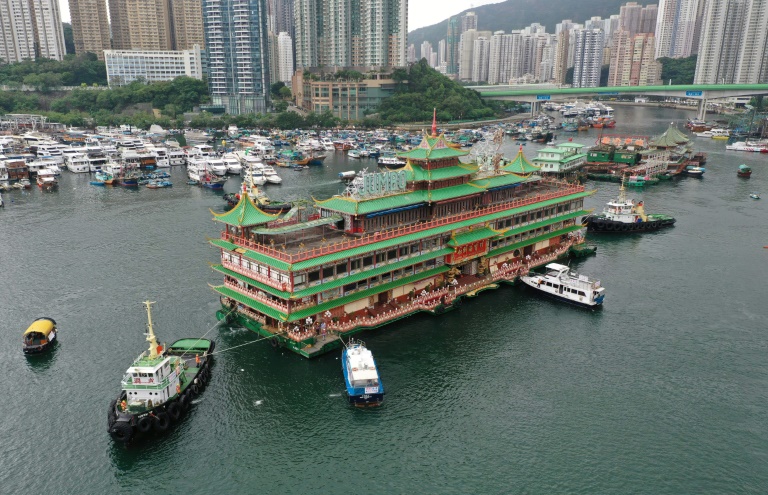
Famed Hong Kong floating restaurant towed away after half a century

Hong Kong’s Jumbo Floating Restaurant, a famed but ageing tourist attraction that featured in multiple Cantonese and Hollywood films, was towed out of the city Tuesday after the Covid pandemic finally sank the struggling business.

The buoyant behemoth, which at 76 metres (250 feet) long could house 2,300 diners, set out shortly before noon from the southern Hong Kong Island typhoon shelter where it has sat for nearly half a century.

Designed like a Chinese imperial palace and once considered a must-see landmark, the restaurant drew visitors from Queen Elizabeth II to Tom Cruise, and featured in several films — including Steven Soderbergh’s “Contagion”, about a deadly global pandemic.

The lavish restaurant’s operators cited the Covid-19 pandemic as the reason for finally closing its doors in March 2020, after around a decade of financial woes.

Restaurant owner Melco International Development announced last month that ahead of its licence expiration in June, Jumbo would leave Hong Kong and await a new operator at an undisclosed location.

Under overcast skies, a scattered group of onlookers gathered on the Aberdeen waterfront to see it be dragged away.

Watching the restaurant’s ponderous progress across the shelter waters was Mr Wong, a 60-year-old man who told AFP he had come specially to see its departure.

“The exterior was for many years a symbol of Hong Kong,” he said, adding he had eaten there once 20 years ago.

“I believe it will come back and I look forward to it,” he added wistfully.

Another spectator, who gave her name as Mrs Chan, said she had heard the news and came to take one last picture by the restaurant before it left. 

“I think it is such a pity to see it go,” she said. 

“Jumbo has a long history and it has attracted many locals and tourists… It’s a restaurant that’s known to the world.”

– ‘Bidding farewell’ –

Opened in 1976 by the late casino tycoon Stanley Ho, the Jumbo Floating Restaurant embodied the height of luxury, reportedly costing more than HK$30 million ($3.8 million) to build.

It featured a “dragon throne” in the style of the Ming dynasty as well as an opulent mural.

The throne was fondly remembered by one of those watching the restaurant’s departure on Tuesday, a 24-year-old man surnamed Leung who said he had always begged his mother to let him sit on it when they visited for dim sum.

“There are quite some childhood memories for me,” he said. “I feel a bit sad. (Coming here) to see it is like bidding my farewell.”

Aberdeen harbour was traditionally a hotspot for seafood eateries — and fierce competition for customers only cooled when Jumbo’s operators acquired its biggest competitor, Tai Pak Floating Restaurant, in the 1980s.

The restaurant was kept afloat by Hong Kong’s booming tourism industry but its popularity had dimmed in recent years even before the coronavirus hit.

Restaurant operator Melco said last month the business had not been profitable since 2013 and cumulative losses had exceeded HK$100 million ($12.7 million).

It was still costing millions in maintenance fees every year and around a dozen businesses and organisations had declined an invitation to take it over at no charge, Melco added. 

In her 2020 policy address, Hong Kong leader Carrie Lam announced plans to turn the restaurant over to local theme park Ocean Park for revitalisation, but the project fell through after the park said it could not find a suitable operator.

The ailing restaurant’s fate was sealed just days before Lam is set to leave office.

In a sign of its dilapidation, on June 1, Jumbo’s kitchen boat listed into the water after a suspected hull breach, tilting almost 90 degrees. 

The derelict kitchen boat will be left behind, according to local media. 

Asian stocks pare early losses but inflation fears remain focus

Asian equities mostly fell Tuesday after the previous day’s global rout but dip-buying helped pare early losses, while Europe saw gains, with attention turning to the Federal Reserve as it prepares to ramp up interest rates to fight runaway inflation.

Panic has swept through trading floors since data on Friday showed US consumer prices rising at their fastest pace in a generation owing to a spike in energy and food costs caused by the Ukraine war, China’s lockdowns and supply chain snarls.

The pain has been felt across all assets, with bitcoin threatening to fall below $20,000 for the first time since December 2020, currencies retreating against the dollar, and even safe-haven plays including the yen and gold feeling the squeeze.

Investors are now laser-focused on Wednesday’s Fed interest rate decision as it struggles to walk a fine line between reining in inflation and trying to keep the economy on track.

Danielle DiMartino Booth, at Quill Intelligence, said: “While tightening into a recession is no easy task, the Federal Reserve must indicate a willingness to raise interest rates by more than a half-percentage point at upcoming meetings if inflation continues to surprise to the upside.”

But JP Morgan Asset Management’s Tai Hui warned: “While there is no doubt that inflation is a considerable challenge for the US at this point, slamming on the brakes too hard risks pushing the economy off its track.”

Before Friday’s news, expectations had been for a 50-point basis hike and a signal that more of the same was to come at the next few meetings. But now analysts say there is a one-in-three chance officials could announce a three-quarter point increase, with some even predicting a one percentage point hike.

That has ramped up fears that the world’s top economy is heading for a recession, and on Monday Wall Street plunged with the broad-based S&P 500 sinking into a bear market after dropping more than 20 percent from its recent peak.

But in Asia dip-buying helped some markets recover to positive territory, and others pare the morning’s drop.

Sydney shed 3.6 percent but was much better off than the initial losses of around five percent as traders there returned after a long weekend.

Tokyo, Seoul, Singapore, Wellington, Taipei and Manila were also lower.

Hong Kong was marginally higher and Shanghai edged up, while there were also advances in Mumbai, Bangkok and Jakarta.

London, Paris and Frankfurt rose in the morning.

– ‘Recipe for recession’ –

Commentators warned that the Fed was in a tough place on what to do Wednesday. A decision to lift rates more than 0.50 percentage points could signal its determination to finally defeat inflation but also hit its credibility as it confuses officials’ signals to traders.

“Once the Fed starts moving in 75s it would be hard to stop, and the combination of this and the Fed’s outcome-based approach to inflation feels like it could be a recipe for recession,” said Evercore ISI’s Krishna Guha and Peter Williams.

But Stephen Innes of SPI Asset Management said there was “some positive readthrough with the Fed front-loading and telegraphing a 75 basis point move”.

“In that case, it not only allows the market to brace for impact but could also mean rate hike clouds start dissipating sooner on the fourth quarter horizon if an aggressive front-loading Fed snuffs out inflation.”

Bets on a run of sharp hikes have sent the dollar spiralling higher against other currencies, hitting a 24-year high Monday against the yen and a record peak on the Indian rupee. 

Both units have clawed back some of the losses but remain under severe pressure, while the euro is in danger of hitting a two-decade low. The pound is at its weakest level in two years.

And bitcoin remains in the firing line, hitting $20,823 for the first time since December 2020, with selling compounded by news that crypto lending platform Celsius Network had paused withdrawals owing to volatile conditions. The announcement raised worries about a possible contagion for other firms.

– Key figures at around 0810 GMT –

Tokyo – Nikkei 225: DOWN 1.3 percent at 26,629.86 (close)

Hong Kong – Hang Seng Index: FLAT at 21,067.99 (close)

Shanghai – Composite: UP 1.0 percent at 3,288.91 (close)

London – FTSE 100: UP 0.4 percent at 7,232.37

Dollar/yen: UP at 134.43 yen from 134.42 yen late Monday

Euro/dollar: UP at $1.0467 from $1.0412

Pound/dollar: UP at $1.2185 from $1.2136

Euro/pound: UP at 85.88 pence from 85.76 pence

Brent North Sea crude: UP 0.8 percent at $123.23 per barrel

West Texas Intermediate: UP 0.7 percent at $121.83 per barrel

New York – Dow: DOWN 2.8 percent at 30,516.74 (close)

— Bloomberg News contributed to this story —

Asian stocks pare early losses but inflation fears remain in focus

Asian equities mostly fell Tuesday after the previous day’s global rout but dip-buying helped pare early losses, while Europe saw gains, with attention turning to the Federal Reserve as it prepares to ramp up interest rates to fight runaway inflation.

Panic has swept through trading floors since data on Friday showed US consumer prices rising at their fastest pace in a generation owing to a spike in energy and food costs caused by the Ukraine war, China’s lockdowns and supply chain snarls.

The pain has been felt across all assets, with bitcoin threatening to fall below $20,000 for the first time since December 2020, currencies retreating against the dollar, and even safe-haven plays including the yen and gold feeling the squeeze.

Investors are now laser-focused on Wednesday’s Fed interest rate decision as it struggles to walk a fine line between reining in inflation and trying to keep the economy on track.

Danielle DiMartino Booth, at Quill Intelligence, said: “While tightening into a recession is no easy task, the Federal Reserve must indicate a willingness to raise interest rates by more than a half-percentage point at upcoming meetings if inflation continues to surprise to the upside.”

But JP Morgan Asset Management’s warned: “While there is no doubt that inflation is a considerable challenge for the US at this point, slamming on the brakes too hard risks pushing the economy off its track.”

Before Friday’s news, expectations had been for a 50-point basis hike and a signal that more of the same was to come at the next few meetings. But now analysts say there is a one-in-three chance officials could announce a three-quarter point increase, with some even predicting a one percentage point hike.

That has ramped up fears that the world’s top economy is heading for a recession, and on Monday Wall Street plunged with the broad-based S&P 500 sinking into a bear market after dropping more than 20 percent from its recent peak.

But in Asia dip-buying helped some markets recover to positive territory, and others pare the morning’s drop.

Sydney shed 3.6 percent but was much better off than the initial losses of around five percent as traders there returned after a long weekend.

Tokyo, Seoul, Singapore, Wellington, Taipei and Manila were also lower.

Hong Kong and Shanghai edged up in the afternoon, while there were also advances in Mumbai, Bangkok and Jakarta.

London, Paris and Frankfurt opened higher.  

Commentators warned that the Fed was in a tough place on what to do Wednesday. A decision to lift rates more than 0.50 percentage points could signal its determination to finally defeat inflation but also hit its credibility as it confuses officials’ signals to traders.

“Once the Fed starts moving in 75s it would be hard to stop, and the combination of this and the Fed’s outcome-based approach to inflation feels like it could be a recipe for recession,” said Evercore ISI’s Krishna Guha and Peter Williams.

But Stephen Innes of SPI Asset Management said there was “some positive readthrough with the Fed front-loading and telegraphing a 75 basis point move”.

“In that case, it not only allows the market to brace for impact but could also mean rate hike clouds start dissipating sooner on the fourth quarter horizon if an aggressive front-loading Fed snuffs out inflation.”

Bets on a run of sharp hikes have sent the dollar spiralling higher against other currencies, hitting a 24-year high Monday against the yen and a record peak on the Indian rupee. 

Both units have clawed back some of the losses but remain under severe pressure, while the euro is in danger of hitting a two-decade low. The pound is at its weakest level in two years.

And bitcoin remains in the firing line, hitting $20,823 for the first time since December 2020, with selling compounded by news that crypto lending platform Celsius Network had paused withdrawals owing to volatile conditions. The announcement raised worries about a possible contagion for other firms.

– Key figures at around 0720 GMT –

Tokyo – Nikkei 225: DOWN 1.3 percent at 26,629.86 (close)

Hong Kong – Hang Seng Index: DOWN 0.3 percent at 21,120.50

Shanghai – Composite: UP 1.0 percent at 3,288.91 (close)

London – FTSE 100: UP 0.8 percent at 7,262.77

Dollar/yen: UP at 134.58 yen from 134.42 yen late Monday

Euro/dollar: UP at $1.0442 from $1.0412

Pound/dollar: UP at $1.2160 from $1.2136

Euro/pound: UP at 85.88 pence from 85.76 pence

Brent North Sea crude: UP 0.7 percent at $123.16 per barrel

West Texas Intermediate: UP 0.7 percent at $121.73 per barrel

New York – Dow: DOWN 2.8 percent at 30,516.74 (close)

— Bloomberg News contributed to this story —

Polluted air cuts global life expectancy by two years

Microscopic air pollution caused mostly by burning fossil fuels shortens lives worldwide by more than two years, researchers reported Tuesday. 

Across South Asia, the average person would live five years longer if levels of fine particulate matter met World Health Organization standards, according to a report from the University of Chicago’s Energy Policy Institute.

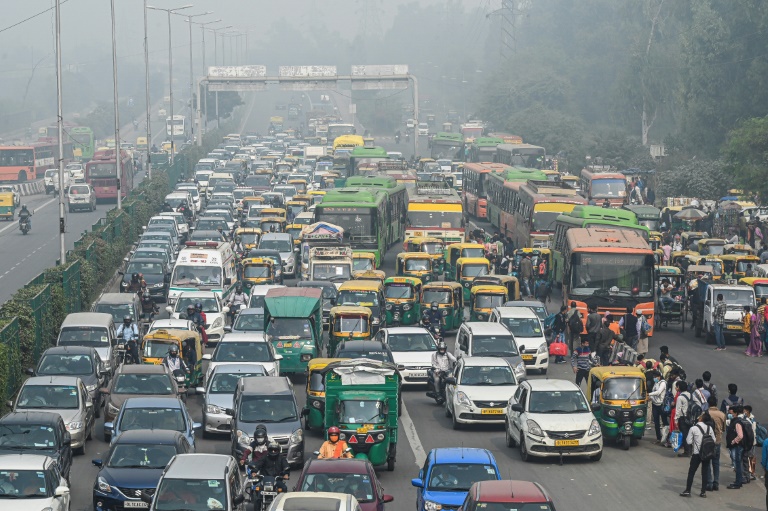
In the Indian states of Uttar Pradesh and Bihar, home to 300 million, crippling lung and heart disease caused by so-called PM2.5 pollution reduces life expectancy by eight years, and in the capital city of New Delhi by a decade.

PM2.5 pollution — 2.5 microns across or less, roughly the diameter of a human hair — penetrates deep into the lungs and enters the bloodstream. 

In 2013, the United Nations classified it as a cancer-causing agent.

The WHO says PM2.5 density in the air should not top 15 microgrammes per cubic metre in any 24-hour period, or 5 mcg/m3 averaged across an entire year.

Faced with mounting evidence of damaging health impacts, the WHO tightened these standards last year, the first change since establishing air quality guidance in 2005.

“Clean air pays back in additional years of life for people across the world,” lead research Crista Hasenkopf and colleagues said in the Air Quality Life Index report.

“Permanently reducing global air pollution to meet the WHO’s guidelines would add 2.2 years onto average life expectancy.”

– Major gains in China –

Almost all populated regions in the world exceed WHO guidelines, but nowhere more so that in Asia: by 15-fold in Bangladesh, 10-fold in India, and nine-fold in Nepal and Pakistan.

Central and West Africa, along with much of Southeast Asia and parts of central America, also face pollution levels — and shortened lives — well above the global average.

Surprisingly, PM2.5 pollution in 2020, the most recent data available, was virtually unchanged from the year before despite a sharp slow-down in the global economy and a corresponding drop in CO2 emissions due to Covid lockdowns.

“In South Asia, pollution actually rose during the first year of the pandemic,” the authors noted.

One country that has seen major improvements is China.

PM2.5 pollution fell in the nation of 1.4 billion people by almost 40 percent between 2013 and 2020, adding two years to life expectancy. 

But even with this progress, lives in China are on average cut short today by 2.6 years.

The worst-hit provinces include Henan and Hebei, in north-central China, and the coastal province of Shandong.

Compared to other causes of premature death, the impact of PM2.5 pollution is comparable to smoking tobacco, more than three times that of alcohol use, and six times that of HIV/AIDS, the report said.

Famed Hong Kong floating restaurant towed away after half a century

Hong Kong’s Jumbo Floating Restaurant, a famed but ageing tourist attraction that featured in multiple Cantonese and Hollywood films, was towed out of the city Tuesday after years of revitalisation efforts went nowhere.

The buoyant behemoth, which at 76 metres long could house 2,300 diners, set out shortly before noon from the southern Hong Kong Island typhoon shelter where it has sat for nearly half a century. 

Designed like a Chinese imperial palace and once considered a must-see landmark, the restaurant drew visitors from Queen Elizabeth II to Tom Cruise, and featured in several films — including Steven Soderbergh’s “Contagion”, about a deadly global pandemic.   

The lavish restaurant’s operators cited the Covid-19 pandemic as the reason for finally closing its doors in March 2020, after around a decade of financial woes. 

Restaurant owner Melco International Development announced last month that ahead of its licence expiration in June, Jumbo would leave Hong Kong and await a new operator at an undisclosed location.

Under overcast skies, a scattered group of onlookers gathered on the Aberdeen waterfront to see it be dragged away. 

Watching the restaurant’s ponderous progress across the shelter waters was Mr Wong, a 60-year-old man who told AFP he had come specially to see its departure. 

“The exterior was for many years a symbol of Hong Kong,” he said, adding he had eaten there once 20 years ago. 

“I believe it will come back and I look forward to it.”

Opened in 1976 by the late casino tycoon Stanley Ho, the Jumbo Floating Restaurant embodied the height of luxury, reportedly costing over HK$30 million ($3.8 million) to build. 

It featured a “dragon throne” in the style of the Ming dynasty as well as an opulent mural, according to the South China Morning Post.

The restaurant’s berth in Aberdeen harbour was traditionally a hotspot for seafood eateries — and fierce competition for customers only cooled when Jumbo’s operators acquired its biggest competitor, Tai Pak Floating Restaurant, in the 1980s.

The restaurant was kept afloat by Hong Kong’s booming tourism industry but its popularity had dimmed in recent years even before the coronavirus hit.

Restaurant operator Melco said last month the business had not been profitable since 2013 and cumulative losses had exceeded HK$100 million ($12.7 million).

It was still costing millions in maintenance fees every year and around a dozen businesses and organisations had declined an invitation to take it over at no charge, Melco added. 

In her 2020 policy address, Hong Kong leader Carrie Lam announced plans to turn the restaurant over to local theme park Ocean Park for revitalisation, but the project fell through after the park said it could not find a suitable operator.

The ailing restaurant’s fate was sealed just days before Lam is set to leave office. 

In a sign of its dilapidation, on June 1, Jumbo’s kitchen boat listed into the water after a suspected hull breach, tilting almost 90 degrees. 

The derelict kitchen boat will be left behind, according to local media. 

Families of overdose victims demand action from social media platforms

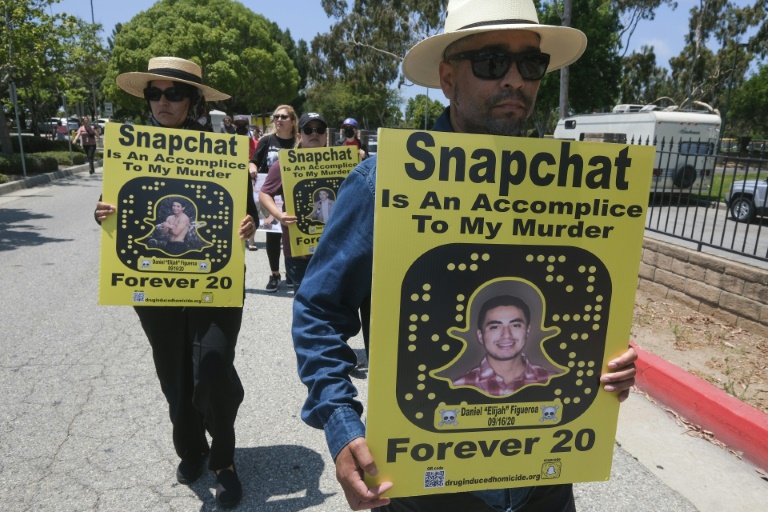
Families of teens who died after overdosing on drugs they bought through Snapchat and other social media platforms called Monday for tech firms to do more to address the problem.

Sam Chapman, part of a group that staged a protest Monday in front of Snapchat’s Santa Monica headquarters, told AFP his son died in February 2021 after a pill he purchased through the platform was laced with the extremely powerful opioid fentanyl.

“I’m here today to warn people about the dangers of social media, delivering drugs and other criminal acts into the lives of our families, through our children,” said Chapman, 57.

His son Sammy would have celebrated his 18th birthday last weekend.

Chapman described the horrific scene of finding his son dead on the floor in his bedroom, in what he said was called the “fentanyl death pose.”

“He had stopped breathing and fell backwards in his chair and vomited, and he choked on his own vomit… It’s a very common way of going,” said Chapman.

Of the 107,000 overdose deaths recorded last year in the United States, 70 percent were caused by “fentanyl poisoning,” which is now the leading cause of death for Americans aged 18 to 45, according to the groups backing Monday’s protest.

Chapman said a drug dealer had contacted his son on Snapchat, and sent him a “colorful drug menu with pictures.”

“At the bottom it said that he delivered. And so he connected with our son and delivered the drugs to our home after we were asleep, like it was a pizza,” he added.

Like the other victims’ family members, Chapman is calling on Snapchat and other social media platforms geared toward young people to take stronger action against drug sales.

“We have been working tirelessly to help combat this national crisis by eradicating illicit drug dealers from our platform,” a Snapchat spokesperson told AFP.

“We use advanced technology to proactively detect and shut down drug dealers who try to abuse our platform, and block search results for dangerous drug-related content,” the representative added.

But Chapman said the tools currently in place do not work because dealers use emojis and code words that aren’t blocked.

The group Victims of Illicit Drugs (VOID) is demanding US law to be updated so that social networks are held liable for what happens to their users on their platforms.

“If you’re walking in a grocery store, you slip and fall, you can sue them,” said VOID president Jaime Puerta.

“The law was written in 1996,” he added.

“The legislators had no idea of where the internet would be today.”

Close Bitnami banner
Bitnami