US Business

Thousands to demonstrate for action on US gun violence

Thousands of people were expected to demonstrate across the United States on Saturday for tighter firearms laws to curb devastating gun violence plaguing the country, where Republican politicians have repeatedly blocked reforms.

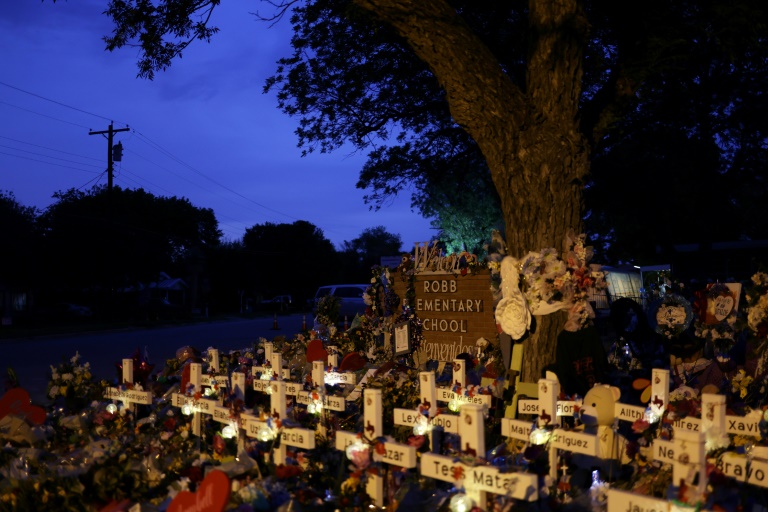
Two horrific shootings last month — one at a Texas elementary school that killed 19 young children and two teachers, and another at a New York supermarket that left 10 Black people dead — helped spark the call for the protests, which are planned at hundreds of locations.

But the problem of gun violence — which has killed more than 19,300 people so far this year in the United States, according to the Gun Violence Archive — goes far beyond high-profile mass killings, with more than half of those deaths due to suicide.

“After countless mass shootings and instances of gun violence in our communities, it’s time to take back to the streets,” March for Our Lives, which is organizing the demonstrations, said on its website.

“Demonstrate to our elected officials that we demand and deserve a nation free of gun violence,” it said.

March for Our Lives was founded by survivors of the shooting at a high school in Parkland, Florida, who organized a rally that drew hundreds of thousands of people to the nation’s capital in March 2018.

David Hogg, a founder and board member of the organization, appealed for Americans of all political stripes to take part in the Saturday protests.

“Whoever you are, march with us… Gun owners, NRA members, Republicans, Democrats, independents, and people from all backgrounds are fed up and it is time we make Congress do something,” Hogg wrote in an opinion piece for Fox News the day before.

“If we can agree that killing children is unacceptable, then we need to either prevent people intent on killing from getting their hands on the guns they use or stop their intent to kill in the first place,” he said.

Both issues have been in the spotlight in the wake of the May 24 shooting at Robb Elementary in Uvalde, Texas, which was carried out by a gunman who bought two assault rifles shortly after turning 18.

– ‘The bigger tragedy- ‘

Gun control advocates are calling for tighter restrictions or an outright ban on the rifles — one of which was also used in the racially motivated supermarket shooting in Buffalo, New York just 10 days before Uvalde.

Opponents of tougher regulations have meanwhile sought to cast mass shootings as primarily a mental health issue, not one of access to firearms.

Mariah Cooley, another March for Our Lives board member, highlighted the toll gun violence has taken on both her and the country.

“I lost important people in my life — including my cousin — to gun violence before the age of 18,” Cooley wrote in a Friday op-ed for The Hill.

“While this statement in itself is a tragedy, the bigger tragedy is that this is a reality that far too many Americans can relate to,” she said.

Frequent mass shootings lead to widespread outrage in the United States, where a majority of people support tighter gun laws, but opposition from many Republican lawmakers has long been a hurdle to major changes.

The Democrat-controlled House of Representatives passed a broad package of proposals this week that included raising the purchasing age for most semi-automatic rifles from 18 to 21, but the party does not have the requisite 60 votes to advance it in the Senate.

A cross-party group of senators has also been working on a narrow collection of controls that could develop into the first serious attempt at gun regulation reform in decades.

The package would boost funding for mental health services and school security, narrowly expand background checks, and incentivize states to institute so-called “red flag laws” that enable authorities to confiscate weapons from individuals considered a threat.

But it does not include an assault weapons ban or universal background checks, meaning it will fall short of the expectations of President Joe Biden, progressive Democrats and anti-gun violence activists.
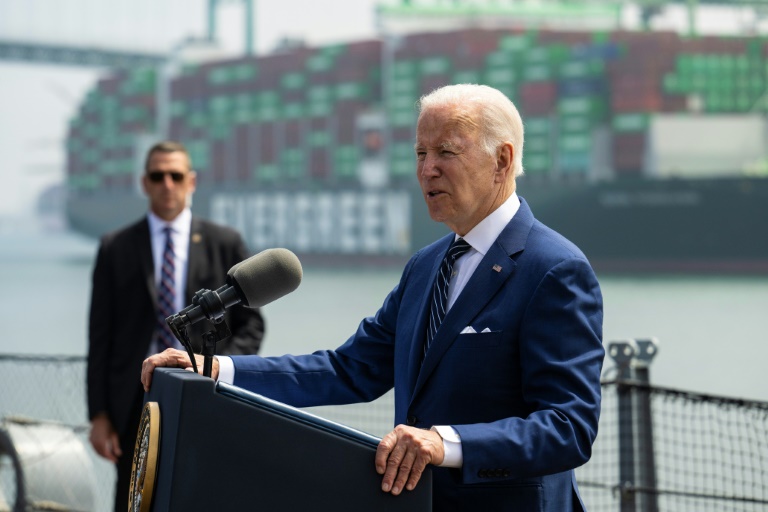
US gas price hits a record $5 a gallon: auto group

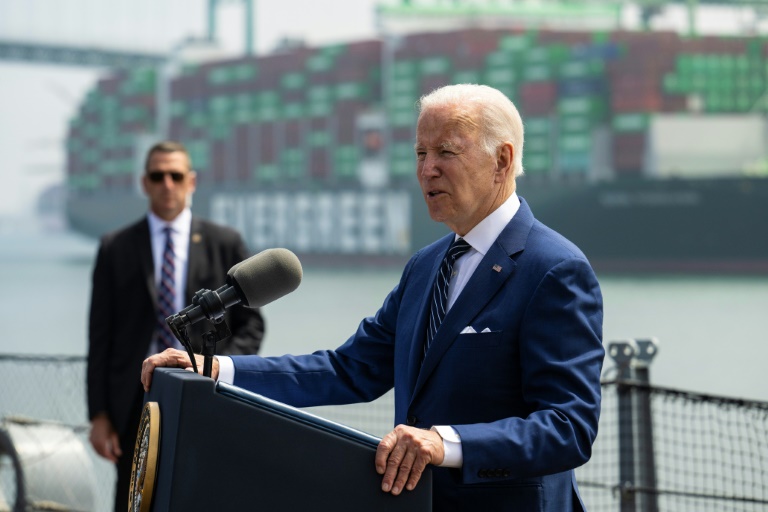
The average price of premium gasoline at the pump has surpassed $5 a gallon for the first time in the United States, the American Automobile Association (AAA) reported Saturday. 

That record level, coming on top of months of soaring inflation, represents the latest bad news for President Joe Biden just five months before crucial midterm elections.

A year ago, the average price of gas in the US was just $3.07; since then it has shot up by 62 percent. 

While Europeans have long been accustomed to paying much more at the pump, US gas taxes are lower — leaving car-loving Americans in shock over surging prices.  

The increase in gas prices follows a steady rise in oil prices — which had plummeted in the early days of the Covid-19 pandemic as demand sagged, but have risen again as world economic activity resumes.

Oil prices soared further after Moscow invaded Ukraine in late February, and as international sanctions against Russia — a major petroleum producer — began to bite. 

A barrel of crude currently sells for more than $120 in both London and New York.

Overall US energy prices in May were nearly 35 percent higher compared to the same month in 2021, according to government data.

This has contributed to the overall rise in US consumer prices, which were up 8.6 percent in May from a year earlier — a 40-year record.

As the summer vacation season nears, Americans — with their longtime love affair for big gas-guzzling vehicles — can expect to see energy prices rise still further. 

That will pile even more pressure on consumers already struggling with higher prices for food (up 10.1 percent in May), housing, automobiles and health care.

All this complicates Biden’s position. For months he has sought to reassure Americans that his administration is doing everything in its power to bring down prices without derailing the economic recovery.

But in November, Americans vote to elect all members of the House of Representatives and one-third of senators — and polls show voters listing the economy, inflation and high gas prices as their top issues.

On Friday, the president again lashed out at the American oil industry, cautioning it in a statement “not (to) use the challenge created by the war in Ukraine as a reason to make things worse for families with excessive profit taking or price hikes.”

US gas price hits a record $5 a gallon: auto group

The average price of premium gasoline at the pump has surpassed $5 a gallon for the first time in the United States, the American Automobile Association (AAA) reported Saturday. 

That record level, coming on top of months of soaring inflation, represents the latest bad news for President Joe Biden just five months before crucial midterm elections.

A year ago, the average price of gas in the US was just $3.07; since then it has shot up by 62 percent. 

While Europeans have long been accustomed to paying much more at the pump, US gas taxes are lower — leaving car-loving Americans in shock over surging prices.  

The increase in gas prices follows a steady rise in oil prices — which had plummeted in the early days of the Covid-19 pandemic as demand sagged, but have risen again as world economic activity resumes.

Oil prices soared further after Moscow invaded Ukraine in late February, and as international sanctions against Russia — a major petroleum producer — began to bite. 

A barrel of crude currently sells for more than $120 in both London and New York.

Overall US energy prices in May were nearly 35 percent higher compared to the same month in 2021, according to government data.

This has contributed to the overall rise in US consumer prices, which were up 8.6 percent in May from a year earlier — a 40-year record.

As the summer vacation season nears, Americans — with their longtime love affair for big gas-guzzling vehicles — can expect to see energy prices rise still further. 

That will pile even more pressure on consumers already struggling with higher prices for food (up 10.1 percent in May), housing, automobiles and health care.

All this complicates Biden’s position. For months he has sought to reassure Americans that his administration is doing everything in its power to bring down prices without derailing the economic recovery.

But in November, Americans vote to elect all members of the House of Representatives and one-third of senators — and polls show voters listing the economy, inflation and high gas prices as their top issues.

On Friday, the president again lashed out at the American oil industry, cautioning it in a statement “not (to) use the challenge created by the war in Ukraine as a reason to make things worse for families with excessive profit taking or price hikes.”

In Kyiv, EU chief says to give signal on Ukraine's hopes next week

The European Commission will provide a clear signal next week on Ukraine’s EU candidate status bid, its chief Ursula von der Leyen said Saturday, as fighting raged in the east and south of the country.

Making a surprise visit to Kyiv, von der Leyen said talks she held with Ukrainian President Volodymyr Zelensky “will enable us to finalise our assessment by the end of next week” — the first time the bloc has publicly given a timing.

Zelensky has been pressing for rapid admission into the European Union as a way of reducing Ukraine’s geopolitical vulnerability, which was brutally exposed by Russia’s February 24 invasion.

But officials and leaders in the bloc caution that, even with candidacy status, actual EU membership could take years or even decades.

Von der Leyen, appearing alongside Zelensky during her second visit to Kyiv since the war began, did not hold out any promises, noting further reforms were needed.

For his part, the Ukrainian president warned it was a “decisive time” for his country and the EU.

“Russia wants to ruin the European unity, wants to leave Europe divided and wants to leave it weak. The entire Europe is a target for Russia. Ukraine is only the first stage in this aggression, in these plans.” 

Despite reservations among some member states, EU leaders are expected to approve Ukraine’s candidate status at a summit on June 23-24, though with stern conditions attached.

– Crisis and famine –

The EU and the United States have strongly backed Ukraine, sending weapons and cash to help it see off Russian forces, and punishing Moscow with unprecedented economic sanctions.

Zelensky has urged them on during a continuous diplomatic offensive that has seen him appearing via video link at parliaments and summits around the world.

On Saturday, he warned the Shangri-La Dialogue security summit in Singapore of the dangers of a global food crisis posed by Russia’s blockade of Ukraine’s Black Sea ports.

He warned of “an acute and severe food crisis and famine”, adding that the “shortage of foodstuffs will inexorably lead to political chaos” — all of it “the direct consequence of the acts of the Russian state”.

Before the war, Ukraine was the world’s top producer of sunflower oil and a major wheat exporter, but millions of tonnes of grain exports remain trapped due to the blockade.

Speaking to delegates including Pentagon chief Lloyd Austin and China’s defence minister, Zelensky urged international pressure to end the blockade.

Kyiv is in discussion with the UN, Turkey and other countries to open a way to allow the grain exports, and Zelensky said the talks are focused on the “format” of the corridor.

– ‘Devastate every city’ –

After withdrawing from the capital Kyiv, Russian forces have concentrated their firepower on the eastern Donbas region and the south.

They continued their bombardment overnight Friday-Saturday of towns and villages around Kharkiv and in the Donbas regions of Lugansk and Donetsk, Zelensky’s office said.

“Russia wants to devastate every city in the Donbas, every single one, without exaggeration,” the president said in his nightly address Friday.

Moscow has particularly focused on the key eastern industrial city of Severodonetsk, which Lugansk regional governor Sergiy Gaiday said Saturday was “ruined” by Russian forces.

“This is their tactics — people are not needed, the infrastructure is not needed, houses are not needed, everything should be simply ruined,” he said in an interview posted on his Telegram channel.

He declined to estimate the number of civilian victims, but said he expected the figure would be “enormous and terrible”.

“Many people were buried in front of their houses’ entrances. A shell from heavy artillery is tearing people up into bits and pieces,” he said.

He added: “They lie like this for a day, three or four. It is impossible to take them out because there is constant shelling.” 

In the Mykolaiv region near the front line in the south, regional governor Vitaliy Kim stressed the urgent need for international military assistance.

“Russia’s army is more powerful, they have a lot of artillery and ammo. For now, this is a war of artillery… and we are out of ammo,” he said.

British Defence Secretary Ben Wallace visited Ukraine on Friday, where Zelensky thanked London for its support.

Following Washington’s lead, Britain announced the delivery of multiple rocket launcher systems — with a range of about 80 kilometres (50 miles), slightly superior than the Russian systems.

It was not clear when Ukraine will be able to start using them. 

– Russian passports issued –

In areas now controlled by its forces, Moscow has sought to impose its authority.

Authorities in the occupied city of Kherson in southern Ukraine handed out Russian passports to local residents for the first time on Saturday, news agencies reported.

Russia’s TASS agency said 23 Kherson residents received a Russian passport at a ceremony through a “simplified procedure” facilitated by a decree signed by Russian President Vladimir Putin in May.

Ukraine has denounced the move as a “flagrant violation” of its territorial integrity, saying Putin’s decree was “legally void”.

It follows the introduction last month in the Kherson region of the Russian ruble as an official currency alongside the Ukrainian hryvnia.

burs-ar/imm

Thousands to demonstrate for action on US gun violence

Thousands of people were expected to demonstrate across the United States on Saturday for tighter firearms laws to curb devastating gun violence plaguing the country.

Two horrific shootings last month — one at a Texas elementary school that killed 19 young children and two teachers, and another at a New York supermarket that left 10 Black people dead — sparked the call for the protests, which are planned at hundreds of locations.

But the problem of gun violence — which has killed more than 19,300 people so far this year in the United States, according to the Gun Violence Archive — goes far beyond high-profile mass killings, with most of those deaths due to suicide.

“After countless mass shootings and instances of gun violence in our communities, it’s time to take back to the streets,” March for Our Lives, which is organizing the demonstrations, said on its website.

“Demonstrate to our elected officials that we demand and deserve a nation free of gun violence,” it said.

March for Our Lives was founded by survivors of the shooting at a high school in Parkland, Florida, who organized a rally that drew hundreds of thousands of people to the nation’s capital in March 2018.

David Hogg, a founder and board member of the organization, has appealed for Americans of all political stripes to take part in the Saturday protests.

“Whoever you are, march with us… Gun owners, NRA members, Republicans, Democrats, independents, and people from all backgrounds are fed up and it is time we make Congress do something,” Hogg wrote in an opinion piece for Fox News the day before.

“If we can agree that killing children is unacceptable, then we need to either prevent people intent on killing from getting their hands on the guns they use or stop their intent to kill in the first place,” he said.

While frequent mass shootings spark widespread outrage in the United States, where a majority of people support tighter gun laws, opposition from many Republican lawmakers has long been a hurdle to major changes.

The Democrat-controlled House of Representatives passed a broad package of proposals this week that included raising the purchasing age for most semi-automatic rifles from 18 to 21, but the party does not have the requisite 60 votes to advance it in the Senate.

A cross-party group of senators has also been working on a narrow collection of controls that could develop into the first serious attempt at gun regulation reform in decades.

The package would boost funding for mental health services and school security, narrowly expand background checks, and incentivize states to institute so-called “red flag laws” that enable authorities to confiscate weapons from individuals considered a threat.

But it does not include an assault weapons ban or universal background checks, meaning it will fall short of the expectations of President Joe Biden, progressive Democrats and anti-gun violence activists.
Sanctions-hit Iran, Venezuela sign 20-year cooperation deal

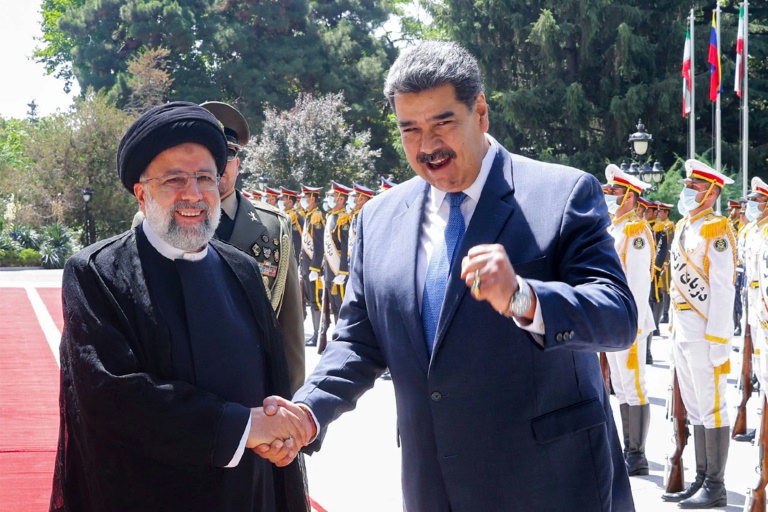
Iran and Venezuela signed a 20-year deal on cooperation between the two allies subject to US sanctions during a visit Saturday to the Islamic republic by Venezuelan President Nicolas Maduro.

The inking of the agreement “shows the determination of the high-level officials of the two countries for development of relations in different fields,” Iranian President Ebrahim Raisi said.

Maduro, speaking at a joint news conference in Tehran, said the cooperation covered the energy and financial sectors as well as “work together on defence projects”.

Alongside the likes of Russia, China, Cuba and Turkey, Iran is one of Venezuela’s main allies. And like Venezuela it is subject to tough US sanctions.

“Venezuela has passed hard years but the determination of the people, the officials and the president of the country was that they should resist the sanctions,” Raisi said during the news conference.

“This is a good sign that proves to everyone that resistance will work and will force the enemy to retreat,” the Iranian president added.

In addition to the 20-year accord inked by the two countries’ foreign ministers, “Iran and Venezuela signed documents on cooperation in the political, cultural, tourism, economic, oil and petrochemical fields,” state news agency IRNA said.

“We have important projects of cooperation between Iran and Venezuela in the fields of energy, petrochemical, oil, gas and refineries,” Maduro said.

– Direct flights –

From July 18, direct flights would operate between Caracas and Tehran “in order to promote tourism and the union between our countries,” he said, adding that “Venezuela is open to receive tourists from Iran”.

Iran’s president said direct flights would pave the way for enhanced “trade and economic relations as well as bringing the two nations closer together”.

The two presidents took part via videoconference in a ceremony marking the delivery of the second of four Iranian-built oil tankers to Venezuela, IRNA reported.

Ties between the two oil producers were strong under late Venezuelan socialist leader Hugo Chavez and have been further bolstered under his successor Maduro.

In May, Iran’s Oil Minister Javad Owji met with Maduro during an official visit to Venezuela, which sits on the world’s largest proven crude reserves.

Owji also held talks with his Venezuelan counterpart Tareck El Aissami on how best to cope with US economic sanctions.

The oil minister’s trip to Venezuela came just weeks after a surprise visit by US officials following the sharp rise in world oil prices triggered by Russia’s invasion of Ukraine in February.

The US delegation even held a hushed meeting with Maduro, whose very legitimacy as president Washington disputes.

Iran is a major oil producer and said in April that its output capacity was back to the levels seen before the reimposition of US sanctions by president Donald Trump in 2018.

In 2020, Venezuela received two shiploads of fuel and derivatives from Iran to help address chronic domestic shortages.

Iran is the third country Maduro has visited this week after trips to Turkey and Algeria.

EU chief visits Ukraine as Zelensky says world must not look away

EU chief Ursula von der Leyen visited Ukraine on Saturday to discuss the country’s hopes of joining the bloc, as President Volodymyr Zelensky warned the world not to look away from the conflict devastating his country.

Von der Leyen’s visit — her second since Russia’s February 24 invasion — came as fierce battles continued in the east and south of Ukraine.

“With President Zelensky I will take stock of the joint work needed for reconstruction and of the progress made by Ukraine on its European path,” she tweeted on arrival in Kyiv.

Ukraine has been pushing for rapid admission into the European Union, but officials and leaders in the bloc have cautioned that membership could take years or even decades.

Von der Leyen told reporters the discussions “will feed into our assessment” of Ukraine’s readiness to be considered a candidate country to begin lengthy negotiations, including on reforms.

Ahead of a June 23-24 EU leaders’ summit that will likely take up the matter, Zelensky questioned why some member states were still hesitant.

“The European system could lose if words are not accompanied by deeds,” he told the 2022 Copenhagen Democracy Summit on Friday.

He later urged the world not to lose sight of what was happening in Ukraine, after more than three months of war that has left thousands dead and sent millions of Ukrainians fleeing.

He said Ukraine must “not allow the world to divert its attention away from what is happening on the battlefield”.

– Difficult battles –

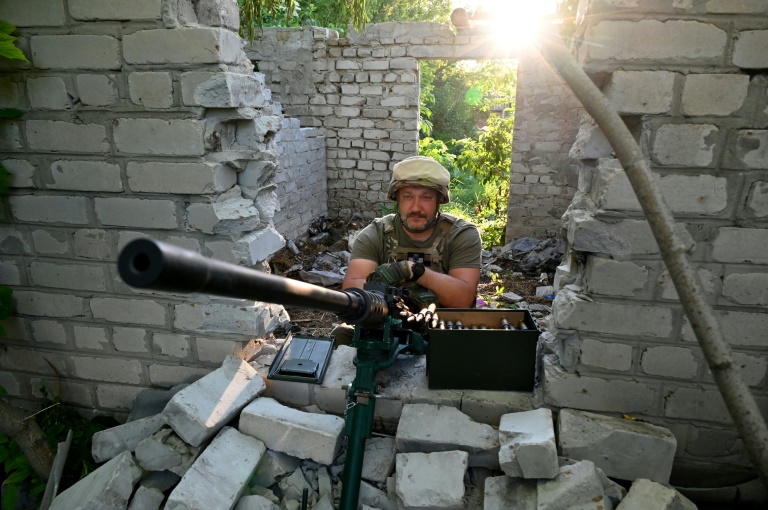
Zelensky reported continued “very difficult battles” including in the eastern Donbas region where Moscow has concentrated its firepower, especially around the eastern industrial city of Severodonetsk.

South-west of Severodonetsk, in the village of Soledar, a Ukrainian soldier who gave his name as Sergey was bullish.

“The enemy is very defiant, trying to go through our defence with small groups,” he told AFP from a field where a Ukrainian tank was hiding near some trees.

“But they of course fail, because our infantry units at the front are doing a good job at locating their advances from observation positions. We, of course, repel them.”

He added: “The truth is on our side, it’s our land that we are defending.”

However, in the Mykolaiv region near the front line in the south, regional governor Vitaliy Kim stressed the urgent need for international military assistance.

The US and other Western allies have provided huge amounts of weapons and cash to Ukraine to help it fend off its neighbour, while also punishing Moscow with economic sanctions.

But Kim said: “Russia’s army is more powerful, they have a lot of artillery and ammo. For now, this is a war of artillery… and we are out of ammo.

“The help of Europe and America is very, very important.”

Further north in Kharkiv, regional governor Oleg Synegubov said Ukrainian forces were making advances but accused Russian forces of targeting attacks on civilian targets.

– France offers Odessa help –

Shockwaves from the conflict have reverberated around the world, with fears mounting of a global food crisis. Before the war, Ukraine was an agricultural powerhouse and a major grain exporter.

An adviser to French President Emmanuel Macron said France was ready to assist in an operation to allow safe access to Ukraine’s Black Sea port of Odessa.

It has been subject to a de facto blockade by Russia, with grain waiting to be shipped.

France wants “victory for Ukraine”, the advisor added, after Macron sparked controversy recently by suggesting Russia should not be humiliated.

Moscow invaded Ukraine in February after weeks of warnings from the United States and its allies that Russia was planning an invasion.

US President Joe Biden said Friday that Zelensky had brushed off those warnings.

“There was no doubt and Zelensky didn’t want to hear it nor did a lot of people,” Biden said at a fundraiser. “I understand why they didn’t want to hear it.”

– ‘Shocking’ death sentences –

Western countries reacted this week with fresh outrage after pro-Kremlin separatist authorities in the Donetsk region of the Donbas sentenced to death Britons Aiden Aslin and Shaun Pinner, and Saadun Brahim of Morocco.

Germany’s foreign ministry said the “shocking” sentences show “once more Russia’s complete disregard for international humanitarian law”.

The United Nations warned that unfair trials of prisoners of war amounted to war crimes.

Ukrainian courts have handed three Russian soldiers long prison sentences at war crimes trials since the invasion.

Russia has repeatedly cautioned the West against getting involved in the conflict, with some officials warning of the risk of nuclear war.

The world’s chemical weapons watchdog said Friday it was keeping a close eye on Ukraine to monitor “threats of use of toxic chemicals as weapons”.

President Vladimir Putin has said that what Russia calls its special military operation is meant to “de-Nazify” Ukraine, suggesting he is merely taking territory back.

But US Defense Secretary Lloyd Austin issued scathing criticism of the invasion and its aims on Saturday.

“Russia’s invasion… (is) what happens when big powers decide that their imperial appetites matter more than the rights of their peaceful neighbours,” he said at the Shangri-La Dialogue security summit in Singapore.

“And it’s a preview of a possible world of chaos and turmoil that none of us would want to live in.”

burs-ar/yad

Iran, Venezuela sign two-decade cooperation deal: state media

Iran and Venezuela signed a 20-year deal on cooperation between the two allies subject to US sanctions during a visit Saturday to the Islamic republic by Venezuela’s President Nicholas Maduro.

The inking of the agreement “shows the determination of the high-level officials of the two countries for development of relations in different fields,” Iran’s President Ebrahim Raisi said.

Maduro, speaking at a joint news conference in the Iranian capital, said the cooperation covered the energy and financial sectors as well as “work together on defence projects”.

Alongside the likes of Russia, China, Cuba and Turkey, Iran is one of Venezuela’s main allies. And like Venezuela it is subject to tough US sanctions.

“Venezuela has passed hard years but the determination of the people, the officials and the president of the country was that they should resist the sanctions,” Raisi said during the news conference, quoted by state television.

“This is a good sign that proves to everyone that resistance will work and will force the enemy to retreat,” the Iranian president added.

In addition to the 20-year accord inked by the two countries’ foreign ministers, “Iran and Venezuela signed documents on cooperation in the political, cultural, tourism, economic, oil and petrochemical fields,” state news agency IRNA said.

“We have important projects of cooperation between Iran and Venezuela in the fields of energy, petrochemical, oil, gas and refineries,” Maduro said.

– Direct flights –

From July 18, direct flights would operate between Caracas and Tehran “in order to promote tourism and the union between our countries,” he said, adding that “Venezuela is open to receive tourists from Iran”.

Iran’s president also emphasised the importance of direct flights between the two capitals, saying it could pave the way for the enhancement of “trade and economic relations as well as bringing the two nations closer together”.

Bilateral ties between the two oil producers were strong under late Venezuelan socialist leader Hugo Chavez and have been further bolstered under his successor Maduro.

In May, Iran’s Oil Minister Javad Owji met with Maduro during an official visit to Venezuela, which sits on the world’s largest proven crude reserves.

Owji also met his Venezuelan counterpart Tareck El Aissami for talks on finding ways to deal with the economic sanctions imposed on both countries by the United States.

Owji’s visit to Venezuela, which sits on the world’s largest proven reserves of crude, came just weeks after a visit by United States officials in the midst of rising global oil prices due to the war on Ukraine.

In March, a US delegation held a hushed meeting with Maduro, whose very legitimacy as president Washington disputes.

Iran is a major oil producer and said in April that output capacity was back to levels before the reimposition of US sanctions under then president Donald Trump in 2018.

In 2020, Venezuela received two shiploads of fuel and derivatives from Iran to help address crippling domestic shortages.

Iran is the third country that Maduro has visited this week after trips to Turkey and Algeria.

WTO negotiators finalise key texts on fishing, Covid jabs

Long-sought WTO agreements on fisheries subsidies and a Covid vaccine patent waiver moved a step closer to completion Saturday after negotiators finalised texts for ministerial review, but significant obstacles remained in hammering out a final deal.

Diplomats have been in round-the-clock talks to hammer out texts on several thorny topics before the World Trade Organization’s first high-level meeting in five years, where trade ministers and officials from 164 countries have four days starting Sunday to try and get the negotiations across the finish line.

It takes place against the backdrop of the Ukraine-Russia war and fears of a global food crisis as a result of the conflict.

The global trade body announced in the early hours Saturday that a draft text on a long elusive deal banning subsidies favouring overfishing had been handed over to the ministers.

They will be tasked with ironing out the final sticking points towards a deal decades in the making.

The success of WTO’s 12th ministerial conference will largely hinge on whether they succeed.

“Not every issue has been resolved. Indeed, this is a draft agreement and in this draft there remain some issues that members have not agreed to yet,” acknowledged Colombian ambassador Santiago Wills, who chairs the WTO fisheries subsidies negotiations.

But he said months of intense negotiations had made it possible to present “a clean solution” to some issues that had long “appeared intractable”.

The WTO takes decisions by consensus, making agreements all the harder to reach.

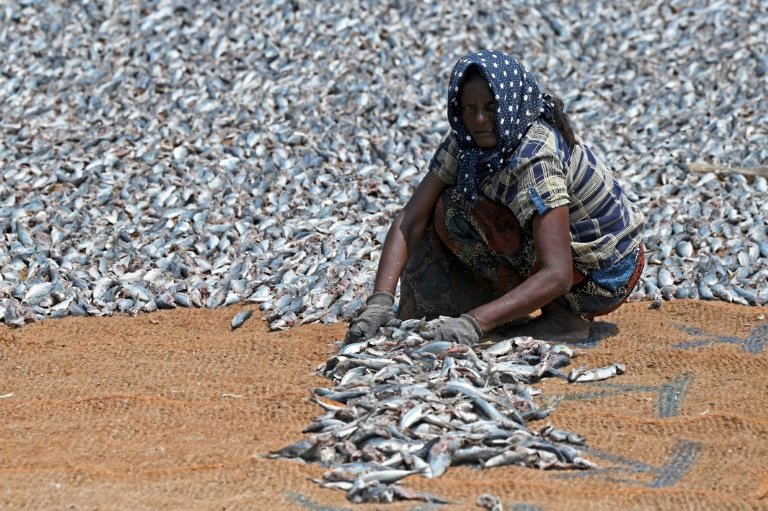
Global fisheries subsidies are estimated at between $14 billion and $54 billion a year, according to the body.

It is widely agreed that action is needed to protect a crucial resource that millions of people depend on for their livelihoods.

WTO members have for the past 20 years been discussing the need for a deal banning subsidies that contribute to illegal and unregulated fishing, as well as to overfishing.

– ‘Significant progress’ –

Wills noted “significant progress” on the tricky issue of “territoriality”, with the draft text ensuring that a WTO panel of experts would not be called upon to decide who has jurisdiction over disputed or overlapping territorial claims.

Progress had also been made on the issue of fuel subsidies, and on the so-called special and differential treatment (SDT) for developing countries, long a key stumbling block, he said, hailing a “considerable narrowing of differences”.

Special treatment for the poorest countries is widely accepted but demands from some self-identified developing countries for exemption from subsidy constraints, including large fishing nations like India, have been difficult to swallow for some.

The draft text proposes that exemptions should not apply to member states accounting for a certain share of the global volume of marine capture production but that percentage has yet to be defined.

Wills stressed the urgency of finally reaching a deal.

“The longer we wait, the more the fish lose. And the more the fish lose, the more we all lose,” he said.

The WTO also said a draft text had been finalised on the thorny issue of a temporary patent waiver for Covid vaccines to provide equitable access to the jabs and better battle the still raging pandemic.

But agreement is far from certain.

The pharmaceutical industry and a number of its host countries have warned of the impact on innovation, while public interest groups warned Saturday that the new text was so weak it might even complicate access to vaccine production further.

“It has been a very difficult process, very difficult,” acknowledged WTO chief Ngozi Okonjo-Iweala.

“I know that for all of you it has been a tough time but we have done the best we can for now.”

Fierce fighting in east Ukraine as Zelensky says world must not look away

Ukrainian President Volodymyr Zelensky said his country’s forces were “doing everything” to stop the Russian offensive, with fierce battles in the east and the south.

Kyiv said Friday it had launched new air strikes in the captured southern region of Kherson, one of the first areas to be taken by Russia after the February 24 invasion.

But Zelensky said Friday “very difficult battles” were ongoing, including in the eastern Donbas region where Moscow has concentrated its firepower, especially around the eastern industrial city of Severodonetsk.

“Ukrainian troops are doing everything to stop the offensive of the occupiers,” Zelensky said in an address.

“As much as the heavy weapons, modern artillery — all that we have asked and continue to ask our partners for — allow them to.”

In the Mykolaiv region near the front line in the south, the regional governor stressed the urgent need for international military assistance.

“Russia’s army is more powerful, they have a lot of artillery and ammo. For now, this is a war of artillery… and we are out of ammo,” Vitaliy Kim said.

“The help of Europe and America is very, very important because we just need ammo to defend our country.”

Zelensky said in his address that Ukraine must “not allow the world to divert its attention away from what is happening on the battlefield”.

In the town of Lysychansk, located just across a river from Severodonetsk, people told AFP about their stark choice: stay and brave the shelling, or flee and abandon their homes. 

Yevhen Zhyryada, 39, said the only way to access water was by heading to a water distribution site in the town.

“We have to go there under shelling, and under fire,” he said.

“This is how we survive.”

– ‘Victory for Ukraine’ –

Shockwaves from the conflict have reverberated around the world, with fears mounting of a global food crisis — Ukraine is an agricultural powerhouse and a major grain exporter.

An adviser to French President Emmanuel Macron said France was ready to assist in an operation to allow safe access to Ukraine’s Black Sea port of Odessa.

It has been subject to a de facto blockade by Russia, with grain waiting to be shipped.

France wants “victory for Ukraine”, the advisor added, after Macron sparked controversy recently by suggesting Russia should not be humiliated.

Moscow poured its troops across the border into Ukraine on February 24 after weeks of warnings from the United States and its allies that Russia was planning an invasion.

US President Joe Biden said Friday that Zelensky had brushed off those warnings.

“There was no doubt and Zelensky didn’t want to hear it nor did a lot of people,” Biden said at a fundraiser. “I understand why they didn’t want to hear it.”

The war has devastated Ukrainian cities and displaced millions, while putting European nations on edge.

Nine of them — Bulgaria, the Czech Republic, Estonia, Hungary, Latvia, Lithuania, Poland, Romania and Slovakia — urged NATO on Friday to beef up its eastern flank.

– ‘Shocking’ death sentences –

Western countries reacted this week with fresh outrage after the pro-Kremlin separatist authorities in the Donetsk region of the Donbas sentenced to death Britons Aiden Aslin and Shaun Pinner, and Saadun Brahim of Morocco.

Germany’s foreign ministry said the “shocking” sentences show “once more Russia’s complete disregard for international humanitarian law”.

The United Nations warned that unfair trials of prisoners of war amounted to war crimes.

Zelensky separately praised British leadership and its support for Kyiv’s fight against Russia during an unannounced visit from UK Defence Secretary Ben Wallace.

“Weapons, finance, sanctions — on these three issues, Britain shows leadership,” Zelensky said in a video statement.

Kyiv has been critical of countries — including Germany and France — for the slow delivery of aid and for giving too much credence to negotiations with Russia’s President Vladimir Putin.

– Not ‘artificially created’ –

Russia has repeatedly cautioned the West against getting involved in the conflict, with some officials warning of the risk of nuclear war.

The world’s chemical weapons watchdog said Friday it was keeping a close eye on Ukraine to monitor “threats of use of toxic chemicals as weapons”.

Putin has said that what Russia calls its special military operation is meant to “de-Nazify” Ukraine, suggesting he is merely taking territory back.

But speaking to British university students via video link, Zelensky said Friday that Russia’s claim that Ukraine was “artificially created” was as preposterous as stating Ukrainians were “not humans but a variety of plants or a species of animals”.

burs-qan/lb

Close Bitnami banner
Bitnami