US Business

Resurging US inflation puts Fed on track for more big rate hikes

Red-hot US inflation is showing few signs of cooling, putting the Federal Reserve on track to continue its aggressive interest rate increases to help cool high prices that are challenging Joe Biden’s presidency.

The hoped-for signs of relief for American families did not materialize in May as consumer prices hit a new four-decade high, rising 8.6 percent and topping what economists thought was the peak in March.

With Russia’s war on Ukraine continuing to pressure global fuel and food prices, and amid ongoing supply chain uncertainties due to Covid-19 lockdowns in Asia, analysts now say the expected easing of inflationary pressures will take much longer to materialize.

The US central bank already had signaled plans for more big increases in the benchmark borrowing rate this week and next month, but chances are rising that the Fed might have to be even more aggressive — which increases the risk the economy might tip into a recession.

The latest inflation report — the last major data point before the Fed’s policy meeting Tuesday and Wednesday — also douses hopes central bankers will be able to call a ceasefire in September ahead of key congressional elections, where Biden’s Democrats are widely expected to suffer damaging losses.

Prices continued to rise last month for a range of goods, including housing, groceries, airline fares and used and new vehicles, setting new records in multiple categories, according to the Labor Department data.

Energy has soared 34.6 percent over the past year, the fastest since September 2005, while food jumped 10.1 percent, and the cost of fuel oil more than doubled, jumping 106.7 percent, the largest increase in the history of CPI, which dates to 1935.

The CPI surge “raises the probability of even more aggressive Fed rate hikes to tamp down on inflationary expectations,” said Mickey Levy of Berenberg Capital Markets

If the policy-setting Federal Open Market Committee decides on a giant step — three quarters of a point rather than the expected half-point increase — it would be the first 75 basis point rate hike since November 1994.

Diane Swonk of Grant Thornton indicated such a move is possible. 

“They are behind the curve and eager to catch up,” she said on Twitter. “Fed has to reduce demand to meet a supply-constrained world. Ugly in many ways.”

Economists at Barclays are now calling for a 0.75-point increase, though Ryan Sweet at Moody’s says chances are low, and Karl Haeling at LBBW expects three more half-point hikes.

– Political considerations? –

Biden is facing growing political backlash as high prices increase the pain for American families, who are seeing daily records at the gas pump and higher grocery bills due to the fallout from Russian leader Vladimir Putin’s invasion of Ukraine.

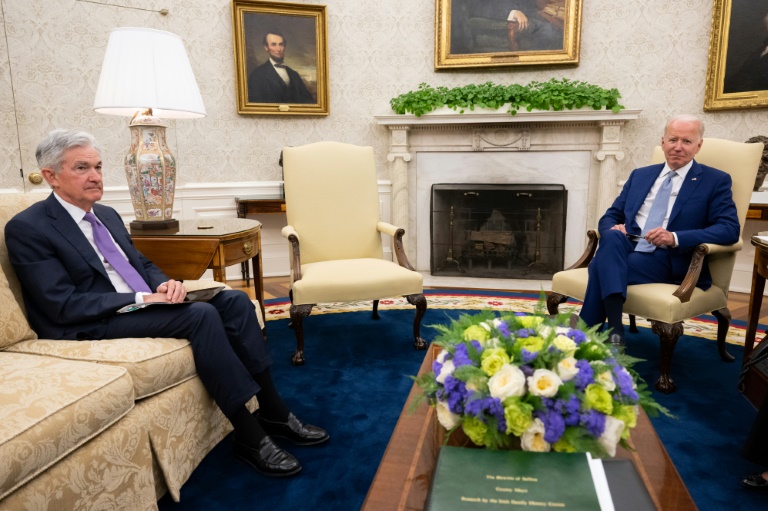
Unlike his predecessor Donald Trump, who relentlessly attacked the Fed and its chair Jerome Powell, Biden has publicly endorsed the central bank’s efforts.

Biden, who blames “Putin’s Price Hike” for the acceleration in inflation, said Washington “must do more — and quickly — to get prices down here in the United States.” 

Hoping to avoid a devastating setback in November elections that could return control of the legislature to opposition Republicans, Biden has urged Congress to approve legislation to bring down costs of key products such as medicines and services such as shipping to soften the blow for US consumers.

Some analysts had speculated that Powell might call for a timeout in the interest rate moves at the FOMC’s September meeting, but economist Levy echoed the prevailing view that a pause in rate hikes is now “looking increasingly unlikely.”

Powell has always insisted that central bankers eschew political considerations and focus on what’s best for the economy.

The Fed, which has already acknowledged that slowing demand will entail some pain, is hoping to cool price pressures without choking off economic growth — but that is looking increasingly difficult.

Gita Gopinath, the number two at the International Monetary Fund, last week said US central bankers are treading an “incredibly narrow path” to achieve a soft landing and avoid a sharp increase in unemployment.

“It will be a real challenge to bring down inflation… without turbulence,” she said at a Financial Times conference, adding that it could “require much steeper increases in rates.”
Price spike: Higher fuel prices test US economy

Surging energy costs are being felt across the US economy with varying effects. Some consumers are absorbing higher costs, while others are shifting behavior or cutting back.

Here’s a sampling of how the story is playing out in different sectors.

– Trucker sees austerity –

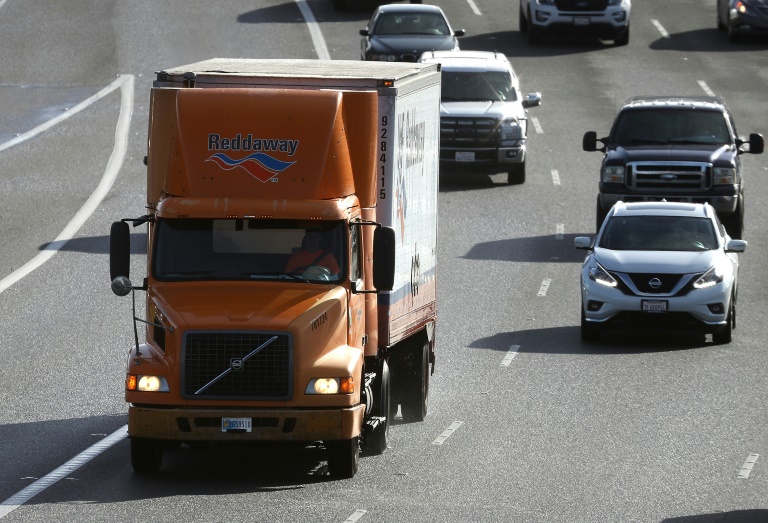
As he contends with surging fuel prices, truck driver Lamar Buckwalter sees signs all around that consumers are cutting back. 

Demand for refrigerated pet food — a torrid business just three months ago — has virtually disappeared. Humans are also shifting their own diets, ordering less high-end meats like veal and crab cakes.

“People are starting to cut off the extras,” said Buckwalter, a third-generation trucker who lives in Pennsylvania. “They’re not buying filet mignon steak.”

The last time he fueled up, Buckwalter spent $5.79 a gallon for diesel, more than double the price from a year ago, a shift exacerbated by lower job rates as demand for trucking services cools.

Mitigating things a bit is Buckwalter’s membership in a national small trucker association that offers discounted fuel. He can also pass on a fraction of the fuel price spike to consumers.

But the pain from fueling up is “enough to make a preacher man curse,” said Buckwalter, who has been turning down trips that pay insufficiently.

He is also planning to tighten the belt on perks for his three employees, such as a summer family picnic. 

“We’ll still do Christmas bonuses,” he said. “Unfortunately, I have to cut back where I can.”

– Tough times for taxis –

Also taking a hit is Rutz Alliance, a New York taxi driver who feels the pinch daily.

“I used to put $25 of gas every day,” Alliance told AFP. “Now it’s up to $45.”

That computes to weekly pay of about $600 to $650, one-third less than the pre-pandemic amount.

“We’re trying to live. We have no choice. Inflation is all over. Rent, food, everything, but it’s take it or leave it.”

Dubbing the jump in prices an “emergency,” the New York Taxi Workers Alliance called in March for a 75-cent temporary fuel surcharge. But city officials have not taken action thus far.

– Airlines pass on the pain –

Airlines have been among the sectors most directly affected by spiking energy prices, with jet fuel prices jumping almost 50 percent since mid-March, according to Argus.

That would normally amount to a huge drag on the industry, given that fuel and labor are two major sources of costs.

“The rule of thumb in this industry is that you can pass through two-thirds of a fuel price increase within three to six months, the full amount within six to 12 months,” said Savanthi Syth, an industry expert at Raymond James. 

But in a twist of fortunes in a pandemic-dominated era, airlines are benefitting from “pent-up demand” of consumers desiring travel after more than two years of being hemmed in.

Airline tickets are currently up 38 percent compared with the level of the year prior, with industry executives saying they are having no trouble passing on the hit from higher fuel costs.

– A higher bar on vacations –

For Chayzz Devyant, one casualty of spiking gasoline prices has been a summer visit to Atlantic City.

Just traveling back and forth to the casino town would cost some $162 in gas, on top of lodging costs.

“Big Oil is to blame,” said Devyant, who hopes to work from home to save on fuel costs. 

But travel experts still expect a busy summer even if more consumers like Devyant cut some trips.

“We are seeing mixed messages. Oil prices obviously have an effect,” said Aaron Szyf, economist for the US Travel Association.

“But pent up demand is so high that hotels/attractions/national parks/flights are all expected to be at full capacity this summer.”

– Electric vehicles get a closer look –

Higher gasoline prices have prompted greater interest from consumers in electric vehicles (EV). Since January, website visits to EV options have soared 73 percent, according to Cox Automotive.

However, the share of visits to EVs remains a relatively small 5.7 percent of overall page views, according to Cox.

Moreover, the shortage of semiconductors and other key supplies has left car dealerships with limited inventories, crimping sales. 

In May, Toyota and Lexus sold 46,000 hybrid vehicles, down 17 percent from the year-ago period amid tight supplies.

At Tesla, the top-selling EV maker in the United States, the wait time is at least three months for delivery of a Model 3 and six for the Model Y.

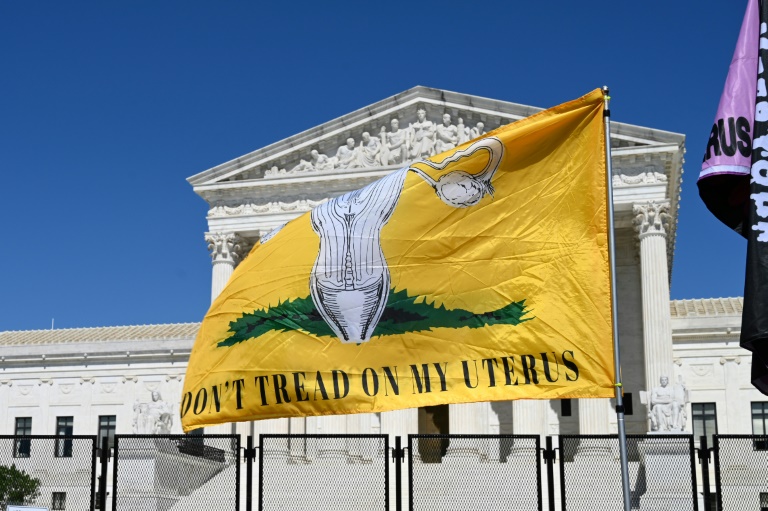
US abortion rights advocates, opponents brace for court decision

Odile Schalit is preparing for “the worst.”

Schalit is the executive director of The Brigid Alliance, an organization that helps women in the United States who are forced to travel long distances to obtain an abortion.

And with the Supreme Court poised to potentially restrict abortion access, her group’s services may soon be more essential than ever.

A draft opinion leaked in May would have the conservative majority on the nine-member court overturn Roe v. Wade, the 1973 landmark decision allowing nationwide access to abortion.

The final ruling on the highly contested issue is expected by June 30.

In the meantime, both defenders and opponents of abortion are engaged in preparations for what is being called the “post-Roe world.”

“I’ve stopped assuming that the worst won’t happen,” Schalit told AFP.

The Brigid Alliance organizes and finances trips for women seeking abortions after the first trimester.

That often involves travel from states with strict abortion laws to other states.

“We’re adding more staff. We’re doing outreach,” Schalit said. “We’re reaching out and trying to grow our donor base.

“We’re really doubling down on all of those efforts.”

The Brigid Alliance currently employs 10 people full-time and assists some 125 women a month. It hopes to boost that number to 200 a month by adding six more employees.

Even then, Schalit said, and despite an increase in donations, “we will not be able to meet the need of every single person needing our services.”

– ‘Trigger’ laws –

Twenty-two of the 50 US states, mostly in the conservative South of the country, are prepared to ban abortion if the Supreme Court goes ahead and overturns Roe v. Wade.

According to the Guttmacher Institute, nine states, including Arizona and Michigan, have pre-1973 laws banning abortion on the books that they could immediately revive.

Others have so-called “trigger” laws that would go into force virtually automatically if the Supreme Court goes ahead and restricts abortion rights.

Iowa, Georgia, Ohio and South Carolina are among the states that have passed laws restricting abortion after six weeks, before many women even know they are pregnant.

While currently blocked by the courts, those laws could take effect if the Supreme Court changes the legal landscape.

Democratic-ruled states, where abortion would remain legal, are preparing, meanwhile, for an influx of women seeking abortions.

Connecticut and Delaware, for example, have expanded the categories of professionals who are authorized to carry out abortions to include nurses and midwives.

Lawmakers in California have allocated $152 million to assist access to abortion and the governor of New York has pledged $35 million.

Planned Parenthood, which performs more than one-third of the 850,000 annual abortions in the United States, is reinforcing its network in places such as Colorado and Illinois, which border states where the procedure may be banned.

Ordinary citizens are also mobilizing — and have been for a while.

Since May 2019, the online discussion platform Reddit has hosted a group called the “Aunties” which offers assistance and anonymity to women seeking an abortion.

Since last month, the number of users has exploded from just 45 to more than 75,000.

A retired woman in her 60s in Tennessee was among those offering to help on Reddit, saying she could drive abortion-seekers to neighboring states.

“It’s amazing,” Schalit said. “More hands is phenomenal.”

At the same time, she said she would prefer that volunteers “consider instead connecting with pre-existing organizations like ours, to build out what already exists.”

Abortion opponents have opened their own “crisis pregnancy centers” during the past few years where they seek to persuade women seeking abortions not to go through with the procedure.

Abortion pills, which account for about half of the abortions in the United States, are another battleground.

Easily available through the internet from sites abroad, the pills can be used without significant risk up until 10 weeks of pregnancy.

Several conservative US states, including Kentucky and South Dakota, have sought to cut off access to the pills by banning their delivery through the mail.

Biden faces uphill climb to restore US clout in Latin America

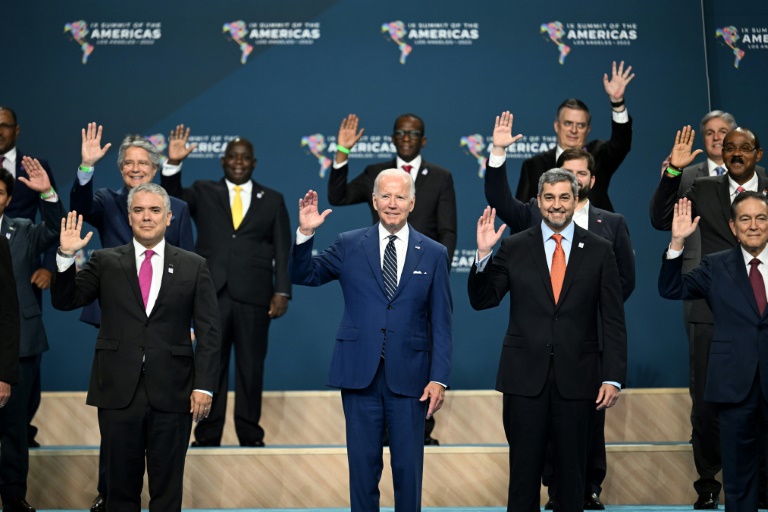
President Joe Biden made a forceful pitch to reassert US influence in Latin America through a weeklong summit in Los Angeles but the modesty of his promises will test his efforts at a time when China is making rapid inroads. 

Some two dozen leaders came together for the Summit of the Americas where Biden and the rest of the top US brass pledged to do more with them on migration, clean energy and health infrastructure — and charmed guests with glitzy receptions befitting Tinseltown. 

Biden said that the Americas should be the “most forward-looking, most democratic, most prosperous, most peaceful, secure region in the world.”   

“No matter what else is happening in the world, the Americas will always be a priority for the United States of America,” Biden said. 

But Biden also faced a boycott by Mexican President Andres Manuel Lopez Obrador and open criticism from several leaders including over the decades-old pressure campaign on Cuba and on whether he would follow through on promises. 

The United States next year marks two centuries since it declared Latin America its exclusive sphere under the Monroe Doctrine and cultural ties run deep.

But China — identified by Washington as its top global competitor — has quickly become the second largest commercial partner in Latin America and the biggest for South America, which has shipped commodities including soybeans and oil to the billion-plus market across the Pacific. 

The fast-growing communist power has lent some $150 billion to Latin America since 2005, about half to Venezuela, offering no political conditions but putting some nations into what critics call a debt trap.

– Modest scope –

Biden at the summit pitched a hemisphere-wide economic “partnership” that will discuss common standards but not directly commit funding or new market access. 

The political mood in the United States has soured over free trade and — despite Biden extolling the democratic model — bitter polarization makes few ambitious initiatives realistic in Congress. 

“It was a mistake to convene a summit with little to offer,” said Christopher Sabatini, a senior fellow at Chatham House. 

“This idea that the hemisphere, because of its proximity, shares the same principles and goals is over,” he said. “The United States doesn’t have the capacity to offer many advantages.”

Jake Sullivan, Biden’s national security advisor, insisted that lavishing state funds was never the US playbook. And the United States already has free-trade deals with a number of Latin American nations including Mexico, Colombia and Chile. 

In one effort to challenge China’s model, Secretary of State Antony Blinken said the administration would push “fundamental reforms” in the Inter-American Development Bank, to which Washington is the largest donor, so it can assist middle-income nations not poor enough for concessionary loans.

Ryan Berg, a senior fellow at the Center for Strategic and International Studies, said that US influence has been sinking in Latin America for the past decade.

The reason is “mostly self-inflicted — a lack of attention to the region, taking the region for granted as a source of stability and prosperity, and an inability to marshal the resources and creativity necessary for a comprehensive, meaningful alternative to China’s development financing.” 

If Cuba has long been a thorn in the US relationship with Latin America, it would have been unthinkable until recently for the president of Mexico not to attend a US-led summit. 

Lopez Obrador boycotted over Biden’s refusal to invite the leftist leaders of Cuba as well as Venezuela and Nicaragua on the grounds that they are authoritarians. 

– Show of commitment –

While insisting the summit is only for democracies, Biden reached out to leaders across the political spectrum, building ties with the left-leaning presidents of Argentina and Chile but meeting for the first time with Brazil’s controversial far-right president, Jair Bolsonaro.

Jason Marczak, who heads the Latin America center at the Atlantic Council, said that attendance was more robust than at the last Summit of the Americas in 2018 in Peru, which then US president Donald Trump did not attend. 

“Pre-summit drama is one of the few consistencies” in the Summits of the Americas, he said. 

He credited Biden with addressing Latin America’s interests but said, “Many of the announcements require additional action and it’s going to be super important that action is a priority.”

Senator Tim Kaine, a member of Biden’s Democratic Party with long experience in Latin America, said the administration showed its commitment through the summit. Complaints about particular US policies, he said, are routine at regional gatherings.

“But I’ll tell you what stays — when people say you’re not present,” Kaine said.

Thousands of protesters demand action on US gun violence

Thousands of people took to the streets in the United States on Saturday to push for action on the devastating gun violence plaguing the country, where Republican politicians have repeatedly blocked efforts to enact stricter firearms laws. 

Protesters of all ages streamed onto the National Mall in Washington, where activists placed more than 45,000 white vases holding flowers — one for each person killed by a firearm in the United States in 2020.

“Protect People Not Guns,” said one sign held by a protester near the Washington Monument. “Fear Has No Place In Schools,” read another.

Two horrific shootings last month — one at a Texas elementary school that killed 19 children and two teachers, and another at a New York supermarket that left 10 Black people dead — helped spur the rallies, organized by March For Our Lives.

The student-led organization, founded by survivors of a shooting at a high school in Parkland, Florida, held a rally that drew hundreds of thousands of people to the nation’s capital in March 2018.

Four years later, the demonstration was marked by frustration at the lack of progress. 

“Enough is enough” rang out repeatedly from the podium, with speakers including Parkland survivor X Gonzalez and Martin Luther King Jr’s granddaughter Yolanda King.

“We are here to demand justice,” said Garnell Whitfield, whose 86-year-old mother was killed in the racially motivated supermarket shooting in Buffalo, New York on May 14. 

“We are here to stand with those who are bold enough to demand sensible gun legislation.”

– Widespread outrage, little change –

The problem of gun violence in the United States — which has killed more than 19,300 people so far this year, according to the Gun Violence Archive — goes far beyond high-profile mass killings, with more than half of those deaths due to suicide.

Outside of Washington, hundreds of other demonstrations were planned around the country Saturday, including in Parkland, where protesters carried signs with messages such as “Am I Next?”

Thousands also turned out in New York City. In Brooklyn, white crosses were erected for the children killed in Uvalde and portraits of those killed in Buffalo fastened to shopping carts. 

Ease of access to firearms, and mental health problems that can lead to them being used in attacks, have both been in the spotlight in the wake of the May 24 shooting at Robb Elementary School in Uvalde, Texas.

The massacre was carried out by a gunman who bought two assault rifles shortly after turning 18.

Gun control advocates are calling for tighter restrictions or an outright ban on such rifles. But opponents have sought to cast mass shootings as primarily a mental health issue, not a weapons problem.

Gerald Mendes, a physical education teacher in Texas who joined the rally in New York said he supports the US constitutional right to bear arms, but that “as far as AR-15s and weapons of war, we regular citizens don’t need those.”

The majority of Americans support tighter gun laws, but opposition from many Republican lawmakers has long been a hurdle to major changes.

“The will of the American people is being subverted by a minority,” said Cynthia Martins, a 63-year-old resident of the US capital, referring to the Republican Party.

“There’s a reason that we’re still in this situation,” she said.

– ‘Fear that we live with everyday’ –

Some lawmakers are trying to pass gun regulations.

The Democrat-controlled House of Representatives passed a broad package of proposals this week that included raising the purchasing age for most semi-automatic rifles from 18 to 21 — but the party does not have the requisite 60 votes to advance it in the Senate.

A cross-party group of senators has also been working on a narrow collection of controls that could develop into the first serious attempt at gun regulation reform in decades.

But it does not include an assault weapons ban or universal background checks, meaning it will fall short of the expectations of President Joe Biden.

Faith Barrett, a teacher who traveled to the rally with her daughter, also a teacher, voiced the frustration shared by many on the Mall. 

“We’re still back in the same place,” the 47-year-old said, voicing only “tentative” hope change would come.  

Both she and her daughter have plans in place in case of a shooting at their school. 

“Most teachers look at every single classroom they go into and think, where am I going to put my kids if something happens,” Barrett said. 

The spectre of gun violence also hung over the rally, where police and security forces had a heavy presence.

A moment of silence for the Uvalde victims was shaken by a brief panic when a disturbance near the stage sent people sprinting away in terror.

While the crowd quickly calmed and the man creating the disturbance was detained, with Park Police telling local media no weapons were found, some were left in shock and tears.

Fred Guttenberg, the father of a Parkland victim, took to the podium to ease the crowd.

“Unfortunately somebody decided to show up and put the fear that we live with everyday to life.”

US judge dismisses rape suit against football star Ronaldo

A US district judge has dismissed a rape lawsuit against football superstar Cristiano Ronaldo, castigating the legal team behind the complaint.

Judge Jennifer Dorsey threw out the case brought by Kathryn Mayorga, a former model and teacher, who alleged she was assaulted by the Portuguese soccer star in a Las Vegas hotel room in 2009.

The 37-year-old Manchester United player has always denied the allegations and maintained that the relationship with Mayorga was completely consensual.

In a 42-page ruling released Friday, the judge accused Mayorga’s attorneys of “abuses and flagrant circumvention of the proper litigation process” and said that as a result, “Mayorga loses her opportunity to pursue this case.”

Her attorneys had actually moved to dismiss the case voluntarily last month, US media said, but Dorsey decided that their repeated use of illicitly obtained confidential documents meant the case had to be dismissed “with prejudice” — meaning it cannot be revived.

“Nothing less than a with-prejudice dismissal will purge the taint that has permeated this case from its very inception and preserve the integrity of the litigation process,” Dorsey wrote.

A criminal case based on the rape allegation against the Manchester United forward was dropped in 2019, with a district attorney saying it “cannot be proven beyond a reasonable doubt” that a sexual assault occurred.

But Mayorga, who waived her right to anonymity, also took up a civil action seeking millions in damages.

She filed a complaint in 2018 alleging she was sexually assaulted by Ronaldo, who strongly denied the accusations.

Mayorga said that while she had agreed to a financial settlement with Ronaldo shortly after the alleged incident — reportedly for $375,000 — her emotional trauma at the time did not allow her to participate in the mediation process.

But in trying to revive the case, Dorsey found, Mayorga’s lawyer Leslie Stovall made repeated use of “cyber-hacked attorney-client privileged documents.”

Those documents included “internal emails between Ronaldo’s lawyers discussing settlement strategies and potential liability” and were “emblazoned with notices that their contents contain attorney-client communications,” the judge wrote.  

Stovall’s use of the documents was “bad faith,” the judge ruled, “and simply disqualifying Stovall will not cure the prejudice to Ronaldo, because the misappropriated documents and their confidential contents have been woven into the very fabric of Mayorga’s claims.”

Ronaldo is one of the biggest stars of world football and is a five-time winner of the Ballon d’Or award for the world’s best player.

He told Portuguese television in 2019 that the allegations had led to “the most difficult year” he had known.

Thousands demonstrate for action on US gun violence

Thousands of people took to the streets in the United States on Saturday to push for action on the devastating gun violence plaguing the country, where Republican politicians have repeatedly blocked efforts to enact stricter firearms laws.   

Protesters of all ages streamed onto the National Mall in Washington, where a gun violence prevention group placed more than 45,000 white vases holding flowers — one for each person killed by a firearm in the United States in 2020.

“Protect People Not Guns,” said one sign held by a protester near the Washington Monument. “Fear Has No Place In Schools,” read another.

Two horrific shootings last month — one at a Texas elementary school that killed 19 young children and two teachers, and another at a New York supermarket that left 10 Black people dead — helped spark the call for the protests.

But the problem of gun violence — which has killed more than 19,300 people so far this year in the United States, according to the Gun Violence Archive — goes far beyond high-profile mass killings, with more than half of those deaths due to suicide.

“The will of the American people is being subverted by a minority,” said Cynthia Martins, a 63-year-old resident of the US capital, referring to the Republican Party.

She carried a sign that used the party’s “GOP” moniker to spell out “Guns Over People.” 

“There’s a reason that we’re still in this situation and there’s still mass shootings,” Martins said, adding: “Hand wringing is not going to do anything — you have to make your voice heard.”

Garnell Whitfield, whose 86-year-old mother was killed in the racially motivated supermarket shooting in Buffalo, New York on May 14, spoke from a stage at the Washington protest.

“We are here to demand justice,” Whitfield said. “We are here to stand with those who are bold enough to demand sensible gun legislation.” 

The protests were organized by March for Our Lives, which was founded by survivors of a shooting at a high school in Parkland, Florida, who held a rally that drew hundreds of thousands of people to the nation’s capital in March 2018.

Demonstrators marched in Parkland on Saturday, carrying signs with messages such as “Am I Next?” and “Books Not Bulletproof Backpacks.”

– Widespread outrage, little change –

Protesters also turned out in New York City, with demonstrations planned at hundreds of locations around the country.

Ease of access to firearms, and mental health problems that can lead to them being used in attacks, have both been in the spotlight in the wake of the May 24 shooting at Robb Elementary in Uvalde, Texas.

The massacre was carried out by a gunman who bought two assault rifles shortly after turning 18.

Gun control advocates are calling for tighter restrictions or an outright ban on such rifles, one of which was also used in Buffalo. But opponents of tougher regulations have sought to cast mass shootings as primarily a mental health issue, not a weapons problem.

Frequent mass shootings have led to widespread outrage in the United States, where a majority of people support tighter gun laws, but opposition from many Republican lawmakers has long been a hurdle to major changes.

The Democrat-controlled House of Representatives passed a broad package of proposals this week that included raising the purchasing age for most semi-automatic rifles from 18 to 21, but the party does not have the requisite 60 votes to advance it in the Senate.

A cross-party group of senators has also been working on a narrow collection of controls that could develop into the first serious attempt at gun regulation reform in decades.

The package would boost funding for mental health services and school security, narrowly expand background checks, and incentivize states to institute so-called “red flag laws” that enable authorities to confiscate weapons from individuals considered a threat.

But it does not include an assault weapons ban or universal background checks, meaning it will fall short of the expectations of President Joe Biden, progressive Democrats and anti-gun violence activists.

US judge dismisses rape suit against football star Ronaldo

A US district judge in Las Vegas has dismissed a rape lawsuit against football superstar Cristiano Ronaldo, castigating the legal team behind the complaint.

Judge Jennifer Dorsey threw out the case brought by Kathryn Mayorga of Nevada, who alleged she was assaulted by the Portuguese soccer star in a Las Vegas hotel room in 2009.

In a 42-page ruling released Friday, the judge accused Mayorga’s attorneys of “abuses and flagrant circumvention of the proper litigation process” and said that as a result, “Mayorga loses her opportunity to pursue this case.”

Her attorneys had actually moved to dismiss the case voluntarily last month, US media said, but Dorsey decided that their repeated use of illicitly obtained confidential documents meant the case had to be dismissed “with prejudice” — meaning it cannot be revived.

“Nothing less than a with-prejudice dismissal will purge the taint that has permeated this case from its very inception and preserve the integrity of the litigation process,” Dorsey wrote.

Mayorga filed a complaint in September last year alleging she was sexually assaulted by Ronaldo, who strongly denied the accusations.

Mayorga said that while she had agreed to a financial settlement with Ronaldo shortly after the alleged incident — reportedly for $375,000 — her emotional trauma at the time did not allow her to participate in the mediation process.

But in trying to revive the case, Dorsey found, Mayorga’s lawyer Leslie Stovall made repeated use of “cyber-hacked attorney-client privileged documents.”

That use of the documents was “bad faith,” the judge ruled, “and simply disqualifying Stovall will not cure the prejudice to Ronaldo, because the misappropriated documents and their confidential contents have been woven into the very fabric of Mayorga’s claims.”

Ronaldo is one of the biggest stars of world football and is a five-time winner of the Ballon d’Or award for the world’s best player.

In Kyiv, EU chief says to give signal on Ukraine's hopes next week

The European Commission will provide a clear signal next week on Ukraine’s EU candidate status bid, its chief Ursula von der Leyen said Saturday, as fighting raged in the east and south of the country.

Making a surprise visit to Kyiv, von der Leyen said talks she held with Ukrainian President Volodymyr Zelensky “will enable us to finalise our assessment by the end of next week” — the first time the bloc has publicly given a timing.

Zelensky has been pressing for rapid admission into the European Union as a way of reducing Ukraine’s geopolitical vulnerability, which was brutally exposed by Russia’s February 24 invasion.

But officials and leaders in the bloc caution that, even with candidacy status, actual EU membership could take years or even decades.

Von der Leyen, appearing alongside Zelensky during her second visit to Kyiv since the war began, did not hold out any promises, noting further reforms were needed.

The Ukrainian president warned it was a “decisive time” for his country and the EU.

“Russia wants to ruin the European unity, wants to leave Europe divided and wants to leave it weak. The entire Europe is a target for Russia. Ukraine is only the first stage in this aggression, in these plans,” he said.

Despite reservations among some member states, EU leaders are expected to approve Ukraine’s candidate status at a summit on June 23-24, though with stern conditions attached.

– Crisis and famine –

The European Union and the United States have strongly backed Ukraine, sending weapons and cash to help it see off Russian forces, and punishing Moscow with unprecedented economic sanctions.

Zelensky has urged them on during a diplomatic offensive that has seen him regularly appear via video link at various parliaments and summits around the world.

Addressing the Shangri-La Dialogue security summit in Singapore on Saturday, he highlighted the dangers of a global food crisis posed by Russia’s blockade of Ukraine’s Black Sea ports.

He warned of “an acute and severe food crisis and famine”, adding that the “shortage of foodstuffs will inexorably lead to political chaos” — all of it “the direct consequence of the acts of the Russian state”.

Before the war, Russia and Ukraine produced 30 percent of the global wheat supply, but grain is stuck in Ukraine’s ports — while Western sanctions on Moscow have disrupted exports from Russia.

Speaking to delegates including Pentagon chief Lloyd Austin and China’s defence minister, Zelensky urged international pressure to end the blockade.

Russian Foreign Minister Sergei Lavrov and his Turkish counterpart held talks this week in Ankara on securing safe passage for Ukrainian grain exports, but the discussions made little headway. 

– ‘Devastate every city’ –

After withdrawing from the capital Kyiv, Russian forces have concentrated their firepower on the eastern Donbas region and the south.

They continued their bombardment of towns and villages around Kharkiv and in the Donbas regions of Lugansk and Donetsk overnight to Saturday, Zelensky’s office said.

“Russia wants to devastate every city in the Donbas, every single one, without exaggeration,” the president said in his nightly address Friday.

Moscow has particularly focused on the key eastern industrial city of Severodonetsk, which Lugansk regional governor Sergiy Gaiday said Saturday was “ruined” by Russian forces.

“This is their tactics — people are not needed, the infrastructure is not needed, houses are not needed, everything should be simply ruined,” he said in an interview posted on his Telegram channel.

He declined to estimate the number of civilian victims, but said he expected the figure would be “enormous and terrible”. 

In the Mykolaiv region near the front line in the south, regional governor Vitaliy Kim stressed the urgent need for international military assistance.

“Russia’s army is more powerful, they have a lot of artillery and ammo. For now, this is a war of artillery… and we are out of ammo,” he said.

For residents living in Mykolaiv, every day brings a brush with death.

Igor Karputov, 31, recalled how his neighbourhood was hit last week, shaking his apartment, and he helped a bleeding man while he waited for an ambulance.

“Then I went to another place which had been hit, where emergency services were already taking care of someone,” he told AFP.

“But they were dead. And the one I had helped died in an ambulance.”

– Russian passports issued –

In areas now controlled by its forces, Moscow has sought to impose its authority.

Authorities in the occupied city of Kherson in southern Ukraine handed out Russian passports to local residents for the first time on Saturday, news agencies reported.

Russia’s TASS agency said 23 Kherson residents received a Russian passport at a ceremony through a “simplified procedure” facilitated by a decree signed by Russian President Vladimir Putin in May.

Ukraine has denounced the move as a “flagrant violation” of its territorial integrity, saying Putin’s decree was “legally void”.

It follows the introduction last month in the Kherson region of the Russian ruble as an official currency alongside the Ukrainian hryvnia.

burs-ar/ah

Sanctions-hit Iran, Venezuela sign 20-year cooperation deal

Iran and Venezuela signed a 20-year deal on cooperation between the two allies subject to US sanctions during a visit Saturday to the Islamic republic by Venezuelan President Nicolas Maduro.

The inking of the agreement “shows the determination of the high-level officials of the two countries for development of relations in different fields,” Iranian President Ebrahim Raisi said.

Maduro, speaking at a joint news conference in Tehran, said the cooperation covered the energy and financial sectors, as well as “work together on defence projects”.

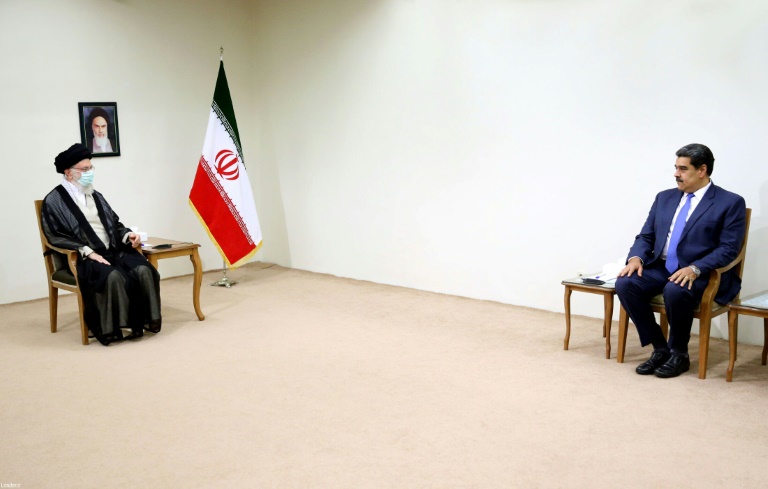
Maduro also met Iran’s supreme leader Ayatollah Ali Khamenei, who said that “resistance” is the way to confront US pressure.

“The conclusion that can be drawn from the resistance and success of the two nations of Iran and Venezuela is that the only way against pressure is to stand and resist,” Khamenei said.

Khamenei welcomed the agreement, and called for “stronger” cooperation between Tehran and Caracas, according to a statement on his official website.

“The Islamic Republic of Iran has shown that it takes risks in times of danger and takes the hands of its friends,” he added.

Alongside the likes of Russia, China, Cuba and Turkey, Iran is one of Venezuela’s main allies. And like Venezuela, it is subject to tough US sanctions.

“Venezuela has passed hard years but the determination of the people, the officials and the president of the country was that they should resist the sanctions,” Raisi said during the joint news conference.

“This is a good sign that proves to everyone that resistance will work and will force the enemy to retreat,” the Iranian president added.

In addition to the 20-year accord inked by the two countries’ foreign ministers, “Iran and Venezuela signed documents on cooperation in the political, cultural, tourism, economic, oil and petrochemical fields,” state news agency IRNA said.

“We have important projects of cooperation between Iran and Venezuela in the fields of energy, petrochemicals, oil, gas and refineries,” Maduro said.

– Direct flights –

From July 18, direct flights would operate between Caracas and Tehran “in order to promote tourism and the union between our countries,” he said, adding that “Venezuela is open to receive tourists from Iran”.

Iran’s president said direct flights would pave the way for enhanced “trade and economic relations, as well as bringing the two nations closer together”.

The two presidents took part via videoconference in a ceremony marking the delivery of the second of four Iranian-built oil tankers to Venezuela, IRNA reported.

Ties between the two oil producers were strong under late Venezuelan socialist leader Hugo Chavez and have been further bolstered under his successor Maduro.

In May 2022, Iran’s Oil Minister Javad Owji met Maduro during an official visit to Venezuela, which sits on the world’s largest proven crude reserves.

Owji also held talks with his Venezuelan counterpart Tareck El Aissami on how best to cope with US economic sanctions.

The oil minister’s trip to Venezuela came just weeks after a surprise visit by US officials following the sharp rise in world oil prices triggered by Russia’s invasion of Ukraine in February.

The US delegation even held a hushed meeting with Maduro, whose very legitimacy as president Washington disputes.

Iran is a major oil producer and said in April that its output capacity was back to the levels seen before the reimposition of US sanctions by president Donald Trump in 2018.

In 2020, Venezuela received two shiploads of fuel and derivatives from Iran to help address chronic domestic shortages.

Iran is the third country Maduro visited this week after trips to Turkey and Algeria.

Close Bitnami banner
Bitnami