US Business

Markets extend global sell-off on inflation, rate fears

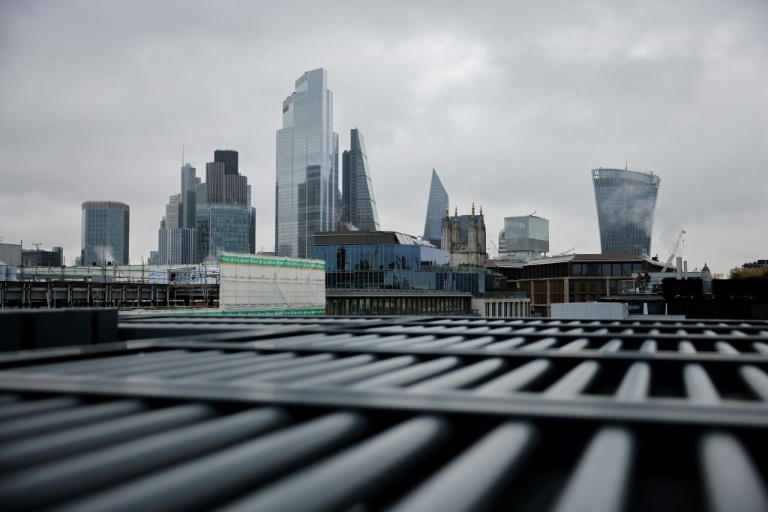
Markets extended a global sell-off Friday after the European Central Bank laid the groundwork to join others in a programme of interest rate hikes, while attention turns to the release of key US inflation data.

After a largely positive start to the week, Asian investors tracked their US and European colleagues in selling up as they contemplate higher borrowing costs and surging prices, which many fear could lead to a recession.

Adding to the unease was news that officials in China had once again locked down millions of people for Covid testing due to another flare-up in cases, dealing a blow to hopes for an economic reopening.

Still, the move helped push down oil prices — a key driver of global inflation — owing to concerns about the impact on demand.

With prices rising at a decades-high pace, central banks have been forced to withdraw the vast financial support measures put in place to combat the impact of the pandemic that helped fuel a rally across markets to record or multi-year highs.

The ECB became the latest to join the tightening campaign, announcing Thursday the end of its bond-buying programme and signalling it will hike rates several times this year.

It also sharply upgraded its inflation forecasts for this year and next while lowering the economic growth outlook.

Focus now turns to the release of US consumer price figures later Friday, with a strong reading likely to give the Federal Reserve more room to be aggressive.

“A robust May… print will probably prompt (policymakers) to hint at a 50 basis point hike for the September meeting,” said SPI Asset Management’s Stephen Innes.

“The tone will remain hawkish and the tough talk on inflation will continue.”

However, he added that “the significant upward revisions to core inflation projections are close to ending. Risk markets could take solace if one or two participants shift to seeing the inflation outlook is more balanced”.

Expectations are that the Fed will hike by half a point for at least three more meetings before January. 

Other commentators also suggested that traders were looking for signs inflation may be close to its highs.

“The big question is whether inflation has peaked or not,” said Matthew Simpson of StoneX Financial. 

“Inflation may have softened to a degree in April, but traders really want to see further evidence that inflation is pointing lower to call ‘peak inflation’ with confidence.

“Besides, one single month of data doesn’t define a trend.”

And OANDA’s Edward Moya said the darkening outlook could provide an argument for the Fed to apply the brakes to hiking later in the year.

“Warning signs about the economy are emerging as weekly jobless claims are starting to rise, China’s Covid situation will prove troublesome for supply chains over the next couple of quarters, and as inflationary pressures broaden and show no sign of easing.

“It seems reductions in global growth forecasts will become a steady theme over the next few months and that should complicate how much more tightening we see from central banks.”

Tokyo, Hong Kong, Sydney, Seoul, Singapore, Taipei, Mumbai, Bangkok, Wellington, Manila and Jakarta were all down.

London, Paris and Frankfurt opened down.

However, data showing Chinese producer price inflation eased last month to its lowest level in more than a year provided some cheer and gave officials a little room to unveil fresh stimulus measures for the beleaguered economy.

That helped Shanghai brush off the targeted lockdowns and buck the regional trend to rally more than one percent.

On currency markets the euro continued to struggle against the dollar after the ECB flagged a quarter-point hike, while the yen remained around two-decade lows to the greenback.

– Key figures at around 0720 GMT –

Tokyo – Nikkei 225: DOWN 1.5 percent at 27,824.29 (close)

Hong Kong – Hang Seng Index: DOWN 0.1 percent at 21,855.18

Shanghai – Composite: UP 1.4 percent at 3,284.83 (close)

London – FTSE 100: DOWN 0.5 percent at 7,442.31

Euro/dollar: UP at $1.0633 from $1.0620 late Thursday

Euro/pound: UP at 85.13 pence from 84.98 pence

Dollar/yen: DOWN at 133.87 yen from 134.40 yen

Pound/dollar: DOWN at $1.2490 from $1.2495

Brent North Sea crude: DOWN 0.3 percent at $122.72 per barrel

West Texas Intermediate: DOWN 0.3 percent at $121.21 per barrel

New York – Dow: DOWN 1.9 percent at 32,272.79 (close)
Ukrainian forces 'holding on' in key Donbas battles

President Volodymyr Zelensky said Ukrainian forces were “holding on” in the flashpoint eastern city of Severodonetsk where intense street battles with Russian troops could determine the fate of the Donbas region. 

Moscow has concentrated its firepower on the industrial city, which it now mostly controls, with the area’s governor saying on Friday that Russian forces had destroyed a major sports arena.

Pro-Russian rebels sentenced one Moroccan and two British fighters to death on Thursday after they were captured while fighting for Ukraine and accused of acting as mercenaries for Kyiv.

Zelensky said in his evening address on Thursday that several “cities in Donbas, which the occupiers now consider key targets, are holding on”. 

He added that Ukrainian forces have made positive strides in the Zaporizhzhia and Kharkiv regions outside Donbas, and are in the process of “liberating our land”.  

With the fiercest fighting now concentrated in Severodonetsk, governor Sergiy Gaiday — who earlier called for Western artillery to quickly help secure a Ukrainian victory — said “one of the symbols of Severodonetsk was destroyed. The Ice Palace burned down.”

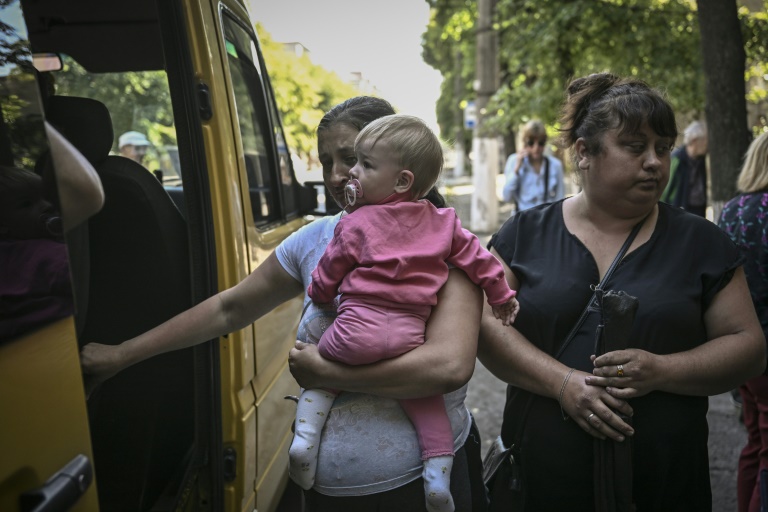
People in the town of Lysychansk, which is located near Severodonetsk, spoke to AFP about the stark choices the war has forced on them: either stay and brave the shelling, or flee and abandon their homes. 

Yevhen Zhyryada, 39, said the only way to access water is by heading to a water distribution site in the town.

“We have to go there under shelling, and under fire,” he said. “This is how we survive.”

But others have chosen to pack up their belongings and get as far away from the fighting as possible. 

“Life made me leave. The constant shelling. And also my grandson. My grandson pleaded with me: ‘Grandma, come to us.’ Only it’s not clear for me where to go, I left their address at home,” Lyubov Akatyeva, 65, said.

Defence Minister Oleksiy Reznikov has said around 100 Ukrainian soldiers were being killed every day in frontline fighting and as many as 500 wounded.

– Death sentence –

Western countries have provided weapons and aid to Ukraine since the February 24 invasion, while some people from abroad have joined the fight against Russian forces.

Separatist authorities in the Donetsk region of the Donbas ordered the death penalty for Aiden Aslin, Shaun Pinner and Saadun Brahim, Russian media reported.

Britain’s Foreign Secretary Liz Truss called the sentence “a sham judgment, with absolutely no legitimacy”, while a spokesman for Prime Minister Boris Johnson said the sentence contravenes prisoner rights under the Geneva Convention.

Britons Aslin and Pinner surrendered in April and Brahim surrendered in March in the eastern town of Volnovakha.

During a trial that lasted three days, the men pleaded guilty to “actions aimed at seizing power and overthrowing the constitutional order of the Donetsk People’s Republic”, Russian news agency Interfax said.

A lawyer representing one of them told the TASS news agency that they would appeal.

– ‘Foreign mercenaries’ –

Pro-Russian separatists have held part of the Donbas region since 2014 and it is now the focus of Moscow’s offensive after its forces were repelled from Kyiv weeks into the invasion.

Russia has repeatedly warned the West against getting involved and said it had targeted a Ukrainian training centre for “foreign mercenaries” in the Zhytomyr region, west of Kyiv.

The Ukrainian presidency said four people were killed in a Russian air strike on Toshkivka, a village around 25 kilometres (16 miles) south of Severodonetsk.

It reported seven other deaths in fighting across the country. 

In Kyiv, Ukraine’s Interior Minister Denys Monastyrsky said the capital was in no immediate danger, but troops were keeping a line of defence all the same.

Russian President Vladimir Putin, meanwhile, appeared to compare his actions to Peter the Great’s conquest of the Baltic coast during his 18th-century war against Sweden.

– Grain crisis –

Zelensky on Thursday called for Russia to be expelled from the UN’s Food and Agriculture Organization (FAO), blaming Moscow for “causing hunger” and spurring the global grain crisis by invading his country.

Ukraine’s Black Sea ports export millions of tonnes of grain each year but have been blocked since the invasion, while Western sanctions on Russia have prevented Moscow from selling much of its grain abroad, sending food prices soaring.

The FAO warned that poor countries will suffer the most from the crisis as they were “paying more but receiving less food”.

The African Union on Thursday urged Kyiv to demine waters around the Ukraine-controlled Odessa port to ease exports, warning of “serious famine” and destabilisation on the continent.

Moscow has also called for Ukraine to demine, but Kyiv has refused for fear of a Russian attack.

burs-dk/ssy/axn

Old tricks, new crises: how US misinformation spreads

With gun control under debate and monkeypox in the headlines, Americans are facing a barrage of new twists on years-old misinformation in their social media feeds.

Accurate news stories about mass shootings have attracted eyeballs but algorithms have also spurred baseless conspiracy theories from trolls who want to push lies to attract traffic. And thousands have unwittingly shared them on Facebook, Twitter and other sites.

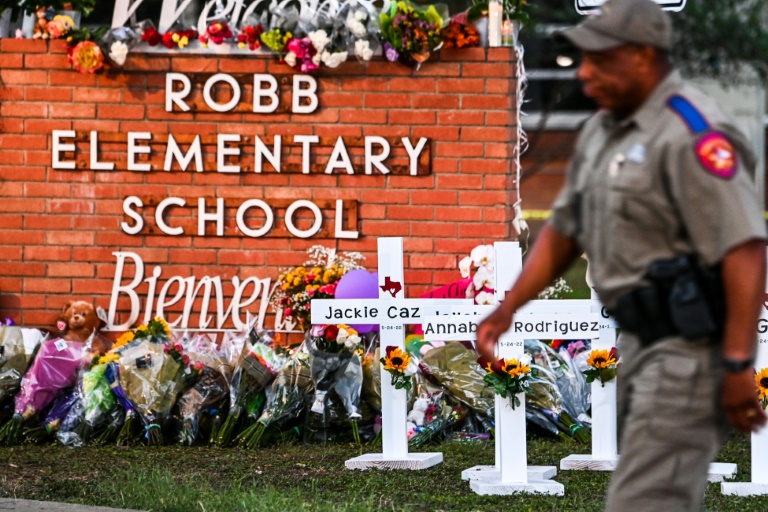
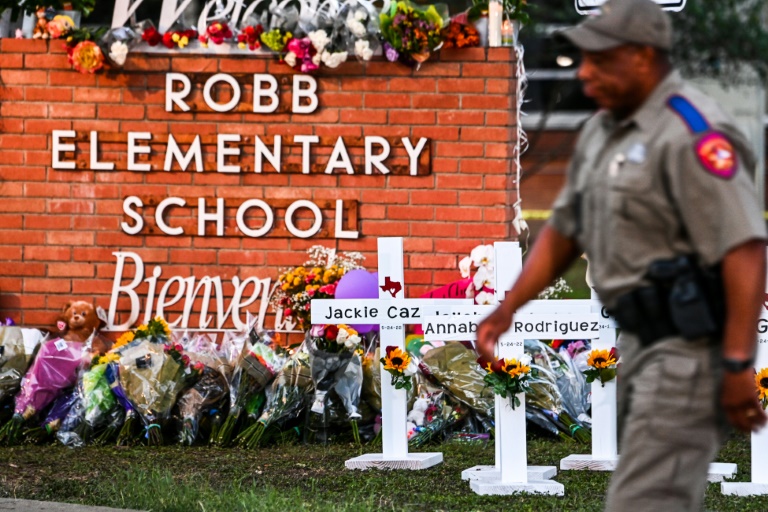
The May 24 attack at Robb Elementary School in Uvalde, Texas was a “false flag” operation aimed at pushing restrictive gun laws, according to Telegram posts from supporters of QAnon. 

Carl Paladino, a New York congressional candidate, was among those who shared a similar theory on Facebook, later deleting it.

Others misidentified a shooting victim as “Bernie Gores” — a made-up name paired with an image of a YouTuber who has been wrongly linked to other major news events, including the Russian invasion of Ukraine.

Experts say such misinformation is part of a pattern in which unscrupulous operators intentionally repurpose old narratives.

“A lot of this stuff is put together almost in this factory production style,” said Mike Caulfield, a misinformation researcher at the University of Washington’s Center for an Informed Public. 

“You have a shooting event, you have these various tropes you can apply.”

Groundless claims of a “false flag” operation, which refers to political or military action that is carried out with the intention of blaming an opponent, can be traced back to the 2012 mass shooting at Sandy Hook Elementary School in Newtown, Connecticut.

After 20 children and six staff members were killed, InfoWars founder Alex Jones falsely claimed the Newtown casualties were “crisis actors” — people who are paid or volunteer to play disaster victims. 

In November 2021, a Connecticut judge found Jones liable for damages in a defamation suit brought by parents of the victims.

But regardless, allegations of staged mass shootings have routinely spread from fringe online networks such as 4chan to mainstream platforms — including the social media feeds of politicians such as Republican congresswoman Marjorie Taylor Greene and, more recently, Arizona state senator Wendy Rogers. 

Hoax posts misidentifying gunmen or victims as internet personalities have also become common.

In the race to capture online attention following breaking news, recycled narratives can be produced quickly and are easier for audiences to digest, Caulfield said. Content producers “make guesses” about what may go viral based on past popular tropes, which can help monetize that attention.

“When you spread this stuff, you want to be seen as in the know,” he said, even though the information is demonstrably false or misleading.

– Copying the Covid-19 playbook –

Similarly, false claims about the recent spread of monkeypox — a rare disease related to smallpox — borrow from Covid-19 misinformation.

Since the outbreak, social media posts have claimed without evidence that the virus is a bioweapon, that the outbreak was planned, and that Microsoft co-founder Bill Gates is behind it. Others have falsely equated monkeypox to other viruses, including shingles.

Those claims resemble debunked conspiracy theories from the early days of the Covid-19 pandemic.

Memetica, a firm that conducts digital investigations, has researched some of the top Covid-19 misinformation recycled for monkeypox. One widespread theory points to a 2021 threat preparation exercise conducted by the Nuclear Threat Initiative (NTI) as purported evidence that the outbreak was planned.

That conspiracy theory is nearly identical to claims about Event 201, a pandemic simulation held in October 2019, that circulated online in early 2020.

“What was surprising to me was how similar (Covid-19 misinformation) is now to monkeypox,” Adi Cohen, chief operating officer at Memetica, told AFP. 

“It’s the same exact story — oh, this is all planned, it’s a ‘plandemic,’ here’s the proof.”

Some monkeypox theories have been shared by conservative figures including Glenn Beck and anti-vaccine advocate Robert F. Kennedy Jr, according to Memetica’s research. Both have previously promoted misinformation about Covid-19.

Cohen said such tactics may be an effective way to get engagement on social media, regardless of the falsity of the information being shared.

“It’s the replication of what seems to work in the past,” he said. “Why work hard when you don’t have to?”

Old tricks, new crises: how US misinformation spreads

With gun control under debate and monkeypox in the headlines, Americans are facing a barrage of new twists on years-old misinformation in their social media feeds.

Accurate news stories about mass shootings have attracted eyeballs but algorithms have also spurred baseless conspiracy theories from trolls who want to push lies to attract traffic. And thousands have unwittingly shared them on Facebook, Twitter and other sites.

The May 24 attack at Robb Elementary School in Uvalde, Texas was a “false flag” operation aimed at pushing restrictive gun laws, according to Telegram posts from supporters of QAnon. 

Carl Paladino, a New York congressional candidate, was among those who shared a similar theory on Facebook, later deleting it.

Others misidentified a shooting victim as “Bernie Gores” — a made-up name paired with an image of a YouTuber who has been wrongly linked to other major news events, including the Russian invasion of Ukraine.

Experts say such misinformation is part of a pattern in which unscrupulous operators intentionally repurpose old narratives.

“A lot of this stuff is put together almost in this factory production style,” said Mike Caulfield, a misinformation researcher at the University of Washington’s Center for an Informed Public. 

“You have a shooting event, you have these various tropes you can apply.”

Groundless claims of a “false flag” operation, which refers to political or military action that is carried out with the intention of blaming an opponent, can be traced back to the 2012 mass shooting at Sandy Hook Elementary School in Newtown, Connecticut.

After 20 children and six staff members were killed, InfoWars founder Alex Jones falsely claimed the Newtown casualties were “crisis actors” — people who are paid or volunteer to play disaster victims. 

In November 2021, a Connecticut judge found Jones liable for damages in a defamation suit brought by parents of the victims.

But regardless, allegations of staged mass shootings have routinely spread from fringe online networks such as 4chan to mainstream platforms — including the social media feeds of politicians such as Republican congresswoman Marjorie Taylor Greene and, more recently, Arizona state senator Wendy Rogers. 

Hoax posts misidentifying gunmen or victims as internet personalities have also become common.

In the race to capture online attention following breaking news, recycled narratives can be produced quickly and are easier for audiences to digest, Caulfield said. Content producers “make guesses” about what may go viral based on past popular tropes, which can help monetize that attention.

“When you spread this stuff, you want to be seen as in the know,” he said, even though the information is demonstrably false or misleading.

– Copying the Covid-19 playbook –

Similarly, false claims about the recent spread of monkeypox — a rare disease related to smallpox — borrow from Covid-19 misinformation.

Since the outbreak, social media posts have claimed without evidence that the virus is a bioweapon, that the outbreak was planned, and that Microsoft co-founder Bill Gates is behind it. Others have falsely equated monkeypox to other viruses, including shingles.

Those claims resemble debunked conspiracy theories from the early days of the Covid-19 pandemic.

Memetica, a firm that conducts digital investigations, has researched some of the top Covid-19 misinformation recycled for monkeypox. One widespread theory points to a 2021 threat preparation exercise conducted by the Nuclear Threat Initiative (NTI) as purported evidence that the outbreak was planned.

That conspiracy theory is nearly identical to claims about Event 201, a pandemic simulation held in October 2019, that circulated online in early 2020.

“What was surprising to me was how similar (Covid-19 misinformation) is now to monkeypox,” Adi Cohen, chief operating officer at Memetica, told AFP. 

“It’s the same exact story — oh, this is all planned, it’s a ‘plandemic,’ here’s the proof.”

Some monkeypox theories have been shared by conservative figures including Glenn Beck and anti-vaccine advocate Robert F. Kennedy Jr, according to Memetica’s research. Both have previously promoted misinformation about Covid-19.

Cohen said such tactics may be an effective way to get engagement on social media, regardless of the falsity of the information being shared.

“It’s the replication of what seems to work in the past,” he said. “Why work hard when you don’t have to?”

Toxic cocktail darkens outlook for British pound

A toxic cocktail of sluggish growth and high inflation, plus Brexit and fallout from the coronavirus pandemic, is set to weigh on the pound in the coming months, economists warned.

Since the start of the year, sterling has fallen by more than seven percent against the dollar, which is benefiting from rises in US interest rates.

The pound has also fallen by 1.7 percent against the euro since the beginning of 2022.

This comes despite the Bank of England having raised UK borrowing costs four times this year to fight inflation.

By contrast, the European Central Bank is waiting until July to raise its key interest rates for the first time in more than a decade.

BoE rate rises have “been insufficient to offset the headwinds weighing on the pound”, said Rabobank analyst Jane Foley. 

“Concerns about growth have been central to the poor performance of the pound,” she said.

Fears of recession in the UK and elsewhere are gaining momentum as soaring inflation — fuelled by rocketing energy prices — hits investment and consumer spending.

Oil and gas demand has surged as economies emerge from pandemic lockdowns, while supplies have been hit by the invasion of Ukraine by major producer Russia. 

Britain’s annual inflation rate stands at nine percent, a 40-year high, while the Bank of England is forecasting the UK economy to contract at the end of the year. 

The Bank of England’s next rate decision is due June 16 when it is expected to take its main borrowing cost above one percent.

“Hiking rates against a sharply slowing economy is never a good look for any currency,” said Bank of America currency strategist, Kamal Sharma.

– Brexit cost –

The pound has dropped to around $1.25 compared with $1.40 before the 2016 vote in favour of Brexit, or Britain’s departure from the European Union.

After the UK entered its first pandemic lockdown in March 2020, sterling sank to $1.14, the lowest level since 1985.

And the pound took a knock this week after embattled British Prime Minister Boris Johnson faced a vote of no confidence from his own Conservative MPs. 

Although Johnson survived, 41 percent of those who voted failed to back him as their leader.

Another big factor affecting the pound is that the BoE “remains wholly unwilling to discuss” the full consequences of Brexit on the UK economy, according to Sharma.

This could partly be due to the fact that it is difficult to pin down the exact financial fallout, with Britain’s departure from the European Union formalised only during the economic shock caused by the Covid-19 pandemic.

Meanwhile, political paralysis in Northern Ireland, a direct consequence of Brexit, poses further problems for the pound, according to economists.

“The added risk is that there is another Brexit bust-up, perhaps over the Northern Ireland Protocol,” Capital Economics analyst Paul Dales told AFP. 

“The latter could result in the pound weakening below $1.22.” 

The protocol was agreed upon as part of Britain’s Brexit divorce deal with Brussels, recognising Northern Ireland’s status as a fragile, post-conflict territory that shares the UK’s new land border with the EU.

But Britain is readying new legislation to rewrite its Brexit commitments to fix trade distortions in the province.

Sharma expressed concern “that the increasing politicisation of UK policy undermines the pound”.

Whatever the financial cost of Brexit, “underpinning the market’s concerns about growth was the recent IMF (International Monetary Fund) projection that the UK is set to have the slowest pace of growth in the G7” group of rich nations next year, said Foley.

Other global financial bodies, such as the Paris-based Organisation for Economic Co-operation and Development (OECD), have also slashed their growth outlooks for Britain, as well as for other major economies.

US Capitol riot probe puts Trump at heart of 'attempted coup'

A congressional panel investigating last year’s mob assault on the US Capitol laid out its case Thursday that Donald Trump and his claims of a stolen election were at the heart of what amounted to an “attempted coup” to remain in power.

In a prime-time presentation of its findings from a year-long probe, the special committee sought to persuade a divided country of the existence of a deep-rooted and ongoing plot — orchestrated by the former president — to overturn the result of the 2020 election won by Joe Biden.

“President Trump summoned the mob, assembled the mob and lit the flame of this attack,” the Republican vice chairwoman of the panel, Liz Cheney, said in her opening remarks at the first in a series of hotly anticipated summer hearings.

Minutes earlier, Democratic committee chief Bennie Thompson accused Trump of being “at the center of this conspiracy.”

“January 6 was the culmination of an attempted coup — a brazen attempt, as one rioter put it shortly after January 6 — to overthrow the government. The violence was no accident,” he said.

Rioters acted “at the encouragement of the president of the United States,” to march on Congress and block the formal transfer of power by lawmakers to Biden, he added.

The panel’s carefully produced presentation made use of testimony given behind closed doors by some of Trump’s most senior and trusted advisors, including former attorney general Bill Barr and Trump’s son-in-law and senior aide, Jared Kushner.

– ‘Witch hunt’ –

The panel aims to demonstrate that the violence was part of a broader — and ongoing — drive by Trump and his inner circle to illegitimately cling to or regain power, tearing up the Constitution and more than two centuries of peaceful transitions from one administration to the next.

Thursday’s session and five subsequent hearings over the coming weeks will focus on Trump’s role in the multi-pronged effort to return him to the Oval Office by disenfranchising millions of voters. 

Trump has defiantly dismissed the probe as a baseless “witch hunt” — but the public hearings were uppermost in his mind Thursday as he fired off a largely false tirade on his social media platform, defending the insurrection as “the greatest movement in the history of our Country to Make America Great Again.”

Following the hearing, he lashed out again on Truth Social, accusing the committee of bias and doubling down on his election fraud claims.  

“The Unselect Committee of political HACKS refuses to play any of the many positive witnesses and statements,” he wrote.

The case the committee wants to make is that Trump laid the groundwork for the insurrection through months of lies about fraud in an election described by his own administration as the most secure ever.

His White House is accused of involvement in several potentially illegal schemes to aid the effort, including a plot to seize voting machines and another to appoint fake “alternative electors” from swing states who would ignore the will of their voters and hand victory to Trump. 

– ‘Slipping in people’s blood’ –

Thursday’s hearing featured live testimony from two people who interacted with members of the neofascist organization the Proud Boys on January 6 and in the days leading to the violence.

Emmy-winning British documentary filmmaker Nick Quested testified about his experience shadowing members of the Proud Boys in the days leading up to January 6 and his interactions with them on the day itself.

Quested recalled being shocked by “the anger” he saw among the group’s members, and described the larger rally crowd as transforming “from protesters to rioters to insurrectionists.”

“I was surprised at the size of the group, the anger and the profanity,” he said.

Capitol Police Officer Caroline Edwards, who was present at the breach of the first barricade, described sustaining head injuries in clashes with the Proud Boys, whose leader has been charged with seditious conspiracy, along with four lieutenants.

“I can just remember my breath catching in my throat, because what I saw was just a war scene. It was something like I’d seen out of the movies,” she said.

“I couldn’t believe my eyes. There were officers on the ground — they were bleeding, they were throwing up… I saw friends with blood all over their faces. I was slipping in people’s blood.”

– Court of public opinion –

The series of hearings will differ from Trump’s two impeachments in that he will not be represented in the room as he is not on trial — except perhaps in the court of public opinion.

Nevertheless, a number of his most loyal counter-punchers are expected to circle the wagons, challenging the investigation at every turn. 

“It is the most political and least legitimate committee in American history,” the leader of the House Republican minority, Kevin McCarthy, told reporters.

In fact, Congress has wide-ranging oversight powers, and a Trump-appointed federal judge last month emphatically rejected Republicans’ arguments that the committee is illegitimate.

The panel has not confirmed what it plans to do after the initial slate of hearings, but at least one more presentation and a final report are expected in the fall.

Ukrainian forces 'holding on' in key Donbas battles

President Volodymyr Zelensky said Ukrainian forces were “holding on” in the flashpoint eastern city Severodonetsk where intense street battles with Russian troops could determine the fate of the Donbas region. 

Moscow has concentrated its firepower on the industrial city, which it now mostly controls, with the area’s governor saying on Friday that Russian forces had destroyed a major sports arena.  

Pro-Russian rebels sentenced one Moroccan and two British fighters to death on Thursday after they were captured while fighting for Ukraine and accused of acting as mercenaries for Kyiv.

Zelensky said in his evening address on Thursday night that several “cities in Donbas, which the occupiers now consider key targets, are holding on”. 

He added that Ukrainian forces have made positive strides in the Zaporizhzhia and Kharkiv regions, and are in the process of “liberating our land”.  

With the fiercest fighting now concentrated in Severodonetsk, governor Sergiy Gaiday — who earlier called for Western artillery to quickly help secure a Ukrainian victory — said “one of the symbols of Severodonetsk was destroyed. The Ice Palace burned down”.

Western countries have provided weapons and aid for Ukraine since the February 24 invasion, while several people from abroad have joined the fight against Russian forces.

Up to 100 Ukrainian soldiers were being killed every day in frontline fighting and as many as 500 wounded, Defence Minister Oleksiy Reznikov said.

– Death sentence –

Separatist authorities in the Donetsk region of the Donbas ordered the death penalty for Aiden Aslin, Shaun Pinner and Saadun Brahim, Russian media reported.

Britain’s Foreign Secretary Liz Truss called the sentence “a sham judgment with absolutely no legitimacy”.

A spokesman for Prime Minister Boris Johnson said the sentence contravenes the Geneva Convention, under which “prisoners of war are entitled to combatant immunity”.

Britons Aslin and Pinner surrendered in April in the southern port city Mariupol, which was captured by Russian troops after a weeks-long siege. They later appeared on Russian TV calling on Johnson to negotiate their release.

Moroccan Brahim surrendered in March in the eastern town of Volnovakha.

During a trial that lasted three days, the men pleaded guilty to committing “actions aimed at seizing power and overthrowing the constitutional order of the Donetsk People’s Republic”, Russian news agency Interfax said.

A lawyer representing one of them told the TASS news agency that they would appeal.

– ‘Foreign mercenaries’ –

After being repelled from Kyiv weeks into their invasion, Russian President Vladimir Putin’s troops have refocused their offensive on the eastern Donbas. 

Pro-Russian separatists have held part of the region since 2014.

Moscow, which has repeatedly warned the West against getting involved, said it had targeted a Ukrainian training centre for “foreign mercenaries” in the Zhytomyr region, west of Kyiv.

The Ukrainian presidency said four people were killed in a Russian air strike on Toshkivka, a village around 25 kilometres (16 miles) south of Severodonetsk.

It reported seven other deaths in fighting across the country. 

In Kyiv, Ukraine’s Interior Minister Denys Monastyrsky said the capital was in no immediate danger, but troops were keeping a line of defence all the same.

Putin, meanwhile, appeared to compare his actions to Peter the Great’s conquest of the Baltic coast during his 18th-century war against Sweden.

“By fighting Sweden he was grabbing something… He was taking it back,” he told young entrepreneurs in Moscow.

“It is our responsibility also to take back and strengthen”.

– ‘Every day something burns’ –

Zelensky on Thursday called for Russia to be expelled from the UN’s Food and Agriculture Organization (FAO), blaming Moscow for “causing hunger” and spurring the global grain crisis by invading his country.

Ukraine’s Black Sea ports export millions of tonnes of grain each year but have been blocked since the invasion, while western sanctions on Russia have prevented Moscow from selling much of its grain abroad, sending food prices soaring.

The FAO warned that poor countries will suffer the most from the crisis as they were “paying more but receiving less food”.

Africa has been hard hit by the shortage, and the African Union (AU) on Thursday urged Kyiv to demine waters around the Ukraine-controlled Odessa port to ease exports, warning of “serious famine” and destabilisation on the continent.

Moscow has also called for Ukraine to demine, but Kyiv has refused for fear of a Russian attack.

burs-dk/ssy/lb

Asian markets track global sell-off on inflation, rate fears

Asia extended losses across world markets on Friday after the European Central Bank laid the groundwork to join others in a programme of interest rate hikes, while attention turns to the release of key US inflation data.

After a largely positive start to the week, investors tracked their US and European colleagues in selling up as they contemplate higher borrowing costs and surging prices, which many fear could lead to a recession.

Adding to the unease was news that officials in China had once again locked down millions of people to test them owing to another flare-up in cases, dealing a blow to hopes for an economic reopening.

Still, the move helped push down oil prices — a key driver of global inflation — owing to concerns about the impact on demand.

With prices rising at a decades-high pace, central banks have been forced to withdraw the vast financial support measures put in place to combat the impact of the pandemic and helped fuel a rally across markets to record or multi-year highs.

The ECB became the latest to join the tightening campaign, announcing Thursday the end of its bond-buying programme and signalling it will hike rates several times this year.

It also sharply upgraded its inflation forecasts for this year and next while lowering the economic growth outlook.

Focus now turns to the release of US consumer price figures later Friday, with a strong reading likely to give the Federal Reserve more room to be aggressive.

“A robust May… print will probably prompt (policymakers) to hint at a 50 basis point hike for the September meeting,” said SPI Asset Management’s Stephen Innes.

“The tone will remain hawkish and the tough talk on inflation will continue.”

However, he added that “the significant upward revisions to core inflation projections are close to ending. Risk markets could take solace if one or two participants shift to seeing the inflation outlook is more balanced”.

Expectations are that the Fed will hike by half a point for at least three more meetings before January. 

Other commentators also suggested that traders were looking for signs inflation may be close to its highs.

“The big question is whether inflation has peaked or not,” said Matthew Simpson of StoneX Financial. 

“Inflation may have softened to a degree in April, but traders really want to see further evidence that inflation is pointing lower to call ‘peak inflation’ with confidence.

“Besides, one single month of data doesn’t define a trend.”

And OANDA’s Edward Moya said that the darkening outlook could provide an argument for the Fed to apply the brakes to hiking later in the year.

“Warning signs about the economy are emerging as weekly jobless claims are starting to rise, China’s Covid situation will prove troublesome for supply chains over the next couple of quarters, and as inflationary pressures broaden and show no sign of easing.

“It seems reductions in global growth forecasts will become a steady theme over the next few months and that should complicate how much more tightening we see from central banks.”

In early trade, Tokyo, Hong Kong, Sydney, Seoul, Singapore, Taipei, Wellington, Manila and Jakarta were all down.

However, data showing Chinese producer price inflation eased last month to its lowest level in a year provided some cheer to mainland traders with Shanghai edging up slightly.

On currency markets the euro continued to struggle against the dollar after the ECB flagged a quarter-point hike, while the yen remained around two-decade lows on the greenback.

– Key figures at around 0230 GMT –

Tokyo – Nikkei 225: DOWN 1.4 percent at 27,848.79 (break)

Hong Kong – Hang Seng Index: DOWN 0.7 percent at 21,726.41

Shanghai – Composite: UP 0.3 percent at 3,248.75

Euro/dollar: UP at $1.0626 from $1.0620 late Thursday

Euro/pound: UP at 85.05 pence from 84.98 pence

Dollar/yen: DOWN at 134.03 yen from 134.40 yen

Pound/dollar: DOWN at $1.2493 from $1.2495

Brent North Sea crude: DOWN 0.8 percent at $122.10 per barrel

West Texas Intermediate: DOWN 0.8 percent at $120.60 per barrel

New York – Dow: DOWN 1.9 percent at 32,272.79 (close)
London – FTSE 100: DOWN 1.5 percent at 7,476.21 (close)

Julie Andrews 'gobsmacked' by Hollywood award, six decades after 'Mary Poppins'

Nearly 60 years after preaching virtues of patience and modesty as Mary Poppins and governess Maria, Julie Andrews declared herself “gobsmacked” to have her career honored at a glitzy Hollywood gala Thursday.

“I didn’t know or think that it would ever come,” the 86-year-old told AFP on the red carpet before receiving the American Film Institute’s life achievement award in Los Angeles, bestowed upon one silver screen legend each year.

“But it’s just as well, because you can’t go around expecting awards and things like that.”

In fact, Andrews won the Oscar for best actress with her very first big-screen role — 1964’s “Mary Poppins” — having rapidly progressed from child singer touring British music halls, to Broadway starlet spotted by Walt Disney.

A year after playing the magical and squeaky-clean nanny, and still in her twenties, Andrews sealed a permanent place among Tinseltown’s elite with “The Sound of Music.”

Five of the actors who played the Von Trapp children — a wealthy Austrian family in need of governess Maria’s singing lessons, and help in evading the Nazis — attended Thursday’s ceremony, along with four of Andrews’ real-life offspring.

Andrews went on to star in a number of films during the 1970s, 1980s and 1990s, with some racy — even topless — scenes, which shocked audiences more used to her straight-laced characters.

In 2000 she was made a Dame by Queen Elizabeth II for services to acting and entertainment.

Following a personal disaster when her vocal chords were damaged in an operation, Andrews revived her career with “The Princess Diaries” (2001) and its sequel in 2004. 

Her voiceover work as Queen Lillian in the “Shrek” animated film series, Gru’s mother in the “Despicable Me” franchise, and Lady Whistledown in the hugely popular Netflix series “Bridgerton” earned her a new generation of young fans.

Andrews was due to receive the AFI award — billed as “the highest honor for a career in film — in 2020 and again in 2021, but the gala was postponed both times due to the pandemic. 

“When they asked me even two-and-a-half years ago — and Covid is what kept us from doing it then — I was gobsmacked,” she said.

Searing US Capitol riot footage revives grim memories of violence

The footage was more violent, more eye-popping than any prime-time network crime show. And it was real.

Video images capturing the raging anger and violence of the mob ransacking the US Congress provided a vivid and visceral picture of the 2021 insurrection on Capitol Hill.

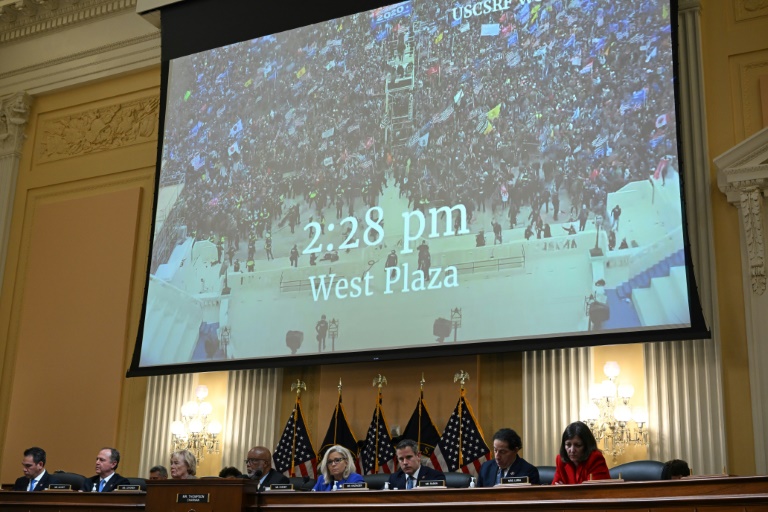
Dozens of journalists, politicians and congressional staffers crammed into the Capitol’s stately Cannon Caucus Room Thursday for the first hearings into the January 6 committee’s findings, their febrile chatter quickly turning to stunned silence as opening speeches were followed by video of the riot playing out on a huge screen.

A minute-by-minute visual breakdown — much of it composed of new footage — served as a painful reminder of the mayhem that played out as a mob attempted to disrupt the formal vote by lawmakers to transfer power from Donald Trump to Joe Biden. 

The committee showed the moment when the mob, spurred on by members of the neofascist Proud Boys, overwhelmed police at the perimeter of the Capitol complex, casting aside barricades as they surged forward.

Police officers were seen desperately trying — and failing — to keep the crowd at bay as rioters climbed scaffolding, hurled chairs and eventually breached the halls of Congress.

The public gallery sat rapt, watching graphic images of the clashes that could have spiraled into a much larger tragedy had lawmakers not been evacuated.

Some people in the public seats looked away at times but many held up phones to record the footage as hordes of rioters — some in tactical gear — were seen streaming into the Capitol through broken windows and other breached entry points. 

The video juxtaposed images of insurrectionists overrunning the complex from the outside with footage of the mob roaming the Capitol — and video and audio of Trump whipping up the crowd beforehand and praising the mob afterwards. 

– ‘Blood, sweat and tears’ –

US Capitol Police officer Caroline Edwards also gave an account of the violence, in which she was concussed when she cracked her head on the Capitol steps after being knocked over by the surging mob.

She spoke of her “literal blood, sweat and tears… shed that day defending the building that I spent countless holidays and weekends working in.”

Measuring roughly the size of two tennis courts, its gilded walls adorned with Corinthian floor-to-ceiling pillars illuminated by crystal chandeliers, the airy, magisterial Cannon Caucus Room in an annex off the main Capitol building is designed to inspire awe. 

Just yards from the main Capitol building in downtown Washington, it was the venue for House Un-American Activities hearings in 1948 during the Soviet “reds under the bed” moral panic, and more recently hearings for Trump’s first impeachment.

The former president — still the nearest thing Republicans have to an official party leader — wasn’t present as lawmakers set out their case that he was to blame for the insurrection that left five dead in January 2021, just across the road.

Yet his presence was almost palpable on “opening night” for a what is certain to be a summer of blockbuster hearings.

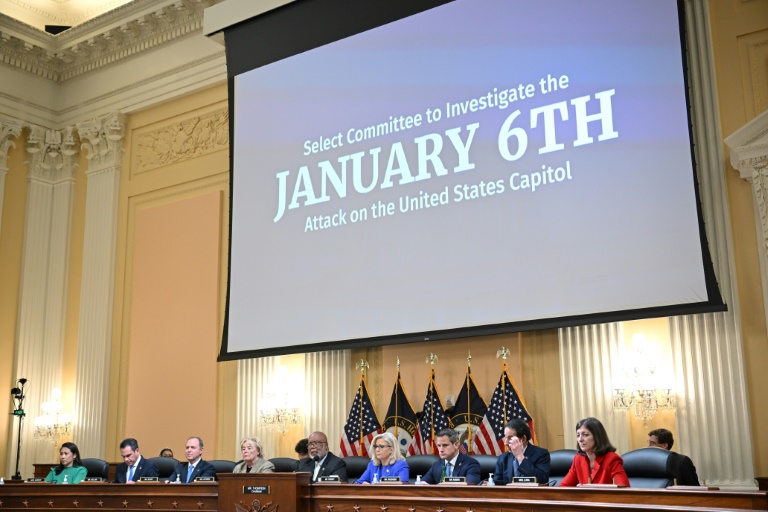
Spectators had come to be part of history as the stiffly-named Select Committee to Investigate the January 6th Attack on the United States Capitol opened its case — and history did not disappoint. 

The meticulously stage-managed made-for-TV session was the panel’s first opportunity to show the public what they’ve learned from more than 1,000 witness interviews and 140,000 documents. 

Its central mission has been to assess the catalysts for the violence of a day unparalleled in history. 

But investigators were also tasked with assessing the extent of Trump’s many suspect attempts to cling to power, and how they played into the bloodshed. 

There were excerpts of taped interviews with Trump administration and campaign officials who told members of Trump’s inner circle there was no justification for overturning the election.

Trump’s attorney general Bill Barr was shown telling investigators the defeated president’s claims of fraud involving manipulated voting machines were “complete nonsense.”

Trump’s eldest daughter and former aide Ivanka Trump — speaking for the first time about the fraud claims —  was shown saying she “accepted” Barr’s rebuttal of the bogus allegations.

With no actual prosecutorial powers — the Justice Department is pursuing a parallel criminal investigation — the panel sees its job as convicting Trump in the court of public opinion. 

This may not be a heavy lift, as the question of Trump’s criminality has already been settled in part, by a landmark ruling in March from a federal judge who said it was “more likely than not that President Trump corruptly attempted to obstruct the joint session of Congress on January 6.”

“The illegality of the plan was obvious,” he said.

Close Bitnami banner
Bitnami