US Business

Why US gun violence spikes in warm weather

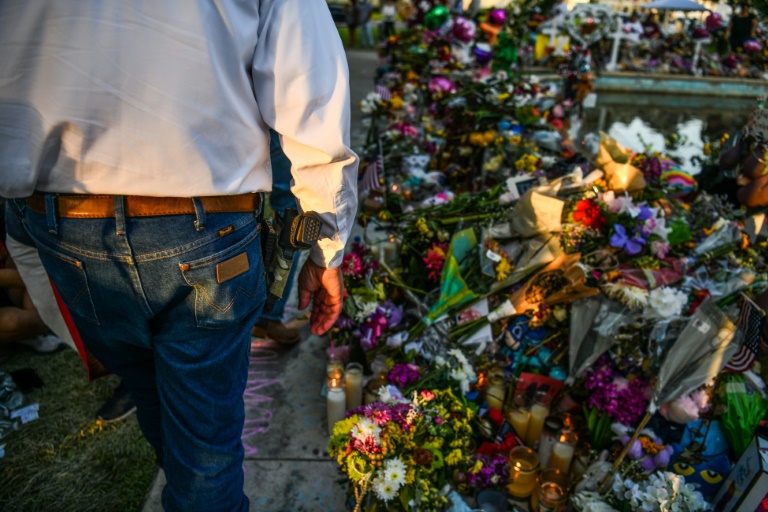
From the Texas school massacre to a Tulsa hospital shooting and many less-reported incidents, a recent spate of gun violence across America bears out a trend police departments have long sworn by: murders go up in warmer weather.

The link has been written about for decades by criminologists, with more recent research drilling down on the precise relationship between temperature and crime rates.

For those who have studied the question, there are common sense as well as potentially less obvious mechanisms at play.

First, the more obvious: “It’s hard to shoot somebody if there’s nobody around,” David Hemenway, a professor of health policy at the Harvard TH Chan School of Public Health, told AFP, explaining why gun crime is lower in bad weather.

A second, more controversial idea is that heat itself — as opposed to weather that encourages people to be out — might rev up conflict.

While there are many causes behind the rising tide of gun violence in the United States, weather could play an increasingly important role in world that is fast warming due to climate change.

– Warm days in cold months – 

Hemenway said he had long been interested in the relationship between heat and higher crime given stereotypes about the north-south divide within the United States and Italy, as well as between the northern European states of Scandinavia and southern Mediterranean countries.

In 2020, he co-wrote a paper in Injury Epidemiology led by his then-graduate student Paul Reeping examining the city of Chicago between 2012 and 2016.

The paper used reports from the Chicago Tribune to get the number of shootings per day, and then matched those against daily high temperature, humidity, wind speed, difference in temperature from historical average, and precipitation type and amount.

They found a 10 degree Celsius higher temperature was significantly associated with 34 percent more shootings on weekdays, and 42 percent more shootings on weekends or holidays. 

They also found a 10C higher than average temperature was associated with 33.8 percent higher rate of shootings.

In other words, said Hemenway, it’s not just heat that’s important, but relative heat: “In the winter, there were more shootings on those days which wouldn’t have been hot in the summer but were warm for winter.”

Another recent paper, led by Leah Schinasi of Drexel University and published in the Journal of Urban Health in 2017, looked at violent crime in Philadelphia.

“I live in Philadelphia, and I remember biking home from work on a very hot day and observing how cranky everyone seemed. I was interested to see if this observation translated to higher rates of crime on hot days,” she told AFP.

She and co-author Ghassan Hamra did indeed find violent crimes happened more often in the warmer months — May through September — and were highest on the hottest days.

The contrast was most striking on comfortable days in the colder months — October through April — compared to colder days in those months. 

When temperatures reached 21C (70F) during that time period, daily rates of violent crime were 16 percent higher compared to 6C (43F) days, the median for those months.

–  ‘Harm reduction’ –

Hemenway believes that both of the main hypotheses on the subject — that more people being outside opens more possibilities of hostile interactions, and that heat itself makes people more aggressive — could be true.

A striking study published by the National Bureau of Economic Research in 2019 involved placing university students in Kenya and California in either hot or cold rooms and measuring the impact on a number of behavioral categories.

It found “heat significantly affects individuals’ willingness to voluntarily destroy other participants’ assets” in the form of gift cards and vouchers.

When it comes to the overall issue of gun violence, there are far bigger drivers than temperature, Hemenway acknowledged.

These include the fact there were an estimated 393 million guns in circulation in the United States in 2020, more than the number of people, while many states have moved in recent years to ease rather than toughen restrictions.

But better understanding the relationship with weather could have policy implications — for example finding more activities for young males to keep them off street corners on the hottest summer days, and boosting police presence in key areas based on forecasts.

“It’s sort of a harm reduction,” said Hemenway. “But even if this wasn’t a gun problem, I suspect we would find the same thing if we had evidence about fights and assaults. What the guns do is make hostile interactions more deadly.”
Biden faces cloud on summit to reset Latin America ties

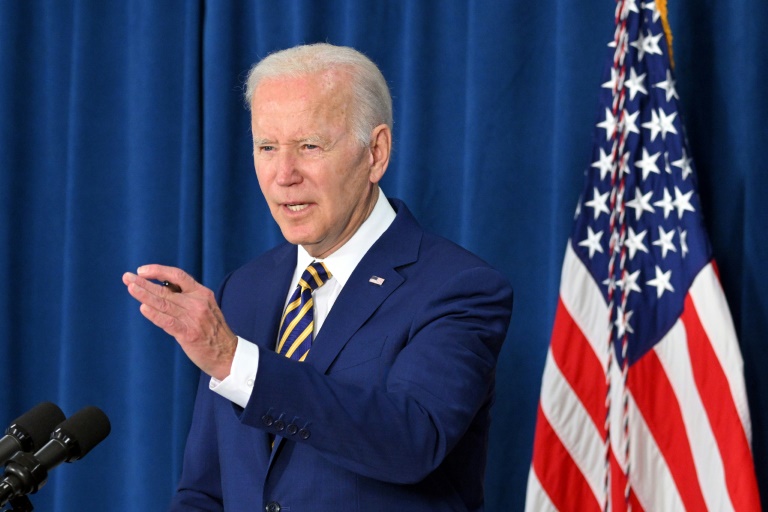
President Joe Biden is hoping to show a new era of US engagement with Latin America at a long-heralded summit next week, but the meeting has been clouded by boycott threats and charges of an unambitious agenda.

Regional leaders will descend on Los Angeles starting Monday for the weeklong Summit of the Americas at a time when China, seen by the United States as a fast-emerging rival, has been making inroads in a zone Washington has historically considered its turf.

Days ahead of the summit, the White House was still finalizing the invitation list in a bid to please Mexican President Andres Manuel Lopez Obrador, who has threatened not to come unless all nations are included.

Biden, vowing to champion democracy, had planned to exclude the leftist governments of Cuba, Nicaragua and Venezuela on the grounds that they are autocratic, and instead to welcome representatives of civil society from the three countries.

Juan Gonzalez, the top White House adviser on Latin America, told reporters that Biden plans to “advance a vision of a region that is secure, middle class and democratic,” which is “fundamentally in the national security interest of the United States.”

Biden is expected to make announcements at the summit on economic cooperation and fighting both the Covid-19 pandemic and climate change, Gonzalez said.

Biden also hopes to secure an agreement on regional cooperation on an issue over which he has faced domestic attacks from the rival Republican Party — migration.

The number of Central Americans and Haitians seeking to enter the United States has been surging as they flee poverty and violence in their homelands.

– ‘Unfortunate subplot’ –

Biden has secured the attendance of other key presidents including Argentina’s left-leaning Alberto Fernandez, whom Biden also invited to Washington, and Brazil’s far-right Jair Bolsonaro, despite his questioning of the legitimacy of October elections.

Benjamin Gedan, who heads the Latin America program at the Woodrow Wilson International Center for Scholars, said that Lopez Obrador’s absence would mark a “significant void” and said the Mexican leader seemed more focused on domestic political gain.

The boycott threat has been “a really unfortunate subplot in the run-up to the summit because it has drained an enormous amount of US diplomatic energy for a bizarre cause celebre,” Gedan said.

He said that Biden has crafted a positive agenda, avoiding simply summoning Latin American leaders to lecture them on democracy, corruption and China.

But he said it was unclear whether Biden will bring substantial resources to the table, in contrast to China’s lavish infrastructure spending and trade privileges.

“The real barometer for this summit will be whether the United States offers meaningful new market access, lending and foreign assistance to support economic recovery and infrastructure in the region,” Gedan said.

” And there I think, inevitably, the United States will disappoint.”

– ‘Progressively less ambitious’ –

The Summit of the Americas is the first held by the United States since the inaugural meeting in 1994 in Miami, where then US president Bill Clinton sought the creation of a trade area to cover the whole continent except communist Cuba.

The United States has since soured on free trade, with Biden following the lead of his predecessor Donald Trump, who said such pacts hurt US workers.

Trump championed a hard line on Venezuela and Cuba, reversing his predecessor Barack Obama’s opening to the island, and did not attend the last Summit of the Americas, in Peru in 2018. 

Eric Farnsworth, vice president of the Council of the Americas, recently told a congressional hearing that each summit has become “progressively less ambitious” with a shift “from a shared vision for democracy, trade and prosperity to a venue for taking a stand.”

The Los Angeles summit, he said, “offers the perfect opportunity for Washington to announce a commitment to regional growth and recovery.”

Michael Shifter, a senior fellow at the Inter-American Dialogue, said that the drama over summit attendance showed the waning hold of the United States over the region.

China has emerged as a leading partner, he said, and Latin American leaders are keenly aware of Biden’s political woes including the possibility that Republicans will retake control of Congress in November.

The United States “still has a lot of soft power,” Shifter said. “As for political and diplomatic influence, it is diminishing by the day.”

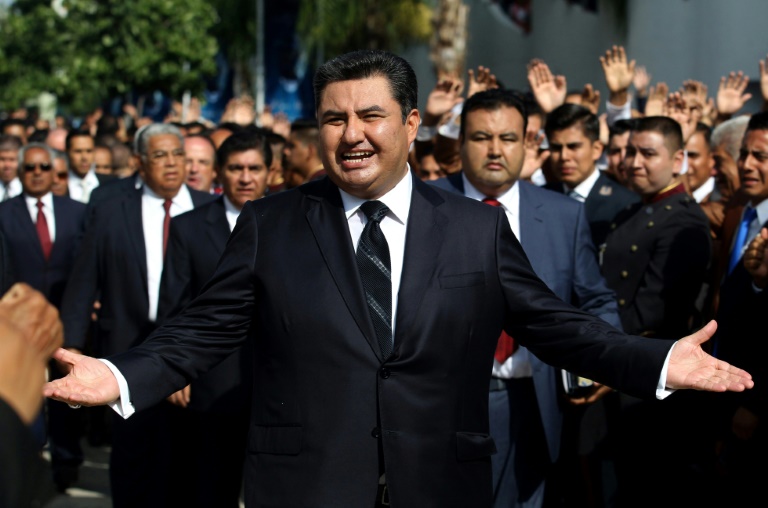
Mexican megachurch leader admits child sex abuse in US

The Mexican head of a huge church admitted sexually abusing children in the United States on Friday, days before he was scheduled to stand trial.

Naason Joaquin Garcia, the leader of La Luz del Mundo (The Light of the World), which claims millions of members worldwide, pleaded guilty to the assaults on young church members around Los Angeles over a number of years.

“As the leader of La Luz del Mundo, Naason Joaquin Garcia used his power to take advantage of children,” California Attorney General Rob Bonta said.

“He relied on those around him to groom congregants for the purposes of sexual assault.”

Prosecutors say Garcia, 53, exploited his position of trust to force underage girls to commit sexual acts on him.

During the course of the investigation they alleged Garcia and his co-defendants had told victims that refusing to comply with his wishes would be acting against God.

Garcia had faced a raft of charges relating to alleged wrongdoing up to his arrest at Los Angeles International Airport in 2019.

The preacher, who was charged alongside two other church members, had been due to stand trial, starting on Monday.

But his guilty pleas to three counts mean he will now be sentenced next week, and is expected to face several years’ jail.

Texas fugitive dies in shootout after allegedly killing five

Texans breathed a sigh of relief on Friday after an escaped murderer suspected of killing five people while on the run was gunned down by police.

Gonzalo Artemio Lopez, 46, who was serving a life sentence for murder, staged a spectacular escape from a prison bus on May 12 and had been the subject of a massive manhunt ever since.

Texas Department of Criminal Justice (TDCJ) spokesman Jason Clark said Lopez had escaped his restraints and sawed through a metal cage in which he was being held on the bus before assaulting the driver and fleeing.

He became the target of one of the largest manhunts in Texas history, involving local, state and federal officers, and a $50,000 reward was offered for his capture.

The authorities became aware of his whereabouts after police were contacted on Thursday by someone who had not heard from relatives who were visiting a vacation home in Centerville.

When police went to the home, they discovered the bodies of an adult and four boys — three brothers and their cousin, aged between 11 and 18, as well as their grandfather — and put out an alert for a Chevy Silverado pickup truck that was missing from the residence.

The stolen truck was located later that evening in Jourdanton, about 200 miles (320 kilometers) from where Lopez escaped, authorities said, and was disabled with “spike strips.”

Lopez, who was armed with an AR-15 assault rifle and a handgun, was shot and killed during a gun battle with law enforcement, TDCJ spokesman Clark said.

“Those officers very swiftly shot and killed Lopez, bringing this whole ordeal to an end,” Clark said.

“We are very saddened that the murders happened but we are breathing a sigh of relief that Lopez will not be able to hurt anyone else,” he said.

– Massive manhunt –

The shaven-headed and heavily-tattooed Lopez, a Mexican mafia gang member, was sentenced to life in prison in 2006 for a murder committed with a pickaxe and kidnapping.

Lopez was being transported some 160 miles by bus from one prison facility to another in Leon County for a medical appointment when he escaped.

There were 15 other prisoners on the bus at the time, according to the authorities, and Lopez was being held in a special metal cage for “high-risk” inmates.

He somehow managed to free himself from restraints, escape from the cage and cut open a gate to attack the bus driver.

Lopez stabbed the driver in the hand and chest in a fight and took the wheel of the bus, authorities said.

Another prison guard shot out the back tires of the bus.

Lopez lost control of the bus less than a mile away and crashed it into a cow pasture. He fled into nearby woods.

He managed to escape detection until late Thursday despite a manhunt that involved hundreds of officers, helicopters, dogs, house-to-house searches and even agents on horseback.

Global stock markets fall after US jobs report

Stock markets mostly fell worldwide on Friday after data showed US employers added jobs at a better-than-expected pace last month, raising the prospect the Federal Reserve’s aggressive interest rate hikes will not be enough to contain inflation and avoid a recession.

Major Wall Street indices fell sharply, with the Nasdaq losing 2.5 percent, and were in the red for the week after a brief positive respite last week.

Paris and Frankfurt both closed slightly down. London’s FTSE 100 was closed for a holiday.

Oil prices, meanwhile, pushed higher, a day after the OPEC+ group of major oil producing nations led by Saudi Arabia and Russia agreed to raise output more than expected in the wake of a European Union ban on most Russian crude.

American employers added 390,000 jobs last month, a sign of a slowdown in hiring but still above forecasts amid a shortage of workers, according to the US Labor Department.

The jobless rate held steady at 3.6 percent for the third consecutive month.

The Fed has hiked interest rates to combat sky-high inflation, but investors worry that more aggressive moves could backfire and hamper economic growth.

The jobs report contained some positive news for the Fed: wage gains slowed in the month and more people returned to the workforce.

But the central bank has signaled big rate hikes are coming, and the increases are likely to continue through the end of the year, adding to investor worries about the economic outlook.

– Worst is not over –

“We are still in a bear market and until proven otherwise the path of least resistance is down,” Maris Ogg of Tower Bridge Advisors, told AFP.

She noted that major components of inflation are not improving.

“Oil is not going to get better, labor is not going to get better, housing is not going to get better. Housing and labor are in shortage,” she said. “As far as the stock market goes, I would be surprised if the worst is over.”

The European Central Bank has indicated it will raise interest rates in July for the first time in over a decade.

Tokyo’s stock market closed higher ahead of the US jobs report. Hong Kong and Chinese mainland indices were closed for holidays.

Among major companies, Tesla shares plunged 9.2 percent after the electric carmaker’s CEO Elon Musk told employees the company plans to cut the salaried workforce by 10 percent and rely on more hourly workers because he had a “super bad feeling” about the economy.

Elsewhere, Brent North Sea crude, the international benchmark, rose 3.2 percent, to $121.31 a barrel.

OPEC+ agreed on Thursday to ramp up output in July by 50 percent more than in previous months.

– Key figures at around 2100 GMT –

New York – Dow: DOWN 1.0 percent to 32,899.7 (close)

New York – S&P 500: DOWN 1.6 percent at 4,108.54 (close)

New York – Nasdaq:  DOWN 2.5 percent at 12,012.73 (close)  

Frankfurt – DAX: DOWN 0.2 percent at 14,460.09 (close)  

Paris – CAC 40: DOWN 0.2 percent at 6,485.30 points (close) 

EURO STOXX 50: DOWN 0.3 percent at 3,783.66 points 

London – FTSE 100: Closed for a holiday

Tokyo – Nikkei 225: UP 1.3 percent at 27,761.57 (close)

Hong Kong – Hang Seng Index: Closed for a holiday

Shanghai – Composite: Closed for a holiday

Brent North Sea crude: UP 3.2 percent at $121.31 per barrel

West Texas Intermediate: UP 2.9 percent at $120.36 per barrel

Euro/dollar: DOWN at $1.0719 from $1.0753 on Thursday

Pound/dollar: DOWN at $1.2488 from $1.2568

Euro/pound: UP at 85.81 pence from 85.49 pence

Dollar/yen: UP at 130.81 yen from 129.85 yen

More than 700 monkeypox cases globally, 21 in US: CDC

The US Centers for Disease Control and Prevention (CDC) said Friday it was aware of more than 700 global cases of monkeypox, including 21 in the United States, with investigations now suggesting it is spreading inside the country.

Sixteen of the first 17 cases were among people who identify as men who have sex with men, according to a new CDC report, and 14 were thought to be travel associated.

All patients are in recovery or have recovered, and no cases have been fatal.

“There have also been some cases in the United States that we know are linked to known cases,” Jennifer McQuiston, deputy director of the CDC’s Division of High Consequence Pathogens and Pathology, told reporters on a call. 

“We also have at least one case in the United States that does not have a travel link or know how they acquired their infection.”

Monkeypox is a rare disease that is related to but less severe than smallpox, causing a rash that spreads, fever, chills, and aches, among other symptoms.

Generally confined to western and central Africa, cases have been reported in Europe since May and the number of countries affected has grown since.

Canada also released new figures Friday, counting 77 confirmed cases — almost all of them detected in Quebec province, where vaccines have been delivered.

Though its new spread may be linked to particular gay festivals in Europe, monkeypox is not thought to be a sexually transmitted disease, with the main risk factor being close skin-to-skin contact with someone who has monkey pox sores. 

A person is contagious until all the sores have scabbed and new skin is formed. 

– ‘More than enough vaccine’ –

Raj Panjabi, senior director for the White House’s global health security and biodefense division, added that 1,200 vaccines and 100 treatment courses had been delivered to US states, where they were offered to close contacts of those infected.

There are currently two authorized vaccines: ACAM2000 and JYNNEOS, which were originally developed against smallpox. 

Though smallpox has been eliminated, the United States retains the vaccines in a strategic national reserve in case it is deployed as a biological weapon. 

JYNNEOS is the more modern of the two vaccines, with fewer side effects.

“We continue to have more than enough vaccine available,” Dawn O’Connell, assistant secretary for preparedness and response in the Department of Health and Human Services, told reporters. 

In late May, the CDC said it had 100 million doses of ACAM200 and 1,000 doses of JYNNEOS available, but O’Connell said Friday the figures had shifted, though she could not divulge precise numbers for strategic reasons.

The CDC has also authorized two antivirals used to treat smallpox, TPOXX and Cidofovir, to be repurposed to treat monkeypox.

“Anyone can get monkeypox and we are carefully monitoring for monkeypox that may be spreading in any population, including those who are not identifying as men who have sex with men,” said McQuiston. 

That being said, the CDC is undertaking special outreach in the LGBT community, she added.

A suspected case “should be anyone with a new characteristic rash,” or anyone who meets the criteria for high suspicion such as relevant travel, close contact, or being a man who has sex with men. 

AU head says 'reassured' after talks with Putin on food shortages

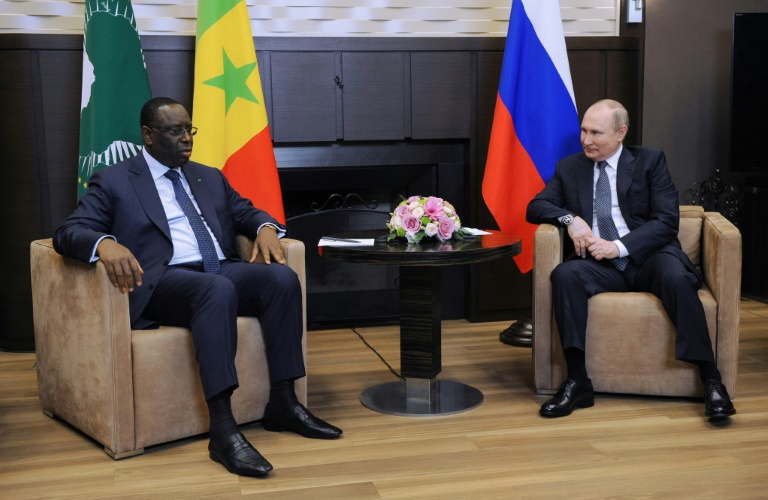
African Union head Macky Sall said on Friday he was “reassured” after talks in Russia with President Vladimir Putin on food shortages caused by Moscow’s military campaign in Ukraine.

Putin hosted the Senegalese president, who chairs the African Union, at his Black Sea residence in Sochi on the 100th day of Moscow’s offensive. Global food shortages and grain supplies stuck in Ukrainian ports were high on the agenda.

“I found Vladimir Putin committed and aware that the crisis and sanctions create serious problems for weak economies, such as African economies,” Sall told journalists, adding that he was leaving Russia “very reassured and very happy with our exchanges”.

Putin in a televised interview in the evening accused the West of “bluster” by claiming Moscow was preventing grain exports from Ukraine.

“There is no problem to export grain from Ukraine,” he said, suggesting several possible routes.

Exports could transit through the Russian-controlled ports of Mariupol and Berdyansk, or the Ukrainian-held port of Odessa as long as Ukraine “cleared” the waters around it of mines, according to Putin.

Other transport options include the Danube River via Romania, Hungary or Poland, he added.

“But the simplest, the easiest, the cheapest would be exports via Belarus, from there one can go to Baltic ports, then to the Baltic Sea and then anywhere in the world.”

But Putin said any export via Belarus would be conditional on the “lifting of sanctions” by the West against Minsk, allied to Moscow.

– ‘On Africa’s side’ –

Ahead of the talks, which lasted three hours, Sall asked Putin “to become aware that our countries… are victims” of the conflict. 

He said it was important to work together so that “everything that concerns food, grain, fertiliser is actually outside” Western sanctions imposed on Moscow after Putin sent troops to Ukraine on February 24.

In his remarks before the talks, Putin did not mention grain supplies but said Russia was “always on Africa’s side” and was now keen to ramp up cooperation.

“We place great importance on our relations with African countries, and I must say this has had a certain positive result,” Putin added.

Washington and Brussels have imposed unprecedented sanctions against Moscow, pushing Putin to seek new markets and strengthen ties with countries in Africa and Asia.

The Kremlin said the two leaders discussed expanding “political dialogue” between Russia and the African Union as well as economic and humanitarian cooperation.

Speaking to reporters earlier on Friday, Putin’s spokesman said the Russian leader would explain to Sall “the real state of affairs” concerning grain supplies stuck in Ukrainian ports.

“No-one is blocking these ports, at least not from the Russian side,” Kremlin spokesman Dmitry Peskov said.

Putin has said Moscow is ready to look for ways to ship grain stuck at Ukrainian ports but has demanded the West lift sanctions.

Russian Foreign Minister Sergei Lavrov is expected in Turkey next Wednesday for talks on creating a “security corridor” to unblock grain exports from Ukraine.

– ‘Food emergency’ –

Moscow’s military campaign in Ukraine and a barrage of international sanctions on Russia have disrupted supplies of fertiliser, wheat and other commodities from both countries, pushing up prices for food and fuel.

Cereal prices in Africa, the world’s poorest continent, have surged because of the slump in exports from Ukraine, sharpening the impact of conflict and climate change and sparking fears of social unrest.

The UN has said Africa faces an “unprecedented” crisis caused by the military operation.

On Thursday, landlocked Chad declared a “food emergency”, urging the international community to help. 

Ships loaded with grain remain blocked in Ukraine, which before February was a leading exporter of corn and wheat and alone accounted for 50 percent of world trade in sunflower seeds and oil. 

Navigation in the Black Sea has also been hampered by mines placed by both Russian and Ukrainian forces.

In 2019, Putin hosted dozens of African leaders in Sochi in a bid to reassert Russia’s influence on the continent.

Though never a colonial power in Africa, Moscow was a crucial player on the continent in the Soviet era, backing independence movements and training a generation of African leaders.

Russia’s ties with Africa declined with the collapse of the Soviet Union in 1991 and in recent years China has emerged as a key foreign power on the continent.

Spain eyes crackdown on video game 'loot boxes'

Spain’s government will within days present a draft bill to regulate video game “loot boxes” for which users must pay, a minister said Friday, warning of the addiction risks for youngsters. 

An increasingly common feature in many video games, “loot boxes” are caches of virtual weapons and equipment which a player can buy to increase their prowess or status within the game.

But not all boxes contain useful tools and gamers can only see what’s inside after paying, prompting widespread criticism for encouraging behaviour similar to that associated with gambling.

“We have drawn up a very specific law which we will present in the coming days” that will regulate the sale of such content, Spain’s Consumer Affairs Minister Alberto Garzon told Radiocable. 

“It is like gambling… because it involves compulsive consumption behaviour which provokes a series of issues for players, from stress to financial bankruptcy,” he told the independent radio station.

“At the end of the day, these are sums which pile up and can lead to gambling addiction,” Garzon said. 

Such features were aimed above all “at the under-18 age group, where in 2021, up to 30 percent admitted they had paid significant amounts of money to obtain such rewards” within a game, he said, citing health ministry statistics. 

The age ratings for such games “don’t take into account the danger posed by this feature, so parents could buy a game for a 13-year-old, for example, without being aware it includes an element which, in real life, could not be bought by anyone under 18,” he explained. 

– ‘Predatory’ –

In April, PEGI, the European body that issues age ratings for video games, introduced a labelling change that requires gaming companies to say if a game includes “paid random items” — a form of optional in-game purchases.

Many other countries have also been struggling with the controversial question of “loot boxes” although few have taken steps to regulate them. 

On Tuesday, 20 European consumer groups threw their weight behind a Norwegian Consumer Council (NCC) report on loot boxes that described them as “exploitative and predatory”, with the groups demanding better regulation of the video game industry. 

“The sale and presentation of loot boxes often involve exploiting consumers through predatory mechanisms, fostering addiction, targeting vulnerable consumer groups and more,” the NCC’s head of digital policy Finn Myrstad said in a statement. 

Gaming companies often used “highly problematic practises to increase their own revenue” through features that “manipulate consumers to spend large sums of money through aggressive marketing, exploitation of cognitive biases, and misleading probabilities”, the report found. 

In Europe, only Belgium and the Netherlands have banned loot boxes after directly associating them with gambling. 

In a statement issued in response to the government’s move, the Spanish Association of Video Games (AEVI) said it “rejects any association with gambling” and insisted on the sector’s right to “self-regulation”. 

Zelensky vows victory on 100th day of Russian invasion

Ukrainian President Volodymyr Zelensky vowed victory on the 100th day of Russia’s invasion on Friday, even as Russian troops pounded the eastern Donbas region.

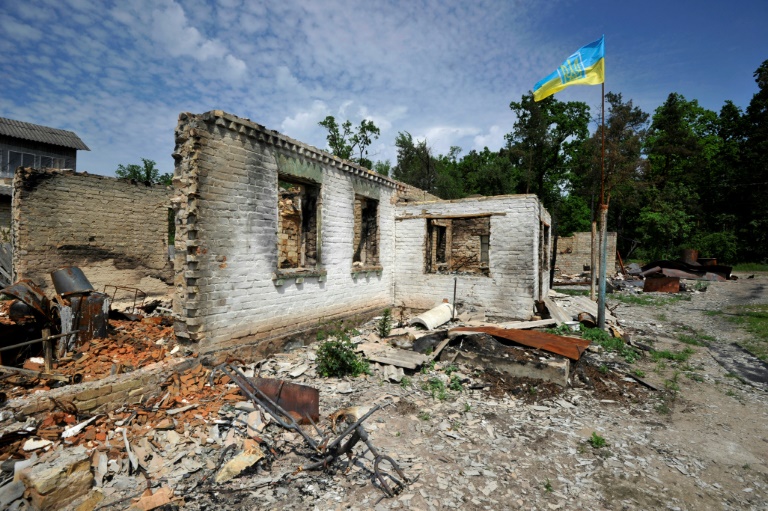
Thousands of people have been killed, millions sent fleeing and towns turned into rubble since Russian President Vladimir Putin ordered his troops into Ukraine on February 24.

Russia’s advance has been slowed by a fierce Ukrainian resistance which repelled them from around the capital and forced Moscow to shift its aims towards capturing the east.

“Victory will be ours,” Zelensky said in a video address similar to one he posted at the onset of the war outside government buildings in Kyiv.

But Kremlin spokesman Dmitry Peskov said: “certain results have been achieved”, pointing to the “liberation” of some areas from what he called the “pro-Nazi armed forces of Ukraine”.

The West has sent ever more potent weapons to Ukraine and piled on ever more stringent sanctions, with the European Union also on Friday formally adopting a ban on most Russian oil imports.

Putin’s alleged girlfriend, former gymnast Alina Kabaeva, was also added to an assets freeze and visa-ban blacklist, along with Russian army personnel suspected of war crimes.

At the same time, the United Nations said it was leading intense negotiations with Russia to allow tens of millions of tons of grain to leave Ukrainian ports to avert a global food crisis.

– ‘No problem’ to export grain –

“I am optimistic that something could give in, something could be made,” said Amin Awad, the UN crisis coordinator for Ukraine, voicing hope that we could “see a breakthrough”.

Putin in a televised interview late Friday said there was “no problem” to export grain from Ukraine, via Kyiv- or Moscow-controlled Ukrainians ports or even via central Europe.

He said this could be done from the Russian-controlled ports of Mariupol and Berdyansk, or the Ukrainian-held port of Odessa as long as Ukraine “cleared” the waters around it.

Russian troops now occupy a fifth of Ukraine’s territory and Moscow has imposed a blockade on the country’s Black Sea ports.

The UN has warned that especially African countries, which imported more than half of their wheat consumption from Ukraine and Russia, face an “unprecedented” crisis caused by the conflict. 

Food prices in Africa have already exceeded those in the aftermath of the 2011 Arab springs and the 2008 food riots.

On Friday, Putin met the head of the African Union, Senegalese President Macky Sall, at his Black Sea residence in Sochi.

Sall told Putin that African countries “are victims” in the Ukraine conflict.

And after the meeting, Sall said he was “very reassured”, adding the Russian leader was “committed and aware that the crisis and sanctions create serious problems for weak economies”.

France’s President Emmanuel Macron, meanwhile, declared Putin had “made a historic and fundamental error” in starting the war.

But he said he should not be “humiliated… so that the day the fighting stops we can pave a way out through diplomatic means.”

Putin’s troops are now concentrating in the Donbas, in the east, where some of the fiercest fighting is centred on the industrial hub city of Severodonetsk.

– Media driver killed –

Fighting continues in Severodonetsk’s city centre, the president’s office said, adding that the invaders were “shelling civilian infrastructure and Ukrainian military”.

“For 100 days, they have been levelling everything”, Lugansk regional governor Sergiy Gaiday said on Telegram.

A driver transporting two Reuters journalists in eastern Ukraine was killed and the two international news agency reporters lightly wounded, a company spokesperson said.

The agency said the group was travelling “in a vehicle provided by the Russian-backed separatists and driven by an individual assigned by the separatists”.

The French foreign ministry also on Friday said a French volunteer fighter in Ukraine had been killed in combat, following reports that the man died in artillery fire in the neighbouring Kharkiv region.

In areas around the capital Kyiv which Russian troops retreated from at the end of March, some residents are still in desperate need.

At an aid distribution point in Horenka, northwest of Kyiv, a tearful Hanna Viniychuk, 67, said she had come for some basic necessities after losing her home in a Russian bombardment.

“I’m grateful for this help,” she said.

– ‘Nothing to come back to’ –

Ukrainian troops were still holding an industrial zone, Gaiday said, a situation reminiscent of Mariupol, where a steelworks was the south-eastern port city’s last holdout until Ukrainian troops finally surrendered in late May.

The situation in Lysychansk — Severodonetsk’s twin city, which sits just across a river — also looked increasingly dire. 

About 60 percent of infrastructure and housing had been destroyed, while internet, mobile network and gas services had been knocked out, said the city’s mayor Oleksandr Zaika.

“The shelling is getting stronger every day,” he said.

In the city of Sloviansk, about 80 kilometres (50 miles) from Severodonetsk, the mayor has urged residents to evacuate as bombing intensified with water and electricity cut off.

Student Gulnara Evgaripova, 18, recounted heavy bombardments as she boarded a minibus to leave the city.

“The situation is getting worse,” she told AFP.

Ekaterina Perednenko, a paramedic, said: “I am scared that there will be nothing to come back to.”

burs-ah/bp

GM unit Cruise to deploy driverless taxis in US first

General Motor’s autonomous vehicle unit Cruise says it will deploy driverless taxis in San Francisco in a first for a major US city.

Cruise announced the plans for a ride hailing service using self-driving electric cars after the California Public Utilities Commission (CPUC) issued it a permit to give rides without anyone in the driver’s seat.

“This means that Cruise will be the first and only company to operate a commercial, driverless ride-hail service in a major US city,” chief operating officer Gil West said in a blog post late Thursday.

“We’ll begin rolling out fared rides gradually.”

The permit allows Cruise to use its fleet of 30 electric, autonomous cars in a taxi service in some parts of San Francisco.

The robotaxis are not to go faster than 30 miles per hour (48 kilometers per hour) and have a green light to only operate between late morning and early evening, barring foul weather such as thick fog or heavy rain, the CPUC permit states.

“Crossing the threshold into commercial operations isn’t just big news for Cruise alone,” West said.

“It is a major milestone for the shared mission of the (autonomous vehicle) industry to improve life in our cities.”

Self-driving, electric car services promise to reduce pollution, and save people time and money, West added.

San Francisco police earlier this year faced an unprecedented problem when an officer stopped a car that was driving at night with no headlights on, only to discover there was no one inside. 

The vehicle, it turned out, was a self-driving Cruise car, and the police officer’s encounter was captured by a passerby, who posted video on social media.

Cruise took to Twitter to say that the self-driving car “yielded to the police vehicle, then pulled over to the nearest safe location for the traffic stop, as intended. An officer contacted Cruise personnel and no citation was issued.”

Cruise explained that the headlights were turned off due to human error.

Founded in 2013, Cruise has developed software that allows cars to drive themselves completely autonomously. 

General Motors owns the majority of shares in the company, valued at more than $30 billion thanks to investments by companies such as Microsoft, Honda and Walmart. 

Cruise rival Waymo last year expanded its robotaxi service to riders in San Francisco, but has “specialists” at the steering wheels to take over driving if needed.

The move expanded a Waymo ride-hailing program which has been operating in Phoenix, Arizona since 2017.

Close Bitnami banner
Bitnami