US Business

Harrowing new accounts emerge from Uvalde's young survivors

Fresh harrowing accounts emerged Saturday of the ordeal faced by survivors of the school shooting in Uvalde, Texas, fanning public fury over the massacre ahead of a visit Sunday by US President Joe Biden.

As residents gathered Saturday in a central square to pay homage to the victims, haunting stories told by young students who played dead while a gunman killed 19 classmates and two teachers were underscored by accounts of the slow reaction to the spree by police. 

Ten-year-old Samuel Salinas was sitting in his fourth-grade classroom when the shooter, later identified as Salvador Ramos, 18, barged in with a chilling announcement: “You’re all going to die.”

Then “he just started shooting,” Salinas told ABC News.

Texas authorities belatedly admitted Friday that as many as 19 police officers were in the school hallway for more than an hour without acting, thinking the shooter had ended his killing, calling it the “wrong decision.”

Ramos, who carried two assault-style rifles, was finally killed by police.

Uvalde survivors have described making desperate, whispered pleas for help in 911 phone calls during his assault. Many played dead to avoid drawing the shooter’s attention.

Eleven-year-old Miah Cerrillo even smeared the blood of a dead friend on herself as she feigned death. 

Samuel Salinas said he thinks Ramos fired at him, but the bullet struck a chair, sending shrapnel into the boy’s leg. “I played dead so he wouldn’t shoot me,” he said.

Another student, Daniel, whose mother would not provide his last name, said he saw Ramos fire through the glass in the classroom door, striking his teacher.

The bullets were “hot,” he told the Washington Post, and when another bullet ricocheted and struck a fellow student in the nose, he said he could hear the sickening sound it made.

Though his teacher lay on the floor bleeding, she repeatedly told the students, “‘Stay calm. Stay where you are. Don’t move,'” Daniel recalled.

He was finally rescued by police who broke the windows of his classroom. Since then, he has had recurrent nightmares.

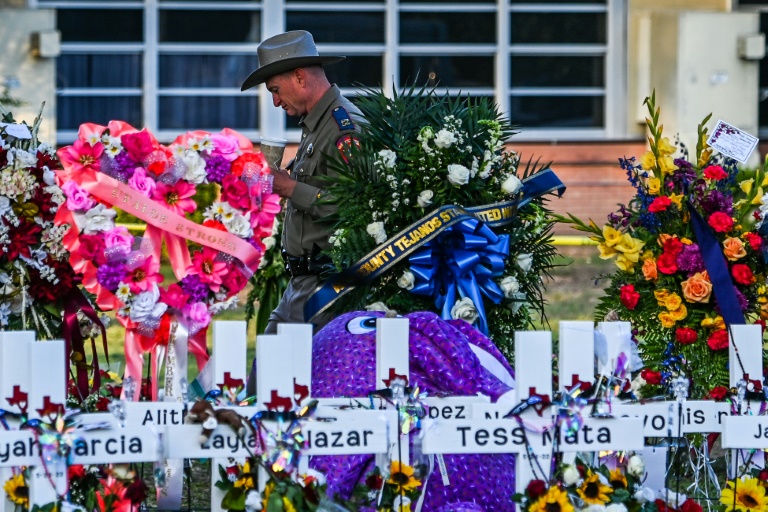
By mid-morning Saturday, several dozen people had gathered at Uvalde’s courthouse square, which has become a somber place of homage to victims and survivors. 

Twenty-one simple white crosses have been erected around a fountain — one for each victim. 

People have left growing piles of stuffed animals and flowers, as well as heart-rending messages: “Love you” and “You will be missed.”

Local resident Humberto Renovato, 33, asked those present to hold hands, form a circle around the crosses, and pray. 

– ‘Too much fear. Too much grief’ –

President Joe Biden will visit Uvalde on Sunday to again make the case for gun control, as activists set about galvanizing voters on the issue in the run-up to November’s midterm election.

Despite the scourge of mass shootings, efforts at nationwide gun control have repeatedly failed, though polls show broad support from Americans.

Speaking at a University of Delaware commencement on Saturday, Biden — himself a grieving father twice over — evoked the image of parents preparing to bury their children in Texas, and lamented “too much violence. Too much fear. Too much grief.”

“We have to stand stronger,” he told the graduates at his alma mater. 

Biden’s deputy, Vice President Kamala Harris, issued a similar call Saturday as she attended the funeral of another mass shooting victim — Ruth Whitfield, who was among the 10 killed when a white supremacist opened fire in a supermarket in Buffalo on May 14.

“We will not let those people who are motivated by hate to separate us or make us feal fear,” Harris said at the funeral for the 86-year-old.

Back in Texas, the state Senate Democratic caucus issued a call Saturday for Governor Greg Abbott to convene an emergency session of the state legislature to pass legislation to raise the minimum age for firearm purchases, among other measures. 

Chances of substantive change there appeared slim, however. Texas has long been one of the most gun-friendly states.

The Uvalde shooting was the deadliest school attack since 20 children and six staff were killed at the Sandy Hook school in Newtown, Connecticut in 2012.

Texas public safety department director Steven McCraw on Friday revealed a series of emergency calls — including by a child begging for police help — that were made from two adjoining classrooms where the gunman was barricaded.

But, explaining the delayed reaction by law enforcement, he said the on-scene commander believed at the time that Ramos was in there alone, with no survivors, after his initial assault.

McCraw separately told reporters, however, that a 911 call received at 12:16 pm reported eight or nine children still alive. 

As many as 19 officers were outside the classroom door at that time, according to McCraw’s timeline.

McCraw said one caller — a child who dialed 911 multiple times — begged for police to come. Her final call was cut off as she made it outside.

Meantime in Uvalde, Humberto Renovato urged those gathered at the courthouse square to help survivors overcome “the trauma, the pain, the suffering” they had endured.

“As a community,” he said, “we have to develop strategies of how we’re going to help these kids to get out of that trauma, to get out of that pain.”
Cash-strapped Sri Lanka gets Russian oil to ease shortages

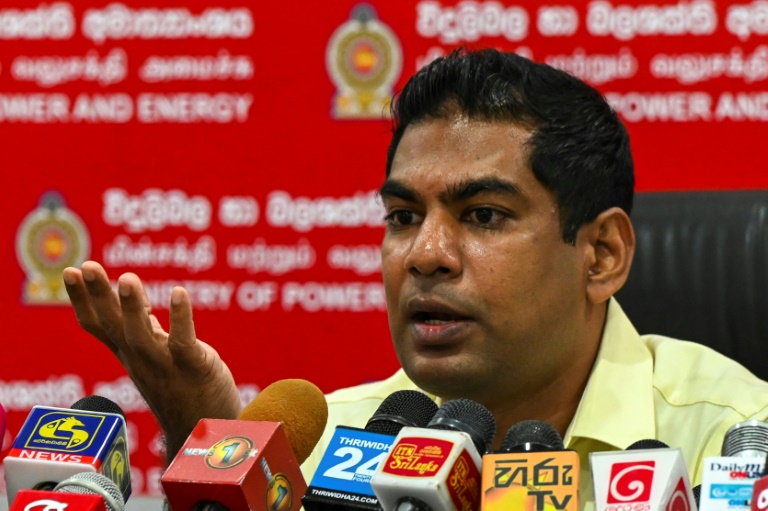
Cash-strapped Sri Lanka took delivery Saturday of Russian oil — which could soon be subject to a European embargo — to restart operations at the country’s only refinery, the energy minister said.

The island nation is suffering its worst economic meltdown since independence, with shortages of fuel and other essentials making life miserable for its 22 million people. 

The state-run Ceylon Petroleum Corporation (CPC) refinery was shuttered in March following Sri Lanka’s foreign exchange crunch, which left the government unable to finance imports, including crude. 

The Russian crude delivery had been waiting offshore of the capital Colombo’s port for over a month as the country was unable to raise $75 million to pay for it, energy minister Kanchana Wijesekera said.

Colombo is also in talks with Moscow to arrange direct supplies of crude, coal, diesel and petrol despite US-led sanctions on Russian banks and a diplomatic outcry over Russia’s invasion of Ukraine.

“I have made an official request to the Russian ambassador for direct supplies of Russian oil,” Wijesekera told reporters in Colombo. 

“Crude alone will not fulfil our requirement, we need other refined (petroleum) products as well.”

Around 90,000 tonnes of Siberian light crude will be sent to Sri Lanka’s refinery after the shipment was acquired on credit from Dubai-based intermediary Coral Energy.

Wijesekera said Ceylon Petroleum Corporation (CPC) was already in arrears of $735 million to suppliers and no one came forward to even bid for its oil tenders.

He added that the Siberian grade was not an ideal match for the refinery, which is optimised for Iranian light crude, but no other supplier was willing to extend credit. 

Sri Lanka will nonetheless call for fresh supply tenders in two weeks before the stock of Siberian light runs out, Wijesekera said.

The Sapugaskanda refinery on Colombo’s outskirts will resume work in about two days to produce about 1,000 tonnes of diesel daily to meet an acute shortage.

European Union leaders are meeting on Monday in an effort to negotiate a fresh round of sanctions against Russia over the Ukraine conflict, including an oil embargo.

Russian oil is already subject to a US embargo and its barrels have traded at a steep discount from international benchmarks, which have risen substantially since the conflict began. 

– Protest milestone –

Sri Lanka’s economic crisis has seen long queues of motorists outside gas stations, waiting hours and sometimes even days for scant supplies of petrol and cooking gas. 

Its people are also grappling with a serious lack of imported food and pharmaceuticals, along with record inflation and lengthy daily blackouts.

Anti-government protests erupted into riots earlier this month, leaving nine people dead and many more wounded.

A demonstration outside President Gotabaya Rajapaksa’s office in Colombo demanding his resignation over the government’s economic mismanagement entered its 50th day Saturday.

Meanwhile thousands of activists led by university students marched through the streets of Colombo and clashed with police guarding access roads to Rajapaksa’s official residence.

Police fired tear gas and water cannon to disperse the protesters who pulled down yellow-painted iron barricades.

Two people were briefly detained by police and later released, according to witnesses.

There were no reports of serious casualties, but ambulances were seen ferrying some people affected by tear gas.

Russia steps up battle for eastern Ukraine

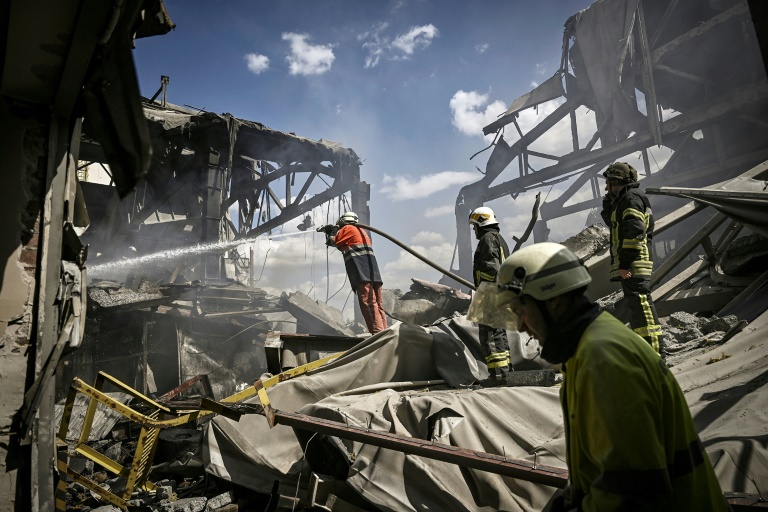
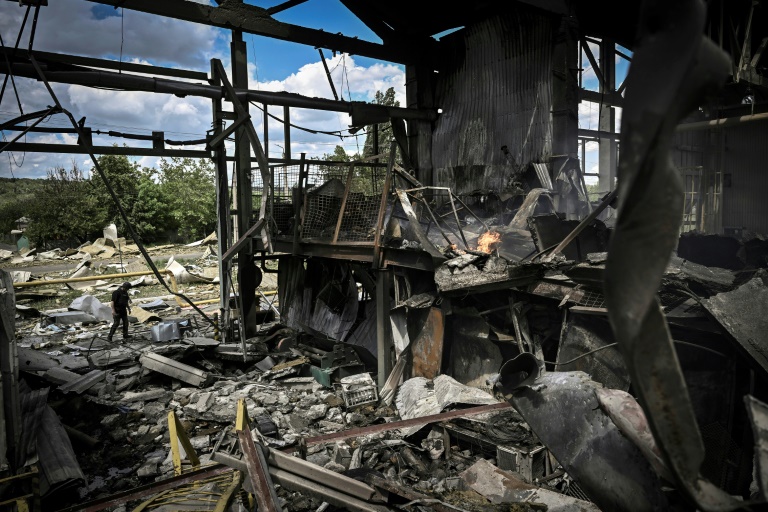
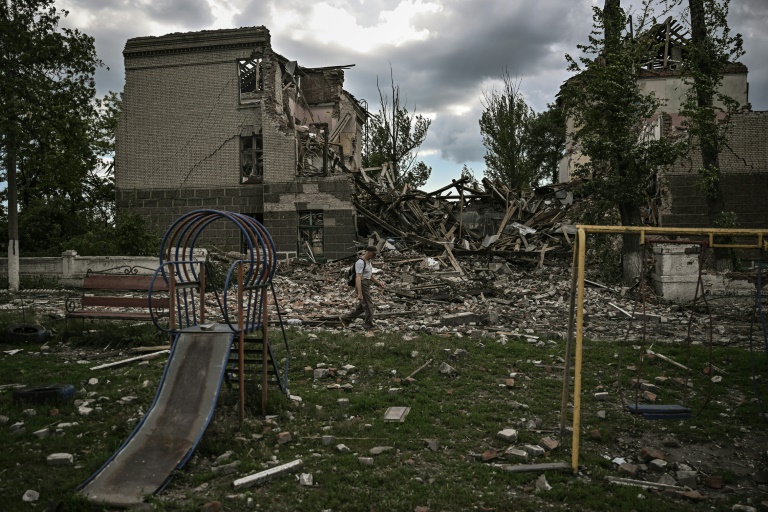
Russia pressed its onslaught on eastern Ukraine Saturday, saying it had captured the strategic town of Lyman and had successfully tested hypersonic missiles in the Arctic.

Ukrainian forces battled to repel Russian forces from the outskirts of the key city of Severodonetsk, a Ukrainian official said, however denying claims it had been surrounded.

Russia is waging all-out war for the eastern Donbas region — Ukraine’s industrial heartland where President Volodymyr Zelensky has accused Moscow of carrying out a “genocide”.

“The town of Krasny Liman has been entirely liberated from Ukrainian nationalists,” the Russian defence ministry said, using the Russian name for Lyman and confirming an announcement made a day earlier by pro-Moscow separatists.

Lyman lies on the road to the urban centres of Severodonetsk and Kramatorsk.

Russian forces have been closing in on Severodonetsk and nearby Lysychansk in Lugansk province, with conflicting reports about the extent of their advance.

Regional governor Sergiy Gaiday said Russian shelling continued on Severodonetsk as Ukrainian soldiers fought to oust the invading forces from a hotel on its edges, but rejected claims the city had been  encircled.

“Severodonetsk has not been cut off… there is still the possibility to deliver humanitarian aid,” he told Ukrainian television.

A Lugansk police official, cited by Russia’s state news agency RIA Novosti, late Friday said Severodonetsk was “now surrounded” and Ukrainian troops could no longer leave the city.

– France, Germany urge talks –

Three months after Russia launched its invasion on February 24, leaving thousands dead on both sides and forcing 6.6 million people out of the country, Moscow has gained control over swathes of eastern and southern Ukraine, including port cities Kherson and Mariupol.

Other Ukrainian ports have been cut off from the world by Russian warships, preventing key grain supplies from being transported out.

Russia and Ukraine supply about 30 percent of the wheat traded on global markets.

Russia has tightened its own exports and Ukraine has vast amounts stuck in storage, driving up prices and cutting availability for importers across the globe.

President Vladimir Putin has repeatedly rejected any responsibility, instead blaming Western sanctions.

But on Saturday he told French President Emmanuel Macron and German Chancellor Olaf Scholz in a phone call Russia was “ready” to look for ways to allow more wheat onto the global market.

“Russia is ready to help find options for the unhindered export of grain, including the export of Ukrainian grain from the Black Sea ports,” the Kremlin reported him as saying.

He called for the lifting of sanctions to allow “an increase in the supply of Russian fertilisers and agricultural products” onto the global market.

Macron and Scholz urged Putin to hold “direct serious negotiations” with Zelensky, the German chancellor’s office said.

And they demanded Russia free 2,500 Ukrainian fighters taken as prisoners of war after surrendering earlier this month at a sprawling steelworks in the ravaged port city of Mariupol.

– More weapons ‘dangerous’ –

Zelensky late Friday said his country was doing everything to defend the Donbas from intense artillery and missile strikes.

“We are protecting our land in the way that our current defence resources allow. We are doing everything to increase them,” he added. 

To further help the Ukrainians, Washington was preparing to send advanced long-range rocket systems, US media reports said.

Pentagon spokesman John Kirby did not confirm the plans to deliver the M270 Multiple Launch Rocket System, highly mobile equipment capable of firing up to 300 kilometres (186 miles) that Kyiv has said it badly needs.

But he said Washington was “still committed to helping them succeed on the battlefield”.

British Prime Minister Boris Johnson pledged his country’s continued support “including helping provide the equipment they need” in a call Saturday with Zelensky, his office said.

But Putin warned Macron and Scholz that ramping up arms supplies to Ukraine would be “dangerous” and risk “further destabilisation”.

He spoke after his army said it had successfully fired one of its Zircon hypersonic cruise missiles some 1,000 kilometres (625 miles) across the Arctic.

– Ship docks in Mariupol –

As he seeks to ramp up international pressure on Moscow, Zelensky will speak to EU leaders at an emergency summit Monday as they try to agree on an embargo on Russian oil, which is being held up by Hungary, whose Prime Minister Viktor Orban has close relations with Putin.

“We need to act until they stop their policy of aggression,” Zelensky told a think tank in Indonesia.

But Moscow said Russia expects to receive one trillion rubles ($15 billion) in additional oil and gas revenues this year, a windfall from the sharp rise in oil prices caused in part by its invasion of Ukraine.

In Ukraine, a spokesman for the Russian-controlled Mariupol port said a first ship had docked there on Saturday.

“It will be loaded up with 2.7 tonnes of steel,” he told Russian state news agency TASS.

There was however no official announcement from either the Russian or separatist authorities.

burs-ah/ach 

Harrowing new accounts emerge from Uvalde's young survivors

Fresh harrowing accounts emerged Saturday of the ordeal faced by survivors of the school shooting in Uvalde, Texas, fanning public fury over the massacre even as the deeply traumatized town prepared for a visit Sunday by US President Joe Biden.

The haunting stories told by young students who were forced to play dead as a heavily armed gunman continued a methodical spree — killing 19 students and two teachers — have been underscored by accounts of the slow reaction by police during the drama. 

Ten-year-old Samuel Salinas was sitting in his fourth-grade classroom when the shooter, later identified as Salvador Ramos, 18, barged in with a chilling announcement: “You’re all going to die.”

Then “he just started shooting,” Salinas told ABC News.

Texas authorities belatedly admitted Friday that as many as 19 police officers were in the school hallway for more than an hour without acting, thinking the shooter had ended his killing.

“From the benefit of hindsight… it was the wrong decision, period,” said Texas Department of Public Safety director Steven McCraw.

Ramos, who carried two assault-style rifles, was finally killed by police.

Uvalde survivors have described making desperate, whispered pleas for help in 911 phone calls during his assault. Many played dead to avoid drawing the shooter’s attention.

Eleven-year-old Miah Cerrillo even smeared the blood of a dead friend on herself as she feigned death. 

Samuel Salinas said he thinks Ramos fired at him, but the bullet struck a chair, sending shrapnel into the boy’s leg. “I played dead so he wouldn’t shoot me,” he said.

Another student, Daniel, whose mother would not provide his last name, said he saw Ramos fire through the glass in the classroom door, striking his teacher.

The bullets were “hot,” he told the Washington Post, and when another bullet ricocheted and struck a fellow student in the nose, he said he could hear the sickening sound it made.

Though his teacher lay on the floor bleeding, she repeatedly told the students, “‘Stay calm. Stay where you are. Don’t move,'” Daniel recalled.

He was finally rescued by police who broke the windows of his classroom. Since then, he has had recurrent nightmares.

– A troubling timeline –

President Joe Biden will visit Uvalde on Sunday to again make the case for gun control, as activists set about galvanizing voters on the issue in the run-up to November’s midterm election.

Despite the scourge of mass shootings, efforts at nationwide gun control have repeatedly failed, though polls show broad support from Americans.

Speaking at a University of Delaware commencement on Saturday, Biden — himself a grieving father twice over — evoked the image of parents preparing to bury their children in Texas, and lamented “too much violence. Too much fear. Too much grief.”

“We have to stand stronger,” he told the graduates at his alma mater. 

The Uvalde shooting was the deadliest since 20 children and six staff were killed at the Sandy Hook school in Newtown, Connecticut in 2012.

McCraw revealed a series of emergency calls — including by a child begging for police help — that were made from two adjoining classrooms where the gunman was barricaded.

But he said the on-scene commander believed at the time that Ramos was in there alone, with no survivors, after his initial assault.

“I’m not defending anything, but you go back in the timeline, there was a barrage, hundreds of rounds were pumped in in four minutes, okay, into those two classrooms,” McCraw said.

“Any firing afterwards was sporadic and it was at the door. So the belief is that there may not be anybody living anymore.”

McCraw separately told reporters, however, that a 911 call received at 12:16 pm reported eight or nine children still alive. 

As many as 19 officers were outside the classroom door at that time, according to McCraw’s timeline.

McCraw said one caller — a child who dialed 911 multiple times — begged for police to come. Her final call was cut off as she made it outside.

Texas Governor Gregg Abbott told journalists who grilled him during a testy news conference Friday that he was given inaccurate information in the wake of the massacre.

“I was misled,” Abbott said. “The information that I was given turned out in part to be inaccurate, and I’m absolutely livid about that.”

Russia steps up battle for eastern Ukraine

Russia pressed its onslaught on eastern Ukraine Saturday, saying it had captured the strategic town of Lyman and had succesfully tested hypersonic missiles in the Arctic.

Ukrainian forces down the road battled to repel Russian forces from the outskirts of the key city of Severodonetsk, a Ukrainian official said, however denying claims it had been surrounded.

Russia is waging all-out war for the eastern Donbas region — Ukraine’s industrial heartland where President Volodymyr Zelensky has accused Moscow of carrying out a “genocide”.

“The town of Krasny Liman has been entirely liberated from Ukrainian nationalists,” the Russian defence ministry said, using the Russian name for Lyman and confirming an announcement a day earlier by pro-Moscow separatists.

Lyman lies on the road to the urban centres of Severodonetsk and Kramatorsk still in Moscow’s sights.

Russian forces have been closing in on Severodonetsk and nearby Lysychansk in Lugansk province, with conflicting reports about the extent of their advance.

Regional governor Sergiy Gaiday said Russian shelling continued on Severodonetsk as Ukrainian soldiers fought to oust invading forces from a hotel on its edges, but rejected claims the city had been completely encircled.

“Severodonetsk has not been cut off… there is still the possibility to deliver humanitarian aid,” he told Ukrainian television.

A Lugansk police official, cited by Russia’s state news agency RIA Novosti, late Friday said Severodonetsk was “now surrounded” and Ukrainian troops could no longer leave the city.

But Zelensky late Friday said his country was doing everything to defend the Donbas from intense artillery fire, “missile strikes and aircraft attacks”.

“We are protecting our land in the way that our current defence resources allow,” he added. 

“We are doing everything to increase them.”

– Australian killed –

As the country faces an increasingly desperate humanitarian situation, an Australian man was on Saturday reported to have been killed this week while supplying aid. 

Tasmania’s Mercury newspaper identified the man as Michael Charles O’Neill, 47, with a tribute on Facebook saying he had been “driving the wounded and injured from the front line”. An Australian official confirmed the death.

Three months after Russia launched its invasion on February 24, leaving thousands dead on both sides and forcing 6.6 million people out of the country, Moscow has gained control over swathes of eastern and southern Ukraine, including port cities Kherson and Mariupol.

Russia Saturday announced the latest test of its Zircon hypersonic cruise missile, which it said had dashed across some 1,000 kilometres (625 miles) and “successfully hit” a target in the Arctic.

To further help Ukraine fight back, Washington was preparing to send advanced long-range rocket systems, according to US media reports.

Pentagon spokesman John Kirby did not confirm the plans to deliver the M270 Multiple Launch Rocket System, a highly mobile system capable of firing up to 300 kilometres (186 miles) that Kyiv has said it badly needs.

But he said Washington was “still committed to helping them succeed on the battlefield”.

Mykhaylo Podolyak, an adviser to President Zelensky, said on Twitter that some of Ukraine’s partners “avoid giving the necessary weapons because of fear of the escalation. Escalation, really?”

– Russian ship in Mariupol –

Seeking to increase international pressure on Russia, Zelensky will speak with EU leaders at an emergency summit Monday as they try to agree on an embargo on Russian oil, which is being held up by Hungary, whose Prime Minister Viktor Orban has close relations with Russian President Vladimir Putin.

“Rather than continue trading with (Russia), we need to act until they stop their policy of aggression,” Zelensky told a think tank in Indonesia.

But in Moscow, Finance Minister Anton Siluanov said Russia expects to receive one trillion rubles ($15 billion) in additional oil and gas revenues this year, a windfall from the sharp rise in oil prices caused in part by its invasion of Ukraine.

As his navy blockades Ukrainian ports, Putin also rejected claims he was disrupting food supplies worldwide.

Russia and Ukraine supply about 30 percent of the wheat traded on global markets.

Russia has tightened its own exports and Ukraine has vast amounts stuck in storage, driving up prices and cutting availability for importers across the globe.

But a spokesman for the Russian-controlled port of Mariupol said a first ship had docked there on Saturday, barely a week after the last Ukrainian fighters surrendered and left the city.

“It will be loaded up with 2.7 tonnes of steel,” he told Russian state news agency TASS.

A correspondent for staunchly pro-Kremlin Russian newspaper Izvestia said it was accompanied by two warships.

There was however no official announcement from either the Russian or separatist authorities.

Russian forces battered the port city for months before the last Ukrainian fighters at its sprawling steelworks finally laid down their weapons last week.

burs-ah/lc

Ukraine says doing 'everything' to defend Donbas from Russian onslaught

Ukraine said it is doing “everything” to defend the eastern Donbas region, where Russia confirmed Saturday it had captured a strategic town in its intensifying offensive.

Russia is waging all-out war for the Donetsk and Lugansk regions that make up Donbas — Ukraine’s industrial heartland where President Volodymyr Zelensky has accused Moscow of carrying out a “genocide”.

Zelensky said late Friday the Russians had “concentrated maximum artillery, maximum reserves in Donbas”.

“There are missile strikes and aircraft attacks — everything,” he said. 

“We are protecting our land in the way that our current defence resources allow,” he added. 

“We are doing everything to increase them.”

Moscow’s army said Saturday it had seized control of Lyman town, on the road to the two key cities of Severodonetsk and Kramatorsk still under Kyiv’s control, confirming an announcement a day earlier by pro-Moscow separatists. 

Russian forces are also closing in on Severodonetsk and Lysychansk in Lugansk province, with conflicting reports about the extent of their advance.

Regional governor Sergiy Gaiday insisted Ukrainian forces would be able to resist for at least another two or three days — but said troops may have to withdraw from some areas to avoid being surrounded.

“Most probably they (Russian troops) will not seize (Lugansk), because there’s enough strength and means to hold the defence,” he said on Telegram.

“Maybe even to avoid encircling there might be a command to our troops to retreat.”

– ‘No longer scared’ –

A Lugansk police official, cited by Russia’s state news agency RIA Novosti, said Severodonetsk was “now surrounded” and Ukrainian troops could no longer leave the city.

That was denied by senior city official Oleksandr Stryuk, though he acknowledged the situation was “very difficult” with incessant bombing.

“People are willing to risk everything to get food and water,” said the head of the main aid distribution centre in Lysychansk, Oleksandr Kozyr.

“They are so psychologically depressed that they are no longer scared. All they care about is finding food.” 

As the country faces an increasingly desperate humanitarian situation, an Australian man was on Saturday reported to have been killed this week while supplying aid. 

Tasmania’s Mercury newspaper identified the man as Michael Charles O’Neill, 47, with a tribute on Facebook saying he had been “driving the wounded and injured from the front line”.

An Australian foreign affairs department spokesperson confirmed the death.

Three months after Russia launched its invasion on February 24, leaving thousands dead on both sides and forcing 6.6 million people out of the country, Moscow has gained control over swathes of eastern and southern Ukraine, including port cities Kherson and Mariupol.

“Russian forces have made steady, incremental gains in heavy fighting in eastern Ukraine in the past several days, though Ukrainian defences remain effective overall,” said the US-based Institute for the Study of War.

To further help Ukraine fight back, Washington was preparing to send advanced long-range rocket systems, according to US media reports.

Pentagon spokesman John Kirby did not confirm the plans to deliver the M270 Multiple Launch Rocket System, a highly mobile system capable of firing up to 300 kilometres (186 miles) that Kyiv has said it badly needs.

“We are still committed to helping them succeed on the battlefield,” Kirby said.

Mykhaylo Podolyak, an adviser to President Zelensky, said on Twitter that some of Ukraine’s partners “avoid giving the necessary weapons because of fear of the escalation. Escalation, really?” 

– ‘Suffering’ –

In a historic move against Russia’s spiritual authorities, the Moscow branch of Kyiv’s Orthodox Church said Friday it was cutting ties with Russia over its invasion of Ukraine.

Ukraine has been under Moscow’s spiritual leadership since at least the 17th century, but part of its Orthodox Church broke with Moscow in 2019 over Russia’s annexation of Crimea and support for separatists in Donbas.

Seeking to increase international pressure on Russia, Zelensky will speak with EU leaders at an emergency summit Monday as they try to agree on an embargo on Russian oil, which is being held up by Hungary, whose Prime Minister Viktor Orban has close relations with Russian President Vladimir Putin.

“Rather than continue trading with (Russia), we need to act until they stop their policy of aggression,” Zelensky told a think tank in Indonesia.

But in Moscow, Finance Minister Anton Siluanov said Russia expects to receive one trillion rubles ($15 billion) in additional oil and gas revenues this year, a windfall from the sharp rise in oil prices caused in part by its invasion of Ukraine.

As his navy blockades Ukrainian ports, Putin also rejected claims he was disrupting food supplies worldwide. Russia and Ukraine supply about 30 percent of the wheat traded on global markets.

Russia has tightened its own exports and Ukraine has vast amounts stuck in storage, driving up prices and cutting availability for importers across the globe.

In a call Friday with Austrian Chancellor Karl Nehammer, Putin put the blame on “anti-Russian sanctions by the United States and the European Union, among other things”, the Kremlin said.

He also accused Kyiv of “sabotaging” negotiations and urged Ukraine to de-mine ports “as soon as possible” to allow the passage of grain-carrying vessels, the Kremlin said.

burs-ah/jv

Country music stars distance themselves from NRA after school massacre

Country music has long been closely linked to America’s pro-gun lobby, but several stars have distanced themselves from the National Rifle Association following the mass shooting at a Texas school.

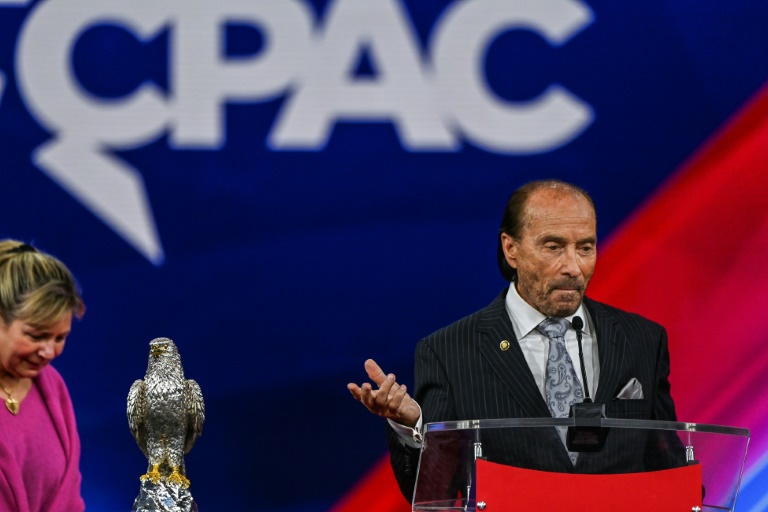
At least five country musicians, including “God Bless the USA” performer Lee Greenwood, pulled out of the NRA’s annual convention that opened Friday in Texas. “American Pie” singer-songwriter Don McLean also withdrew.

Their initial billing highlights the close links between country music and the gun-supporting right in the United States, but experts say their withdrawal is indicative of shifting attitudes.

McLean, 76, said it would be “disrespectful and hurtful” to perform at the convention’s “Grand Ole Night of Freedom” concert scheduled for Saturday after 19 students and two teachers were killed at an elementary school in the small town of Uvalde.

Greenwood, whose patriotic signature song regularly rings out at Donald Trump rallies, said he canceled “out of respect” for those mourning, while Larry Gatlin said he couldn’t perform “in good conscience.”

T. Graham Brown and Larry Stewart, lead singer of country band Restless Heart, also withdrew, according to statements carried by USA Today.

– ‘Not monolithic’ –

Conjuring up images of stetson hats, cowboy boots and the Stars and Stripes flag, country has traditionally been the favorite music of conservative white Americans.

Its fan base is predominantly white, with roots in the largely Republican southern US states.

“Country music is not monolithic by any means,” Professor Mark Brewer, who teaches a class on music and American politics at the University of Maine, told AFP.

“But I think it’s safe to say that the predominant themes over the years have been more conservative, maybe with a hint of libertarian populism mixed in.”

Brewer says there have been “longstanding connections” between country music, conservative politics, and gun culture. One of the reasons is geography.

“There’s a big regional overlap. Country music has its origins in the American south and southern American politics have always been conservative.

“The United States as a whole has a pretty prevalent gun culture, but it’s even more pronounced in the south,” he added.

Professor Joel Schwindt, who teaches country music history at the Boston Conservatory at Berklee, said the genre was “very specifically marketed” to white America from the start.

Adding to its appeal amongst white working class groups was a “firm support for the military.”

-2017 Las Vegas shooting –

Unlike Hollywood and the US pop music industry, which lean left, country music has plenty of conservative artists.

The musicians who withdrew from the NRA convention were careful not to criticize the gun body in their statements.

Stewart praised it as a “great organization” as he defended the US constitution’s famous Second Amendment right to bear arms.

Numerous country musicians have called for more gun regulations though, including Eric Church, Jason Isbell, Maren Morris and Kacey Musgraves.

Several spoke out after a man opened fire from his hotel on a Las Vegas country music festival in 2017, killing 60 people in the deadliest mass shooting in modern US history.

Rosanne Cash, singer-songwriter and daughter of late country musician Johnny Cash, wrote an Op-Ed in the New York Times later that year calling on country musicians to stand up to the NRA.

“I think we’ve had more genuinely progressive stands in the last decade than we’ve probably ever had before,” including on LGBTQ issues, said Brewer.

Although there are no conclusive studies, he thinks this might be because younger performers tend to be more progressive, as are the fans they are trying to attract.

Schwindt notes that while country music’s fan base is primarily white, “regular listenership among non-white listeners, Black listeners and Hispanic listeners in particular, has grown pretty significantly over the past 10 to 20 years.”

Could that lead to more country stars taking progressive stances in the future?

“It’s something we’re seeing more of,” said Brewer. “I don’t know if I’d say that’s the dominant position still by any means. But it’s becoming more and more visible,” he added.

Ukraine says 'everything' being done to defend Donbas from Russian onslaught

Ukraine has pledged to do “everything” to defend Donbas, where an intensifying Russian offensive is prompting Kyiv’s forces to consider a strategic retreat from some key areas to avoid being surrounded.

Russia is waging all-out war for the eastern Donetsk and Lugansk regions that make up Donbas — the country’s industrial heartland — where Ukraine’s President Volodymyr Zelensky has accused Moscow of carrying out a “genocide”.

In his daily address to Ukrainians, Zelensky said the Russians had “concentrated maximum artillery, maximum reserves in Donbas.”

“There are missile strikes and aircraft attacks — everything,” he said. 

“We are protecting our land in the way that our current defense resources allow,” he added. “We are doing everything to increase them.”

Pro-Russian separatists said Friday they had captured the town of Lyman between Severodonetsk and Kramatorsk, on the road leading to the key cities still under Kyiv’s control.

Russian forces are also closing in on Severodonetsk and Lysychansk in the Lugansk province, with conflicting reports about the extent of their advance.

Regional governor Sergiy Gaiday insisted that the Russian forces would not be able to seize the entire region within two to three days — but said that Ukraine’s troops may have to withdraw from some areas to avoid being surrounded. 

“Most probably they will not seize (Lugansk), because there’s enough strength and means to hold the defence,” he said on Telegram.

“Maybe even to avoid encircling there might be a command to our troops to retreat.”

– Escalation –

A Lugansk police official, cited by Russia’s state news agency RIA Novosti, said Severodonetsk was “now surrounded” and Ukrainian troops could no longer leave the city.

That was denied by senior city official Oleksandr Stryuk, though he acknowledged the situation was “very difficult” with incessant bombing.

“People are willing to risk everything to get food and water,” said the head of the main aid distribution centre in Lysychansk, Oleksandr Kozyr.

“They are so psychologically depressed that they are no longer scared. All they care about is finding food.” 

Three months after Russia launched its invasion on February 24, leaving thousands dead on both sides and forcing 6.6 million people out of the country, Moscow has gained control over swathes of eastern and southern Ukraine, including port cities Kherson and Mariupol.

“Russian forces have made steady, incremental gains in heavy fighting in eastern Ukraine in the past several days, though Ukrainian defenses remain effective overall,” said the US-based Institute for the Study of War.

To further help Ukraine fight back against the invasion, Washington was preparing to send advanced long-range rocket systems, according to US media reports.

Pentagon spokesman John Kirby did not confirm the plans to deliver the M270 Multiple Launch Rocket System (MLRS) to Ukraine, a highly mobile system that can fire up to 300 kilometres (186 miles) which Kyiv has said it badly needs.

“We are still committed to helping them succeed on the battlefield,” he said.

Mykhaylo Podolyak, an adviser to President Zelensky, referring to the rocket systems, said on Twitter that some of the country’s partners “avoid giving the necessary weapons because of fear of the escalation. Escalation, really?” 

– ‘Suffering’ –

In a historic move against Russia’s spiritual authorities, the Moscow branch of Kyiv’s Orthodox Church said Friday it was cutting ties with Russia over its invasion of Ukraine, declaring “full independence”

A church council that focused on Russia’s “aggression” condemned the pro-war stance of Patriarch Kirill of the Russian Orthodox Church.

“Not only did he (Kirill) fail to condemn Russia’s military aggression but he also failed to find words for the suffering Ukrainian people,” church spokesman Archbishop Kliment told AFP.

Ukraine has been under Moscow’s spiritual leadership since at least the 17th century, but part of its Orthodox Church broke with Moscow in 2019 over Russia’s annexation of Crimea and support for separatists in Donbas.

Seeking to build on the international pressure on Russia, Zelensky will speak with EU leaders at an emergency summit Monday as they try to agree on an embargo on Russian oil, which is being held up by Hungary, whose Prime Minister Viktor Orban has close relations with Russian President Vladimir Putin.

“Rather than continue trading with (Russia), we need to act until they stop their policy of aggression,” Zelensky told a think tank in Indonesia.

But in Moscow, Finance Minister Anton Siluanov said the country expects to receive one trillion rubles ($15 billion) in additional oil and gas revenues this year, a windfall from the sharp rise in oil prices caused in part by its invasion of Ukraine.

As his navy blockades Ukrainian ports, Putin also rejected accusations that he was using food shortages as a weapon. Russia and Ukraine supply some 30 percent of the wheat traded on global markets.

Russia has tightened its own exports and Ukraine has vast amounts stuck in storage, driving up prices and cutting availability for importers across the globe.

In a call Friday with Austrian Chancellor Karl Nehammer, Putin put the blame on “anti-Russian sanctions by the United States and the European Union, among other things,” according to the Kremlin.

He also accused Kyiv of “sabotaging” negotiations and urged Ukraine to de-mine ports “as soon as possible” to allow the passage of grain-carrying vessels, the Kremlin said.

burs-oho/dhc

Freedom and fear: the foundations of America's deadly gun culture

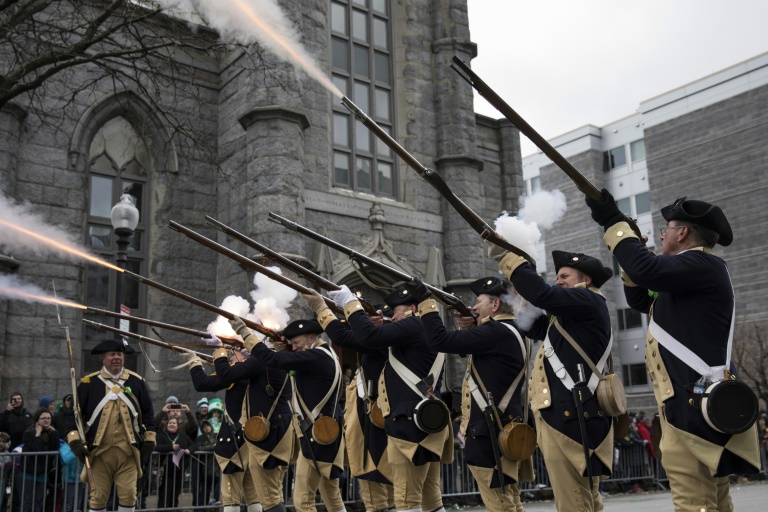
It was 1776, the American colonies had just declared their independence from England, and as war raged the founding fathers were deep in debate: should Americans have the right to own firearms as individuals, or just as members of local militia?

Days after 19 children and two teachers were slaughtered in a Texas town, the debate rages on as outsiders wonder why Americans are so wedded to the firearms that stoke such massacres with appalling frequency.

The answer, experts say, lies both in the traditions underpinning the country’s winning its freedom from Britain, and most recently, a growing belief among consumers that they need guns for their personal safety.

Over the past two decades — a period in which more than 200 million guns hit the US market — the country has shifted from “Gun Culture 1.0,” where guns were for sport and hunting, to “Gun Culture 2.0” where many Americans see them as essential to protect their homes and families.

That shift has been driven heavily by advertising by the nearly $20 billion gun industry that has tapped fears of crime and racial upheaval, according to Ryan Busse, a former industry executive.

Recent mass murders “are the byproduct of a gun industry business model designed to profit from increasing hatred, fear, and conspiracy,” Busse wrote this week in the online magazine The Bulwark.

– Guns and the new nation –

For the men designing the new United States in the 1770s and 1780s, there was no question about gun ownership.

They said the monopoly on guns by the monarchies of Europe and their armies was the very source of oppression that the American colonists were fighting.

James Madison, the “father of the constitution,” cited “the advantage of being armed, which the Americans possess over the people of almost every other nation.”

But he and the other founders understood the issue was complex. The new states did not trust the nascent federal government, and wanted their own laws, and own arms.

They recognized people needed to hunt and protect themselves against wild animals and thieves. But some worried more private guns could just increase frontier lawlessness.

Were private guns essential to protect against tyranny? Couldn’t local armed militia fulfil that role? Or would militia become a source of local oppression?

In 1791, a compromise was struck in what has become the most parsed phrase in the Constitution, the Second Amendment guaranteeing gun rights:

“A well regulated militia, being necessary to the security of a free state, the right of the people to keep and bear arms, shall not be infringed.”

– 1960s gun control –

Over the following two centuries, guns became an essential part of American life and myth.

Gun Culture 1.0, as Wake Forest University professor David Yamane describes it, was about guns as critical tools for pioneers hunting game and fending off varmints — as well as the genocidal conquest of native Americans and the control of slaves.

But by the early 20th century, the increasingly urbanized United States was awash with firearms and experiencing notable levels of gun crime not seen in other countries. 

From 1900 to 1964, wrote the late historian Richard Hofstadter, the country recorded more than 265,000 gun homicides, 330,000 suicides, and 139,000 gun accidents. 

In reaction to a surge in organized crime violence, in 1934 the federal government banned machine guns and required guns to be registered and taxed. 

Individual states added their own controls, like bans on carrying guns in public, openly or concealed.

The public was for such controls: pollster Gallup says that in 1959, 60 percent of Americans supported a complete ban on personal handguns.

The assassinations of John F. Kennedy, Robert F. Kennedy and Martin Luther King, brought a push for strenuous regulation in 1968.

But gunmakers and the increasingly assertive National Rifle Association, citing the Second Amendment, prevented new legislation from doing more than implement an easily circumvented restriction on direct mail-order gun sales.

– The holy Second amendment –

Over the next two decades, the NRA built common cause with Republicans to insist that the Second Amendment was absolute in its protection of gun rights, and that any regulation was an attack on Americans’ “freedom.”

According to Matthew Lacombe, a Barnard College professor, achieving that involved the NRA creating and advertising a distinct gun-centric ideology and social identity for gun owners.

Gun owners banded together around that ideology, forming a powerful voting bloc, especially in rural areas that Republicans sought to seize from Democrats.

Jessica Dawson, a professor at the West Point military academy, said the NRA made common cause with the religious right, a group that believes in Christianity’s primacy in American culture and the constitution.

Drawing “on the New Christian Right’s belief in moral decay, distrust of the government, and belief in evil,” the NRA leadership “began to use more religiously coded language to elevate the Second Amendment above the restrictions of a secular government,” Dawson wrote.

– Self-defense –

Yet the shift of focus to the Second Amendment did not help gunmakers, who saw flat sales due to the steep decline by the 1990s in hunting and shooting sports. 

That paved the way for Gun Culture 2.0 — when the NRA and the gun industry began telling consumers that they needed personal firearms to protect themselves, according to Busse.

Gun marketing increasingly showed people under attack from rioters and thieves, and hyped the need for personal “tactical” equipment.

The timing paralleled Barack Obama becoming the first African American president and a rise in white nationalism.

“Fifteen years ago, at the behest of the NRA, the firearms industry took a dark turn when it started marketing increasingly aggressive and militaristic guns and tactical gear,” Busse wrote.

Meanwhile, many states answered worries about a perceived rise in crime by allowing people to carry guns in public without permits. 

In fact, violent crime has trended downward over the past two decades — though gun-related murders have surged in recent years.

That, said Wake Forest’s Yamane, was a key turning point for Gun Culture 2.0, giving a sharp boost to handgun sales, which people of all races bought, amid exaggerated fears of internecine violence.

Since 2009, sales have soared, topping more than 10 million a year since 2013, mainly AR-15-type assault rifles and semi-automatic pistols.

“The majority of gun owners today — especially new gun owners — point to self-defense as the primary reason for owning a gun,” Yamane wrote.

Turkey shows off drones at Azerbaijan air show

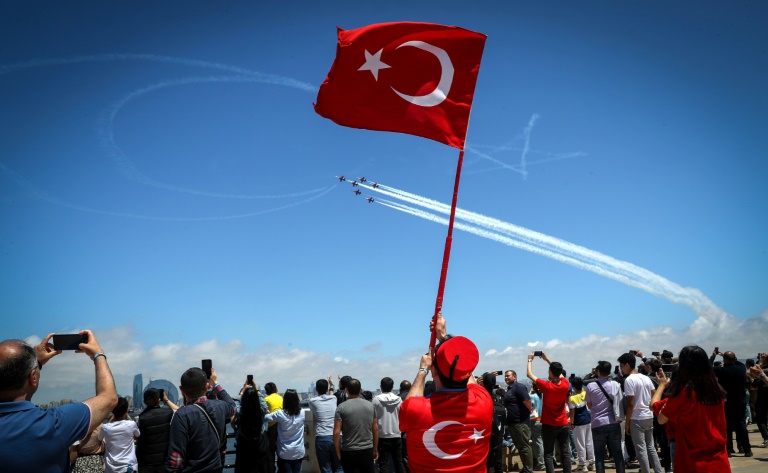
Looping in the air at lightning speed, Turkish drones like those used against Russian forces in Ukraine draw cheers from the crowd at an air show in Azerbaijan.

Turkey is showcasing its defence technology at the aerospace and technology festival “Teknofest” that started in Azerbaijan’s capital Baku this week.

Turkish President Recep Tayyip Erdogan is expected to attend on Saturday.

Turkey’s TB2 drones are manufactured by aerospace company Baykar Defence, where Erdogan’s increasingly prominent son-in-law Selcuk Bayraktar is chief technology officer.

On Wednesday, Bayraktar flew over Baku aboard an Azerbaijani air force Mikoyan MiG-29 plane. One of his combat drones, the “Akinci”, accompanied the flight. 

A video showing Bayraktar in command of the warplane, dressed in a pilot’s uniform decorated with Turkish and Azerbaijani flag patches, went viral on social media. 

“This has been a childhood dream for me,” Bayraktar told reporters after the flight. 

– Proximity to ‘threats’ –

Turkey’s drones first attracted attention in 2019 when they were used during the war in Libya to thwart an advance by rebel commander, General Khalifa Haftar, against the government in Tripoli. 

They were then again put into action the following year when Turkey-backed Azerbaijan in recapturing most of the land it lost to separatist Armenian forces in the disputed Nagorno-Karabakh region. 

Azerbaijani audience members at the aviation festival applauded during a display of TB2 drones, which are now playing a prominent role against invading Russian forces in Ukraine.

A senior official from the Turkish defence industry said his country was facing a wide spectrum of “threats”, including the Kurdistan Workers’ Party (PKK) and Islamic State group jihadists.  

The PKK is listed as a terror group by Ankara and its Western allies.

But with NATO allies — including the United States — having imposed embargoes on Turkey, Ankara was forced to take matters into its own hands to build defence equipment, the official told AFP.

“The situation is changing now with the war in Ukraine,” the official said.

Turkey has been looking to modernise its air force after it was kicked out of the F-35 fighter jet programme because of its purchase of Russia’s S-400 missile defence system.

But Ankara’s role in trying to mediate an end to the Ukraine conflict through direct negotiations may have helped improve its relations with Washington in the past months.

In April, US President Joe Biden’s administration said it now believed that supplying Turkey with F-16 fighter jets would serve Washington’s strategic interests.

– Exports to 25 countries –

Michael Boyle, of the Rutgers University-Camden in the United States, said Turkish drones such as Bayraktar TB2 drones were “increasingly important to modern conflicts because they have spread so widely”.

For years, leading exporters like the United States and Israel limited the number of countries they would sell to, and also limited the models they were willing to sell, he told AFP. 

“This created an opening in the export market which other countries, notably Turkey and China, have been willing to fill,” added the author of the book “The Drone Age: How Drone Technology Will Change War and Peace”.

The Turkish official said Turkey has been investing in the defence industry since the 2000s, but the real leap came in 2014 after serious investments in advanced technologies and a shift towards using locally made goods. 

While Turkey’s export of defence technologies amounted to $248 million in early 2000, it surpassed $3 billion in 2021 and was expected to reach $4 billion in 2022, he said. 

Today Turkey exports its relatively cheap and effective drones to more than 25 countries.

Boyle said these drones could be used “for direct strikes, particularly against insurgent and terrorist forces, but also for battlefield reconnaissance to increase the accuracy and lethality of strikes”. 

“So they are an enabler of ground forces, and this makes them particularly useful for countries like Ukraine which are fighting a militarily superior enemy,” he said.

Close Bitnami banner
Bitnami