US Business

Two decades of deadly gun violence in US schools

Fourteen students and a teacher were shot dead Tuesday when an 18-year-old gunman opened fire at their Texas elementary school, the latest in the United States’ relentless cycle of school mass shootings.

Here are America’s deadliest classroom gun massacres in the last two decades.

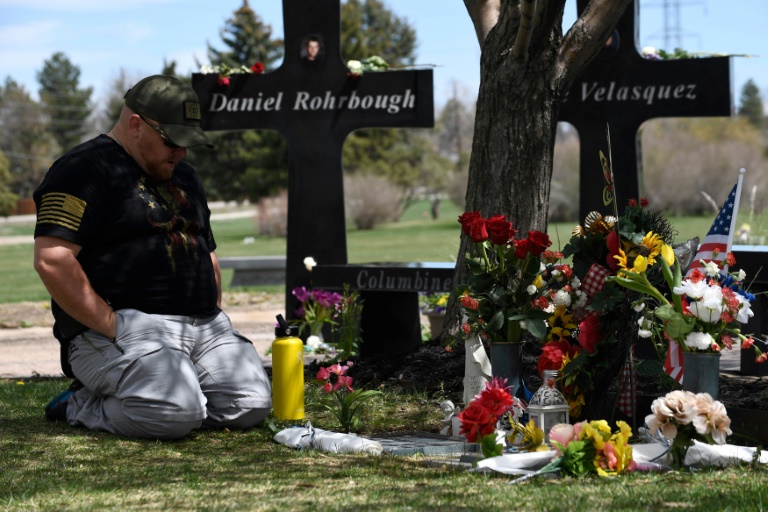
– Columbine High School (1999) –

Two teenagers from Columbine, Colorado, armed with an assortment of weapons and homemade bombs, went on a rampage at their local high school.

Twelve students and a teacher were killed during the April 20 massacre. Another 24 people were wounded.

Columbine, whose name has become synonymous with school shootings, is one of the first — and still among the deadliest — such shootings in the United States.

– Virginia Tech (2007) –

A South Korean student at the Virginia Polytechnic Institute opened fire on the Blacksburg, Virginia, campus, killing 32 students and professors before committing suicide.

Thirty-three people were wounded.

The gunman had apparently idolized the Columbine shooters, referring to them as “martyrs” in a video, part of a hate-filled manifesto he mailed to police during the shooting.

– Sandy Hook Elementary School (2012) –

A 20-year-old man with a history of mental health issues killed his mother in Newtown, Connecticut, on December 14 before blasting his way into Sandy Hook Elementary School.

Twenty children, aged six and seven, were shot dead, as well as six adults. The shooter then committed suicide.

The parents of Sandy Hook victims have led numerous campaigns to toughen gun control laws, but their efforts have largely failed.

Some conspiracy theorists insist the massacre was a government hoax, claiming the shooting involved “actors” in a plot to discredit the gun lobby.

– Marjory Stoneman Douglas High School (2018) –

On February 14, a 19-year-old former student at Marjory Stoneman Douglas High School who was expelled for disciplinary reasons returned to the Parkland, Florida, school and opened fire.

He killed 14 students and three adult staff.

Stoneman Douglas students have become crusaders against gun violence under the banner “March for Our Lives,” lobbying for tougher gun control laws and organizing protests and rallies.

Their campaign has taken off on social media, mobilizing hundreds of thousands of young Americans.

– Santa Fe High School (2018) –

Ten people, including eight students, were killed when a 17-year-old student armed with a shotgun and a revolver opened fire on his classmates in rural Santa Fe, Texas.

Classes had just started on the morning of May 18 when the shooting began.

Following the tragedy, Texas Governor Greg Abbott unveiled 40 recommendations, mainly focused on increasing armed security on school campuses and stepping up mental health screenings to identify troubled children. 

Gun ownership can be a point of pride for many Texans, and even some Santa Fe High School students spoke out against linking the shooting to the need for better gun control.
Outside court, hardcore Depp fans want 'Justice for Johnny'

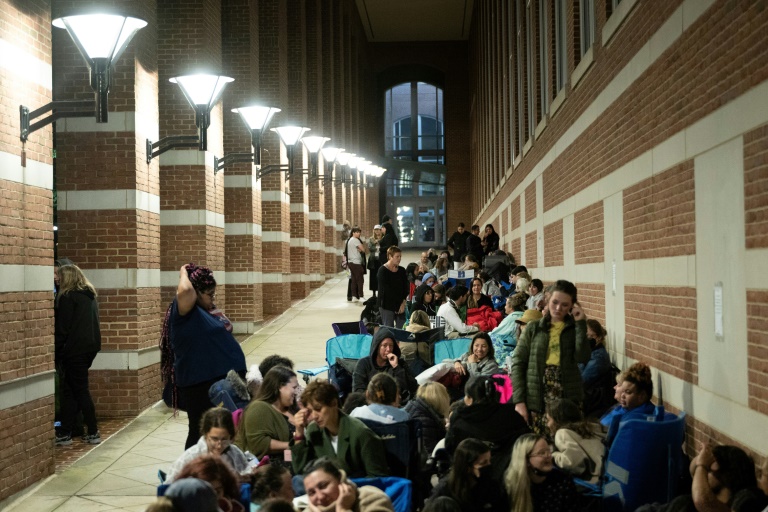
The early morning sun has barely poked through the clouds, but Luz-Hazel Walrath and Pam Cuddapah have already been huddled outside a courthouse in the suburbs of Washington for nine hours — determined to show their support for Johnny Depp.

The two substitute teachers, both 23, drove five hours from their homes in North Carolina to Fairfax, Virginia, arriving at 10:00 pm on Monday evening to try to snag one of the 100 public seats for the next day’s hearing.

They were among scores who gather each day — and night — at the court, hoping to catch a glimpse of the “Pirates of the Caribbean” star as he battles ex-wife Amber Heard in a blockbuster defamation case.

“We just wanted to support Johnny,” Walrath said, explaining she had grown up watching movies featuring the actor.

Walrath and Cuddapah may be biased, but they say they are not convinced by evidence presented by Heard’s legal team, who allege the actress suffered “rampant physical violence and abuse” from Depp.

“I usually believe victims, but in this specific case… I just don’t really fully believe her,” Cuddapah said. 

She says she came to her conclusion based on research via social media, while adding “also he’s a great actor.”

Almost all those waiting in the queue are loyal to Depp, who says Heard is actually the one who was violent toward him.

A few carry signs, some calling for “#JusticeforJohnny.” One group has come with a bouquet of heart-shaped balloons and a poster declaring their love for the troubled former pinup.

– Card games, and makeup –

In the small hours of Tuesday, many waited under the building’s colonnade to shelter from the rain.

They passed the time trying to sleep — wrapped up in blankets on the ground — playing cards, or chatting with new friends.

Early arrivals bided their time across the street before rushing across the courthouse lawn to secure a place in line when the Fairfax County Sheriff’s Department finally allowed them on the premises.

Office manager Glenna Bobb, who drove three hours from Philadelphia, described the scene as a “mad dash.” “Honestly, it was chaos,” she said.

By the time the sun comes up, the crowd is ready for breakfast and coffee ordered via delivery apps.

Some, still in their sweatpants, do their makeup as 7:00 am approaches — the moment when sheriff’s deputies hand out the wristbands that are the fans’ prized tickets into the courtroom.

Bobb, 44, started following the trial when it began back in April, when she was in isolation recovering from Covid.

“I had nothing else to do,” she said. “And then it was just like a train wreck.”

After all the wristbands are distributed, those who didn’t get in traipse to the back of the courthouse, hoping for the next best thing: a glimpse of Depp as he drives in through a rear entrance.

Barricades are erected as the street corner quickly fills with spectators, baby strollers and dogs — one wearing its own “Justice for Johnny Depp” sign.

A lone pro-Heard voice, Christina Taft holds up her sign blasting what she calls a social media “operation” against the “Aquaman” star.

Facing down the Depp crowd is “really hard,” the 28-year-old from Los Angeles said.

She uses a bullhorn to shout “Go Amber Heard!” as the actress’s car rolls through the parking lot gates, but she is drowned out by boos and taunts.

A few minutes later, Depp drives past, waving and smiling through the car’s open window at his cheering fans.

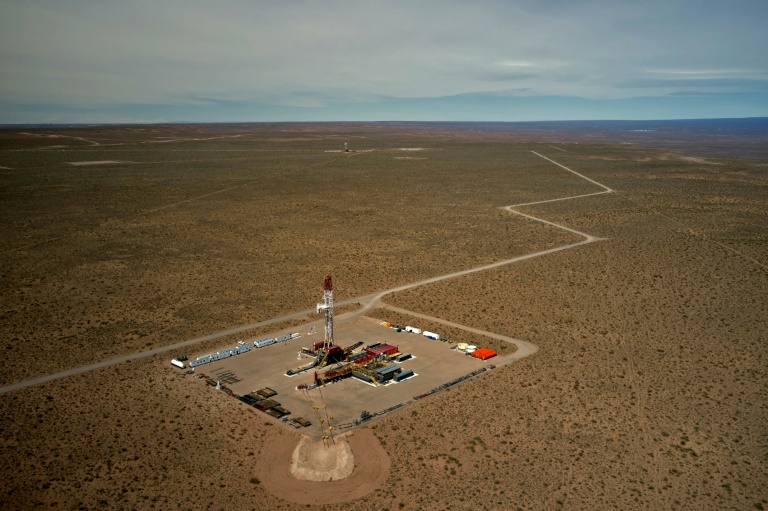
Argentina to ease exchange control for oil and gas companies

Argentina on Tuesday announced an easing of foreign exchange controls for the shale oil and gas industry in a bid to promote investment and boost production.

In an area known as Vaca Muerta in Patagonia, Argentina has what is considered the second-largest shale gas reserve in the world and the fourth largest of shale oil. 

Extraction has been hampered by a lack of much-needed but costly investment, especially for hydraulic fracking. 

On Tuesday, Economy Minister Martin Guzman said “a special regime for currency access” would be put in place for the hydrocarbon industry “to guarantee the special equipment they require,” especially for fracking.

About 20 oil companies have been operating in Vaca Muerta since 2013, including Chevron, Shell, Total and Statoil in partnership with the Argentine oil company YPF. 

Since September 2019, Argentina has had exchange controls in place with a limited official rate of about 120 pesos for one dollar. 

At the same time, currency can be exchanged at a rate of some 200 pesos to the dollar through debt bonds or on the informal market.

“We have a great opportunity in energy in Argentina. The next 15 years have great potential for development,” said President Alberto Fernandez, on a working trip with Guzman.

The government says oil production can increase by 70 percent and gas production by 30 percent over the next five years. 

In recent months, Argentina has increased its production of hydrocarbons to reach a record 578,000 barrels per day in April — an increase of 13 percent in 12 months, according to the government.

Gas production in the same month was 127 million cubic meters, an increase of 12 percent year-on-year.

That has allowed the country to reverse five years of decline in oil production, said Guzman.

Last month, the government launched a construction tender phase for a gas pipeline from Vaca Muerta to the north of the country, to increase domestic supply and exports at a time when worldwide energy costs have shot up due to the war in Ukraine.

Petrobras shares fall after Bolsonaro fires its boss

The price of shares in Brazil’s state oil giant Petrobras fell Tuesday in reaction to President Jair Bolsonaro firing its boss after only 40 days on the job.

Bolsonaro dismissed Petrobras CEO Jose Mauro Coelho on Monday in a tug-of-war over rising fuel prices, which are set by Petrobras but tied to international market movement.

Petrobras shares lost more than four percent in afternoon trade on the Sao Paulo Stock Exchange, before recovering somewhat to 2.85 percent lower than Monday’s worth.

The movement reflects investor concerns of a possible intervention by the State, the main shareholder in Petrobras, in its autonomous pricing decisions.

Coelho took over last month for what should have been a one-year term. He became the company’s third CEO in just over a year after Bolsonaro also fired his predecessors. 

Fuel prices in Brazil have risen more than 33 percent in the past year, according to official figures, driving annual inflation of more than 12 percent and hurting Brazilians’ wallets in an election year.

The far-right Bolsonaro trails leftist ex-president Luiz Inacio Lula da Silva in opinion polls ahead of elections in October.

Brazil’s Ministry of Mines and Energy announced Coelho’s dismissal, saying the country was “experiencing a challenging moment, due to the effects of the extreme volatility of hydrocarbons in international markets.”

The government has proposed for Coelho to be replaced by Caio Mario Paes de Andrade, an official in the Economy Ministry.

He must be confirmed by the company’s board of directors.

Earlier this month, Bolsonaro also replaced his longtime energy minister, Bento Albuquerque, days after Petrobras reported record quarterly profits.

Bolsonaro said those profits amounted to “rape,” and called on Albuquerque and Coelho to stop Petrobras from raising prices.

Petrobras went on to hike diesel prices by an additional 8.9 percent.

Soros says 'civilization may not survive' Ukraine war

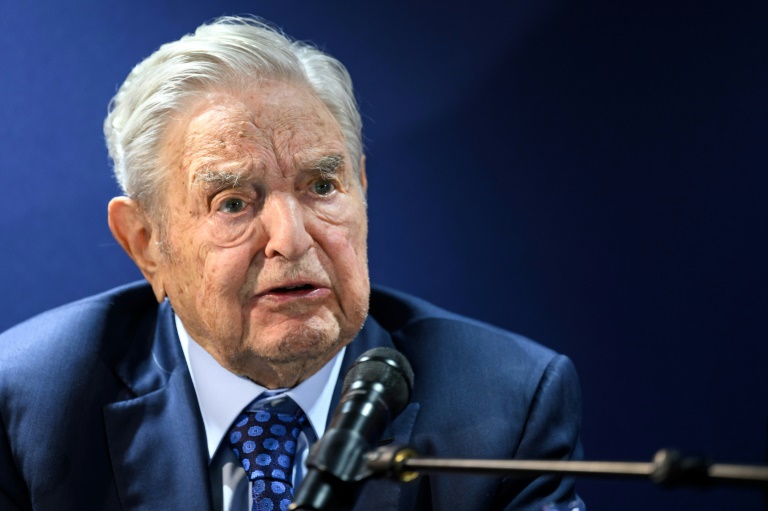
US billionaire George Soros warned Tuesday that “civilization may not survive” Russia’s invasion of Ukraine but said Europe could have a stronger position against President Vladimir Putin regarding gas than it realises.

In his traditional dinner speech on the sidelines of the World Economic Forum in the Swiss mountain town of Davos, the Hungarian-born investor and philanthropist said the war has “shaken Europe to its core.”

“The invasion may have been the beginning of the Third World War and our civilization may not survive it,” Soros said.

“We must mobilise all our resources to bring the war to an early end. The best and perhaps only way to preserve our civilization is to defeat Putin as soon as possible,” he said.

He praised US and European support for Ukraine but Europe’s dependence on Russian fossil fuels “remains excessive,” Soros said.

He said this dependence was “due largely to the mercantilist policies pursued by former (German) chancellor Angela Merkel” who made “special deals” with Moscow for gas supplies.

The European Union is now aiming to reduce its use of Russian gas by two-thirds this year, but it has fallen short of banning imports due to German reluctance.

The EU has also struggled to agree on an oil ban due to Hungary’s opposition.

“I think Putin has been very clever in sort of blackmailing Europe, threatening to cut off the gas, but actually his case is much less strong than he pretends,” Soros said.

“He’s actually in a crisis and he has managed somehow to terrify Europe,” he said. 

He said Putin put gas in storage last year instead of exporting it to Europe, creating a shortage that raised prices and made Russia “a lot of money.”

But storage facilities will be full in July and Russia has no other place to ship the gas than Europe as it is its only market, he said. 

Soros said he had explained this in a recent letter to Italian President Mario Draghi, but he has yet to receive a reply.

Putin is “in a tight situation. He has to do something with that gas,” Soros said. “Europe has a much stronger position than it recognises.”

– Xi and Putin: the ‘dictators’ –

Soros’s dinner is among the most eagerly awaited events of the gathering of global business and political elites in Davos, but it last took place in January 2020 as the Covid pandemic thwarted last year’s confab.

Soros, the founder of the Open Society Foundations, used this year’s speech to take aim again at another usual target, Chinese President Xi Jinping.

He called Xi and Putin “dictators” whose countries represent “the biggest threat to open society”.

“They are tied together in an alliance that has no limits. They also have a lot in common. They rule by intimidation, and as a consequence they make mind-boggling mistakes,” Soros said.

“Putin expected to be welcomed in Ukraine as a liberator. Xi Jinping is sticking to a zero-Covid policy that can’t possibly be sustained,” he said, referring to China’s strict lockdowns to contain coronavirus outbreaks.

Risk of blood clots in lung doubled for Covid survivors: US study

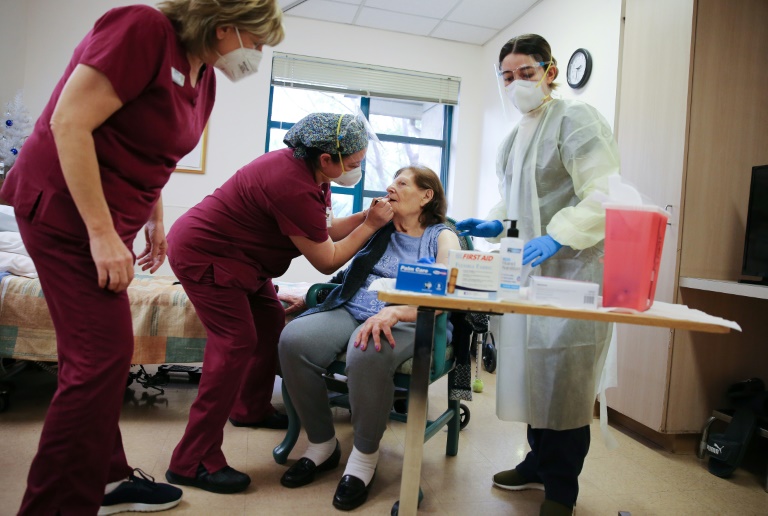
Coronavirus survivors have twice the risk of developing dangerous blood clots that travel to their lungs compared to people who weren’t infected, as well double the chance of respiratory symptoms, a large new study said Tuesday.

The research by the Centers for Disease Control and Prevention found that as many as one in five adults aged 18-64 years and one in four of those over 65 went on to experience health conditions that could be related to their bout of Covid — a finding consistent with other research.

Among all conditions, the risk of developing acute pulmonary embolism — a clot in an artery of the lung — increased the most, by a factor of two in both adults younger and older than 65, as did respiratory symptoms like a chronic cough or shortness of breath.

Pulmonary embolisms usually travel to the lungs from a deep vein in the legs, and can cause serious problems, including lung damage, low oxygen levels and death.

The study was based on more than 350,000 patient records of people who had Covid-19 from March 2020 – November 2021, paired with 1.6 million people in a “control” group who had sought medical attention in the same month as a corresponding “case” patient, but weren’t diagnosed with Covid.

The team assessed the records for the occurrence of 26 clinical conditions previously associated with long Covid. 

Patients were followed one month out from the time they were first seen until they developed a subsequent condition, or until a year had passed, whichever came first.

The most common conditions in both age groups were respiratory symptoms and musculoskeletal pain.

In patients under 65, risks after Covid elevated for most types of condition, but no significant differences were observed for cerebrovascular disease, mental health conditions, or substance-related disorders.

“Covid-19 severity and illness duration can affect patients’ health care needs and economic well-being,” the authors wrote. 

“The occurrence of incident conditions following infection might also affect a patient’s ability to contribute to the workforce and might have economic consequences for survivors and their dependents,” as well as placing added strain on health systems.

Limitations of the study included the fact that data on sex, race, and geographic region were not considered, nor was vaccination status. Because of the time period, the study also didn’t factor in newer variants.

Battleground Georgia tests Trump's US voter fraud 'Big Lie'

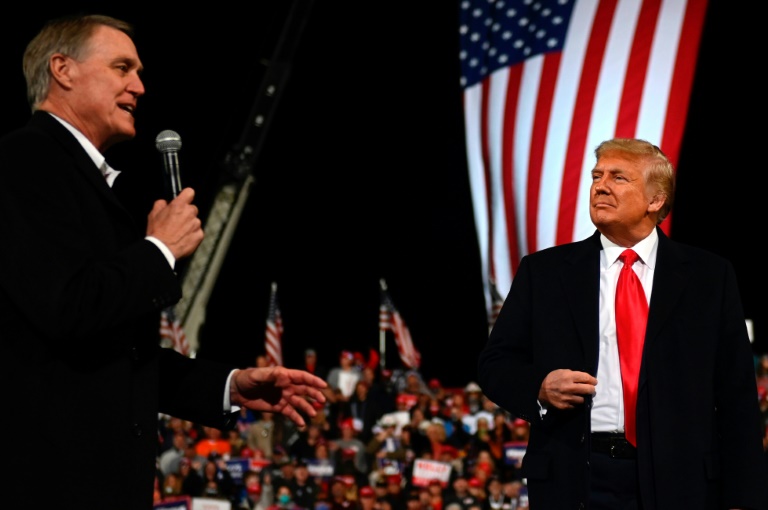
Republican voters appeared set Tuesday to deliver a stark repudiation of Donald Trump’s “Big Lie” that the 2020 US election was stolen as the swing state of Georgia picked its candidates for November’s midterms. 

Five states were holding nominating contests for congressional elections that will decide which party controls the US Senate and House of Representatives for the remainder of President Joe Biden’s first term.

But all eyes are on the Peach State, where wounds from the 2020 presidential election are still festering two years after Trump lost there by the narrowest of margins.

A record-smashing 850,000 ballots were cast in early voting that ended Friday, in a signal of an electorate determined to have its say despite complaints over new laws that critics warn are making it harder to vote.

“It’s really important,” government consultant Che Alexander told AFP after filling out her voting slip at a downtown Atlanta polling station.

“I’m going to post on my social media now, how important it is to vote, because if you don’t have an opinion, there’s no reason to complain, right?”

Up and down the ballot, the Republican side of the Georgia primary pits candidates peddling the former president’s false claims of widespread election fraud against hopefuls who pushed back in defense of the Constitution.

In the contest to be the next governor, incumbent Brian Kemp, frequently the target of Trump’s wrath for refusing to help overturn the election, leads former senator David Perdue by more than 20 points.

Perdue has made bogus claims about 2020 a centerpiece of his campaign, in a direct appeal to Trump supporters who continue wrongly to question the validity of the outcome.

Trump, who banked much of his own political capital in the race, faces humiliation if Kemp’s lead holds — undermining his push to make his nationwide endorsements a sign of his continuing sway over the party.

– ‘Inelegant delivery’ – 

After sinking $2.5 million of his own campaign funds into the Perdue effort, the former president appeared largely to have given up on the candidate, offering only a written 11th-hour statement of endorsement rather than visiting the state in person during the home stretch. 

Kemp’s confidence in victory over his imploding opponent was apparent Monday at a rally in Cobb County with former vice president Mike Pence, where neither man mentioned Perdue once.

“I was for Brian Kemp before it was cool,” Pence told a cheering crowd of a few hundred at an airfield on the outskirts of Atlanta.

Pence’s support for a candidate Trump reviles marks a high-profile clash between the former president and his White House wingman, underscoring the party’s internal tug of war over its future direction. 

The race to be Georgia’s secretary of state is seen as equally consequential, as these are the officials who oversee elections in the United States.

Democrats fear that, across the country, Trump will be able to install loyalists who can weaponize specious fraud accusations from 2020 to make it harder for his opponents to vote in 2024.     

As the man responsible for certifying Georgia’s 2020 election results, Brad Raffensperger was in lockstep with Kemp in pushing back against Trump.

He faces Jody Hice, one of more than a dozen Trump-backed candidates across America bidding to become secretary of state and professing to believe the 2020 election was stolen.

Biden was the first Democratic presidential candidate since 1992 to win Georgia, while Raphael Warnock and Jon Ossoff triumphed in runoff elections in January 2021 that wrested control of the US Senate from Republicans.

Georgia’s Democrats are doing all they can to cement those gains, headlined by news that Democratic star campaigner Stacey Abrams is reprising her bid for governor.

Abrams courted controversy over the weekend with remarks that Georgia is the “worst state in the country to live,” citing its healthcare and crime statistics, rising incarceration rates and falling wages.

At a news conference Tuesday she attempted to clean up a comment that Republicans have seized on as a sign of her lack of local pride, faulting herself for an “inelegant delivery” of her message.

Fighting rages as Russia eyes prolonged war in Ukraine

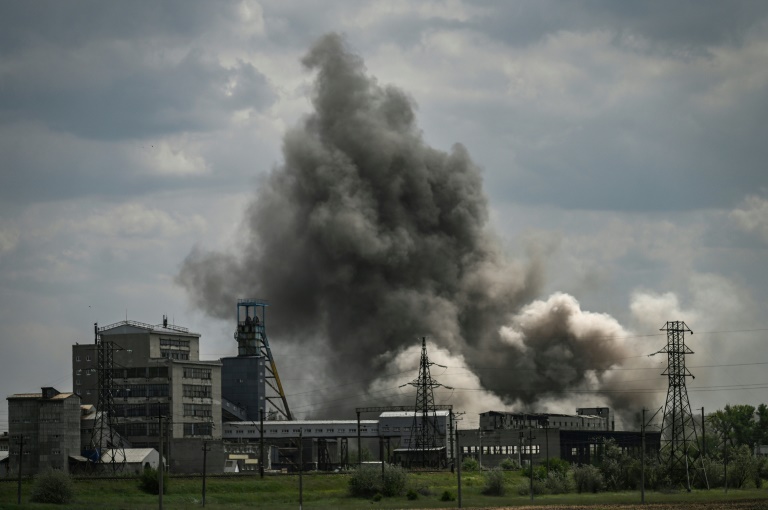
Russia signalled on Tuesday it was bedding in for a long war in Ukraine as the conflict entered its fourth month with heavy fighting in the east but signs of some normality returning elsewhere.

“We will continue the special military operation until all the objectives have been achieved,” Russian Defence Minister Sergei Shoigu said, using Moscow’s name for the war.

Three months after Moscow’s invasion, Western funds and weapons have helped Ukraine hold off its neighbour’s advances in many areas, including the capital Kyiv.

Russia is now focused on securing and expanding its gains in the eastern Donbas region, near the border and home to pro-Russian separatists, as well as the southern coast.

Ukrainian Foreign Minister Dmytro Kuleba warned that the “Russian offensive in the Donbas is a ruthless battle, the largest one on European soil since WWII.”

“The coming weeks of the war will be difficult,” Ukraine’s President Volodymyr Zelensky said Monday after regional leaders and residents reported heavy bombardments.

“The most difficult fighting situation” was in Donbas, he said, singling out the worst-hit towns of Bakhmut, Popasna and Severodonetsk.

Ukraine’s armed forces said Russian troops were conducting non-stop “offensive operations” in the region.

In the village of Yakovlivka, on a major stretch of the eastern front, 55-year-old Ukrainian soldier Andriy hid in a ditch as shells fired by encroaching Russians whistled past.

– Too late to leave –

“Our guys have stopped firing back,” he whispered after glancing up and down the road.

“We do not want to provoke them because then the Russians will start shooting at us even harder.”

The governor of Lugansk said Russia had sent thousands of troops to capture his region and that Severodonetsk was under massive attack.

Sergiy Gaidai warned an estimated 15,000 civilians still in the city that it was too late to leave.

“Stay in a shelter, because such a density of shelling will not allow us to calmly gather people and come for them,” he said on Telegram.

He later said four people died on Tuesday after Russian forces fired on the Azot chemical plant in Severodonetsk, where several bomb shelters had been set up.

Another resident who was injured in a central part of the city later died, he added.

More than six million people have fled Ukraine and eight million have been internally displaced since the war broke out, according to the United Nations.

Speaking to regional counterparts from the Russia-led Collective Security Treaty Organization, Russia’s Shoigu blamed his country’s slow advance on a “deliberate” attempt to avoid civilian casualties. 

– Kharkiv metro reopens –

“We are not rushing to meet deadlines,” added the secretary of Russia’s Security Council, Nikolai Patrushev, in an interview.

Kyiv has pleaded with Western allies to send more weapons faster and take tougher action against Moscow.

The head of Ukrainian military intelligence, Kyrylo Budanov, said delays in getting to the frontline had left Kyiv “catastrophically short of heavy weapons”.

He said, however, that he expected a “turning point” by August as they come through, in an interview to news outlet Ukrainska Pravda.

Speaking to political and business elites at the World Economic Forum in Davos on Monday, Zelensky urged an international oil embargo on Russia, as well as punitive measures against all its banks and the shunning of its IT sector.

The EU has proposed a ban on Russian oil imports, although Hungary is blocking the measure.

Some semblance of normality returned to Ukraine’s second city of Kharkiv, where the metro was reopened Tuesday after months of use as a bomb shelter.

“We decided to relaunch services because we have to relaunch the economy,” mayor Igor Terekhov told journalists, adding that train rides would be free for the next two weeks.

– ‘State terrorist’ –

The Kharkiv metro, with 30 stations, has sheltered thousands of residents seeking to escape indiscriminate shelling on the city, which is adjacent to the Russian border.

Three stations in areas that are occasionally shelled remain shuttered.

In Mariupol, the strategic southern port city that finally fell after a devastating siege, the Russian army said it had begun a de-mining operation.

“To date, more than 50 kilometres of the coast along the Sea of Azov has been examined and more than 300 various munitions have been neutralised,” it said.

Mariupol Mayor Vadym Boychenko said 100,000 people were without water, without food, without electricity.

Speaking to Davos via video-link, he accused Russia of behaving like a “state terrorist”, and warned disease risked further fatalities.

Referring to Ukraine’s estimated death toll from the siege of Mariupol, he said: “We see that war already took lives of 20,000 people, and epidemics could take the lives of thousands more.”

The siege has become emblematic of the horror of the conflict, along with towns such as Bucha, where the discovery of bodies dressed in civilian clothes after Russian troops withdrew prompted claims of war crimes.

A Kyiv court on Monday found a 21-year-old Russian soldier guilty of killing an unarmed civilian in northeast Ukraine, in the first verdict of its kind since the invasion began.

Vadim Shishimarin was handed a life sentence in a trial, as international institutions and Ukrainian authorities investigate thousands of other alleged war crimes.

burs-ar/jm

US new home sales fall sharply in April amid rising prices

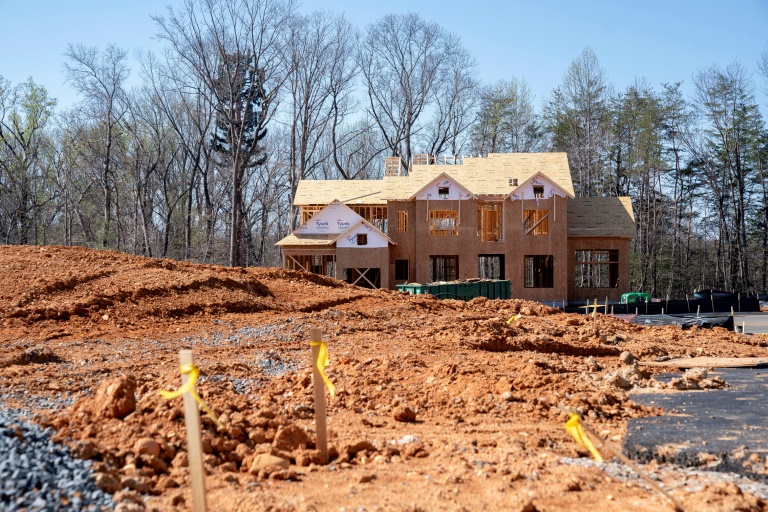
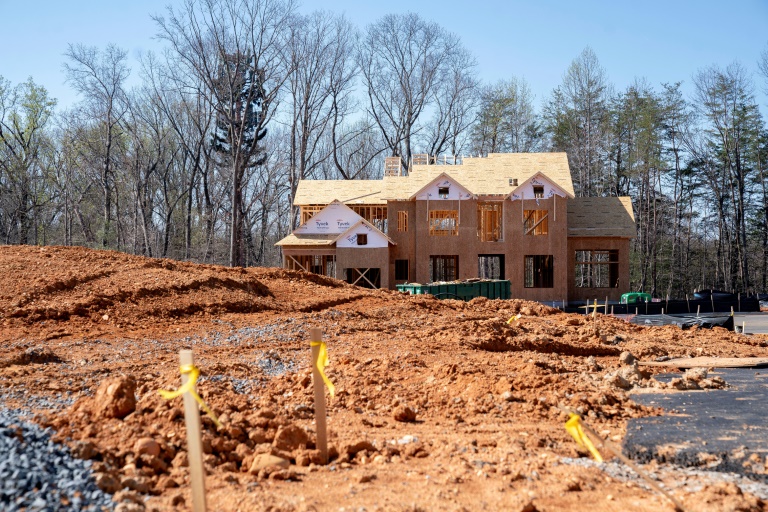
US new home sales plunged in April to their lowest in two years, even as prices continued to climb, according to government data released Tuesday, as would-be buyers felt the heat of soaring inflation and rising interest rates.

Home sales have been booming throughout the Covid-19, but with inflation at its highest since the early 1980s, the Federal Reserve has begun raising interest rates aggressively to cool the economy, which is pushing borrowing costs higher.

Sales of new single-family homes fell 16.6 percent in April to an annual rate of 591,000, seasonally adjusted, the Commerce Department reported, the lowest rate since April 2020.

The decline was far worse than analysts had projected, and compounded by the downward revision to the sales figures for March.

“It’s pretty scary,” said Gregory Daco, chief economist at Ernst & Young.

“I was expecting a decline, but not this steep a drop,” he told AFP, noting that new home sales had slowed for the fourth consecutive month.

All regions saw sales fall sharply, though the South saw the steepest decline.

Last month’s sales pace was a 26.9 percent drop compared to April 2021, the report said.

However, even amid higher borrowing costs that are cooling demand from homebuyers, prices continued to rise in April, reaching a median of $450,600 from $435,000 in the prior month.

The popularity of remote work as well as increased household savings during the pandemic prompted many families to move out of congested urban areas and purchase larger houses or vacation homes.

The surge in demand sent prices soaring as potential homebuyers competed to snap up properties — even paying cash — in an increasingly tight market hindered by global supply chain snarls that held back new construction.

– ‘Recession warning’ –

Home sales are a key driver of activity, spurring sales of many categories of goods, including furniture and appliances, so a slowdown could have broader effects on the economy, economists say.

“The April drop for new home sales is a clear recession warning,” said Robert Dietz, chief economist at the National Association of Home Builders (NAHB).

“While the nation needs additional housing, home sales are slackening as tightening monetary policy continues to put upward pressure on mortgage rates and supply chain disruptions raise construction costs.”

As the sales pace dropped sharply, the supply of new homes on the market rose last month, jumping to a nine months’ supply from 6.9 months in April, the report said.

Existing home sales have also slowed over the past several months, falling 2.4 percent in April, the National Association of Realtors (NAR) reported last week.

The average rate on a 30-year, fixed-rate mortgage was 4.98 percent in April, up from 4.17 percent in March, and far above the 2021 average of 2.96 percent, according to Freddie Mac.

“Higher mortgage rates and lofty prices are making housing more expensive, particularly for first-time buyers,” said Oren Klachkin, the lead US economist at Oxford Economics. “Looking ahead, income gains won’t keep up with rising borrowing costs and elevated home prices, pushing down affordability and pressuring home sales.”

“Builders will add to the housing stock, but not sufficiently enough to meaningfully tilt housing market dynamics in favor of buyers.”

US new home sales fall sharply in April amid rising prices

US new home sales plunged in April to their lowest in two years, even as prices continued to climb, according to government data released Tuesday, as would-be buyers felt the heat of soaring inflation and rising interest rates.

Home sales have been booming throughout the Covid-19, but with inflation at its highest since the early 1980s, the Federal Reserve has begun raising interest rates aggressively to cool the economy, which is pushing borrowing costs higher.

Sales of new single-family homes fell 16.6 percent in April to an annual rate of 591,000, seasonally adjusted, the Commerce Department reported, the lowest rate since April 2020.

The decline was far worse than analysts had projected, and compounded by the downward revision to the sales figures for March.

“It’s pretty scary,” said Gregory Daco, chief economist at Ernst & Young.

“I was expecting a decline, but not this steep a drop,” he told AFP, noting that new home sales had slowed for the fourth consecutive month.

All regions saw sales fall sharply, though the South saw the steepest decline.

Last month’s sales pace was a 26.9 percent drop compared to April 2021, the report said.

However, even amid higher borrowing costs that are cooling demand from homebuyers, prices continued to rise in April, reaching a median of $450,600 from $435,000 in the prior month.

The popularity of remote work as well as increased household savings during the pandemic prompted many families to move out of congested urban areas and purchase larger houses or vacation homes.

The surge in demand sent prices soaring as potential homebuyers competed to snap up properties — even paying cash — in an increasingly tight market hindered by global supply chain snarls that held back new construction.

– ‘Recession warning’ –

Home sales are a key driver of activity, spurring sales of many categories of goods, including furniture and appliances, so a slowdown could have broader effects on the economy, economists say.

“The April drop for new home sales is a clear recession warning,” said Robert Dietz, chief economist at the National Association of Home Builders (NAHB).

“While the nation needs additional housing, home sales are slackening as tightening monetary policy continues to put upward pressure on mortgage rates and supply chain disruptions raise construction costs.”

As the sales pace dropped sharply, the supply of new homes on the market rose last month, jumping to a nine months’ supply from 6.9 months in April, the report said.

Existing home sales have also slowed over the past several months, falling 2.4 percent in April, the National Association of Realtors (NAR) reported last week.

The average rate on a 30-year, fixed-rate mortgage was 4.98 percent in April, up from 4.17 percent in March, and far above the 2021 average of 2.96 percent, according to Freddie Mac.

“Higher mortgage rates and lofty prices are making housing more expensive, particularly for first-time buyers,” said Oren Klachkin, the lead US economist at Oxford Economics. “Looking ahead, income gains won’t keep up with rising borrowing costs and elevated home prices, pushing down affordability and pressuring home sales.”

“Builders will add to the housing stock, but not sufficiently enough to meaningfully tilt housing market dynamics in favor of buyers.”

Close Bitnami banner
Bitnami