US Business

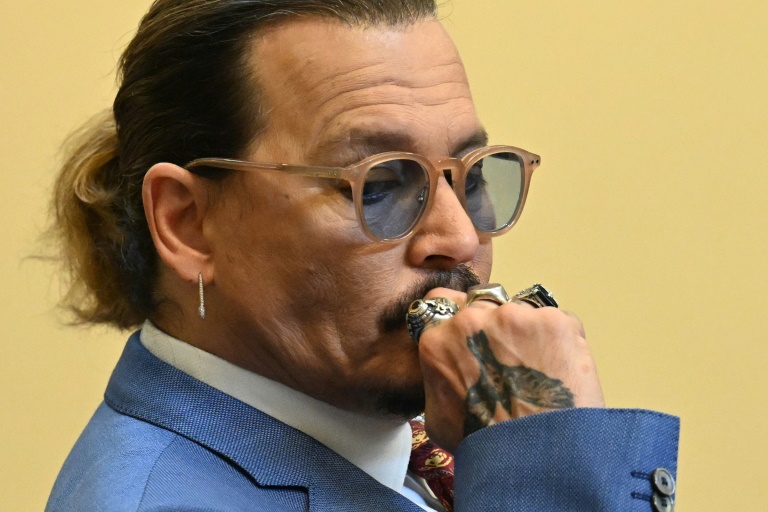
Amber Heard's defense rests in Johnny Depp defamation trial

Lawyers for Amber Heard rested their defense on Tuesday against the defamation suit filed by her former husband Johnny Depp, after six weeks of testimony riding on graphic claims and counterclaims of domestic violence.

Depp’s attorneys responded by asking that Heard’s countersuit against the “Pirates of the Caribbean” star be dismissed but the judge hearing the case in Virginia, near the US capital, declined to do so.

Judge Penney Azcarate said enough evidence has been presented for the case to continue and for both suit and countersuit to eventually go to the seven-person jury.

The 58-year-old Depp filed suit against Heard over an op-ed she wrote for The Washington Post in December 2018 in which she described herself as a “public figure representing domestic abuse.”

Heard, 36, who had a starring role in “Aquaman,” did not name Depp in the op-ed, but he sued her for implying he was a domestic abuser and is seeking $50 million in damages.

The Texas-born Heard countersued, asking for $100 million and claiming that she suffered “rampant physical violence and abuse” at his hands.

Depp, during his four days on the witness stand, denied ever striking Heard or any other woman and claimed that she was the one who was frequently violent.  

– ‘Chemistry’ –

After the judge denied the dismissal motion by Depp’s attorneys, lawyers for the “Pirates” star called their first rebuttal witness.

Walter Hamada, president of DC Comics-based film production at Warner Brothers, testified about Heard’s contract with the studio for the “Aquaman” series.

Heard’s legal team has claimed her role and compensation for “Aquaman 2” was harmed by allegedly defamatory remarks made about her by Depp’s former attorney, Adam Waldman.

Waldman’s statements form the basis of the counter-claim for defamation filed by Heard, who earned $1 million for “Aquaman” and $2 million for “Aquaman 2.”

Hamada said Heard’s compensation for “Aquaman 2” was not affected by anything said by Waldman or Depp.

He said it was not the practice of Warner Brothers to renegotiate contracts although he acknowledged that the studio did so for “Aquaman” star Jason Momoa.

Hamada said there had been “conversations” about recasting Heard’s role in “Aquaman 2” but that was because of a perceived lack of “chemistry” between her and co-star Momoa.

“The reality is it’s not uncommon on movies for two leads to not have chemistry,” he said. “You know it when you see it.”

– ‘Negative publicity’ –

On Monday, a Hollywood expert called by Heard’s team, Kathryn Arnold, said Heard’s career was “on the precipice of a meteoric rise” following “Aquaman” but it has been stymied by a “lot of negative publicity.”

Arnold estimated that Heard has suffered between $45 and $50 million in lost film and TV roles and endorsements.

Depp’s lawyers put experts on the stand earlier in the trial who testified that the actor lost millions because of the abuse accusations, including a $22.5-million payday for a sixth installment of “Pirates.”

Depp filed the defamation complaint in the United States after losing a separate libel case in London in November 2020 that he brought against The Sun for calling him a “wife-beater.”

Depp, a three-time Oscar nominee, and Heard were married in February 2015. Their divorce was finalized two years later.

Azcarate, the judge, has scheduled closing arguments in the case for Friday, after which it will go to the jury.

Stocks fall after sentiment Snap-ped

Stock markets retreated Tuesday on renewed concerns over weak global growth following a profit warning from the owner of Snapchat that spooked investors and further shocked the tech sector.

It comes amid concerns over the impact of China’s Covid-19 restrictions on the world’s second-largest economy after the United States.

Monday’s strong Wall Street rally, where the Dow closed up two percent failed to carry over into Tuesday as Snap, the parent of social media app Snapchat, warned overnight that it saw the economic outlook as having darkened considerably.

Its share price plummeted 41.3 percent in late morning trading.  

“Snap provided a shock,” noted Neil Wilson, chief market analyst at Markets.com.

The company “spooked the market with a macroeconomic warning that dented tech the most and pointed to earnings revisions that could drag the market lower for longer”, he added. 

The tech-heavy Nasdaq Composite quickly sank more than three percent. Shares in Facebook-parent Meta fell 8.9 percent and Google-owned Alphabet shed 6.7 percent.

Patrick J. O’Hare at Briefing.com said that Snap’s warning impacted the broader market as investors are worried about the economic trajectory.

“The real issue hitting the market in terms of the Snap warning is the context for the warning: ‘the macroeconomic environment has deteriorated further and faster than anticipated,'” he said.

– Pound lashed –

The pound also took a knock after an S&P Global’s economic sentiment survey for Britain fell to a 15-month low. 

“The extent of the fall points to a UK economy hitting the buffers hard as the combined effect of surging energy prices, and tax rises starts to curtail economic activity,” said Michael Hewson, chief market analyst at CMC Markets.

Shares in British energy firms slumped following reports that the UK government may impose a windfall tax on excess profits enjoyed by electricity producers.

Prime Minister Boris Johnson has so far indicated he does not want to impose such a tax on oil and gas producers despite them also earning vast sums as prices soar.

Shares in Drax fell by 16.1percent, SSE by 7.7 percent and Centrica by 7.6 percent.

Johnson argues an exceptional levy on the likes of BP and Shell would harm their efforts to invest in greener fuels like solar and wind power.

In China, Beijing’s announcement Monday of a fresh raft of measures to stimulate the economy did little to calm investors’ nerves.

China’s economy has taken a hit from Beijing’s zero-Covid approach to the pandemic, which has resulted in lengthy lockdowns of major cities and mass testing of millions of people.

Prolonged virus lockdowns have constricted supply chains, dampened demand and stalled manufacturing.

Investment banks UBS Group and JPMorgan Chase have responded by cutting their China economic growth forecasts.

“The lingering restrictions and lack of clarity on an exit strategy from the current Covid policy will likely dampen corporate and consumer confidence and hinder the release of pent-up demand,” UBS economists including Tao Wang wrote in a research note.

Concerns over the Chinese economy and its impact on oil demand weighed on crude prices Tuesday.

– Key figures at around 1530 GMT –

New York – Dow: DOWN 1.3 percent at 31,460.55 points

EURO STOXX 50: DOWN 0.9 percent at 3,579.31

London – FTSE 100: DOWN 0.4 percent at 7,484.35 (close)

Frankfurt – DAX: DOWN 1.8 percent at 13,919.75 (close)

Paris – CAC 40: DOWN 1.7 percent at 6,253.14 (close)

Tokyo – Nikkei 225: DOWN 0.9 percent at 26,748.14 (close)

Hong Kong – Hang Seng Index: DOWN 1.8 percent at 20,112.10 (close)

Shanghai – Composite: DOWN 2.4 percent at 3,070.93 (close)

Euro/dollar: UP at $1.0733 from $1.0692 at 2030 GMT Monday

Pound/dollar: DOWN at $1.2519 from $1.2587

Euro/pound: UP at 85.72 pence from 84.92 pence

Dollar/yen: DOWN at 126.52 yen from 127.90 yen 

Brent North Sea crude: UP 0.4 percent at $113.77 per barrel

West Texas Intermediate: DOWN less than 0.1 percent at $110.23 per barrel

burs-rl/pvh

Zimbabwe rallies allies to push for legal ivory trade

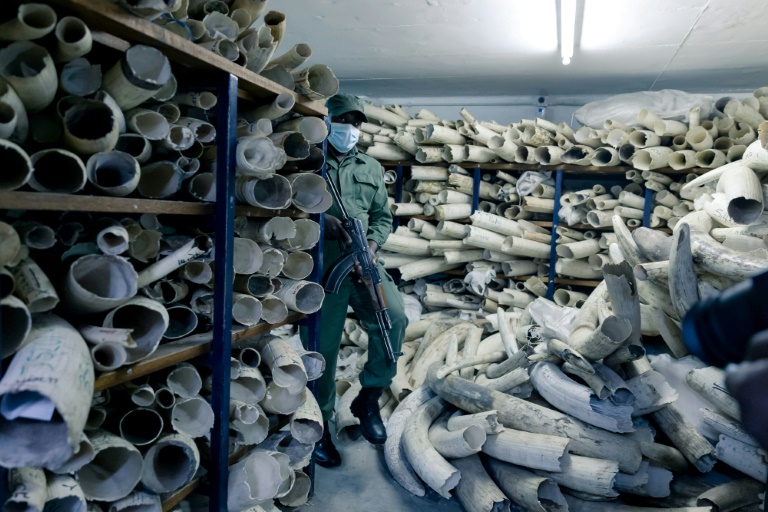
Zimbabwe will this week press a drive to legalise the ivory trade, inviting officials from 15 nations to meet in a national park that’s a beacon of success in protecting elephants.

Hwange National Park is overflowing with elephants, which now routinely wander outside the boundaries to feed, sometimes running into deadly conflicts with people living in the surrounds.

Zimbabwe and its neighbours in southern Africa have seen their elephant herds thrive in recent years and are now home to about 70 percent of the continent’s elephants.

That’s a markedly different story than in the rest of Africa, where poaching and habitat loss have seen numbers declining.

Zimbabwe, by contrast, is home to 100,000 elephants — nearly double the number that conservationists say the country’s parks can support.

Elephants require vast areas for feeding. Even Hwange, a park nearly half the size of Belgium, isn’t big enough to support its population.

Zimbabwe and other countries with large herds say they’re left protecting vast stockpiles of ivory they can’t sell to raise funds for either conservation work or to support communities affected by the growing elephant numbers.

“These are pertinent issues that are difficult to address in a balanced manner,” Tourism and Environment Minister Mangaliso Ndhlovu said in a statement.

Zimbabwe last week urged European ambassadors to allow a one-off sale of $600 million worth of elephant ivory, kept in a warehouse outside central Harare.

International trade in ivory and elephants has been banned since 1989 under the Convention on International Trade in Endangered Species of Wild Fauna and Flora (CITES). One-off sales were allowed in 1999 and 2008, despite fierce opposition.

Countries in southern Africa say the ban prevents them even from supporting each other’s conservation efforts, for example, by moving elephants from Zimbabwe to countries that want to repopulate.

The conference brings together countries likely to support a legalisation move, including China and Japan, where ivory is highly prized.

Kenya and Tanzania, which fear legalisation will encourage more poaching, were not invited. But the island nations of Seychelles and Madagascar, which have no elephants, are attending.

– Dangerous signal –

A collection of 50 anti-ivory trade organisations issued a statement warning that opening the ivory market would decimate the African herd, which in some regions is near extinction.

“The conference is sending a dangerous signal to poachers and criminal syndicates that elephants are mere commodities, and that ivory trade could be resumed heightening the threat to the species,” they said.

But growing elephant herds pose real dangers to nearby communities.

Zimbabwe says 60 people have been killed by elephants so far this year, compared with 72 in all of last year.

“Governments of elephant range states are faced with social and political pressures on why elephants are prioritised over their own life and livelihoods,” Ndhlovu said.

Georgia set to test Trump's US voter fraud 'Big Lie'

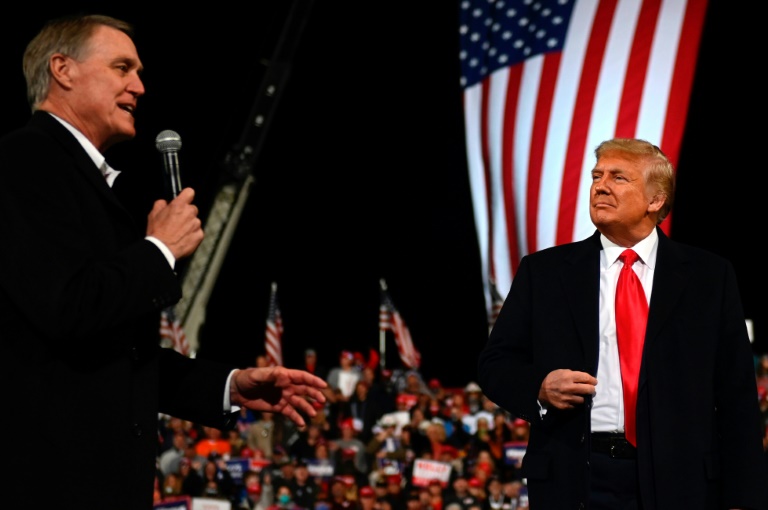
Republican voters in the battleground US state of Georgia appeared set Tuesday to deliver a stark repudiation of Donald Trump’s “Big Lie” that the 2020 election was stolen.

Four other states — Texas, Arkansas, Alabama and Minnesota — are also picking contenders for November’s midterm elections, which will decide which party controls the US Senate and House of Representatives for the remainder of President Joe Biden’s first term.

But all eyes are on the Peach State, where wounds from the 2020 presidential election are still festering two years after Trump lost there by the narrowest of margins.

Up and down the ballot, the Republican side of the Georgia primary pits candidates peddling the former president’s false claims of widespread election fraud against hopefuls who pushed back in defense of the Constitution.

In the contest to be the next governor, incumbent Brian Kemp, frequently the target of Trump’s wrath for refusing to help overturn the election, leads former senator David Perdue by more than 20 points.

Perdue has made bogus claims about 2020 a centerpiece of his campaign, in a direct appeal to Trump supporters who continue wrongly to question the validity of the outcome.

But some analysts argue that outrage over the fiction that Trump was the victim of election theft is beginning to dissipate.

They point to an April University of Georgia poll showing almost 60 percent of Republican voters said they were confident that November’s midterms would be fair.

Trump, who banked much of his own political capital in the race, faces humiliation if Kemp’s lead holds — undermining his push to make his nationwide endorsements a sign of his continuing sway over the party.

– Dead heat –

After sinking $2.5 million of his own campaign funds into the Perdue effort, the former president appeared largely to have given up on the candidate, declining to visit his state in the home stretch.

But Trump did offer an 11th-hour endorsement of the “conservative fighter” — and landed swipes at his opponent, charging in a statement Tuesday that Kemp had “failed Georgia” and “allowed massive Election Fraud.”

Kemp’s confidence in victory over his imploding opponent was apparent Monday at a rally in Cobb County with former vice president Mike Pence, where neither man mentioned Perdue once.

“I was for Brian Kemp before it was cool,” Pence told a cheering crowd of a few hundred at an airfield on the outskirts of Atlanta.

Pence’s support for a candidate Trump reviles marks a high-profile clash between the former president and his White House wingman, and only highlights the party’s internal tug of war over its future direction. 

The race to be Georgia’s secretary of state is seen as equally consequential, as these are the officials who oversee elections in the United States.

Democrats fear that, across the country, Trump will be able to install loyalists who can weaponize specious fraud accusations from 2020 to make it harder for his opponents to vote in 2024.     

As the man responsible for certifying Georgia’s 2020 election results, Brad Raffensperger was in lockstep with Kemp in pushing back against Trump.

He faces Jody Hice, one of more than a dozen Trump-backed candidates across America bidding to become secretary of state and professing to believe the 2020 election was stolen.

The four-term congressman was also among 147 House Republicans who voted against certifying the results for Biden without evidence of election fraud.

In an April poll published by The Atlanta Journal-Constitution and the University of Georgia, Raffensperger and Hice were in a dead heat.

Biden was the first Democratic presidential candidate since 1992 to win Georgia, while Raphael Warnock and Jon Ossoff triumphed in runoff elections in January 2021 that wrested control of the US Senate from Republicans.

Georgia’s Democrats are doing all they can to cement those gains, headlined by news that Democratic star campaigner Stacey Abrams is reprising her bid for governor.

Abrams is unopposed in her effort to unseat Kemp in November and Warnock is expected to sail through his primary before facing a challenge from Trump-backed former football star Herschel Walker.

Billionaires promote CO2-removing schemes to protect climate

The boss of NetZero still can’t believe his start-up has won a million-dollar prize from Elon Musk to improve ways of sucking climate-heating carbon dioxide (CO2) from the air.

“That’ll fund a year of R&D (research and development)… or two-thirds of a factory,” Axel Reinaud told AFP.

The XPrize Carbon Removal competition, set up by the billionaire Tesla boss, is a response to the scary conclusion reached by the world’s top climate scientists.

However quickly the world slashes man-made greenhouse gas emissions, it will still need to extract CO2 from the air and oceans to avoid climate catastrophe, the UN’s Intergovernmental Panel on Climate Change (IPCC) said in April. 

Today, CO2 removal is a necessary weapon in the battle to stop global heating accelerating beyond a point of no return. 

Technology to do so exists but remains prohibitively expensive. It also needs to be ramped up significantly to make a dent in the 40 billion tonnes of CO2 the world emits each year.

So private-sector giants are stepping in to kick-start research, as they did with vaccines and the first aeroplanes.

The $100-million (93-million-euro) XPrize initiative is a bid to foster low-cost solutions for sucking up huge quantities of CO2 every year and stocking it for ever.

The top prize will be announced in 2025.

NetZero has already scooped up one of the 15 early-stage awards for an astute economic model. 

It burns farm waste, which contains CO2, and turns it into “biochar”, a kind of “carbon dust” used to enrich the soil.

The heat generated by burning is captured to generate renewable electricity, which is sold to the grid.

In all, NetZero says it can remove a tonne of CO2 for just a few dozen dollars.

In North America, companies like Alphabet, Meta, McKinsey, Shopify and Stripe have agreed to invest $925 million in fostering carbon removal schemes between now and 2030.

The First Movers Coalition, an alliance of some 50 firms from sectors where emissions are hard to reduce such as aviation, shipping and cement, has also committed to financing carbon removal technology.

– Tried and tested method –

Today, research on removing carbon from the atmosphere is conspicuous by its near-absence. 

The process is “extremely difficult to manage”, French science historian Amy Dahan told AFP. “Musk’s idea is to give this field of research a higher profile,” she explained.

This is a tried and tested method.

In the 1920s the Orteig prize, which promised $25,000 to the first aviator to fly non-stop from New York to Paris, spurred developments that changed the history of aviation. 

More recently, Microsoft founder Bill Gates’s promise of finance has done much to accelerate vaccine research since 2010.

But the $100 million for R&D into carbon capture and storage “is in another league altogether”, Dahan said. 

The US-based Climate Foundation has also received a significant boost from the XPrize.

It uses seaweed to absorb carbon from surface ocean waters. When the algae decompose, they sink to the ocean depths, taking the trapped carbon with them.

The prize money will help it grow its first hectare of seaweed platform, founder Brian Von Herzen told AFP.

He is conscious, though, that such philanthropic incentives are a drop in the ocean.

“Such prizes, including carbon purchases made by Stripe and Microsoft, are important but insufficient first steps to building out a robust carbon removal ecosystem,” he said.

“We have to start scaling up these solutions right now. In fact, we’re already late,” NetZero’s Reinaud added.

“We should have started 20 years ago. We’re behind on all climate issues.”

– A drop in the ocean –

The vital goal is to remove billions of tonnes of CO2 every year — before 2050 — to prevent the average temperature of the planet rising more than 1.5 degrees Celsius.

This is critical to avoid large and irreversible changes to the climate.

At present, the world is only removing “microscopic” quantities of CO2, Reinaud said.

Instead, we need to build “something as huge as the oil industry in just 30 years”, which requires investments equivalent to “several percentage points of GDP” rather than the current “peanuts”.

Dahan agreed. Billionaires would do better to stop greenwashing and change their carbon-spewing business models, she said.

“Of course, we need them to take part in this effort,” she said, but what we really need are binding government policies and international agreements. 

Despite the $3.5 billion the US government has pledged to invest in carbon removal, “governments aren’t grabbing this problem by the horns”, she said.

UK government in talks with 'international partners' over Chelsea sale

Todd Boehly’s takeover of Chelsea received a boost on Tuesday as the British government confirmed talks have started with “international partners” to help complete the protracted sale.

Boehly’s consortium agreed a £4.25 billion ($5.3 billion) deal to buy the Premier League club from owner Roman Abramovich on May 7.

The Russian billionaire put Chelsea on the market in early March, just before he was sanctioned by the British government following his country’s invasion of Ukraine.

Completing the purchase has been a lengthy process due to government concerns over the potential for Abramovich to profit from the sale.

There had been fears the takeover would collapse because of the £1.5 billion debt owed by Chelsea’s parent company, Fordstam Ltd, to Camberley International Investments, a Jersey-based company with suspected links to Abramovich.

Abramovich, who has said he has not asked for his loan to be repaid, is understood to have provided confirmation to the government that his associate, Demetris Ioannides, has resigned from the trust owning Camberley International.

That is believed to be a key development in meeting the government requirements for the granting of a new sale licence.

As part of the sanctions, Chelsea are currently under a special operating licence that expires on May 31.

Abramovich, who became a Portuguese citizen in 2021 and is also sanctioned in the European Union, is described by the UK government as part of Russian President Vladimir Putin’s inner circle.

British ministers are now liaising with their Portuguese counterparts and the European Union to ensure the sale can be ratified.

Prime Minister Boris Johnson’s spokesman on Tuesday confirmed the government’s work on the process.

“We are working closely with Chelsea to progress the sale,” the spokesman said.

“We are holding intense discussions with the relevant international partners to get the necessary approvals and we will set out further details as soon as we can.

“We want to get this process done as soon as possible while also ensuring the sanctions regime is protected, but we will say more on this as soon as we possibly can.”

Los Angeles Dodgers co-owner Boehly is poised to end Abramovich’s 19-year reign and has already attended several Chelsea matches since the sale was agreed in principle.

California investment firm Clearlake Capital will assume the majority shareholding in Chelsea once the deal is completed.

As Ukraine war rages, NATO in show of force in the Med

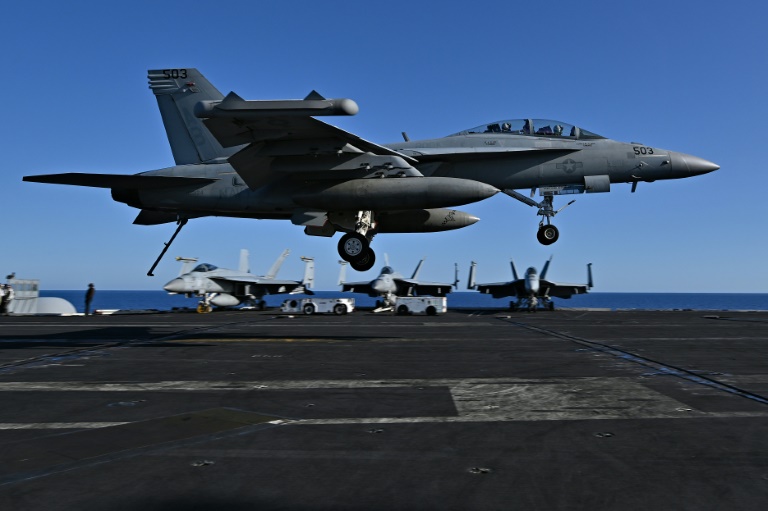
A deafening stream of fighter jets land and take off from a US aircraft carrier, part of a long-planned NATO exercise in the Mediterranean to show military might while Russia wages war in Ukraine.

“I want us to be as ready as we can possibly be,” US Rear Admiral Curt Renshaw, commander of the Carrier Strike Group Eight, told reporters this week on a visit on board USS Harry S. Truman. 

“We look at the Russian capability and we look at our own capabilities and then we train to counter what they might do and to defend ourselves and to defend partners and allies.”

The aircraft carrier is taking part in “Neptune Shield 2022”, a NATO training activity in the Mediterranean and the Baltic Sea this month involving nations from Italy, Poland and Turkey to Britain and the United States.

The goal is to overcome the difficulties of integrating command and control of air, sea and land assets from different countries in the NATO military alliance.

The operation has been in the pipeline for two years, but Russia’s invasion of Ukraine in late February has cast a new light on events.

Speaking in Mediterranean waters between Crete and Libya, Renshaw is well aware how this show of strength comes across on the other side of Europe.

“Look at the strike fighters, look around you! Of course this should be a deterrent effect,” he said, surrounded by F-18 Super Hornet jets lined up in a hangar.

“I think anyone would not be very wise to attack us or to have some sort of aggression against an ally if you think of the capabilities we have.”

Asked about more precise activities, he added: “I won’t talk about specific operations but we do keep close track of where Russia operates submarines.”

– ‘Weighs on our minds’ –

USS Harry S. Truman is akin to a small floating town, carrying around 4,800 individuals, with a disturbingly short runway from which jets fire off regularly or land abruptly, their tailhooks snagged in the ship’s arresting wires.

Among the pilots is British Royal Navy officer Rory Cheyne, who is on an exchange programme with the Americans and recalls recent training flights into France, Germany and Spain.

Asked about the impact of the Ukraine war, he told AFP: “Clearly the training nature of this activity, enhanced vigilance activity, has been put into a different context.

“But certainly what we’re doing… is no different given that context. We are here to work hand in hand with our allies and be ready for whatever eventuality should occur.”

Lieutenant Commander Jeannette Lazzaro, a 33-year-old American, works in the operations department, which sets out the air plan on which flight schedules are based.

The war “has not had a direct impact on what we’re doing… however it does certainly weigh on our minds”, she told AFP.

The exercise is a serious business, but there are moments of levity — not least an informal competition by some of the pilots to grow the best moustache, an adornment typical of World War II fighter pilots.

“It’s a proven fact that a man sporting a moustache is far better in tactical execution and esprit de corps within a combat unit than a man without a moustache,” joked Hayward Foard, second-in-command of the Strike Fighter Squadron.

“Typically we compete who can grow the most finely shaped moustache. I like to think I’m first in the running.”

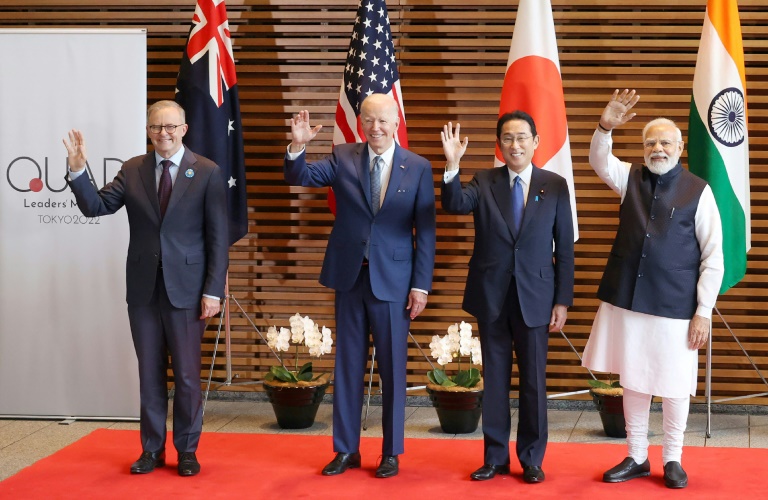
Quad nations warn against 'change by force' with eyes on China

Leaders of Japan, India, Australia and the United States warned Tuesday against attempts to “change the status quo by force” as concerns grow about whether China could invade self-ruled Taiwan.

A joint statement by the so-called Quad bloc avoided any direct mention of China’s growing military power in the region, but left little doubt about where its concerns lie.

The carefully worded document also made reference to the conflict in Ukraine, but without offering any joint position on the Russian invasion, which India has pointedly declined to condemn.

The Quad’s other members have been less coy about their view that a strong response to Russia’s war is needed, one that would deter other countries, including China.

“As Russia’s invasion of Ukraine is shaking the fundamental principles of the international order… (we) confirmed that unilateral attempts to change the status quo by force will never be tolerated anywhere, particularly in the Indo-Pacific region,” Japan’s Prime Minister Fumio Kishida said, using another term for the Asia-Pacific.

The group’s statement made no mention of Russia, or China, but inveighed against a range of activities that Beijing has regularly been accused of in the region.

“We strongly oppose any coercive, provocative or unilateral actions that seek to change the status quo and increase tensions in the area, such as the militarisation of disputed features, the dangerous use of coast guard vessels and maritime militia and efforts to disrupt other countries’ offshore resource exploitation activities,” it said.

Hours after the summit, Japan said Chinese and Russian military planes had flown jointly over the Sea of Japan and East China Sea as the leaders met, in a move the country’s defence minister called “provocative”.

“As the international community responds to Russia’s aggression against Ukraine, the fact that China took such action in collaboration with Russia, which is the aggressor, is cause for concern. It cannot be overlooked,” Nobuo Kishi told reporters.

Beijing confirmed the flights, saying they were in line with the Chinese and Russian “annual military cooperation plan”.

The Quad nations are attempting to build their loose grouping into a more substantive counterweight to China’s rising military and economic power, despite their differences.

They unveiled plans to invest at least $50 billion into regional infrastructure projects over the next five years, and a maritime monitoring initiative seen as intended to bolster surveillance of Chinese activities.

– ‘Democracies versus autocracies’ –

The moves come with worries over recent efforts by China to build ties with Pacific nations including the Solomon Islands, which signed a security pact with Beijing last month.

China’s foreign minister will this week kick off a visit to a host of Pacific nations including the Solomons, Papua New Guinea, Fiji and Kiribati as well as holding video calls with Micronesia and the Cook Islands, Beijing confirmed Tuesday.

Kishida urged Quad members to “listen carefully” to regional neighbours, including the Pacific islands, while Australia’s newly elected Prime Minister Anthony Albanese said the bloc needed to “push our shared values in the region at a time when China was clearly seeking to exert more influence”.

The Quad met a day after US President Joe Biden raised eyebrows and the regional temperature by saying Washington was ready to intervene militarily to defend Taiwan against any Chinese attack.

He insisted Tuesday that his comments did not mean a change to Washington’s longstanding “strategic ambiguity” on how it might respond to a Chinese invasion, prompting another fierce response from Beijing.

Foreign ministry spokesman Wang Wenbin accused Washington of playing “word games” on Taiwan and warned of an “unbearable cost” if the United States “carries on down the wrong path”.

If Biden was keen to avoid being seen as changing policy on Tuesday, he left little doubt about where the Quad’s focus lies.

“This is about democracies versus autocracies, and we have to make sure we deliver,” Biden said as the summit began.

Among the regional concerns are increased Chinese sorties, naval exercises and encroachments by fishing vessels that are viewed as probing regional defences and red lines.

The bloc said its new maritime monitoring programme would “promote stability and prosperity in our seas and oceans”, again avoiding pointing the finger at Beijing while referencing illegal fishing — an accusation frequently levelled at China.

Environmental protesters force suspension of Shell AGM

Oil giant Shell was on Tuesday forced to temporarily suspend its annual general meeting because of disruption from climate change activists.

Proceedings at the venue in central London were halted about half an hour after they started at 10:00 a.m. (0900 GMT).

“Stop kidding yourself that you are doing no harm,” activists shouted at shareholders, according to a live feed of the meeting. 

“Think of your children and your family. They will not escape the effects of the climate emergency.”

Protesters sang “We will, we will stop you!” to the tune of Queen’s 1977 rock anthem “We Will Rock You” before police arrived and they were ejected.

Outside, another group of demonstrators sang and shouted slogans such as “shame on Shell”.

AGM chairman Andrew Mackenzie apologised to delegates after trying in vain to persuade the protesters to wait for discussion of a resolution about a climate transition plan.

The company said later in a statement: “We respect the right of everyone to express their point of view and welcome any engagement on our strategy and the energy transition which is constructive.

“However, this kind of disruption at our AGM is the opposite of constructive engagement.”

It added: “We agree that society needs to take urgent action on climate change.”

Money Rebellion said that more than 70 people took part in the protest, which was part of a wider call for action against Shell for its climate action plan.

It has previously disrupted AGMs of the banks HSBC, Barclays and Standard Chartered.

On Monday, a Shell consultant resigned and accused the oil giant in an email of “failing on a massive planetary scale” to limit climate risks.

Caroline Dennett, a UK-based safety consultant, said the company’s continued extraction of oil and gas was causing “extreme harm” to the planet.

In response, the company said it had short, medium and long-term objectives to reach net zero by 2050 and was committed to reducing its carbon footprint.

Billions of dollars have already been invested in low-carbon energy, although the transition from oil and gas would take decades, a spokeswoman told AFP.

HSBC has meanwhile suspended a top executive for playing down the impact of climate change in a recent presentation.

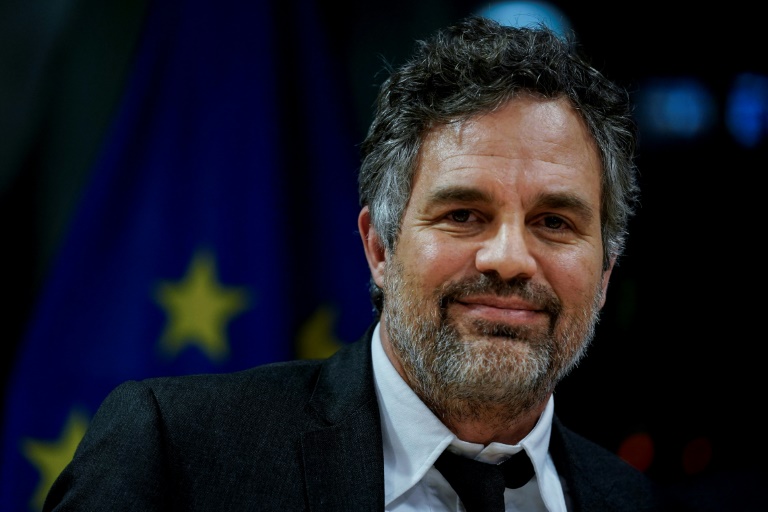
'Hulk' star Ruffalo joins call for global wealth tax

US actor Mark Ruffalo on Tuesday joined a call by over 150 wealthy people for governments to tax them more, as global elites and policymakers met at the World Economic Forum in Swiss resort Davos.

The face of Hulk in a decade of Marvel movies was one of dozens of new millionaires to put their names to an open letter titled “In Tax We Trust”, which was first delivered to attendees at a virtual WEF conference in January.

“While the world has gone through an immense amount of suffering in the last two years, we have actually seen our wealth rise during the pandemic — yet few if any of us can honestly say that we pay our fair share in taxes,” the letter read.

The Patriotic Millionaires group said it had boosted the number of signatories to over 150 by May, from 100 in January.

Its chairman Morris Pearl, a former managing director at mammoth asset manager BlackRock, vowed in a statement to “continue to pressure global leaders to heed our call: tax the rich before it’s too late”.

But Organisation for Economic Cooperation and Development (OECD) secretary-general Mathias Cormann said that wealth taxes could be less effective than other revenue-raising options.

“They don’t necessarily raise that much revenue,” he told a panel discussion at Davos. 

“In terms of the politics of it, it’s attractive, but in terms of the substance of what it achieves it’s not that attractive.”

Cormann did suggest that “property taxes are probably the most efficient, least distorting” form of wealth tax.

“There’s huge scope in wealth taxation… it’s been tried and in some countries it works,” Oxfam executive director Gabriela Bucher responded.

“These amounts that are being accumulated. You could not spend them in several lifetimes”.

Cormann and the OECD are betting on a deal struck by over 130 countries last year to tax multinational companies at a minimum of 15 percent to boost revenue for hard-up governments.

Asked if Washington might walk back its commitment should Republicans win control of Congress at November mid-term elections, Cormann said that “it’s in the rational self-interest of the United States to be part of this deal”.

For companies, it’s “much better for them to be operating in a globally consistent framework” rather than navigate conflicting tax regimes, he added.

“I can’t imagine that any country or any side of politics in any country would make a judgement that would put themselves at that sort of disadvantage.”

Close Bitnami banner
Bitnami