US Business

Biden says 'hi' to North Korea's Kim, despite weapons test fears

President Joe Biden had a short message for North Korea’s Kim Jong Un: “Hello. Period.” he told reporters Sunday in Seoul, before heading to Japan for the second leg of his Asia trip which has been overshadowed by fears of a nuclear test by Pyongyang.

Biden is leaving South Korea, after spending two days with newly elected President Yoon Suk-yeol, with the pair discussing possibly expanding joint military exercises to counter Kim Jong Un’s sabre-rattling.

His goal to reinforce US leadership across Asia has been dogged  by fears the unpredictable, nuclear-armed North could conduct a weapons test while Biden is in the region, but on his last day in Seoul, he told reporters he had a short message for Kim: “Hello. Period.”

He said he was “not concerned” about Pyongyang’s possible weapons test, saying: “We are prepared for anything North Korea does.”

Early Sunday, Biden met with the chairman of Hyundai to celebrate a decision by the auto giant to invest $5.5 billion in an electric vehicle plant in the southern US state of Georgia.

He will also meet US and South Korean troops with Yoon, a schedule that a senior White House official said was able to “reflect the truly integrated nature” of the countries’ economic and military alliance.

Biden has used his visit to call for the democratic allies to deepen ties, saying at a joint press conference with Yoon that Asia was a key battleground in the global “competition between democracies and autocracies”.

“We talked in some length about the need for us to make this larger than just the United States, Japan, and Korea, but the entire Pacific and the South Pacific and Indo-Pacific. I think this is an opportunity,” Biden said.

While China is the main US rival in that struggle, Biden illustrated the acute challenge from Russia when he signed a $40 billion aid bill late Saturday to help Ukraine fight the invasion by Moscow’s forces.

The bill, passed earlier by Congress, was flown to Seoul so that Biden could make it law without having to wait for his return to Washington late next Tuesday.

In Japan, Biden will meet with Prime Minister Fumio Kishida and Emperor Naruhito on Monday ahead of Tuesday’s Quad summit, bringing together the leaders of Australia, India, Japan and the United States.

Also on Monday, Biden will unveil a major new US initiative for regional trade, the Indo-Pacific Economic Framework for Prosperity. 

– North Korea threat –

Biden and Yoon said in a statement Saturday that “considering the evolving threat” from North Korea, they “agree to initiate discussions to expand the scope and scale of combined military exercises and training on and around the Korean peninsula”.

The possible beefing up of joint US-South Korean military exercises comes in response to North Korea’s blitz of sanctions-busting weapons tests this year.

Joint exercises had been scaled back due to Covid and in order for Biden and Yoon’s predecessors, Donald Trump and Moon Jae-in, to embark on a round of high-profile but ultimately unsuccessful diplomacy with the North.

In contrast to the dovish Moon, Yoon said he and Biden discussed possible “joint drills to prepare for a nuclear attack” and called for more tactical US assets to be deployed to the region.

Any build-up of forces or expansion of US-South Korea joint military exercises would likely enrage Pyongyang, which views the joint drills as rehearsals for invasion.

Meanwhile, Biden and Yoon extended an offer of help to Pyongyang, which has recently announced it is in the midst of a Covid-19 outbreak — a rare admission of internal troubles.

The US-South Korea statement said the two presidents “express concern over the recent Covid-19 outbreak” and “are willing to work with the international community to provide assistance” to North Korea.

On Sunday, North Korean state media said 2.6 million people had been sick with “fever” with 67 deaths — which they claimed was a fatality rate of just 0.003 percent, despite an unvaccinated population where malnutrition is widespread.

Biden, while adding that he would not exclude a meeting with Kim if he were “sincere”, indicated the difficulty of dealing with the unpredictable dictator.

“We’ve offered vaccines, not only to North Korea but to China as well and we’re prepared to do that immediately,” Biden said at a press conference with Yoon. “We’ve got no response.”

Moldova wine industry's EU focus pays off

In the small Moldovan village of Pereni, Nicolae Tronciu gazes at his vineyard, with its buds ready to bloom.

The 71-year-old launched his current brand four years ago, selling it to Europe rather than Russia, traditionally his country’s biggest customer — a move that is paying off amid the war in Ukraine.

“Most of my production goes to Europe, especially to our Romanian brothers,” Tronciu told AFP at his vineyard, about 50 kilometres (30 miles) away from the Ukrainian border.

Moldova — a small former Soviet republic of some 2.6 million people nestled between Ukraine and Romania, and among the world’s 20 largest wine producers — has long sought closer ties with Europe.

This has now mitigated the war’s impact as the industry struggles with rising prices for raw materials and a lack of Ukrainian consumers.

– ‘Freedom blend’ –

“The Russian market was our traditional market… In the EU you can charge higher prices for wine, but there the focus is on quality,” Tronciu said.

His family has been making wine for four generations, and he hopes to turn over his business to his sons working abroad.

He makes no secret of where his preferences stand.

“Geographically and as a person I’m pro-European, yes,” he said.

Moldova seeking stronger Europe ties has angered Moscow and resulted in two Russian embargoes in 2006 and 2013.

Those pushed the country further West with the EU liberalising its market for Moldovan wines and sealing a bilateral free trade agreement with Chisinau in 2014.

The transformation has been radical — Russia accounted for only 10 percent of Moldovan wine exports in 2021, down from 80 percent in the early 2000s, according to figures from the Moldovan Ministry of Agriculture.

Moldova exported more than 120 million litres to European countries last year, compared to 8.6 million litres to Russia.

“Before the 2006 (Russian) embargo, the country did not know the term ‘market diversification’… Today, it exports nearly 68 million bottles each year to more than 70 countries,” senior agriculture ministry official Sergiu Gherciu told AFP.

Moldova’s top wine maker Purcari has even taken a direct political stance against Russia’s influence with a wine called “Freedom Blend”, launched in 2014 and made from three grape varieties from Georgia, Ukraine and Moldova.

“This wine is a symbol of these countries which are de facto fighting for their freedom,” Purcari chief operating officer Eugen Comendant said.

After Russia invaded Ukraine in February, the company helped Ukrainian refugees — offering them free accommodation — and sponsored an anti-war banner in the Romanian capital Bucharest, where Purcari is listed on the stock exchange.

– Expensive raw materials –

Comendant said the war’s impact was “close to zero” in terms of Russians no longer purchasing Purcari wines.

There are currently no trade restrictions on wine between the two countries, but the war has made transport difficult and international sanctions make it difficult for Russia to conduct international trade.

But the Ukrainian market, which was in full development and represented four percent of the company’s sales, collapsed.

The war blocking the southern Ukrainian port of Odessa has also caused “major logistical problems and complicates our exports to Asia,” Comendant added.

In March, the Moldovan government said more than 750,000 euros ($790,000) worth of wine were blocked in the Ukrainian port. 

But the main challenge for Moldova’s wine producers lies with rising production costs, which are expected to soar by 50 percent this year, according to Gherciu.

Tronciu, who sells between eight and ten tonnes of wine every year, said all the raw materials have gotten more expensive. 

“Pesticide, fuel, gas, even the iron wire we use” for the grapevines, he said.

He also deplored a lack of tourists, who he used to welcome.

“Most of them were Ukrainians, but also a few Russians,” he said in his now empty tasting room.

Manufacturers getting to grips with airless tyres

Airless tyres that never go flat or need to be inflated: It’s a decades-long dream that manufacturers hope to turn into a reality soon, but for truck drivers first.

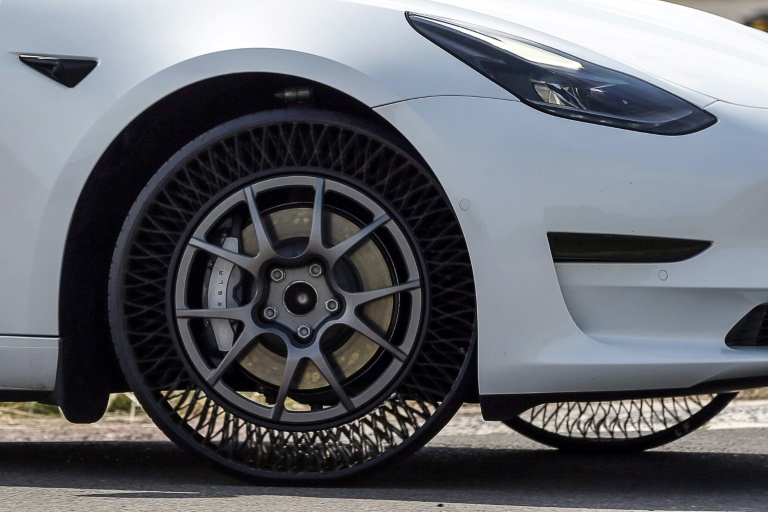
The challenges that the technology faces were put on display at a Goodyear test track in Luxembourg, where a group of journalists put a Tesla equipped with airless tyres through its paces.

Instead of being filled with air, the tyres have a web of spokes that keep the wheels firm and give them a see-through look.

The thin layer of rubber gripping the asphalt has a gargantuan physical challenge to meet: supporting the weight of the car and absorbing shocks as well as standard pneumatic tyres for thousands and thousands of kilometres.

That challenge is being overcome: the tyre’s rubber and plastic structure resisted the huge stress as the car banked into the track’s tight turns.

The ride is smooth but the grip is not as good as on conventional tyres — and they are noisier.

The tyres were tested for 120,000 kilometres (75,000 miles) at speeds of up to 160 kph in both scorching temperatures as well as snow, said Michael Rachita, who heads up Goodyear’s efforts to develop airless tyres.

“The most obvious advantage is that it’s puncture proof,” said Rachita.

“It will never run flat, you could drive over any nail and expect not to lose performance,” he added.

Rachita said airless tyres will also be maintenance free for drivers as they will never need to check and adjust air pressure.

He said a second generation of airless tyres that are lighter, quieter and roll better are in the works.

– Gradual transition seen –

Michelin has released the Tweel, but it is for construction vehicles rather than cars where the demands in terms of driving performance are much greater.

The French firm has also unveiled the Uptis which it is developing with US car manufacturer General Motors, and which it hopes can make the jump from auto shows to showrooms next year.

Its researchers are working on a cocktail of fibreglass and resin to hold the rubber onto the honeycomb structure of the new tyre. 

But Michelin’s CEO Florent Menegaux doesn’t expect airless tyres to squeeze out regular tyres anytime soon.

“We’re going continue to have air tyres for several decades,” he said.

Goodyear, which submitted its first patent on airless tyre technology in 1982, has recently put its food down on the accelerator in terms of research and development.

The US firm aims to have a maintenance-free and long-lasting airless tyre for cars by the end of the decade.

It already has an early version for shuttle buses and automated delivery vehicles on university campuses.

Bridgestone also hopes to have an airless tyre ready within a decade, having already tested early versions on utility vehicles.

Other manufacturers are more sceptical that airless tyres will ever offer comparable shock absorption as traditional tyres and the noise can be reduced sufficiently.

“They aren’t a viable solution and I don’t expect they will become one,” a Continental researcher, Gerrit Bolz, said at a tyre convention in 2017.

– Environmental benefits, economic concerns –

But independent researcher Ulf Sandberg at the Swedish National Road and Transport Research Institute, which is working on an airless tyre for trucks, believes they will eventually become a viable alternative.

“I believe that sooner or later airless tyres could take over,” he told AFP.

“If rolling resistance is reduced by 50 percent, it would increase the range of vehicles by 25 percent, and could be extremely valuable” for car manufacturers, particularly for electric vehicles where range is a key concern.

Airless tyres could prove to be environmentally beneficial as they could last the entire lifetime of most vehicles and could then be recycled or retreaded for a second life.

But manufacturers may not be burning rubber to bring airless tyres to market because they also pose threats to their business model, said Sandberg.

A switch to airless tyres would strand the manufacturing equipment used for pneumatic tyres, a heavy cost for the companies to bear.

Given the longevity of the airless tyres, companies would be making less of them.

Goodyear’s vice president for product development in Europe, Xavier Fraipont, acknowledged that airless tyres requires a “rethinking our business model, of rethinking our manufacturing”.

Yet the possibility of gaining a lead on competitors or being left behind by an affordable and high-performing airless tyre for the consumer market keeps their research rolling forward.

Bitter harvest for Indian farmers after wheat export ban

When New Delhi banned wheat exports as prices soared over Russia’s invasion of Ukraine it provoked consternation abroad and drove the cereal even higher. 

Now Indian farmers and traders are fuming they have been denied a windfall as domestic prices have plummeted. 

India is the world’s second-biggest wheat producer, but the government — itself the country’s biggest buyer of the crop — said it chose to protect food security for its mammoth population despite inflation concerns.

The move — along with dwindling global supplies from Russia and Ukraine, both among the world’s top five wheat exporters — sent prices to all-time highs on commodity exchanges in Chicago and Europe.

But at Asia’s largest grain market in Khanna, in India’s breadbasket state of Punjab, values went the other way.

Every year, thousands of farmers from the wheat-growing region sell their produce at the facility, which is dominated by a dozen giant storage sheds, each the size of a football pitch.

From 2,300 rupees (about $30) per 100 kilograms of wheat before the export ban, prices slumped to 2,015 rupees — the government-set minimum price at which it buys grain for its vast public distribution system.

India’s hundreds of millions of small farmers eke out a borderline existence, subject to the vagaries of the weather, and some in Punjab were already reeling from production losses due to a severe heatwave.

The price fall represents the difference between a bumper payout and heartache, they say.

Farmer Navtej Singh saved half his 60-tonne wheat harvest to sell during the lean season, when prices normally rise, and is aghast at the government’s decision.

Now he is scrambling to sell his remaining stock.

“This ban has come as a shock,” he told AFP. “The price has dropped to the lowest and doesn’t even cover our expenses. I can’t even wait for a day.”

The authorities had not consulted anyone and had acted “selfishly”, he said. 

“We were already hit with production losses this year, and the ban order has made our life difficult.”

– ‘Feed the world’ –

Before the war in Ukraine and the heatwave, India’s wheat production of 109 million tonnes in 2021 and seven million tonnes of exports had both been expected to rise this year.

Prime Minister Narendra Modi last month even offered to help plug the global wheat deficit and “feed the world”.

But extreme weather conditions are becoming more frequent in a phenomenon experts say is driven by climate change. After producers in Punjab were hit by a heatwave, the national harvest came in at four million tonnes less than expected.

Now federal and state authorities are cutting procurement for the public distribution system, which provides free and highly subsidised grains to nearly 800 million people, as food security schemes set up during the coronavirus pandemic are cut back. 

Even so, retail wheat flour prices are at a 12-year high, and Manish Pajni, head of the Punjab government’s grain procurement department in Khanna, has backed the ban, saying wholesale rates could have gone as high as 3,000 rupees without it.

But trader Raj Sood said the government should have adopted a wait and watch policy before abruptly halting exports and causing market turmoil.

“The market was already under stress from the harvest crisis and, without a thought, the government came up with the ban,” he said.

“No doubt the major losses will be incurred by big exporters like Cargill, ITC and Glencore, but small traders and farmers will also be impacted.”

And many businessmen in Khanna say the measure will only have a temporary effect as the rules of supply and demand are unavoidable.

Flour mill owner Divender Verma usually obtains his raw materials from government stocks but said they were running at their minimum. 

“This time we do not hope they can provide for us. So the scenario for wheat is tight,” Verma told AFP. 

Private suppliers will inevitably charge more, he added — further driving up prices for bread and other wheat products.

'Enormously risky': How NFTs lost their lustre

A slew of celebrity endorsements helped inflate a multi-billion dollar bubble around digital tokens over the past year, but cryptocurrencies are crashing and some fear NFTs could be next.

NFTs are tokens linked to digital images, “collectable” items, avatars in games or property and objects in the burgeoning virtual world of the metaverse.

The likes of Paris Hilton, Gwyneth Paltrow and Serena Williams have boasted about owning NFTs and many under-30s have been enticed to gamble for the chance of making a quick profit.

But the whole sector is suffering a rout at the moment with all the major cryptocurrencies slumping in value, and the signs for NFTs are mixed at best.

The number of NFTs traded in the first quarter of this year slumped by almost 50 percent compared to the previous quarter, according to analysis firm Non-Fungible.

They reckoned the market was digesting the vast amount of NFTs created last year, with the resale market just getting off the ground.

Monitoring firm CryptoSlam reported a dramatic tail-off in May, with just $31 million spent on art and collectibles in the week to May 15, the lowest figure all year.

A symbol of the struggle is the forlorn attempt to re-sell an NFT of Twitter founder Jack Dorsey’s first tweet.

Dorsey managed to sell the NFT for almost $3 million last year but the new owner cannot find anyone willing to pay more than $20,000.

– The year of scams –

Molly White, a prominent critic of the crypto sphere, told AFP there were many possible reasons for the downturn.

“It could be a general decrease in hype, it could be fear of scams after so many high-profile ones, or it could be people tightening their belts,” she said.

The reputation of the industry has been hammered for much of the year.

The main exchange, OpenSea, admitted in January that more than 80 percent of the NFTs created with its free tool were fraudulent — many of them copies of other NFTs or famous artworks reproduced without permission.

“There’s a bit of everything on OpenSea,” said Olivier Lerner, co-author of the book “NFT Mine d’Or” (NFT Gold Mine).

“It’s a huge site and it’s not curated, so you really have no idea what you’re buying.”

LooksRare, an NFT exchange that overtook OpenSea for volume of sales this year, got into similar problems as its rival.

As many as 95 percent of the transactions on its platform were found to be fake, according to CryptoSlam.

Users were selling NFTs to themselves because LooksRare was offering tokens with every transaction — no matter what you were buying.

And the amounts lost to scams this year have been eye-watering.

The owners of Axie Infinity, a game played by millions in the Philippines and elsewhere and a key driver of the NFT market, managed to lose more than $500 million in a single swindle.

– ‘Like the lottery’ –

“As soon as you have a new technology, you immediately have fraudsters circling,” lawyer Eric Barbry told AFP.

He pointed out that the NFT market had no dedicated regulation so law enforcement agencies are left to cobble together a response using existing frameworks.

Molly White said strong regulation could help eliminate the extreme speculation but that could, in turn, rob NFTs of their major appeal — that they can bring quick profits.

“I think less hype would be a good thing — in its current form, NFT trading is enormously risky and probably unwise for the average person,” she said.

NFTs are often likened to the traditional art market because they have no inherent utility and their prices fluctuated wildly depending on trends and hype.

But Olivier Lerner suggested a different comparison.

“It’s like the lottery,” he said of those seeking big profits from NFTs. “You play, but you never win.” 

Jill Biden says US to increase funding to fight HIV/AIDS in Latin America

The United States will increase aid to Latin America to combat HIV/AIDS, First Lady Jill Biden said on Saturday during a visit to Panama.

Biden made the announcement while visiting the Casa Hogar el Buen Samaritano — “The Good Samaritan Home” — a shelter east of Panama City for people living with HIV.

Biden’s spokesman Michael La Rosa said in a statement that the United States will send an additional $80.9 million to Latin America, $12 million of which will go to Panama.

“The State Department is making an announcement for increased funding for PEPFAR,” Biden said, referring to the US President’s Emergency Plan for AIDS Relief.

“There is hope on the horizon,” said Biden, who is on a tour of Latin America including Ecuador, Panama and Costa Rica.

PEPFAR was launched by former president George Bush in 2003.

The United States has invested $100 billion in the global fight against HIV/AIDS.

During her visit to Panama, Biden spoke with several HIV/AIDS patients, who told her about discrimination they face.

“This is something that is not talked about in my village, and that is why we have to migrate to the big cities,” said Raul Tugri, an Indigenous man who has been HIV positive since 2014.

“I think it starts within the family unit within the churches, to start changing people’s attitudes,” Biden told him. “I have hope for you.”

Ukraine's Zelensky warns only diplomacy can end war

Ukrainian President Volodymyr Zelensky has warned only a diplomatic breakthrough rather than an outright military victory can end Russia’s war on his country, while pushing its case for EU membership.

Zelensky also appealed for more military aid, even as US President Joe Biden formally signed off on a $40-billion package of aid for the Ukrainian war effort.

And he insisted Saturday that his war-ravaged country should be a full candidate to join the EU, rejecting a suggestion from France’s President Emmanuel Macron and some other EU leaders that a sort of associated political community be created as a waiting zone for a membership bid.

“We don’t need such compromises,” Zelensky said during a joint news conference with visiting Portuguese Prime Minister Antonio Costa.

“Because, believe me, it will not be compromise with Ukraine in Europe, it will be another compromise between Europe and Russia.”

Speaking on Ukrainian television Saturday, Zelensky said: “There are things that can only be reached at the negotiating table.”

The war “will be bloody, there will be fighting but will only definitively end through diplomacy”.

“Discussions between Ukraine and Russia will decidedly take place. Under what format I don’t know,” he added.

But he promised that the result would be “fair” for Ukraine.

– Cruise missile ‘strike’ –

After just over 12 weeks of fierce fighting, Ukrainian forces have halted Russian attempts to seize Kyiv and the northern city of Kharkiv, but they are under intense pressure in the eastern Donbas region.

Moscow’s army has flattened and seized the Black Sea port of Mariupol and subjected Ukrainian troops and towns in the east to relentless ground and artillery attacks.

On Saturday, Russia’s defence ministry claimed to have struck with cruise missiles a large stockpile of weapons supplied by the West in the country’s northwest Zhytomyr region.

“Long-range, high-precision Kalibr missiles, launched from the sea, destroyed a large consignment of weapons and military equipment supplied by the United States and European countries,” the ministry said. The strike has yet to be independently confirmed.

– Russia cuts Finland’s gas-

Zelensky’s Western allies have shipped a steady stream of modern weaponry to his forces and imposed sweeping sanctions on the Russian economy and President Vladimir Putin’s inner circle.  

The Kremlin has responded by disrupting European energy supplies.

On Saturday, Russian energy giant Gazprom said it had halted supplies to neighbouring Finland as it had not received the ruble payments it was due.

Helsinki had refused to pay its bill in rubles, which Moscow had demanded in a bid to side-step financial sanctions.

In 2021, Gazprom supplied about two-thirds of the country’s gas consumption but only eight percent of its total energy use.

Gasum, Finland’s state-owned energy company, said it would use other sources, such as the Balticconnector pipeline, which links Finland to fellow EU member Estonia.

Moscow cut off gas to Poland and Bulgaria last month, a move the European Union denounced as “blackmail”.

The row over Finland’s gas bill comes just days after the country joined neighbouring Sweden in breaking their historical military non-alignment and applying to join NATO.

Moscow has warned Finland that joining NATO would be “a grave mistake with far-reaching consequences”, and Defence Minister Sergei Shoigu has said it will respond by building military bases in western Russia.

But both Finland and Sweden are now apparently on the fast track to join the military alliance, with Biden this week offering “full, total, complete backing” to their bids.

All 30 existing NATO members must agree, however, and Turkey has condemned Sweden’s alleged tolerance for the presence of exiled Kurdistan Workers’ Party (PKK) militants

– Dogged resistance –

On the ground in Ukraine, the fighting remains fiercest in the eastern region of Donbas, a Russian-speaking area partially controlled by pro-Kremlin separatists since 2014.

In Severodonetsk, a frontline city now at risk of encirclement, 12 people were killed and another 40 wounded by Russian shelling, said regional governor Sergiy Gaiday.

“The Russians are using artillery day and night,” he said.

In the neighbouring Donetsk region, governor Pavlo Kyrylenko said on Telegram on Saturday that seven civilians had been killed and 10 wounded.

Further north in Kharkiv, just 50 kilometres from the border with Russia, new networks of trenches and checkpoints have cropped up as the city prepares to defend against a fresh assault.

“When we were here on the 24th of February there were no positions at all,” says “Doctor”, a medic with the National Guard, referring to the day the Russians invaded.

“But now we have trenches, we have well-protected zones, so for them, it would be impossibly hard to capture (this position).” 

On the roads leading out of the city — some of which have been closed off — civilians help soldiers fill sandbags for the checkpoints.

“We have a problem, we are at war,” jokes a soldier as he checks a vehicle and turns it back.

-Prisoner swap mooted-

On Friday, Moscow declared its bloody, months-long battle for the Azovstal steelworks in Mariupol at an end.

Russian defence ministry spokesman Igor Konashenko said 2,439 Ukrainian personnel had surrendered at the plant since May 16, the final 500 on Friday.

Ukraine hopes to exchange the surrendering soldiers for Russian prisoners. But in Donetsk, pro-Kremlin authorities have threatened to put some of them on trial.

A Russian negotiator on Saturday said Moscow would consider exchanging prisoners from Ukraine’s far-right Azov battalion for Viktor Medvedchuk, a wealthy Ukrainian businessman known for his close ties to Putin.

“We are going to study the possibility,” said Leonid Slutsky, a senior member of Russia’s negotiating team, speaking from the separatist city of Donetsk, the RIA Novosti news agency reported.

Medvedchuk, 67, is a politician and one of Ukraine’s richest people. He escaped from house arrest after Russia invaded in February but was re-arrested in mid-April.

burs-jj/har/cwl/mtp

US high schoolers design low-cost filter to remove lead from water

When the pandemic forced schools into remote learning, Washington-area science teacher Rebecca Bushway set her students an ambitious task: design and build a low-cost lead filter that fixes to faucets and removes the toxic metal.

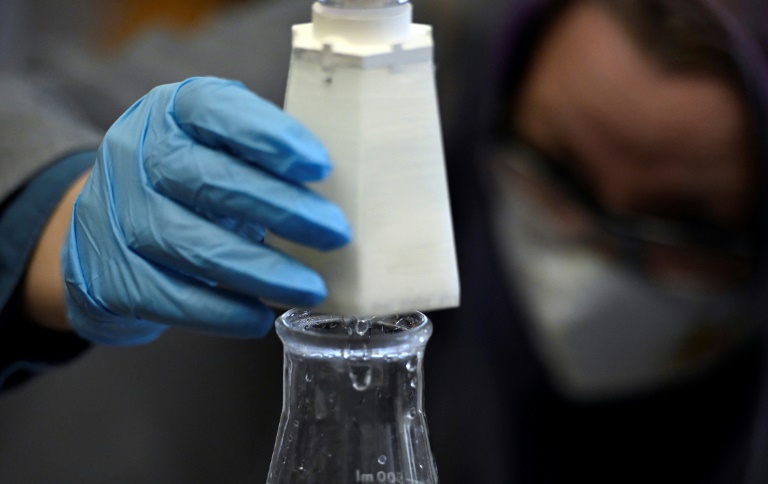
Using 3D printing and high-school level chemistry, the team now has a working prototype — a three-inch (7.5 centimeter) tall filter housing made of biodegradable plastic, which they hope to eventually bring to market for $1 apiece.

“The science is straightforward,” Bushway told AFP on a recent visit to the Barrie Middle and Upper School in suburban Maryland, where she demonstrated the filter in action. 

“I thought, ‘We have these 3D printers. What if we make something like this?'” 

Bushway has presented the prototype at four conferences, including the prestigious spring meeting of the American Chemistry Society, and plans to move forward with a paper in a peer-reviewed journal.

Up to 10 million US homes still receive water through lead pipes, with exposure particularly harmful during childhood. 

The metal, which evades a key defense of the body known as the blood-brain-barrier, can cause permanent loss of cognitive abilities and contribute to psychological problems that aggravate enduring cycles of poverty.

A serious contamination problem uncovered in Flint, Michigan in 2014 is perhaps the most famous recent disaster — but lead poisoning is widespread and disproportionately impacts African Americans and other minorities, explained Barrie team member Nia Frederick.

“And I think that’s something we can help with,” she said.

The harms of lead poisoning have been known for decades, but lobbying by the lead industry prevented meaningful action until recent decades.

President Joe Biden’s administration has pledged billions of dollars from an infrastructure law to fund the removal of all the nation’s lead pipes over the coming years — but until that happens, people need solutions now.

– A clever trick – 

Bushway’s idea was to use the same chemical reaction used to restore contaminated soil: the exposure of dissolved lead to calcium phosphate powder produces a solid lead phosphate that stays inside the filter, along with harmless free calcium.

The filter has a clever trick up its sleeve: under the calcium phosphate, there’s a reservoir of a chemical called potassium iodide. 

When the calcium phosphate is used up, dissolved lead will react with potassium iodide, turning the water yellow – a sign it is time to replace the filter.

Student Wathon Maung spent months designing the housing on 3D printing software, going through many prototypes.

“What’s great about it was that it’s kind of this little puzzle that I had to figure out,” he said. 

Calcium phosphate was clumping inside the filter, slowing the reaction. But Maung found that by incorporating hexagonal bevels he could ensure the flow of water and prevent clumping. 

The result is a flow rate of two gallons (nine liters) per minute, the normal rate at which water flows out a tap.

Next, the Barrie team would like to incorporate an instrument called a spectrophotometer that will detect the yellowing of the water even before it is visible to the human eye and then turn on a little LED warning light.

Paul Frail, a chemical engineer who was not involved in the work, said the group “deserves an incredible amount of credit” for its work, combining general chemistry concepts with 3D printing to design a novel product.

He added, however, that the filter would need further testing with ion chromatography instruments that are generally available in universities or research labs — as well as market research to determine the demand.

Bushway is confident there is a niche. Reverse osmosis systems that fulfill the same role cost hundreds to thousands of dollars, while carbon block filters available for around $20 have to be replaced every few months, which is more often than her group’s filter.

“I am over-the-Moon proud of these students,” Bushway said, adding that the group hoped to work with partners to finalize the design and produce it at scale.

Hurting Tiger struggles to 79 and ponders pullout at PGA

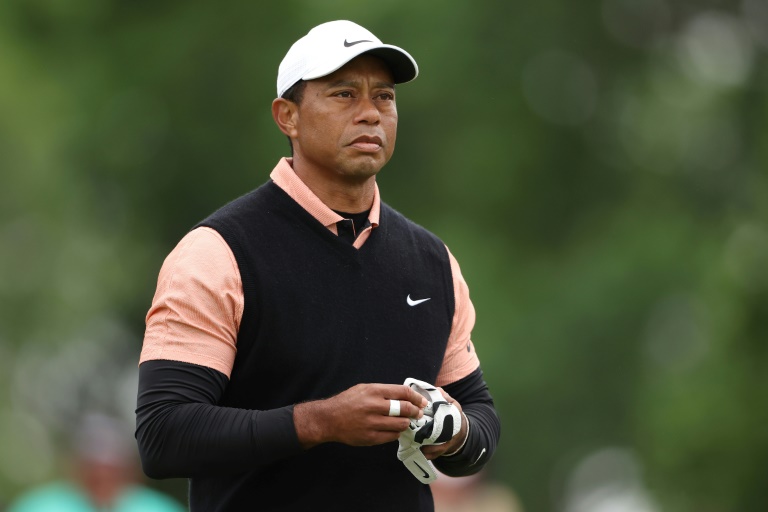
Tiger Woods struggled to the third-worst major round of his career with a nine-over par 79 in Saturday’s third round of the PGA Championship and the 15-time major winner wouldn’t commit to playing Sunday’s final round.

Asked if he definitely would play on Sunday after he limped through the third round on his injured right leg, Woods replied, “Well, I’m sore. I know that is for a fact.

“We’ll do some work and see how it goes.”

Woods made five consecutive bogeys at a major for the first time in his career from the ninth through 13th holes and stood on 12-over 222 after 54 holes at rain-hit Southern Hills.

“I didn’t do anything right,” Woods said. “I didn’t hit many good shots. Consequently I ended up with a pretty high score.”

Woods, who suffered severe right leg damage in a February 2021 car crash, shared 76th — last place among the 79 players who made the cut.

Woods struggled to his worst-ever score in 79 PGA Championship rounds and his only worse major scores were a 10-over 81 in the third round of the 2002 British Open and a 10-over 80 in the first round of the 2015 US Open.

“I just didn’t play well,” Woods said. “I didn’t hit the ball very well and got off to not the start I needed to get off to.”

After Woods spent weeks hospitalized and months unable to walk, he recovered well enough to return only 14 months later at last month’s Masters, sharing 47th and pleased to walk all 72 holes.

But after struggling to his worst Masters rounds with weekend 78s, Woods again could not follow the effort to make a cut in Tulsa with a solid round.

Former world number one Woods, now ranked 818th, has said all week his right leg hurts after rounds with limited mobility and strength.

He requires ice baths and physical therapy between rounds to enable his right leg — held together by rods, plates, screws and pins — to have the strength to walk the 7,556-yard course.

Woods sank a 13-foot par putt at the first hole but found water off the second tee on the way to a bogey then lipped out a five-foot birdie putt at the fourth.

“I thought I hit a good tee shot down two and ended up in the water, and just never really got any kind of momentum on my side,” Woods said.

After another tee-shot splashdown at the sixth, Woods hit into greenside rough and needed three to get down for triple bogey, then missed a six-foot putt to bogey the seventh.

– Tiger rides bogey train –

At nine, Woods embedded a ball in bunker-side grass blasting out of the sand and needed an eight-foot putt to salvage bogey and a six-over 41 on the front nine.

That began his run of five bogeys in a row, errant tee shots costing him time and again.

“I couldn’t get off the bogey train there,” Woods said.

Woods sank a 36-foot putt at the par-4 15th for his only birdie of the day and closed with three pars.

South African Shaun Norris, who played alongside Woods on Saturday, was amazed at his pain tolerance.

“He grinds through everything and pushes himself, even all the pain,” Norris said. “It’s not easy to see a guy like him have to go through that and struggle like that.

“He’s swinging it nicely and I think he’ll be back once he gets back to normal health and sorts out all the problems.”

Biden, Yoon signal expanded military drills due to N. Korea 'threat'

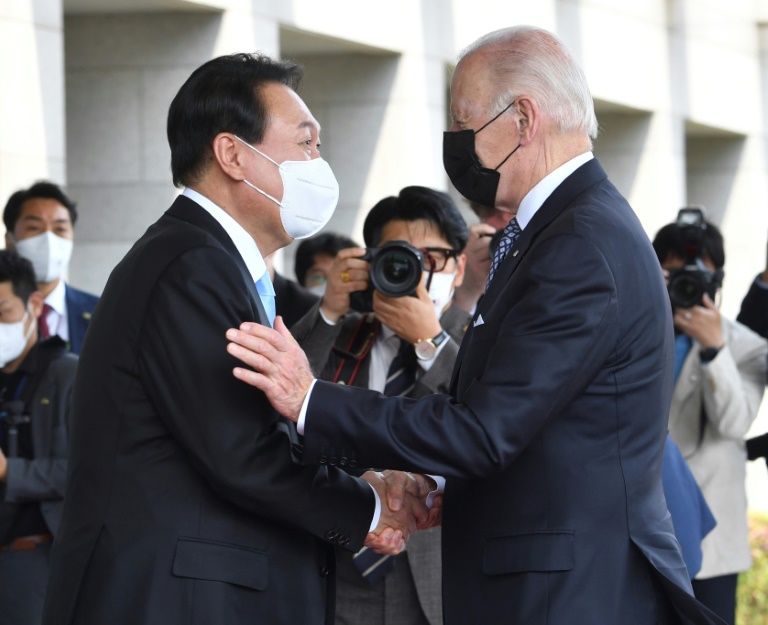
US President Joe Biden and South Korea’s new President Yoon Suk-yeol signalled Saturday an expanded military presence in response to the “threat” from North Korea, while also offering to help the isolated regime face a Covid-19 outbreak.

After meeting in Seoul on Biden’s first trip to Asia as president, the two leaders said in a statement that “considering the evolving threat posed by” North Korea, they “agree to initiate discussions to expand the scope and scale of combined military exercises and training on and around the Korean peninsula”.

The possible beefing up of joint exercises comes in response to North Korea’s growing belligerance, with a blitz of sanctions-busting weapons tests this year as fears grow that Kim Jong Un will order a nuclear test while Biden is in Asia.

Biden and Yoon also extended an offer of help to Pyongyang, which has recently announced it is in the midst of a Covid-19 outbreak, a rare admission of internal troubles.

The US-South Korea statement said the two presidents “express concern over the recent Covid-19 outbreak” and “are willing to work with the international community to provide assistance” to North Korea to help fight the virus.

On Saturday, North Korean state media reported nearly 2.5 million people had been sick with “fever” with 66 deaths as the country “intensified” its anti-epidemic campaign.

Biden, while adding that he would not exclude a meeting with Kim if he were “sincere”, indicated the difficulty of dealing with the unpredictable dictator.

“We’ve offered vaccines, not only to North Korea but to China as well and we’re prepared to do that immediately,” Biden said at a press conference with Yoon. “We’ve got no response.”
For his part, Yoon stressed that the offer of Covid aid was according to “humanitarian principles, separate from political and military issues”.

Elected on a strongly pro-US message, Yoon emphasised the need to reinforce South Korea’s defences.

According to Yoon, he and Biden “discussed whether we’d need to come up with various types of joint drills to prepare for a nuclear attack”.

Talks are also ongoing on ways to “coordinate with the US on the timely deployment of strategic assets when needed”, he said, reaffirming commitment to North Korea’s “complete denuclearization”.

The strategic assets should include “fighter jets and missiles in a departure from the past when we only thought about the nuclear umbrella for deterrence”, he said.

Any such deployments, or a ramping up of US-South Korea joint military exercises, is likely to enrage Pyongyang, which views the drills as rehearsals for invasion.

– Biden-Yoon ‘personal relationship’ –

Biden began his day by paying respects at Seoul National Cemetery, where soldiers killed defending South Korea, including many who fought alongside US troops in the Korean War, are buried.

He then held closed-door talks with Yoon ahead of the joint press conference and a state dinner.

A US official said that in addition to tensions over North Korea and the US-led campaign to punish Russia for invading Ukraine, Biden’s main focus Saturday was establishing “a strong personal relationship” with Yoon, who is less than two weeks into his presidency.

Like Japan, where Biden flies on Sunday, South Korea is seen as a key player in US strategy to contain China and maintain what Washington calls the “free and open Indo-Pacific”.

Biden’s Asia trip “is about demonstrating unity and resolve and strengthening the coordination between our closest allies”, a senior US official told reporters on condition of anonymity. 

In Japan, Biden will meet with Prime Minister Fumio Kishida and the emperor.

On Monday, he will unveil a major new US initiative for regional trade, the Indo-Pacific Economic Framework for Prosperity. A day later, he will join a regional summit of the Quad — a grouping of Australia, India, Japan and the United States.

– Cutting-edge investments –

On arrival Friday in South Korea, Biden accompanied Yoon on a tour of a massive Samsung semiconductor factory.

The microchips are a vital component in almost every piece of sophisticated modern technology, and South Korea and the United States need to work to “keep our supply chains resilient, reliable and secure”, Biden said.

For the US leader, whose Democratic Party fears a possible trouncing in midterm elections in November, snarled supply chains are an acute domestic political challenge, with Americans increasingly frustrated over rising prices and setbacks in the post-Covid pandemic recovery.

Biden emphasised Samsung’s decision to build a new semiconductor plant in Texas, opening in 2024.

In the southern US state of Georgia, the governor on Friday announced that South Korean auto giant Hyundai will build a $5.5 billion plant to produce electric vehicles and batteries.

Close Bitnami banner
Bitnami