US Business

US backs Nordic NATO bids, Ukraine tries Russian for war crime

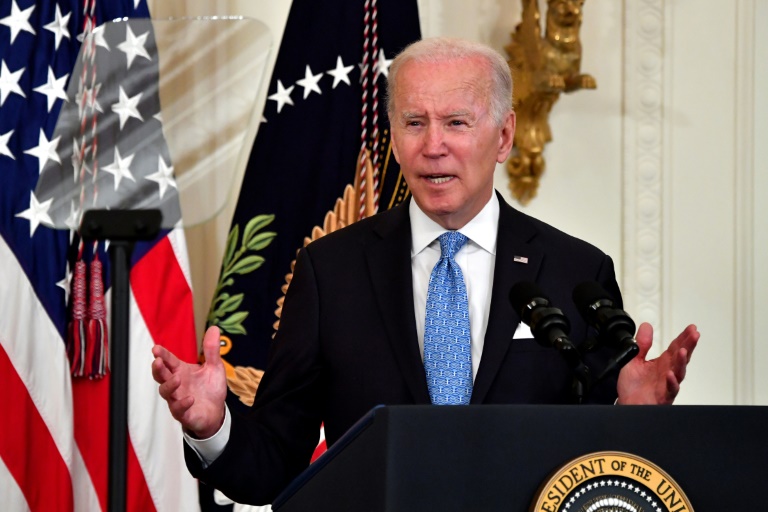
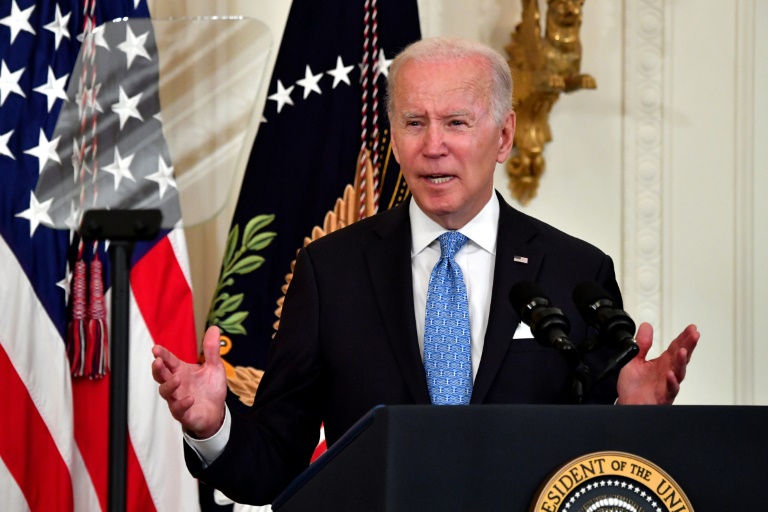
US President Joe Biden will host the leaders of Finland and Sweden on Thursday to discuss their NATO membership bids, while Ukraine said no military option was left to rescue the soldiers still inside a steel plant besieged by Russian forces.

Moscow’s troops have been accused of widespread atrocities against civilians during their devastating campaign, and Ukraine began its first war crimes trial of the conflict on Wednesday with a Russian soldier pleading guilty.

The brutality of the invasion that began on February 24 shook Sweden and Finland, and the neighbours — neutral for decades — decided to seek NATO membership despite warnings from the Kremlin.

“I warmly welcome and strongly support the historic applications from Finland and Sweden for membership in NATO,” Biden said in a statement Wednesday, offering US support against any “aggression” while their bids are considered.

Biden will meet President Sauli Niinisto of Finland and Sweden’s Prime Minister Magdalena Andersson in Washington on Thursday for consultations.

Their bids face stiff resistance from NATO member Turkey, which accuses the two nations of harbouring anti-Turkish extremists.

But Western allies remain optimistic they can overcome Ankara’s objections.

In an effort to lower the diplomatic heat, US Secretary of State Antony Blinken met with Turkey’s Foreign Minister Mevlut Cavusoglu at the United Nations, who called the face-to-face discussion “extremely positive”.

Applications for entry into the alliance require the approval of all members.

For now, several including Britain have offered security guarantees to Finland and Sweden to guard against any Russian aggression.

British Prime Minister Boris Johnson said these applications would not have been expected recently “but Putin’s appalling ambitions have transformed the geopolitical contours of our continent”.

– ‘Catastrophic mistakes’ –

On the ground, in the ruined port city of Mariupol, more than 1,000 Ukrainian soldiers including senior commanders remained inside the besieged Azovstal steel plant, a pro-Russian separatist leader said.

Moscow said 959 of the troops had surrendered this week.

Ukraine’s defence ministry pledged to do “everything necessary” to rescue those still in the sprawling plant’s tunnels but admitted there was no military option available.

Those who have left the heavily shelled plant were taken into Russian captivity, including 80 who were seriously wounded, Russia’s defence ministry said.

The defence ministry in Kyiv said it was hoping for an “exchange procedure… to repatriate these Ukrainian heroes as quickly as possible”.

But their fate was unclear, with Kremlin spokesman Dmitry Peskov refusing to say whether they would be treated as criminals or prisoners of war.

Ukraine’s President Volodymyr Zelensky hit out at Moscow in his nightly address to the nation, calling the invasion an “absolute failure”.

“They are afraid to acknowledge that catastrophic mistakes were made at the highest military and state level,” Zelensky said.

Despite their last-ditch resistance in places such as Mariupol and the successful defence of Kyiv, Ukrainian forces are retreating across swathes of the eastern front.

The losses often come after weeks of battles over towns and small cities that get pulverised by the time the Russians surround them in a slow-moving wave.

“I tell everyone that there is no reason to worry when the banging is from outgoing fire,” Volodymyr Netymenko said as he packed up his sister’s belongings before evacuating her from the burning village of Sydorove in eastern Ukraine.

“But when it is incoming, it is time to run. And things have been flying at us pretty hard for the past two or three days.”

– ‘Clear signal’ on war crimes –

The conflict has sparked a massive exodus of more than six million Ukrainians, many bearing accounts of torture, sexual violence and indiscriminate destruction.

Ukraine’s first trial for war crimes — expected to be the first of many linked to the Russian invasion — began in a cramped Kyiv courtroom on Wednesday.

Vadim Shishimarin, a shaven-headed Russian sergeant from Irkutsk in Siberia, pleaded guilty to a war crime and faces a life sentence.

Shishimarin admitted to shooting dead an unarmed 62-year-old man in Ukraine’s Sumy region four days into the invasion.

“By this first trial, we are sending a clear signal that every perpetrator, every person who ordered or assisted in the commission of crimes in Ukraine shall not avoid responsibility,” prosecutor general Iryna Venediktova said.

Russia’s government has no information on the soldier, Kremlin spokesman Peskov said, adding that many such cases reported by Ukraine are “simply fake or staged”.

The International Criminal Court is deploying its largest-ever field team to Ukraine, with 42 investigators, forensic experts and support staff to gather evidence of alleged war crimes.

– Global food crisis –

In another step affirming US support for Ukraine, the American embassy in Kyiv reopened on Wednesday after three months.

The Kremlin meanwhile intensified a tit-for-tat round of diplomatic expulsions against European countries, ordering dozens of personnel from France, Italy and Spain to leave.

The Russian invasion has blown a hole in Ukraine’s finances, as tax revenue has dropped sharply, leaving it with a shortfall of around $5 billion a month.

Finance ministers from G7 nations will meet in Germany on Thursday to try and find a solution for Kyiv’s budget troubles.

The conflict’s economic impact has cascaded across the world, fuelling a global food crisis that has pushed up prices, especially in developing nations.

Russia and Ukraine produce 30 percent of the global wheat supply.

UN Secretary-General Antonio Guterres said Wednesday that the conflict “threatens to tip tens of millions of people over the edge into food insecurity”.

“Malnutrition, mass hunger and famine” could follow “in a crisis that could last for years,” Guterres warned as he and others urged Russia to release Ukrainian grain exports.

burs-qan/dhc
Asian markets plunge after Wall St battering

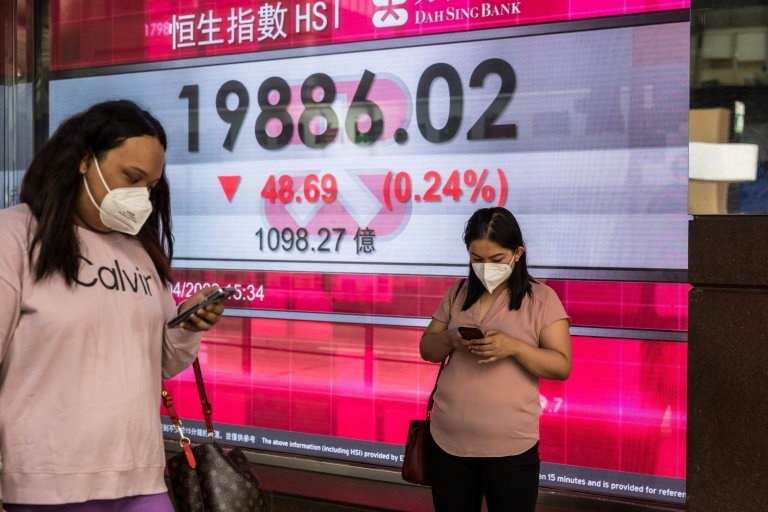
Asian markets posted big early losses Thursday, after Wall Street suffered one of its worst batterings in two years in the previous session.

Downcast earnings reports from retailers had exacerbated worries about consumer resilience and corporate profitability Wednesday, sparking a rough day’s trade.

On Thursday morning, Hong Kong was down by more than three percent, while Tokyo was down by about 2.5 percent.

Among the biggest losers in Hong Kong was Chinese tech giant Tencent, whose stocks fell more than eight percent on lacklustre first-quarter results.

Elsewhere in the region, Australia posted its lowest jobless rate in 48 years, in a potential boost to Prime Minister Scott Morrison two days ahead of tightly contested federal elections.

The unemployment rate dipped to 3.9 percent, the official statistics body said, the lowest rate since 1974.

But stocks in Sydney were still down, as were those in Singapore, Shanghai, Seoul and Taipei, though Jakarta was up by more than two percent.

Stephen Innes at SPI Asset Management called Wednesday’s losses “the most significant daily decline since June 2020”.

“The weakness came as Target’s quarterly earnings added fuel to the recession risk narrative,” he added.

Target, the North American-focused big-box retailer, plunged around 25 percent after earnings missed expectations despite higher sales.

The company pointed to the hit from higher operating costs in results that echoed those of bigger rival Walmart.

The retailers said profits were under pressure and some consumers were avoiding discretionary purchases as prices for food, gasoline and other household staples rise.

All three major US indices dove, with the Dow sinking more than 1,150 points or 3.6 percent, and the Nasdaq plunging 4.7 percent.

European bourses were also down.

“The big falls in shares of these retails… highlights the damage inflation is inflicting on the sector’s profit margins,” said Fawad Razaqzada at City Index.

“What’s more, consumers are getting squeezed as well and if they now start to cut back on spending then retailers could suffer even further,” he added.

In some of his most hawkish remarks to date, Federal Reserve Chair Jerome Powell said Tuesday that the US central bank would raise interest rates until there is “clear and convincing” evidence that inflation is in retreat. 

— Bloomberg News contributed to this report —

– Key figures at around 0215 GMT –

Hong Kong – Hang Seng Index: DOWN 3.07 percent at 20,009.68 

Shanghai – Composite: DOWN 0.89 percent at 3,058.44 

Tokyo – Nikkei 225: DOWN 2.63 percent at 26,202.70 (break)

Brent North Sea crude: UP 1.08 percent at $110.19 per barrel

West Texas Intermediate: UP 0.62 percent at $110.21 per barrel

Euro/dollar: DOWN at $1.0487 from $1.0533

Pound/dollar: DOWN at $1.2349 from $1.2476

Euro/pound: UP at 84.93 pence from 84.43 pence

Dollar/yen: DOWN at 128.54 yen from 129.18 yen

New York – Dow: DOWN 3.6 percent at 31,490.07 (close)

London – FTSE 100: DOWN 1.1 percent at 7,438.09 (close)

US to fly in baby formula on military contracted planes

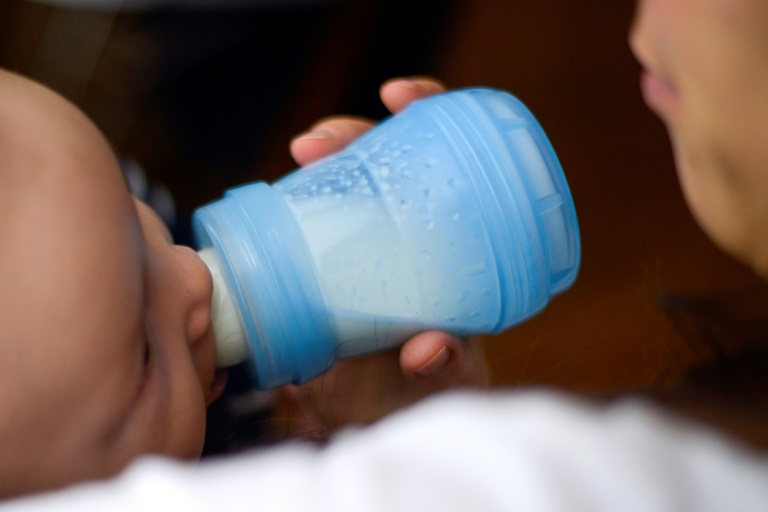
The US government will fly in baby formula on commercial planes contracted by the military in an airlift aimed at easing the major shortage plaguing the country, the White House said on Wednesday.

The lack of formula — the result of a perfect storm of supply chain issues and a massive recall — is leaving parents increasingly desperate, and has become a political headache for President Joe Biden as midterm elections loom.

The Department of Defense “will use its contracts with commercial air cargo lines, as it did to move materials during the early months of the Covid pandemic, to transport products from manufacturing facilities abroad that have met Food and Drug Administration (FDA) safety standards,” the White House said.

“Bypassing regular air freighting routes will speed up the importation and distribution of formula and serve as an immediate support as manufacturers continue to ramp up production,” it said, dubbing the effort “Operation Fly Formula.”

Biden has also invoked the Defense Production Act to give baby formula manufacturers first priority in supplies.

“Directing firms to prioritize and allocate the production of key infant formula inputs will help increase production and speed up in supply chains,” the White House said.

Initially caused by supply chain blockages and a lack of production workers due to the pandemic, the shortage was exacerbated in February when, after the death of two infants, manufacturer Abbott announced a “voluntary recall” for formula made at its factory in Michigan and shut down that location.

A subsequent investigation cleared the formula, and the FDA reached an agreement on Monday with Abott to resume production. But it will take weeks to get the critical product back on store shelves.

– Bridging the gap –

Biden wrote in a letter to the heads of the Departments of Agriculture and Health and Human Services that imports of formula “will serve as a bridge to this ramped up production.”

“I request that you work expeditiously to identify any and all avenues to speed the importation of safe infant formula into the United States and onto store shelves,” the president wrote.

The shortage has left many parents frantic and fearful their infants may starve. Formula is a necessity for many families, particularly in low-income households in which mothers have to return to work almost immediately after giving birth and cannot breastfeed.

A further issue is that prices for the formula that remains have skyrocketed.

The desperation of parents is highlighted on social media, where posts shared hundreds of thousands of times urge people to make formula at home — a move pediatricians warn against.

“It won’t meet your baby’s essential nutritional needs, can be very dangerous to their growth and development, and can even make your baby sick,” Tanya Altmann, author of several parenting books and founder of Calabasas Pediatrics in California, told AFP.

The formula shortage also has political consequences, with the Republican opposition — which has set its sights on wresting back control of Congress in November’s midterm elections — seizing on the issue to berate Biden and the Democrats.

The United States relies on domestic producers for 98 percent of the baby formula it consumes. The average out-of-stock rate for the key product hit 43 percent earlier this month, according to Datasembly, which collected information from more than 11,000 retailers.

US to fly in baby formula on military contracted planes

The US government will fly in baby formula on commercial planes contracted by the military in an airlift aimed at easing the major shortage plaguing the country, the White House said on Wednesday.

The lack of formula — the result of a perfect storm of supply chain issues and a massive recall — is leaving parents increasingly desperate, and has become a political headache for President Joe Biden as midterm elections loom.

The Department of Defense “will use its contracts with commercial air cargo lines, as it did to move materials during the early months of the Covid pandemic, to transport products from manufacturing facilities abroad that have met Food and Drug Administration (FDA) safety standards,” the White House said.

“Bypassing regular air freighting routes will speed up the importation and distribution of formula and serve as an immediate support as manufacturers continue to ramp up production,” it said, dubbing the effort “Operation Fly Formula.”

Biden has also invoked the Defense Production Act to give baby formula manufacturers first priority in supplies.

“Directing firms to prioritize and allocate the production of key infant formula inputs will help increase production and speed up in supply chains,” the White House said.

Initially caused by supply chain blockages and a lack of production workers due to the pandemic, the shortage was exacerbated in February when, after the death of two infants, manufacturer Abbott announced a “voluntary recall” for formula made at its factory in Michigan and shut down that location.

A subsequent investigation cleared the formula, and the FDA reached an agreement on Monday with Abott to resume production. But it will take weeks to get the critical product back on store shelves.

– Bridging the gap –

Biden wrote in a letter to the heads of the Departments of Agriculture and Health and Human Services that imports of formula “will serve as a bridge to this ramped up production.”

“I request that you work expeditiously to identify any and all avenues to speed the importation of safe infant formula into the United States and onto store shelves,” the president wrote.

The shortage has left many parents frantic and fearful their infants may starve. Formula is a necessity for many families, particularly in low-income households in which mothers have to return to work almost immediately after giving birth and cannot breastfeed.

A further issue is that prices for the formula that remains have skyrocketed.

The desperation of parents is highlighted on social media, where posts shared hundreds of thousands of times urge people to make formula at home — a move pediatricians warn against.

“It won’t meet your baby’s essential nutritional needs, can be very dangerous to their growth and development, and can even make your baby sick,” Tanya Altmann, author of several parenting books and founder of Calabasas Pediatrics in California, told AFP.

The formula shortage also has political consequences, with the Republican opposition — which has set its sights on wresting back control of Congress in November’s midterm elections — seizing on the issue to berate Biden and the Democrats.

The United States relies on domestic producers for 98 percent of the baby formula it consumes. The average out-of-stock rate for the key product hit 43 percent earlier this month, according to Datasembly, which collected information from more than 11,000 retailers.

'Transmitting violence': Livestream video's dark side

A gunman’s livestream of a mass killing in New York state was taken down in a matter of minutes — but even that was not fast enough to prevent those images from becoming effectively impossible to erase from the internet.

Posting horrific clips like those is not barred by US speech laws, experts told AFP, so the decision on whether to keep them online is largely left up to individual tech companies.

But even the sites that want them taken down say they struggle to do so, since once unleashed onto the internet, the videos can be edited and shared again and again.

In the case of the Buffalo shooting that killed 10 African Americans at a grocery store on Saturday, it’s particularly chilling because writings attributed to the suspect noted he was in part inspired by another mass shooter’s livestream.

“If (companies) are going to commit to live streaming, you are committed to transmitting a certain number of rapes, murders, suicides and other types of crimes,” said Mary Anne Franks, a professor at University of Miami school of law.

“That’s just what comes with that territory,” she added.

The live feed of the killing on Amazon’s Twitch platform was pulled down within two minutes, the company said –- far quicker than the 17 minutes New Zealand mosque shooter Brenton Tarrant’s attack was streamed on Facebook in 2019.

Social media firms say they fight hard to keep these types of images off their platforms, with automated and manual efforts by workers to squelch video of the Buffalo attack and similar horrors. 

But the images can be edited, titles or names changed and then re-posted on sites that are happy to have the traffic that others have decided is beyond their limit.

One tweet on Wednesday cited the Buffalo suspect’s name, 18-year-old Payton Gendron, and included a link to a video about the attack, but did not show the killing.

However, once on the site viewers were offered additional videos, including one showing over 90 seconds of the attack and which said it had nearly 1,800 views since Sunday.

Websites don’t have to allow this type of video but American law is mostly silent on prohibiting them.

“There is nothing illegal in the US about posting a video of the (Buffalo) livestream. It doesn’t really fall into a category of speech that is unprotected,” said Ari Cohn, who is free speech counsel at think tank TechFreedom.

– ‘Life and death consequences’ –

Once a crime like a mass shooting is broadcast on a major platform it can take various routes to perpetual life online, including being recorded by people watching it live.

A spokesperson for Facebook parent Meta said new versions of videos, which are created to dodge being removed, then become part of a whack-a-mole effort to hunt down the clips.

The same problem is seen at other platforms like Twitter, which has a policy of removing the accounts of mass attackers “and may also remove tweets disseminating manifestos or other content produced by perpetrators,” it says. 

Meta’s vice president of integrity Guy Rosen told journalists in a briefing Tuesday the firm has to tread a fine line because too broad of a filter could end up unintentionally taking down the wrong kind of content.

Live broadcasts are one of the areas where social media platforms face accusations of fanning violence and hatred, and law professor Franks said it’s not likely wise to offer that capability to the general public.

“The bigger problem here is when tech companies make these decisions for the public… that this is a tool that is useful in ways that will outweigh its disadvantages,” she added.

New York’s Attorney General Letitia James announced Wednesday a probe of various tech companies over the attack, including Twitch.

The general lack of up-to-date social media policies on the national level in the United States has also contributed to the problems associated with live videos online.

US states have crafted their own policies, which can reflect the heavy partisan divides along what should be allowed online.

Texas, for example, has enacted a controversial social media law that bars larger sites from “discriminating against expression,” which has been heavily criticized for being so broad that it interferes with content moderation.

“The recent tragedy (in Buffalo) underscores that this is not just about partisan point scoring,” Matt Schruers, president of the Computer & Communications Industry Association, told a panel discussion about the law this week. 

“There are life and death consequences to tying the industry’s hands to respond to bad actors on the internet,” he added.

What a waste: US campaigner wears his trash for a month

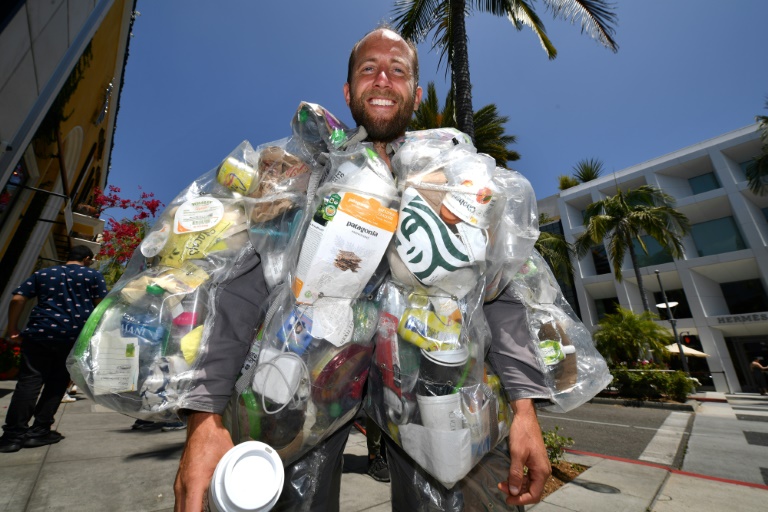
We all know someone with a rubbish fashion sense, but Rob Greenfield is proud to be wearing garbage — it’s all part of a plan to show just how much trash we unthinkingly throw away every month.

The campaigner is wandering the streets of Los Angeles and surrounding cities in a specially designed suit that holds all of the junk he has produced over the last few weeks.

“For most of us, trash is out of sight, out of mind,” he told AFP on the swanky shopping streets of Beverly Hills.

“We throw it in the garbage can and it goes away and we never think about it again. I wanted to create a visual that helps people to really see how much our trash adds up.”

With just a few days left to go in his challenge, Greenfield is wearing around 62 pounds (28 kilograms) of rubbish generated from the drinks, snacks and meals he has consumed.

All of it is packed in his clear plastic suit, with specially constructed pockets on the arms, legs and back.

The legs are already bulging with cans that clatter and restrict his ability to walk, adding to the overall impression of a robot made of junk.

“It was about day 12 that I started to really feel the burden of consumerism,” he said, noting that the average person in the US creates around five pounds of waste per day.

“I really started to feel the weight and see the visual and just say ‘wow, it’s astounding how much our trash really adds up’.”

Greenfield, who prides himself on living a minimalist life with only a handful of possessions, no bank account and no driving license, is no stranger to stunts aimed at raising awareness of environmental issues.

In 2019, he fed himself for a whole year on food he grew and harvested himself.

But for the purpose of the trash suit, he decided to put aside the asceticism and consume like the average American for 30 days.

The sight of a man wearing garbage as he wanders through upmarket parts of one of America’s most avowedly consumerist cities raises some eyebrows, but, he says, most people are interested in learning more.

“There are some people who think I’m someone who’s experiencing homelessness or that I have a mental health issue, but for the most part, people have just been very positive.

“People can understand this message and it helps me to really reach people from all walks of life.”

Basquiat owned by Japan's Maezawa sells for $85 mn

Jean-Michel Basquiat’s “Untitled” 1982 sold for $85 million at auction in New York Wednesday, well above its pre-sale estimate and netting Japanese billionaire space tourist Yusaku Maezawa a tidy profit.

Phillips auction house sold the 16-foot-wide painting on behalf of Maezawa, who purchased it in 2016 for $57.3 million.

The auctioneers had tipped it to go for around $70 million.

Phillips announced in a statement in March that it would put the artwork under the hammer.

Maezawa, the mega-rich founder of Japan’s largest online fashion mall, said in the statement that the past six years of owning the painting were “a great pleasure.”

But art “should be shared so that it can be a part of everyone’s lives,” he added.

Ahead of its sale, the massive artwork went on an international tour, being displayed in London, Los Angeles and Taipei.

Maezawa, who in 2017 set a new auction record for Basquiat works when he paid $110.5 million for another painting by the 20th century giant, has said he plans to create a new museum to exhibit his collection.

He founded the Contemporary Art Foundation in Tokyo and was on the 2017 list of “Top 200 Collectors” by the ARTnews magazine based in New York.

He has been in the headlines more recently for becoming the first space tourist to travel to the International Space Station with Russia’s space agency.

His odyssey is believed to have cost around 10 billion yen ($87 million), and he plans to follow it up with a trip around the Moon organized by Elon Musk’s SpaceX.

UN urges Ukraine grain release, World Bank pledges extra $12 bn

The UN warned Wednesday that a growing global food crisis could last years if it goes unchecked, as the World Bank announced an additional $12 billion in funding to mitigate its “devastating effects.”

Food insecurity is soaring due to warming temperatures, the coronavirus pandemic and Russia’s invasion of Ukraine, which has led to critical shortages of grains and fertilizer.

At a major United Nations meeting in New York on global food security, Secretary-General Antonio Guterres said the war “threatens to tip tens of millions of people over the edge into food insecurity.”

He said what could follow would be “malnutrition, mass hunger and famine, in a crisis that could last for years,” as he and others urged Russia to release Ukrainian grain exports.

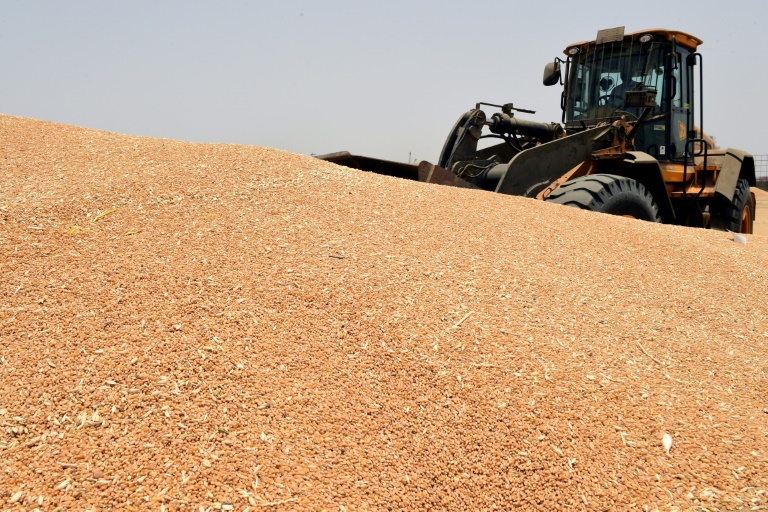
Russia and Ukraine alone produce 30 percent of the global wheat supply.

Moscow’s invasion of Ukraine and international economic sanctions on Russia have disrupted supplies of fertilizer, wheat and other commodities from both countries, pushing up prices for food and fuel, especially in developing nations.

Before the invasion in February, Ukraine was seen as the world’s bread basket, exporting 4.5 million tonnes of agricultural produce per month through its ports — 12 percent of the planet’s wheat, 15 percent of its corn and half of its sunflower oil.

But with the ports of Odessa, Chornomorsk and others cut off from the world by Russian warships, the supply can only travel on congested land routes that are far less efficient.

“Let’s be clear: there is no effective solution to the food crisis without reintegrating Ukraine’s food production,” Guterres said.

“Russia must permit the safe and secure export of grain stored in Ukrainian ports.”

US Secretary of State Antony Blinken, who chaired the summit, and World Food Programme head David Beasley echoed the call.

“The world is on fire. We have solutions. We need to act and we need to act now,” implored Beasley.

Russia is the world’s top supplier of key fertilizers and gas.

The fertilizers are not subject to the Western sanctions, but sales have been disrupted by measures taken against the Russian financial system while Moscow has also restricted exports, diplomats say.

Guterres also said Russian food and fertilizers “must have full and unrestricted access to world markets.”

– Ukraine only ‘latest shock’ –

Food insecurity had begun to spike even before Moscow, which was not invited to Wednesday’s UN meet, invaded its neighbor on February 24.

In just two years, the number of severely food insecure people has doubled — from 135 million pre-pandemic to 276 million today, according to the UN.

More than half a million people are living in famine conditions, an increase of more than 500 percent since 2016, the world body says.

The World Bank’s announcement will bring total available funding for projects over the next 15 months to $30 billion.

The new funding will help boost food and fertilizer production, facilitate greater trade and support vulnerable households and producers, the World Bank said.

The bank previously announced $18.7 billion in funding for projects linked to “food and nutrition security issues” for Africa and the Middle East, Eastern Europe and Central Asia, and South Asia.

Washington welcomed the decision, which is part of a joint action plan by multilateral lenders and regional development banks to address the food crisis.

The Treasury Department described Russia’s war as “the latest global shock that is exacerbating the sharp increase in both acute and chronic food insecurity in recent years” as it applauded institutions for working swiftly to address the issues.

India over the weekend banned wheat exports, which sent prices for the grain soaring.

The ban was announced Saturday in the face of falling production caused primarily by an extreme heatwave.

“Countries should make concerted efforts to increase the supply of energy and fertilizer, help farmers increase plantings and crop yields, and remove policies that block exports and imports, divert food to biofuel, or encourage unnecessary storage,” said World Bank President David Malpass.

Fact Check: Pediatricians say homemade baby formula unsafe

Social media posts are urging parents who face baby formula shortages to make it themselves. But pediatricians told AFP they do not advise patients to use homemade formula, warning it may lack vitamins and nutrients key to helping infants grow and thrive.

One formula recipe, said to be from 1960, has been shared on Facebook hundreds of thousands of times, urging parents to mix evaporated milk, water and Karo corn syrup.

Parents in the United States say purchasing restrictions and price gouging have left them increasingly desperate to get their hands on the food required for infants who are not breastfed. But the American Academy of Pediatrics (AAP) cautions against formula made at home.

Tanya Altmann, author of several parenting books and founder of Calabasas Pediatrics in California, agreed.

“I advise my patients not to make homemade infant formula,” she told AFP. “It won’t meet your baby’s essential nutritional needs, can be very dangerous to their growth and development and can even make your baby sick.”

Looking at the recipe circulating online, Altmann said the added sugar would not be safe or healthy for infants.

“Karo syrup was once used to help ease constipation, but it is not advised as it’s not effective and can even contain harmful bacteria,” she said.

Azza Ahmed, an associate professor of nursing at Purdue University, said homemade formula can put a baby at risk of “contamination and infection.”

And although parents are feeling stressed by shortages, formula should never be watered down, as this can quickly lead to an imbalance of nutrition, she added.

Social media posts prompted by shortages also claim orange juice mixed with water can be introduced at three weeks of age.

But the Academy of Breastfeeding Medicine warned against juice and other formula substitutes.

“Do not give your baby under six months of age any water, tea, or juice,” it said.

Other Facebook posts are recommending that parents substitute goat’s milk for formula. 

But goat milk lacks nutrients necessary for human babies, according to Gabrina Dixon from Children’s National Hospital in Washington, DC. She pointed to its lack of folate and vitamin B12 — which is necessary to stave off anemia, or a low red blood cell count.

Experts told AFP that concerned parents should consult their pediatricians about feeding options, but urged more open attitudes about switching formula brands or using generic products, especially for children who have not shown signs of sensitivity to ingredients.

Johnny Depp grabbed Amber Heard by hair, hit her repeatedly: sister

Johnny Depp grabbed his then-wife Amber Heard by the hair and repeatedly struck her in the face during a heated argument about a month after their marriage, her sister said Wednesday.

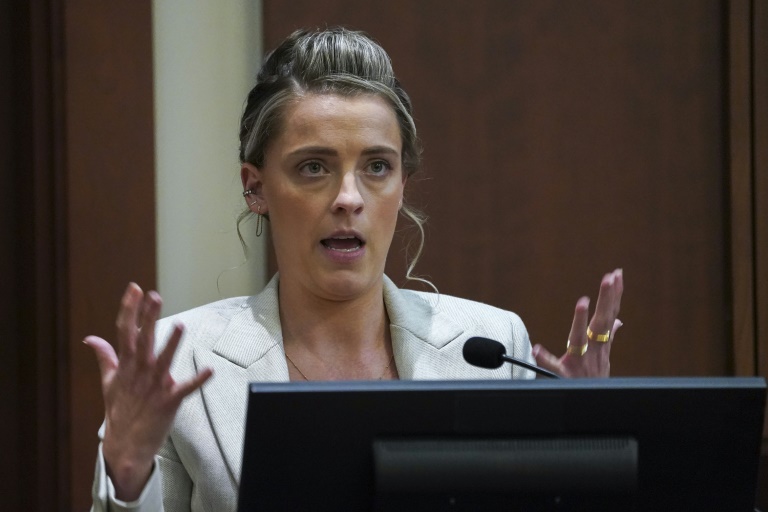
Heard also punched Depp during the March 2015 fight at their Los Angeles penthouse, Whitney Henriquez testified at the high-profile defamation case between the celebrity couple.

Henriquez, Heard’s 34-year-old younger sister, said the “Pirates of the Caribbean” star sought to have her sign a non-disclosure agreement after the incident, but she declined to do so.

The 58-year-old Depp filed suit against Heard over an op-ed she wrote for The Washington Post in December 2018 in which she described herself as a “public figure representing domestic abuse.”

Heard, who had a starring role in “Aquaman,” did not name Depp in the op-ed, but he sued her for implying he was a domestic abuser and is seeking $50 million in damages.

The Texas-born Heard countersued, asking for $100 million and claiming she suffered “rampant physical violence and abuse” at his hands.

Depp, during his four days on the witness stand, denied ever striking Heard and claimed that she was the one who was frequently violent.

Henriquez testified on behalf of her sister on Wednesday — day 18 of the trial being heard by a seven-person jury in Virginia.

Henriquez, who lived for a time in the same penthouse complex as Depp and Heard, said the couple had a volatile relationship.

“When he was sober things were wonderful,” she said. “When he wasn’t sober they were terrible.”

“If he was using or if he was drinking there was almost always a fight,” she said.

– ‘Saying really nasty things’ –

Henriquez recounted in detail the March 2015 incident at the Los Angeles penthouse complex owned by Depp.

She said Heard woke her up in the middle of the night to tell her that Depp had been cheating on her and that the newly married couple then got into a fight.

“They were saying really nasty things to one another,” Henriquez said.

“Johnny runs up the stairs,” she said. “He comes up behind me, strikes me in the back kind of.”

“I hear Amber shout ‘Don’t hit my fucking sister,'” she said. “She smacks him, lands one.”

Henriquez said Depp’s bodyguard moved to intervene, “but by that time Johnny had already grabbed Amber by the hair with one hand and was whacking her repeatedly in the face with the other.”

The bodyguard pulled them apart, she said, and Depp then proceeded to trash the penthouse, breaking numerous items in the kitchen and emptying racks of Heard’s clothes on the ground.

Depp’s lawyers have put experts on the stand who testified that he has lost millions because of the abuse accusations, including a $22.5-million payday for a sixth installment of “Pirates.”

Depp filed the defamation complaint in the United States after losing a separate libel case in London in November 2020 that he brought against The Sun for calling him a “wife-beater.”

Depp, a three-time Oscar nominee, and Heard met in 2009 on the set of “The Rum Diary” and were married in February 2015. Their divorce was finalized two years later.

Judge Penney Azcarate has scheduled closing arguments in the case for May 27, after which it will go to the jury.

Close Bitnami banner
Bitnami