US Business

US carrier JetBlue launches hostile takeover of Spirit Airlines

Low-cost US carrier JetBlue Airlines announced on Monday a hostile takeover bid for its rival Spirit Airlines, which had rejected a previous offer in favor of a merger with Frontier.

Earlier this month, Spirit reiterated its support for a deal with Frontier Airlines, saying the $3.6 billion JetBlue offer involved excessive regulatory risk.

It said the US Justice Department’s challenge of JetBlue’s alliance with American Airlines raised the odds that a takeover of Spirit might get blocked.

JetBlue called the antitrust concerns a “smokescreen” and said the deal with Frontier will face similar regulatory scrutiny.

“They based their rejection on unsupportable claims that are easily refuted,” JetBlue Chief Executive Officer Robin Hayes said in a letter to Spirit shareholders.

“The Spirit Board of Directors has failed to act in the best interests of their shareholders by refusing to engage constructively on our clearly superior proposal,” he said.

The company offered a cash buyout of Spirit at $30 a share — adding that it was prepared to return to its original offer of $33 if Spirit agreed to return to the negotiating table.

JetBlue launched a “Vote No” campaign asking Spirit shareholders to reject the proposed merger with Frontier at a meeting June 10.

“JetBlue offers more value — a significant premium in cash — more certainty, and more benefits for all stakeholders,” Hayes said.

“We are confident we can address any regulatory concerns the Spirit Board, regulators or courts may have.”

– Airline competition –

Asked about the competing deals, US Transportation Secretary Pete Buttigieg said competition in the industry is critical.

It “needs to be demonstrated that this would not have a negative effect on competition in order to meet those legal hurdles,” he said on CNBC.

Amid growing concentration in the airline sector, he said it is up to the Justice Department do decide “where you draw the line.”

In early February, budget carriers Spirit and Frontier announced they were combining to create a competitive low-cost carrier that aims to test the dominance of larger rivals.

The merger would create the nation’s fifth-largest airline by seat capacity, behind American, United, Delta and Southwest.

But in April, JetBlue challenged the deal, offering a similar argument about challenging larger US carriers.

Spirit shares jumped 13.5 percent, while JetBlue fell 6.1 percent. Frontier rose 5.9 percent.

bur-leg-hs-jmb/caw

Biden announces new plan to ease housing shortage, lower costs

Faced with a shortage of homes that has driven up prices and rents, President Joe Biden’s White House on Monday unveiled a plan to improve housing supply and affordability.

Consumer prices are rising at their fastest pace since the early 1980s — nearly a third of which is due to housing costs — and Biden has said tackling US inflation is his key priority.

The new plan aims to provide access to credit for homebuilders and buyers, especially low-income families, and assistance to renters, while easing supply constraints for building materials and construction workers.

It also will take steps to discourage the recent trend of investors snapping up many of the available homes, while encouraging state and local authorities to ease zoning restrictions to allow more density, especially multifamily buildings.

“This is the most comprehensive all of government effort to close the housing supply shortfall in history,” the White House said in a statement, noting that fewer new homes were built in the decade following the 2008 recession than in any decade since the 1960s.

The problem has been exacerbated since the start of the Covid-19 pandemic as record low mortgage rates and massive government stimulus created a surge in homebuying, while supplies of lumber and other materials were disrupted by the pandemic.

The Case-Schiller Home Price Index showed home prices surged nearly 20 percent in the 12 months ended in February.

And the rapid recovery also created a shortage of workers at all levels.

“Rising housing costs have burdened families of all incomes, with a particular impact on low- and moderate-income families, and people and communities of color,” the White House said.

The Housing Supply Action Plan aims to “help close America’s housing supply shortfall in five years.”

The announcement won praise from the private sector.

“We agree with the White House that the key to resolving our nation’s housing affordability challenges is to build more homes,” said Jerry Konter, chairman of the National Association of Home Builders (NAHB) 

He praised the efforts on “the long-term headwinds, like supply chain bottlenecks and chronic construction labor shortages” that are holding back housing production. 

Uber bolsters platform for post-pandemic life

Uber said Monday it is revving up to be a “go anywhere and get anything” service, testing delivery robots, weaving in Google voice commands and more as people shed their pandemic lifestyles.

The San Francisco-based tech firm unveiled enhancements to its platform as it navigates tough economic conditions but looks to ride a busy travel season.

“After two years of pandemic living, 2022 is looking like a sea change,” said Uber chief executive Dara Khosrowshahi.

“One of the busiest travel seasons is upon us, a record-breaking number of weddings will be held this year, and climate is at the center of the global conversation.”

The suite of products unveiled by Uber was intended to help users “go anywhere and get anything,” he added, building on Uber’s goal of being an app used for far more than simply summoning rides.

“Today, we’re talking a lot about travel and reconnecting with places and people you care about,” Uber Rides head of product Jen You told AFP.

“But broadly speaking, we want to be your daily one-stop shop for anything, whether it’s for travel, work, social, even personal errands.”

Uber is testing autonomous, electric delivery robots in Los Angeles to shuttle orders from local merchants to customers in neighborhoods, Khosrowshahi said.

The delivery bots are part of an Uber goal for every ride in North America and Europe to be electric-powered by the year 2030.

Uber laid out how it is further meshing its food delivery and ride services by letting riders use the app to have orders waiting at airport or sports stadium restaurants upon arrival in a smattering of locations.

Uber said it is also weaving in the ability to let users connect Google mail, calendar and digital assistant features into the app to enable voice commands or get help with arranging travel.

“These are all part of the ultimate vision to have more touch points with consumers across their daily activities,” You said.

Along with its rides service, Uber has an Eats food delivery arm that boomed during the pandemic and a Freight platform that matches truckers with shipments in a way similar to how it pairs passengers with drivers.

Wheat prices hit record high after Indian export ban

Wheat prices surged to a new record high in European trading on Monday after India decided to ban exports of the commodity as a heatwave hit production.

The price jumped to 438.25 euros ($456.68) per tonne as the Euronext market closed, breaking the previous closing record of 422.40 struck on March 7, according to trader Damien Vercambre at grains brokerage Inter-Courtage. 

It had earlier set a record opening price of 435 euros.

On the Chicago Board of Trade, wheat was trading nearly six percent higher in midday trading at $12.48 per bushel.

Global wheat prices have soared 40 percent on supply fears since Russia’s February invasion of agricultural powerhouse Ukraine, which previously accounted for 12 percent of global exports.

The spike, exacerbated by fertiliser shortages and poor harvests, has fuelled inflation globally and raised fears of famine and social unrest in poorer countries.

India, the world’s second-largest wheat producer, said on Saturday that it was banning exports after its hottest March on record, with traders needing express government approval to enter into new deals.

New Delhi said the move was needed to protect the food security of its own 1.4 billion people in the face of lower production and sharply higher global prices.

Some parts of India have seen prices in wheat and flour jump 20 to 40 percent in recent weeks, Commerce Secretary BVR Subrahmanyam said on Sunday.

Because of the sharp rise in global prices, some farmers were selling to traders and not to the government.

This got the government worried about its buffer stock of almost 20 million tonnes — depleted by the pandemic  — needed for handouts to millions of poor families and to avert any possible famine.

“Contrary to Russia which has had an export quota and tax system in place for years, India no doubt has more difficulty in controlling exports,” said Damien Vercambre at grains brokerage Inter-Courtage.

The export ban drew sharp criticism from the Group of Seven industrialised nations, which said that such measures “would worsen the crisis” of rising commodity prices.

– ‘Worsen the crisis’ –

Export deals agreed before the directive issued on May 13 could still be honoured but future shipments needed government approval, it said.

However, exports could also take place if New Delhi approved requests from other governments “to meet their food security needs”.

India, which possesses major buffer stocks, previously said it was ready to help fill some of the supply shortages caused by the Ukraine war.

Only last week India said it would send delegations to Egypt, Turkey and elsewhere to discuss boosting wheat exports. It was unclear whether these visits will now go ahead.

India recorded its warmest March on record — blamed on climate change — and in recent weeks has seen a scorching heatwave with temperatures upwards of 45 degrees Celsius (113 Fahrenheit).

This hit farmers in wheat-producing northern India, prompting the government to predict output would fall at least five percent this year from 109 million tonnes in 2021.  

The downturn could not come at a worse time as Ukraine, which was in line to become the world’s number three wheat exporter, will see its output cut by a third due to the fighting there, according to forecasts by the US Department of Agriculture. 

The USDA expects Ukraine to export around 10 million tonnes of wheat this year, down from 19 million tonnes last year. Dry weather in the United States and western Europe has added to supply concerns.

Ukraine 'unhappy' as Hungary stalls EU Russian oil ban

Ukraine’s foreign minister urged the EU Monday to overcome Hungary’s resistance to an embargo on Russian oil and then look to “kill” all of Moscow’s exports to starve its war machine of funds.  

Budapest has been holding up a push by Brussels, backed by other European Union states, to ban Moscow’s vital oil exports, the cornerstone of a planned sixth package of sanctions, arguing that it would hammer its own economy.

“We are unhappy with the fact that the oil embargo is not there,” Ukraine’s top diplomat Dmytro Kuleba said after meeting EU foreign ministers in Brussels. 

“It’s clear who’s holding up the issue. But time is running out because every day Russia keeps making money and investing this money into the war.”

Kuleba said he was convinced the oil embargo would come and “the only question is when and what will be the price that the European Union will have to pay to make it happen.”

He then called on the 27-nation bloc to move on to a seventh package of sanctions that would “kill Russian exports” and deliver a crushing blow to President Vladimir Putin’s coffers.

Brussels is desperate to avoid the appearance of division in the face of the Kremlin’s onslaught on Ukraine, and officials are scrambling behind the scenes to patch up a compromise with Hungary after making the oil proposal on May 4.

“The whole union is being held hostage by one member state who cannot help us find the consensus,” Lithuanian Foreign Minister Gabrielius Landsbergis declared

EU foreign affairs chief Josep Borrell said discussions to break the deadlock would go back to ambassadors after Hungary laid out the economic costs of the move. 

“I cannot tell you if it’s going to take one week or two,” he said. 

– Hungary hikes cost –

Brussels has offered Hungary, the Czech Republic and Slovakia long grace periods to phase out Russian oil imports but that has not yet convinced Budapest to budge. 

Bulgaria’s Prime Minister Kiril Petkov said that Sofia was also seeking a two year exemption on enforcing the ban to allow it to put in place new infrastructure.

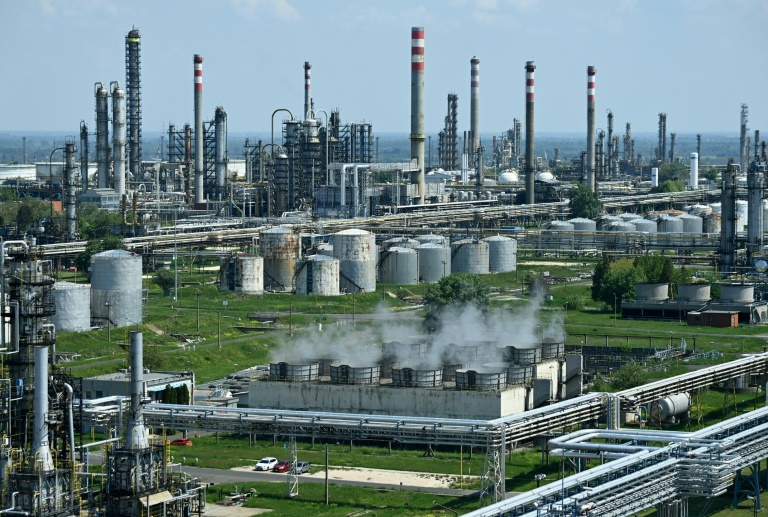
Hungary, often the odd one out in EU decision making, has demanded to be exempted from the embargo for at least four years and wants 800 million euros ($830 million) in EU funds to re-tool a refinery and boost the capacity of a pipeline to Croatia.  

And Foreign Minister Peter Szijjarto on Monday appeared to up the price tag for ditching Russian oil by saying it would cost 15 to 18 billion euros ($16 to $19 billion) to prepare its economy for the move.  

“It is legitimate for Hungarians to expect a proposal” from the European Commission to cushion that blow, Szijjarto said in comments broadcast on his Facebook page.

“A complete modernisation of the Hungarian energy infrastructure is needed to the scale of 15 to 18 billion euros.”

Putin’s invasion at the end of February has seen the EU slap unprecedented sanctions on Moscow and send weapons to Ukraine in a strong show of unity that now risks cracking. 

The protracted dispute over the oil embargo has led some EU diplomats to believe achieving a ban on Russian natural gas is beyond their reach. 

The EU plans to cut its reliance on Russian gas by two thirds this year, but it has been reluctant to halt imports as Germany opposes such a move.

Ukraine 'unhappy' as Hungary stalls EU Russian oil ban

Ukraine’s foreign minister urged the EU Monday to overcome Hungary’s resistance to an embargo on Russian oil and then look to “kill” all of Moscow’s exports to starve its war machine of funds.  

Budapest has been holding up a push by Brussels, backed by other European Union states, to ban Moscow’s vital oil exports, the cornerstone of a planned sixth package of sanctions, arguing that it would hammer its own economy.

“We are unhappy with the fact that the oil embargo is not there,” Ukraine’s top diplomat Dmytro Kuleba said after meeting EU foreign ministers in Brussels. 

“It’s clear who’s holding up the issue. But time is running out because every day Russia keeps making money and investing this money into the war.”

Kuleba said he was convinced the oil embargo would come and “the only question is when and what will be the price that the European Union will have to pay to make it happen.”

He then called on the 27-nation bloc to move on to a seventh package of sanctions that would “kill Russian exports” and deliver a crushing blow to President Vladimir Putin’s coffers.

Brussels is desperate to avoid the appearance of division in the face of the Kremlin’s onslaught on Ukraine, and officials are scrambling behind the scenes to patch up a compromise with Hungary after making the oil proposal on May 4.

“The whole union is being held hostage by one member state who cannot help us find the consensus,” Lithuanian Foreign Minister Gabrielius Landsbergis declared

Dutch Foreign Minister Wopke Hoekstra said he “would have liked us to agree today on the sixth package” and that he hoped it would be clinched by the end of the week. 

Portugal’s top diplomat Joao Gomes Cravinho estimated that it could take “a couple of weeks” — a timescale that would take  the debate up to the next full summit of EU leaders.

– Hungary hikes cost –

Brussels has offered Hungary, the Czech Republic and Slovakia long grace periods to phase out Russian oil imports but that has not yet convinced Budapest to budge. 

Hungary’s Prime Minister Viktor Orban, often the odd man out in EU decision making, has demanded to be exempted from the embargo for at least four years and wants 800 million euros ($830 million) in EU funds to re-tool a refinery and boost the capacity of a pipeline to Croatia.  

And Foreign Minister Peter Szijjarto on Monday appeared to up the price tag for ditching Russian oil by saying it it would cost 15 to 18 billion euros ($16 to $19 billion) to prepare its economy for the move.  

“It is legitimate for Hungarians to expect a proposal” from the European Commission to cushion that blow, Szijjarto said in comments broadcast on his Facebook page.

“A complete modernisation of the Hungarian energy infrastructure is needed to the scale of 15 to 18 billion euros.”

Putin’s invasion at the end of February has seen the EU slap unprecedented sanctions on Moscow and send weapons to Ukraine in a strong show of unity that now risks cracking. 

The protracted dispute over the oil embargo has led some EU diplomats to believe achieving a ban on Russian natural gas is beyond their reach. 

The EU plans to cut its reliance on Russian gas by two thirds this year, but it has been reluctant to halt imports as Germany opposes such a move.

US, EU team up on chip making and Russia disinformation

The United States and the European Union announced on Monday a joint effort to boost microchip manufacturing and tackle Russian disinformation around the war in Ukraine.

The two sides met outside Paris as part of the Trade and Technology Council (TTC), a forum created last year aimed largely at countering China’s increasingly powerful position in the technology sector.

But EU and US officials focused much of their efforts instead on Russia, issuing a statement that accused Moscow of an “all-out assault on the truth”.

They vowed to tackle Russian disinformation at home and abroad, accusing Moscow of seeking to blame Western sanctions for food supply shortages in Asia and Africa.

“We see the damage from the Russian invasion spreading across the world,” EU competition commissioner Margrethe Vestager told a press conference in Saclay, a technology hub south of Paris.

The council’s statement said practical actions could include funding or other support to promote access to “trustworthy and fact-based information”.

– No ‘subsidy race’ –

The TTC, which held its first meeting in the US city of Pittsburgh last September, has working groups that cover issues from Artificial Intelligence to export controls.

Officials said its work had already helped undermine Russia’s war effort by limiting exports of advanced technology in aerospace and cyber-surveillance.

Although Russia was the main focus, several of the council’s goals are aimed at China.

The TTC is trying to calm the two-year supply chain crisis in the chip industry, where China is a major global player.

The crisis is being blamed on a surge in demand for electronic gadgets during the pandemic coupled with the global supply chain crunch.

EU and US officials pledged to give the chip industry the maximum possible subsidies, but said they wanted to invest in a coordinated way to avoid “subsidy races”.

The forum also announced an “early warning system” that would highlight disruptions in the supply of semiconductors — materials like silicon that form the basis of chips.

The US already has an early warning system that proved useful “in helping us get ahead of a couple of potential shutdowns earlier this year”, according to one US official.

The official added that the two sides were already looking ahead to supply disruptions caused by pandemic lockdowns in China — the only major economy still hewing to a zero-Covid strategy.

– ‘A shrinking pie’ –

A related issue is a long-running shortage of rare earth elements, which are vital for the manufacture of products including electric vehicles.

The forum’s final statement highlighted that EU and US companies did not have “prominent positions” in the supply chain for rare earths.

“Nearly all production stages are concentrated in China,” the statement said, in one of only a handful of direct mentions of China.

Both the US and EU trumpeted their efforts to boost capacity to procure and process these elements and promised to “take utmost care to avoid unnecessary barriers to trade” across the Atlantic.

Russia’s war has handed the TTC a wider brief than initially envisaged, but US Trade Representative Katherine Tai argued that the forum had shown “agility” in adapting to what she described as a challenge to the whole logic of globalisation.

“This invasion results in a shrinking pie, not just for Russia, Ukraine or the EU, but for the entire world,” she told reporters.

Renault hands Russian assets to Moscow, McDonald's says will exit Russia

The exodus of Western businesses from Russia deepened on Monday as French automaker Renault’s local assets were effectively nationalised and fast food giant McDonald’s said it would exit the market.

Renault handed over its local assets to the Russian government, both parties announced, marking the first major nationalisation since the onset of sanctions over Moscow’s military campaign in Ukraine.

Meanwhile, American fast-food giant McDonald’s said it would exit the Russian market and sell its business after more than 30 years of operations in the country.

Renault controlled 68 percent of AvtoVAZ, the largest carmaker in Russia with the country’s top brand Lada, but was under pressure to pull out of the country since the start of Russia’s military intervention in Ukraine in late February.

Renault has funnelled billions of euros into the Soviet-era factory since the two automakers signed a strategic partnership agreement in 2008.

No financial details were provided on Monday, but Russian Industry and Trade Minister Denis Manturov said in April that Renault planned to sell its Russian assets for “one symbolic ruble”.

“Agreements were signed on the transfer of Russian assets of the Renault Group to the Russian Federation and the government of Moscow,” the industry ministry said in a statement.

Under the agreement Renault will retain a six-year option to buy back the stake in AvtoVAZ.

The deal also included Renault’s Moscow plant, which makes Renault and Nissan models.

“It was a brave and quick decision,” Renault chief executive Luca de Meo told reporters.

– ‘New page in history’ –

De Meo said Russia and its car industry will likely “continue to suffer for a long time” from sanctions imposed over Ukraine. 

He added that the company’s Russian operations would have quickly faced bankruptcy and 45,000 people would have lost their jobs. 

“We didn’t have many choices. I think we did the right thing,” he said.

De Meo did not disclose the financial details of the deal. 

Renault indicated that a non-cash writedown of 2.2 billion euros will be made on the firm’s Russia assets in the first half of 2022.

Renault’s shares skidded 0.7 percent lower on Monday, and are down more than a third from before the invasion began.

Thanks to AvtoVAZ, Russia was Renault Group’s second-largest market behind Europe last year, with around half a million vehicles sold.

Moscow mayor Sergei Sobyanin said production of passenger cars at the Renault plant would resume under the Soviet-era Moskvich (Muscovite) brand, which the French automaker had discontinued.

“We cannot allow thousands of workers to be left without work,” Sobyanin said in a statement.

“In 2022, we will open a new page in the history of Moskvich,” he added.

The first Moskvich cars were produced in 1946 and were inspired by Germany’s Opel Kadett K38, but the brand’s vehicles were notorious for their shoddiness.

Political commentator Anton Orekh said that it was unclear what Moscow authorities planned to do with the plant, but trying to make a new car from scratch in the absence of access to foreign technologies and components would be akin to throwing “billions to the wind.”

– McDonald’s exiting Russia  –

Since President Vladimir Putin sent troops into Ukraine on February 24, Renault has had difficulty keeping its operations going due to a lack of components following the imposition of Western sanctions.

The conflict and sanctions have triggered an exodus of foreign corporations.

Russian authorities said they were ready to nationalise foreign assets, and some officials assured Russians that their favourite brands would have domestic alternatives.

In March, citing “unspeakable suffering to innocent people”, McDonald’s closed all of its 850 restaurants in the country.

On Monday, the company said it was looking to sell “its entire portfolio of McDonald’s restaurants in Russia to a local buyer”.

The company added that after the sale, the restaurants would no longer be able to use the McDonald’s name, logo, branding or menu.

The restaurant chain, which launched in Moscow in January 1990 to great fanfare almost two years before the Soviet Union was dissolved, characterised the withdrawal as difficult but necessary.

“We’re exceptionally proud of the 62,000 employees who work in our restaurants, along with the hundreds of Russian suppliers who support our business, and our local franchisees,” chief executive Chris Kempczinski said in a statement. 

“However, we have a commitment to our global community and must remain steadfast in our values.”

McDonald’s shares were down 0.6 percent in midday trading in New York.

Stocks dip on recession worries

Stocks mostly slipped lower on Monday with traders assessing recession risks as high inflation causes central banks to hike interest rates.

However, movements were more muted than during the volatile trading last week that saw huge swings higher and lower. 

Recession worries were sparked by data showing China’s retail sales slumped 11.1 percent on-year in April. Industrial production sank 2.9 percent — the lowest showing since March 2020.

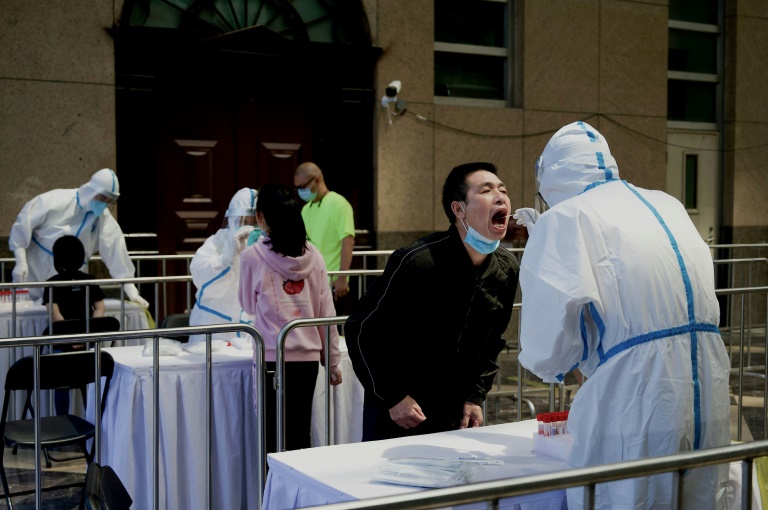
The economic haemorrhaging has been driven by China’s Covid-19 lockdowns, with Shanghai in particular under strict virus restrictions since April, shuttering factories and pausing port activity. 

“Sentiment continues to remain cautious… as it becomes ever more apparent that the Chinese economy is likely to stay in the doldrums for a while yet, with the damage caused by Covid restrictions unlikely to improve significantly until well into the summer,” said Michael Hewson at CMC Markets UK.

Economist Clifford Bennett of ACY Securities said “there is a very real risk, even likelihood of a triple northern hemisphere recession across the US, Europe and China simultaneously and virtually immediately”.

He added that all eyes will be on how the Federal Reserve acts in the coming months, specifically whether it will further raise US interest rates to combat surging inflation. 

Wall Street’s three main stock indices were lower in late morning trading, with the tech-heavy Nasdaq slumping. 

While London ended with a gain, both Frankfurt and Paris ended lower amid more signs of economic fragility in the eurozone.

Brussels on Monday sharply cut its eurozone growth forecast for 2022, blaming skyrocketing energy prices caused by Russia’s invasion of Ukraine.

In commodities trading, wheat prices surged to a record after India banned exports of the commodity owing to a heatwave hitting production.

Global wheat prices had already soared on tight supply concerns since Russia’s February invasion of agricultural powerhouse Ukraine, which previously accounted for 12 percent of world exports.

The price jumped to 435 euros ($453) per tonne as the European market opened Monday.

Despite the recession concerns, oil prices rose on Monday as traders focused on risks of supply disruptions as EU nations continue to move towards a ban on Russian oil imports.

On the corporate front Monday, American fast-food giant McDonald’s said it would exit the Russian market and sell its business in the country to a local buyer in the wake of the Ukraine war.

Shares in McDonald’s shed 0.9 percent at the open of trading in New York.

French automaker Renault has meanwhile handed over its Russian assets to the Russian government, marking the first major nationalisation since the onset of sanctions over Moscow’s military campaign.

Renault shares skidded 0.7 percent lower.

– Key figures at around 1530 GMT –

New York – Dow: DOWN 0.3 percent at 32,087.89 points

EURO STOXX 50: DOWN 0.1 percent at 3,600.19

London – FTSE 100: UP 0.6 percent at 7,464.80 (close)

Frankfurt – DAX: DOWN 0.5 percent at 13,964.38 (close)

Paris – CAC 40: DOWN 0.2 percent at 6,347.77 (close)

Hong Kong – Hang Seng Index: UP 0.2 percent at 19,950.21 (close)

Shanghai – Composite: DOWN 0.3 percent at 3,073.75 (close)

Tokyo – Nikkei 225: UP 0.5 percent at 26,547.05 (close)

Brent North Sea crude: UP 0.5 percent at $112.05 per barrel

West Texas Intermediate: UP 1.0 percent at $111.62 per barrel

Euro/dollar: DOWN at $1.0402 from $1.0417 at 2130 GMT Friday

Pound/dollar: DOWN at $1.2247 from $1.2262

Euro/pound: UNCHANGED at 84.92 pence

Dollar/yen: DOWN at 129.12 yen from 129.19 yen

McDonald's to exit Russia, sell business in country

American fast-food giant McDonald said Monday it will exit Russia in the wake of the Ukraine invasion, ending a more than three-decade run begun in the hopeful period near the end of the Cold War.

The restaurant chain, which launched in Moscow in January 1990 to great fanfare almost two years before the Soviet Union was dissolved, characterized the withdrawal as difficult but necessary.

“The humanitarian crisis caused by the war in Ukraine, and the precipitating unpredictable operating environment, have led McDonald’s to conclude that continued ownership of the business in Russia is no longer tenable, nor is it consistent with McDonald’s values,” the company said in a statement.

The chain is looking to sell “its entire portfolio of McDonald’s restaurants in Russia to a local buyer.”

The burger giant is one of numerous foreign firms that have pulled out of the country or suspended operations following Moscow’s invasion of Ukraine in late February.

Earlier on Monday, French automaker Renault announced it had handed over its Russian assets to the government, marking the first major nationalization since the onset of Western sanctions against Moscow’s military campaign.

Russia’s President Vladimir Putin ordered troops into pro-Western Ukraine on February 24, triggering unprecedented sanctions and sparking an exodus of foreign corporations including H&M, Starbucks and Ikea.

In March, citing “unspeakable suffering to innocent people,” McDonald’s closed all of its 850 restaurants in the country, where it says it employs 62,000 workers.

But on Monday the “Big Mac” maker went a step further, saying the company “is pursuing the sale of its entire portfolio of McDonald’s restaurants in Russia to a local buyer.”

After the sale, the restaurants would no longer be able to use the McDonald’s name, logo, branding or menu, though the company will retain its trademark in the country, the company said.

Russia currently accounts for nine percent of the company’s revenue and three percent of its operating profit.

McDonald’s expects to a one-time charge of $1.2 billion to $1.4 billion to write off the investment.

– A ‘new era’ –

The withdrawal offers a stark contrast to the optimism that surrounded the arrival of the quintessentially American brand in Russia in the waning days of the Cold War.

The company began discussing the Russian business at the 1976 Olympics in Canada where the McDonald’s let Russian athletes use the “Big Mac Bus” in a sign of good will.

That led to 14 years of negotiations, “culminating in the glorious day in January of 1990 when the first McDonald’s opened to so much hope and excitement in Pushkin Square,” recalled McDonald’s Chief Executive Chris Kempczinski in a message to employees.

“In the history of McDonald’s, it was one of our proudest and most exciting milestones,” Kempczinski said. “After nearly half a century of Cold War animosity, the image of the Golden Arches shining above Pushkin Square heralded for many, on both sides of the Iron Curtain, the beginning of a new era.”

In the subsequent decades, McDonald’s operations in Russia expanded far beyond Moscow as the company invested billions of dollars and grew its supply chain.

But Kempczinski said the Russia investment was no longer viable in terms of business, or consistent with company values. 

Still, he closed his message on a hopeful note, saying, “let us not end by saying, ‘goodbye’… (but) ‘Until we meet again.'”

The company’s decision to divest “underlines a view that relations with Russia will not soon be normalized,” said Neil Saunders, a retail expert at GlobalData.

The conditions of the exit, including the financial challenges facing prospective Russian buyers means “it is unlikely the sale price will be anywhere near the pre-invasion book value of the business,” said Saunders, adding that the departure “will leave a hole” in McDonald’s growth plans “that is not easily filled in the near-term.”

Shares of McDonald’s fell 0.4 percent to $243.24 in mid-morning trading.

Close Bitnami banner
Bitnami