US Business

Between searing drought and Ukraine war, Iraq watchful over wheat

Iraqi farmer Kamel Hamed looks at the golden ears of wheat waving in the wind, unable to hide his anguish over the baking heat that is decimating his harvest.

“The drought is unbelievable,” said the 53-year-old in a white dishdasha robe and keffiyeh head covering at his farm in Jaliha village of central Diwaniya province.

“Even the well water can’t be used, it’s salt water.”

Searing heat and a lack of rain were already threatening his harvest. Then came Russia’s invasion of Ukraine in February, driving up the cost of fuel, seeds and fertiliser.

Like all farmers in Iraq, Hamed must follow the instructions of the state authorities who are the main grain buyers.

They determine the areas to be planted and the level of irrigation, depending on rain and water reserves. This year, due to water shortages, Iraq has reduced the area under cultivation by half.

As a result, Hamed has planted just one quarter of his 100 donums (10 hectares), where the combine harvester was now throwing grain into a truck bed.

“This year we didn’t even get 500 kilograms (1,100 pounds) of wheat from one donum” — less than half the usual harvest — he said.

The war in Ukraine has “pushed up the price of motor oil and of high-yield seeds”, he added — yet “another financial burden for farmers”.

“I don’t know how to support my family. No salary, no job, where can I go?”

– ‘Abandon the land’ – 

After decades of war and insurgency, Iraq faces another huge challenge: severe water scarcity driven by climate change.

It is highly sensitive issue for Iraq and its 41 million people, who feel the impacts on a daily basis, from depleted rivers to rapid desertification and more intense sandstorms.

Iraq’s big rivers, the Tigris and Euphrates, and their tributaries originate in Turkey and Syria as well as Iran, which dam them upstream, reducing the flow as they enter Iraq.

Irrigated by the Euphrates, Diwaniya province, where Jaliha is located, normally receives 180 cubic metres of water per second.

This year the volume has been at least halved to “80 to 90 cubic metres”, said Hani Shaer, who heads a farmers’ collective responsible for distributing the water.

The result can be seen in the stagnant water in the main irrigation canal, which serves the 200,000 donums of surrounding land, with some gullies now completely dry.

Shaer denounced a lack of support from authorities, charging that the agriculture ministry provided just five kilos of fertiliser this season, down from 40 kilos in previous years.

“The farmer will leave, abandon the land and head to the city to look for any kind of work,” he said.

– Collapsed harvest –

Agriculture ministry spokesman Hamid al-Nayef said the state was helping by raising the purchase price in order to pay producers around $500 per tonne of wheat.

In 2019 and 2020, wheat harvests had reached five million tonnes, enough to guarantee “self-sufficiency” for Iraq, he told AFP.

This season, Iraq may only grow 2.5-3 million tonnes of wheat, “not enough for a whole year for the Iraqis,” Nayef acknowledged.

“We will have to import,” he said.

Iraq will be confronted with the vagaries of the world market and prices driven up by the conflict in Ukraine, even though Baghdad imports its cereals mainly from Canada, Australia and the United States.

“With the interplay of supply and demand, prices are rising even in the United States and other countries,” Nayef said.

Back in Jaliha, another farmer, Ahmed al-Jelhawi, was questioning his life choices. He said he used to harvest 500 tonnes of wheat, but this year expects just 50-75 tonnes.

“I gave up my studies to devote myself to agriculture,” he lamented. “But this year, agriculture is zero.”

“Between the low production and the rising prices, we probably won’t be able to plant next year.”

Nigerian airlines suspend flights over soaring fuel prices

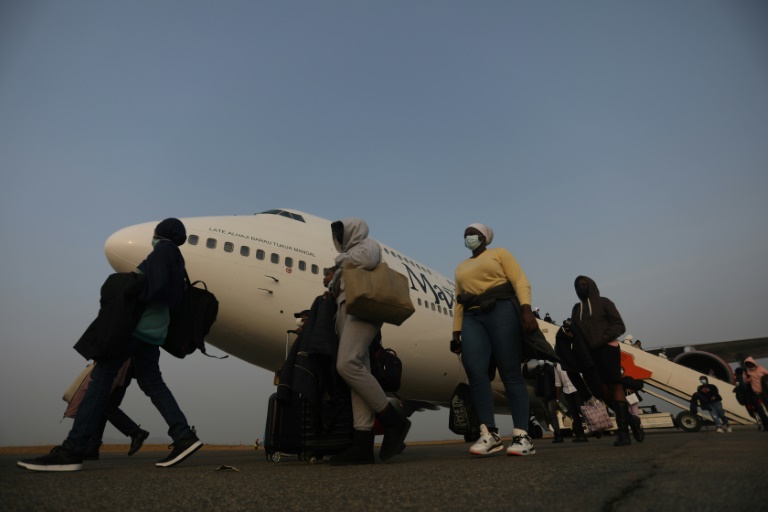
Nigerian airlines are to suspend all flights from Monday over rising jet fuel prices, an umbrella organisation of operators said on Saturday.

The cost of fuel has soared worldwide since Russia invaded its neighbour Ukraine in February and the West responded by slapping sanctions on Moscow.

The Airline Operators of Nigeria said the price of jet fuel had jumped from 190 to 700 Nigerian naira per litre (from $0.45 to almost $1.70).

“No airline in the world can absorb this kind of sudden shock from such an astronomical rise over a short period,” the AON said.

The group said it would now cost a customer 120,000 naira ($289) for a one-hour flight, a sum unaffordable for Nigerians “already experiencing a lot of difficulties”.

The AON therefore wished “to regrettably inform the general public that member airlines will discontinue operations nationwide with effect from Monday May 9, 2022 until further notice,” it said.

The aviation ministry responded by urging airlines to “consider the multiplier effect of shutting down operations, on Nigerians and global travellers”.

The Nigerian consumer protection agency also implored “domestic airlines to consider the effect of the proposed shutdown on passengers and the magnitude of difficulties and hardship associated with such an action”.

It added it was “concerned with rising consumer feedback that airlines have continued to sell tickets beyond the date announced for the proposed service shutdown.”

Social media users made fun of the airlines suggesting customers find alternative means of travel.

“Airlines in Nigeria will shut down their services to passengers from Monday,” one tweeted to more than 110,000 followers.

“I hope you can trek from Lagos to Abuja?” they wrote, of the journey of more than 700 kilometres (more than 400 miles) by road between the country’s largest city and its capital — one that normally takes just over an hour on an airplane.

“If you use the roads, I hope you have your ransom money?” they added, making light of abductions in other parts of the oil-rich country.

Nigeria produces 1.4 million barrels of crude a day, but it refines little. It relies almost completely on fuel imports, making the local market vulnerable to disruptions.

The rising price of fuel has caused prolonged power blackouts in recent weeks.

What next for Chelsea after Boehly group win battle to succeed Abramovich

Chelsea have some clarity after an uncertain few months with the consortium led by LA Dodgers co-owner Todd Boehly set to buy the Premier League giants.

The Boehly group, which includes fellow Dodgers co-owner Mark Walter, Swiss billionaire Hansjoerg Wyss and US investment firm Clearlake Capital have committed to a deal worth £4.25 billion ($5.2 billion), a record for a sports club.

A sum of £1.75 billion is earmarked for future investment in the club with the other £2.5 billion frozen due to the sanctions imposed on current owner Roman Abramovich.

The Russian oligarch has insisted his intention is for all of the proceeds to be donated to victims of the war in Ukraine.

The sale brings to an end Abramovich’s 19-year reign during which the Blues have enjoyed unparallelled success.

Chelsea won five Premier League titles and two Champions League among 19 major trophies.

But the Abramovich era was brought down by Russia’s invasion of Ukraine as he was sanctioned by the UK government for his links to Russian president Vladimir Putin.

AFP Sport looks at the job that lies ahead for the future Chelsea owners.

Stadium redevelopment

The bulk of the future financial commitment to the club is expected to go on redeveloping Stamford Bridge into a stadium worthy of one of Europe’s elite clubs.

Abramovich shelved plans for a £1 billion redevelopment in 2018 during another dispute with the UK government over his visa.

Stamford Bridge’s 42,000 capacity lags well behind Premier League rivals Manchester United, Manchester City, Liverpool, Arsenal and Tottenham.

Spurs’ £1 billion home, completed in 2019, has become a sporting hub in the English capital, hosting major boxing, rugby and NFL events, as well as concerts and conferences.

Boehly’s track record of both sporting success and stadium redevelopment at the Dodgers gave his bid credibility to go with the major funding behind it.

Investment in the stadium was reportedly a key part of the consortium’s pitch to American bank Raine, who oversaw the sales process.

A larger ground will also be part of the long-term strategy to drive revenue and recoup their huge outlay to buy the European champions.

Stabilise the squad

Chelsea have been operating under a special licence for the past two months since sanctions were levied on Abramovich.

Due to the restrictions applied, the Blues were not allowed to offer new contracts or sign new players.

Defenders Antonio Rudiger and Andreas Christensen are set to leave on free transfers at the end of the season and will need to be replaced.

Abramovich’s lavish spending means he leaves behind a very competitive squad.

Just a year ago, Chelsea beat Manchester City to win the Champions League and are on course to finish in the Premier League top four.

With clarity over their future, the club can now work towards assembling a squad to challenge City and Liverpool for the title next season.

“When the situation is clear you can take actions, make judgements,” said Chelsea manager Thomas Tuchel on Friday.

Get fan support

Much to the dismay of politicians, Abramovich’s name was still chanted by Chelsea fans following the sanctions thanks to the success he had bankrolled over the past two decades.

Winning will be the quickest way into the hearts of the Chelsea faithful for the new ownership, but there are other pitfalls to be avoided.

There are fears that to see a return on their investment, the deeply unpopular European Super League could be revived for the guaranteed income it sought to provide.

Fans have also taken issue with American ownership of other Premier League clubs.

Protests have been a common occurence outside Old Trafford this season with Manchester United supporters furious at the dividends taken out of the club by the Glazer family during a decade of decline.

Fenway Sports Group have enjoyed much greater success reviving the fortunes of Liverpool, but have also been pressured into climbdowns on ticket prices and signing up to the Super League by fan fury.

Indonesia seizes tanker over palm oil export ban violation

The Indonesian Navy has seized a tanker that was carrying palm oil out of the country in violation of an export ban, a spokesman said Saturday.

Indonesia, the world’s largest producer of palm oil, prohibited its export last week to rein in skyrocketing domestic prices and shortages.

An Indonesian warship intercepted the Singapore-flagged MV Mathu Bhum on Wednesday as it headed for Malaysia, Navy spokesman Agung Prasetiawan said in a press release.

“The ship was carrying… 34 containers containing refined, bleached, deodorized (RBD) palm olein. This is the type of material that is temporarily prohibited for exports,” he added.

Indonesia produces about 60 percent of the world’s palm oil, which is used in a range of products such as cosmetics and chocolate spreads. A third of its output is consumed domestically.

Vegetable oils are among the staple food items that have seen prices hit record highs in recent weeks following Russia’s invasion of agricultural powerhouse Ukraine, according to the United Nations Food and Agriculture Organisation.

Producers in Indonesia have been reluctant to sell at home recently because exporting is more profitable currently because of high international prices.

But authorities in the archipelago stepped in to try and control prices, fearing public anger as consumers in several cities were forced to queue for hours at distribution centres to buy cooking oil at subsidised rates.

The Indonesian export ban sent prices of palm, soybean, European rapeseed and canola oils to historic highs.

It plans to resume exports when the local bulk price of cooking oil falls to 14,000 rupiah (97 cents), having soared in recent weeks to 26,000 rupiah.

The price had dropped to 17,200 rupiah by Friday.

Soy boon for Argentina as Ukraine war boosts prices

Russia’s war on Ukraine has sent grain prices skyrocketing — a worry for consumers worldwide but potentially a boon for producers like Argentina, which hopes an influx of soybean “agridollars” will boost its faltering economy.

South America’s third-largest economy is the biggest exporter of soybean meal and oil in the world, and only the United States and Brazil export more soybean grains.

Soy represents nearly a third of Argentina’s exports and in 2021 contributed $9 billion to the state coffers.

This year, the sector is expecting record sales of $23.7 billion — about $700 million more than in 2021 — despite a 10 percent smaller harvest due to severe drought.

“The prospects for the producer are good… There is optimism,” said Martin Semino, who sells farming equipment and presides over the Rural Society of Lobos, a fertile agricultural zone southwest of Buenos Aires.

The harvest season is at its height, and workers are laboring from dawn to dusk to clear the fields before the autumn rains arrive.

“Soy is the dollar, the currency of the countryside,” Semino told AFP.

In the past, the grain has been a savior for inflation-troubled Argentina.

A soybean boom in the 2000s is widely considered to have helped the country recover from its worst economic crisis in 2001. 

In the last 40 years, the planted surface area of soy has multiplied 14 times.

– ‘Seize the moment’ – 

Argentina is also a major producer of sunflower oil and wheat — other grains affected by the ongoing war.

After a record sunflower harvest of 3.4 million tonnes in 2021-2022, the area under cultivation is set to increase by 17 percent this season to two million hectares (4.9 million acres).

The country also had a record wheat harvest this season.

Estimates are that in 2022, Argentina’s agroindustrial exports will bring in a record $41 billion — about $3 billion more than in 2021.

“With prices close to historic records, Argentina, which always needs dollars, must seize the moment,” Tomas Rodriguez Zurro, an analyst at the Rosario Stock Exchange, told AFP.

The rise in prices “is temporary, it will end when the war is over,” he cautioned.

But some point out that Argentina could have reaped an even larger benefit if it weren’t for rising input costs.

Argentina imports about 60 percent of the fertilizers needed to grow food — around 15 percent of it from Russia — but supplies are now short and prices climbing, meaning lower yields.

Higher fuel prices are also taking a toll, set against the backdrop of soaring consumer inflation of around 60 percent projected this year for Argentina.

The chambers of the Oilseed Industry (Ciara) and Grain Exporters (CEC) have warned that rising input costs — as well as shortages of fuel and fertilizer — have “neutralized, or worse, the relative benefits” derived from the commodity price rise.

Added Semino: “Input costs have exploded with the war.”

– Angry farmers –

In April, farmers staged a protest in Buenos Aires to express their ire at government plans to impose a windfall tax on products boosted by the war in Ukraine.

The tax, imposed only on those earning more than a billion pesos ($8.5 million) in net profit for the 2021-22 season, would be used to cushion inflationary shocks for the poor.

Argentina has a 37 percent poverty rate.

The government has also introduced quotas on wheat and maize, the latter of which Argentina is the world’s second-largest exporter of.

It has announced a so-called “wheat stabilization fund” seeking to ensure that the price of the staple grain — and hence bread — remains shielded from steep fluctuations.

Chelsea says Todd Boehly-led group to buy club in $5.2 bn deal

Chelsea FC said a group led by Los Angeles Dodgers co-owner Todd Boehly would acquire the London club after agreeing terms in a deal worth £4.25 billion ($5.2 billion).

“The sale is expected to complete in late May subject to all necessary regulatory approvals,” the football club said in a statement late Friday.

“More details will be provided at that time,” it added.

Chelsea’s Russian owner Roman Abramovich put the Premier League club on the market in March, just days before he was sanctioned by the British government following the invasion of Ukraine.

After a lengthy bidding process involving several groups, Boehly and his fellow investors were picked by Raine Group, the New York bank overseeing the Blues’ sale.

Boehly’s group of investors includes fellow Dodgers co-owner Mark Walter, Swiss billionaire Hansjoerg Wyss and US investment firm Clearlake Capital.

“Chelsea Football Club can confirm that terms have been agreed for a new ownership group, led by Todd Boehly, Clearlake Capital, Mark Walter and Hansjoerg Wyss, to acquire the Club,” the Chelsea statement said.

“Of the total investment being made, £2.5bn will be applied to purchase the shares in the Club and such proceeds will be deposited into a frozen UK bank account with the intention to donate 100 percent to charitable causes as confirmed by Roman Abramovich,” it said.

“UK government approval will be required for the proceeds to be transferred from the frozen UK bank account.”

In addition, the new owners would commit £1.75 billion in further investment for the benefit of the club, Chelsea said.

– Proceeds to victims of Ukraine war –

Chelsea were forced to operate under a special licence from the government after Abramovich was sanctioned by Britain and the European Union for his links to Russian President Vladimir Putin.

Abramovich cannot profit from Chelsea’s sale, but had already vowed to write off the club’s £1.5 billion debt and that all proceeds from the sale would go to victims of the war in Ukraine.

There had been fears over the future of the club if a sale was not finalised before the licence runs out on May 31.

Under the terms of the licence, Chelsea were unable to offer new contracts to existing players or sign players from other clubs.

The sale of the European champions brings the curtain down on 19 years of nearly unbroken success under the 55-year-old Abramovich, who has overseen five Premier League titles and two Champions League triumphs.

After initially embarking on a long winning run following Abramovich’s decision to sell the club, Chelsea have struggled to find their best form recently.

They suffered a painful Champions League quarter-final defeat at Real Madrid after nearly pulling off an epic comeback from a 3-1 first leg deficit.

Chelsea’s place in the Premier League’s top four is also far from guaranteed.

'Like family': Japan's virtual YouTubers make millions from fans

Mayu Iizuka sheds her soft-spoken personality and starts cackling, screaming and waving wildly in a makeshift studio in Tokyo as her avatar appears on a livestream before hundreds of fans.

Virtual YouTubers like Iizuka, who voices and animates a character called Yume Kotobuki, have transformed a niche Japanese subculture into a thriving industry where top accounts can rake in more than a million dollars a year.

The videos are designed to make fans feel they are interacting directly with their favourite animated idols — with viewers sometimes paying hundreds of dollars to have a single comment highlighted on a livestream.

“When I’m playing video games on my channel and succeed at something, my fans congratulate me” and pay tips “as a way to show their support and appreciation”, Iizuka told AFP.

The 26-year-old uses a laptop, webcam and a motion sensor worn around her neck to appear on screen as Yume, whose facial expressions are controlled by a producer.

With her squeaky voice, short skirt and huge purple eyes, Iizuka’s avatar follows a popular model for “VTuber” characters, which often resemble the hyper-feminine heroines of Japanese anime.

Since emerging about five years ago, the VTuber world has grown quickly, with about 16,000 active streamers globally, according to data firm User Local, and growing fanbases on other platforms like TikTok and gaming site Twitch.

Regional governments in Japan have used them for promotion, and “The Batman” stars Robert Pattinson and Zoe Kravitz even gave a recent interview to a top Japanese VTuber.

– Super Chat –

VTubers generate money in ways similar to traditional livestreamers, including through YouTube’s “Super Chat” system, where the more a fan shells out, the more attention is drawn to their comments.

In fact, the world’s nine top-earning YouTube accounts for “Super Chat” last year were all VTubers.

All nine are affiliated with one Tokyo-based talent agency, and each earned between $700,000 and $1.7 million from the cash gifts, according to data analysis site Playboard.

Most fans spend only a few hundred yen ($1) per comment, but the most dedicated sometimes splurge 50,000 yen ($400) to post impassioned missives to their virtual idols.

Kazuma Murakami, a 30-year-old car parts inspector, has been known to spend 10,000 yen to get his comments highlighted in red and seen by his favourite VTuber.

“I really want her to notice I’m here again, visiting her channel,” Murakami told AFP.

Another VTuber fan, who asked to be identified only by his first name, Kazumi, has adorned his tiny one-room apartment near Tokyo with posters, framed pictures and keyrings featuring his favourite character, Mio Ookami.

The 30-year-old computer engineer spends time after work and on weekends immersing himself in Mio’s videos and crafting digital illustrations of the black-haired “wolf girl”.

“I dedicate five, or maybe 10 hours to thinking just about her,” he said.

“She is like family to me.”

That devotion, and the willingness of fans to pay big money, is linked to the way other fan subcultures function in Japan, said Noriyuki Nagamatsu, a digital business specialist at advertising firm D.A. Consortium.

“Super Chat is essentially an extension of a longstanding culture where idol and anime fans try to support their ‘oshi’, or favourite, by splurging on their merchandise,” he told AFP.

“It’s also a way of winning attention from their beloved and feeling superior to fellow fans.”

– Human ‘soul’ –

VTubers usually keep the person behind the character — often referred to as their “soul” — out of the picture, and like many fans, Kazumi says his love is directed towards Mio the avatar, not whoever plays her.

But the line between virtual and real can become blurred.

A Japanese court recently ruled in favour of a VTuber actor who argued that online slander against her character amounted to an attack on her.

Virtual YouTubers can “transcend gender, age or physique… but what’s important is that there’s a real person there who is speaking and reads the comments in real life,” said Kazuhito Ozawa, the plaintiff’s lawyer.

For Iizuka, a professional voice actress, making the rare decision to reveal her identity after four years of making videos as Yume was nerve-wracking.

“Part of me was afraid that fans of Yume, who has these big, shiny eyes and a perfect belly, might be disappointed to find out what the ‘real’ person inside looks like,” she said.

But “so far the response from fans has been very kind”.

And the more outspoken, vivacious personality of Yume’s virtual self is even gradually rubbing off on Iizuka, she said.

“I used to baulk at speaking publicly, but Yume is such an experienced livestreamer that my identity as her has been helping me speak more confidently.”

Brazil, Guyana agree to widen energy cooperation

Brazil and Guyana on Friday agreed to broaden energy cooperation during a visit by President Jair Bolsonaro to Georgetown, in which the South American neighbors also signed infrastructure and legal deals.

Former British and Dutch colony Guyana has emerged as one of the main low cost oil production countries and is preparing to auction offshore oil blocks at the end of the year.

“In terms of oil and gas, we have a Brazilian giant called Petrobras for whom cooperation with Guyana is becoming an ever greater reality. That’s what we hope for,” said Bolsonaro.

US giant ExxonMobil announced in April the discovery of three new oil deposits in Guyana, raising estimates of the country’s oil reserves to the equivalent of 11 billion barrels.

Those discoveries fueled Guyana’s existing border dispute with Venezuela, which wants to explore territorial waters claimed by both countries.

Guyana President Irfaan Ali evoked the idea of creating an energy corridor through his country, Brazil and Surinam.

“In the area of energy, we have discussed working together on a natural gas strategy and how that can be integrated in the development of Brazil and how we can coordinate and cooperate in this area,” said Ali.

As part of the agreements, Brazil will provide Guyana with IT teams and programs to help in information gathering for defense and security, as well as the construction of a deep water port, road and rail links, hydroelectric energy development, fiber optic connectivity and agricultural projects.

They also signed legal cooperation agreements in civil and criminal matters.

Global stocks mostly fall despite solid US jobs data

Global stocks mostly tumbled Friday to conclude a volatile week as investors fretted over inflation and worries about slowing growth despite a solid US jobs report.

The US economy added a better-than-expected 428,000 jobs in April, with the unemployment rate remaining at a low 3.6 percent, the Labor Department reported.

The data pointed to continued strong employment growth and contained hints that some inflationary pressures may be easing, with workers’ wages rising less than in March.

But investors remain anxious that rising prices and higher interest rates will hit consumers, slowing the economy’s expansion in the second half of 2022.

“There is a real concern about slowing growth and the possibility that the economy could tip into recession,” said Briefing.com analyst Patrick O’Hare.

Wall Street stocks flirted with positive territory at times, but finished lower, with the S&P 500 dropping 0.6 percent. 

All three US indices ended with weekly losses, with the Nasdaq suffering the most at 1.5 percent.

Earlier, European indices also slumped, with London losing 1.5 percent, Frankfurt 1.6 percent and Paris 1.7 percent.

“A sinking feeling has taken over financial markets at the end of a volatile week,” said Hargreaves Lansdown analyst Susannah Streeter.

“Investors are digesting the unpalatable implications of inflation and fretting that there will be a need for a bigger dose of the bitter medicine being administered to try and bring it under control.”

Asian equities tumbled after steep Wall Street losses Thursday, as traders contemplated a period of fierce monetary tightening by the US Federal Reserve. 

Meanwhile, the pound hit a two-year low at $1.2276, one day after the Bank of England warned that UK inflation would top 10 percent and the economy would contract later this year.

The euro jumped to 85.92 pence, which was last seen late in 2021. 

Crude prices rebounded after key producers led by Saudi Arabia and Russia refused to lift output more than their planned marginal increase as they weighed tight supply concerns caused by Moscow’s invasion of Ukraine.

Oil prices have also gotten support from a proposed European Union ban on Russian crude in the wake of the Ukraine invasion.

“If EU efforts to ban Russian crude and products are able to continue moving forward, it would mark the most significant measure directly targeting Russian energy exports amid a wave of sanctions,” said a note from Robbie Fraser of Schneider Electric.

“Replacing Russian crude volumes is a significant logistical challenge.”

– Key figures at around 2050 GMT –

New York – Dow: DOWN 0.3 percent at 32,899.37 (close)

New York – S&P 500: DOWN 0.6 percent at 4,123.34 (close)

New York – Nasdaq: DOWN 1.4 percent at 12,144.66 (close)

London – FTSE 100: DOWN 1.5 percent at 7,387.94 (close) 

Frankfurt – DAX: DOWN 1.6 percent at 13,674.29 (close)

Paris – CAC 40: DOWN 1.7 percent at 6,258.36 (close)

EURO STOXX 50: DOWN 1.8 percent at 3,629.17 (close)

Hong Kong – Hang Seng Index: DOWN 3.8 percent at 20,001.96 (close)

Shanghai – Composite: DOWN 2.2 percent at 3,001.56 (close)

Tokyo – Nikkei 225: UP 0.7 percent at 27,003.56 (close)

Brent North Sea crude: UP 1.3 percent at $112.39 per barrel

West Texas Intermediate: UP 1.4 percent at $109.77 per barrel

Euro/dollar: UP at $1.0556 from $1.0542 on Thursday

Pound/dollar: DOWN at $1.2339 from $1.2362

Euro/pound: UP at 85.52 pence from 85.28 pence

Dollar/yen: UP at 130.56 yen from 130.20 yen

burs-jmb/cs

Solid job growth continues in recovering US economy

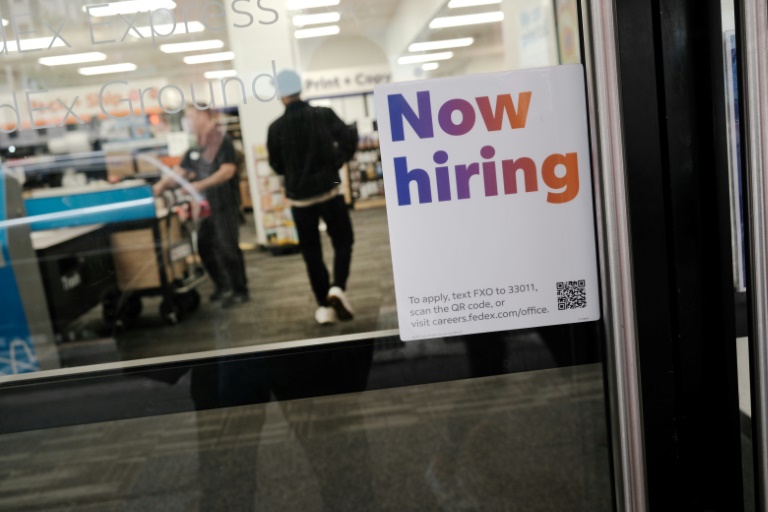
From bars to factories to warehouses, American businesses hired staff with vigor in April as the US economy recovers from the damage done by Covid-19 while grappling with inflation that has hit the highest rate in decades.

Employers in the world’s largest economy added 428,000 jobs last month, the Labor Department said Friday, keeping the unemployment rate at 3.6 percent, just above where it was before the spread of Covid-19 caused mass layoffs two years ago.

The data pointed to continued strong job growth and contained hints that some inflationary pressures may be easing — welcome news for an economy where consumer prices have climbed at a rate not seen since the 1980s.

President Joe Biden described the data as a sign that his policies had revived the economy from the grievous damage wrought by the pandemic.

“Our plans and policies have produced the strongest job creation economy in modern times,” Biden said in a statement.

The report was released two days after the Federal Reserve hiked its key lending rate by a half-percentage point to crush the wave of price increases, and signaled it plans further hikes in the months to come.

Workers’ wages are a component of accelerating inflation, and the jobs report showed average hourly earnings rising only 0.3 percent compared to March, a slower pace that in recent months and potential signal the price pressures are abating.

However, economist Joel Naroff warned wages were still trending upwards and the generally rosy picture of the labor market the data painted may convince the Fed aggressive rate hikes are needed to lower inflation.

“Sometimes good news is not necessarily good news and this report, though it shows that the economy is still moving forward solidly, may be a problem for investors,” he said.

– Hiring across industries –

After spiking to 14.7 percent in April 2020 following business closures across the country as the pandemic began, unemployment has declined steadily and is now just a hair above its 3.5 percent rate before Covid-19 arrived.

The number of unemployed people was at 5.9 million last month, the Labor Department said, also not far from where it was in February 2020, while a range of businesses took on new hires.

These included the leisure and hospitality sector, which encompasses the bars and restaurants that bore the brunt of the pandemic restrictions.

That industry added 78,000 jobs last month, while manufacturers hired 55,000, transportation and warehousing took on 52,000, and employment at professional and business services firms rose 41,000.

But the labor force participation rate, which indicates the share of the population employed or searching for work, declined 0.2 percentage points from March, bringing it to 62.2 percent, where it was at the start of the year.

Supply of workers has been an ongoing problem for employers: Other data released recently shows there are nearly two job openings for every unemployed person in the labor force.

“Looking ahead, we expect more workers to come off the sidelines in search of work and labor demand to cool as businesses feel the pinch from high inflation and tighter financial conditions,” Kathy Bostjancic of Oxford Economics said.

– Potent inflation –

The data indicated some improvement in racial disparities in the labor market, with the Hispanic unemployment rate falling slightly to 4.1 percent. 

Joblessness among African-American workers declined to 5.9 percent as more women were hired, though unemployment rose for Black men.

Asian unemployment ticked up to 3.1 percent, while it was flat for white workers at 3.2 percent.

Despite the slowing in monthly wage growth, Sophia Koropeckyj of Moody’s Analytics noted the 5.5 percent annual salary increase in April was not keeping pace with inflation, which has seen consumer prices climb at an 8.5 percent annual rate.

“The one month of softer wage growth is really not sufficient to allay concern about wage pressures. Hence, the Fed’s success in slowing the economy and tempering wage and price pressures is of paramount importance,” she wrote in an analysis.

Close Bitnami banner
Bitnami