US Business

For Biden's battered approval, 'nothing else matters' like inflation

Historically low joblessness is the kind of thing American leaders dream of, but President Joe Biden also has nightmarishly high inflation that supporters and opponents alike believe may cost his Democratic Party dearly.

Biden’s popularity has sunk in recent months even as the unemployment rate has ticked progressively lower amid booming job creation, which experts attribute to record-high price increases the US economy has weathered as it recovers from the pandemic. 

“Politically speaking, nothing else matters,” said Charlie Cook, a longtime political analyst and founder of the Cook Political Report.

Job growth is a traditional metric of presidential success, and the White House has attempted to focus the public’s attention on the progress made in the labor market, where new applications for jobless aid are at more than half-century lows and the unemployment rate is almost back to where it was before Covid-19 broke out.

But Cook said the spike in consumer prices to levels not seen since 1981 has undercut those arguments because while some voters may benefit from the strengthening jobs market, everyone experiences higher prices for gasoline, food and other necessities.

Biden’s approval ratings are now hovering around 42.2 percent, according to poll aggregator FiveThirtyEight, and with midterm elections in seven months, even Biden’s allies worry that his Democratic party will lose its narrow control of one, or perhaps both, houses of Congress.

“High prices are preventing Americans from feeling the Biden boom,” said Will Marshall, president of the center-left Progressive Policy Institute.

– Losing, not gaining, jobs –

Biden took office at a time when unemployment was on a downward trajectory after spiking to 14.7 percent in 2020 as businesses laid off workers en masse after the pandemic arrived on American shores.

Throughout his presidency, it has fallen steadily to hit 3.6 percent last month, a hair above its pre-pandemic level.

But consumer prices have shot up, jumping by 8.5 percent over the 12 months to March, and polls indicate Americans are pointing the finger at Biden.

Nearly two-thirds of voters disapprove of Biden’s handling of the economy, according to a poll by the Associated Press and NORC Center for Public Affairs Research released late last month, while progressive data firm Navigator Research found more Americans believe the economy is losing jobs than gaining them.

The high inflation rate is a consequence of a collision between global shortages and shipping delays, the Federal Reserve’s low interest rate policies and shocks to commodity markets caused by Russia’s invasion of Ukraine that have sent gas prices soaring.

Another factor is pandemic rescue bills Congress approved under Biden and his Republican predecessor Donald Trump that fattened Americans’ wallets and drove them to buy scarce goods.

While economists debate how much of an effect these policies have had on inflation, Marshall acknowledged missteps in Biden’s congressional priorities as prices rose last year and his administration was reeling from the chaotic withdrawal of US troops from Afghanistan.

The president won bipartisan support for a $1 trillion overhaul to the nation’s infrastructure, but delayed that bill’s passage while trying to unite Democratic lawmakers around Build Back Better, his signature proposal to overhaul the country’s social services, which ultimately failed.

“I think people mistakenly thought, well, this is a second coming of the New Deal,” Marshall told AFP, referring to a 1930s-era Democratic expansion of government in response to the Depression. “I think they overreached.”

– Can he come back? –

Douglas Holtz-Eakin, who served as an economist in Republican former president George W. Bush’s administration, said Democrats might have been worse off if they passed Build Back Better, because voters would have linked its high price tag to inflation.

“I think they benefited more from its failure than it cost them,” said Holtz-Eakin, now the president of the American Action Forum.

Biden’s Democrats control Congress, but only by the thinnest majorities — 12 seats in the House and one vote in the Senate — which he argued does not give them a mandate to enact major legislation.

“They mistakenly think they have to do something. They don’t, they should get out of the way, let the Fed take care of inflation, let the private sector take care of growth,” Holtz-Eakin said.

The Federal Reserve is in the process of raising interest rates, and many economists believe the inflation spike will flatten as the year progresses.

But whether it comes soon enough for Biden remains to be seen. 

It is common for a president’s party to lose ground in the midterm congressional elections, and his two predecessors in the White House were mauled in when their parties lost control of the House — a fate Cook warned Biden appears on course to meet.

“Are we really going to see a meaningful reduction in inflation between now and the time voting starts between late September and October?” he asked. “I don’t think it’s realistic at all.”


Ukraine crisis pushes US inflation to new four-decade high

Americans paid more for gasoline, food and other essentials last month amid an ongoing wave of record inflation made worse by Russia’s invasion of Ukraine, according to government data released Tuesday.

The consumer price index (CPI) climbed 8.5 percent over the 12 months to March, the biggest jump since December 1981 and a sign of the pressure President Joe Biden’s administration is under even as it looks for more ways to punish Moscow for the attack on its neighbor.

The inflation surge has dragged Biden’s approval lower since it began last year, and the president sought to pin the blame on Russian President Vladimir Putin and the invasion’s disruptions to global energy markets.

“Seventy percent of the increase in prices in March came from Putin’s price hike in gasoline,” Biden argued during a speech in Iowa, though the Labor Department said it accounted for closer to half.

Prices began rising last year as the economy recovered from the Covid-19 pandemic, and while the latest report showed costs hitting new heights for many items, it also contained signs the spike may be leveling off.

Compared to February, prices rose 1.2 percent, in line with analysts’ forecasts, but “core” prices, which exclude volatile food and energy sectors, rose 0.3 percent rise, less than expected.

“The Russia-Ukraine war has added further fuel to the blazing rate of inflation via higher energy, food, and commodity prices that are turbo charged by a worsening in supply chain problems,” Kathy Bostjancic of Oxford Economics said.

The potency of the ongoing price jumps bolstered the case that the Federal Reserve will take aggressive action at its policy meeting next month, likely raising the key lending rate by half a percentage point as opposed to the quarter-point increase last month.

“With labor shortages pressuring firms to raise wages, we are in the midst of a wage-price inflation cycle that will require extreme action on the part of the Fed to rid the economy of the spreading inflation threat,” economist Joel Naroff said.

– Real pain –

A collision of factors has fueled the inflation surge, including business’ struggles to find enough workers and supplies, the Fed’s low interest rate policies, and congressionally approved stimulus measures that drove up demand among American consumers.

In response, the White House has scrambled to offer relief, including by releasing strategic oil supplies to lower prices at the pump and waiving a prohibition on selling a lower-price gasoline blend during the summer months, which Biden promoted during his visit to Iowa.

But the most potent actor in Washington against inflation is the Fed. 

Though rate hikes are expected to lower prices in the months to come, central bank Governor Lael Brainard said Tuesday that the fallout from the war in Ukraine “probably skews risks to the upside in inflation.” 

A new pandemic lockdown in China also “has the potential to lengthen out some of those constraints that we’ve seen in supply chains,” Brainard said in a discussion following the data’s release.

The Labor Department data showed Americans are facing real financial pain when they go to purchase must-have items.

Prices for shelter, the category including rents, rose 0.5 percent, while food prices rose one percent overall. 

Prices for groceries were up 1.5 percent in the month, and 10 percent over the past year — the largest such increase since March 1981, according to the data.

– Used cars reverse –

However, prices for used cars, which were one of the first items to surge last year, declined 3.8 percent last month, pushing core CPI lower. New car prices rose only 0.2 percent after seeing monthly gains of more than one percent in the latter months of 2021.

But considering how high prices have risen for other categories, Naroff said some on the Fed’s policy setting committee may advocate for an even more forceful 0.75 point rate increase next month — and that would not necessarily bring prices down quickly.

“The ability of any Fed to sharply raise rates to slow extremely high inflation, while not driving the economy into a recession, is limited, especially given factors such as war that are out of its control,” he said in a note. 

“We are talking about art here, not science, and there is little history of this Fed painting pretty pictures.”

US stocks fall on latest hot inflation report; oil prices rise

Equity markets in Europe and New York fell Tuesday following another report showing red-hot US inflation, while oil prices pushed higher.

The consumer price index surged 8.5 percent in March compared with a year ago, the biggest jump since December 1981. CPI climbed 1.2 percent over February’s level.

The report was the first to fully encompass the shock caused by Russia’s invasion of Ukraine and Western sanctions against Moscow, which have caused energy and food prices to spike worldwide.

Higher prices for food, shelter and fuel are “likely forcing some people to do without,” said economist Joel Naroff.

Though the Federal Reserve is poised to raise interest rates quickly to tamp down inflation pressures, the effects would not be immediate.

“Inflation should moderate, if only because some of the biggest increases are behind us. But there is a difference between decelerating and low,” Naroff said. 

“Since monetary (policy) works with a lag, don’t expect major progress on the inflation front even if the Fed acts aggressively.”

US equities initially climbed on the inflation data, with some analysts appearing to view the report as corroborating “peak inflation” narrative based on the idea that pricing pressures will soon ease.

But stocks lost steam later in the session, with the S&P 500 finishing 0.3 percent lower. Some analysts pointed to nervousness heading into the earnings season.

Shares of large banks fell more than one percent ahead of quarterly results, which kick off Wednesday morning with JPMorgan Chase.

Analysts expect banks to report lower earnings compared with last year, when profits from were lifted by the release of funds set aside early in the pandemic in case of bad loans.

Meanwhile, European markets fell, with London’s FTSE 100 ending the day down 0.6 percent. Frankfurt off 0.5 percent and Paris shedding 0.3 percent.

Oil prices advanced more than six percent, lifting US benchmark West Texas Intermediate back above $100 a barrel.

“The crude correction ended now that the market has mostly priced in the strategic petroleum release plan, China is beginning to lift some of their lockdowns and as negotiations between Russia and Ukraine appear to have hit a dead-end,” said Oanda’s Edward Moya. 

“The energy market expects to remain very tight from the summer and if geopolitical risks remain elevated, $100 oil should easily hold.”

– Key figures around 2040 GMT –

New York – Dow: DOWN 0.3 percent at 34,220.36 (close)

New York – S&P 500: DOWN 0.3 percent at 4,397.45 (close)

New York – Nasdaq: DOWN 0.3 percent at 13,371.57 (close)

London – FTSE 100: DOWN 0.6 percent at 7,576.66 (close)

Paris – CAC 40: DOWN 0.3 percent at 6,537.41 (close)

Frankfurt – DAX: DOWN 0.5 percent at 14,124.95 (close)

EURO STOXX 50: DOWN 0.2 percent at 3,831.47 (close)

Tokyo – Nikkei 225: DOWN 1.8 percent at 26,334.98 (close)

Hong Kong – Hang Seng Index: UP 0.5 percent at 21,319.13 (close)

Shanghai – Composite: UP 1.5 percent at 3,213.33 (close)

Brent North Sea crude: UP 6.3 percent at $104.64 per barrel

West Texas Intermediate: UP 6.7 percent at $100.60 per barrel

Euro/dollar: DOWN at $1.0832 from $1.0884 late Monday

Dollar/yen: DOWN at 125.33 yen from 125.37 yen

Pound/dollar: DOWN at $1.3002 from $1.3030

Euro/pound: DOWN at 83.28 pence from 83.53 pence

burs-jmb 

Ukraine crisis pushes US inflation to new four-decade high

Americans paid more for gasoline, food and other essentials last month amid an ongoing wave of record inflation made worse by Russia’s invasion of Ukraine, according to government data released Tuesday.

The consumer price index (CPI) climbed 8.5 percent over the 12 months to March, the biggest jump since December 1981, which adds pressure to President Joe Biden’s administration even as it looks for more ways to punish Moscow for the attack on its neighbor.

Prices have surged across the world’s largest economy as it tries to recover from the Covid-19 pandemic, dragging Biden’s approval ratings lower, though the Labor Department’s March data contained signs the spike may be leveling off.

“The Russia-Ukraine war has added further fuel to the blazing rate of inflation via higher energy, food, and commodity prices that are turbo charged by a worsening in supply chain problems,” Kathy Bostjancic of Oxford Economics said.

Compared to February, prices rose 1.2 percent, in line with analysts’ forecasts, but if there were signs of deceleration to be found, they were in the lower-than-expected 0.3 percent rise in “core” prices, which exclude volatile food and energy sectors.

The potency of the ongoing price jumps bolstered the case that the Federal Reserve will take aggressive action at its policy meeting next month, likely raising the key lending rate by half a percentage point as opposed to the quarter-point increase last month.

“With labor shortages pressuring firms to raise wages, we are in the midst of a wage-price inflation cycle that will require extreme action on the part of the Fed to rid the economy of the spreading inflation threat,” economist Joel Naroff said.

– Real pain –

While the US economy has bounced back strongly from the mass layoffs that marked the early weeks of the pandemic, inflation has bedeviled the recovery since last year, as businesses struggled to find enough workers and supplies, the Fed kept interest rates low, and Congress approved stimulus measures that drove up demand among American consumers.

Biden’s public support has dropped as prices have increased, leaving the White House scrambling to offer relief, including by releasing strategic oil supplies to lower prices at the pump and waiving a prohibition on selling a lower-price gasoline blend during the summer months, a measure announced just before the data was released on Tuesday.

But the most potent actor in Washington against inflation is the Fed. 

Though rate hikes are expected to lower prices in the months to come, central bank Governor Lael Brainard said Tuesday that the fallout from the war in Ukraine “probably skews risks to the upside in inflation” 

And a new pandemic lockdown in China “has the potential to lengthen out some of those constraints that we’ve seen in supply chains,” Brainard said in a discussion after the data was released.

The Labor Department data showed Americans are facing real financial pain when they go to purchase must-have items.

Gasoline prices rose 18.3 percent last month, accounting for half the overall increase in CPI, while prices for shelter, the category including rents, rose 0.5 percent.

Food prices rose one percent overall, while prices for groceries were up 1.5 percent in the month, and 10 percent over the past year — the largest such increase since March 1981, according to the data.

– Used cars reverse –

However, prices for used cars, which were one of the first items to surge last year, declined 3.8 percent last month, pushing core CPI lower. New car prices rose only 0.2 percent after seeing monthly gains of more than one percent in the latter months of 2021.

Dan Alpert of Westwood Capital tweeted that the data showed signs of deflation “in those things that went bonkers during 2020: transportation, electronics, recreation and leisure. Supply chains are reopened for the most part and demand is becoming sated.”

But considering how high prices have risen for other categories, Naroff said some on the Fed’s policy setting committee may advocate for an even more forceful 0.75 point rate increase next month — and even that would not necessarily bring prices down quickly.

“The ability of any Fed to sharply raise rates to slow extremely high inflation, while not driving the economy into a recession, is limited, especially given factors such as war that are out of its control,” he said in a note. 

“We are talking about art here, not science, and there is little history of this Fed painting pretty pictures.”

Boeing cuts its order book following Ukraine invasion

Boeing has removed orders for 141 jets from its backlog, mostly due to sanctions placed on Russia in the aftermath of the Ukraine invasion, officials from the plane manufacturer said Tuesday.

Most of the planes stripped from Boeing’s official tally were 737 models, with about two-thirds coming as “a result of geopolitical events,” a Boeing spokesperson said. 

The removal of the Russian jets from Boeing’s backlog comes as the company also again reported no deliveries from its 787 Dreamliner for the first quarter.

On the positive side, the company added a net of 145 new jet orders during the quarter as more people traveled and global economies recovered from the worst of the pandemic.

Boeing now holds orders for 4,231 new planes, down from 4,375, according to an update for March orders and deliveries.

The Commerce Department on April 7 announced that Russian state airline Aeroflot, Azur Air and Utair were barred from receiving American goods for the next 180 days.

The move was part of a series of steps by Washington and other Western governments in response to Moscow’s invasion of Ukraine.

In the first quarter, Boeing reported 95 commercial deliveries compared with 77 in the year-ago period. The biggest jump was for the 737, reflecting Boeing’s resumption of deliveries for the 737 MAX following a lengthy grounding.

Deliveries of the 787 have been halted since May as Boeing works to satisfy demands to address quality and manufacturing problems flagged by the Federal Aviation Administration.

Stocks mixed as US inflation jumps to four-decade high

Stock markets diverged on Tuesday as investors digested official data showing US inflation hit a four-decade high in March, raising expectations the  Federal Reserve will act more aggressively to tame prices.

Oil prices, meanwhile, surged as Shanghai began to ease Covid restrictions and the OPEC group of crude-producing nations lowered its forecast for global demand this year, citing the Ukraine war’s impact on the world economy. 

Inflation had already been rising worldwide in recent months as economies emerge from Covid lockdowns, but Russia’s invasion of Ukraine and sanctions against Moscow have pushed energy and food prices even higher worldwide.

US inflation continued to surge in March, sending the consumer price index (CPI) up 8.5 percent over the past 12 months, its largest increase since 1981, according to the US Labor Department.

Wall Street stocks advanced nevertheless, with the Dow Jones Industrial Average rising 0.8 percent, the S&P 500 gaining 1.0 percent and the tech-heavy Nasdaq up 1.5 percent.

European markets fell, with London’s FTSE 100 ending the day down 0.6 percent. Frankfurt fell 0.5 percent and Paris shed 0.3 percent.

Analysts said investors may see the March inflation reading as a sign that the CPI had reached its peak.

“The latest US CPI numbers raised the hope that the surge in price pressures we’ve been seeing over the last 6 months might be starting to show signs of topping out,” said Michael Hewson at CMC Markets UK. 

The headline 8.5 percent figure was higher than expected, the core figure which excludes volatile energy prices, came in lower than expected at 6.5 percent. 

“There had been a widespread expectation that they could well have been a lot worse, and this has prompted some paring back in US yields, which in turn has supported a rebound in stock markets,” said Hewson.

The Fed last month raised interest rates by a quarter point in the first of a series of increases, and since then a chorus of officials — including Fed Chair Jerome Powell — have signalled their openness to half-point rate increases, a more aggressive measure.

– Oil prices surge –

On the oil market, meanwhile, the price of Brent North Sea crude, the international benchmark, surged 6.7 percent to $105.10 per barrel while US contract, WTI, jumped 6.9 percent to $100.77.

Prices had fallen on Monday on fears about the impact of Covid lockdowns in China, the world’s biggest crude consumer.

But they rebounded on Tuesday after OPEC said in a report lowered its demand forecast to 3.7 million barrels per day, a reduction of 500,000 barrels per day, as it said the Ukraine conflict would dent global economic growth.

Craig Erlam at OANDA said that in its report pushed back against calls by the West for it to utilise its spare capacity to replace Russian oil, saying it wasn’t possible. 

“While the EU is continuing to push for higher output which would enable it to consider sanctions on Russian oil without severe economic damage at home — with current prices already causing problems — it seems it’s not going to be aided by the group that remains Russia’s ally in the OPEC+ alliance,” he wrote in a note to clients.

“With that in mind, the brief flirtation with double-digit oil may already be at an end for now,” Erlam added.

– Key figures around 1530 GMT –

New York – Dow: UP 0.8 percent at 34,566.61 points

EURO STOXX 50: DOWN 0.2 percent at 3,831.62

London – FTSE 100: DOWN 0.6 percent at 7,576.66 (close)

Paris – CAC 40: DOWN 0.3 percent at 6,537.41 (close)

Frankfurt – DAX: DOWN 0.5 percent at 14,124.95 (close)

Tokyo – Nikkei 225: DOWN 1.81 percent at 26,334.98 (close)

Hong Kong – Hang Seng Index: UP 0.52 percent at 21,319.13 (close)

Shanghai – Composite: UP 1.46 percent at 3,213.33 (close)

Brent North Sea crude: UP 6.7 percent at $105.10 per barrel

West Texas Intermediate: UP 6.9 percent at $100.77

Euro/dollar: DOWN at $1.0863 from $1.0884 late Monday

Dollar/yen: DOWN at 125.16 yen from 125.37 yen

Pound/dollar: UP at $1.3037 from $1.3030

Euro/pound: DOWN at 83.32 pence from 83.53 pence

burs-rl/ach 

Apple chief Cook takes App Store battle to Washington

Apple head Tim Cook attacked moves to regulate his company’s App Store in a rare speech in Washington on Tuesday, arguing that new rules could threaten iPhone users’ privacy.

Cook put forth the Silicon Valley giant’s perspective as momentum gathered for legislation that could weaken Apple’s app market dominance, which critics have said amounts to a monopoly.

“We are deeply concerned about regulations that would undermine privacy and security in service of some other aim,” Cook told an International Association of Privacy Professionals gathering.

“Proponents of these regulations argue that no harm would be done by simply giving people a choice, but taking away a more secure option will leave users with less choice, not more,” he added.

At issue is efforts by policy makers in the United States and elsewhere to force Apple to let apps onto the iPhone from places other than the App Store, which is currently the only gateway onto the firm’s billions of devices in circulation.

Apple and Google hold a dominant position in the market, with their operating systems running on the overwhelming majority of the world’s smartphones.

Apple has clashed in court with Fortnite creator Epic Games, which has sought to break Apple’s grip on the App Store, accusing the iPhone maker of operating a monopoly in its shop for digital goods or services.

A federal judge in November ordered Apple to loosen control of its App Store payment options, but said Epic had failed to prove that antitrust violations had taken place.

Apple has also recently sparred with regulators in Europe.

Letting iPhone users “sideload” apps from digital shops other than the App Store would bypass Apple vetting for malicious code or data collecting features, Cook said.

“That means data hungry companies would be able to avoid our privacy rules, and once again track our users against their will,” Cook added.

Critics have countered that Apple uses the App Store to its advantage, taking a bite out of financial transactions and keeping app makers under its thumb.

“If we are forced to let unvetted apps on the iPhone, the unintended consequences will be profound,” Cook argued. “We will continue to make our voices heard on this issue.”

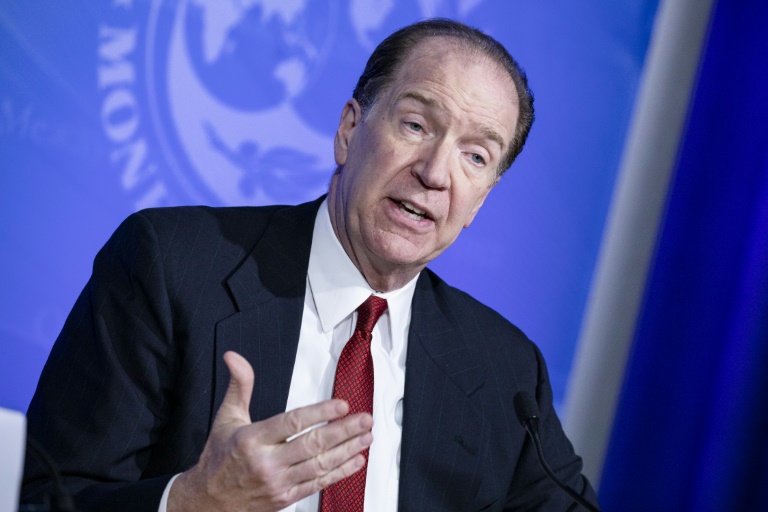
Ukraine war fuels 'overlapping crises': World Bank's Malpass

The Russian war on Ukraine has set off a chain reaction in the global economy, pushing energy and food prices higher, exacerbating debt concerns and potentially worsening poverty and hunger, World Bank President David Malpass said Tuesday.

Faced with these “overlapping crises,” the leader of the development lender urged advanced nations to keep markets open, removing trade barriers and reversing policies that concentrate wealth.

The war came as the global economy was trying to right itself following the Covid-19 pandemic, while navigating supply chain snarls that created shortages and a surge in inflation that has sparked unrest in some countries. 

New lockdowns in China have added further uncertainty to the recovery.

“Never have so many countries experienced a recession at once, suffering lost capital, jobs, and livelihoods. At the same time, inflation continues to accelerate,” Malpass said during an event at the Warsaw School of Economics.

Beyond the immediate humanitarian crisis caused by the war, “Supply constraints and disruptions have fueled price increases and worsened inequality around the globe.”

Ukraine is a key source of grain while Russia is a major producer of energy and fertilizer needed for agriculture, and the war is “creating sudden shortages of energy, fertilizer, and food, pitting people against each other and their governments,” Malpass said.

An “intense drought” in South America is making the food situation worse, he added.

“For every one percentage point increase in food prices, 10 million people are expected to fall into extreme poverty,” he said, noting, “Malnutrition is expected to grow.”

– Debt crisis –

The World Bank on Sunday issued a grim outlook for Ukraine, projecting the economy would collapse, with GDP dropping more than 45 percent this year, while Russia will see an 11.2 percent decline.

But Malpass said countries far beyond the region are feeling the conflict’s pain.

Protestors in Peru have taken to the streets to demand government action, as did people in Sri Lanka, where the government on Tuesday announced it was defaulting on its $51 billion in foreign debt.

Malpass has been sounding the warning about the growing debt burden in developing nations, and said the total “has risen sharply to a 50-year high.” 

“Most emerging market and developing economies are ill-prepared to face the coming debt shock,” he warned.

The World Bank chief called on advanced countries to keep their markets open to help those countries.

“Most of the trade barriers protect the privileged at the expense of the rest of society, worsening inequality,” he said.

Policies such as quotas on sugar imports, subsidies for corn production or domestic content requirements “cause asymmetrical damage to the poor.”

– Rebuilding Ukraine –

He also noted that “rapid addition of major new energy production in other parts of the world will be a necessary ingredient for global recovery and energy security in Europe.”

Speaking ahead of the World Bank and International Monetary Fund’s annual meetings next week, Malpass pledged to help Ukraine rebuild following the war.

The two global lenders have quickly rolled out aid for the country, and Malpass said the bank has secured donor support for $1 billion in funding under the concessional lending arm as part of a $3 billion package, as well as $100 million for Moldova, which the board will now consider.

That is part of facility to help Kyiv keep critical services running, including paying wages for hospital workers and pensions, he said.

Malpass also praised Poland for welcoming the flood of refugees that has driven four million fleeing into neighboring countries.

Ukraine crisis pushes US inflation to new four-decade high

Americans paid more for gasoline, food and other essentials last month amid an ongoing wave of record inflation that Russia’s invasion of Ukraine made worse, according to government data released Tuesday.

The Labor Department’s consumer price index (CPI) climbed 8.5 percent over the 12 months to March, a rate — not seen since December 1981 — that added pressure to President Joe Biden’s administration even as it looks for ways to punish Moscow for the attack on its neighbor.

Prices have surged across the world’s largest economy as it tries to recover from the Covid-19 pandemic, dragging Biden’s approval ratings lower, though the March data contained signs that the spike was rounding off.

“The Russia-Ukraine war has added further fuel to the blazing rate of inflation via higher energy, food, and commodity prices that are turbo charged by a worsening in supply chain problems,” Kathy Bostjancic of Oxford Economics said.

Compared to February, prices rose 1.2 percent, within analysts’ forecasts, but if there was good news to be found in the data, it was in “core” prices, which exclude the volatile food and energy sectors. These increased 0.3 percent last month, less than economists anticipated.

The data nonetheless underscored the potency of the price jumps and bolstered the case that the Federal Reserve will take aggressive action at its policy meeting next month, likely raising rates by half a percentage point as opposed to the quarter-point increase agreed to last month.

“With labor shortages pressuring firms to raise wages, we are in the midst of a wage-price inflation cycle that will require extreme action on the part of the Fed to rid the economy of the spreading inflation threat,” economist Joel Naroff said.

– Real pain –

While the US economy has bounced back strongly from the mass layoffs that marked the pandemic’s start, inflation began bedeviling the recovery last year, as businesses struggled to find enough workers and supplies, the Fed kept interest rates low, and Congress approved stimulus measures that drove up demand among American consumers.

Biden’s public support has dropped as prices have increased, leaving the White House scrambling to offer relief, including by releasing strategic oil supplies to lower prices at the pump and, before the data’s release on Tuesday, waiving a prohibition on selling a lower-price gasoline blend during the summer months.

But the most potent actor in Washington against inflation is the Fed, and their rate increases are indeed expected to lower prices in the months to come, though economists warn the tightening could also cause a recession.

Until then, the Labor Department data showed Americans are facing real financial pain when they go to purchase things they cannot avoid.

Gasoline prices rose 18.3 percent last month, accounting for half the overall increase in CPI. Prices for shelter, the category including rents, rose 0.5 percent.

Food prices rose one percent overall, while prices for groceries were up 1.5 percent in the month, and 10 percent over the past year — the largest such increase since March 1981, according to the data.

– Used cars reverse –

However prices for used cars, which were one of the first items to surge last year, declined 3.8 percent last month, pushing core CPI lower, while new car prices rose only 0.2 percent after seeing monthly gains of more than one percent in the latter months of 2021.

Dan Alpert of Westwood Capital said the data showed signs of deflation “in those things that went bonkers during 2020: transportation, electronics, recreation and leisure. Supply chains are reopened for the most part and demand is becoming sated.”

But considering how high prices have risen elsewhere in the data, Naroff said some on the Fed’s policy setting committee may advocate for an even more forceful 0.75 point rate increase next month — and that won’t necessarily bring prices down quickly.

“The ability of any Fed to sharply raise rates to slow extremely high inflation, while not driving the economy into a recession, is limited, especially given factors such as war that are out of its control,” he said in a note. 

“We are talking about art here, not science, and there is little history of this Fed painting pretty pictures.”

Space balloon company offers first look at luxury cabins

A new entrant in the space tourism market promises customers views of the Earth’s curvature from the comfort of a luxury cabin, lifted to the upper atmosphere with a giant balloon.

Space Perspective on Tuesday revealed illustrations of its swish cabins, which it hopes to start launching from the Kennedy Space Center in Florida from late 2024. More than 600 tickets have so far been sold, at $125,000 each.

With five-feet (1.5 meter) high windows, deep seats, dark, purple tones and subdued lighting, the atmosphere contrasts with the white and sanitized capsules of its competitors.

Wifi connectivity and a drinks bar round out the “Space Lounge” inside the company’s Neptune capsule.

Whether it really constitutes spaceflight is a matter of debate. 

The balloon reaches an altitude of 20 miles (30 kilometers), much lower than rivals Virgin Galactic, which goes just over 50 miles high, or Blue Origin, which breaches the Karman Line, 62 miles above sea level, the internationally-recognized space border.

SpaceX Crew Dragons fly even deeper into space.

But 20 miles is still far higher than commercial planes, which ascend around six miles high.

“We are above 99 percent of Earth’s atmosphere,” co-founder Jayne Poynter told AFP, meaning passengers will really see the inky black of space.

There’s no special training required. The balloon climbs at a serene 12 miles per hour (19 kilometers per hour), and the company pitches itself as a greener, zero-emissions alternative to rocket fuels.

They intend to get the hydrogen for the balloon from renewable sources, rather than extracting it from fossil fuels.

The price for the two-hour-up, two-hours-gliding, and two-hour-down voyage, which ends with an ocean splashdown, is significantly less than Virgin Galactic tickets that cost $450,000 for a ride on a spaceplane.

Blue Origin doesn’t disclose its prices but they are thought to be far more, while four entrepreneurs who flew to the International Space Station on a SpaceX ship paid a reported $55 million each to the company Axiom Space for the privilege.

“We wanted to find a way that really changed the way people think about spaceflight that makes it much more approachable and accessible,” said Poynter.

One thing the passengers won’t experience is feelings of weightlessness.

With Virgin’s spaceplane and Blue Origin’s rocket, passengers can unbuckle and float when the rocket engines are cut but the ship keeps coasting upwards for a few minutes, before gravity pulls it back down.

Passengers on SpaceX spaceships and those on the ISS likewise experience apparent weightlessness because the vessels are orbiting the Earth.

Space Perspective plans 25 flights in its first year, with all seats now booked.

Close Bitnami banner
Bitnami