US Business

Dubai's DEWA shares soar in Gulf's biggest IPO since 2019

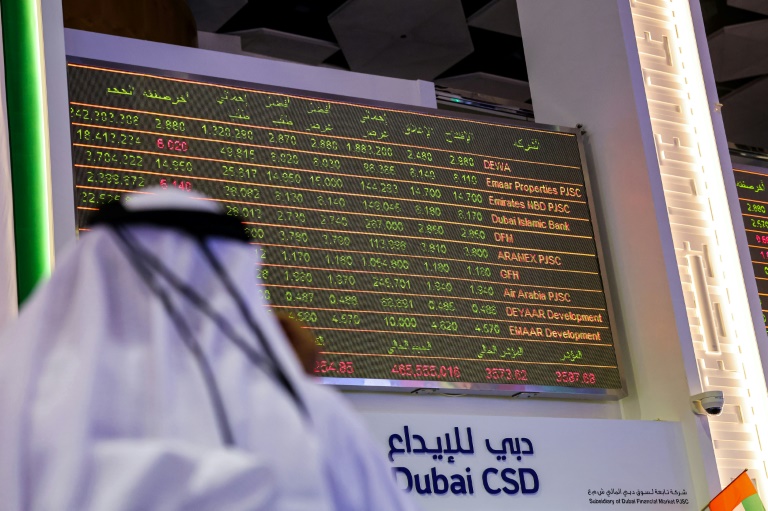
Shares in the Dubai Electricity and Water Authority rose nearly 16 percent on Tuesday in the Gulf region’s biggest initial public offering since Saudi oil giant Aramco in 2019.

DEWA shares soared 19 percent in the first minutes of trading before closing up 15.72 percent at 2.87 dirhams ($0.78), as the Dubai stock exchange was down 0.5 percent. 

The Dubai-owned utility last week said it had raised 22.3 billion dirhams ($6.1 billion) in the Gulf’s largest IPO since Aramco’s world-record flotation.

Some nine billion shares, an 18 percent stake, were listed, with the initial price set at 2.48 dirhams ($0.68). 

The deal, in which more than 65,000 institutional and retail investors participated, values the company at 124 billion dirhams ($33.9 billion), the company said. 

The record for the largest public listing in the Gulf, and in the world, is held by Aramco, which raised $29.4 billion by listing a 1.7 percent stake on the Saudi Stock Exchange in December 2019.

The emirate of Dubai, which lacks the large oil reserves boasted by some of its neighbours, has diversified its economy by focusing on finance, tourism and trade.

But it is facing increased competition in the region, notably from Saudi Arabia, which is also seeking to reduce its dependence on oil and gas. 

Stock markets retreat before US inflation data

European stocks sank Tuesday as investors awaited the latest reading on rampant US inflation.

Most Asian indices also fell after a weak overnight lead from Wall Street with all eyes on surging prices in the world’s biggest economy that have been fuelled by fallout from the Ukraine war.

Approaching the half-way stage, Frankfurt’s DAX index slid 1.0 percent, London shed 0.4 percent and Paris dropped 0.8 percent.

Oil prices rebounded from much of Monday’s sharp losses, as concerns subsided over weaker Chinese demand after Shanghai eased Covid restrictions.

The dollar remained elevated versus the yen, one day after hitting a 2015 high at 125.77 yen on expectations of tightening US monetary policy.

That was not far from the greenback’s two-decade peak of 125.86 yen.

– ‘Feeling the heat’ –

“Investors feel the heat before today’s inflation print,” said Swissquote analyst Ipek Ozkardeskaya.

Economists predict US inflation will soar in March to nearly 8.5 percent, which would be the highest since late 1981.

Inflation had already spiked to 7.9 percent over the 12 months to February, the biggest increase in 40 years.

A fresh inflation surge could spur the US Federal Reserve into aggressive interest rate hikes.

That would in turn weigh on investor sentiment and overall activity in the world’s biggest economy.

– ‘Hotter than hot’ –

“It’s not really about the level of inflation anymore, as it has been well broadcast that CPI is hotter than hot,” said Matt Simpson, senior market analyst at City Index.

“The big question is how long it takes to come back down and whether the Fed will tip the US into a recession in doing so.”

Elsewhere Tuesday, bitcoin crept back above $40,000 on strengthening demand for the world’s most popular virtual unit following recent heavy losses.

– Key figures around 1130 GMT –

London – FTSE 100: DOWN 0.4 percent at 7,586.40 points

Paris – CAC 40: DOWN 0.8 percent at 6,504.87

Frankfurt – DAX: DOWN 1.0 percent at 14,050.44

EURO STOXX 50: DOWN 0.7 percent at 3,813.76

Tokyo – Nikkei 225: DOWN 1.81 percent at 26,334.98 (close)

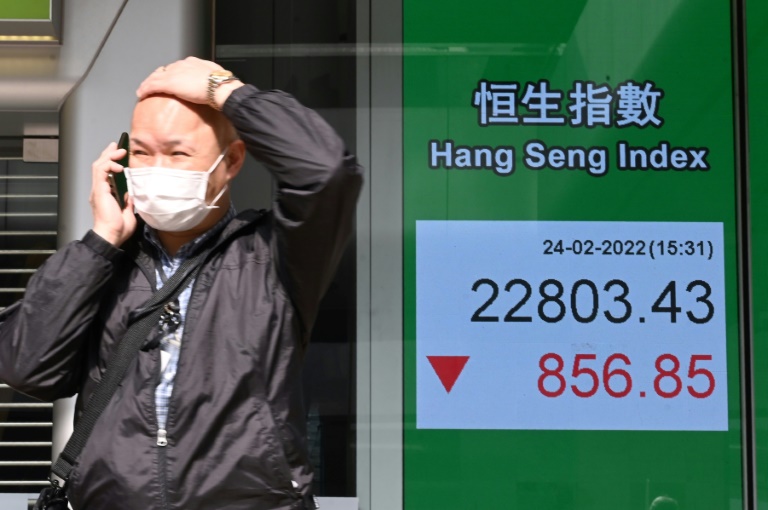
Hong Kong – Hang Seng Index: UP 0.52 percent at 21,319.13 (close)

Shanghai – Composite: UP 1.46 percent at 3,213.33 (close)

New York – Dow: DOWN 1.19 percent at 34,308.08 (close)

Brent North Sea crude: UP 3.4 percent at $101.81 per barrel

West Texas Intermediate: UP 3.3 percent at $97.43

Euro/dollar: DOWN at $1.0863 from $1.0884 late Monday

Dollar/yen: UP at 125.66 yen from 125.37 yen

Pound/dollar: DOWN at $1.2999 from $1.3030

Euro/pound: UP at 83.57 pence from 83.53 pence

burs-rfj/bcp/lth

Crisis-hit Sri Lanka defaults on foreign debt

Sri Lanka announced a default on its $51 billion foreign debt Tuesday as the island nation grapples with its worst economic crisis in memory and escalating protests demanding the government’s resignation.

Acute food and fuel shortages, as well as long daily electricity blackouts, have brought widespread suffering to the country’s 22 million people in the most painful downturn since independence in 1948.

The government has struggled to service foreign loans and Tuesday’s decision comes ahead of negotiations for an International Monetary Fund bailout aimed at preventing a more catastrophic hard default that would see Sri Lanka completely repudiate its debts.

“We have lost the ability to repay foreign debt,” Sri Lanka’s Central Bank governor Nandalal Weerasinghe told reporters in Colombo.

“This is a pre-emptive negotiated default. We have announced (it) to the creditors.”

Officials say the move will free up foreign currency to finance desperately needed food, fuel and medicine imports after months of scarce supplies. 

Just under half of Sri Lanka’s debt is market borrowings through international sovereign bonds, including one worth $1 billion that was maturing on July 25. 

China is Sri Lanka’s largest bilateral lender and owns about 10 percent of the island’s foreign debt, followed by Japan and India.

The government has borrowed heavily from Beijing since 2005 for infrastructure projects, many of which became white elephants. 

Sri Lanka also leased its strategic Hambantota port to a Chinese company in 2017 after it became unable to service the $1.4 billion debt from Beijing used to build it.

This sparked concerns from Western countries and neighbour India that the strategically located South Asian nation was falling victim to a debt trap.

Chinese foreign ministry spokesman Zhao Lijian said Tuesday’s default would not stop Beijing from lending support to Sri Lanka’s beleaguered economy.

“China has always done its best in providing assistance to Sri Lanka’s economic and social development. We will continue to do so in the future,” he said.

– ‘Frightened of the future’ –

Sri Lanka’s snowballing economic crisis began to be felt after the coronavirus pandemic torpedoed vital revenue from tourism and remittances. 

The government imposed a wide import ban to conserve dwindling foreign currency reserves and use them to service the debts it has now defaulted on.

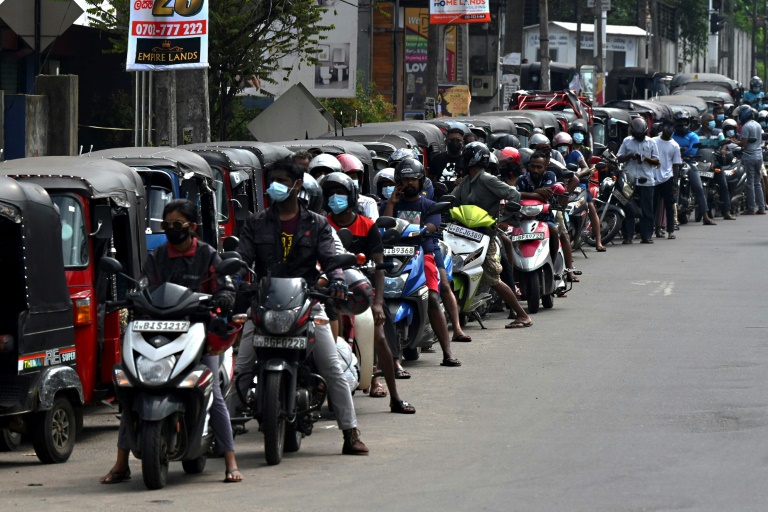
But the resulting shortages have stoked public anger. At least eight people have died while waiting in fuel queues since March 20 with two of the deaths reported on Monday.

“It’s been depressing to be so frightened of the future and where it’s going,” protester Vasi Samudra Devi told AFP at an anti-government rally in Colombo Monday.

“There are already people who are suffering… We are all here because we are being affected by the economic problems.”

Crowds have attempted to storm the homes of government leaders and security forces have dispersed protesters with tear gas and rubber bullets. 

Thousands of people were camped outside President Gotabaya Rajapaksa’s seafront office in the capital Colombo in the fourth straight day of protests calling for him to step down.

Economists say the crisis has been made worse by government mismanagement, years of accumulated borrowing and ill-advised tax cuts.

International rating agencies also downgraded Sri Lanka last year, effectively blocking the country from accessing foreign capital markets to raise new loans.

– ‘Last resort’ –

Sri Lanka’s finance ministry said Tuesday’s default was “a last resort in order to prevent further deterioration of the republic’s financial position”.

Creditors were free to capitalise any interest payments due to them or opt for payback in Sri Lankan rupees, the ministry added.

The government is seeking around $3 billion in IMF support over the next three years to revive the economy, finance minister Ali Sabry told parliament on Friday. 

Ministry officials told AFP last week the government was preparing a programme for sovereign bond holders and other creditors to take a haircut and avoid a hard default.

Sri Lanka had sought debt relief from India and China this year, but both countries instead offered more credit lines to buy commodities from them.

Estimates showed Sri Lanka needed $7 billion to service its debt load this year, against just $1.9 billion in reserves at the end of March. 

Ukraine war set to push record US inflation even higher

US government data will on Tuesday likely confirm what many Americans already suspected: prices continued to rise at record rates last month, continuing a phenomenon that began last year but which has been exacerbated by Russia’s invasion of Ukraine.

The Labor Department’s consumer price index (CPI) report for March will be the first to fully encompass the shock caused by the war in Ukraine and the Western sanctions against Moscow, and is almost certain to show a spike in prices for gasoline and other petroleum products.

“Russia’s invasion of Ukraine has definitely added upside risks to US inflation through channels such as energy, food and also elevated risks of supply bottlenecks lingering for longer,” Pooja Sriram of Barclays said.

Americans have been weathering steadily accelerating price increases that hit 7.9 percent over the 12 months to February, a rate not seen in four decades.

But as the Federal Reserve raises interest rates, some economists believe the report will also mark the peak of the inflation wave that began last year as the economy recovered from Covid-19 — though it could be a while before consumers feel relief.

“The subsequent slowing may not be meaningful given all the supply restrictions on products from Russia and Ukraine as well as the growing supply chain bottlenecks on finished goods from China due to the Covid lockdowns there,” Karl Haeling of LBBW said.

The inflation wave has become a political liability for President Joe Biden, and before the data’s release, the White House temporarily waived a seasonal ban on sales of E15 gasoline, which is cheaper but usually not allowed to be sold during the summer.

But that won’t stop the Labor Department from reporting another sky-high year-on-year inflation number in March that analysts believe could hit somewhere around 8.5 percent.

– Nearing the peak? –

After years of muted price pressures, inflation began climbing as the economy recovered a year ago, driven by the Fed’s pandemic-era easy money policies, global shortages of components and delays in shipping, and government stimulus packages that fattened Americans’ wallets and drove up demand.

The consensus among economists is for CPI to accelerate by 1.2 percent in March compared to February, but for “core” CPI, which excludes volatile food and energy prices, to rise by 0.5 percent in March, the same as the month prior.

Ian Shepherdson of Pantheon Macroeconomics predicted “this will be the peak” of the annual increases — but only because future reports will be compared to months in 2021 when prices were already climbing.

Gasoline will play a big role in March’s price gains, Shepherdson said, adding 0.7 percent to the monthly figure overall. Food prices also rose in the month, he said, as did hotel prices and airfares, though prices for scarce used cars may decline after recent surges.

– Hitting demand –

While analysts are skeptical that the White House’s moves to cut pump prices will be effective, a recent decline in global oil prices may ultimately take some pressure off Americans.

Meanwhile, the Fed is moving to tighten lending conditions to stop inflation, though whether they can do so without causing a recession is an open question.

The central bank hiked interest rates a quarter-point higher from zero last month, and are widely expected to raise them by a half-point next month, and continue increasing throughout this year.

“There is no road map for what the Fed is trying to accomplish except in world (with) supply constraints,” Grant Thornton economist Diane Swonk warned on Twitter. 

The “Fed needs to hit demand. Hard. Very hard,” she wrote.

Markets mostly down ahead of key US data

Most Asian and European markets were down Tuesday, after a weak lead from Wall Street and with all eyes on key US inflation data due later in the trading day.

Tokyo closed down by nearly two percent, though Hong Kong was up more than one percent by the end of trade.

Shanghai also posted gains, while Seoul, Taipei, Sydney and Singapore were all in the red. Jakarta eked out small gains.

In Europe, London dipped 0.8 percent at the open, while Paris and Frankfurt were both down by just under two percent.

This followed a weak Monday performance from Wall Street and Europe, with sentiment souring on flat UK economic growth and expectations for another strong US inflation report, which will likely bring aggressive interest rate hikes from the Federal Reserve.

The government is set to release the US consumer price index (CPI) for March on Tuesday, after inflation rose 7.9 percent over the 12 months to February, the biggest increase in 40 years.

Calling it the “Putin price hike” in reference to the economic ramifications of Russia’s invasion of Ukraine, White House Press Secretary Jen Psaki told reporters: “We expect March headline inflation to be extraordinarily elevated.”

Economists are expecting annual US inflation to spike to nearly 8.5 percent, which would be the highest since late 1981.

“It’s not really about the level of inflation anymore, as it has been well broadcast that CPI is hotter than hot,” said Matt Simpson, senior market analyst at City Index. “The big question is how long it takes to come back down and whether the Fed will tip the US into a recession in doing so.”

“What we’re faced with this year is stagflation,” Kathryn Rooney Vera, head of global macro research at Bulltick LLC, told Bloomberg Television. 

“It’s a very complicated environment that the Fed has found itself in”, and the market is pricing in potentially 50 basis points of hikes at each of the next two policy meetings, she added.

US Treasuries declined, taking the 10-year yield past 2.80 percent.

All those concerns were weighing on the Tokyo market, Okasan Online Securities said in a note.

“Investors will then likely refrain from making major moves ahead of the release of the March US consumer prices data later in the day. The market will likely lose a sense of clear direction” until the data’s release, the brokerage said.

“The Chinese government gave out its first online game approvals in months,” noted Jeffrey Halley, senior markets analyst at OANDA, in relation to the gains in Hong Kong and Shanghai.

The approvals were for the first batch of new video game licences since July, a step that could ease some of the worst concerns about Beijing’s gaming-sector curbs.

But “sentiment hasn’t been helped by the latest Covid extended lockdown measures being initiated by Chinese authorities in Shanghai in what is likely to be a fruitless attempt to stem the spread of the more contagious Omicron variant”, said Michael Hewson, chief market analyst at CMC Markets UK.

Oil steadied, with Brent crude back just over $100 a barrel, after a tumble that erased most of the commodity’s gains sparked by Russia’s war in Ukraine.

Stephen Innes of SPI Asset Management attributed the rise to a partial lifting of restrictions in Shanghai “easing concerns around Chinese oil demand”.

He added: “Sort of the light-at-the-end-of-the-tunnel trade, but oil bulls have fingers crossed that light isn’t a Chinese Covid freight train at the other end of the tunnel.”

– Key figures around 0810 GMT –

Tokyo – Nikkei 225: DOWN 1.81 percent at 26,334.98 (close)

Hong Kong – Hang Seng Index: UP 0.52 percent at 21,319.13 (close)

Shanghai – Composite: UP 1.46 percent at 3,213.33 (close)

London – FTSE 100: DOWN 0.81 percent at 7,556.88

Brent North Sea crude: UP 2.42 percent at $100.86 per barrel

West Texas Intermediate: UP 2.53 percent at $96.68 per barrel

Euro/dollar: DOWN at $1.0864 from $1.0871

Pound/dollar: DOWN at $1.3006 from $1.3021

Euro/pound: UP at 83.53 pence from 83.49 pence

Dollar/yen: UP at 125.61 yen from 125.40

New York – Dow: DOWN 1.19 percent at 34,308.08 (close)

— Bloomberg News contributed to this report —

As EU eyes stopping Russian gas imports, Israel sees an opening

As Europe aims to wean itself off Russian fossil fuel because of the Ukraine invasion, Israel hopes to help fill the gap with gas from its offshore reserves.

EU states remain divided on the time scale, but European Commission President Ursula von der Leyen has said the bloc hopes to phase out its dependency on Russian gas, oil and coal by 2027.

Israel could build one or more pipelines, potentially via Greece or Turkey, or increase the quantity of gas piped to Egypt to be liquified and shipped off, say officials and experts. 

Israeli Foreign Minister Yair Lapid said after a recent visit to Athens that “the war in Ukraine stands to change the structure of the European and Middle Eastern energy market”. 

“We are also examining additional economic cooperation, with an emphasis on the energy market.”

The Jewish state has worked for years to create gas export routes, with mixed results so far. 

Turkey, whose ties with Israel have recently thawed after over a decade of rupture, has expressed new interest in a pipeline, and its energy minister is expected in Israel in the coming weeks.

During the years of diplomatic alienation from Turkey, Israel signed an accord with Greece and Cyprus in 2020 aiming to build the EastMed pipeline through those two countries from Israel to Europe. 

Turkey opposed the project, and a senior US diplomat said last week it would be too expensive and take too long to build. 

Energy Minister Karine Elharrar also hailed the potential for gas sales to Europe, telling the French Association of Defence Journalists that “we have the ability and we will try to do as much as we can”.

– Regional alliances –

With both Greece and its regional rival Turkey vying to be the conduit for the gas, Israel would have to tread carefully amid the regional alliances it wishes to uphold and strengthen.

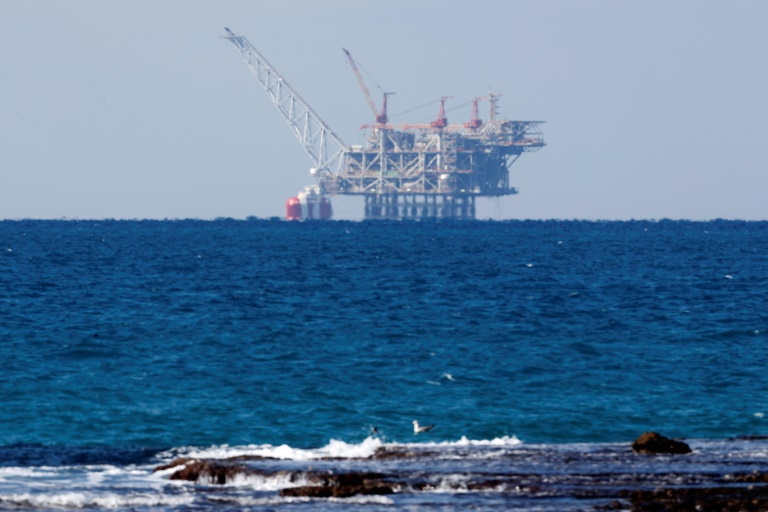
Major gas finds in the eastern Mediterranean — nearly 1,000 billion cubic meters (bcm) — have in the past decade turned Israel from a natural gas importer into an exporter.

It now sells small quantities from its two major offshore fields, Leviathan and Tamar, to Egypt and Jordan. 

Israel’s domestic consumption over the next three decades would leave some 600 bcm available for export, said opposition lawmaker Yuval Steinitz, Israel’s energy minister until last year.

“In 2016 the pipeline to Turkey was examined, including with Turkey and commercial companies,” said Orit Ganor, director of natural gas international trade at Israel’s energy ministry. 

“The project didn’t reach fruition mainly due to economic reasons.”

Ganor said “the EastMed pipeline is still an option, and the company advancing it, Poseidon, is in the final stages of geophysical and geotechnical surveys of the pipe’s route in our waters and those of Greece and Cyprus”.

No financing has been secured for the project, which Steinitz said would cost about $6 billion and take around four years to complete.

He said there was also agreement with Cairo on a seabed pipeline from Leviathan to Egypt’s liquification plants that would allow for greater exports to Europe.

– ‘Catch-22’ –

Israel’s Leviathan field, which would be the source for European exports, is operated by an Israeli-American consortium including NewMed Energy and US major Chevron. 

NewMed Energy CEO Yossi Abu recently stated his ambition of “bringing Israeli gas to Europe and Asia”.

Experts say Israel’s current gas fields represent a third of potential reserves, but a means to sell future finds would be needed to encourage further exploration by private companies.

The state of Israel provides exploitation licenses and regulatory support, but does not drill for gas or build pipelines.

“There’s a ‘Catch-22’ here,” said Elai Rettig, a political scientist at Tel Aviv’s Bar-Ilan university.

“You need to find a customer that will agree to pay for this very, very expensive pipeline, and they won’t do it until you show them you’ve found enough gas to justify it.

“And you won’t find enough gas to justify it until you show that there’s someone to sell the gas to.”

Europe’s efforts to diversify gas imports began before the Ukraine war when it “experienced harsh weather and gas prices rose significantly,” said Ganor, the energy ministry official. 

Steinitz said a pipeline to Turkey would cost $1.5 billion and take two to three years to build.

Israel “could definitely be a serious factor in creating more independence and a wealth of energy sources for Europe,” he said.

He said Israel could even export via Greece, Turkey and Egypt at the same time because “we have enough gas to export through the three channels”.

Rettig stressed Israel’s need for “balance” between Turkey and Greece and to “continuously talk to both sides and to reassure them that one doesn’t come at the expense of the other”.

Crisis-hit Sri Lanka defaults on all foreign debt

Sri Lanka defaulted on its $51 billion foreign debt Tuesday as the island nation grapples with its worst economic crisis in memory and widespread protests demanding the government’s resignation.

Acute food and fuel shortages, alongside long daily electricity blackouts, have brought widespread suffering to the country’s 22 million people in the most painful downturn since independence in 1948.

Public anger has flared in recent weeks with crowds attempting to storm the homes of government leaders and security forces dispersing protesters with tear gas and rubber bullets. 

Sri Lanka’s finance ministry said the country was defaulting on all external obligations, including loans from foreign governments, ahead of an International Monetary Fund bailout.

“The government is taking the emergency measure only as a last resort in order to prevent further deterioration of the republic’s financial position,” a statement from the ministry said.

Creditors were free to capitalise any interest payments due to them or opt for payback in Sri Lankan rupees, the ministry added.

Sri Lanka’s snowballing economic crisis began with an inability to import essential goods, after the coronavirus pandemic torpedoed vital revenue from tourism and remittances. 

The government imposed a wide import ban to conserve its foreign currency reserves and use them to service the debts it has now defaulted on.

Economists say the crisis has been made worse by government mismanagement, years of accumulated borrowing and ill-advised tax cuts.

Public frustration with the government is widespread, with long queues around the island nation forming each day to buy scarce supplies of petrol, gas and kerosene for cooking stoves. 

Thousands of people were camped outside President Gotabaya Rajapaksa’s seafront office in the capital Colombo in the fourth straight day of protests calling for him to step down.

– Rating downgrade –

International rating agencies also downgraded Sri Lanka last year, effectively blocking the country from accessing foreign capital markets to raise new loans and meet demand for food and fuel.

Sri Lanka had sought debt relief from India and China, but both countries instead offered more credit lines to buy commodities from them.

Official figures show that China and Japan, two key bilateral sovereign creditors, hold about 10 percent each of Sri Lanka’s foreign debt while India’s share is under five percent.

Just under half of Sri Lanka’s debt is market borrowings through international sovereign bonds and other similar instruments.

Estimates showed Sri Lanka needed $7 billion to service its debt load this year, against just $1.9 billion in reserves at the end of March. 

Asia markets mostly down ahead of key US data

Most Asian markets were down Tuesday afternoon, after a weak lead from Wall Street and with all eyes on key US inflation data due later in the day.

Tokyo closed down by nearly two percent, though Hong Kong was up more than one percent by the afternoon.

Shanghai also posted gains, while Seoul, Taipei, Sydney and Jakarta were all in the red.

This followed a weak Monday performance from Wall Street and Europe, with sentiment souring on flat UK economic growth and expectations for another strong US inflation report, which will likely bring aggressive interest rate hikes from the Federal Reserve.

The government is set to release the US consumer price index (CPI) for March on Tuesday, after inflation rose 7.9 percent over the 12 months to February, the biggest increase in 40 years.

Calling it the “Putin price hike” in reference to the economic ramifications of Russia’s invasion of Ukraine, White House Press Secretary Jen Psaki told reporters: “We expect March headline inflation to be extraordinarily elevated.”

Economists are expecting annual US inflation to spike to nearly 8.5 percent, which would be the highest since late 1981.

“It’s not really about the level of inflation anymore, as it has been well broadcast that CPI is hotter than hot,” said Matt Simpson, senior market analyst at City Index. “The big question is how long it takes to come back down and whether the Fed will tip the US into a recession in doing so.”

“What we’re faced with this year is stagflation,” Kathryn Rooney Vera, head of global macro research at Bulltick LLC, told Bloomberg Television. 

“It’s a very complicated environment that the Fed has found itself in”, and the market is pricing in potentially 50 basis points of hikes at each of the next two policy meetings, she added.

US Treasuries declined, taking the 10-year yield past 2.80 percent.

All those concerns were weighing on the Tokyo market, Okasan Online Securities said in a note.

“Investors will then likely refrain from making major moves ahead of the release of the March US consumer prices data later in the day. The market will likely lose a sense of clear direction” until the data’s release, the brokerage said.

“The Chinese government gave out its first online game approvals in months,” noted Jeffrey Halley, senior markets analyst at OANDA, in relation to the gains in Hong Kong and Shanghai.

The approvals were for the first batch of new video game licences since July, a step that could ease some of the worst concerns about Beijing’s gaming-sector curbs.

But “sentiment hasn’t been helped by the latest Covid extended lockdown measures being initiated by Chinese authorities in Shanghai in what is likely to be a fruitless attempt to stem the spread of the more contagious Omicron variant”, said Michael Hewson, chief market analyst at CMC Markets UK.

Oil steadied, with Brent crude back just over $100 a barrel, after a tumble that erased most of the commodity’s gains sparked by Russia’s war in Ukraine.

– Key figures around 0710 GMT –

Tokyo – Nikkei 225: DOWN 1.81 percent at 26,334.98 (close)

Hong Kong – Hang Seng Index: UP 1.09 percent at 21,440.35

Shanghai – Composite: UP 1.46 percent at 3,213.33

Brent North Sea crude: UP 3.15 percent at $101.58 per barrel

West Texas Intermediate: UP 3.21 percent at $97.32 per barrel

Euro/dollar: DOWN at $1.0857 from $1.0871

Pound/dollar: DOWN at $1.3005 from $1.3021

Euro/pound: FLAT at 83.49 pence

Dollar/yen: UP at 125.68 yen from 125.40

New York – Dow: DOWN 1.19 percent at 34,308.08 (close)

London – FTSE 100: DOWN 0.67 percent at 7,618.31 (close)

— Bloomberg News contributed to this report —

From Denmark to Portugal, Europe ups effort to quit Russian gas

In Denmark, large black pipes are about to be buried in a muddy trench, as construction of a gas pipeline from Norway to Poland resumes following Russia’s invasion of Ukraine.

From plans for liquefied natural gas terminals in northern Germany, Finland and France to potential new routes through Spain and the Mediterranean, Europe is striving to rid itself of its dependence on Russian gas, though experts say the task will take years to complete.

In Middelfart in central Denmark, work resumed last month on the Baltic Pipe project, a planned 900-kilometre link, mainly intended to help Poland reduce its dependence on Russian natural gas.

“Of course it’s also to have the gas in the Danish system but mainly also to help our good neighbours’ gas systems and our Polish good friends,” Soren Juul Larsen, head of the project at Danish energy infrastructure operator Energinet, told AFP in English.

Just a week after the invasion of Ukraine, the Danish environmental authority — which had concerns about the project’s impact on local populations of mice and bats — granted a permit to continue construction, after a nine-month suspension.

“The pipeline was stopped because of a lack of permissions concerning the protection of nature and rare species,” Trine Villumsen Berling, a researcher at the Danish Institute for International Studies, told AFP.

“We were expecting it to soon be approved but of course the war made it a more pressing issue,” Villumsen said.

– Not enough for all –

Envisioned almost 20 years ago, construction of the partly submerged pipeline began in 2018. It is now expected to start operations in October, before becoming fully operational on January 1, 2023.

“We really have a good cooperation with all contractors to speed up (and) do whatever we can to protect the schedule,” Juul Larsen explained during a visit to the construction site.

With an annual transport capacity of 10 billion cubic metres of gas, the pipeline should cover around 50 percent of consumption by Poland, which announced three years ago it would end its contract with Russian giant Gazprom in 2022.

While this may be good news for Poland, it could spell trouble for other European countries seeking to free themselves of Russian gas.

Norway, Europe’s second-largest gas supplier after Russia, is delivering at full capacity, so more gas to Poland means less for the rest of the continent.

“This project would help out Poland but may lead to less Norwegian gas exports to the UK and Germany,” Zongqiang Luo, an expert at research firm Rystad Energy, told AFP.

In addition, many long-term contracts between Russia and European suppliers are valid for another 10 to 15 years, he noted.

While the European Union has resisted calls to ban Russian gas immediately, it has announced plans to slash imports by two thirds this year and eliminate them entirely before the end of the decade.

With Norway at full capacity, Dutch and UK fields in decline, and Russian gas declared undesirable, Europe is looking for gas from further away, including liquefied natural gas (LNG) transported by ship from the US, Qatar and Africa. 

But such imports require the construction of large LNG terminals to turn it back into gas or, at the very least, the purchase of so-called floating storage regasification units (FSRUs).

– Emancipation –

As the entry into service of the Nord Stream 2 gas pipeline from Russia has been suspended, Germany has urgently relaunched three LNG terminal projects previously considered to be of low priority.

One is expected to be completed in the winter of 2023-24 but the other two not before 2026.

Finland and Estonia last week announced a project to lease an import terminal ship. Estonia and the other two Baltic countries say they have stopped importing Russian gas since April 1.

In southern Europe, Spain and Portugal are strengthening an alternative supply route to help Europe wean itself off Russian gas.

To this end, the port of Sines, Portugal’s largest, plans to double the capacity of its gas terminal in under two years.

Spain, which is linked to Algeria via a pipeline and has vast LNG terminals, could provide another supply option for Europe but this would require major work to improve connections with the rest of the EU, notably via France. 

Another option under consideration is to connect Europe to the gas from the eastern Mediterranean, where large reserves have been discovered off Israel and Cyprus over the past 20 years.

Film industry guns for fresh start at Cannes

The Cannes Film Festival will hope to relaunch the industry’s hopes with another star-packed line-up to be announced on Thursday. 

After a slow return to cinema-going after the Covid-19 pandemic, the film business will be hoping for a boost on the French Riviera when the 75th edition of the world’s leading cinema festival returns from May 17 to 28. 

Tom Cruise is already confirmed for the festival promoting the world premiere of “Top Gun: Maverick”, the sequel to his 1986 blockbuster. Also attending is Tom Hanks, who co-stars in “Elvis” as the rock’n’roll star’s manager, Colonel Tom Parker. 

The latter is the latest spectacle from Australian director Baz Luhrmann, who has previously lit up Cannes with “Moulin Rouge!” and “Gatsby”.  

The rest of the line-up will be announced on Thursday, including the 20-odd films competing for the top prize Palme d’Or.

The selection committee, who have been working their way through more than 2,000 entries in recent weeks, have a tough act to follow after last year’s vintage edition. 

Coming after the festival was cancelled by the pandemic in 2020, it launched several films that went on to global success, especially “Drive My Car”.

After picking up three awards at Cannes, it went on to win this year’s Oscar for best international feature film — and was the first Japanese film to be nominated in the best picture category.

– Big-name speculation –

Last year’s jury — led by US director Spike Lee — gave the Palme d’Or to Julia Ducournau’s body-horror “Titane” — ensuring the festival maintained its reputation for boosting bold and edgy filmmaking alongside starry entertainment. 

The organisers have left it late to announce who will chair the jury this year, but Penelope Cruz and Marion Cotillard are among the favourites according to industry insiders. 

Film experts have also been picking through the release schedules for ideas on who might be in competition. 

Many are hoping to see the return of David Cronenberg, whose upcoming sci-fi/horror cross-over stars Viggo Mortensen, Kristen Stewart and Lea Seydoux. 

Also hotly tipped is Australian George Miller, the man behind “Mad Max”, who takes a new direction with “Three Thousand Years of Longing” about a djinn (played by Idris Elba) offering three wishes to Tilda Swinton. 

Another possibility is Terrence Malick, who won previously for “Tree of Life” starring Brad Pitt. His new film follows the life of Jesus Christ and stars Mark Rylance as Satan.

Though women have been getting more of a presence on the festival circuit, they remain poorly represented.

One possible contender in competition at Cannes might be US director Kelly Reichardt, with her new film, “Showing Up”. Her lo-fi hit “First Cow” was on many critics’ end-of-year lists in 2021. 

– Shadow of war –

As with everything in the arts at the moment, the Russian invasion of Ukraine hangs over the selection. 

Possible names include exiled Russian filmmaker Kantemir Balagov, 30, whose film “Beanpole” won the directing award of the Un Certain Regard section in 2019. 

Or there may be the return of Kirill Serebrennikov, who was unable to attend Cannes last year for his Palme nominee “Petrov’s Flu”, after being banned from travelling due to a controversial court case.

One possible Ukrainian entry is a film about the Allied destruction of German cities at the end of World War II by director Sergei Loznitsa. 

Meanwhile, festival director Thierry Fremaux has been pushing for a change to the rule that bars streaming platforms from competing at Cannes. 

But French cinema distributors, who have a seat on the festival board, continue to block the move even as big-name directors such as Martin Scorcese and Jane Campion have turned to Netflix and other streamers for financial support.

In the short term, that means that the much-anticipated Marilyn Monroe biopic, “Blonde”, starring Ana de Armas, a Netflix film, cannot compete for Palme, although fans are still hoping it will get a premiere on the Cote d’Azur.

Close Bitnami banner
Bitnami