US Business

Bulgarians stock up on firewood as energy costs surge

Winter is closing in but the sound of chainsaws still reverberates on the forest-covered slopes of the mountains in northern Bulgaria, while horses stand ready to transport the freshly cut wood down the steep paths.

Many in the EU’s poorest member of 6.5 million people have rushed to stock up on firewood as Europe struggles with an energy crisis triggered by the war in Ukraine.

“Firewood remains the cheapest means of heating, and demand has increased three times compared to last year,” farming minister Yavor Gechev said recently.

Gechev has pleaded for people not to buy more wood than they need as the usual coal deliveries from Ukraine’s Donbas region have largely failed to arrive in Bulgaria.

Over half of the households in Bulgaria use coal and wood for heating, especially in the rural areas, where frequent cuts make electricity unreliable.

Even before the current crisis, one in four Bulgarians was unable to heat their home properly in wintertime, the highest percentage across the European Union, according to Eurostat data.

– ‘Getting harder’ –

In the mountainous region around Teteven, 4,800 households have placed orders for firewood, compared to less than 2,000 households last year, said Stoycho Moskovski, a press officer for the municipality of 18,000 residents.

A lack of snow so far this year has allowed logging to continue well into December, said the chief of the local state forestry farm, engineer Docho Dochev.

After workers fell young beech trees high up over Teteven, the logs are cut into one-metre-long (3.3-feet-long) pieces for transportation, mostly by horses because of the mountainous terrain.

On a crisp day earlier this month, workers loaded the logs on the saddles of a dozen horses that waited patiently. 

Then they started their short journey down a steep forest path to a place from where the wood can be loaded onto trucks.

Ten horses can transport about three cubic metres of firewood at a time and usually make two trips per day, Dochev told AFP.

In the nearby villages on the way down to Teteven, piles of logs were seen lining fences, and stocks of firewood, cut and ready for the stove, filled sheds, balconies and staircases.

But not everyone has gotten their wood on time this year.

“Every year I use roughly the same amount of five cubic metres of firewood for heating. But this year I waited for quite some time — over two months — for the delivery,” pensioner Blagovesta Dogandzhiyska, 80, told AFP as a trucker unloaded logs outside her house in Teteven.

This year, she is also paying double the 90 leva (45 euros) per cubic metre that she spent last year.

“It’s very hard (to heat my home), and it’s getting even harder,” the pensioner shrugged.

Suspect in Paul Pelosi assault also targeted Tom Hanks, court hears

The man accused of attacking US House Speaker Nancy Pelosi’s husband with a hammer had a list of future targets that included Hollywood superstar Tom Hanks, a US court heard Wednesday.

David DePape told police he had intended to kidnap the Democratic Party’s top politician in Congress and get her to admit to “lies” or he would smash her kneecaps.

But when he broke into her San Francisco home in October, he instead found her 82-year-old husband Paul Pelosi, and after what he told officers was a “pretty amicable” exchange, bludgeoned him with a hammer.

San Francisco Superior Court Judge Stephen Murphy ruled Wednesday that there was enough evidence for 42-year-old DePape, a Canadian former public nudity activist, to stand trial over the assault, which left Paul Pelosi with a fractured skull.

The defendant has denied the charges of attempted murder, assault with a deadly weapon, elder abuse, residential burglary, false imprisonment and threatening the life of or causing serious bodily harm to a public official.

DePape told investigators he was looking at other high-profile targets as well as Nancy Pelosi, the court heard.

These included Hanks, California Governor Gavin Newsom and Hunter Biden, the son of President Joe Biden and the frequent target of rightwing conspiracy theorists.

At Wednesday’s hearing, prosecutors played parts of an interview DePape gave to investigators after his arrest.

The suspect said he had told Paul Pelosi that he had no intention of surrendering, the San Francisco Chronicle reported.

“I had threatened him a couple of times but for the most part it was pretty amicable,” DePape said on the recording.

But when he lunged at Pelosi, he did so with “full force,” the Chronicle said.

Nancy Pelosi — who as House speaker is second in line to the US presidency after the vice president — was not in San Francisco at the time of the attack.

Paul Pelosi had managed to call police while his assailant was in the house.

Officers were able to subdue the attacker, but not before he had fractured Pelosi’s skull, knocking him unconscious.

Prosecutors on Wednesday showed body camera footage from one of the officers, the Chronicle reported.

DePape could be heard saying “Uh, nope,” after he was ordered to drop the hammer before the attack and subsequent tussle.

“A sound that appeared to be Pelosi’s snoring, after he was struck by the hammer, was heard loudly at the end of the video,” the Chronicle reported.

The assault and attempted kidnapping came just days before the high-stakes midterm elections, with America’s febrile political atmosphere being regularly fed by outlandish conspiracy theories from national figures.

“The only reasonable interpretation of (DePape’s) statements is that he intended to kill Paul Pelosi when Mr. Pelosi got in his way,” the judge said Wednesday.

DePape was ordered to appear in court again on December 28 for arraignment.

A separate federal case against DePape is ongoing. He has denied charges of kidnap and assault levied there.

Paul Pelosi spent almost a week in hospital, where he underwent surgery after the attack.

Nancy Pelosi later said her husband was facing “a long recovery process.”

Google says does not change search results after Hong Kong anthem row

Google said Thursday it does not manipulate search results, after Hong Kong’s government said the tech giant had refused its demand to remove a popular protest song.

The controversy began after it emerged that links to the pro-democracy song “Glory to Hong Kong” appeared ahead of China’s official “March of the Volunteers” when people searched for the city’s anthem.

The song was accidentally played for Hong Kong athletes at two international sports events last month, prompting the demand from the Chinese city to remove it from search results.

“Google handles billions of search queries every day, so we build ranking systems to automatically surface relevant, high quality, and helpful information,” the tech giant told AFP in response to a query about the anthem request.

“We do not manually manipulate organic web listings to determine the ranking of a specific page,” it said in a statement.

Hong Kong’s security chief Chris Tang said Monday that Google had refused the city government’s request. He described the company’s explanation — that results were based on algorithms — as “evasive” and “inconceivable”.

Hong Kong leader John Lee said this week that Google had a “moral obligation” to respect a country’s national anthem.

The Chinese Foreign Ministry backed Lee, saying internet companies “have a duty to deliver correct information to the public”.

Google told AFP it was in contact with Hong Kong’s government to explain “how our platforms and removal policies work”.

“We do not remove web results except for specific reasons outlined in our global policy documentation.”

Both Tang and Lee have argued that Google search results can be manipulated, citing the placement of ads and the deletion of certain results to comply with privacy laws in the European Union.

Police have also been asked to investigate whether the anthem mix-up in South Korea was a violation of the city’s national security law, which Beijing imposed in 2020 to crush dissent after democracy protests.

Google’s search engine is banned in mainland China but is freely accessible in Hong Kong, where the firm also has an office.

It was among the tech companies that suspended cooperation with Hong Kong police on data requests after the security law came into effect.

This year, YouTube — a Google subsidiary — terminated Hong Kong leader Lee’s channel citing US sanctions.

Lee was among the officials sanctioned by the United States in 2020 for their role in curtailing civil liberties in Hong Kong.

EU meets facing subsidy race with US in trade spat

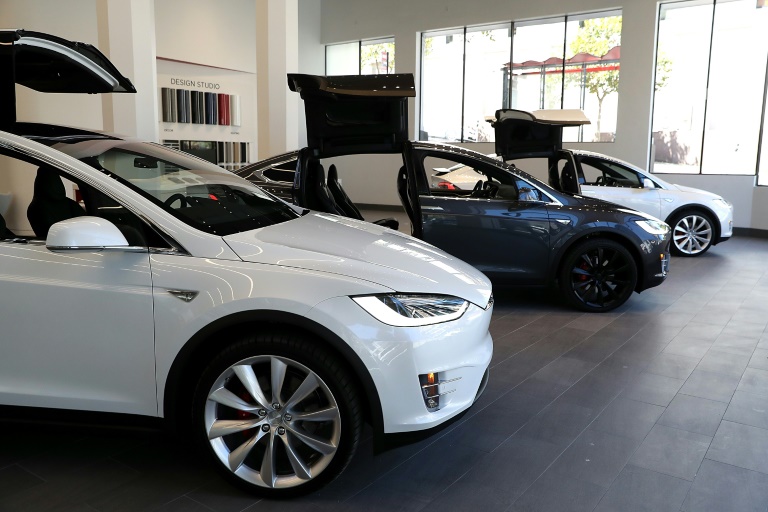
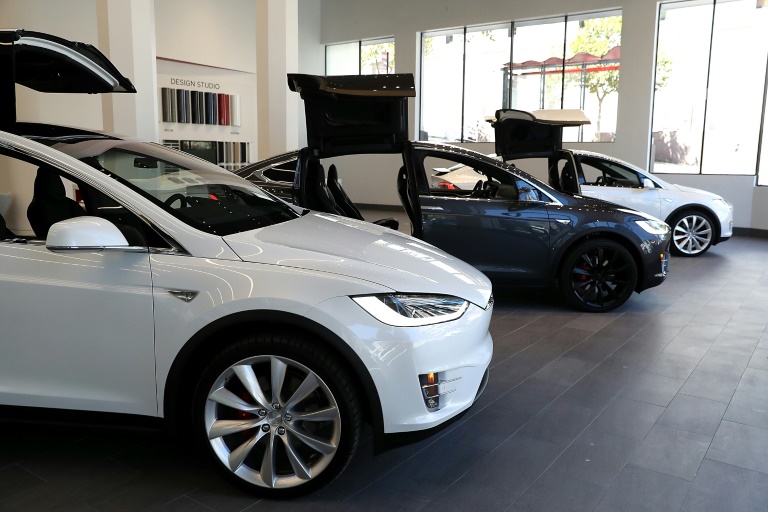
EU leaders meeting in Brussels on Thursday will focus on a trade dispute with key ally the United States that threatens to trigger a subsidy race between the economic superpowers.

European Commission chief Ursula von der Leyen sent a letter ahead of the summit urging leaders to back a plan to compete with billions of dollars in new US subsidies and tax cuts for car makers.

Brussels views the “Buy American” condition for purchasers of electric vehicles mainly made in the United States as discriminatory against European car manufacturers.

It is also concerned Washington’s plan will drain investment from the EU to the United States and that they violate World Trade Organization (WTO) rules.

But, with US President Joe Biden refusing to change course beyond some promised “tweaks”, the commission is now looking to match the US move by loosening its own state aid rules and boosting public investment in cleaner energy.

Von der Leyen said the e-vehicle subsidies contained in a broader US Inflation Reduction Act (IRA) “risk un-levelling the playing field and discriminating against European companies”.

The EU emphasises its close cooperation with the United States — especially on supporting Ukraine and fighting climate change. 

But it is worried Washington is working up a trade advantage over it while it was going through an energy crunch, economic headwinds and was still recovering from the coronavirus pandemic.

– Against a ‘trade war’ –

German Chancellor Olaf Scholz, whose country is the EU’s main car exporter, said Wednesday that Europe was united in the dispute, but should solve it through talks “rather than a big conflict”.

Commission Vice President Margrethe Vestager told the European Parliament the US move was “counter-productive in terms of climate and sustainability… it’s also a violation of international trade rules”.

She added: “We already have war in Europe. The last thing we need is a trade war on top.”

Von der Leyen’s spokeswoman sought to calm the rhetoric, insisting the commission was avoiding any mention of “a subsidy race, or on anything linked to a trade war”.

She and other officials emphasised that talks were continuing with the US administration on the issue through a special task force, and preferred that route before resorting to the WTO.

The EU summit was to also examine the situation, and consequences in Europe, of Russia’s war in Ukraine, which European Council President Charles Michel said was at “the heart of our concerns”.

The gathering was set to be less fractious than initially feared, after EU member Hungary this week dropped its veto of 18 billion euros ($19 billion) in financial aid to cash-strapped Kyiv.

In exchange, the bloc’s other countries agreed to reduce the amount of EU funds frozen because of Hungary’s democratic backsliding to 6.3 billion euros, from 7.5 billion euros initially recommended by the commission. 

Another 5.8 billion euros from a post-Covid recovery fund was conditionally approved for disbursement next year — if Budapest showed progress in restoring EU rule of law.

EU meets facing subsidy race with US in trade spat

EU leaders meeting in Brussels on Thursday will focus on a trade dispute with key ally the United States that threatens to trigger a subsidy race between the economic superpowers.

European Commission chief Ursula von der Leyen sent a letter ahead of the summit urging leaders to back a plan to compete with billions of dollars in new US subsidies and tax cuts for car makers.

Brussels views the “Buy American” condition for purchasers of electric vehicles mainly made in the United States as discriminatory against European car manufacturers.

It is also concerned Washington’s plan will drain investment from the EU to the United States and that they violate World Trade Organization (WTO) rules.

But, with US President Joe Biden refusing to change course beyond some promised “tweaks”, the commission is now looking to match the US move by loosening its own state aid rules and boosting public investment in cleaner energy.

Von der Leyen said the e-vehicle subsidies contained in a broader US Inflation Reduction Act (IRA) “risk un-levelling the playing field and discriminating against European companies”.

The EU emphasises its close cooperation with the United States — especially on supporting Ukraine and fighting climate change. 

But it is worried Washington is working up a trade advantage over it while it was going through an energy crunch, economic headwinds and was still recovering from the coronavirus pandemic.

– Against a ‘trade war’ –

German Chancellor Olaf Scholz, whose country is the EU’s main car exporter, said Wednesday that Europe was united in the dispute, but should solve it through talks “rather than a big conflict”.

Commission Vice President Margrethe Vestager told the European Parliament the US move was “counter-productive in terms of climate and sustainability… it’s also a violation of international trade rules”.

She added: “We already have war in Europe. The last thing we need is a trade war on top.”

Von der Leyen’s spokeswoman sought to calm the rhetoric, insisting the commission was avoiding any mention of “a subsidy race, or on anything linked to a trade war”.

She and other officials emphasised that talks were continuing with the US administration on the issue through a special task force, and preferred that route before resorting to the WTO.

The EU summit was to also examine the situation, and consequences in Europe, of Russia’s war in Ukraine, which European Council President Charles Michel said was at “the heart of our concerns”.

The gathering was set to be less fractious than initially feared, after EU member Hungary this week dropped its veto of 18 billion euros ($19 billion) in financial aid to cash-strapped Kyiv.

In exchange, the bloc’s other countries agreed to reduce the amount of EU funds frozen because of Hungary’s democratic backsliding to 6.3 billion euros, from 7.5 billion euros initially recommended by the commission. 

Another 5.8 billion euros from a post-Covid recovery fund was conditionally approved for disbursement next year — if Budapest showed progress in restoring EU rule of law.

ECB tipped to follow Fed with smaller rate hike

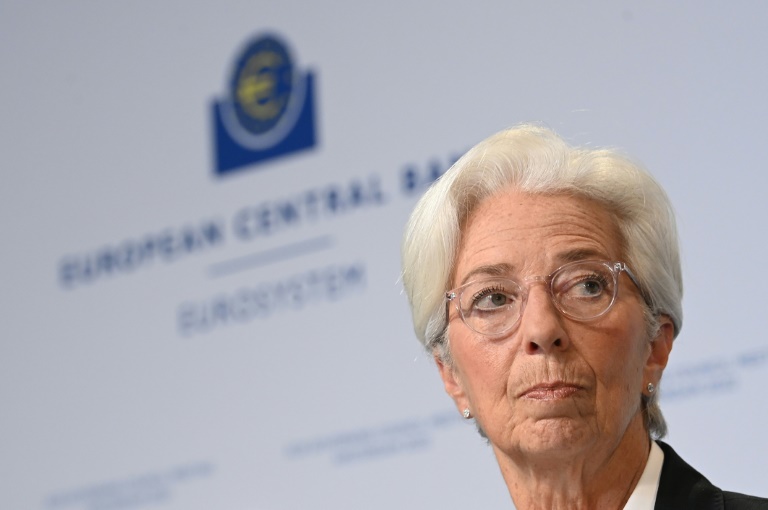
The European Central Bank is expected to follow the US Federal Reserve’s lead on Thursday and opt for a smaller interest rate hike, analysts said, on signs that red-hot inflation is finally easing.

The ECB has been hiking rates at what president Christine Lagarde has called “the fastest pace ever” to bring down record-high inflation after Russia’s war in Ukraine sent food and energy costs soaring.

But following two straight increases of 75 basis points, policymakers in Frankfurt are tipped to downshift to a 50 basis-point rate hike in their final meeting of 2022.

Analysts say policymakers may point to the latest inflation data to justify a slower pace, which showed eurozone consumer prices unexpectedly decelerating in November for the first time in 17 months, to 10 percent.

The early Christmas present could “take away some of the urgency to continue with jumbo rate hikes”, said ING bank economist Carsten Brzeski, even if a 75-basis-point hike is “still on the table”.

The ECB’s chief economist Philip Lane hinted at a slightly less aggressive pace last week when he said it was “likely we are close to peak inflation”. 

And although more rate increases would be needed to return inflation to the bank’s two-percent target, Lane said “a lot has been done already”.

A half-point move would mirror the action taken by the US Federal Reserve on Wednesday, after four previous 75-point hikes.

In a key week for central bankers, Ipek Ozkardeskaya, senior analyst at Swissquote Bank, predicted “a deluge of 50 basis-point hikes”, with the Bank of England likely opting for its own half-point rise on Thursday.

The BoE had in early November announced its biggest hike in 33 years to fight sky-high inflation that it warned was pushing Britain into a recession that could last until mid-2024.

– Recession fears –

Central bankers around the world are walking a fine line between raising borrowing costs to cool inflation, without dampening demand so much it triggers an economic downturn.

The ECB’s three main interest rates are currently sitting in a range of between 1.5 and 2.25 percent.

The bank’s next rate move will be guided by the latest economic forecasts, to be released on Thursday, including its first-ever inflation estimate for 2025.

The new forecasts are also expected to show the eurozone economy contracting in the final quarter of 2022 and first quarter of 2023 — meeting the technical definition of a recession.

But analysts say the winter recession could be a mild one, in part thanks to European governments unleashing massive support packages to steer households and businesses through the energy crisis.

Berenberg Bank economist Holger Schmieding urged the ECB not to “overdo its response to inflation”, warning that further aggressive rate hikes could make the recession “even more painful”.

ECB policymakers will also be taking a close look at wage growth in weighing their next steps, although analysts say the dreaded “wage-price spiral” has not yet materialised in the eurozone.

Lagarde however may face questions at her afternoon press conference on the ECB’s own rumbling pay dispute, after staff voiced unhappiness over a proposed below-inflation salary increase in January.

– Excess liquidity –

In line with its monetary policy tightening, the ECB will on Thursday shed more light on plans to slim down the bank’s massive balance sheet.

It has already toughened the terms of an ultra-cheap bank loan scheme, aimed at keeping credit flowing during the pandemic, in a bid to incentivise early repayment of so-called TLTRO loans.

The move appears to be paying off, with eurozone lenders handing back around 750 billion euros ($790 billion) in TLTRO cash since October.

Analysts are also eager to hear how and when the ECB plans to start shrinking its five-trillion-euro bond portfolio, after years of hoovering up government and corporate debt.

The ECB has already indicated that the process of “quantitative tightening” — letting the bonds mature or actively selling them — would be gradual and predictable to avoid spooking financial markets.

Asian markets sink with Wall St on hawkish Fed outlook

Asian equities fell Thursday after the Federal Reserve signalled US interest rates would go higher than expected and warned the world’s biggest economy would grow less than expected next year, fanning fears a recession is on the way.

Traders took their lead from Wall Street, where a more hawkish statement than expected dented hopes the central bank could soften its approach to fighting inflation.

Markets had rallied after data on Tuesday showed the consumer price index rose less than forecast in November, marking a fifth straight slowdown and the lowest level since December last year.

But the Fed appeared less inclined to accept that the recent figures were enough to indicate enough progress was being made.

While it lifted rates by the expected 50 basis points — down from the previous four 75-point hikes — its “dot plot” of forecasts suggested it saw them top out next year at 5.1 percent, higher than markets had predicted.

“Fifty basis points is still a historically large increase, and we still have some ways to go,” Fed boss Jerome Powell told reporters after the announcement.

He added that he “wouldn’t see us considering” any cuts until officials were happy that inflation was on track to its two percent target.

“It will take substantially more evidence to give confidence that inflation is on a sustained downward path,” he said.

The Fed also cut its expectations for growth next year as it faced headwinds from the tighter monetary policies, stirring fresh warnings of a recession, which have weighed on equities for much of the year.

But Powell said: “I don’t think anyone knows whether we’re going to have a recession or not, and if we do, whether it’s going to be a deep one or not.”

– ‘Worried about a recession’ –

After Wall Street’s retreat, Asia fell into the red, with Hong Kong, Shanghai, Tokyo, Sydney, Seoul, Taipei, Manila and Jakarta all down.

“The Fed did not welcome the disinflation trends that have just started to emerge and focused on robust job gains and elevated inflation,” said OANDA’s Edward Moya.

“Any hopes of a soft landing disappeared as the Fed seems like they are committed to taking rates much higher.”

Despite the tougher talk from the Fed, Tomo Kinoshita at Invesco Asset Management said: “US shares have seen limited falls, indicating that financial markets are not wholeheartedly believing in that hawkishness, perhaps because some Fed policymakers have talked about the possibility of rate cuts already.”

But he added: “Long-term bond yields appeared to have peaked out, which is a sign investors are now worried about a recession.”

The likelihood of rates going even higher outweighed hopes about China’s emergence from nearly three years of strict zero-Covid containment measures that have crippled its economy.

While the reopening is expected to provide a much-needed boost to growth, there is an immediate worry about the impact of soaring infection numbers on the healthcare system and firms’ ability to function.

And in a sign of the effect of the anti-Covid strategy, data on Thursday showed retail sales fell more than expected in November, industrial output growth slowed and investment weakened.

And analysts warned there would not likely be any improvement this month.

– Key figures around 0300 GMT –

Tokyo – Nikkei 225: DOWN 0.3 percent at 28,081.55 (break)

Hong Kong – Hang Seng Index: DOWN 1.9 percent at 19,309.24

Shanghai – Composite: DOWN 0.3 percent at 3,166.04

Euro/dollar: DOWN at $1.0655 from $1.0684 on Wednesday

Dollar/yen: UP at 135.57 yen from 135.45 yen

Pound/dollar: DOWN at $1.2392 from $1.2424

Euro/pound: UP at 85.98 pence from 85.96 pence

West Texas Intermediate: DOWN 0.8 percent at $76.66 per barrel

Brent North Sea crude: DOWN 0.7 percent at $82.17 per barrel

New York – Dow: DOWN 0.4 percent at 33,966.35 (close)

London – FTSE 100: DOWN 0.1 percent at 7,495.93 (close)

Biden seeks principled Africa partnership as US businesses pour in

President Joe Biden called Wednesday for a long-term partnership with Africa rooted in good governance as US businesses unveiled billions of dollars led by tech investment for a continent where China has become a top player.

Addressing a summit that brought 49 African leaders to the Washington cold, Biden avoided uttering China’s name but made clear the United States would take a different approach.

At the first such gathering since Barack Obama invited African leaders in 2014, Biden said the United States sought “partnerships — not to create political obligation, to foster dependence, but to spur shared success and opportunity.”

“When Africa succeeds, the United States succeeds. Quite frankly, the whole world succeeds as well,” the president said.

The Biden administration is laying out more than $55 billion in support over the three-day summit and on Wednesday welcomed US and African businesses, which promised more than $15 billion in trade deals.

In an implicit contrast with China, which takes a hands-off approach in countries where it invests, Biden highlighted “the core values that unite our people — all our people, especially young people: freedom, opportunity, transparency, good governance.”

Africa’s economic transition, he said, “depends on good government, healthy populations and reliable and affordable energy.”

Biden stayed uncharacteristically brief, saying leaders likely wanted to see the World Cup, and watched a semi-final with the prime minister of Morocco, the first African nation to advance so far in the football tournament.

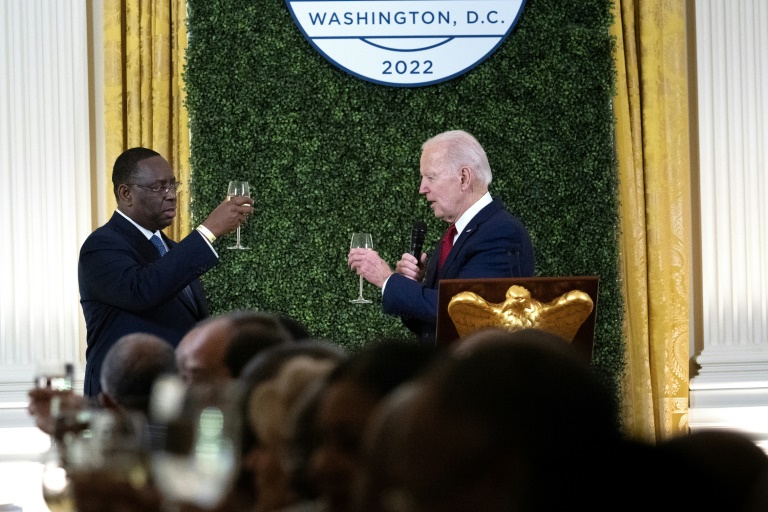
Biden later invited the leaders to the White House to a dinner of sea bass and black-eyed peas and a performance by Gladys Knight.

In a toast, Biden spoke of the “unimaginable cruelty” of “my nation’s original sin” — the enslavement of Africans — and hailed the contributions of the diaspora.

“Our people lie at the heart of the deep and profound connection that forever binds Africa and the United States together,” Biden said.

– Pushing tech investment –

China in the past decade has surpassed the United States on investing in Africa via highly visible infrastructure projects, often funded through loans that have totaled more than $120 billion since the start of the century.

Defense Secretary Lloyd Austin on Tuesday warned African leaders that both China and Russia were “destabilizing” the continent, saying Beijing’s mega-contracts lacked transparency.

Biden announced a $100 million aid package for clean energy and the White House unveiled another $800 million in public and private financing for digital development in Africa.

In one of the biggest corporate announcements, Visa said it would pump $1 billion into Africa to develop digital payments — an area in which China has emerged as a global leader.

Cisco and partner Cybastion said they would commit $858 million to bolster cybersecurity through 10 contracts across Africa, addressing a key vulnerability, and the ADB Group promised $500 million starting in Ivory Coast for cloud technology centers that can draw major US firms.

Microsoft said it would employ satellites to bring internet access for the first time to some 10 million people, half of them in Africa, starting in Egypt, Senegal and Angola.

In Africa, “there is no shortage of talent, but there is a huge shortage of opportunity,” Microsoft president Brad Smith told AFP.

– Putting standards on aid –

China denies US accusations it is imposing a “debt trap” in Africa and in turn has accused Washington of turning the continent into a geopolitical battlefield.

The United States has made much of its infrastructure aid conditional on democratic standards.

Biden announced that four nations — Gambia, Mauritania, Senegal and Togo — were selected to design future US grants through the Millennium Challenge Corporation, which funds projects in countries that meet key standards on good governance.

Secretary of State Antony Blinken took part in the signing of a $504 million infrastructure package through the corporation that will connect Benin’s port of Cotonou with landlocked Niger’s capital Niamey, with US officials estimating 1.6 million people will benefit.

“For a long time we’ve considered this to be our natural port,” Niger’s President Mohamed Bazoum said, as he promised “institutional reforms” to support trade.

Benin’s President Patrice Talon thanked the United States for addressing development, saying: “The attractiveness of Africa must be a part of the relationship with the US.”

Blinken said the deal will not “saddle governments with debt.”

“Projects will bear the hallmarks of America’s partnership,” Blinken said. “They’ll be transparent. They’ll be high quality. They’ll be accountable to the people that they mean to serve.”

Mississippi executes former Marine for 2000 rape and murder

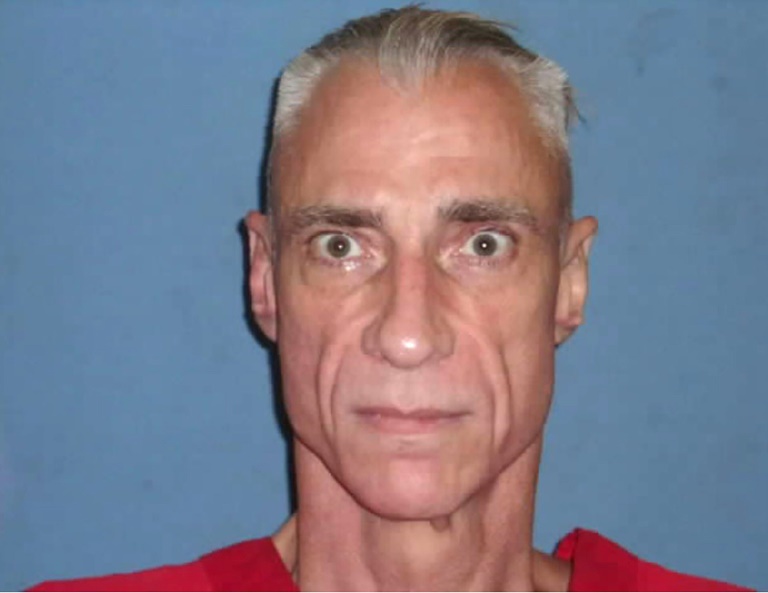
A former US Marine who confessed to raping and murdering a 16-year-old girl was executed Wednesday in the southern US state of Mississippi.

Thomas Edwin Loden, 58, was pronounced dead at 6:12 pm (0012 GMT) after he was administered a lethal injection at the Mississippi State Penitentiary in Parchman, the Mississippi Department of Corrections said in a statement.

Loden pleaded guilty to the June 2000 kidnapping of Leesa Gray, who had been stranded on the side of a rural road after her car had a flat tire.

Loden, a gunnery sergeant and recruiter for the US Marine Corps, confessed to repeatedly raping Gray in his van before suffocating and strangling her.

He was discovered the next day lying by the side of the road with the words “I’m sorry” which he had carved into his chest, according to court records.

Loden was sentenced to death in 2001. He is the first person executed in Mississippi this year and the second since 2013.

It was the 18th execution in the United States this year.

About half of the 50 US states allow capital punishment but before Wednesday had only been used in five states so far in 2022 — Alabama, Arizona, Missouri, Oklahoma and Texas. Loden’s execution makes Mississippi the sixth.

On Tuesday, Kate Brown, the governor of Oregon, commuted the sentences of the 17 inmates on Death Row in the northwestern state to life in prison.

Several hundred tourists stranded at Machu Picchu amid protests

Hundreds of foreign tourists were stranded Wednesday in Peru’s renowned Machu Picchu region after train service was suspended due to violent protests following the ouster and arrest of ex-president Pedro Castillo.

A state of emergency was declared earlier Wednesday as Castillo’s supporters have taken to the streets and set up roadblocks countrywide in protests against new President Dina Boluarte that have left seven people dead and 200 injured. 

Officials said nearly 800 tourists of varying nationalities had become stranded since Tuesday. 

They were stuck in the town at the base of the mountain where Machu Picchu, the most important attraction in Peruvian tourism and a UNESCO World Heritage site, is located.

Israeli tourist Gale Dut was unable to return to Cusco to catch a flight out of the country.

“I’m with my kids. For me, it’s a problem,” Dut told AFP. 

One Belgian tourist, who identified himself as Walter, said it is “not clear” how he will be able to return home if he is not able to get back to Cusco in order to catch a flight to Lima.

The train service that connects the famed Incan temple with Cusco, the ancient empire’s capital city, is the only way to get to Machu Picchu, about 70 miles (110 kilometers) away. 

Trains were suspended Tuesday as Indigenous and agrarian organizations called for an indefinite strike as part of the protests that began Monday in Cusco, with marches, attacks on public spaces and attempts to take over the city’s international airport. 

The small town’s mayor Darwin Baca called for humanitarian help from the government, seeking helicopters to help evacuate tourists from the United States, Mexico and Spain. 

The country plunged into crisis last week when Castillo tried to dissolve Congress and rule by decree, but was quickly impeached by lawmakers and arrested.

The new president, Boluarte, has struggled to quell tensions, and has now called for the next election — normally due in 2026 — to be brought forward to December 2023, after an earlier bid to hold them in 2024 failed to halt the protests.

Close Bitnami banner
Bitnami