World

Biden slams Trump 'extremist' assault on democracy

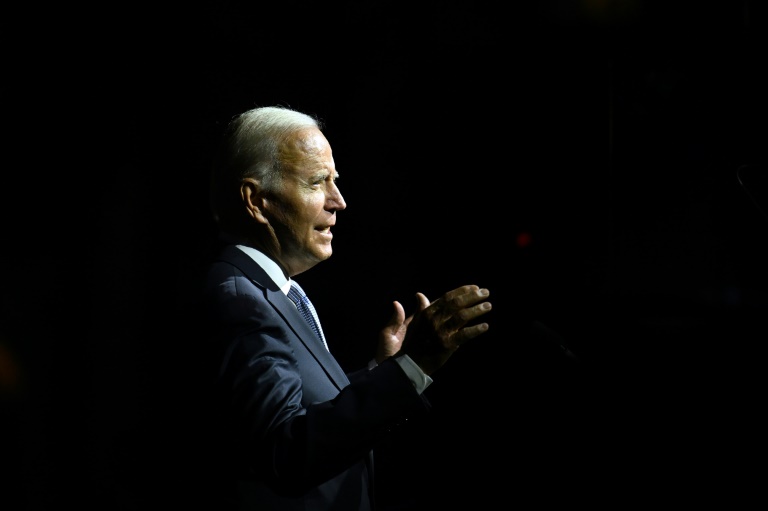
US President Joe Biden took fierce aim Thursday at Donald Trump and his “extremist” supporters, labeling them enemies of American democracy in a prime-time address that sought to fire up voters ahead of key midterm elections.

Speaking in Philadelphia, the cradle of US democracy, the president launched an extraordinary assault on those Republicans who embrace Trump’s “Make America Great Again” ideology — and urged his own supporters to fight back.

“Donald Trump and the MAGA Republicans represent an extremism that threatens the very foundations of our republic,” thundered Biden, speaking near the spot where the Declaration of Independence and the US Constitution were adopted more than two centuries ago.

“They embrace anger. They thrive on chaos. They live not in the light of truth but in the shadow of lies.” 

“There is no place for political violence in America. Period. None. Ever,” warned the 79-year-old Democrat — in a reference to last year’s assault on the US Capitol by hardline Trump supporters refusing to accept his defeat.

Citing the nationwide assault on abortion rights by hardline conservatives — and fears for other freedoms from contraception to same-sex marriage — the US leader charged that “MAGA forces” were “determined to take this country backwards.” 

With control of Congress in the balance come November, Biden appealed directly to mainstream Republicans to join forces with Democrats and repudiate Trump’s brand of politics — which still holds sway over much of his party.

And he made it clearer than ever that Democrats intended to make the midterms a referendum on Trump, saying the Republican Party was wholly “dominated, driven and intimidated” by the former president and his MAGA agenda.

“And that is a threat to this country,” he said, insisting American democracy had to be defended. 

“Protect it. Stand up for it,” Biden urged.

– ‘Semi-fascism’ –

Biden’s speech — billed as an address on the “battle for the Soul of the Nation” — harked back to an article he published in The Atlantic magazine in 2017, after a deadly white nationalist rally in Charlottesville, Virginia that he says spurred his presidential run. 

“We are living through a battle for the soul of this nation,” Biden wrote then.

After his election in 2020, the veteran politician initially planned to wage this battle through dialogue with moderate Republican lawmakers, and through economic and social policies aimed at the middle class.

But the talk of reconciliation has died down, as polls seem to indicate the Democratic leader is better served by being more aggressive.

Last week, Biden accused Trump’s supporters of being consumed by “semi-fascism.”

The term sparked indignation in conservative ranks — with Republican Senate Minority Leader Kevin McCarthy charging that it “vilifies” millions of “hardworking, law-abiding citizens.

“With all due respect Mr President, there’s nothing wrong with America’s soul,” retorted Republican senator and longtime Trump loyalist Lindsey Graham after Biden’s speech. “The American people are hurting because of your policies.”

A new poll published Thursday by The Wall Street Journal shows that if the midterm elections were held today, 47 percent of eligible voters would cast ballots for Democrats, and 44 percent would vote Republican. 

In March, the Republicans had a five-point advantage.

The Democrats are hoping for an upset in November’s elections, in which all of the seats in the House of Representatives and a third of the Senate seats are on the ballot. Traditionally, the midterms don’t favor the ruling party.

Things have been going well for Biden lately, however, with inflation slowing, a series of his landmark reforms finally pushed through Congress and Trump fighting off a series of criminal investigations. Polls show widespread support for abortion rights, which could put many Republicans on the back foot.

This would be enough to give hope to the Democrats, who are battling to keep their hold on the House and preserve their Senate majority — or even strengthen it.

And Pennsylvania will be crucial for any of that to happen.

Historically a key battleground state in US politics, the Keystone State will likely prove vital to both parties in the midterms — and Biden will visit three times this week alone.

Trump is also planning an appearance in the state on Saturday to support his candidate in the Senate race, TV physician Mehmet Oz.


Ukraine schools return to sound of war

Antonina Sidorenko has put on her favourite clothes, selected the prettiest ribbon to adorn her hair and can recite by heart the poem given by her schoolteacher.

But with lessons taking place at home to the background sound of gunfire and shelling, this is no ordinary first day back at school for the nine-year-old Ukrainian.

Sitting behind a desk in the middle of her sitting room, “Tonia” adjusts the mobile phone screen showing her teacher Natalia Vasylivna, best friend Igor and other classmates she has not seen since Russia’s February invasion.

“I’m happy to be back at school but I would be even happier if there was no war because I miss my teacher and my friends,” she told AFP, saying her best friend had fled to Poland. 

Antonina, five-year-old sister Sonia and parents Natalia and Andriy live in Pokrovske, a hamlet of 24 people in the southern region of Mykolaiv near the frontline.

Remote learning is in place across the region due to the fighting. 

For Natalia and Andriy, that posed significant technical challenges, and they only managed to configure the Zoom app on their mobile phone a few days before September 1, when schools returned nationwide.

They also made sure the internet router was working. After their electricity was cut off in the summer, the family gets its power from a solar panel supplied by an NGO.

But there’s little they can do against cannons. The boom of Ukrainian artillery fire reverberates at regular intervals, followed by the Russian reply. Two days previously, their kitchen windows were smashed by shrapnel.

– ‘I’m not scared’ –

Antonina, a young girl with bright blond plaits, has already stopped flinching when the sounds of war echo in the distance. 

“At the start, when there was shelling near the house, I used to hide and lie on the floor. But now, when it’s far away, I’m used to it and I’m not scared,” she said.

While her teacher attempts to get to grips with Zoom, Antonia shows off the room she shares with Sonia. 

“Now we sleep on the floor, that way we won’t be killed by the shrapnel,” she said.

In the courtyard, she feeds the rabbits, her favourite animals. The rabbits, a pig and two cows are the reason why the family is staying put despite the danger.

The pig owes its survival to the irregular electricity supply, which makes the preservation of any choice cutlets impossible, Natalia explained.

“What would we do in town? Where would we stay, how would we live?” asked Andriy, showing the damage left by the last strike as another explosive sound is heard behind him. 

“Did you hear that? It never ends!”

– ‘Like a soldier’ –

Andriy said selling all his possessions would earn him 15,000 hryvnias ($406), whereas a house costs at least 100,000 hryvnias even in the nearest village, Novooleksandrivka.

When the bombardment is too intense, the family escapes by car for a while before calm returns to their neighbourhood.

“You need to be like a soldier: stay together, be ready, have everything packed, be quick, don’t hesitate, listen to your parents, pack your bags and go,” said Natalia.

The 33-year-old treasures her daughter and is proud of her good results and artistic talent, which she says Tonia inherited from her father.

But behind the calm exterior, Natalia admits she worries a lot for her children despite her best efforts not to panic.

She refuses to leave, saying she worked hard to build the house and save money for her daughters’ future.

The mother thinks the return to school will soon fail. Tonia’s teacher has still not managed to configure Zoom, but her young pupil makes use of the delay to chat with long-term friend Igor.

Tonia insists on reciting the poem she has learned by heart.

“Peace will come to Ukraine. Good people want peace. Adults as well as children aspire to peace on Earth.”

England's drought-hit summer 2022 joint hottest on record

England had its joint hottest summer on record this year, tied with 2018, the country’s meteorological agency said Thursday as it unveiled provisional mean temperature statistics for the three-month period.

The announcement comes with most of England and Wales gripped by drought after exceptionally high temperatures and several heatwaves alongside minimal rainfall, mirroring conditions seen across northwest Europe.

England also smashed its all-time temperature record in July, when the mercury topped 40 degrees Celsius (104 degrees Fahrenheit) for the first time ever, while July was the driest on record across the south.

“It is too early to speculate on how the year overall will finish, but the persistent warm conditions are certainly notable and have certainly been made more likely by climate change,” Mark McCarthy of the National Climate Information Centre said.

“For many this summer’s record-breaking heat in July… will be the season’s most memorable aspect,” he added in a statement.

“However, for England to achieve its joint warmest summer takes more than extreme heat over a couple of days, so we shouldn’t forget that we experienced some persistently warm and hot spells through June and August too.”

Detailing the seasonal period starting in June, the Met Office — whose records date back to 1884 — confirmed England’s mean temperature of 17.1 degree Celsius was the joint warmest ever, equalling the summer of four years ago.

The hottest and driest areas relative to average were in the east, with East Anglia and parts of northeast England seeing their warmest summer on record. 

– ‘Human-induced climate change’ –

Across the entire UK — which also includes Scotland, Wales and Northern Ireland — it was provisionally the fourth warmest summer. 

The top British summers, all in the last two decades, were all very close in temperature, with the two hottest ever averaging 15.8 degrees and the two second hottest 15.7 degrees.

“This means that four of the five warmest summers on record for England have occurred since 2003, as the effects of human-induced climate change are felt on England’s summer temperatures,” the Met Office noted.

This year’s parched conditions have had an impact across England, notably with the source of the River Thames drying up and shifting several miles downstream.

Satellite imagery has shown the nation’s traditionally green and lush countryside turning to various shades of yellow and brown, as huge swathes of southern, central and eastern England dried out.

Some water companies have imposed restrictions on water use, including hosepipe bans, with the lack of rainfall and punishing heat depleting rivers, reservoirs and groundwater levels.

Thames Water, which supplies 15 million people in London and some surrounding areas, introduced a hosepipe ban in its area from August 24 in the first such restriction in the British capital in a decade.

Severe heatwaves — made hotter and more frequent by climate change — are already being felt beyond Britain and across the world, threatening human health, wildlife and crop yields. 

Outside western Europe, which has seen devastating wildfires this summer, half of China has been crippled by drought as some regions experience the longest continuous period of high temperatures since records began there more than 60 years ago.

Brazilian Amazon records worst August for fires in 12 years

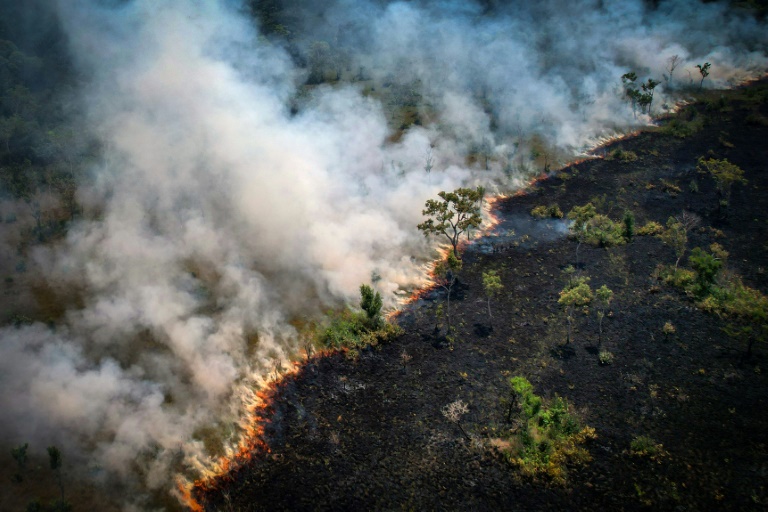
The Brazilian Amazon recorded its worst month of August for forest fires since 2010, with an 18 percent rise from a year ago, according to official data released Thursday.

The Brazilian INPE space agency said its satellites had recorded 33,116 fires in the rainforest, a key buffer against global warming, in August this year, compared to 28,060 in the same month last year.

At least 3,358 fires were recorded on August 22 alone, the highest number for any 24-hour period since September 2007, it said.

The number was nearly triple that recorded on the so-called “Day of Fire” — August 10, 2019 — when farmers launched a coordinated plan to burn huge amounts of felled rainforest in the northern state of Para.

Then, fires sent thick, gray smoke all the way to Sao Paulo, some 2,500 kilometers (1,500 miles) away, and triggered a global outcry over one of Earth’s most vital resources burning.

Between January and August, the INPE recorded 46,022 fires — a 16 percent rise from the same period in 2021.

The Amazon had not burnt more in a month of August — usually the worst for fires in the Brazilian dry season — since 2010, when 45,018 were recorded.

All the worst August figures since then — 30,900 fires in 2019, 29,307 in 2020, 28,060 in 2021 and 33,116 in 2022 — happened during the four-year term of far-right President Jair Bolsonaro, who will be seeking re-election next month.

“This uncontrolled increase in fires in the last four years is closely related to the increase in deforestation,” said Mariana Napolitano of WWF Brazil.  

“The Amazon is a humid rainforest and, contrary to what happens in other biomes, fire does not arise spontaneously. Fires are always linked to human action,” she added.

According to experts, fires are mainly caused by farmers who illegally clear land by burning vegetation. 

Deforestation in Brazil is also at an historic high: in the first half of 2022 some 3,988 km2 were lost, a record since INPE’s Deter satellite monitoring system began collecting data in 2016.

Bolsonaro, an agribusiness ally, faces international criticism for a surge in Amazon destruction on his watch.

But he rejects the censure.

“None of those who are attacking us have the right. If they wanted a pretty forest to call their own, they should have preserved the ones in their countries,” he wrote on Twitter last month.

“The Amazon belongs to Brazilians, and always will,” said Bolsonaro.

Brazilian Amazon records worst August for fires in 12 years

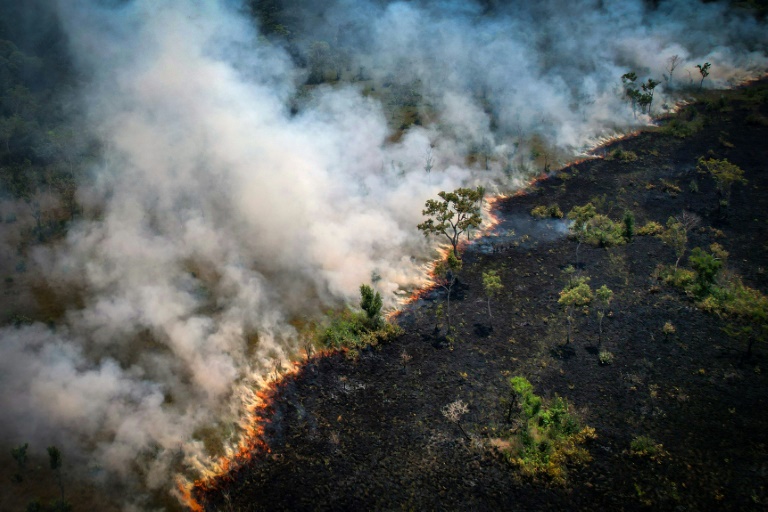
The Brazilian Amazon recorded its worst month of August for forest fires since 2010, with an 18 percent rise from a year ago, according to official data released Thursday.

The Brazilian INPE space agency said its satellites had recorded 33,116 fires in the rainforest, a key buffer against global warming, in August this year, compared to 28,060 in the same month last year.

At least 3,358 fires were recorded on August 22 alone, the highest number for any 24-hour period since September 2007, it said.

The number was nearly triple that recorded on the so-called “Day of Fire” — August 10, 2019 — when farmers launched a coordinated plan to burn huge amounts of felled rainforest in the northern state of Para.

Then, fires sent thick, gray smoke all the way to Sao Paulo, some 2,500 kilometers (1,500 miles) away, and triggered a global outcry over one of Earth’s most vital resources burning.

Between January and August, the INPE recorded 46,022 fires — a 16 percent rise from the same period in 2021.

The Amazon had not burnt more in a month of August — usually the worst for fires in the Brazilian dry season — since 2010, when 45,018 were recorded.

All the worst August figures since then — 30,900 fires in 2019, 29,307 in 2020, 28,060 in 2021 and 33,116 in 2022 — happened during the four-year term of far-right President Jair Bolsonaro, who will be seeking re-election next month.

“This uncontrolled increase in fires in the last four years is closely related to the increase in deforestation,” said Mariana Napolitano of WWF Brazil.  

“The Amazon is a humid rainforest and, contrary to what happens in other biomes, fire does not arise spontaneously. Fires are always linked to human action,” she added.

According to experts, fires are mainly caused by farmers who illegally clear land by burning vegetation. 

Deforestation in Brazil is also at an historic high: in the first half of 2022 some 3,988 km2 were lost, a record since INPE’s Deter satellite monitoring system began collecting data in 2016.

Bolsonaro, an agribusiness ally, faces international criticism for a surge in Amazon destruction on his watch.

But he rejects the censure.

“None of those who are attacking us have the right. If they wanted a pretty forest to call their own, they should have preserved the ones in their countries,” he wrote on Twitter last month.

“The Amazon belongs to Brazilians, and always will,” said Bolsonaro.

Africa's oldest dinosaur found in Zimbabwe

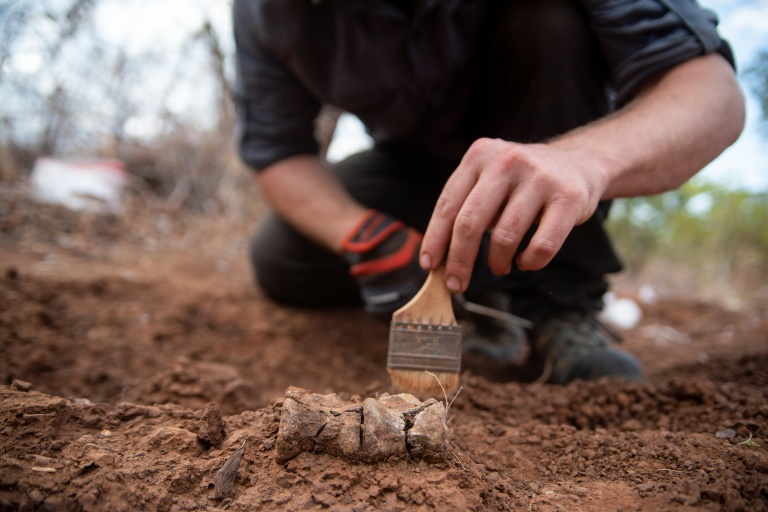
Scientists in Zimbabwe have discovered the remains of Africa’s oldest dinosaur, which roamed the earth around 230 million years ago. 

The dinosaur, named Mbiresaurus raathi, was only about one metre (3.2 feet) tall, with a long tail, and weighed up to 30 kilograms (66 pounds), according to the international team of palaeontologists that made the discovery. 

“It ran around on two legs and had a fairly small head,” Christopher Griffin, the scientist who unearthed the first bone, told AFP on Thursday.

Probably an omnivore that ate plants, small animals and insects, the dinosaur belongs to the sauropodomorph species, the same linage that would later include giant long-necked dinosaurs, said Griffin, a 31-year-old researcher at Yale University.

The skeleton was found during two expeditions in 2017 and 2019 by a team of researchers from Zimbabwe, Zambia, and the United States. 

“I dug out the entire femur and I knew in that moment, that it was a dinosaur and I was holding Africa’s oldest known dinosaur fossil,” said Griffin, who at the time was a PhD candidate at Virginia Tech University.

His team’s findings were first published in journal Nature on Wednesday.

Dinosaurs’ remains from the same era had previously been found only in South America and India. 

The palaeontologists selected the Zimbabwe site for digging after calculating that when all continents were connected in a single land mass known as Pangea, it laid roughly at the same latitude of earlier findings in modern day South America. 

“Mbiresaurus raathi is remarkably similar to some dinosaurs of the same age found in Brazil and Argentina, reinforcing that South America and Africa were part of continuous landmass during the Late Triassic,” said Max Langer of the University of Sao Paulo in Brazil. 

The dinosaur is named after the Mbire district, northeast of Zimbabwe, where the skeleton was found, and palaeontologist Michael Raath, who first reported fossils in this region.

“What this (discovery) does is it broadens the range that we knew the very first dinosaurs lived in,” Griffin said.

Other specimens were discovered in the area, and all are reposited in the Natural History Museum of Zimbabwe, in the second largest city, Bulawayo. 

“The discovery of the Mbiresaurus is an exciting and special find for Zimbabwe and the entire palaeontological field,” said museum curator Michel Zondo.

“The fact that the Mbiresaurus skeleton is almost complete, makes it a perfect reference material for further finds.”

Three dead of mystery pneumonia in Argentina, six others ill

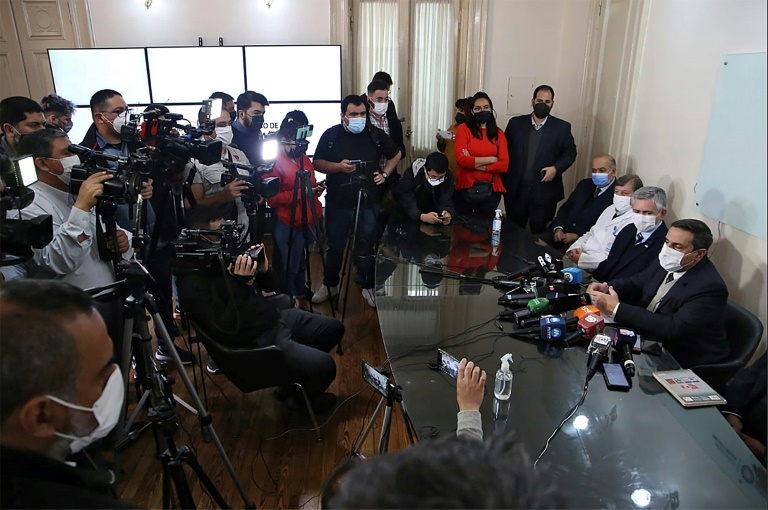
A third person has died this week in Argentina from a type of pneumonia of unknown origin, with the fatalities thus far limited to a single clinic, health authorities said Thursday.

Nine people in northwestern Tucuman province have come down with a mysterious respiratory illness, including eight medical staff at the private clinic, Tucuman health minister Luis Medina Ruiz told reporters.

Three — two health personnel and now also a patient at the clinic — have died since Monday.

Authorities are conducting tests but Medina said they have already ruled out Covid-19, flu, influenza types A and B, the legionella bacterial disease and the hantavirus spread by rodents.

Samples have been sent to the Malbran Institute in Buenos Aires.

The latest victim was a 70-year-old woman who had been admitted to the clinic for surgery.

Medina said the woman could have been “patient zero, but that is being evaluated.”

The mystery disease claimed its first victim among health personnel at the clinic on Monday and a second two days later.

The first six patients started exhibiting symptoms between August 18 and 23.

Medina said on Wednesday the patients were struck with “a severe respiratory condition with bilateral pneumonia… very similar to Covid.”

Symptoms included vomiting, a high fever, diarrhea and body aches.

Of the six people receiving treatment, four were in serious condition in hospital and two were in isolation at home.

All other staff at the clinic were being monitored.

Experts were analyzing the water and air conditioners for possible contamination or poisoning.

The provincial health ministry said Wednesday the outbreak could have come from an infectious agent, but investigators were not excluding “toxic or environmental causes.”

Infectious disease specialist Mario Raya said Thursday that “for the moment, we have no cases outside” the stricken clinic.

Added Hector Sale, president of the Tucuman provincial medical college: “we are not dealing with a disease that causes person-to-person transmission” as no cases have been identified among close contacts of any of the patients.

US official rejects Amazon challenge to New York union vote

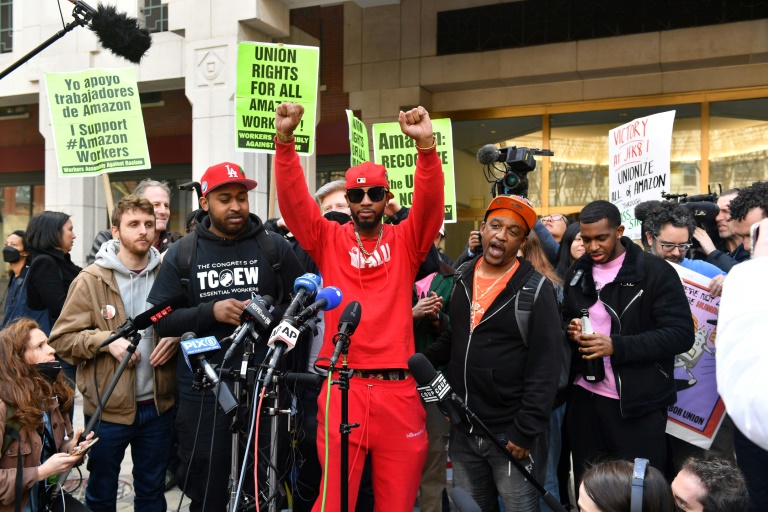
A US official Thursday rejected Amazon’s efforts to overturn a worker vote in favor of unionization at a New York warehouse, dismissing the retailer’s election complaints as groundless.

Lisa Dunn, a hearing officer with the National Labor Relations Board (NLRB), who oversaw a 24-day hearing on Amazon’s complaints earlier this summer, concluded the firm’s objections “should be overruled in their entirety,” according to a statement released by the NLRB’s press office.

“The Employer has not met its burden of establishing that Region 29, the Petitioner, or any third parties have engaged in objectionable conduct affecting the results of the election,” the NLRB said, adding that Amazon should recognize Amazon Labor Union as the bargaining representative for the facility, JFK8.

Amazon has until September 16 to contest Dunn’s conclusion. The NLRB regional director would then decide whether to rerun the election or certify the vote in a determination that could be appealed to the board itself.

Dunn’s decision is the latest development since Amazon Labor Union’s (ALU) shock victory in April in which New York workers voted to establish the first Amazon union in America at a facility in Staten Island, New York.

Amazon criticized the decision and said it intends to appeal.

“As we showed throughout the hearing with dozens of witnesses and hundreds of pages of documents, both the NLRB and the ALU improperly influenced the outcome of the election and we don’t believe it represents what the majority of our team wants,” spokesperson Kelly Nantel said.

Amazon has asserted that union members intimidated workers into voting for the union and that local NLRB staff were biased against the retail colossus.

But the ALU has said these claims are groundless, accusing the company of using delay tactics to put off talks on a on a contract in an attempt to quash the labor movement.

GM driverless car unit recalls vehicles after accident

General Motor’s autonomous vehicle unit Cruise recalled 80 cars and updated their software after one failed to properly predict the trajectory of an oncoming vehicle.

The company, which is the first to have deployed driverless taxis in San Francisco in June, sent a notice this week to the US agency in charge of road safety, the National Highway Traffic Safety Administration (NHTSA).

In filings which came to public attention Thursday, Cruise explains that on June 3 one of its cars was hit from the rear by another vehicle after breaking sharply while making an unprotected left turn.

The self-driving vehicle decided “a hard brake was necessary to avoid a severe front-end collision with an oncoming vehicle,” the document said.

Two people were slightly injured, according to a report submitted to the California Department of Motor Vehicles.

Police determined that the other vehicle was primarily responsible for the incident as it was not in the correct lane and was traveling over the speed limit.

The NHTSA, however, did not fully exonerate Cruise from liability, stating that the software could, “in certain circumstances when making an unprotected left, cause the ADS (automated driving system) to incorrectly predict another vehicle’s path or be insufficiently reactive.”

Cruise has modified the software and says were the vehicle to be in the same situation again, it would act differently to avoid error.

Carmakers, led by Tesla, have been working for several years on development of autonomous driving and driving assistance systems, but progress has been slower than initially hoped.

Waymo, a Cruise rival and subsidiary of Google’s parent company Alphabet, has offered a ride-hailing program in Phoenix, Arizona for several years.

Cruise is the first company to be granted permission to transport passengers for a fee in a larger city.

Starbucks names outgoing Reckitt leader as next CEO

Starbucks named Laxman Narasimhan, a veteran of PepsiCo and other consumer brands, as its next chief executive on Thursday.

Narasimhan, who was most recently chief executive of Anglo-Dutch multinational Reckitt, will relocate to Seattle from London and join Starbucks on October 1, the company said in a news release.

Following a stretch working with longtime Starbucks CEO and interim boss Howard Schultz, Narasimhan will take over the top spot on April 1, 2023.

The transition comes as Starbucks navigates a burgeoning US unionization push following a difficult stretch for workers during Covid-19.

Starbucks has responded to the drive by boosting investments in worker pay and stores as Schultz has undertaken a “listening tour” to hear out employee concerns.

Narasimhan “is uniquely positioned to shape this work and lead the company forward with his partner-centered approach,” Schultz said, calling him “the right leader to take Starbucks into its next chapter.”

Starbucks Workers United organizing member Michelle Eisen called on Narasimhan to end the company’s “scorched earth union-busting campaign and work with all Starbucks partners to make Starbucks a better company and better place to work.”

Neil Saunders, analyst at GlobalData Retail, said the appointment was a “good move” in light of  Narasimhan’s record in overseas markets and experience in retail operations.

“One of Mr Narasimhan’s tasks will be to ensure that Starbucks remains on the front foot. Howard Schultz has already set out some embryonic plans for doing this,” Saunders said. 

“Given that Mr Schultz has been involved in the recruitment process we believe the transition will be relatively seamless as Starbucks moves to its next chapter.”

Reckitt had announced Narasimhan’s departure earlier Thursday, saying he had been motivated to relocate back to the United States for “personal and family reasons.”

Close Bitnami banner
Bitnami