World

NASA readies for Saturday Moon rocket launch attempt

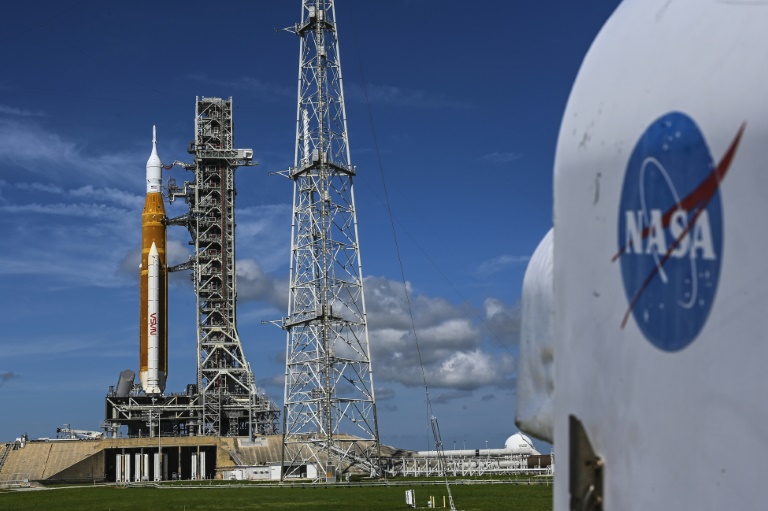
The stars appear to be aligned for NASA’s Moon rocket to finally blast off on Saturday, with weather forecasts favorable and technical issues that postponed the launch earlier this week resolved.

Liftoff is scheduled for 2:17 pm local time (1817 GMT) from Kennedy Space Center in Florida, with the potential for up to a two-hour delay if necessary.

The chance for favorable weather conditions within that window sat at 60 percent Thursday evening. 

“The weather looks good,” and isn’t expected to be a “showstopper,” forecast analyst Melody Lovin said at a press conference.

NASA has also been working to correct the technical difficulties that lead to the last-minute delay of the launch during its originally scheduled window Monday.

At first, it seemed that one of the rocket’s four main engines was too hot, though it turned out just to be a reading from a “bad sensor,” the rocket’s program manager John Honeycutt said Thursday. 

In the future, the incorrect information will simply be ignored. 

Then a fuel tank leak had to be patched. 

“We were able to find what we believe is the source of the leak and correct that,” launch director Charlie Blackwell-Thompson said. 

The Artemis 1 mission is an uncrewed test flight. It will be the first launch for the Space Launch System (SLS) rocket, the most powerful in the world and which has been in development for more than a decade. 

“There’s no guarantee that we’re going to get off on Saturday, but we’re going to try,” Artemis mission manager Mike Sarafin said. 

If the mission goes ahead Saturday, the Orion capsule fixed atop the rocket will spend 37 days in space, orbiting the Moon from about 60 miles (100 kilometers) away. 

It is the Orion that will then take future astronauts back to the Moon — including the first woman and the first person color to walk on its surface — in 2025 at the earliest. 

Artemis is named for the twin sister of the Greek god Apollo, for whom the first Moon missions were named. With the new flagship program, NASA hopes to test technology someday meant for sending humans to Mars.

NASA readies for Saturday Moon rocket launch attempt

The stars appear to be aligned for NASA’s Moon rocket to finally blast off on Saturday, with weather forecasts favorable and technical issues that postponed the launch earlier this week resolved.

Liftoff is scheduled for 2:17 pm local time (1817 GMT) from Kennedy Space Center in Florida, with the potential for up to a two-hour delay if necessary.

The chance for favorable weather conditions within that window sat at 60 percent Thursday evening. 

“The weather looks good,” and isn’t expected to be a “showstopper,” forecast analyst Melody Lovin said at a press conference.

NASA has also been working to correct the technical difficulties that lead to the last-minute delay of the launch during its originally scheduled window Monday.

At first, it seemed that one of the rocket’s four main engines was too hot, though it turned out just to be a reading from a “bad sensor,” the rocket’s program manager John Honeycutt said Thursday. 

In the future, the incorrect information will simply be ignored. 

Then a fuel tank leak had to be patched. 

“We were able to find what we believe is the source of the leak and correct that,” launch director Charlie Blackwell-Thompson said. 

The Artemis 1 mission is an uncrewed test flight. It will be the first launch for the Space Launch System (SLS) rocket, the most powerful in the world and which has been in development for more than a decade. 

“There’s no guarantee that we’re going to get off on Saturday, but we’re going to try,” Artemis mission manager Mike Sarafin said. 

If the mission goes ahead Saturday, the Orion capsule fixed atop the rocket will spend 37 days in space, orbiting the Moon from about 60 miles (100 kilometers) away. 

It is the Orion that will then take future astronauts back to the Moon — including the first woman and the first person color to walk on its surface — in 2025 at the earliest. 

Artemis is named for the twin sister of the Greek god Apollo, for whom the first Moon missions were named. With the new flagship program, NASA hopes to test technology someday meant for sending humans to Mars.

Most Asian markets down as traders focus on US jobs data

Asian markets struggled again Friday and the dollar held gains as rate hike expectations grew, with traders now focusing on a key US jobs report later in the day.

Oil prices rose on fading expectations for an Iran nuclear deal anytime soon, but they remained under severe pressure from a range of issues including the strengthening dollar, Covid lockdowns in China, and worries about a demand-sapping recession.

Healthy readings on US factory activity, unemployment claims and private jobs creation indicated the world’s top economy remained strong despite rising interest rates and four-decade-high inflation.

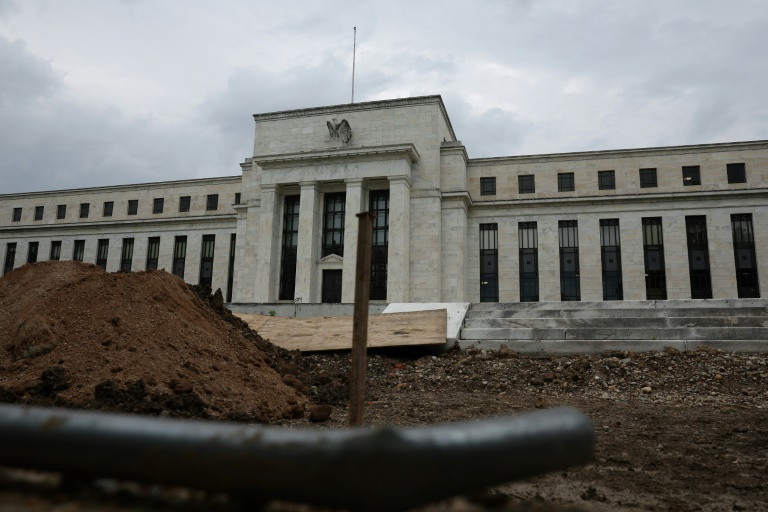
But analysts said the figures were a case of “good news in bad news” as they would give the US Federal Reserve more room to keep tightening monetary policy, with officials lining up to commit to beating inflation even if that causes a recession. 

Bets are increasing on a third successive 75-basis-point increase at its September meeting. 

OANDA’s Edward Moya warned Fed officials could even start considering rising into 2023, with inflation data later this month becoming increasingly important.

“If the economy remains resilient over the next few months, the Fed-funds futures market might believe the Fed won’t be done tightening at the end of year,” he wrote in a commentary.

“Markets might start pricing in a February rate hike as well, if pricing pressures don’t show further signs of easing with the September 13th inflation report.”

Wall Street ended with a late rally, with the Dow and S&P 500 snapping a four-day retreat, though the Nasdaq extended its losing streak. European markets fell again after record inflation figures ramped up expectations the European Central Bank will announce a big increase in costs next Thursday.

Asia continued to wobble, though there were some positives.

Tokyo, Hong Kong, Sydney, Wellington and Taipei fell, while Shanghai, Seoul, Manila and Jakarta edged up.

Meera Pandit at JPMorgan Asset Management said the near-term outlook was not positive.

“We don’t have a lot of reasons to be bullish in this type of environment for the next couple of weeks and months,” she told Bloomberg Television.

– Dollar gains –

With US rates expected to keep rising, the dollar has rallied to highs not seen for decades including against the pound and euro,

On Thursday, it broke 140 yen for the first time since 1998.

Expectations are that it could strengthen further as the Bank of Japan keeps rates ultra-low to kickstart the economy, while analysts said an intervention to prop up the yen was unlikely as the effects would be brief.

The rising greenback was adding to downward pressure on oil, which is priced in dollars, while demand hopes were dealt a hefty blow Thursday by news that China had effectively locked down around 20 million people in Chengdu to fight a Covid outbreak.

The closure of the tech manufacturing hub follows a similar shutdown of Shanghai, which sent shockwaves through the economy, and has battered hopes for a recovery in the world’s number-two economy.

“Lockdowns/mass testing continues to impede stimulus efforts to revive the economy, with announced stimulus to date unlikely to gain much traction if the zero-Covid policy continues,” said National Australia Bank’s Tapas Strickland.

“Given Chengdu is also a production hub for high tech manufacturing,” global supply chains will likely continue to be disrupted, he added.

Crude, which has lost all the gains made in the aftermath of Russia’s February invasion of Ukraine, rose Friday after US officials said they had received a new response from Iran on reviving a nuclear deal but that it was not “constructive”.

– Key figures at around 0300 GMT –

Tokyo – Nikkei 225: DOWN 0.2 percent at 27,604.37 (break)

Hong Kong – Hang Seng Index: DOWN 0.7 percent at 19,461.46

Shanghai – Composite: UP 0.1 percent at 3,186.68

Dollar/yen: DOWN at 140.12 yen from 140.20 yen on Thursday

Euro/dollar: UP at $0.9960 from $0.9947

Pound/dollar: UP at $1.1546 from $1.1542

Euro/pound: UP at 86.26 pence from 86.16 pence

West Texas Intermediate: UP 1.3 percent at $87.72 per barrel

Brent North Sea crude: UP 1.2 percent at $93.43 per barrel

New York – Dow: UP 0.5 percent at 31,656.42 (close)

London – FTSE 100: DOWN 1.9 percent at 7,148.50 (close)

Munich's Olympic village not 'haunted' 50 years after attack

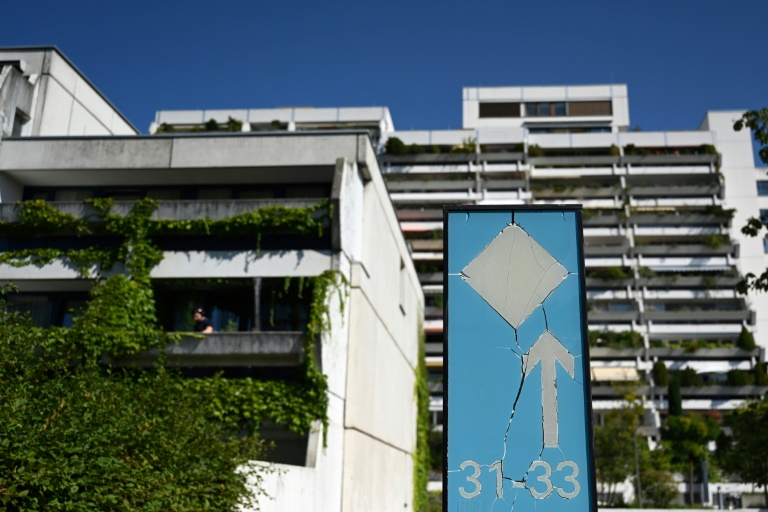
Connollystrasse 31 may be seared in most people’s memories as the address where Palestinian gunmen took Israeli athletes hostage during the 1972 Olympic Games in Munich. But for Mechthild Foerster, it is her home.

When she and her husband found the apartment in 1986, they did not know it would be located in the same building where the terror unfurled.

“We knew pretty soon afterwards, with the plaque outside the building,” she tells AFP, referring to the memorial plate in German and Hebrew commemorating the 11 members of the Israeli delegation who were killed five decades back.

“It is not as if I had the scary feeling of moving into a haunted castle. Life goes on and wounds must heal.”

On September 5, 1972, members of the militant Palestinian “Black September” group stormed into the Israeli Olympic delegation’s lodgings, shooting two dead and taking nine others hostage.

West German police responded with a bungled rescue operation in which all nine hostages were killed in a shootout, along with five of the eight hostage-takers and a police officer.

– ‘Plants everywhere’ –

Despite the atrocities that unfolded at the site, the Olympic village was transformed into homes for locals barely a year after the Games.

Foerster, 85, already knew what life was like in the Olympic village from visiting her sister-in-law, who moved in in 1973.

Today, the 40-hectare (99-acre) residential district adjoining the 80-hectare Olympic park is a thriving district popular with families and retirees alike.

In her block, the apartments once inhabited by the Israeli delegation have been acquired by the Max Planck Institute, which puts up visiting researchers there. Others are inhabited by longer-term residents like Foerster.

Recalling the early years at the village, Foerster says: “It was really hot inside, because it was really only a pile of concrete, a sort of mountain that heats up in the summer.”

“If we didn’t have plants everywhere it would really be unlivable. Now it’s very pleasant,” she says, having just returned from the shops on her bike.

On every balcony of the apartment complex that faces the sun there are potted plants, ivy, and small trees that bring a little freshness in summer.

Soon after the fateful Games in 1972, ramps were built to make the buildings more accessible to disabled people.

With all the roads buried underground there are no cars, no noisy traffic, and parents let children play in the street without fear.

– ‘Wouldn’t live anywhere else’ –

The local school is embedded in the village and no more than a 10-minute walk from home — another advantage for families.

“I don’t think I would live anywhere else in Munich with children,” says Charlotte Haupt, mother to an 18-month-old boy.

“Ours is just a year-and-a-half but the older he gets the more advantages there will be. We can let the kids play outside the house, there are no cars,” she says.

Haupt moved into the area in 2010 as a student in a shared apartment, and has lived here with her partner since 2016.

Tina Wild arrived in the Olympic village a week before giving birth 18 months ago.

“To be honest, I don’t know if we would have bought here had I not been pregnant. For a couple without children, there are more interesting neighbourhoods,” Wild says.

“It’s a village but in the positive sense of the word. Residents help each other out, say hello in the morning, you know each other, especially when you have children,” Haupt says.

“Volunteers sometimes go and do the shopping for older people, go with people on a walk, visit them at home. It’s quite simple and when you live here a while, you get to know each other,” says Foerster.

Germany, Israel mark 50 years since Munich Olympics massacre

Israel and Germany’s presidents will jointly commemorate the 1972 Munich Olympics attack that left 11 Israeli athletes dead, after a last-minute compensation deal averted a feared boycott by bereaved relatives.

Around 70 relatives of victims will join in next Monday’s solemn 50th-anniversary ceremony, Ankie Spitzer, whose husband Andre Spitzer counted among the dead, told AFP. Separately, the Israel Olympic Committee confirmed a delegation at the event.

The long-planned ceremony had risked descending into a fiasco over a row between relatives and the German state over financial compensation for their suffering.

But an 11th-hour deal on “historical clarification, recognition and compensation” was announced on Wednesday, with Germany offering 28 million euros (dollars) in reparations, six times the amount previously provided.

With the agreement, the German state acknowledges its “responsibility and recognises the terrible suffering of those killed and their relatives,” said Frank-Walter Steinmeier and his Israeli counterpart Isaac Herzog in a statement.

“The agreement cannot heal all wounds. But it opens a door to each other,” they added.

At the ceremony at the Fuerstenfeldbruck air base, west of Munich, where the hostage-taking reached its tragic climax, bereaved relatives are also hoping Steinmeier will become the first German head of state to publicly take responsibility for the failings that led to the carnage.

– ‘Incompetence’ –

Held almost three decades after the Holocaust, the Games in Munich were meant to showcase a new Germany. But it instead opened a deep rift with Israel.

On September 5, 1972, eight gunmen from the Palestinian militant group Black September stormed the Israeli team’s flat at the Olympic village, shooting two dead and taking nine others hostage.

Former East German handballer Klaus Langhoff saw the scenes unfold from the balcony opposite the Israeli team’s quarters. 

He described the terrifying moments when he saw the hostage-takers bringing out the lifeless body of Israeli coach wrestling coach Moshe Weinberg and leaving it on the street. 

“It was awful. Whenever we looked out of the window or on the balcony, we saw this dead athlete there,” he told AFP.

West German police responded with a botched rescue operation in which all nine hostages were killed in a shootout, along with five of the eight hostage-takers and a police officer.

Then chancellor Willy Brandt spoke of the chain of events as a “shocking document of German incompetence” and created the commando team GSG9 within the month. 

But only weeks later, three hostage-takers who were captured were also freed in an exchange when terrorists hijacked a Lufthansa plane on October 29, 1972, and demanded their release.

Incensed by the chain of events, Israel subsequently launched the operation “Wrath of God” to hunt down the leaders of Black September.

Four decades after the massacre, Israel released official documents on the killings, including specially declassified material and an official account from the former Israeli intelligence head, lambasting the performance of the West German security services.

The police “didn’t make even a minimal effort to save human lives”, former Mossad head Zvi Zamir said at the time after returning from Munich.

For years following the tragedy, relatives of victims battled to obtain an official apology from Germany, access to official documents and appropriate compensation.

In the immediate aftermath, they were offered only a million deutschmarks (510,000 euros) in what was described as a “humanitarian gesture” in order for it not to be viewed as an admission of guilt. 

Further financial compensation was provided in 2002 but still a fraction of what the victims’ families were seeking.

“I came home with the coffins after the massacre,” said Spitzer.

“You don’t know what we’ve gone through for the past 50 years.”

German officials acknowledged that Wednesday’s deal was only the beginning of a long road to laying to rest the wrongs of the last decades. 

“After 50 years, the conditions have been created to finally come to terms with a painful chapter in our common history, acknowledging it and laying the foundation for a new and lively culture of remembrance,” said government spokesman Steffen Hebestreit in a statement.

Man arrested for pointing gun at Argentine VP Kirchner

A man was arrested in Argentina on Thursday for pointing a gun at Vice President Cristina Kirchner, security minister Anibal Fernandez said.

Several television channels broadcast footage of the man aiming a gun at the vice president’s head from close range as she was getting out of the car that was taking her home in Buenos Aires.

Fernandez said police would open an investigation. 

“Now, the situation has to be analyzed by our scientific people to evaluate the fingerprints and the capacity and propensity this person had,” he said

The gun did not go off as the man, who approached Kirchner as part of a crowd gathering around the politician to ask for her autograph, waved the weapon in her face. 

Local media reported the suspect was a Brazilian national.

Kirchner’s opponent party Together for Change condemned the attack.

“My absolute repudiation of the attack suffered by Cristina Kirchner, who fortunately was not injured. This very serious act requires an immediate and deep investigation by prosecutors and security forces,” Mauricio Macri, who was president from 2015 to 2019, tweeted. 

Venezuelan President Nicolas Maduro, a strong Kirchner ally who has called the accusations against her a “farse,” also tweeted his support Thursday night.

“We send our solidarity to Vice President Cristina Kirchner in the face of the attack against her life,” he wrote. “We strenuously reject this act that sought to destabilize the peace of the our brother Argentine people. The great homeland is with you, comrade!” 

Hundreds of activists have gathered in recent days in front of the home of Kirchner, who is accused of fraudulently awarding public works contracts in her stronghold in Patagonia.

Prosecutors have asked that the ex-president, who ruled from 2007 to 2015, face 12 years in jail and a lifetime ban from politics.

“Nothing, absolutely nothing that they have said was proven,” Kirchner, a lawyer by trade who succeeded her late husband, Nestor Kirchner, as president, said last week.

Kirchner, 69, is the Senate president and enjoys parliamentary immunity.

Even if convicted — the verdict is expected at the end of the year — she would not go to prison unless her sentence was ratified by the country’s Supreme Court, or she loses her Senate seat at the next elections at the end of 2023.

Most Asian markets down as traders focus on US jobs data

Asian markets struggled again Friday and the dollar held gains as rate hike expectations grew, with traders now focusing on a key US jobs report later in the day.

Oil prices rose on fading expectations for an Iran nuclear deal anytime soon, but they remained under severe pressure from a range of issues including the strengthening dollar, Covid lockdowns in China, and worries about a demand-sapping recession.

Healthy readings on US factory activity, unemployment claims and private jobs creation indicated the world’s top economy remained strong despite rising interest rates and four-decade-high inflation.

But analysts said the figures were a case of “good news in bad news” as they would give the US Federal Reserve more room to keep tightening monetary policy, with officials lining up to commit to beating inflation even if that causes a recession. 

Bets are increasing on a third successive 75-basis-point increase at its September meeting. 

OANDA’s Edward Moya warned Fed officials could even start considering rising into 2023, with inflation data later this month becoming increasingly important.

“If the economy remains resilient over the next few months, the Fed-funds futures market might believe the Fed won’t be done tightening at the end of year,” he wrote in a commentary.

“Markets might start pricing in a February rate hike as well, if pricing pressures don’t show further signs of easing with the September 13th inflation report.”

Wall Street ended with a late rally, with the Dow and S&P 500 snapping a four-day retreat, though the Nasdaq extended its losing streak. European markets fell again after record inflation figures ramped up expectations the European Central Bank will announce a big increase in costs next Thursday.

Asia continued to wobble, though there were some positives.

Tokyo, Hong Kong, Sydney, Wellington and Taipei fell, while Shanghai, Seoul, Manila and Jakarta edged up.

Meera Pandit at JPMorgan Asset Management said the near-term outlook was not positive.

“We don’t have a lot of reasons to be bullish in this type of environment for the next couple of weeks and months,” she told Bloomberg Television.

– xxxx –

With US rates expected to keep rising, the dollar has rallied to highs not seen for decades including against the pound and euro,

On Thursday, it broke 140 yen for the first time since 1998.

Expectations are that it could strengthen further as the Bank of Japan keeps rates ultra-low to kickstart the economy, while analysts said an intervention to prop up the yen was unlikely as the effects would be brief.

The rising greenback was adding to downward pressure on oil, which is priced in dollars, while demand hopes were dealt a hefty blow Thursday by news that China had effectively locked down around 20 million people in Chengdu to fight a Covid outbreak.

The closure of the tech manufacturing hub follows a similar shutdown of Shanghai, which sent shockwaves through the economy, and has battered hopes for a recovery in the world’s number-two economy.

“Lockdowns/mass testing continues to impede stimulus efforts to revive the economy, with announced stimulus to date unlikely to gain much traction if the zero-Covid policy continues,” said National Australia Bank’s Tapas Strickland.

“Given Chengdu is also a production hub for high tech manufacturing,” global supply chains will likely continue to be disrupted, he added.

Crude, which has lost all the gains made in the aftermath of Russia’s February invasion of Ukraine, rose Friday after US officials said they had received a new response from Iran on reviving a nuclear deal but that it was not “constructive”.

– Key figures at around 0300 GMT –

Tokyo – Nikkei 225: DOWN 0.2 percent at 27,604.37 (break)

Hong Kong – Hang Seng Index: DOWN 0.7 percent at 19,461.46

Shanghai – Composite: UP 0.1 percent at 3,186.68

Dollar/yen: DOWN at 140.12 yen from 140.20 yen on Thursday

Euro/dollar: UP at $0.9960 from $0.9947

Pound/dollar: UP at $1.1546 from $1.1542

Euro/pound: UP at 86.26 pence from 86.16 pence

West Texas Intermediate: UP 1.3 percent at $87.72 per barrel

Brent North Sea crude: UP 1.2 percent at $93.43 per barrel

New York – Dow: UP 0.5 percent at 31,656.42 (close)

London – FTSE 100: DOWN 1.9 percent at 7,148.50 (close)
NASA readies for Saturday Moon rocket launch attempt

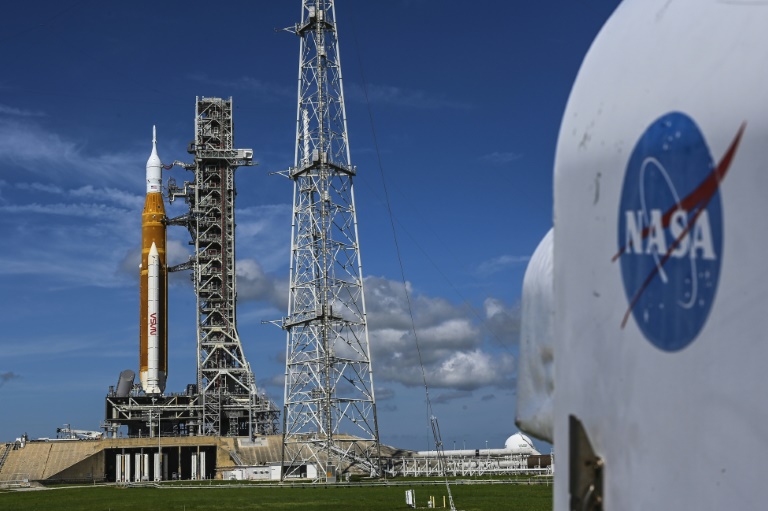
The stars appear to be aligned for NASA’s Moon rocket to finally blast off on Saturday, with weather forecasts favorable and technical issues that postponed the launch earlier this week resolved.

Liftoff is scheduled for 2:17 pm local time (1817 GMT) from Kennedy Space Center in Florida, with the potential for up to a two-hour delay if necessary.

The chance for favorable weather conditions within that window sat at 60 percent Thursday evening. 

“The weather looks good,” and isn’t expected to be a “showstopper,” forecast analyst Melody Lovin said at a press conference.

NASA has also been working to correct the technical difficulties that lead to the last-minute delay of the launch during its originally scheduled window Monday.

At first, it seemed that one of the rocket’s four main engines was too hot, though it turned out just to be a reading from a “bad sensor,” the rocket’s program manager John Honeycutt said Thursday. 

In the future, the incorrect information will simply be ignored. 

Then a fuel tank leak had to be patched. 

“We were able to find what we believe is the source of the leak and correct that,” launch director Charlie Blackwell-Thompson said. 

The Artemis 1 mission is an uncrewed test flight. It will be the first launch for the Space Launch System (SLS) rocket, the most powerful in the world and which has been in development for more than a decade. 

“There’s no guarantee that we’re going to get off on Saturday, but we’re going to try,” Artemis mission manager Mike Sarafin said. 

If the mission goes ahead Saturday, the Orion capsule fixed atop the rocket will spend 37 days in space, orbiting the Moon from about 60 miles (100 kilometers) away. 

It is the Orion that will then take future astronauts back to the Moon — including the first woman and the first person color to walk on its surface — in 2025 at the earliest. 

Artemis is named for the twin sister of the Greek god Apollo, for whom the first Moon missions were named. With the new flagship program, NASA hopes to test technology someday meant for sending humans to Mars.

In Louisiana, the first US climate refugees find new safe haven

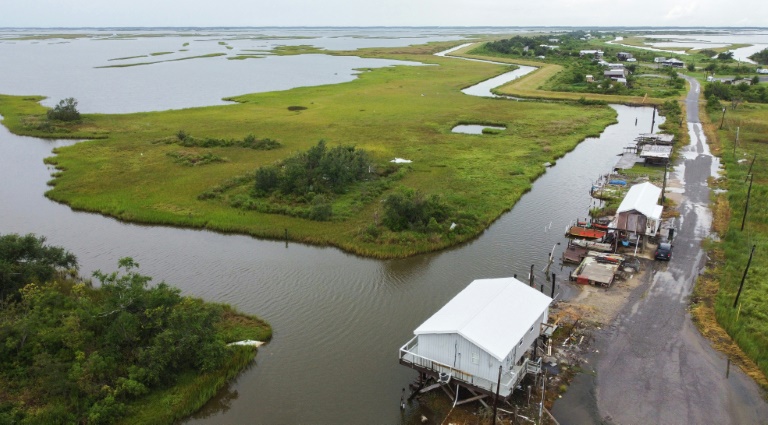
Joann Bourg stands in front of her new home, about an hour’s drive from the low-lying Louisiana island where she grew up — an area gradually sinking into the Gulf of Mexico.

“I’m very excited. I can’t wait to just move on in,” Bourg told AFP. “I’ve been waiting for this day forever.”

Bourg is one of about a dozen Native Americans from the Isle de Jean Charles who have been relocated to Schriever, less than 40 miles (60 kilometers) to the northwest — the maiden beneficiaries of a federal resettlement grant awarded in 2016.

They are the first so-called “climate refugees” in the United States, forced from their homes due to the consequences of climate change.

“The house we had back there on the island — well, that has been home forever. Me and my siblings all grew up there, went to school down there,” Bourg recalls. “It was peaceful.”

But the family home — as with many others on the island — was destroyed.

There is only one road connecting Isle de Jean Charles to the mainland, and it is sometimes impassable due to high winds or tides.

Residents are mainly of Native American descent — several tribes sought shelter on the island from rampant government persecution in the 1800s.

But climate change has transformed the island into a symbol of the scourge that plagues much of hurricane-prone Louisiana — coastal erosion.

– 90 percent under water –

Eventually, 37 new homes will be built in Schriever to accommodate about 100 current or former residents of Isle de Jean Charles, thanks to a $48 million federal grant initially allocated in 2016.

“This is the first project of its kind in our nation’s history,” state Governor John Bel Edwards, who was on site to see the residents close on their new properties, told AFP.

“We’ve had people over the years that we would buy their homes out and move them. But we’ve not done whole communities like this and moved them to one place before because of climate change.”

Since the 1930s, Isle de Jean Charles has lost “about 90 percent” of its surface area to the encroaching bayou waters, explains Alex Kolker, an associate professor at the Louisiana Universities Marine Consortium.

The island was already fragile, but climate change heightens the risks, he says — sea levels are rising, the ground is sinking and erosion is rampant. More frequent and fiercer storms intensify the problem.

“This community is one of the most vulnerable communities in Louisiana, and Louisiana is one of the most vulnerable places in the US,” Kolker says.

– Dead trees –

The road to Isle de Jean Charles is lined with dozens of homes, many of which are stripped down to the pilings.

A year ago, Hurricane Ida slammed into Louisiana as a dangerous category 4 storm; it was the second most damaging hurricane on record in the state, after the devastation of Katrina in 2005.

The storm ripped part of Chris Brunet’s roof off his home. 

The 57-year-old placed a sign in front of his home: “Climate change sucks.”

Seemingly indifferent to the voracious and omnipresent mosquitos, and occasionally speaking the old Acadian French associated with the area, Brunet says hurricanes are nothing compared to so-called “saltwater intrusion” destroying canals and other waterways.

A few years ago, he finally agreed to relocation, adopting the view of the leader of his Choctaw tribe that it was the only way to preserve the island’s dwindling community.

But those whose homes remain upright do not want to completely abandon their ancestral land.

Bert Naquin, who is moving into one of the new federally funded houses in Schriever, hopes to repaint her family dwelling in Isle de Jean Charles, despite her joy at being a first-time full homeowner.

“I plan on being down there a lot, because it’s still my home,” the 64-year-old Naquin said.

“This house up here is my house. But the island is always going to be my home in my heart.”

Slowdown or not? US job market walking a tight rope

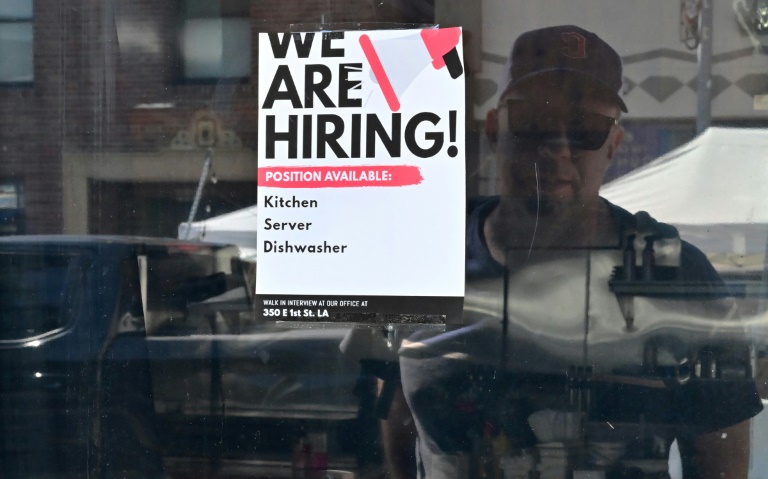
The number of “Help Wanted” signs may have decreased across the United States in August, but the job situation still remains tense, official figures are expected to show Friday.

According to consensus, the unemployment rate for August should fall somewhere around 3.5 percent when official data is released at 8:30 am (1230 GMT).

If the estimate turns out to be true, it would be the same rate as July when unemployment first returned to its pre-pandemic levels, which had been the lowest in 50 years.

Job creation, on the other hand, is expected to have slowed sharply, falling to 300,000 — almost half July’s number.

Data for private sector jobs created in August already disappointed: American employers ratcheted back their hiring in the month to 132,000, according to data published Wednesday by payroll firm ADP, a far cry from the 315,000 jobs that had been expected.

“We think that these numbers suggest a shift to a more moderate pace of hiring,” Nela Richardson, chief economist for ADP, said in a conference call.

Firms of all sizes are trying “to read what has become a complex economic picture” due to high inflation and a lack of workers at a moment when employers are looking to hire on a large scale.

Neither an economic slowdown, fears of recession nor action taken by the Federal Reserve to curb soaring inflation have deflated the hot job market. 

In July, the labor market demonstrated particular dynamism when it returned to its pre-pandemic level.

The unemployment rate fell to a historically low 3.5 percent as the 22 million jobs lost due to Covid-19 returned.

By the end of the month, there were more than 11 million job openings, or two for every job seeker. Just over four million Americans quit their jobs in July, and the same held true for June.

– ‘Some pain’ –

Meanwhile, weekly jobless claims — which provide insight into layoffs — fell almost every week in August and remain at historically low levels.

“Labor market conditions remain tight despite fairly weak economic growth,” said Nancy Vanden Houten, chief economist for Oxford Economics, in a note released Thursday.

US GDP contracted in the first two quarters of 2022, which falls under the classic definition of a recession.

But because of its glaringly robust job market, the US economy doesn’t quite seem to fall under the recession label for the moment.

The August jobs report data is expected to strengthen the Federal Reserve’s commitment to raising interest rates.

The Fed’s rate-hiking fight against high inflation will likely result in an employment slowdown and even a rise in the unemployment rate.

Federal Reserve chair Jerome Powell hammered home this point last week at a conference in Jackson Hole, Wyoming, warning of “some pain to households and businesses,” as well as a “softer labor market.”

With companies having faced a labor shortage for more than a year, many are offering higher wages, which is in turn driving up prices.

Amid the soaring inflation, the Fed has been gradually raising its key rate, making credit more expensive and thus slowing consumption as well as pressure on prices.

It is expected to raise rates again at its next meeting on September 20 and 21. To determine the extent of the rate hike, it will take Friday’s employment figures into serious consideration.

A slowdown in the labor market could indicate that the Fed’s rate hikes are finally bearing fruit, whereas a tight labor market would lead the Fed to act more forcefully.

Inflation, at its highest in 40 years, slowed to 8.5 percent over the previous year in July, according to the CPI index.

Close Bitnami banner
Bitnami