World

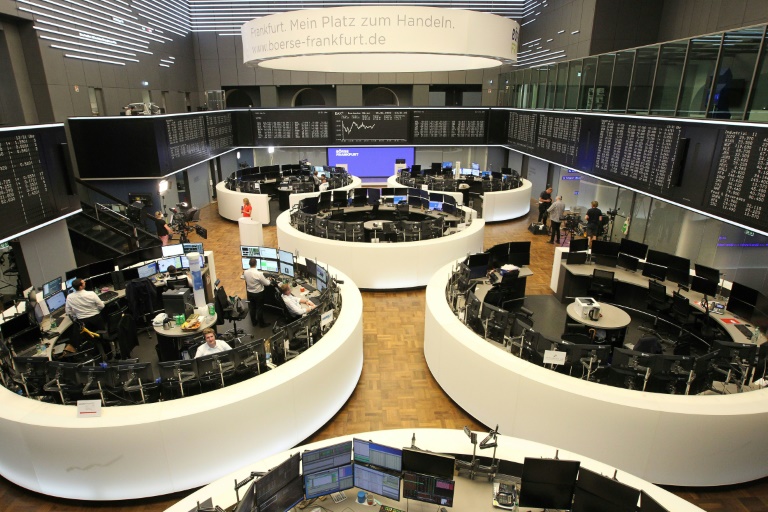
European stocks drop on record eurozone inflation

European equities slid Wednesday as record-high eurozone inflation fanned fears that more interest rate hikes could herald recession.

Frankfurt, London and Paris stocks dropped as data showed eurozone inflation hit 9.1 percent in August on surging fuel prices, sparking talk of rising European Central Bank rates.

Most Asian markets meanwhile fell on concerns the US Federal Reserve’s rate-hiking policy would send the world’s biggest economy into recession, with oil prices diving on demand jitters.

The ECB is set to lift borrowing costs next week, having increased them in July for the first time in a decade to help tackle rampant inflation.

– ‘Real’ recession risk –

“The reality is that a more aggressive (ECB) tightening is going to be needed, and when the economy is already as fragile as it is, the situation quickly starts to look quite problematic,” OANDA analyst Craig Erlam told AFP.

“That’s not good for stocks as it’s extremely difficult for companies to prosper if the bloc is in a deep recession made worse by higher interest rates, which is now a real risk.”

Major central banks are rushing to contain runaway consumer price inflation that has largely been prompted by fallout from key energy supplier Russia’s invasion of Ukraine.

State energy giant Gazprom suspended gas deliveries to Germany on a major pipeline on Wednesday.

It was the latest in a series of supply halts that have fuelled Europe’s energy crisis and sent gas and electricity prices soaring before the peak-demand winter.

– Sentiment takes a hiding –

Wall Street’s three main indexes fell for a third straight day Tuesday to sit at a one-month low, despite healthy data on US consumer sentiment and job openings.

Investor sentiment took a hiding after Fed chief Jerome Powell warned last Friday that the US central bank would need to tighten policy much more to tackle sky-high inflation.

“Inflation remains the key issue, with commentary from both the Fed and ECB serving to highlight the fact that controlling prices will remain the central target irrespective of economic suffering,” IG analyst Joshua Mahony told AFP.

“A drawn out period of higher costs, higher wages, and lower demand point towards further downside for equity markets,” he noted.

Traders are now awaiting the release of US job-creation figures on Friday for a better idea about the state of the economy.

– Key figures at around 1130 GMT –

London – FTSE 100: DOWN 1.1 percent at 7,279.75 points

Frankfurt – DAX: DOWN 0.4 percent at 12,912.99

Paris – CAC 40: DOWN 0.7 percent at 6,168.14

EURO STOXX 50: DOWN 0.5 percent at 3,545.14

Tokyo – Nikkei 225: DOWN 0.4 percent at 28,091.53 (close)

Hong Kong – Hang Seng Index: FLAT at 19,954.39 (close)

Shanghai – Composite: DOWN 0.8 percent at 3,202.14 (close)

New York – Dow: DOWN 1.0 percent at 31,790.87 (close)

Euro/dollar: DOWN at $0.9996 from $1.0015 on Tuesday

Pound/dollar: DOWN at $1.1629 from $1.1656

Euro/pound: UP at 85.95 pence from 85.92 pence

Dollar/yen: DOWN at 138.71 yen from 139.00 yen

West Texas Intermediate: DOWN 2.7 percent at $89.16 per barrel

Brent North Sea crude: DOWN 3.3 percent at $96.00 per barrel

burs-rfj/lcm
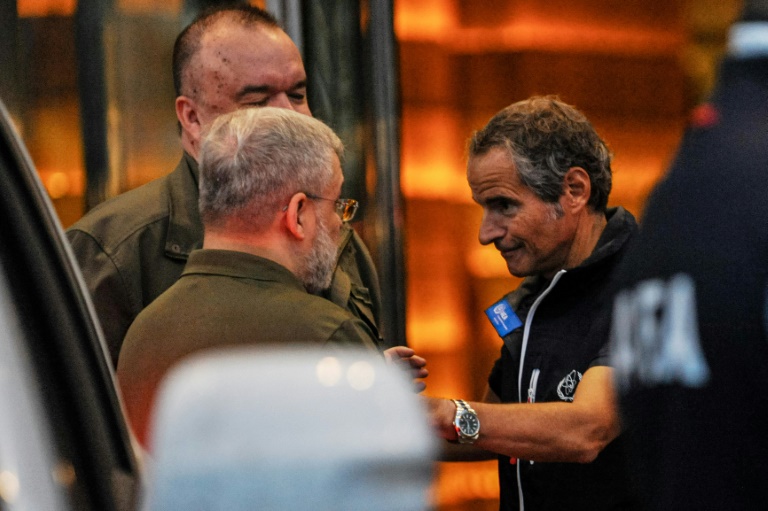
IAEA team reaches Zaporizhzhia en route to Russia-held nuclear plant

IAEA inspectors arrived in the southern Ukrainian city of Zaporizhzhia Wednesday ahead of a visit to a Russian-held nuclear power plant, after fresh shelling near Europe’s largest atomic facility.

A convoy brought in the 14-strong team, led by the head of the International Atomic Energy Agency (IAEA), which had left Kyiv in the morning. 

The fate of the Zaporizhzhia nuclear plant which is located on the frontline between Russian and Ukrainian forces has stoked global concern. 

The area has been shelled repeatedly in recent days, with Ukraine on Wednesday accusing Russian forces of hitting Energodar, a town with a pre-war population of some 50,000 people which is next to the plant.

Both sides have repeatedly traded blame over attacks in the area. 

“The Russian army is shelling Energodar,” said Evhen Yevtushenko, head of Nikopol district military administration which is located on the northern bank of the Dnipro River opposite the town and its plant. 

“These provocations are dangerous,” he wrote on Telegram.

One of the shells hit Energodar’s city council, Mayor Dmytro Orlov wrote on Telegram, posting pictures of the damaged building with a hole punched into the side and debris littering the ground. 

News of the strike came after the IAEA team left Kyiv for the southern city of Zaporizhzhia. 

Although the city is normally about a two-hour drive from the plant, it was far from clear how or when the IAEA team would reach the site given the complexities of crossing into Russian-held areas. 

– ‘Extremely menacing’ –

“We are now finally moving,” IAEA chief Rafael Grossi told reporters before heading off with his 13-strong team. 

He said they planned to spend “a few days” at the plant and would report back afterwards.

The plant has been occupied by Russian troops since March and Ukraine has accused Russia of deploying hundreds of soldiers and storing ammunition there.

Kyiv has insisted the team access the plant via Ukrainian-held territory, meaning the inspectors will have to cross the front line with security guarantees from both sides.

“Sadly, Russia is not stopping its provocations precisely in the direction the mission needs to travel to reach the plant,” President Volodymyr Zelensky said late Tuesday after meeting Grossi.

The situation was “extremely menacing”, he said, accusing the Russians of “continuing bombardments” and calling for “an immediate and total demilitarisation” of the Zaporizhzhia nuclear plant. 

In Moscow, the Russian defence ministry accused Kyiv of “continued provocations aimed at disrupting the work of the IAEA mission” saying it had shelled the area around the plant on Tuesday hitting a building containing “the solid radioactive waste processing complex”.

– Counteroffensive in the south –

Meanwhile, intensive fighting raged across the nearby southern region of Kherson where Ukraine began a counteroffensive on Monday. 

Most of the region and its provincial capital of the same name were seized by Russian forces at the start of the invasion six months ago.

With the war in the eastern Donbas region largely stalled, analysts have said for weeks that combat is likely to shift south to break the stalemate before winter comes.

In its morning update, the president’s office in Kyiv said “fighting continued throughout the night” in Kherson, and that one person had been killed and two injured in an overnight bombing in the Mykolaiv area. 

But the Russian defence ministry said Kyiv’s attempts to advance its counteroffensive had “failed” with Ukrainian forces suffering “significant losses and were driven back by Russian troops”. 

For its part, the Ukrainian presidency claimed its forces had destroyed “almost all large bridges” over the Dnipro River, a key supply route for Russian forces, leaving only pedestrian crossings in place.

Meanwhile, Russian energy giant Gazprom suspended gas deliveries to Germany for maintenance on a major pipeline Wednesday, in the latest in a series of supply halts that have fuelled an energy crisis in Europe.

The move comes as European countries have faced soaring energy prices since Russia invaded Ukraine in late February and subsequently curbed its gas deliveries to the region.

And in Prague, which holds the rotating European Union presidency, EU foreign ministers are meeting to discuss travel restrictions on Russia over its Ukraine invasion.

Taliban mark anniversary of foreign troop exit with chants, military parade

The Taliban celebrated the first anniversary of the withdrawal of foreign troops from Afghanistan Wednesday with victory chants and a military parade showcasing equipment left behind by US-led forces.

Afghanistan’s new rulers — not formally recognised by any other nation — have reimposed their harsh version of Islamic law on the impoverished country, with women squeezed out of public life.

Despite the restrictions, and a deepening humanitarian crisis, many Afghans say they are glad the foreign forces that prompted the Taliban insurgency left after a brutal 20-year war.

“We are happy that Allah got rid of the infidels from our country, and the Islamic Emirate has been established,” said Zalmai, a resident of Kabul.

In a statement, the government said the day marked “the country’s freedom from American occupation”.

“So many mujahideen were wounded, so many children orphaned, and so many women became widows.”

The authorities held an official celebration that included a military parade at Bagram Airbase, the nerve centre of US operations during the war.

Groups of Taliban fighters — dressed in traditional shalwar kameez and carrying rocket-propelled grenades — marched as helicopters flew by, video footage aired by state television showed.

Minutes later, dozens of military vehicles including humvees and artillery tanks, seized in the war or left behind by US forces during their chaotic withdrawal, were paraded.

Foreign media outlets were not given access to the event.

Celebrations were also held in several provinces, with locals reading poems and verses from the holy Koran.

– Victory chants –

Banners celebrating victories against three empires — the former Soviet Union and Britain also lost wars in Afghanistan — flew in Kabul.

Hundreds of white Taliban flags bearing the Islamic proclamation of faith flew from lamp posts and government buildings, while squares in the capital were decorated with lights.

Kabul residents chose to stay indoors after the authorities declared a national holiday, but hundreds of Taliban fighters gathered at Massoud Square, next to the now shut US embassy.

“Death to America! Death to occupation! Long live freedom!” chanted the fighters.

“The flag of Islam is flying high. We are happy to live under the banner of Islam,” Taliban fighter Shah Ahmad Omari told AFP.

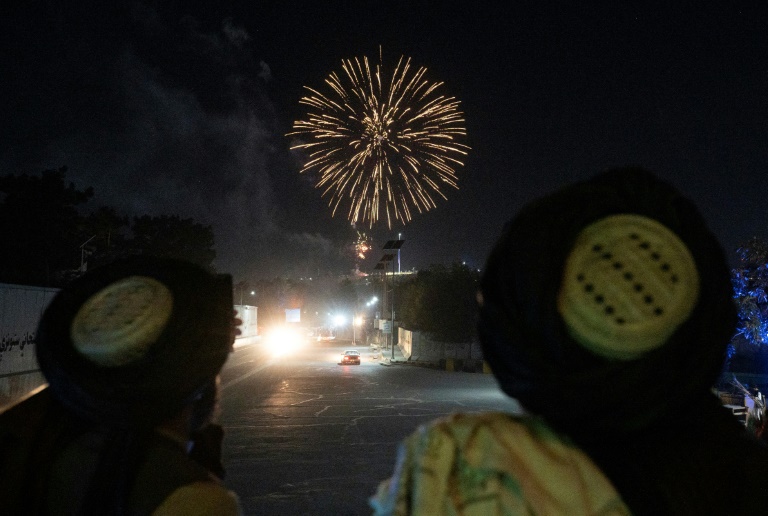
On Tuesday night, the skies above Kabul were lit up with fireworks and celebratory gunfire from crowds of Taliban fighters.

The plane carrying the last US troops took off from Kabul just a minute before midnight on August 31 last year.

That departure ended America’s longest war, which began in the wake of the September 11, 2001 attacks in the United States.

More than 66,000 Afghan troops and 48,000 civilians were killed in the conflict, but it was the deaths of US service members — 2,461 in total — that became too much for the American public to bear.

“The burden of the war in Afghanistan, however, went beyond Americans,” the US military said Tuesday.

More than 3,500 troops from other NATO countries were also killed.

Thousands of civilians were also killed in horrific bomb and gun attacks by the Taliban during the war.

– ‘No good memory’ –

Two weeks before the end of last year’s withdrawal, the Taliban seized power following a lightning offensive against government forces.

Taliban social media accounts posted videos and pictures of newly trained troops — many flaunting equipment the US military left behind.

“This is how you troll a superpower after humiliating them and forcing them to withdraw from your country,” read a tweet with a photo of a giant Taliban flag now painted on the wall of the former US embassy.

Despite the Taliban’s pride in taking over, Afghanistan’s 38 million people face a desperate humanitarian crisis — aggravated after billions of dollars in assets were frozen and foreign aid dried up.

Hardships for ordinary Afghans, especially women, have increased.

The Taliban have shut girls’ secondary schools in many provinces and barred women from many government jobs.

They have also ordered women to fully cover up in public — ideally with an all-encompassing burqa.

“There is no good memory of the past year. I have to think twice about what to wear before stepping out, to avoid a beating by the Taliban,” said Marwa Naseem, a female Kabul resident.

“It also hurts to see that girls cannot go to school, which is part of a normal life anywhere. The Taliban is using religion just to prevent women from progressing.”

But government spokesman Zabihullah Mujahid last week claimed there had been “major achievements” in the past year.

“Afghans are no longer being killed in war, foreign forces have withdrawn, and security has improved,” he told reporters.

US life expectancy drops for 2nd straight year, due to Covid

Life expectancy for Americans dropped in 2021 for the second straight year — the biggest two-year decline in a century — notably due to the Covid-19 pandemic, US health officials announced Wednesday.

US life expectancy at birth dipped by nearly a full year from 2020 to 2021, to 76.1 years, the lowest average since 1996, according to provisional data from the Centers for Disease Control and Prevention (CDC).

By comparison, Americans in 2020 were expected to live 77 years, a sharp drop from the 78.8 years in 2019.

“The declines in life expectancy since 2019 are largely driven by the pandemic,” said the CDC’s National Center for Health Statistics.

Coronavirus-related deaths accounted for three quarters of the drop in 2020, and about half of the decline in 2021, it said.

Some 15 percent of the 2021 slide could be attributed to deaths from accidents or unintentional injuries, notably drug overdoses.

The sharpest decline in life expectancy last year occurred among Native Americans and Alaska Natives, at 1.9 years, followed by white Americans (1.0) and Black Americans (0.7), according to the CDC.

Life expectancy for Native Americans was estimated at a mere 65.2 years in 2021, compared to 70.8 years for Black Americans and 76.4 years for white Americans.

Health officials also noted the growing gap in life expectancy between men and women, a difference which widened from 5.7 years in 2020 to 5.9 in 2021 — the largest gap since 1996. 

American women in 2021 had a life expectancy of 79.1 years, compared to 73.2 years for men.

Covid-19 was the third-leading cause of death in the United States last year, just as it was in 2020, after heart disease and cancer, according to a previous CDC report.

More than 1.04 million people with Covid-19 have died in the United States since early 2020.

After a peak in early 2022, Covid-related US deaths have dropped, although the country still records about 400 such deaths per day. 

Iraq political gridlock persists after bloody unrest

A months-long political crisis in Iraq showed little sign of abating Wednesday despite a fresh push for negotiations after nearly 24 hours of deadly violence between rival Shiite factions ended.

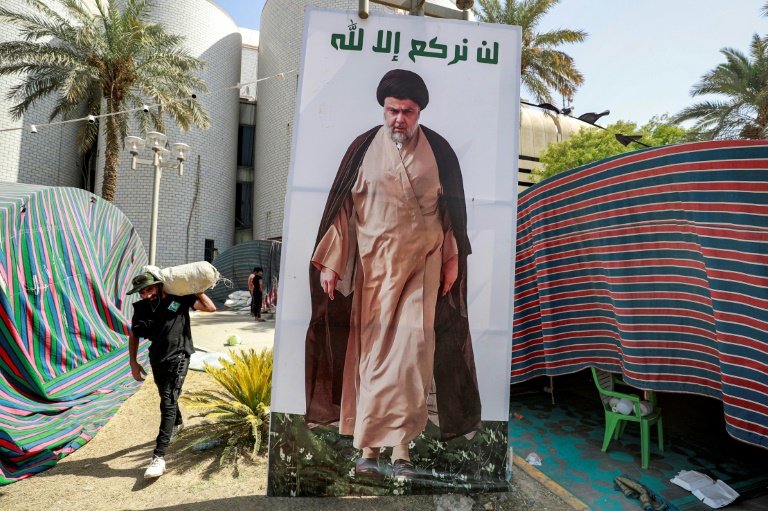
Baghdad’s highly-secured Green Zone returned to normality after 30 people were killed and 570 wounded in the clashes pitting supporters of powerful Shiite cleric Moqtada Sadr against pro-Iran factions.

Since elections in October 2021, political deadlock has left Iraq without a new government, prime minister or president, due to disagreement over the formation of a coalition.

The tensions escalated sharply on Monday when Sadr loyalists stormed the government palace inside the Green Zone following their leader’s announcement that he was quitting politics.

But Sadr’s supporters trickled out of the Green Zone in a steady stream on Tuesday afternoon when he appealed for them to withdraw within the hour.

A nationwide curfew was lifted, before shops reopened and infamous traffic jams returned to Baghdad’s streets on Wednesday as the government announced the resumption of school exams postponed by the unrest.

But the hurdles obstructing a solution to Iraq’s political crisis remained firmly in place, with rival powers refusing to budge on their demands.

Early elections, less than a year after the last polls, and the dissolution of parliament have been a key demand of Sadr.

Iraqi President Barham Saleh said late Tuesday that snap elections could provide “an exit from the stifling crisis”.

– Snap polls –

Under the constitution, parliament can only be dissolved by a majority vote, which can take place at the request of a third of lawmakers, or by the prime minster in agreement with the president.

Sadr’s rivals in the pro-Iran Coordination Framework want a new head of government to be appointed before any new elections are held.

On Tuesday, they called for the swift formation of a new government, “to prevent a recurrence of the strife” that paralysed Baghdad this week.

The Framework urged parliament and other state institutions to “return to exercising their constitutional functions and carry out their duties towards citizens”.

The statement drew the ire of a senior aid of Sadr, Saleh Mohammad al-Iraqi, who said it overlooked the rightful demands of protesters killed in the Green Zone who want parliament dissolved.

“Iran should reign in its Iraqi camels, or else there will be little room left for regret,” he said Wednesday, referring to the Coordination Framework.

Prime Minister Mustafa al-Kadhemi, meanwhile, threatened to resign unless the paralysis ends.

“If they want to continue to stir up chaos, conflict, discord and rivalry… I will take the moral and patriotic step and vacate my post,” he said.

– ‘More protests’ –

Iraqi political analyst Sajad Jiyad said a return to violence was possible in the absence of a longer term solution.

“The biggest loser is the state, standing idly by while two powerful armed parties continue to struggle for control,” he said.

“Unless a proper solution is reached, more protests and violence are possible.”

Falah Al-Barzanji, a 63-year-old activist, said he believed the calm would be short-lived.  

“Today life has returned to normal, but the fire is still burning under the ashes,” he told AFP.

“The Iraqi parliament must be dissolved and a reformist government must be installed.”

Pope Francis, who visited Iraq last year, said he was “following with concern the violent events that have taken place in Baghdad”.

“Dialogue and fraternity are the best way to face the current difficulties.”

Sadr — a longtime player in the war-torn country’s political scene, though he himself has never directly been in government — announced he was quitting politics two days after he said “all parties” including his own should give up government positions to help overcome the deadlock.

Sadr’s bloc emerged from the October election as the biggest in the legislature, with 73 seats, but short of a majority.

Since then Iraq has been paralysed due to disagreement between Shiite factions over forming a coalition.

In June, Sadr’s lawmakers quit in a bid to break the logjam, which led to the Coordination Framework becoming the largest.

Sadr’s supporters had for weeks been staging a sit-in outside Iraq’s parliament, after storming the legislature’s interior on July 30, demanding fresh elections be held.

Eurozone inflation jumps to new record 9.1%

The eurozone inflation rate hit a new record in August, official data showed on Wednesday, increasing pressure on the European Central Bank to hike rates to tame Ukraine war-fuelled prices.

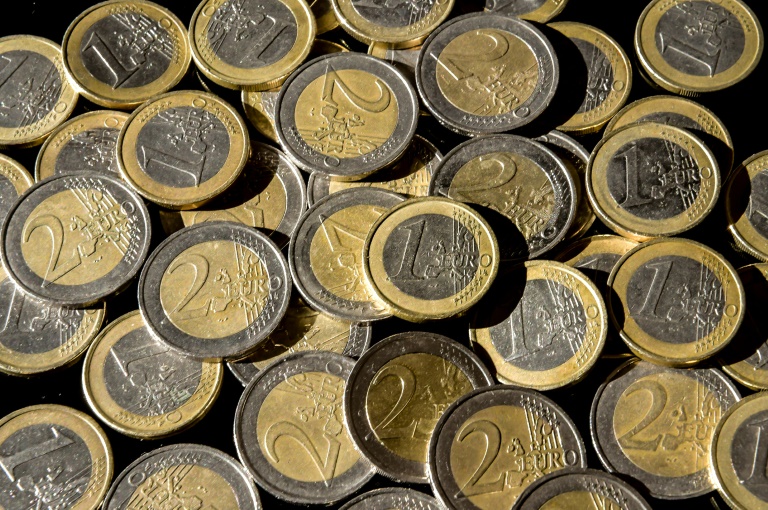
Driven by soaring energy prices caused by Russia’s invasion in Ukraine, the yearly inflation rate in the 19-country single currency area reached 9.1 percent, its highest since records began, according to Eurostat.

Consumer prices had accelerated to 8.9 percent in July.

The president of Germany’s powerful federal central bank, Joachim Nagel, immediately declared that the ECB should plan for a “strong rise in interest rates for September”.

“Otherwise, inflation expectations could become permanently entrenched above our target of two percent,” he warned.

The headline rate has been rising since November 2021, amid global supply chain stresses. War erupted in Ukraine in February and the European summer was marked by a drought that helped force up food prices.

The ECB is expected to raise interest rates at its next meeting on September 8, after first increasing them in July for the first time in a decade. Rates had been kept low as Europe emerged from its coronavirus slump.

France, which has moved to cap energy prices saw the lowest rate within the eurozone, with 6.5 percent in August, according to Eurostat. 

But powerhouse Germany was high on 8.8 percent, Italy saw nine percent and Spain 10.3. 

Russia’s neighbours on the Baltic, Estonia, Lithuania and Latvia suffered the most, at 25.2 percent, 21.1 and 20.8 respectively.

Economist Jack Allen-Reynolds of Capital Economics warned that the eurozone inflation rate could hit 10 percent by the end of the year, even if the bank hikes rates.

“The balance of probabilities is shifting towards a 75 basis points hike next week,” he said. The ECB raised rates by 50 basis points in July, from a zero interest rate to 0.5 percent.

– Slam on the brakes? –

For Bert Colijn, a senior economist at the bank ING, the increase in the price of goods contained within the broader inflation rate should worry observers as much as the hikes in energy. 

“The increase from 4.5 percent to 5 percent was much larger than expected and fuels worries about second-round effects from the input cost shock lasting longer,” he said.

But he noted that wage growth data for the second quarter of the year — salaries rose only 2.1 percent — suggested that Europe was tightening its belt already.

“As the economy is slowing rapidly –- and perhaps already contracting at this point — the question is how much the ECB needs to slam the brakes,” he said.

“Another hike of at least 50 basis points in September seems to be a done deal, with the hawks pushing for 75 basis points,2 he said.

“The big question is how the ECB will respond after this, if indeed signs of economic distress become more apparent, and inflation remains highly driven by supply-side factors.”

Among the items in the eurozone inflation basket, energy prices once again experienced the highest annual increase in August, although they slowed slightly to 38.3 percent compared to 39.6 in July. 

Food prices including alcohol and tobacco increased by 10.6 percent, from 9.8 in July. Industrial goods and services increased by five percent and 3.8 respectively, also accelerating compared to the previous months.

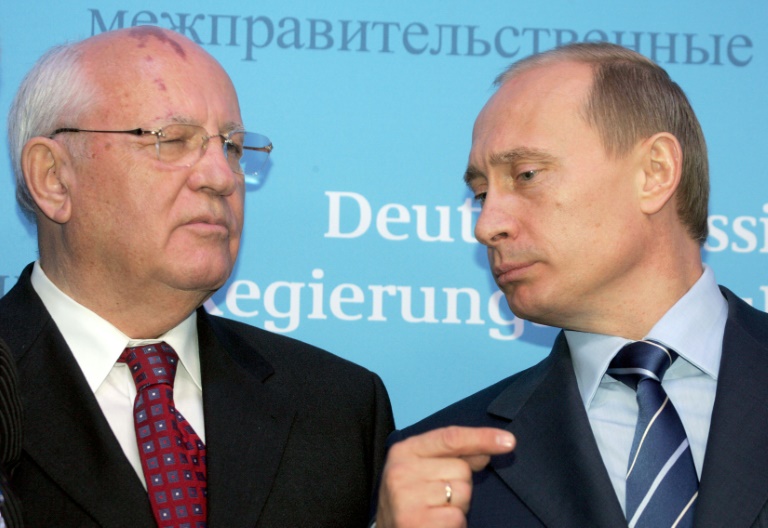
Gorbachev's love-hate relationship with Putin

Mikhail Gorbachev struggled to make up his mind about Vladimir Putin.

Over the more than 20 years after Putin came to power, the ex-Soviet leader embraced, then rejected, then embraced again the man who — much like Gorbachev in the 1980s — came to embody Russia in the eyes of the West.

A grudging respect seemed to have developed in the end, with Gorbachev saying ahead of Putin’s 2018 re-election for a fourth term: “Today he is a leader who deservedly enjoys people’s support.” 

After the chaos of the 1990s and the rule of his nemesis Boris Yeltsin, Gorbachev expressed hope for the former KGB agent who was first elected Russia’s president in 2000.

Putin, he said at the time, was “intelligent, serious, reserved and well-organised. I like people of this kind.”

For Gorbachev, Putin represented a chance for stability and economic growth, while continuing the transition to democracy he had set in place.

Even in 2006, as activists expressed increasing concern about the tough treatment of civil society under Putin, Gorbachev was able to declare that “those who fear Putin’s authoritarian tendencies are wrong.”

But as the years went by and hopes of democratic development in Russia evaporated, Gorbachev turned to veiled criticism and then to strongly worded attacks.

Fraud-tainted 2011 parliamentary elections hardened his attitude against the president, as well as Putin’s decision to stand for an unprecedented third term in office.

Gorbachev backed a protest movement that followed the elections and in 2013 made a stinging attack on Russia under Putin.

“Politics is more and more turning into an imitation of democracy. All power is in the hands of the authorities and the president,” Gorbachev said at the time. 

“The economy is monopolised. Corruption has taken on colossal proportions.”

Foreign media often latched on to his comments and he part-owned the proudly anti-Kremlin Novaya Gazeta newspaper, which suspended publication earlier this year after Russia launched its military action in Ukraine.

– An irritating thorn –

But at most Gorbachev was an irritating thorn in Putin’s side. 

The Kremlin shrugged off criticism from the man who allowed the collapse of the USSR, which Putin famously described as the biggest geopolitical tragedy of the 20th century.

When Gorbachev slammed Putin over the decision to return to the Kremlin for a third term, the Russian strongman spat back by accusing the former Soviet president of “abdicating” power.

By 2014, there were signs of another change of heart, with Gorbachev supporting Moscow’s seizure of Crimea from Ukraine despite a Western outcry.

“Crimea is Russia and let someone prove the opposite,” Gorbachev said.

The next year he backed Russia’s launching of a military campaign in Syria to support President Bashar al-Assad’s regime.

By the time Putin was running for a historic fourth term in 2018, Gorbachev was saying he was the kind of leader Russia needed in a “very complicated international situation”.

The bitter irony was that in his twilight years Gorbachev supported a man who did not think much of him and who dismantled much of what the Soviet leader worked to achieve.

While Gorbachev had opened the door to political opposition and a free press, Russia under Putin was accused of persecuting dissenters and squelching freedom of speech.

Putin said little of Gorbachev’s achievements in a letter of condolences after his death.

He was, Putin wrote, “a politician and statesman who had a huge impact on the course of world history”, one who “strove to offer his own solutions to urgent problems”.

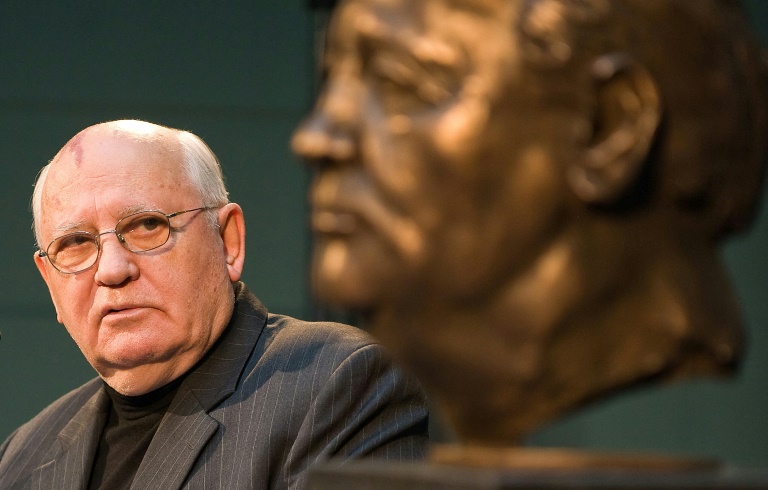
Tributes from West as Gorbachev dies at 91

The death of Mikhail Gorbachev triggered an outpouring of tributes from Western leaders on Wednesday but reaction was muted in Russia, where many blamed the last Soviet leader for the loss of the country’s status as a global superpower.

Gorbachev, who changed the course of history by triggering the demise of the Soviet Union and was one of the great figures of the 20th century, died on Tuesday aged 91. 

Russian news agency reports said he had died in a central Moscow hospital “after a serious and long illness”.

Gorbachev, in power between 1985 and 1991, helped bring US-Soviet relations out of a deep freeze and was the last surviving Cold War leader.

His life was one of the most influential of his times, and his reforms as Soviet leader transformed his country and allowed Eastern Europe to free itself from Soviet rule.

The changes he set in motion saw him lionised in the West — he won the Nobel Peace Prize in 1990 — but also earned him the scorn of many Russians after the country was plunged into economic chaos and saw its international influence decline.

President Vladimir Putin, who called the Soviet collapse the greatest geopolitical catastrophe of the 20th century, has spent much of his more than 20-year rule reversing parts of Gorbachev’s legacy.

By cracking down on independent media and political opposition, critics say, Putin has worked to undo Gorbachev’s efforts to bring “glasnost”, or openness, to the Soviet system.

And with the launch earlier this year of a military campaign in Ukraine, he has sought to reassert Russian influence in one of the countries that won its independence when the Soviet Union fell apart.

– ‘One-of-a-kind’ –

In a letter of condolences published by the Kremlin, Putin said Gorbachev “was a politician and statesman who had a huge impact on the course of world history” but said little of his political accomplishments.

Kremlin spokesman Dmitry Peskov told Russian news agencies it was not yet clear if a state funeral would be held and that a decision would be made later based on the family’s wishes.

On the streets of Moscow many Russians refused to comment on his death, with one muttering that he was “a traitor” and a young Russian asking who he was.

But in the West, where Gorbachev was regarded fondly and affectionately referred to as Gorby, he was hailed as an iconic figure.

US President Joe Biden credited Gorbachev with having “the imagination to see that a different future was possible and the courage to risk his entire career to achieve it”.

“The result was a safer world and greater freedom for millions of people,” he said.

British Prime Minister Boris Johnson said Gorbachev’s “tireless commitment to opening up Soviet society remains an example to us all,” while UN chief Antonio Guterres called him “a one-of-a-kind statesman” who “did more than any other individual to bring about the peaceful end of the Cold War”.

French President Emmanuel Macron praised Gorbachev as a “man of peace whose choices opened up a path of liberty for Russians,” and former German chancellor Angela Merkel said he demonstrated how “one single statesman can change the world for the better”.

Gorbachev was best known for defusing US-Soviet nuclear tensions in the 1980s as well as bringing Eastern Europe out from behind the Iron Curtain.

He won the Nobel Peace Prize for negotiating a historic nuclear arms pact with US leader Ronald Reagan, and his decision to withhold the Soviet army when the Berlin Wall fell a year earlier was seen as key to preserving Cold War peace.

He was also championed in the West for spearheading reforms to achieve transparency and greater public discussion that hastened the breakup of the Soviet empire.

He spent much of the past two decades on the political periphery, intermittently calling for the Kremlin and the White House to mend ties as tensions soared to Cold War levels after Russia annexed Crimea in 2014 and launched the offensive in Ukraine earlier this year.

– Backed Crimea annexation –

Gorbachev had supported the Crimea annexation, saying that most people in the peninsula “wanted to be reunited with Russia”.

He made no public statements on Russia’s military action in Ukraine, though his foundation called for “an early cessation (to) hostilities and immediate start of peace negotiations”.

He spent the twilight years of his life in and out of hospital with increasingly fragile health and observed self-quarantine during the pandemic. 

He remained a controversial figure and had a difficult relationship with Putin.

Many Russians still look back fondly on the Soviet period, and Putin leans on its achievements to buttress Russia’s claim to greatness and his own prestige.

As the USSR collapsed, Gorbachev was superseded by the younger Boris Yeltsin, who became post-Soviet Russia’s first president. 

From then on, Gorbachev was relegated to the sidelines, devoting himself to educational and humanitarian projects. 

– Supporter of free press –

He made a disastrous attempt to return to politics and ran for president in 1996 but received just 0.5 percent of the vote.

An early supporter of Russia’s leading independent newspaper Novaya Gazeta, founded in 1993, he donated part of his Nobel winnings to help it buy its first computers. 

But the newspaper, like Russian independent media across the board, came under increasing pressure under Putin.

Novaya Gazeta, whose chief editor Dmitry Muratov last year won the Nobel Peace Prize, suspended publication in late March after the military intervention in Ukraine.

In a tribute published after Gorbachev’s death, Muratov hailed him as a man who “put human rights above the state, and valued a peaceful sky more than personal power”.

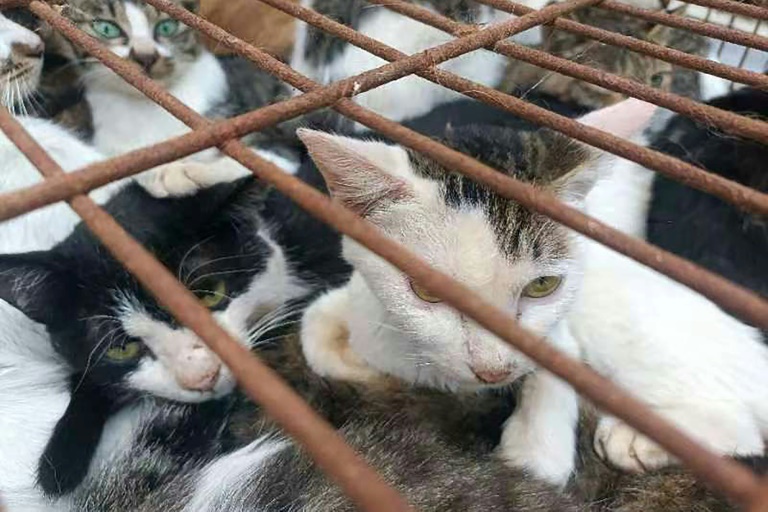
Chinese police rescue 150 cats headed for dinner tables

Nearly 150 cats bound for slaughterhouses have been rescued by police in eastern China, an international animal welfare organisation said.

The animals were crammed into rusty cages when they were found by police in the eastern city of Jinan in Shandong province, Humane Society International (HSI) said in a statement Tuesday.

A gang placed sparrows in cages as bait and used a remote control to shut the traps as soon as each cat entered, an activist with local animal rights group VShine said.

“It was shocking to see the state they were in, many of them emaciated and crying out,” an activist, who only offered their last name Huang, said in a statement to HSI.

“Our discovery of dozens of live sparrows used as bait to lure the cats was also a big shock.”

Most of the rescued felines are believed to have been household pets and have been sent to local animal shelters, the statement added.

Activists also found 31 sparrows — a protected species in China — at the scene and released them back into the wild.

China has no animal cruelty prevention laws, but the suspects could face penalties for hunting the birds, property theft and for violations of animal epidemic prevention rules.

Around 10 million dogs and four million cats are killed for human consumption each year in China, according to HSI.

Dog and cat meat is considered a delicacy in some parts of China, and the trade in their flesh remains lucrative enough to spur criminal gangs to steal pets, though the habit has seen a steady decline as pet ownership has risen.

Every June, the city of Yulin in southern China hosts a dog meat festival, where live canines and cats are sold for eating.

The tradition of eating dogs and cats in south China’s Guangdong and Guangxi provinces dates back thousands of years.

“These are China’s two main cat meat eating hotspots,” Dr Peter Li, HSI China policy specialist, said in a statement.

“Throughout the rest of mainland China, cat meat is not part of the food culture at all.”

The Covid-19 outbreak appears to have further reduced the appetite for cat and dog meat, after the disease was linked to a market in the central city of Wuhan selling live animals for food.

China banned the consumption and trade of wildlife in 2020.

The Guangdong cities of Shenzhen and Zhuhai banned the consumption of dogs and cats in April that year, becoming the first cities in China to do so.

Iraq political gridlock persists after bloody unrest

A months-long political crisis in Iraq showed little sign of abating Wednesday despite a fresh push for negotiations after nearly 24 hours of deadly violence between rival Shiite factions ended.

The highly-secured Green Zone in Baghdad returned to normality after 30 people were killed and 570 wounded in the clashes pitting supporters of powerful Shiite cleric Moqtada Sadr against factions linked to Iran.

Since elections in October last year, political deadlock has left Iraq without a new government, prime minister or president, due to disagreement over the formation of a coalition.

The tensions escalated sharply on Monday when Sadr loyalists stormed the government palace inside the Green Zone following their leader’s announcement that he was quitting politics.

But Sadr’s supporters trickled out of the Green Zone in a steady stream on Tuesday afternoon when he appealed for them to withdraw within the hour.

A nationwide curfew was lifted, before shops reopened and infamous traffic jams returned to Baghdad’s streets on Wednesday as the government announced the resumption of school exams postponed by the unrest.

But the hurdles obstructing a solution to Iraq’s political crisis remained firmly in place, with rival powers refusing to budge on their demands.

Early elections, less than a year after the last polls, and the dissolution of parliament have been a key demand of Sadr.

Iraqi President Barham Saleh said on Tuesday night that snap elections could provide “an exit from the stifling crisis”.

– Snap polls –

Parliament can only be dissolved by a majority vote, according to the constitution. Such a vote can take place at the request of a third of lawmakers, or by the prime minster with the president’s agreement.

Sadr’s rivals in the pro-Iran Coordination Framework want a new head of government to be appointed before any new elections are held.

On Tuesday, they called for the swift formation of a new government, “to prevent a recurrence of the strife” that paralysed the Iraqi capital this week.

The Framework urged parliament and other state institutions to “return to exercising their constitutional functions and carry out their duties towards citizens.”

The statement drew the ire of a senior aid of Sadr, Saleh Mohammad al-Iraqi, who said it overlooked the rightful demands of protesters killed in the Green Zone who want parliament dissolved.

“Iran should reign in its Iraqi camels, or else there will be little room left for regret,” he said on Wednesday, referring to the Coordination Framework.

Prime Minister Mustafa al-Kadhemi, meanwhile, threatened to resign if the political paralysis continues.

“If they want to continue to stir up chaos, conflict, discord and rivalry… I will take the moral and patriotic step and vacate my post at the appropriate time,” he said in a speech.

– ‘More protests’ –

Iraqi political analyst Sajad Jiyad said a return to violence was possible in the absence of a longer term solution.

“The biggest loser is the state, standing idly by while two powerful armed parties continue to struggle for control,” he said.

“Unless a proper solution is reached, more protests and violence are possible.”

Sadr — a longtime player in the war-torn country’s political scene, though he himself has never directly been in government — announced he was quitting politics two days after he said “all parties” including his own should give up government positions in order to help resolve the political crisis.

Sadr’s bloc emerged from last October’s election as the biggest in the legislature, with 73 seats, but short of a majority.

Since then the country has been mired in political deadlock due to disagreement between Shiite factions over forming a coalition.

In June, Sadr’s lawmakers quit in a bid to break the logjam, which led to the Coordination Framework becoming the largest.

Sadr’s supporters had for weeks been staging a sit-in outside Iraq’s parliament, after storming the legislature’s interior on July 30, demanding fresh elections be held.

Close Bitnami banner
Bitnami