World

Russia's Gazprom halts pipeline gas flow in new jitters for Europe

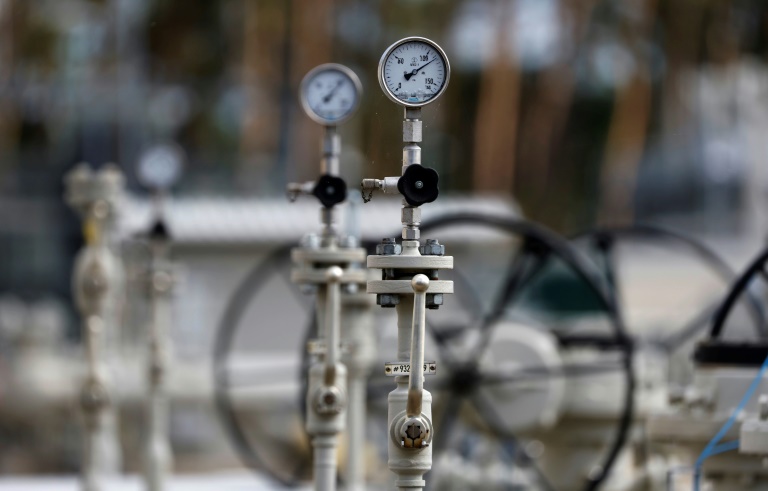
Russian energy giant Gazprom suspended gas deliveries to Germany on a major pipeline on Wednesday, the latest in a series of supply halts that have fuelled an energy crisis in Europe.

Gazprom said supplies via Nord Stream 1 were “completely stopped” for “preventative work” at a compressor unit, shortly after European gas network operator ENTSOG announced that deliveries had ceased.

Gazprom has also said it would suspend gas supplies to France’s main provider Engie from Thursday after it failed to pay for all deliveries made in July.

The latest stop comes as European countries have faced soaring energy prices since Russia invaded Ukraine in late February and subsequently curbed its gas deliveries to the region.

Germany, which is heavily dependent on Russian gas, has accused Moscow of using energy as a “weapon”.

But Gazprom has said the three-day maintenance work was “necessary” and had to be be carried out after “every 1,000 hours of operation”.

Germany’s Federal Network Agency chief Klaus Mueller has called it a “technically incomprehensible” decision, warning that it was likely just a pretext by Moscow to wield energy supplies as a threat.

Experience shows that Moscow “makes a political decision after every so-called maintenance”, he said, adding that “we’ll only know at the beginning of September if Russia does that again”. 

– ‘Much better position’ –

With winter around the corner, European consumers are bracing for huge power bills. Some countries like France have warned that rationing is a possibility.

The European Union is preparing to take emergency action to reform the electricity market in order to bring galloping prices under control, with energy ministers scheduled to hold extraordinary talks next week.

Asked if gas supplies would resume after the three-day works were completed on Saturday, Russian government spokesman Dmitry Peskov said “there is a guarantee that, apart from technical problems caused by sanctions, nothing interferes with supplies”.

Western capitals “have imposed sanctions against Russia, which do not allow for normal maintenance, repair work”, he added, in what appeared to hint at a replay of an earlier round of start-stop rigmarole.

Gazprom had already carried out 10 days of long-scheduled maintenance works in July. While it restored gas flows following the works, it drastically dwindled supplies just days later, claiming a technical issue on a turbine.

The Russian company insists that a key turbine could not be sent to Russia because of sanctions on Moscow. But Germany, where the turbine was located, has said Moscow was itself blocking the component’s delivery to Russia.

An official at Gascade, which operates the distribution network within Germany, also viewed Gazprom’s latest actions sceptically.

“In July, it was regular maintenance planned for a long time by Nord Stream 1, this time it was not planned and we don’t know what is behind this operation,” the official said on condition of anonymity.

A day ahead of the new shutdown, Chancellor Olaf Scholz said Germany was now “in a much better position” in terms of energy security, having achieved its gas storage targets far sooner than expected.

Germany’s gas storage tanks were now almost at 85 percent of capacity, said Mueller, assessing that “Germany is better prepared for the new ‘maintenance’ by Nord Stream”. 

Europe as a whole was also getting a march on filling its gas storage tanks. On Sunday, storage levels were already at 79.9 percent of capacity in the EU.

– ‘Gas emergency’ –

At the same time, fears over throttled supplies have also driven companies to slash their energy usage.

Germany’s industry consumed 21.3 percent less gas in July than the average for the month from 2018 to 2021, said the Federal Network Agency.

Mueller has said such pre-emptive action “could save Germany from a gas emergency this winter”.

And Europe’s biggest economy was already racing to turn its back on Russian gas. 

At the German coastal city of Lubmin, where Nord Stream 1 comes onshore, plans are already well underway for the switch to liquefied natural gas (LNG).

The LNG, transported in by ships, will arrive at Lubmin’s industrial port and be converted back into gas and pumped into Gascade’s distribution network, which has so far been used to funnel Russian gas around the country.

“We expect to be able to inject gas into the distribution network on December 1,” said Stephan Knabe of Deutsche ReGas — the company managing the LNG project.

Russia's Gazprom halts pipeline gas flow in new jitters for Europe

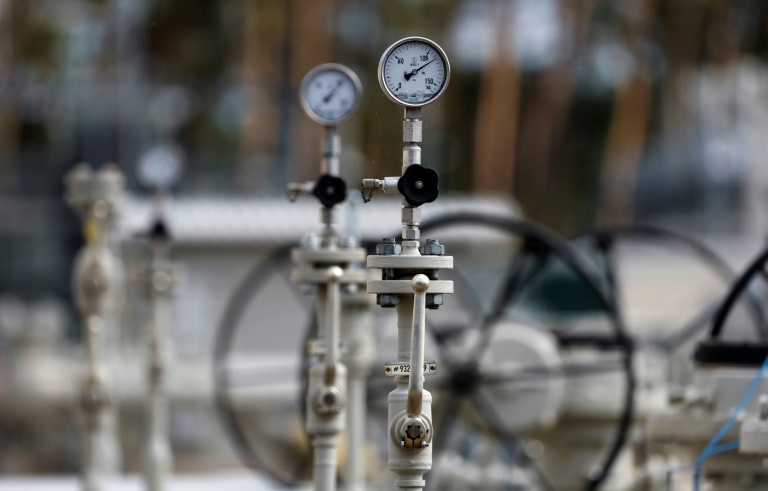
Russian energy giant Gazprom suspended gas deliveries to Germany on a major pipeline on Wednesday, the latest in a series of supply halts that have fuelled an energy crisis in Europe.

Gazprom said supplies via Nord Stream 1 were “completely stopped” for “preventative work” at a compressor unit, shortly after European gas network operator ENTSOG announced that deliveries had ceased.

Gazprom has also said it would suspend gas supplies to France’s main provider Engie from Thursday after it failed to pay for all deliveries made in July.

The latest stop comes as European countries have faced soaring energy prices since Russia invaded Ukraine in late February and subsequently curbed its gas deliveries to the region.

Germany, which is heavily dependent on Russian gas, has accused Moscow of using energy as a “weapon”.

But Gazprom has said the three-day maintenance work was “necessary” and had to be be carried out after “every 1,000 hours of operation”.

Germany’s Federal Network Agency chief Klaus Mueller has called it a “technically incomprehensible” decision, warning that it was likely just a pretext by Moscow to wield energy supplies as a threat.

Experience shows that Moscow “makes a political decision after every so-called maintenance”, he said, adding that “we’ll only know at the beginning of September if Russia does that again”. 

– ‘Much better position’ –

With winter around the corner, European consumers are bracing for huge power bills. Some countries like France have warned that rationing is a possibility.

The European Union is preparing to take emergency action to reform the electricity market in order to bring galloping prices under control, with energy ministers scheduled to hold extraordinary talks next week.

Asked if gas supplies would resume after the three-day works were completed on Saturday, Russian government spokesman Dmitry Peskov said “there is a guarantee that, apart from technical problems caused by sanctions, nothing interferes with supplies”.

Western capitals “have imposed sanctions against Russia, which do not allow for normal maintenance, repair work”, he added, in what appeared to hint at a replay of an earlier round of start-stop rigmarole.

Gazprom had already carried out 10 days of long-scheduled maintenance works in July. While it restored gas flows following the works, it drastically dwindled supplies just days later, claiming a technical issue on a turbine.

The Russian company insists that a key turbine could not be sent to Russia because of sanctions on Moscow. But Germany, where the turbine was located, has said Moscow was itself blocking the component’s delivery to Russia.

An official at Gascade, which operates the distribution network within Germany, also viewed Gazprom’s latest actions sceptically.

“In July, it was regular maintenance planned for a long time by Nord Stream 1, this time it was not planned and we don’t know what is behind this operation,” the official said on condition of anonymity.

A day ahead of the new shutdown, Chancellor Olaf Scholz said Germany was now “in a much better position” in terms of energy security, having achieved its gas storage targets far sooner than expected.

Germany’s gas storage tanks were now almost at 85 percent of capacity, said Mueller, assessing that “Germany is better prepared for the new ‘maintenance’ by Nord Stream”. 

Europe as a whole was also getting a march on filling its gas storage tanks. On Sunday, storage levels were already at 79.9 percent of capacity in the EU.

– ‘Gas emergency’ –

At the same time, fears over throttled supplies have also driven companies to slash their energy usage.

Germany’s industry consumed 21.3 percent less gas in July than the average for the month from 2018 to 2021, said the Federal Network Agency.

Mueller has said such pre-emptive action “could save Germany from a gas emergency this winter”.

And Europe’s biggest economy was already racing to turn its back on Russian gas. 

At the German coastal city of Lubmin, where Nord Stream 1 comes onshore, plans are already well underway for the switch to liquefied natural gas (LNG).

The LNG, transported in by ships, will arrive at Lubmin’s industrial port and be converted back into gas and pumped into Gascade’s distribution network, which has so far been used to funnel Russian gas around the country.

“We expect to be able to inject gas into the distribution network on December 1,” said Stephan Knabe of Deutsche ReGas — the company managing the LNG project.

Chinese electric carmaker BYD plummets after Buffett sale

Shares in Chinese electric carmaker BYD plunged on Wednesday after its largest backer, Warren Buffett’s Berkshire Hathaway, reduced its stake amid speculation of a potential exit.

Hong Kong-listed shares of the EV manufacturer fell by as much as 13 percent, a day after a regulatory filing showed Berkshire reducing its holdings from 20.04 percent to 19.92 percent.

It ended the day 7.9 percent lower, while its Shenzhen-listed stock finished 7.4 percent down.

The sale of around 1.33 million securities was valued at approximately $47 million.

Electronic carmakers in China were left scrambling after the government response to coronavirus outbreaks this year disrupted supply chains, with plants across the country suspending production for weeks.

While the Shenzhen-based firm reported strong earnings this week, rumours have swelled that the legendary American investor behind Berkshire may be looking to offload his entire stake.

Berkshire first bought 225 million BYD shares in 2008 and has been the biggest stakeholder in the company, now China’s largest EV manufacturer and a major rival to Tesla.

Berkshire sold around 6.3 million shares in BYD between June 30 and August 24, Bloomberg News reported, citing filings from both companies.

BYD told Chinese media that there was “no need to over-interpret” the stake sale, adding that the company was operating normally and had no major moves to disclose.

On Monday, the Shenzhen-based company reported that net income had tripled to 3.6 billion yuan ($521 million) from a year earlier, overcoming supply chain disruptions caused by the pandemic and China’s economic slowdown.

BYD said in a filing that it achieved record output and sales in the first half, with revenue jumping 66 percent year-on-year to 151 billion yuan.

The carmaker added that it was leading the domestic new energy vehicle sector with 24.7 percent market share in the first six months, citing data from the China Automobile Association.

“Investors could interpret this as the beginning of Berkshire closing its position in BYD,” Bridget McCarthy, a market research analyst at hedge fund Snow Bull Capital, told Bloomberg.

“I would expect arguably one of the world’s greatest investors to take some profits after over a decade, especially on his highest-returning investment, percentage-wise.”

Some analysts have argued that BYD’s strong fundamentals, coupled with Beijing’s push to develop its domestic green energy sector, means the company still has room to grow.

“Despite the short term share price struggle, there is value to invest in the company with its solid business model in the medium to long term,” Andy Wong, fund manager at LW Asset Management Advisors in Hong Kong, said.

Last month, a stake identical to the size of Berkshire’s holdings was entered into Hong Kong’s Central Clearing and Settlement System. 

Hong Kong requires anyone who owns more than five percent of a listed company to notify the stock exchange when initiating a trade that changes the stake percentage into the next whole number.

Asian markets mostly drop as traders eye more monetary tightening

Most Asian markets resumed their downward trend Wednesday, with traders fearing the Federal Reserve’s determination to beat inflation with higher interest rates will tip the world’s top economy into recession.

After bouncing from their June lows, global equities are once again taking a hiding from worried investors after Fed chief Jerome Powell warned last week the bank would need to tighten policy much more to succeed in its battle against prices.

Wall Street’s three main indexes fell for a third straight day Tuesday to sit at a one-month low, with healthy data on US consumer sentiment and job openings indicating the economy remained resilient despite recent rate hikes and four-decade-high inflation.

But analysts said the readings were a case of good news being bad news as they would allow the Fed to stick to its plan of lifting borrowing costs further. Expectations are growing for a third successive three-quarter-point increase next month.

Traders are now awaiting the release of US job-creation figures on Friday for a better idea about the state of the economy.

However, commentators said trying to plot a course through the next few months would be tricky owing to inflation and rate increases as well as other issues such as the Ukraine war, geopolitical tensions and China’s Covid-damaged economy.

“What’s clear is that predicting this market is not clean cut,” Angeline Newman, of UBS Global Wealth Management, told Bloomberg Television.

“We are living in a world where conflicting economic signals are making the path of monetary policy very difficult to determine.”

Shanghai dropped after a report on Chinese factory activity showed another contraction, as the sector was buffeted by lockdowns due to Beijing’s zero-Covid strategy and high temperatures that led to energy rationing.

The reading reinforced the view that the world’s number-two economy continued to struggle.

There were also losses in Tokyo, Sydney, Singapore, Wellington, Manila and Bangkok, though Seoul, Jakarta and Taipei rebounded from early losses. Hong Kong was flat.

London, Paris and Frankfurt all fell after reversing a positive start.

“Having seen such a promising start to August, last week’s speech by… Powell appears to have been the final straw for any sort of hope that we might see another positive month for equity markets,” said CMC Markets analyst Michael Hewson.

Worries about an economic slowdown and the possible hit to demand were also dragging on oil, which was on course for a third monthly drop, with both main contracts tumbling more than five percent Tuesday.

However, market watchers pointed out the commodity had plenty of upside potential as investors grapple with a range of supply issues including unrest in Libya and Iraq and expectations that Iran nuclear talks will not end any time soon.

Adding to the upward pressure was news that Russian energy giant Gazprom had shut off gas deliveries for three days from Wednesday via the Nord Stream pipeline through Germany.

– Key figures at around 0810 GMT 

Tokyo – Nikkei 225: DOWN 0.4 percent at 28,091.53 (close)

Hong Kong – Hang Seng Index: FLAT at 19,954.39 (close)

Shanghai – Composite: DOWN 0.8 percent at 3,202.14 (close)

London – FTSE 100: DOWN 0.3 percent at 7,340.96

Euro/dollar: DOWN at $1.0007 from $1.0024 on Tuesday

Pound/dollar: DOWN at $1.1644 from $1.1661

Euro/pound: DOWN at 85.92 pence from 85.95 pence

Dollar/yen: DOWN at 138.59 yen from 138.66 yen

West Texas Intermediate: DOWN 0.5 percent at $91.18 per barrel

Brent North Sea crude: DOWN 0.7 percent at $98.60 per barrel

New York – Dow: DOWN 1.0 percent at 31,790.87 (close)

Misery mounts for millions in Pakistan's 'monsoon on steroids'

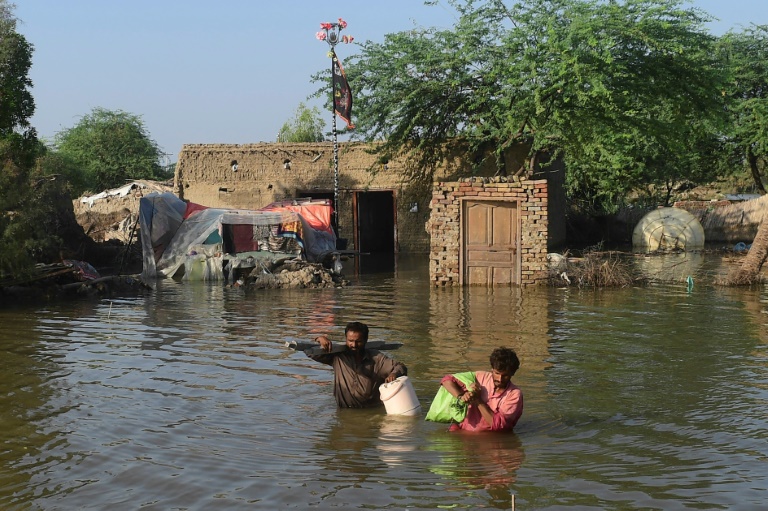
Army helicopters flew sorties over cut-off areas in Pakistan’s mountainous north Wednesday and rescue parties fanned out across waterlogged plains in the south as misery mounted for millions trapped by the worst floods in the country’s history.

Monsoon rains have submerged a third of Pakistan, claiming at least 1,160 lives since June and unleashing powerful floods that have washed away swathes of vital crops and damaged or destroyed more than a million homes.

United Nations chief Antonio Guterres called it “a monsoon on steroids” as he launched an international appeal late Tuesday for $160 million in emergency funding.

Officials say more than 33 million people are affected — one in every seven Pakistanis — and it will cost more than $10 billion to rebuild.

The focus for now, however, is reaching tens of thousands still stranded on hills and in valleys in the north, as well as remote villages in the south and west.

“We appeal to the government to help end our miseries at the soonest,” said Mohammad Safar, 38, outside his submerged home Wednesday in Shikarpur in the southeastern province of Sindh.

“The water must be drained out from here immediately so we can go back to our homes.”

There is so much water however that there is nowhere for it to drain.

Climate Change Minister Sherry Rehman described the country as “like a fully soaked sponge”, incapable of absorbing any more rain.

– ‘Burning with pain’ –

Pakistan has received twice its usual monsoon rainfall, weather authorities say, but Balochistan and Sindh provinces have seen more than four times the average of the last three decades.

Padidan, a small town in Sindh, has been drenched with an astonishing 1.75 metres (70 inches) since June.

Pakistan receives heavy — often destructive — rains during its annual monsoon season, which are crucial for agriculture and water supplies, but such intense downpours have not been seen for three decades.

Officials have blamed climate change, which is increasing the frequency and intensity of extreme weather around the world.

Earlier this year much of the nation was in the grip of a drought and heatwave, with temperatures hitting 51 degrees Celsius (124 Fahrenheit) in Sindh province.

The latest disaster could not have come at a worse time for Pakistan, where the economy is in free fall.

Pakistan Prime Minister Shehbaz Sharif promised aid donors that any funding would be responsibly spent.

“I want to give my solemn pledge and solemn commitment… every penny will be spent in a very transparent fashion. Every penny will reach the needy,” he said.

Pakistan was already desperate for international support and the floods have compounded the challenge.

Prices of basic goods — particularly onions, tomatoes and chickpeas — are soaring as vendors bemoan a lack of supplies from the flooded breadbasket provinces of Sindh and Punjab.

Makeshift relief camps have sprung up all over Pakistan — in schools, on motorways and in military bases.

Displaced people are sweltering in the summer heat with sporadic food aid and little access to water.

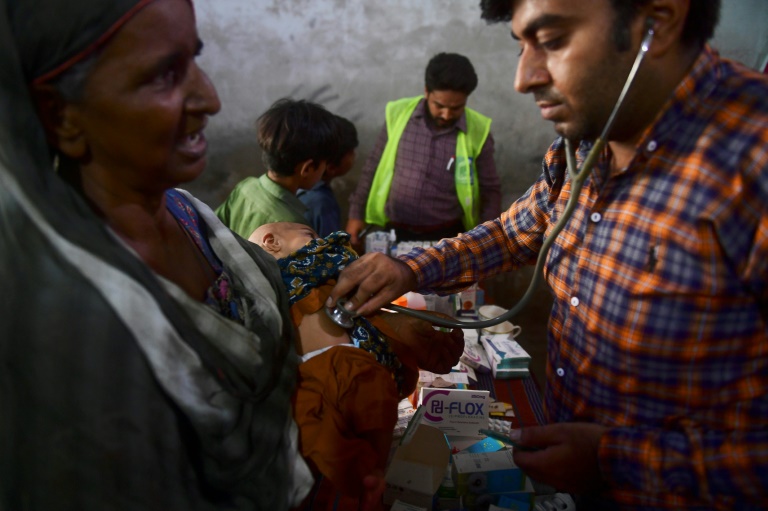
In Sindh, doctors treated patients who made their way to a makeshift clinic after walking barefoot through dirty floodwater, mud and streets full of debris and manure.

“My child’s foot is burning with pain. My feet too,” said Azra Bhambro, a 23-year-old woman who had come to the clinic for help.

In the northwestern town of Nowshera, a technical college was turned into a shelter for up to 2,500 flood victims.

The army said its helicopters had flown over 140 sorties in the past 24 hours, plucking people from cut-off areas in the north, and dropping off food and fresh water elsewhere.

Aid flights have arrived in recent days from China, Turkey and the United Arab Emirates, while other countries including Canada, Australia and Japan have also pledged assistance.

Taliban celebrate anniversary of foreign troop withdrawal

The Taliban declared Wednesday a national holiday and decorated the capital with coloured lights to celebrate the first anniversary of the withdrawal of US-led troops from Afghanistan.

The country’s new rulers — not formally recognised by any other nation — have reimposed their harsh version of Islamic law on the impoverished country, with women squeezed out of public life.

But despite the restrictions, and a deepening humanitarian crisis, many Afghans say they are glad the foreign force that prompted the Taliban insurgency left after a brutal 20-year war.

“We are happy that Allah got rid of the infidels from our country, and the Islamic Emirate has been established,” said Zalmai, a resident of Kabul.

“Happy Independence Day,” tweeted government spokesman Zabihullah Mujahid.

In a separate statement, the government said the day marked “the country’s freedom from American occupation”.

“So many mujhahideen have been wounded (over the years), so many children became orphans and so many women become widows.”

The authorities held an official celebration at Bagram air base, which US forces used to launch air strikes against the Taliban.

Foreign media outlets were not allowed to attend the event.

Kabul was quiet on Wednesday morning with a few Taliban fighters driving around the city and most residents staying indoors after the government declared a national holiday.

– Fireworks in Kabul –

The plane carrying the last US troops took off from Kabul just a minute before midnight on August 31 last year.

That departure ended America’s longest war, which began in the wake of the September 11, 2001 attacks in New York.

Some 66,000 Afghan troops and 48,000 civilians were killed in the conflict, but it was the deaths of US service members — 2,461 in total — that became too much for the American public to bear.

“The burden of the war in Afghanistan, however, went beyond Americans,” the US military said Tuesday.

More than 3,500 troops from other NATO countries were also killed.

Two weeks before the end of last year’s withdrawal, the Taliban seized power following a lightning offensive against government forces.

Banners celebrating victories against three empires — the former Soviet Union and Britain also lost wars in Afghanistan — flew in Kabul on Wednesday.

Hundreds of white Taliban flags bearing the Islamic proclamation of faith flew from lamposts and government buildings, while squares in the capital were decorated with lights.

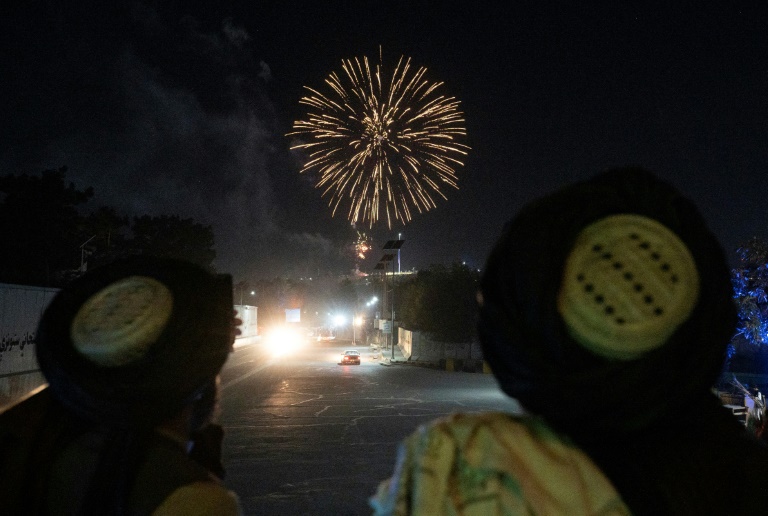
On Tuesday night, the skies above Kabul were lit up with fireworks and celebratory gunfire from crowds of Taliban fighters.

In Massoud Square, near the former US embassy, armed fighters carrying Taliban flags chanted “Death to America”. Others drove around the city honking their horns. 

– Flaunting equipment –

Taliban social media accounts posted videos and pictures of newly trained troops — many flaunting equipment the US military left behind during its chaotic withdrawal.

“This is how you troll a superpower after humiliating them and forcing them to withdraw from your country,” read a tweet with a photo of a giant Taliban flag now painted on the wall of the former US embassy.

Despite the Taliban’s pride in taking over, Afghanistan’s 38 million people face a desperate humanitarian crisis — aggravated after billions of dollars in assets were frozen and foreign aid dried up.

Hardships for ordinary Afghans, especially women, have increased.

The Taliban have shut secondary girls’ schools in many provinces and barred women from many government jobs.

They have also ordered women to fully cover up in public — ideally with an all-encompassing burqa.

“Women are mentally disturbed because they have no career, no education, and no basic rights,” said Zulal, a former government employee in the city of Herat who lost her job after the arrival of the Taliban.

“Girls are particularly distressed after their schools were closed. You can see it on their faces.”

Taliban spokesman Mujahid last week claimed there had been “major achievements” in the past year.

“Afghans are no more being killed in war, foreign forces have withdrawn, and security has improved,” he told reporters.

Documents 'likely concealed' to obstruct Trump probe: Justice Dept

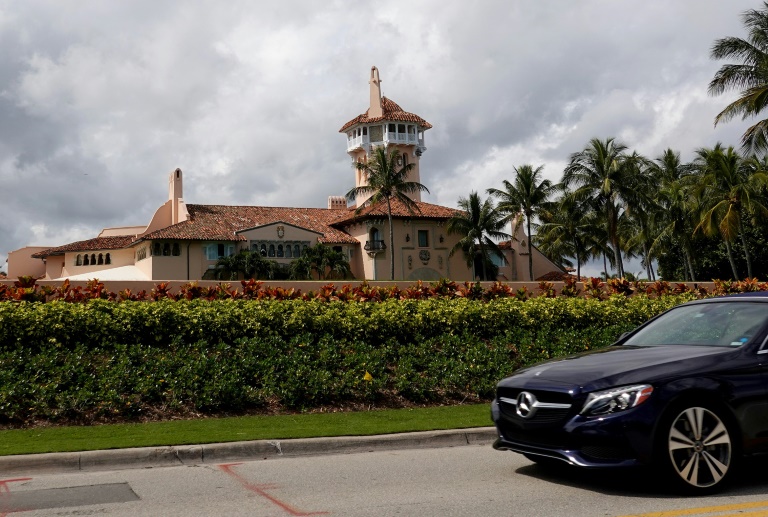
Documents at former US president Donald Trump’s Florida home were “likely concealed” to obstruct an FBI probe into his potential mishandling of classified materials, the Justice Department said in a court filing Tuesday.

The filing provides the most detailed account yet of the motivation for the FBI raid this month on Trump’s Mar-a-Lago estate, which was triggered by a review of records he previously surrendered to authorities that contained top secret information. 

Before the raid, the FBI uncovered “multiple sources of evidence” showing that “classified documents” remained at Mar-a-Lago, the filing says.

“The government also developed evidence that government records were likely concealed and removed… and that efforts were likely taken to obstruct the government’s investigation,” the filing adds.

The DOJ said it provided the detailed background on the build-up to the raid “to correct the incomplete and inaccurate narrative set forth in (Trump’s) filings.”

The filing responds to Trump’s request last week for an independent party, or “special master,” to screen files seized in the FBI raid for materials protected by personal privilege.

Naming a special master could potentially block investigators’ access to the documents, especially if he or she accepts Trump’s claims that most were privileged.

The filing argues that the court should not appoint a special master, “because those records do not belong to (Trump).”

The “appointment of a special master is unnecessary and would significantly harm important governmental interests, including national security interests,” the filing adds.

Trump, who is weighing another White House run in 2024, has accused the Justice Department under Democratic President Joe Biden of conducting a “witch hunt” and said the judge “should never have allowed the break-in of my home.”

'Burning with pain': Pakistan floods threaten major health crisis

At a charity clinic in a southern Pakistani village, dozens of people affected by relentless rains and floods crowd around the door waiting to talk to a volunteer doctor.

The village of Bhambro is in a poor district of Sindh province, hard-hit by record floods that have destroyed more than a million homes and damaged critical infrastructure including health facilities across the country.

Bhambro is surrounded by vast stretches of flooded farmland, its streets full of mud and strewn with debris and manure — conditions ripe for outbreaks of malaria, cholera and skin diseases such as scabies.

“Skin diseases are the main problem here because of dirty, stagnant water and unhygienic conditions,” said Sajjad Memon, one of the doctors at the clinic, which is run by the charity Alkhidmat Foundation.

He used the flashlight on his mobile phone to examine patients, who were mostly reporting scabs and rashes on Tuesday.

Many had made their way to the clinic walking barefoot through filthy floodwater and mud.

“My child’s foot is burning with pain. My feet too,” said Azra Bhambro, a 23-year-old woman who had come to the clinic for help.

Abdul Aziz, a doctor in charge of Alkhidmat’s clinics in the area, told AFP that cases of scabies and fungal infections were on the rise.

Scabies outbreaks are common in crowded places with tropical conditions — such as flood relief camps and shelters — and can lead to severe itching and rashes, according to the World Health Organization.

Memon told AFP that many of the patients at the clinic could not afford to purchase shoes.

– Major health hazards –

The millions of people affected by the floods face major health hazards including potentially deadly diseases such as malaria and dengue fever, the WHO warned in a statement Tuesday.

Sindh province, in Pakistan’s south, has been hit particularly hard, with vast swathes of land under water and many villagers forced to head to large cities for shelter, food aid and medical assistance.

The health threat is even greater in areas such as Bhambro, where health services were already limited, and for the tens of thousands who are taking shelter in crowded relief camps.

“Ongoing disease outbreaks in Pakistan, including acute watery diarrhoea, dengue fever, malaria, polio, and Covid-19 are being further aggravated, particularly in camps and where water and sanitation facilities have been damaged,” the WHO said.

Japan defence ministry asks for $40 bn budget with eyes on Russia, China

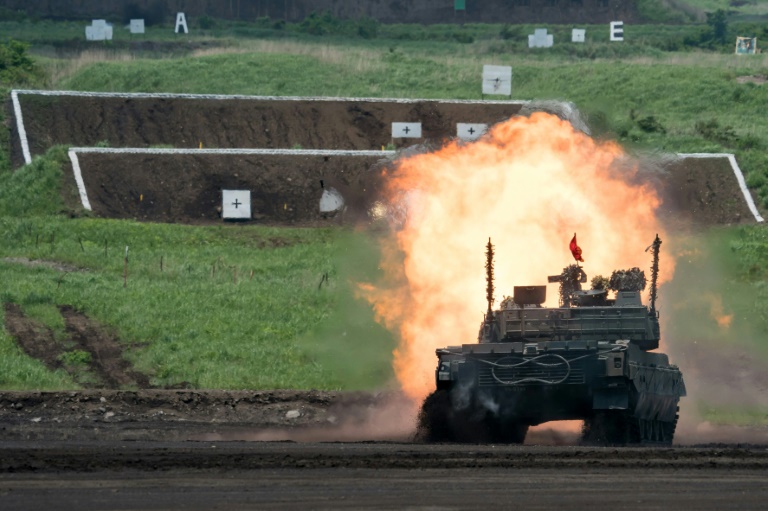
Japan’s defence ministry requested a $40 billion budget on Wednesday, pointing to the war in Ukraine and warning that the world faces its “toughest challenges” since World War II.

Japan’s defence spending has risen almost annually over the last decade, but pressure has grown for more following the Russian invasion of Ukraine and China’s growing pressure on Taiwan.

Prime Minister Fumio Kishida has promised sweeping upgrades, and his defence ministry unveiled a wishlist including armed drones and research on hypersonic missiles.

“The international community faces a period of the toughest challenges since World War II. The existing order faces serious challenges, as the world enters a new era of crisis,” the ministry warned in its request.

“What is happening in Europe can happen in the Indo-Pacific region,” it added, using another term for the Asia-Pacific region.

It said it was seeking 5.59 trillion yen ($40 billion) for the financial year starting April 2023 — a record but a modest increase from last year’s 5.48 trillion request.

However, the final figure — not due until the government finalises several defence policies including a five-year spending outline — is expected to be higher.

Defence officials declined to speculate on the final budget, but nationalist members of Kishida’s ruling party want defence spending to hit two percent of GDP within five years — around 10 trillion yen ($72 billion).

That could make Japan the third-largest military spender after the United States and China, rivalling India and surpassing Britain and Russia.

– ‘A vulnerable country now’ –

Japan’s military is not officially recognised under the country’s post-war constitution and spending on it is limited to nominally defensive capabilities.

The defence budget has traditionally hovered around one percent of GDP, but Nozomu Yoshitomi, a former army major general who now teaches defence policy at Nihon University, said it must increase.

“Japan is a vulnerable country now, being directly exposed to a powerful China,” he told AFP.

“It feels only natural that Japan increases its defence budget.”

Toshiyuki Ito, a professor at the Kanazawa Institute of Technology and a retired vice admiral at Japan’s Maritime Self-Defense Force, said boosting military spending to two percent of GDP may be difficult.

“It’s difficult to imagine it will go straight to an additional five trillion yen,” he told AFP.

He said an extra two trillion yen a year was a more realistic target and would provide much-needed funds to improve pay and supplies for Japanese troops.

“We need to invest in people and routine maintenance,” he told AFP.

Kishida has not yet committed himself to a specific target, saying increases will be weighed against tax revenues and spending priorities.

Any increase in military spending will put more pressure on Japan’s government, which is already saddled with enormous costs associated with an ageing and shrinking population.

Gazprom halts pipeline gas flow in new jitters for Europe

Russian energy giant Gazprom suspended gas deliveries to Germany for maintenance on a major pipeline on Wednesday, the latest in a series of supply halts that have fuelled an energy crisis in Europe.

Gazprom said supplies via Nord Stream 1 were “completely stopped” for “preventative work” at a compressor unit, shortly after the the pipeline’s operator, Entsog, announced that deliveries had stopped.

The move comes as European countries have faced soaring energy prices since Russia invaded Ukraine in late February and subsequently curbed its gas deliveries to the region.

Germany, which is heavily dependent on Russian gas, has accused Moscow of using energy as a “weapon”.

But Gazprom has said the three-day maintenance work was “necessary” and had to be be carried out after “every 1,000 hours of operation”.

Germany’s Federal Network Agency chief Klaus Mueller has called it a “technically incomprehensible” decision, warning that it was likely just a pretext by Moscow to wield energy supplies as a threat.

Experience shows that Moscow “makes a political decision after every so-called maintenance”, he said, adding that “we’ll only know at the beginning of September if Russia does that again”. 

– ‘Much better position’ –

With winter around the corner, European consumers are staring down the barrel of huge power bills. Some countries like France have warned that rationing is a possibility.

The European Union is preparing to take emergency action to reform the electricity market in order to bring galloping prices under control, with energy ministers scheduled to hold extraordinary talks next week.

Asked if gas supplies would resume after the three-day works were completed on Saturday, Russian government spokesman Dmitry Peskov said “there is a guarantee that, apart from technical problems caused by sanctions, nothing interferes with supplies”.

Western capitals “have imposed sanctions against Russia, which do not allow for normal maintenance, repair work”, he added, in what appeared to hint at a replay of an earlier round of start-stop rigmarole.

Gazprom had already carried out 10 days of long-scheduled maintenance works in July. While it restored gas flows following the works, it drastically dwindled supplies just days later, claiming a technical issue on a turbine.

The Russian company insists that a key turbine could not be sent to Russia because of sanctions on Moscow. But Germany, where the turbine was located, has said Moscow was itself in fact blocking the turbine’s delivery to Russia.

An official at Gascade, which operates the distribution network within Germany, also viewed Gazprom’s latest actions sceptically.

“In July, it was regular maintenance planned for a long time by Nord Stream 1, this time it was not planned and we don’t know what is behind this operation,” the official said on condition of anonymity.

A day ahead of the new shutdown, Chancellor Olaf Scholz said Germany was now “in a much better position” in terms of energy security, having achieved its gas storage targets far sooner than expected.

Europe as a whole was also getting a march on filling its gas storage tanks. On Sunday, storage levels were already at 79.9 percent of capacity in the EU.

– ‘Gas emergency’ –

At the same time, fears over throttled supplies have also driven companies to slash their energy usage.

Germany’s industry consumed 21.3 percent less gas in July than the average for the month from 2018 to 2021, said the Federal Network Agency.

Mueller has said such pre-emptive action “could save Germany from a gas emergency this winter”.

And Europe’s biggest economy was already racing to turn its back on Russian gas. 

At the German coastal city of Lubmin, where Nord Stream 1 comes onshore, plans are already well underway for the switch to liquefied natural gas (LNG).

The LNG, transported in by ships, will arrive at Lubmin’s industrial port and be converted back into gas and pumped into Gascade’s distribution network, which has so far been used to funnel Russian gas around the country.

“We expect to be able to inject gas into the distribution network on December 1,” said Stephan Knabe of Deutsche ReGas — the company managing the LNG project.
The company believes that up to 4.5 billion cubic metres of gas can be imported via the Lubmin LNG terminal alone, making up around eight percent of Nord Stream 1’s capacity.

Close Bitnami banner
Bitnami