World

Virtual reality revives Iraq's war-ravaged heritage

An Iraqi museum is using computer technology and virtual reality headsets to turn back time, so visitors can explore heritage sites destroyed by jihadist fighters and in battles to defeat them.

Islamic State group fighters captured a third of Iraq in a lightning offensive in 2014, seizing the northern city of Mosul as their stronghold and vandalising or destroying a swathe of cultural sites across the country.

Now, using thousands of photographs, a group of local engineers have given a virtual rebirth to five historic sites in Mosul and the broader Nineveh province, including a mosque and its leaning minaret.

“It takes you to another world,” said Mahiya Youssef, pulling the VR goggles off her rose-covered hijab at the Mosul Heritage House museum, after exploring the 3D images of damaged buildings.

“I really wish it was the real Mosul, not just a virtual version”, added Youssef, 50, who works in a food factory in the northern city. “The return to reality is painful.”

The IS group’s then chief, Abu Bakr al-Baghdadi, made his only confirmed public appearance at Mosul’s Al-Nuri mosque, where he declared the establishment of a “caliphate”.

Mosul’s Old City was reduced to rubble during the battle to retake the city, including the mosque and its adjacent leaning minaret, nicknamed Al-Hadba or the “hunchback”.

Iraqi authorities have accused IS of planting explosives at the site before their withdrawal. Only the minaret’s base survived.

– ‘Retrieve memories’ –

VR technology has been used before to recreate the heritage destroyed by the IS group, including a UNESCO-backed exhibit in the United States.

But this museum brings sites back to life for the people who live in Mosul.

“Many children have never seen the Al-Nuri mosque and its Al-Hadba minaret,” 29-year-old Ayoub Younes, the museum’s founder.

“We try, through virtual reality, to let the person experience visiting those sites and retrieve those memories.”

Five years after Iraqi forces and an international coalition routed the jihadists in mid-2017, historic sites, mosques and churches in Mosul are still being restored.

But large parts of the Old City remain oceans of debris.

While some residents have returned to other districts, much of the city remains a patchwork of buildings either ruined or under construction. 

The private museum with a marble facade, sitting along the Tigris river, opened in mid-June and saw more than 4,000 visitors in its first month, Younes said. 

In a sombre room, curious visitors wait to use the museum’s sole VR headset, a pair of large black googles.

Other sites on the virtual visit are the historic Al-Tahera church, tucked among the once meandering alleyways of the Old City, and the more than 2,000 year old Hatra archaeological site in the desert south of Mosul.

The jihadists took guns and pickaxes to the once extensive remains of the ancient city, releasing video footage in 2015 of their orgy of destruction. 

– ‘Saving the memory’ – 

On his computer screen, Abdullah Bashir showed a 3D replica of the mosque housing the Nabi Yunus shrine — revered by both Muslims and Christians as the tomb of Prophet Jonah — which the extremists blew up in 2014.

“We used personal photos and shots taken by residents” to reconstruct the sites in their former state, he said.

But he said there were “very few” images before 2014, citing the “lack of photos” as the main difficulty.

Bashir and other specialised engineers from QAF Lab have brought the former scenes back to life, in a project he says is “a way of saving the memory of Mosul”.

After his virtual tour, visitor Mohammed Abdullah pushed his wheelchair around the real-life displays in museum’s vaulted rooms.

Many of the exhibits are daily-life objects donated by local families, from terracotta amphoras to oil lamps, traditional wall hangings, metal containers and even an old radio.

Abdullah, 28, a student of telecommunication engineering, also said the contrast between the VR and the reality of Mosul was painful.

“Reconstruction is extremely slow, and is not equal to the devastation,” said Abdullah.

He called for faster restoration of heritage sites both to attract tourists and to “breathe life” into nearby areas. 

Despite the bitter taste the virtual visit left, he said he has not lost hope. 

“The day will come when we will make this visit in reality,” he said. “It will be even better than the virtual one”.


Experienced Truss favourite to be next UK PM

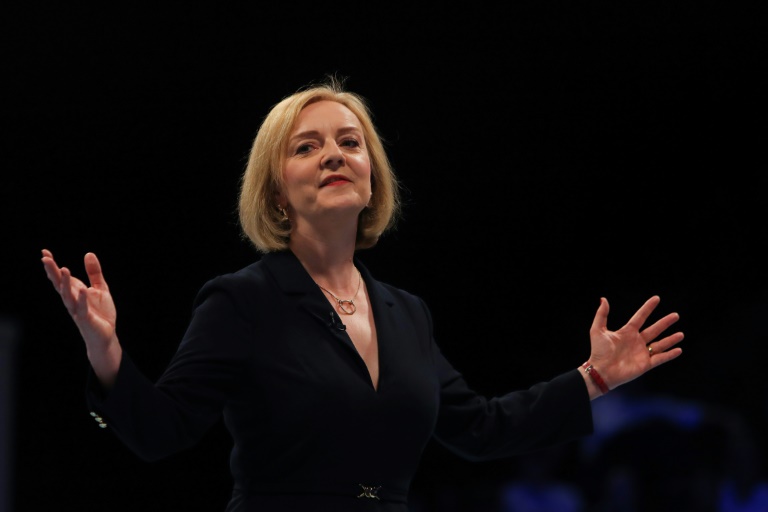
Liz Truss has emerged as the clear favourite to succeed Boris Johnson as leader of the ruling Conservative party and UK prime minister, using her political experience to pull ahead of challenger Rishi Sunak.

Sunak helped to spark the contest after resigning in opposition to a series of government scandals, prompting others to follow and Johnson to step down.

But although considered a better public speaker, he has come under fire for clinging to fiscal orthodoxy to tackle the economic crisis and hamstrung by his image as a wealthy technocrat.

Sunak, who would become Britain’s first prime minister of colour, has also faced accusations of treachery for bringing down the Tories’ Brexit hero Johnson.

Truss meanwhile has doggedly hammered home a direct and consistent message, promising massive tax cuts, and has shied away from criticising Johnson.

“She’s a better politician,” said John Curtice, a political scientist at the University of Strathclyde in Glasgow.

“If you ask me what Liz Truss’s campaign was about I will immediately say to you: ‘a tax cut not a handout’. Very clear,” he told AFP.

“There is no strapline for Sunak, nothing.”

For Curtice, Truss has effectively conveyed “traditional Conservative messages” to Tory members while Sunak has been more nuanced.

“It’s also a bit of a lecture,” he said, assessing that he has come across as “a wee bit brittle” under pressure.

“You can see that she’s been in the game for longer,” he added.

– Political journey –

Truss, 47, has described her ascent towards the top of British politics as a “journey” that has seen her criticised for being ambitiously opportunistic.

She comes from a left-wing family and initially joined the centrist Liberal Democrats before jumping ship to the right-wing Conservatives.

She became MP for the South West Norfolk constituency in eastern England in 2010, surviving revelations of an affair that almost cost her the nomination.

Since 2012 she has held a series of ministerial posts in the education, finance and departments as well as a difficult spell in justice.

In 2016, she campaigned for the UK to remain in the European Union but quickly became one of its strongest supporters when Britons voted for Brexit.

When the UK left the EU, Johnson put her in charge of negotiating new free trade deals before appointing her as foreign secretary last year.

In the role, she took on the controversial task of trying to overhaul differences with Brussels about post-Brexit trade in Northern Ireland.

Like Johnson, she has talked tough on Russia and given unswerving backing for Ukraine.

Truss’s dress sense and photo opportunities — posing in a tank in Estonia and wearing a fur hat in Moscow — have earned her comparisons to Tory icon Margaret Thatcher.

Her sometimes stiff style has become visibly more relaxed and allies have sought to soften her image, revealing her love of karaoke and socialising.

– Establishment elite? –

“For a party that’s gone in quite a populist direction in recent years, she’s been able to present herself as more authentic, more ordinary than Rishi Sunak, who is all too easily presented as part of the global elite,” said Tim Bale, from Queen Mary University of London.

“Like Boris Johnson, she is keen on the idea that there is some kind of elite that has to be countered and she sets herself up as being outside the establishment, despite having been in government for eight years.”

Sunak, 42, the grandson of Indian immigrants, grew up as the son of a doctor and a pharmacist in Southampton, on England’s south coast.

He attended the prestigious fee-paying Winchester College school, then Oxford University. 

Truss, who went to a state school in Leeds, northern England, also studied at Oxford. Both studied politics, philosophy and economics.

Sunak met his wife, Akshata Murty, whose father founded the Indian tech giant Infosys, at US university Stanford before jobs at Goldman Sachs and investment funds.

He has represented the constituency of Richmond in northern England since 2015, where he was soon marked out as a potential future prime minister.

He became finance minister in early 2020, quickly winning plaudits for spearheading government support to people and businesses affected by the coronavirus pandemic.

But Sunak, a self-confessed geek with a love of Star Wars, saw opinion turn against him this year, after it emerged that his wife did not pay UK tax.

Critics have also used his private wealth, expensive clothes and houses to portray him as out of touch with the ordinary public.

'Quiet quitting' raising a din in stressful US workplaces

They are drawing a line at the 40-hour work week, limiting after-hours calls and emails and generally, if softly, saying “no” more often — some American workers are embracing the concept of “quiet quitting” as they push back against what some see as the stifling trap of constant connectivity. 

Maggie Perkins — who lives in Athens, Georgia — was racking up 60-hour weeks as a matter of course in her job as a teacher, but the 30-year-old realized after her first child was born that something was wrong. 

“There’s pictures of me grading papers on an airplane on the way to vacation. I did not have a work-life balance,” Perkins explains in a TikTok video about how she chose — though she did not have a name for it back then — to begin “quiet quitting.” 

Perkins told AFP she eventually left her job to pursue a PhD, but remains an advocate for her former colleagues — producing videos and podcasts with practical tips on making their workload fit inside their workday.

“Adopting this ‘quiet quitting’ mindset really just means that you are establishing a boundary that helps you to do your job when you are paid to do it — and then you can leave that, and go home and be a human with your family,” she says.

– Work-life balance or slacking? –

The buzzword seems to have first surfaced in a July TikTok post.

In the words of user @zaidleppelin, “You’re not outright quitting your job but you’re quitting the idea of going above and beyond. You’re still performing your duties but you’re no longer subscribing to the hustle culture mentality that work has to be your life.”

That post went viral, drawing nearly a half-million likes. Responses bubbled over with a sense of shared resentment — and newspaper columnists spilled ink all summer trying to decipher the phenomenon.

For the debate soon erupted: Are “quiet quitters” merely trying to draw boundaries in pursuit of a reasonable work-life balance, more associated with a European lifestyle than with always-on US work culture? 

Are they slackers with a trendy new name? Or are they people at genuine risk of burnout — who would do best to quit outright?

Data suggests the need for greater balance is real.

On-the-job stress rose from 38 percent of those polled in 2019 to 43 percent the following year as Covid-19 upended the world of work, Gallup found, with women in the United States and Canada facing the most pressure.

Similar dynamics helped fuel the “Great Resignation” — the surge in employees leaving or switching jobs amid pandemic-related pressures.

Many “quiet quitters” say they are perfectly willing to work hard, but only for the hours the job is meant to entail. Their motto: “act your wage.”

Some observers are skeptical, of course, contending that offices have always had their share of clock-watchers and prickly workers claiming certain tasks are not their responsibility.

Going further, Arianna Huffington, founder of the Huffington Post, panned the phenomenon as “a step toward quitting on life.”

But former US labor secretary Robert Reich summed up the — forceful — counterargument, saying “Workers aren’t ‘quiet quitting.’ They’re refusing to be exploited for their labor.”

– ‘Six months of dread’ –

A case in point: the experience of Bess, who asked not to be identified by her real name, illustrates how Covid allowed some jobs to spill far outside their normal boundaries.

She was hired shortly before the pandemic in a job originally meant to involve regular trips to Germany. 

But, she told AFP, Covid left her stuck in her New York apartment, having to take phone calls as early as 3:00 am due to the time difference.

Out of self-preservation, she began to dial back her efforts — which her American friends had trouble understanding.

“There is that stigma — you put your blood, sweat and tears into your job in the US, and if you don’t work, you don’t deserve to be here,” she said.

“After six months of dread,” Bess explains, she simply stopped answering emails for several weeks — and ultimately parted ways with her company.

Philip Oreopoulos, a labor economist at the University of Toronto, said one solution is better communications to clarify employer expectations before accepting a job.

“If you need to be on call at home, then they should clearly state that,” he said.

And if things do get out of hand — and quiet quitting won’t fix the problem — aggrieved workers do have one asset to fall back on: a historically low unemployment rate.

“Come to an employer and say, ‘I have an opportunity with another firm and I’m thinking of taking it,'” Oreopoulos said. “It’s a good time in general to be asking for a raise.”

Truss tipped to prevail as UK leadership race nears end

The race to become Britain’s next prime minister is in its final week, with Liz Truss appeared poised to secure the top job, along with daunting challenges.

Foreign Secretary Truss, 47, has consistently outrun 42-year-old former finance minister Rishi Sunak by wide margins in polls of Conservative party members who will decide the contest, which started in early July.

An estimated 200,000 Tory grassroots have been able to vote since earlier this month for their preferred candidate, before postal and online ballots close on Friday.

The winner will be announced next Monday and replaces outgoing leader Boris Johnson in Downing Street the following day — only to face immediate crises over the spiralling cost of living.

The unenviable job of leading Britain through its highest inflation in 40 years and warnings of an imminent recession arose after Johnson announced in early July that he would be standing down.

It followed months of scandals that eventually triggered Sunak and dozens of other ministers to resign from government, forcing his departure.

However, some ministers and MPs — including Truss — remained loyal to the end, arguing Johnson deserved more time to turn around his controversy-tarred three-year tenure.

Nearly 10,000 Tory members are reportedly so angry at his enforced resignation they are pushing the ruling party to allow a vote over whether to accept it.

The Tory hierarchy is resisting the move while Downing Street has distanced itself from the campaign, insisting Johnson will back the winner of the leadership fight. 

Whoever that is may struggle to reunite the Conservatives, with the splits worsened by the bitter battle between Truss and Sunak.

– Backlash –

Eight Conservative MPs initially qualified to run in the race, before the party’s MPs whittled that number down in five ballots.

Sunak was the early frontrunner, topping all those votes of Conservative MPs while Truss repeatedly finished third. 

She scraped into the final pairing on July 20 by just eight votes.

However, once the run-off began she quickly became the frontrunner, winning the endorsements of big hitters in Johnson’s outgoing cabinet and stealing the support of several MPs from her rival’s camp.

Sunak, who has faced a backlash from some Tory members over his part in ousting Johnson, has been relegated to long-shot contender.

The two candidates have sparred over their policies and records in several television debates as well as a dozen hustings in front of members — the last of which will be held in London Wednesday evening.

But with surveys showing Truss leading by more than 30 points, the contest seems effectively over.

However, recent polls of the wider electorate show the challenge ahead.

The main opposition Labour party now boasts a double-digit lead over the Conservatives in a deteriorating economic landscape.

The next general election is due by January 2025 at the latest, but could come sooner, with most people expecting it in 2024.

– ‘Remarkable achievement’ –

The leadership contest has been dominated by how to respond to Britain’s growing economic woes, with the rival candidates and their camps descending into open political warfare.

Truss has pledged immediate tax cuts and renewed focus on economic growth, while assailing her rival for pushing taxes to record highs and presiding over declining growth.

Sunak has emphasised the need to maintain current taxes — including recent rises — in the short-term, while pledging more targeted support for the most needy during the cost-of-living crisis.

He has argued his finance ministry record during the pandemic shows he can help Britons through the economic woes. 

His furlough scheme, which temporarily paid the wages of millions, is credited with staving off mass unemployment.

First elected to parliament in 2015 and a Brexit supporter during the 2016 referendum, Sunak has accused Truss of “fairytale economics” and claimed her tax cuts will worsen inflation. 

But analysts say the campaign has shown Truss — first elected an MP in 2010 — possesses superior political experience and skills.

“She was able to communicate effectively,” said polling expert John Curtice, noting Sunak had appeared a “bit brittle”.

Politics professor Tim Bale, of Queen Mary University of London, noted Truss had in some ways defied her own record. 

A minister in successive Tory governments for the past decade, who voted to remain in the European Union in 2016, she nonetheless showcased a populist anti-establishment image in the race.

“She’s somehow managed to present herself as more Brexiteer than Rishi Sunak, who actually voted to leave (the EU), which is a remarkable achievement,” said Bale.

NASA shoots for the Moon, on its way to Mars

NASA’s most powerful rocket yet is set to blast off Monday on the maiden voyage of a mission to take humans back to the Moon, and eventually to Mars.

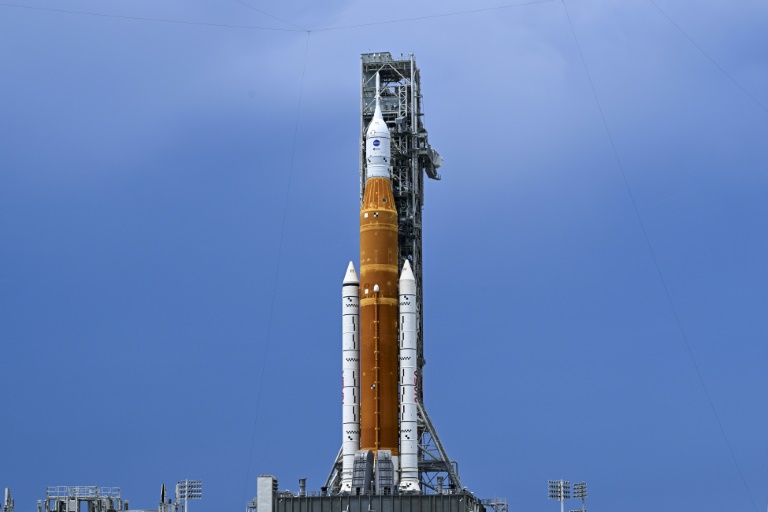
Fifty years after the last Apollo mission, the space program called Artemis is to get under way with the blast off of the uncrewed 322-foot (98-meter) Space Launch System (SLS) rocket at 8:33 am (1233 GMT) from the Kennedy Space Center in Florida.

Tens of thousands of people are on hand along the beaches of Florida to watch this launch that’s been decades in the making. They include Vice President Kamala Harris.

Hotels around Cape Canaveral are booked solid with between 100,000 and 200,000 spectators expected to attend the launch.

The goal of the flight, baptized Artemis 1, is to test the SLS and the Orion crew capsule that sits atop the rocket.

The capsule will orbit the Moon to see if the vessel is safe for people in the near future. At some point Artemis will see a woman and a person of color walk on the Moon for the first time.

“This mission goes with a lot of hopes and dreams of a lot of people. And we now are the Artemis generation,” NASA administrator Bill Nelson said Saturday.

The massive orange-and-white rocket has been sitting on the space center’s Launch Complex 39B for a week.

Its fuel tanks were to be filled overnight Sunday into Monday with more than three million liters of liquid hydrogen and oxygen.

NASA said there is an 80 percent chance of acceptable weather for a liftoff on time at the beginning of a launch window lasting two hours.

For the first time a woman  — Charlie Blackwell-Thompson — will give the final green light for liftoff. Women now account for 30 percent of the staff in the control room; there was just one back with Apollo 11.

Cameras will capture every moment of the 42-day trip and include a selfie of the spacecraft with the Moon and Earth in the background.

The Orion capsule will orbit around the Moon, coming within 60 miles (100 kilometers) at its closest approach and then firing its engines to get to a distance 40,000 miles beyond, a record for a spacecraft rated to carry humans.

– Temperatures half as hot as the Sun –

Besides the weather, any kind of technical snafu could delay the liftoff at the last minute, NASA officials have said, stressing that this is a test flight.

If the rocket is unable to take off on Monday, September 2 and 5 have been penciled in as alternative flight dates.

One of the primary objectives of the mission is to test the capsule’s heat shield, which at 16 feet in diameter is the largest ever built.

On its return to the Earth’s atmosphere, the heat shield will have to withstand a speed of 25,000 miles per hour and a temperature of 5,000 degrees Fahrenheit (2,760 degrees Celsius). That is half as hot as the Sun.

Taking the place of people for now, dummies fitted with sensors will take the place of crew members, recording acceleration, vibration and radiation levels.

It will deploy small satellites to study the lunar surface.

A complete failure would be devastating for a program that is costing $4.1 billion per launch and is already running years behind schedule.

– Life on the Moon –

“What we are starting with the launch Monday is not a near term sprint, but a long term marathon to bring the solar system and beyond into our sphere,” said Bhavya Lal, NASA associate administrator for technology, policy, and strategy.

The next mission, Artemis 2, will take astronauts into orbit around the Moon without landing on its surface. The crew of Artemis 3 is to land on the Moon in 2025 at the earliest.

While the Apollo astronauts who walked on the Moon were exclusively white men, the Artemis program plans to include the first woman and person of color.

And since humans have already visited the Moon, Artemis has its sights set on another lofty goal — an eventual crewed mission to Mars.

The Artemis program is to establish a lasting human presence on the Moon with an orbiting space station known as Gateway and a base on the surface.

Gateway would serve as a staging and refueling station for a voyage to Mars that would take a minimum of several months.

Thousands of Orthodox Serbians march against EuroPride

Thousands of Orthodox Christians marched in Belgrade Sunday to warn against holding EuroPride, despite the Serbian authorities’ decision to cancel the pan-European gathering of the LGBTQ community next month.

Carrying icons, crosses and religious flags, protesters marched through the city centre while praying and chanting before gathering outside the cathedral of St Sava.

President Aleksandar Vucic on Saturday announced that he had decided, in consultation with the government, that the pride parade would be “postponed or cancelled”.

Vucic said it was not possible to “handle everything” at a time when Serbia was “pressured with all kinds of problems”, underlining recent tensions with former province Kosovo and concerns over energy and food.

But EuroPride organisers vowed to press on with the parade.

“Pride will go ahead as planned on September 17,” Belgrade Pride coordinator Marko Mihailovic said.

Addressing the crowd on Sunday, Serbian Orthodox Bishop Nikanor hailed the authorities’ decision to reverse “the desecration of our country, our Church and our family”. 

For him, it was an “abnormality” which should be treated as in the Russia of President Vladimir Putin — whom he referred to as “the tsar of the planet”, according to video footage on the Glas Javnosti news site.

In 2013, Russia introduced a law banning LGBT “propaganda” aimed at minors, punishable with fines and imprisonment.

Bishop Nikanor said the faithful were ready to take to the streets again to “put themselves before those who intend to destroy the values of Serbia”.

The first two Belgrade Pride marches, in 2001 and 2010, were marred by violence. The parade has been organised regularly since 2014 but with a large law enforcement presence.

Rival Libya leaders trade blame after Tripoli clashes kill 32

Libya’s rival premiers on Sunday traded accusations over deadly clashes in Tripoli — the worst in the capital since a landmark 2020 ceasefire and which sparked fears of a major new conflict.

The health ministry said 32 people were killed and 159 wounded during the fighting between rival armed groups which began overnight Friday and continued into Saturday, setting buildings on fire and damaging several hospitals.

The fighting came after months of mounting tensions between backers of Abdulhamid Dbeibah and Fathi Bashagha, whose administrations are vying for control of the oil-rich North African country.

Dbeibah, whose government was installed in Tripoli in the country’s west as part of a United Nations-led peace process last year, accused his rivals of responding to “foreign agendas”.

Local media and experts said Bashagha had failed in what was his second attempt to dislodge his rival from the capital in three months. 

In a video address late Sunday, Dbeibah lashed out at “criminals” and “putschists” who “waged war on the capital with tanks and heavy weapons”.

He vowed to “go after all those involved” and to relocate the headquarters of some armed groups outside the city centre.

Earlier, his rival Bashagha, who was appointed by Libya’s eastern-based parliament this year, said Dbeibah, “his ruling family and his armed gangs” were “responsible for the blood that flowed” in Tripoli, accusing them of wanting to cling onto power “at any cost”.

Bashagha, a former interior minister, is backed by powerful eastern military chief Khalifa Haftar, whose 2019 attempt to seize the capital by force turned into a year-long conflict.

Dbeibah has refused to cede power on the grounds that the next administration should be the product of elections.

– ‘Terrified’ –

Libya plunged into chaos following the 2011 overthrow and killing of dictator Moamer Kadhafi in a NATO-backed uprising, with myriad armed groups and foreign powers moving to fill the power vacuum.

A cautious calm had set in by Saturday evening, an AFP correspondent reported. Flights resumed and shops re-opened on Sunday.

During the fighting, rockets “were flying over our heads, in the middle of residential buildings,” said resident Mohammed Abaya, 38.

“We were terrified,” said another resident, retiree Lotfi Ben Rajab. “A rocket fell in my neighbour’s living room but didn’t explode, thank God”.

Bashagha had initially ruled out the use of violence to take power in Tripoli but subsequently hinted that he could resort to force.

Certain armed groups, seen as neutral in the latest crisis, returned to support Dbeibah this weekend to push back Bashagha.

The public prosecutor on Sunday asked the head of passports to issue travel bans against Bashagha, some of his ministers and a former military intelligence official, according to a letter carried by local media.

Dbeibah said earlier Sunday he would create two committees to survey the damage from the fighting.

– Shifting sands –

Dbeibah’s Government of National Unity said fighting had broken out after negotiations to avoid bloodshed in Tripoli collapsed. Bashagha denied such talks had taken place.

The UN’s Libya mission had called for “an immediate cessation of hostilities”, deploring “indiscriminate medium and heavy shelling in civilian-populated neighbourhoods”.

Local media reported late Saturday that a group of pro-Bashagha militias that had been making their way to the capital from Misrata later turned back.

The fighting prompted several airlines to cancel flights to and from the capital, but flights resumed and shops reopened on Sunday morning. Educational institutions said student exams would go ahead on Monday.

On Saturday evening, Dbeibah ordered the arrest of anyone involved in the “attack on Tripoli”, both civilian and military.

A pro-GNU force from Misrata — the hometown of both Dbeibah and Bashagha — said Sunday it had arrested several “assailants”. 

But analysts said the crisis was far from resolved, with the capital controlled by a multitude of armed groups with shifting alliances.

The “groups that found themselves on the same side in yesterday’s Tripoli fighting will tomorrow clash over turf, positions and budgets,” analyst Wolfram Lacher said on Twitter.

“The factions that were pro-Dbeibah yesterday will challenge him tomorrow.”

'Sight to behold': tourists flock to Florida for Moon rocket launch

Seeing a rocket blast off to the Moon is “a once-in-a-lifetime thing to experience,” says Joanne Bostandji. 

The 45-year-old has traveled all the way from northern England to Florida with her husband and two children for a space-themed vacation, and they’re prepared to make sure they don’t miss a second of the action as NASA’s newest and most powerful rocket is scheduled to launch for the first time Monday. 

“The plan is to drive very early in the morning and get a spot” on Cocoa Beach, she said, not far from the Kennedy Space Center. 

“I know it’s going be from a far distance, but I still think it’s going be a sight to behold,” Bostandji told AFP as the family waited to enter a park dedicated to space exploration.  

Between 100,000 and 200,000 visitors are expected to attend the launch of the mission, called Artemis 1, which will propel an empty capsule to the Moon as part of a test for future crewed flights.

The “historic nature” of Monday’s flight, the first of several as the United States returns to the Moon, “certainly has increased public interest,” Meagan Happel of Florida’s Space Coast Office of Tourism told AFP.

Traffic jams are expected to start by 4 am, with the launch scheduled at 8:33 am (1233 GMT). 

And even more people might show up if the launch faces a weather delay, as the make-up date falls on a weekend. 

– Space cruise –

Sabrina Morley was able to find an apartment to rent not far from the beach, and plans to bring her two children and a few dozen other people on a boat chartered for the occasion by a company called Star Fleet Tours. 

For $95 a ticket, “we’ll go out into the ocean as close as they can get to the launch and we’ll watch the launch from the boat,” she said

“I’ve never been this close to a launch before,” said the 43-year-old, who grew up in Orlando, less than an hour away. 

As a child, she could see space shuttles taking off from her backyard, like “an orange ball of smoke” rising into the sky.

“We would hear the sonic booms,” she remembered. 

Morley likes that NASA’s Artemis program aims to land a woman on the Moon for the first time, with a crew to head up in 2025 at the earliest.

“Representation matters,” she said, glancing at her two-year-old daughter, who is already wearing an imitation astronaut helmet on her head. 

– Good for business – 

The return of prestigious space launches is an economic boon for the region. A family of three will spend an average of $1,300 over four or five days, according to the tourism office. 

On the main road to Merritt Island, the peninsula where the Kennedy Space Center is located, Brenda Mulberry’s space memorabilia shop is packed with tourists. 

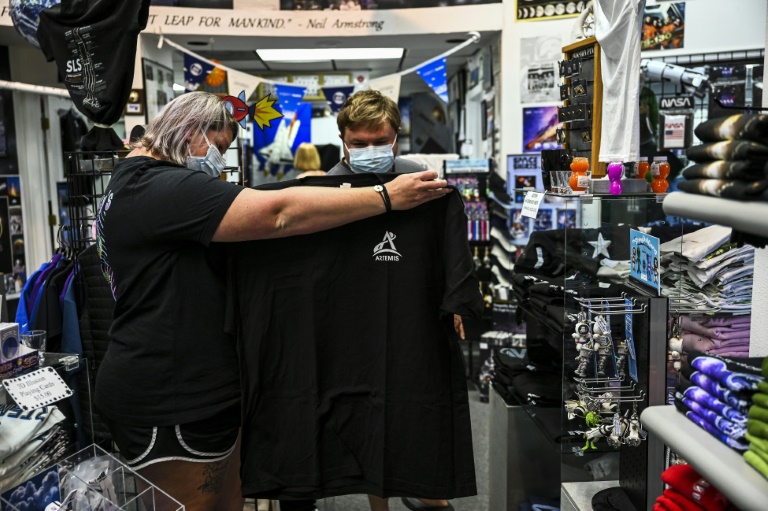
As soon as they enter, visitors are greeted with Artemis T-shirts for sale, printed in-house — there were 1,000 copies made Saturday alone. 

The last few days has seen an influx of customers, Mulberry, who founded “Space Shirts” in 1984, told AFP. 

“They’re just excited I think to see a NASA launch because the private space business is not so motivating to the people,” she said.

This rocket, called the SLS — a large model of which is displayed in front of her shop — “belongs to the people,” Mulberry said. 

“It’s their rocket. It’s not SpaceX rocket,” she added.

There is an air of nostalgia for the Apollo rocket program — it’s been 50 years since the last time a crewed mission went to the Moon, in 1972.

“My family, they had to go to the neighbor’s house to watch (the Apollo missions) because they didn’t have a television,” Bostandji, who was not yet born, said. 

“Now we’re going to see it hopefully for real.”

'Sight to behold': tourists flock to Florida for Moon rocket launch

Seeing a rocket blast off to the Moon is “a once-in-a-lifetime thing to experience,” says Joanne Bostandji. 

The 45-year-old has traveled all the way from northern England to Florida with her husband and two children for a space-themed vacation, and they’re prepared to make sure they don’t miss a second of the action as NASA’s newest and most powerful rocket is scheduled to launch for the first time Monday. 

“The plan is to drive very early in the morning and get a spot” on Cocoa Beach, she said, not far from the Kennedy Space Center. 

“I know it’s going be from a far distance, but I still think it’s going be a sight to behold,” Bostandji told AFP as the family waited to enter a park dedicated to space exploration.  

Between 100,000 and 200,000 visitors are expected to attend the launch of the mission, called Artemis 1, which will propel an empty capsule to the Moon as part of a test for future crewed flights.

The “historic nature” of Monday’s flight, the first of several as the United States returns to the Moon, “certainly has increased public interest,” Meagan Happel of Florida’s Space Coast Office of Tourism told AFP.

Traffic jams are expected to start by 4 am, with the launch scheduled at 8:33 am (1233 GMT). 

And even more people might show up if the launch faces a weather delay, as the make-up date falls on a weekend. 

– Space cruise –

Sabrina Morley was able to find an apartment to rent not far from the beach, and plans to bring her two children and a few dozen other people on a boat chartered for the occasion by a company called Star Fleet Tours. 

For $95 a ticket, “we’ll go out into the ocean as close as they can get to the launch and we’ll watch the launch from the boat,” she said

“I’ve never been this close to a launch before,” said the 43-year-old, who grew up in Orlando, less than an hour away. 

As a child, she could see space shuttles taking off from her backyard, like “an orange ball of smoke” rising into the sky.

“We would hear the sonic booms,” she remembered. 

Morley likes that NASA’s Artemis program aims to land a woman on the Moon for the first time, with a crew to head up in 2025 at the earliest.

“Representation matters,” she said, glancing at her two-year-old daughter, who is already wearing an imitation astronaut helmet on her head. 

– Good for business – 

The return of prestigious space launches is an economic boon for the region. A family of three will spend an average of $1,300 over four or five days, according to the tourism office. 

On the main road to Merritt Island, the peninsula where the Kennedy Space Center is located, Brenda Mulberry’s space memorabilia shop is packed with tourists. 

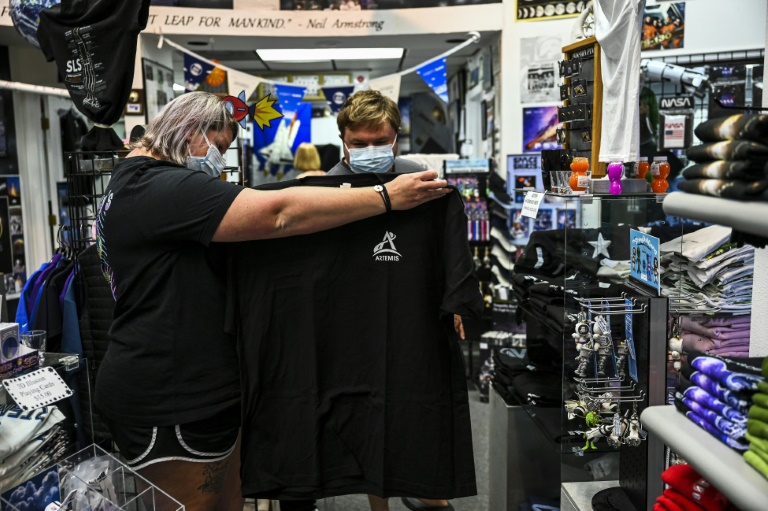
As soon as they enter, visitors are greeted with Artemis T-shirts for sale, printed in-house — there were 1,000 copies made Saturday alone. 

The last few days has seen an influx of customers, Mulberry, who founded “Space Shirts” in 1984, told AFP. 

“They’re just excited I think to see a NASA launch because the private space business is not so motivating to the people,” she said.

This rocket, called the SLS — a large model of which is displayed in front of her shop — “belongs to the people,” Mulberry said. 

“It’s their rocket. It’s not SpaceX rocket,” she added.

There is an air of nostalgia for the Apollo rocket program — it’s been 50 years since the last time a crewed mission went to the Moon, in 1972.

“My family, they had to go to the neighbor’s house to watch (the Apollo missions) because they didn’t have a television,” Bostandji, who was not yet born, said. 

“Now we’re going to see it hopefully for real.”

Two US Navy warships transit through Taiwan Strait

Two United States warships sailed through the Taiwan Strait on Sunday, the American navy said, the first such transit since China staged unprecedented military drills around the island.

In a statement, the US Navy said the passage “demonstrates the United States’ commitment to a free and open Indo-Pacific.”

Tensions in the Taiwan Strait soared to their highest level in years this month after US House Speaker Nancy Pelosi visited Taipei.

Beijing reacted furiously, staging days of air and sea exercises around Taiwan. Taipei condemned the drills and missile tests as preparation for an invasion.

Taiwan lives under constant threat of an invasion by China, which claims the self-ruled, democratic island as part of its territory to be seized one day — by force if necessary.

Washington diplomatically recognizes Beijing over Taipei, but maintains de facto relations with Taiwan and supports the island’s right to decide its own future.

The US Seventh Fleet said the pair of Ticonderoga-class guided-missile cruisers — the USS Antietam and the USS Chancellorsville — conducted the “routine” transit on Sunday “through waters where high seas freedoms of navigation and overflight apply in accordance with international law.”

“These ships transited through a corridor in the Strait that is beyond the territorial sea of any coastal State,” a statement said. 

“It sends a very clear message,” a White House official, National Security Council spokesman John Kirby, said Sunday on CNN. “The US Navy will sail, fly and operate wherever international law allows it to.”

Kirby, a retired navy rear admiral, said the operation had been “planned long ago.”

The Chinese People’s Liberation Army (PLA) said the United States had “openly hyped up” the ships’ passage through the strait.

“The PLA Eastern Theatre Command is following and warning the US vessels throughout their entire journey, and is aware of all movements,” spokesman Senior Colonel Shi Yi said.

“Troops in the (eastern) theatre remain on high alert and are prepared at all times to foil any provocations.”

Taiwan’s defense ministry confirmed a pair of warships sailed from north to south through the channel.

“During their southward journey through the Taiwan Strait, the military is fully monitoring relevant movements in our surrounding sea and airspace, and the situation is normal.”

– ‘Freedom of navigation’ –

The Seventh Fleet is based in Japan and is a core part of the US Navy presence in the Pacific.

The US and Western allies have increased “freedom of navigation” crossings by naval vessels of both the Taiwan Strait and South China Sea to reinforce the concept that those seas are international waterways, sparking anger from Beijing.

Washington has said its position on Taiwan remains unchanged and has accused China of threatening peace in the Taiwan Strait and using the visit by Pelosi as a pretext for military exercises.

China’s drills included firing multiple ballistic missiles into waters off Taiwan — some of the world’s busiest shipping routes — which was the first time Beijing has taken such a step since the mid-1990s.

Taiwan staged its own drills, simulating a defense against invasion and displaying its most advanced fighter jet in a rare nighttime demonstration.

Under President Xi Jinping, China’s tone on Taiwan has grown more aggressive, with increased military activity and more combative messaging in recent years.

Close Bitnami banner
Bitnami