World

Half of China hit by drought in worst heatwave on record

A crippling drought exacerbated by a record heatwave has spread across half of China and reached the normally frigid Tibetan Plateau, according to official data released ahead of more searing temperatures on Thursday.

The world’s second-largest economy has experienced over 70 days of heatwaves, flash floods and droughts — phenomena that scientists say are becoming more frequent and intense due to climate change.

Southern China has recorded its longest continuous period of high temperatures since records began more than 60 years ago, the agriculture ministry said this week.

Experts have said the intensity, scope and duration of the heatwave could make it one of the worst recorded in global history.

A chart from the National Climate Centre showed Wednesday that swathes of southern China — including the Tibetan Plateau — were experiencing “severe” to “extraordinary” drought conditions.

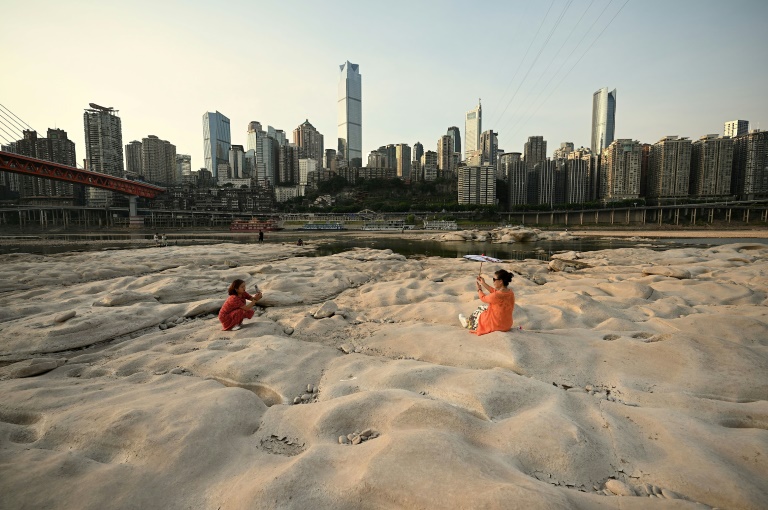
The worst-affected area — the Yangtze river basin, stretching from coastal Shanghai to Sichuan province in China’s southwest — is home to over 370 million people and contains several manufacturing hubs including the megacity of Chongqing.

The China Meteorological Administration predicted continued high temperatures of up to 40 degrees Celsius (104 degrees Fahrenheit) in Chongqing and the provinces of Sichuan and Zhejiang Thursday.

But some regions gained relief from the heatwave. Parts of southwestern Sichuan were battered by heavy rains overnight, causing the evacuation of almost 30,000 people, state broadcaster CCTV reported.

And in the southeast, Typhoon Ma-on made landfall in coastal Guangdong province and Hong Kong Thursday morning.

“High temperatures have basically been alleviated in the regions of south China, Jiangxi and Anhui,” the meteorological administration said.

“But high temperatures will continue for the next three days in regions including the Sichuan basin and provinces surrounding Shanghai.”

– ‘Severe threat’ –

China’s State Council on Wednesday announced a 10 billion yuan ($1.45 billion) subsidy to support rice farmers experiencing drought conditions, which authorities have warned pose a “severe threat” to this year’s autumn harvest.

China produces more than 95 percent of the rice, wheat and maize it consumes, but a reduced harvest could mean increased demand for imports in the world’s most populous country — putting further pressure on global supplies already strained by the conflict in Ukraine.

Wednesday’s CCTV evening news broadcast showed trucks supplying villagers who lacked drinking and agricultural water in rural Sichuan and Chongqing.

These regions have also been battling wildfires since last week, exacerbated by high temperatures and water scarcity. 

Livestock owners have fared badly, with Chongqing authorities pledging emergency measures to protect pig farms and a Sichuan farmer’s tearful plea going viral after she said all her chickens had died due to the heatwave and power cuts.

Some Chongqing residents complained on social media about queueing for hours in sweltering heat for compulsory mass testing required in the wake of a Covid outbreak. 

In parts of Sichuan and Chongqing, locals seeking cooler temperatures have taken to sleeping in car parks and subway stations due to daily power cuts. 

Temperatures as high as 45 degrees Celsius (113 Fahrenheit) have led multiple Chinese provinces to impose industrial power cuts, as cities struggle to cope with a surge in demand for electricity.

Record low water levels on the Yangtze River have also put pressure on the region’s hydropower generators, with the National Energy Administration pledging Wednesday to make up the shortfall by ramping up coal production. 

Recent heat broke records in Sichuan, where one county recorded a temperature of 44 degrees Celsius (111 Fahrenheit) Wednesday.
Half of China hit by drought in worst heatwave on record

A crippling drought exacerbated by a record heatwave has spread across half of China and reached the normally frigid Tibetan Plateau, according to official data released ahead of more searing temperatures on Thursday.

The world’s second-largest economy has experienced over 70 days of heatwaves, flash floods and droughts — phenomena that scientists say are becoming more frequent and intense due to climate change.

Southern China has recorded its longest continuous period of high temperatures since records began more than 60 years ago, the agriculture ministry said this week.

Experts have said the intensity, scope and duration of the heatwave could make it one of the worst recorded in global history.

A chart from the National Climate Centre showed Wednesday that swathes of southern China — including the Tibetan Plateau — were experiencing “severe” to “extraordinary” drought conditions.

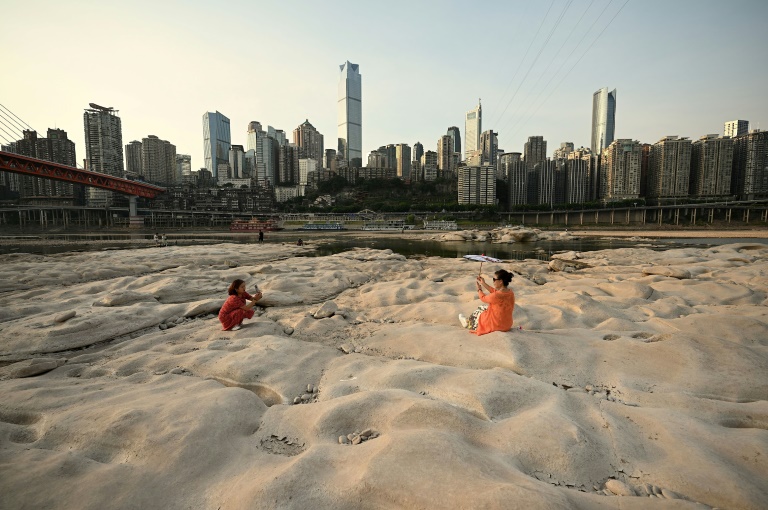
The worst-affected area — the Yangtze river basin, stretching from coastal Shanghai to Sichuan province in China’s southwest — is home to over 370 million people and contains several manufacturing hubs including the megacity of Chongqing.

The China Meteorological Administration predicted continued high temperatures of up to 40 degrees Celsius (104 degrees Fahrenheit) in Chongqing and the provinces of Sichuan and Zhejiang Thursday.

But some regions gained relief from the heatwave. Parts of southwestern Sichuan were battered by heavy rains overnight, causing the evacuation of almost 30,000 people, state broadcaster CCTV reported.

And in the southeast, Typhoon Ma-on made landfall in coastal Guangdong province and Hong Kong Thursday morning.

“High temperatures have basically been alleviated in the regions of south China, Jiangxi and Anhui,” the meteorological administration said.

“But high temperatures will continue for the next three days in regions including the Sichuan basin and provinces surrounding Shanghai.”

– ‘Severe threat’ –

China’s State Council on Wednesday announced a 10 billion yuan ($1.45 billion) subsidy to support rice farmers experiencing drought conditions, which authorities have warned pose a “severe threat” to this year’s autumn harvest.

China produces more than 95 percent of the rice, wheat and maize it consumes, but a reduced harvest could mean increased demand for imports in the world’s most populous country — putting further pressure on global supplies already strained by the conflict in Ukraine.

Wednesday’s CCTV evening news broadcast showed trucks supplying villagers who lacked drinking and agricultural water in rural Sichuan and Chongqing.

These regions have also been battling wildfires since last week, exacerbated by high temperatures and water scarcity. 

Livestock owners have fared badly, with Chongqing authorities pledging emergency measures to protect pig farms and a Sichuan farmer’s tearful plea going viral after she said all her chickens had died due to the heatwave and power cuts.

Some Chongqing residents complained on social media about queueing for hours in sweltering heat for compulsory mass testing required in the wake of a Covid outbreak. 

In parts of Sichuan and Chongqing, locals seeking cooler temperatures have taken to sleeping in car parks and subway stations due to daily power cuts. 

Temperatures as high as 45 degrees Celsius (113 Fahrenheit) have led multiple Chinese provinces to impose industrial power cuts, as cities struggle to cope with a surge in demand for electricity.

Record low water levels on the Yangtze River have also put pressure on the region’s hydropower generators, with the National Energy Administration pledging Wednesday to make up the shortfall by ramping up coal production. 

Recent heat broke records in Sichuan, where one county recorded a temperature of 44 degrees Celsius (111 Fahrenheit) Wednesday.

Taiwan announces plans for record defence budget after China drills

Taiwan announced plans for a record increase to its defence budget on Thursday after huge military drills by China earlier this month sent tensions between the two to their highest in decades.

Taipei has proposed a defence budget of Tw$415.1 billion ($13.7 billion) for next year, up 13 percent year-on-year, pending parliamentary approval.

An additional special budget will also be created specifically to acquire new fighter jets and other projects to boost naval and air capabilities, the top budgeting agency said in a statement.

“To protect national security, the overall defence budget for next year will reach Tw$586.3 billion to a record high,” a cabinet spokesman quoted Premier Su Tseng-chang as saying.

Taiwan lives under constant threat of invasion by China, which claims the democratic island as part of its territory to be seized one day — by force if necessary. 

Beijing’s sabre-rattling has grown more pronounced under President Xi Jinping, China’s most assertive leader in a generation. 

The bolstered military budget was unveiled after Beijing staged unprecedented exercises around Taiwan in retaliation for US House Speaker Nancy Pelosi’s visit to Taipei earlier this month. 

Beijing lashes out at any diplomatic action that might lend Taiwan legitimacy and has responded with growing anger to visits by Western officials and politicians. 

For a week after Pelosi’s visit, China sent warships, missiles and fighter jets into the waters and skies around Taiwan, its largest and most aggressive exercises since the mid-1990s.

Even before this month’s drills, Beijing had increased military pressure on Taiwan in recent years, particularly with incursions into the island’s air defence identification zone (ADIZ). 

Last year, Taiwan recorded incursions by around 970 Chinese warplanes into its air defence zone, according to a database compiled by AFP, more than double the roughly 380 in 2020. 

The figure this year already exceeded 980, with more than 360 incursions being recorded in August alone.

The increased activity puts further stress on Taiwan’s outgunned military resources, especially its ageing fleet of fighter jets.

“There have been significant increases in operation maintainance in response to the cross-strait situation, as our aircraft and naval ships have been (increasingly) deployed,” budgeting chief Chu Tzer-ming told reporters.

Historically, Taiwan’s military has favoured big-ticket purchases like fighter jets and warships. 

But American and Taiwanese strategists have increasingly pushed Taipei to adopt a “porcupine” strategy of asymmetric warfare. 

That strategy emphasises purchasing comparatively inexpensive and mobile weapon systems, like anti-ship and aircraft missiles, as well as training soldiers and civilian reservists to fight behind enemy lines to make an invasion a grim prospect even for China’s huge military.

Mexico ex-attorney general to face trial over missing students

A Mexican judge on Wednesday ordered a former attorney general to stand trial in the case of 43 students whose murky disappearance in 2014 traumatized the nation.

Jesus Murillo Karam will be tried on charges of forced disappearance, torture and obstruction of justice, the Federal Judiciary Council said after a court hearing in Mexico City.

He is considered the architect of the so-called historical truth version of events — presented in 2015 by the government of then president Enrique Pena Nieto — that was widely rejected, including by relatives.

So far the remains of just three of the students from the Ayotzinapa teachers’ college in the southern state of Guerrero have been identified.

Murillo Karam, a former heavyweight of the once-dominant Institutional Revolutionary Party (PRI), is the most senior figure charged so far in connection with the case, which triggered international condemnation.

He was arrested on Friday at his home in an exclusive neighborhood of Mexico City and remanded in custody, with the judge ruling he will remain in pre-trial custody.

The judge also ordered a second, three-month complementary investigation into the case. 

President Andres Manuel Lopez Obrador said on Wednesday that anybody involved in a cover-up must be held to account, including the person who “gave the order.”

Arrest warrants were also issued last week for more than 80 other suspects, including military personnel, police officers and cartel members, prosecutors announced.

The case is one of the worst human rights tragedies in Mexico, where a spiral of drug-related violence has left more than 100,000 people missing.

– Unsolved crime –

The students had commandeered buses to travel to a demonstration in Mexico City before they went missing.

Investigators say they were detained by corrupt police and handed over to the Guerreros Unidos drug cartel, which mistook them for members of a rival gang, but exactly what happened to them is disputed.

According to the official report presented in 2015, cartel members killed the students and incinerated their remains at a garbage dump.

Those conclusions were rejected by independent experts and the office of the United Nations High Commissioner for Human Rights, as well as the families.

Lopez Obrador said in March that navy members were under investigation for allegedly tampering with evidence, including at the dump.

A truth commission investigating the atrocity has branded the case a “state crime” involving agents of various institutions.

It said that military personnel bore “clear responsibility,” either directly or through negligence, contrary to the “historical truth,” which did not attribute any responsibility to members of the armed forces.

The PRI, now an opposition party, has criticized Murillo Karam’s arrest as politically motivated.

Mexico has also repeatedly asked Israel to detain the fugitive former head of the Criminal Investigation Agency, Tomas Zeron, in connection with the case.

Zeron is accused of using torture to extract supposed confessions from suspects, enforced disappearance and embezzling public funds.

Japan seeks 'sustainable world' in Africa aid forum

With its stated purpose to “create a sustainable world together”, Japan on Saturday kicks off its aid conference for Africa, where rival China has invested heavily in recent years.

The eighth Tokyo International Conference on African Development (TICAD8) comes against the backdrop of China’s rising influence, cemented on the continent by its “Belt and Road” infrastructure initiative.

A “complex” international environment caused by issues including “the situation in Ukraine” surrounds the meeting in Tunisia’s capital, the Japanese foreign ministry said.

It is the first TICAD — held every three years either in Japan or an African country — since the pandemic began and Prime Minister Fumio Kishida will be attending remotely after testing positive for Covid-19.

Replacing him at the head of the Japanese delegation will be his Foreign Minister Yoshimasa Hayashi, and about 5,000 participants are expected to attend.

Among them will be 30 heads of state and government, converging on the Tunisian capital from across the continent.

Alongside the summit, businesspeople will attend an economic conference while various parallel events and workshops will address civil society and women’s inclusion.

Since their inception in 1993, the TICAD conferences, co-sponsored by the United Nations, World Bank and African Union, have generated 26 development projects in 20 African countries, largely funded by the Japan International Cooperation Agency (JICA).

– An alternative to China –

With a view to “accelerating Japanese investment in Africa”, the conference will focus on three pillars: economy; society; and peace and stability, according to the official presentation.

With more than $130 million already set to be delivered in food aid, Japan will also provide assistance for “rice production and food security” in view of the food crisis worsened by the Ukraine war.

Japanese economic paper Nikkei reported that aid to Africa could increase by 40 percent over the next three years, compared to 2020-2022.

Such assistance comes “in response” to other powers that have bolstered their presence in Africa, namely the United States, Europe and in particular China, Nikkei said.

In response to competition from China, a Japanese foreign ministry official said Tokyo’s “African diplomacy… can be boiled down to two words: ownership and partnership”.

“Japan has a 30-year history of involvement” in the continent through TICAD, he said.

“The core message we would like to get across this time is that Japan wants to remain Africa’s partner.”

At the closing of the last TICAD in 2019, former premier Shinzo Abe — who was assassinated at a campaign event last month — warned investors in Africa that they must beware of burdening countries with “excessive” debt, in an apparent swipe at China.

– Production hub –

On the Tunisian side, authorities hope to profit from holding the summit, particularly as Tunis is a two-hour flight from many major European capitals.

Tunisia hopes to attract Japanese investment domestically, particularly for its health, automotive and renewable energy sectors.

More than 80 projects are on the table with a value of $2.7 billion, according to Hedi Abbes, head of the Tunisian-Japanese chamber of commerce.

These projects, on offer to Tunisian and other African private investors, are expected to create about 35,700 jobs, he said.

With its industrial capacities, Tunisia hopes to become a hub for the production of medicines and vaccines, as some African countries have lagged far behind in vaccination efforts.

During a global Covid-19 summit in May, the Japanese premier stressed the importance of promoting “local production capacity for pharmaceuticals and medical products, including vaccines”.

“To that end, we have decided to provide assistance of up to $200 million through JICA to enhance the capacity in Africa,” Kishida said.

Half of China hit by drought in worst heatwave on record

Half of China’s vast territory is now experiencing drought, including parts of the frigid Tibetan Plateau, official data showed — with more high temperatures forecast Thursday for hundreds of millions of people enduring the country’s hottest summer on record.

The world’s second-largest economy has been hit by record heat, flash floods and droughts — phenomena that scientists say are becoming more frequent and intense due to climate change.

Southern China has recorded its longest continuous period of high temperatures since records began more than 60 years ago, the agriculture ministry said this week.

Experts have said the intensity, scope and duration of the heatwave could make it one of the worst recorded in global history.

A chart from the National Climate Centre showed Wednesday that swathes of southern China — including the Tibetan Plateau — were experiencing “severe” to “extraordinary” drought conditions.

The worst-affected area — the Yangtze river basin, stretching from coastal Shanghai to Sichuan province in China’s southwest — is home to over 370 million people and contains several manufacturing hubs including the megacity of Chongqing.

The China Meteorological Administration predicted continued high temperatures of up to 40 degrees Celsius (104 degrees Fahrenheit) in Chongqing and the provinces of Sichuan, Jiangxi and Zhejiang Thursday.

China’s State Council on Wednesday announced a 10 billion yuan ($1.45 billion) subsidy to support rice farmers experiencing drought conditions which authorities have warned pose a “severe threat” to this year’s autumn harvest.

China produces more than 95 percent of the rice, wheat and maize it consumes, but a reduced harvest could mean increased demand for imports in the world’s most populous country — putting further pressure on global supplies already strained by the conflict in Ukraine.

Officials also called for “a combination of measures to increase water sources to fight drought, first ensure drinking water for the people, ensure water for agricultural irrigation,” the readout added.

Wednesday’s CCTV evening news broadcast showed trucks supplying villagers who lacked drinking and agricultural water in rural Sichuan and Chongqing, with remote mountain areas particularly hard hit.

Temperatures as high as 45 degrees Celsius (113 Fahrenheit) have led multiple Chinese provinces to impose industrial power cuts, as cities struggle to cope with a surge in demand for electricity partly driven by people cranking up the air conditioning.

Record low water levels on the Yangtze River have also put pressure on the region’s hydropower generators.

The heat broke records in Sichuan, where a temperature of 43.9 degrees Celsius (111 Fahrenheit) was recorded Wednesday afternoon, the province’s Meteorological Service Centre said in a statement.

Half of China hit by drought in worst heatwave on record

Half of China’s vast territory is now experiencing drought, including parts of the frigid Tibetan Plateau, official data showed — with more high temperatures forecast Thursday for hundreds of millions of people enduring the country’s hottest summer on record.

The world’s second-largest economy has been hit by record heat, flash floods and droughts — phenomena that scientists say are becoming more frequent and intense due to climate change.

Southern China has recorded its longest continuous period of high temperatures since records began more than 60 years ago, the agriculture ministry said this week.

Experts have said the intensity, scope and duration of the heatwave could make it one of the worst recorded in global history.

A chart from the National Climate Centre showed Wednesday that swathes of southern China — including the Tibetan Plateau — were experiencing “severe” to “extraordinary” drought conditions.

The worst-affected area — the Yangtze river basin, stretching from coastal Shanghai to Sichuan province in China’s southwest — is home to over 370 million people and contains several manufacturing hubs including the megacity of Chongqing.

The China Meteorological Administration predicted continued high temperatures of up to 40 degrees Celsius (104 degrees Fahrenheit) in Chongqing and the provinces of Sichuan, Jiangxi and Zhejiang Thursday.

China’s State Council on Wednesday announced a 10 billion yuan ($1.45 billion) subsidy to support rice farmers experiencing drought conditions which authorities have warned pose a “severe threat” to this year’s autumn harvest.

China produces more than 95 percent of the rice, wheat and maize it consumes, but a reduced harvest could mean increased demand for imports in the world’s most populous country — putting further pressure on global supplies already strained by the conflict in Ukraine.

Officials also called for “a combination of measures to increase water sources to fight drought, first ensure drinking water for the people, ensure water for agricultural irrigation,” the readout added.

Wednesday’s CCTV evening news broadcast showed trucks supplying villagers who lacked drinking and agricultural water in rural Sichuan and Chongqing, with remote mountain areas particularly hard hit.

Temperatures as high as 45 degrees Celsius (113 Fahrenheit) have led multiple Chinese provinces to impose industrial power cuts, as cities struggle to cope with a surge in demand for electricity partly driven by people cranking up the air conditioning.

Record low water levels on the Yangtze River have also put pressure on the region’s hydropower generators.

The heat broke records in Sichuan, where a temperature of 43.9 degrees Celsius (111 Fahrenheit) was recorded Wednesday afternoon, the province’s Meteorological Service Centre said in a statement.

Asian markets rise with eyes on China, Fed speech

Asian markets rose Thursday after China unveiled fresh measures to boost its economy, while investors awaited a speech by the Fed chair that may hold clues about future rate hikes.

Central bankers are meeting in Jackson Hole in the US state of Wyoming, and all eyes are on Federal Reserve boss Jerome Powell’s Friday speech for clues about its plans to tame inflation.

Market sentiment was also boosted by the Chinese government’s Wednesday announcement of new policies to help sustain the recovery in the world’s second-largest economy.

Asian traders on Thursday followed a positive lead from Wall Street, where the Dow, Nasdaq and S&P 500 all closed higher.

Tokyo, Sydney, Shanghai and Singapore were up in morning trade. Taipei and Seoul also rose.

Hong Kong markets will hold a shortened session starting at 1 pm (0500 GMT), the city’s stock exchange announced, after Typhoon Ma-On forced a delay.

There are concerns that the Fed’s fight against soaring inflation could lead to a recession in the United States, which could, in turn, hit a global economy still recovering from the Covid-19 pandemic.

“A slower global growth environment is not going away anytime soon and now we are clearly seeing broader signs of weakness for the US economy,” OANDA’s Edward Moya said in a note.

“Powell’s fight against inflation might send the US economy into a recession late next year, but for now he needs to stick to the hawkish script and leave all options of tightening on the table.”

– China stimulus –

Central banks around the world are trying to find a delicate balance between curbing inflation and avoiding recessions.

The challenge has been compounded this year by Russia’s invasion of Ukraine, which has sent energy and food prices skyrocketing.

Traders are also keeping an eye on how China will repair the economic damage from its strict Covid controls, a crisis in its property sector and power shortages caused by a record-breaking heatwave.

Fresh measures to shore up the economy were announced by China’s State Council on Wednesday, including steps to encourage lending, consumption and investment, according to the official Xinhua news agency.

They also included support for electricity producers and agriculture, two sectors hit especially hard by the heatwave, though Xinhua’s readout of the State Council meeting did not mention the extreme weather.

Crude traded higher Thursday with concerns building about global supplies after key exporter Saudi Arabia teased the possibility of production cuts and with talks ongoing about the resurrection of the Iran nuclear deal.

– Key figures at 0300 GMT –

Tokyo – Nikkei 225: UP 0.6 percent at 28,471.61

Hong Kong – Hang Seng Index: Shortened session to begin at 0500 GMT

Shanghai – Composite: UP 0.1 percent at 3,218.19

Euro/dollar: UP at 0.9984 from 0.9967 on Wednesday

Pound/dollar: UP at 1.1817 from 1.1797

Euro/pound: UP at 84.50 pence from 84.49 pence

Dollar/yen: DOWN at 136.81 yen from 137.06 yen

West Texas Intermediate: UP 0.6 percent at $5.45 per barrel

Brent North Sea crude: UP 0.7 percent at $101.93

New York – Dow: UP 0.2 percent at 32,969.23 points (close)

London – FTSE 100: DOWN 0.2 percent at 7,471.51 (close) 

British Museum showcases ancient vessels smashed in Beirut blast

Eight ancient glass vessels shattered in the 2020 Beirut explosion go on display at the British Museum from Thursday, walking visitors through the painstaking international project to piece them back together.

The vessels, from the Roman, Byzantine and Islamic periods, were reconstructed at the world-famous museum’s conservation laboratories, and will be shown as part of its “Shattered Glass of Beirut” showcase, before returning to Lebanon later this year.

“(It) tells a story of near destruction and recovery, of resilience and collaboration,” said Hartwig Fischer, Director of the British Museum.

The vessels were among 74 contained within a case at the American University in Beirut (AUB). 

The case fell over when the shockwave of the port blast, which occurred three kilometres (two miles) away on August 4, 2020, hit the building, smashing the glass objects inside.

A team of experts had the daunting task of sorting every shard of glass, deciding if it was part of an ancient vessel, rather than display case, and which vessel it belonged to, Duygu Camurcuoglu, a senior conservator at the British Museum, told AFP.

“It’s all pretty much done by hand or by eye — brainwork basically. You have to know certain techniques to be able to carry out this work,” she added.

Once the pieces had been sorted, the conservators began the mammoth jigsaw-puzzle exercise of reassembling the vessels.

“It’s a case of using an adhesive to reconstruct the vessels,” said Camurcuoglu. But they could not just use anything.

“We don’t use superglue, we don’t use UHU,” she joked. 

– ‘Scars’ –

The most challenging vessels were the “large dish and the Byzantine pitcher,” Camurcuoglu recalled.

Eighteen of the vessels have so far been conserved as part of an emergency recovery campaign in Beirut, along with the eight vessels at the British Museum and two that emerged unscathed from the fall. 

Experts hope that at least half of the remaining 46 objects in Beirut can be conserved soon too.

The collaborative project between the British Museum and the AUB’s Archaeological Museum began in 2021, following an offer of help from the London institution.

Conservators agreed early on to make the vessels structurally sound but leave imperfections caused by the shattering visible, bearing witness to the explosion. 

The exhibition will take visitors on the journey undergone by the glass vessels, from the moment of the blast to their display in the famous London museum. 

Lighting will be used in the display to illuminate cracks and gaps in the glass.

“We really wanted to highlight the damage these objects went through, so we can all look at the scars, and remember how they were revived together,” said Camurcuoglu.

The vessels are considered important in telling the story of the development of revolutionary glass-blowing techniques in Lebanon in the 1st century BC, enabling the mass production of glass objects and making them available for common use.

Their restoration, and the teamwork involved, is a source of pride to the conservators, said Camurcuoglu.

“We all individually felt that, I think, we contributed to something by working on these objects — by sharing this pain, these emotions.

“So it’s not only about the conservation… but also the working together and achieving something together,” she added.

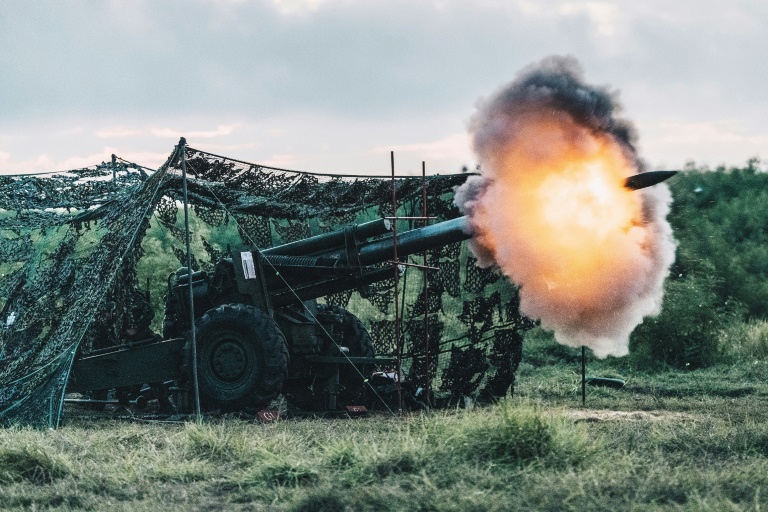
'Not ready': Taiwan reservists stoic but unprepared for China threat

Sitting pensively in a pew at a Taipei church, army reservist Henry Cheng is nonchalant about the Chinese warships and jets circling his island — but he also feels ill-prepared for war.

China’s massive military drills this month pushed tensions in the Taiwan Strait to their highest point in years, deepening fears Beijing could forcibly take control of the self-ruled democracy it claims as its own. 

Coming on the heels of Russia’s invasion of Ukraine, the crisis has revived debate within Taiwan and among key Western allies about the readiness of the island’s vastly outnumbered military. 

But Cheng said he was unconcerned.

“It was like ‘Oh, they’re at it again,'” the 25-year-old insurance sales agent told AFP. “They’ve been talking about a war since I was little but there still hasn’t been one.”

Cheng completed his mandatory four-month military service last year, placing him in the ranks of some 2.5 million reservists who could be called up to battle if an invasion took place.

Yet conflict feels like a distant reality for Cheng compared to his usual routine of meeting clients and rehearsing Christian worship songs as a drummer for his church band. 

“I’m definitely not ready (for war), because four months to me is more like going there to play,” he said, referencing his training.

“I’d probably die very quickly. I’ll face it when it comes.”

– ‘Too short’ –

Mandatory service used to be deeply unpopular in Taiwan, which was once a brutal military dictatorship but has since morphed into a progressive democracy. 

Taiwan’s previous government reduced compulsory service from one year to four months with the aim of creating a mainly volunteer force.

But Beijing’s sabre-rattling has grown more intense under President Xi Jinping, China’s most authoritarian leader in a generation.

And Russia’s invasion of Ukraine has shown the deadly risks of a giant authoritarian neighbour’s verbal threats becoming real.

As a result, President Tsai Ing-wen’s administration is exploring whether to reinstate tougher military service. 

It is not clear yet when a decision might be made, but polling shows more than three-quarters of the Taiwanese public now believe the length of service is too short.

Taiwan remains massively outgunned by China, with 88,000 ground forces compared to China’s one million, according to Pentagon estimates.

But the mountainous island would still present a formidable challenge. 

Taipei has stepped up reservist training and increased purchases of jets and anti-ship missiles. But experts say it is not enough.

“I truly believe four months is too short,” said Joseph Hwang, associate professor at Taiwan’s National Defense University.

“Taiwan has no condition for voluntary military service whatsoever.”

Peter Yang, an engineer who plays wargames in his spare time, remembers much of his compulsory military service was mostly “spent doing paperwork”.

“There was not a lot of time spent on training, just basic physical training and shooting practice,” the 24-year-old told AFP

“Our job is really just to die on the battlefield… so it’s enough for us to know how to fire a gun,” he said, adding reservists were given only 12 bullets for each shooting practice. 

Last month, former US army chief Mark Esper called for Taiwan to triple its mandatory service to a year and extend its enrolment to women.

– ‘Dancing, drinking, exercising’ –

American and Taiwanese strategists have pushed Taipei to adopt a “porcupine” strategy of asymmetric warfare like Ukraine to defend against a Chinese invasion.

But Taiwan’s population is not ready for the die-hard resistance seen in the streets of Ukraine’s cities, said retired air force colonel Richard Chou, who served for 21 years.

“Taiwan’s military preparation from my perspective is not enough,” the 52-year-old said, adding he would serve willingly if called back.

“It’s not only about one person holding a rifle. They also have to learn how to handle situations together as a group through training –- only then will they have a hope of resisting in the future.”

To demonstrate how unmoved the Taiwanese are by the threat, 75-year-old veteran Jasper Lee points around a central Taipei park.

“They just had the military exercise around Taiwan island and the people are like this — dancing, drinking, exercising,” he said.

But underneath the stoicism, fears of China linger for many.

John Chen, a 26-year-old reservist, said the drills have increased his anxiety, comparing Beijing to a stalker.

“This person really likes you, but he keeps saying you belong to him… he knows where you go to work every day and follows you home from work. This is the situation that Taiwan is in,” he said. 

“I’m worried about whether my country will continue to exist.”

Close Bitnami banner
Bitnami