World

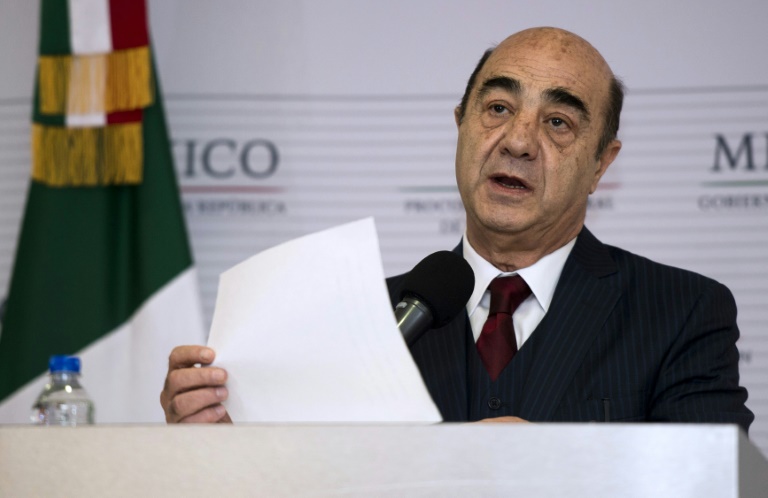
Mexico ex-attorney general to face trial over missing students

A Mexican judge on Wednesday ordered a former attorney general to stand trial in the case of 43 students whose murky disappearance in 2014 traumatized the nation.

Jesus Murillo Karam will be tried on charges of forced disappearance, torture and obstruction of justice, the Federal Judiciary Council said after a court hearing in Mexico City.

He is considered the architect of the so-called “historical truth” version of events — presented in 2015 by the government of then-president Enrique Pena Nieto — that was widely rejected, including by relatives.

So far the remains of just three of the students from the Ayotzinapa teachers’ college in the southern state of Guerrero have been identified.

Murillo Karam, a former heavyweight of the once-dominant Institutional Revolutionary Party (PRI), is the most senior figure charged so far in connection with the case, which triggered international condemnation.

He was arrested on Friday at his home in an exclusive neighborhood of Mexico City and remanded in custody.

President Andres Manuel Lopez Obrador said on Wednesday that anybody involved in a cover-up must be held to account, including the person who “gave the order.”

Arrest warrants were also issued last week for more than 80 other suspects, including military personnel, police officers and cartel members, prosecutors announced.

The case is one of the worst human rights tragedies in Mexico, where a spiral of drug-related violence has left more than 100,000 people missing.

– Unsolved crime –

The students had commandeered buses to travel to a demonstration in Mexico City before they went missing.

Investigators say they were detained by corrupt police and handed over to the Guerreros Unidos drug cartel, which mistook them for members of a rival gang, but exactly what happened to them is disputed.

According to the official report presented in 2015, cartel members killed the students and incinerated their remains at a garbage dump.

Those conclusions were rejected by independent experts and the office of the United Nations High Commissioner for Human Rights, as well as the families.

Lopez Obrador said in March that navy members were under investigation for allegedly tampering with evidence, including at the dump.

On Thursday, a truth commission investigating the atrocity branded the case a “state crime” involving agents of various institutions.

It said that military personnel bore “clear responsibility,” either directly or through negligence, contrary to the “historical truth,” which did not attribute any responsibility to members of the armed forces.

The PRI, now an opposition party, has criticized Murillo Karam’s arrest as politically motivated.

Mexico has also repeatedly asked Israel to detain the fugitive former head of the Criminal Investigation Agency, Tomas Zeron, in connection with the case.

Zeron is accused of using torture to extract supposed confessions from suspects, enforced disappearance and embezzling public funds.
Ukraine president vows fight 'until the end' on war anniversary

President Volodymyr Zelensky announced a deadly attack on a rail station Wednesday, the country’s independence day, as he pledged Ukraine would fight “until the end” on the day that marked six months of war.

Washington separately warned Moscow was preparing to hold “sham” referendums in occupied areas of Ukraine that would seek to formalise its control.

The Russian missile strike on Chaplino station, in the central Dnipropetrovsk region, killed 22 people he said. In an earlier toll he said 15 had died and 50 others had been wounded.

“Chaplino is our pain today. As of this moment, there are 22 dead, including five people who burned in a car. A youth died, he was 11 years old, a Russian rocket destroyed his house,” he said in his daily address.

Zelensky was speaking on the day the nation celebrated its 1991 independence from the Soviet Union — and on the day marking six months since Russian President Vladimir Putin ordered troops to invade.

Over the weekend, he had warned that Russia might do something “particularly cruel” on Ukraine’s independence day.

In Washington, a senior official warned that Russia could begin announcing referendums designed to formalise its control of occupied areas as soon as this week.

“Russian leadership has instructed officials to begin preparing to hold sham referenda,” White House national security coordinator John Kirby said.

“In fact, we can see a Russian announcement of the first one or ones before the end of this week.”

British Prime Minister Boris Johnson paid a surprise visit to Kyiv, hailing Ukraine’s six-month long resistance, as sirens sounded throughout the day.

Putin had failed to account for the “strong will of Ukrainians to resist”, Johnson said.

“You defend your right to live in peace, in freedom, and that’s why Ukraine will win,” he added.

Earlier the Ukrainian leader had issued his own defiant morning video address, declaring: “We don’t care what army you have, we only care about our land. We will fight for it until the end.”

Referring to Russia he vowed Ukraine “will not try to find an understanding with terrorists”.

“For us Ukraine is the whole of Ukraine,” he said. “All 25 regions, without any concession or compromise.”

– Fresh aid –

The US, meanwhile, announced $3 billion in fresh military aid.

The new funding will help Kyiv acquire more materiel for its armed forces, locked in a grinding war of attrition with Russian troops in the east and south, with neither side advancing significantly.

Johnson unveiled his own £54 million ($64 million) package of aid, including 2,000 “state-of-the-art drones” as well as anti-tank munitions.

Gatherings were banned in the capital Kyiv and Zelensky had urged citizens to be on guard against “Russian terror”.

Nevertheless he and his wife marked a minute of silence for fallen Ukrainian soldiers and laid yellow and blue floral bouquets at a memorial in central Kyiv.

Johnson’s visit was accompanied by other messages of support from Ukraine’s allies.

United Nations Secretary-General Antonio Guterres called the anniversary of the start of Russia’s war in Ukraine a “sad and tragic milestone”.

European Commission President Ursula von der Leyen said the EU has been standing with Ukraine “from the very beginning” and “will be for as long as it takes”.

Even Alexander Lukashenko, the authoritarian leader of Belarus congratulated Ukraine on its Independence Day, comments dismissed by a spokesman for the Ukrainian presidency.

Belarus offered its territory as a staging ground for Russia’s invasion.

– Muted anniversary –

In the early days and weeks of Russia’s invasion, Kyiv was under siege by Russian troops which reached the suburbs of the capital.

Moscow’s offensive quickly faltered, and its forces withdrew in late March to regroup for assaults on Ukraine’s east and south.

But in the capital, Ukrainians were sombre about the anniversary. 

“Six months, the peace of life has been broken in every family,” Nina, an 80-year-old pensioner, said on Independence Square on Tuesday.

“How much destruction, how many dead, how can we relate to it?” she asked.

The capital city’s administration shut public service centres on Wednesday and Thursday, and shopping centres said they would close for the anniversary over safety concerns. 

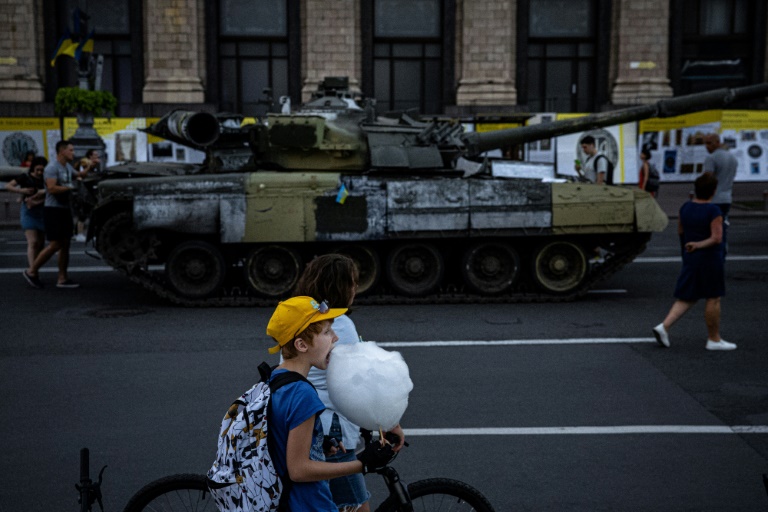
However in central Kyiv trailing crowds of people inspected dozens of disabled Russian tanks, trucks and armoured vehicles installed near the government quarter to showcase Ukraine’s military prowess.

Candy floss vendors sold to curious visitors who peered down tank barrels and posed for selfies, draped in the Ukrainian flag. 

Discussions continued on how to protect the Zaporizhzhia nuclear plant in southern Ukraine, occupied by Russian troops and threatened by shelling, which Moscow blames on Kyiv.

The two sides traded accusations at a Tuesday meeting of the UN Security Council on Zaporizhzhia.

Ukraine and its allies have demanded Russia pull its troops out of the plant — Europe’s largest nuclear facility — and agree to a demilitarised zone.

And on Wednesday the head of Russia’s state nuclear energy agency met the IAEA chief to follow up on the expected inspection.

Equities move higher ahead of US Fed chair speech

European and US equities mostly advanced on Wednesday as investors awaited signals on coming Federal Reserve interest rate hikes.

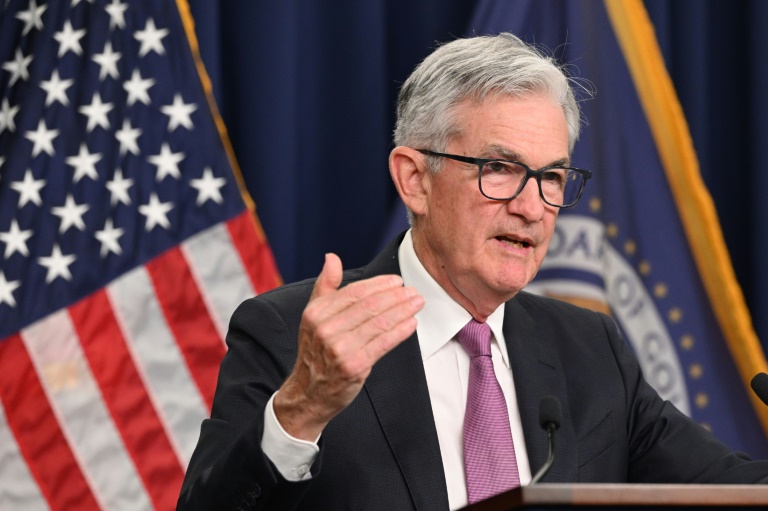
With the Jackson Hole meeting of central bankers this week, focus is on what US Federal Reserve chief Jerome Powell will say Friday about the ongoing campaign to tackle high prices.

Many fear higher borrowing costs amid its battle to rein in inflation could send the world’s biggest economy into recession.

The euro sunk close to a two-decade low against the dollar before rebounding, and the greenback struck a two-year peak against China’s yuan.

European gas prices soared to more than 300 euros per megawatt hour just as equity markets closed, as another temporary cut off of Russian deliveries via pipeline to Germany approached.

US natural gas prices also continued to rise to post-2008 highs.

“European markets have traded in a lackluster manner today as higher gas prices serve to contain any attempt to push strongly higher,” said market analyst Michael Hewson at CMC Markets UK.

– ‘A lot of tightening’ –

On Wall Street, shares ended a three-day skid, with the broad-based S&P 500 rising percent, but expectations have been building ahead of Powell’s speech.

Oanda analyst Edward Moya said the “Fed still has a lot of tightening to do.”

“Today’s rebound is small and on light volume, which means most traders are playing the waiting game until Fed Chair Powell’s Jackson Hole Symposium speech,” he said.

“Powell’s fight against inflation might send the US economy into a recession late next year, but for now he needs to stick to the hawkish script.”

Central banks face a delicate balancing act between battling inflation — with Russia’s war in Ukraine sending energy prices soaring — and avoiding recession.

Yet concerns are growing that spiking energy costs could still prompt a worldwide downturn.

Key markets in Asia slid on Wednesday.

In Europe, London shed 0.2 percent but both Frankfurt and Paris posted modest gains.

– Rollercoaster ride –

The foreign exchange market has faced a rollercoaster ride so far this week.

The euro tumbled on Tuesday to $0.9901 — a new two-decade low — but later clawed back losses as the greenback was hit by tepid US economic data.

The dollar had strengthened this week ahead of Powell’s speech, amid prospects the Fed will continue to tighten its monetary policy.

Higher interest rates boost the American currency as they make dollar-denominated debt more attractive to investors.

But the euro also has been weighed down by a gloomy outlook for the eurozone economy, amid fears of a halt to Russia’s gas deliveries.

Oil prices wobbled following recent gains on talk of an OPEC output cut, with Brent crude pushing back above $100 a barrel.

Oil prices had dropped below $100 this month on worries of a global economic slowdown and the possibility of Iran reaching a deal on its nuclear program that would end international sanctions on its crude exports and boost global supply.

– Key figures at around 2000 GMT –

New York – Dow: UP 0.2 percent at 32,969.23 points (close)

New York – S&P 500: UP 0.3 percent at 4,140.77 (close)

New York – Nasdaq: UP 0.4 percent at 12,431.53 (close)

EURO STOXX 50: UP 0.3 percent at 3,667.46

London – FTSE 100: DOWN 0.2 percent at 7,471.51 (close) 

Frankfurt – DAX: UP 0.2 percent at 13,220.06 (close) 

Paris – CAC 40: UP 0.4 percent at 6,386.76 (close)

Tokyo – Nikkei 225: DOWN 0.5 percent at 28,313.47 (close)

Hong Kong – Hang Seng Index: DOWN 1.2 percent at 19,268.74 (close)

Shanghai – Composite: DOWN 1.9 percent at 3,215.20 (close)

Euro/dollar: UP at 0.9967 from 0.9970 on Tuesday

Pound/dollar: DOWN at 1.1797 from 1.1836

Euro/pound: UP at 84.49 pence from 84.23 pence

Dollar/yen: UP at 137.06 yen from 136.36 yen

West Texas Intermediate: UP 1.2 percent at $94.89 per barrel

Brent North Sea crude: UP 1.0 percent at $101.22

Fighting flares up in northern Ethiopia after five-month lull

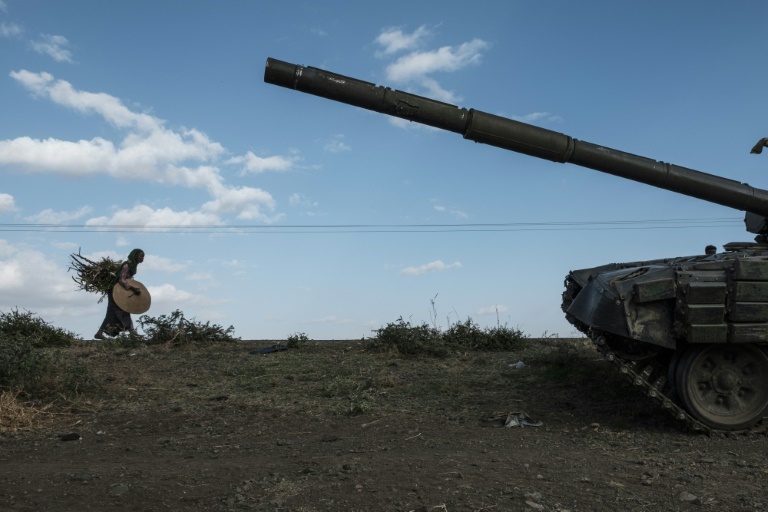
Fighting erupted between government forces and Tigrayan rebels in northern Ethiopia on Wednesday, shattering a five-month truce and dealing a blow to peace efforts. 

Reports of fresh offensives were followed by Ethiopia’s air force announcing it had downed a plane carrying weapons for the Tigray People’s Liberation Front (TPLF).

The government of Prime Minister Abiy Ahmed and the rebels have accused each other of undermining efforts to peacefully resolve the brutal 21-month war in Africa’s second most populous nation, and traded blame over who was responsible for returning to combat.

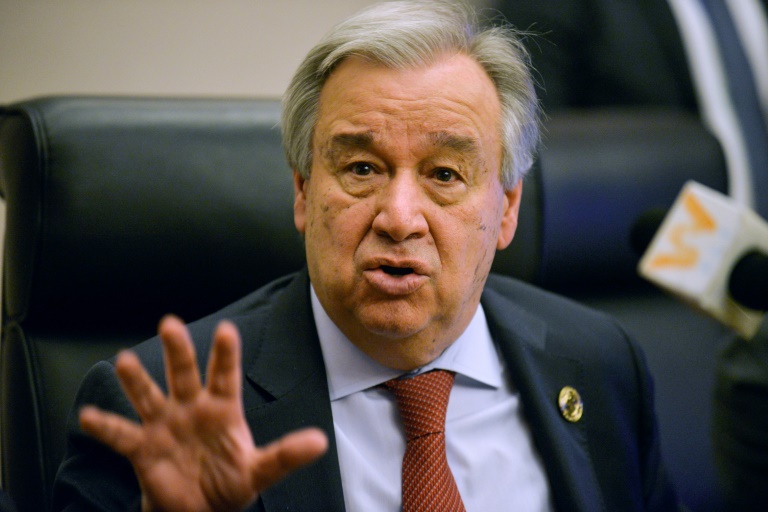
UN chief Antonio Guterres said he was “deeply shocked” by the renewed fighting and appealed for an “immediate cessation of hostilities and for the resumption of peace talks”.

The head of the African Union Commission, Moussa Faki Mahamat, called for a “de-escalation” and the resumption of “talks to seek a peaceful solution”.

The United States urged both sides “to redouble efforts to advance talks to achieve a durable ceasefire”, a US State Department spokesman said.

The TPLF said government forces and their allies had launched a “large scale” offensive towards southern Tigray early Wednesday after a months-long lull in fighting.

But the government accused the TPLF of striking first and violating the ceasefire.

“Ignoring all of the peace alternatives presented by the government, the terrorist group TPLF armed group continued its recent provocations and launched an attack this morning at 5 am (0200 GMT)” around southern Tigray, the Government Communication Service said in a statement.

The rival claims could not be independently verified as access to northern Ethiopia is restricted, but there were reports of fighting around southern Tigray in areas bordering the Amhara and Afar regions.

“They launched the offensive early this morning around 5 am local time. We are defending our positions,” TPLF spokesman Getachew Reda told AFP.

He said on Twitter that the “large-scale” offensive was launched “against our positions in the southern front” by the Ethiopian army and special forces as well as militias from neighbouring Amhara.

– ‘Violated our airspace’ –

The air force said Wednesday it had shot down a plane “believed to be a property of historical enemies who want Ethiopia’s weakness”.

“The airplane which violated our airspace from Sudan… and aimed to supply weapons to the terror group was shot down by our heroic air force,” the Ethiopian News Agency quoted armed forces spokesman Major General Tesfaye Ayalew as saying.

The date of the incident, the type of aircraft and how it was downed were not detailed.

The TPLF said it was a “blatant lie”.

The March truce had paused fighting in a war that first began in November 2020, allowing a resumption of some international aid to Tigray after a three-month break.

Both sides in recent weeks had evoked possible peace talks. 

But they disagree on who should lead negotiations, and the TPLF also insists basic services must be restored to Tigray’s six million people before dialogue can begin.

Abiy’s government says any talks must be brokered by the African Union’s Horn of Africa envoy Olusegun Obasanjo, who is leading the international push for peace, but the rebels want outgoing Kenyan President Uhuru Kenyatta to mediate.

In a statement dated August 23, TPLF leader Debretsion Gebremichael said “two rounds of confidential face-to-face” meetings with top civilian and military officials had taken place, the first acknowledgment by either side of direct talks.

No time or place was given for these talks, which the government has not confirmed. 

William Davison, senior Ethiopia analyst for the International Crisis Group (ICG) think tank, urged all parties to cease fighting to avert “a return to full-blown war”.

“This serious breach of the truce agreed earlier this year demonstrates the need for the two parties to arrange unconditional face-to-face negotiations as soon as these hostilities cease,” Davison said in a statement.

– ‘Enough of this war’ –

The conflict has killed untold numbers, with widespread reports of atrocities including mass killings and sexual violence.

Millions of people need humanitarian assistance in Tigray, the country’s northernmost region, as well as Afar and Amhara.

The UN’s World Food Programme said last week that nearly half the population in Tigray is suffering from a severe lack of food and rates of malnutrition had “skyrocketed”.

Tigray is largely cut off from the rest of Ethiopia, without basic services such as electricity, communications and banking.

Abiy sent troops into Tigray in November 2020 to topple the TPLF after months of tensions with the party that had dominated Ethiopian politics for three decades.

The 2019 Nobel Peace Prize winner said the move came in response to rebel attacks on army camps. 

The TPLF mounted a comeback, recapturing Tigray and expanding into Afar and Amhara, before the war reached a stalemate.

Last Wednesday, an Ethiopian government committee tasked with looking into negotiations called for a formal ceasefire as part of a proposal it planned to submit to the AU.

“If you can’t win, then you’ve got to sit down and talk,” Abiy said Sunday in remarks carried on state media.

“My advice is… let’s have enough of (this) war.”

txw-ayv/ah/gw

US regulator queried Twitter on false accounts

Twitter faced scrutiny from US market regulators over how the platform calculates the number of false or spam accounts, a topic at the heart of the firm’s legal battle with Elon Musk.

The Security and Exchange Commission’s letter sent mid-June, but made public only Wednesday, asked Twitter to disclose its methodology as well as the “underlying judgements and assumptions” involved.

That letter surfaced just a day after news broke that a former Twitter security chief had told US authorities the company misled users and regulators about “extreme, egregious” security gaps.

Twitter rejected those accusations, which could help Musk in the October trial over whether he can walk away from his $44 billion bid to buy the platform. 

When queried for comment on the letter, Twitter on Wednesday cited its SEC reply, which reiterated its statement that false or spam accounts are fewer than five percent of Twitter users who can be shown ads.

“Twitter believes that it already adequately discloses the methodology that it uses in calculating these figures,” said the firm’s June 22 reply, which noted previous filings and public comments.

While the SEC deals primarily with activities involving securities, mainly stocks and bonds, it may also be interested in listed companies’ communications to verify they present a reliable picture of a business’s activities.

The issue of fake and spam accounts is at the heart of the legal battle between Twitter and Tesla chief Musk. 

Musk has moved to back out of the deal by saying the firm misled him on the numbers of those accounts, but Twitter has sued to try to force him close the purchase.

The case is to be decided in a trial, which will begin on October 17 and is scheduled to last five days.

Peiter Zatko, former Twitter security chief-turned-whistleblower, has thrown fresh turbulence into the company’s fight with Musk. 

His complaint warned of obsolete servers, software vulnerable to computer attacks and executives seeking to hide the number of hacking attempts, both from US authorities and from the company’s board of directors.

In particular, Zatko accuses the platform and its CEO Parag Agrawal of issuing untrue statements on account numbers because “if accurate measurements ever became public, it would harm the image and valuation of the company.”

US lawmakers immediately raised concerns about the allegations in Zatko’s filing and have pledged to look into them.

UN chief laments 'sad and tragic' six-month Ukraine war milestone

United Nations Secretary-General Antonio Guterres on Wednesday called the six-month anniversary of the start of Russia’s war in Ukraine a “sad and tragic milestone.”

Guterres made the comments during a special meeting of the UN Security Council in New York to mark the anniversary of Russia’s invasion of its neighbor on February 24.

The UN chief described the six months of conflict as “devastating,” adding that he remained “gravely concerned” about military activity around the Zaporizhzhia nuclear plant in southern Ukraine, Europe’s largest atomic power plant.

“The warning lights are flashing,” he said.

“Any further escalation of the situation could lead to self-destruction. The security of the plant must be ensured, and the plant must be re-established as purely civilian infrastructure,” he added.

The plant is occupied by Russian troops and threatened by shelling, which Moscow blames on Kyiv.

Ukrainian President Volodymyr Zelensky, addressing the meeting via video link, told the UN that Russia “should unconditionally stop nuclear blackmail” and “completely withdraw” from the plant. 

“Europe and neighboring regions face the threat of the radiation pollution. This is a fact,” Zelensky told the session, which had been requested by the United States, France and Britain.

Russia’s ambassador to the UN, Vassily Nebenzia, objected to Zelensky being allowed to speak.

He said he was not opposed to the Ukrainian leader’s participation, but to the fact that he was not attending in person.

The 15-member council voted 13 to one in favor of allowing Zelensky to speak, with China abstaining.

After the meeting, some 50 countries, including the United States, Japan, Britain and France released a joint statement repeating their demand for an immediate cessation of hostilities.

During the session, Nebenzia denounced “mantras about Russian aggression.”

“No one is arguing that it is difficult for Ukrainians today,” he said. 

“However, responsibility for this lies with the Kiev regime… (which) has been steadily leading the country to disaster, choosing the path of Russophobia and the glorification of Nazi criminals,” Nebenzia added.

Guterres — back from a recent trip to Ukraine and Turkey that focused on grain exports, which have resumed following an agreement in July — warned of the continuing threat to food and fuel security.

“The consequences of this senseless war are being felt far beyond Ukraine,” he said.

“If we don’t stabilize the fertilizer market in 2022, there simply will not be enough food in 2023,” the secretary-general warned.

Vote counting begins in tightest ever Angolan election

Ballot counting began in Angola Wednesday after polls closed in what was widely seen as the most competitive vote in the country’s democratic history, with incumbent President Joao Lourenco squaring up against charismatic opposition leader Adalberto Costa Junior.

The election has been overshadowed by Angola’s many woes — a struggling economy, inflation, poverty and drought, compounded by the death of a former strongman president.

The People’s Movement for the Liberation of Angola (MPLA), which has ruled the oil-rich nation for nearly five decades, faced its most serious challenge since the first multiparty vote in 1992.

Eight political parties were running, but the real contest lay between the MPLA and its long-standing rival and ex-rebel movement the National Union for the Total Independence of Angola (UNITA).

Pre-voting opinion polls suggested that support for the MPLA — which won 61 percent of the vote in 2017 elections — would dwindle, while the UNITA — which has entered an electoral pact with two other parties — would make gains. 

But UNITA’s inroads might not be enough to unseat Lourenco, 68, who succeeded veteran leader Jose Eduardo dos Santos five years ago.

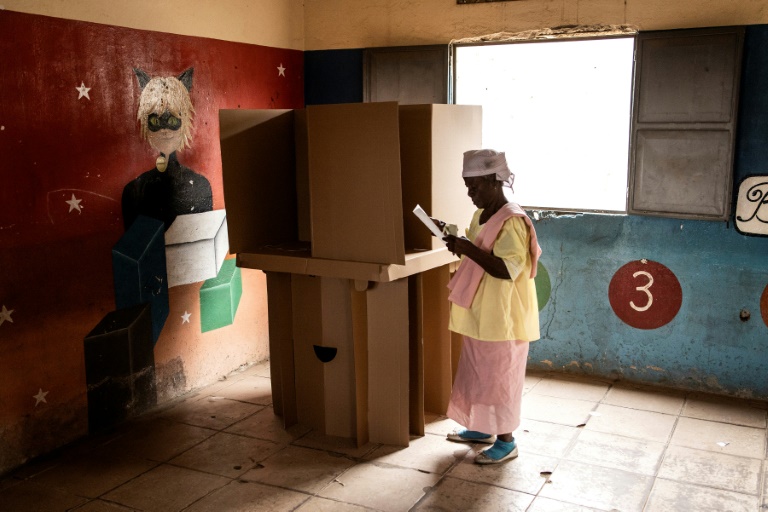
Dozens of voters lined up at polling stations in the early morning, but by midday they were just a trickle. 

Both leading candidates — Lourenco at the capital’s Lusiada University and Costa Junior in the working-class Nova Vida district — called on the public to make their voices heard while casting their ballots.

Some stations started to close in the early evening about an hour before the scheduled time, with no more would-be voters in sight, according to AFP reporters.

– ‘Closer than ever’ –

Costa Junior, 60, is popular among youth — a significant and growing voting bloc — and has pledged to “eradicate poverty” and create jobs.

Analyst Justin Pearce said the race looked “very competitive”.

“The further we’ve gotten from the civil war, the less currency… the MPLA has had,” said the history lecturer at South Africa’s Stellenbosch University.

“The outcome looks like it’s going to be closer than ever before.” 

The MPLA traditionally wields a grip over the electoral process and state media in Angola, and opposition and civic groups have raised fears of voter tampering. 

In the working-class district of Cazenga, 57-year-old Miguel said he would welcome the vote’s outcome, whatever it was.

“We have to accept the results, it’s the democratic game,” he said, without giving his surname.

But Alberto Bernardo Muxibo, another voter, disagreed.

“We don’t have a real democracy. The government oppresses the people,” he said.

– Poverty and graft –

Lourenco, a Soviet-educated former general who had promised a new era for Angola when he was first elected, is credited with making far-reaching reforms in one of southern Africa’s economic powerhouses.

“The West would not mind an MPLA victory — even with concerns of vote rigging,” said Johannesburg-based analyst Marisa Lourenco said.

“Governments and companies abroad prefer stability over change”.

But little has changed for most of Angola’s 33 million people, for whom life is a daily grind.

Angola is Africa’s second largest crude producer, but the oil bonanza also nurtured corruption and nepotism under dos Santos, who died in Spain last month.

The low-key, night-time repatriation of his remains in the final leg of campaigning has added a macabre touch to the election. 

Dos Santos will be buried on Sunday, which would have been his 80th birthday.

Some 14.7 million people were registered to vote at 13,200 polling stations across the vast southern African nation.

Angolans living overseas were for the first time able to cast ballots from abroad.

Results are expected within a few days. In past elections, results have been contested, in a process that can take several weeks.

US responds to Iran on nuclear deal as momentum builds

The United States on Wednesday responded to Iran’s suggestions on reviving a 2015 nuclear deal as momentum builds to bring back the landmark agreement trashed by former president Donald Trump.

Just weeks after the deal looked dead, the European Union put forward on August 8 what it called a final text to restore the agreement, in which Iran would see sanctions relief and be able to sell its oil again in return for severe limits on its nuclear program.

Iran came back last week with a series of proposed changes, to which the United States formally responded on Wednesday, a day after Tehran accused its arch-enemy of stonewalling.

Iran, the United States and the European Union all confirmed the US response, but none immediately discussed it in depth.

“As you know, we received Iran’s comments on the EU’s proposed final text through the EU,” State Department spokesman Ned Price said.

“Our review of those comments has now concluded. We have responded to the EU today.”

In Tehran, Iranian foreign ministry spokesman Nasser Kanani said Tehran received the response “on the outstanding issues in the negotiations to lift sanctions” from the European Union late Wednesday local time.

“The process of carefully reviewing the US opinions has begun and the Islamic Republic of Iran will announce its opinion in this context to the coordinator after it completes its review,” Kanani added.

With signs that the agreement will reach the finish line, Iran’s arch-rival Israel stepped up pressure on Western nations to block it.

“On the table right now is a bad deal. It would give Iran $100 billion a year,” Israeli Prime Minister Yair Lapid told journalists Wednesday.

The money would be used by Iran-backed militant groups Hamas, Hezbollah and Islamic Jihad to “undermine stability in the Middle East and spread terror around the globe,” he added.

Lapid, however, has promised to preserve cooperation with the United States, Israel’s crucial ally, and has avoided the confrontational stance of former prime minister Benjamin Netanyahu, who openly joined then-president Barack Obama’s Republican rivals to campaign against the deal when it was reached.

Israel’s National Security Advisor Eyal Hulata was holding talks in Washington. His counterpart Jake Sullivan told him Tuesday that the United States was committed to “preserve and strengthen” Israel’s defenses and “ensure that Iran never acquires a nuclear weapon.”

– Syria strikes —

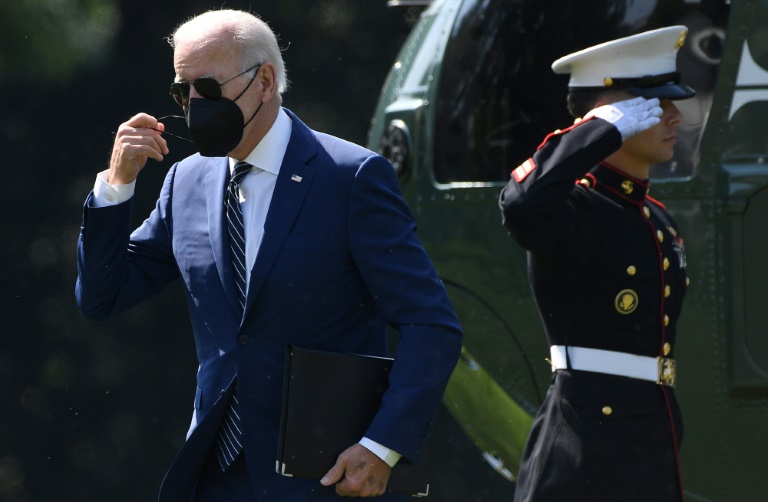
President Joe Biden took office with a goal of restoring the agreement, believing it was the best way to constrain Iran’s nuclear program and that Trump’s withdrawal had done nothing but lead Iran to accelerate its nuclear work.

But a year and a half of diplomacy trudged along slowly in Vienna, where Iran pressed hard and insisted on dealing only indirectly with US envoy Rob Malley, with EU mediators shuttling between hotels.

With the agreement bitterly opposed by Israel, US Republicans and some Iranian hardliners, both Washington and Tehran have gone into spin mode to present the other side as offering concessions.

The United States says that Iran has backed down on a key sticking point — that Biden undo Trump’s blacklisting of the powerful Islamic Revolutionary Guard Corps as a terrorist group.

Biden refused to do so and just Tuesday ordered air strikes in Syria said to target paramilitary fighters linked to the Revolutionary Guards, the clerical regime’s elite ideological unit.

The US Central Command (CENTCOM) said the strikes destroyed infrastructure including ammunition storage in a bid to avoid attacks on the small contingent of US troops in Syria, as witnessed on August 15.

CENTCOM said it purposely avoided casualties. Iran’s foreign ministry denounced the attack as “terrorist” and denied the targeted groups were linked to Tehran.

Under a reported compromise worked out by the European Union, the United States will keep the terrorist designation but limit actions against outside actors that deal with the Revolutionary Guards, who have vast influence across the Iranian economy.

EU foreign policy chief Josep Borrell, in an interview Tuesday with Spanish television, indicated that other nations in the agreement — Britain, China, France, Germany and Russia — were fine with the suggestions offered by Iran.

burs-sct/wd

Equities drift higher ahead of US Fed chair speech

European and US equities mostly advanced on Wednesday as investors awaited signals on the next US interest rate hikes.

With the Jackson Hole meeting of central bankers this week, focus is on what US Federal Reserve chief Jerome Powell will say Friday about plans to tackle high prices.

Many fear higher borrowing costs could send the world’s biggest economy into recession in its battle to rein in inflation.

The euro fell close to a two-decade low against the dollar before rebounding to parity, and the greenback struck a two-year peak against China’s yuan.

European gas prices soared to more than 300 euros per megawatt hour just as equity markets closed, as another temporary cut off of Russian deliveries via pipeline to Germany approached.

– Losing momentum –

“European markets have traded in a lacklustre manner today as higher gas prices serve to contain any attempt to push strongly higher,” said market analyst Michael Hewson at CMC Markets UK.

“Markets seem to have lost their momentum,” noted AJ Bell investment director Russ Mould.

“Investors have become nervous once again, with all eyes on Powell and what he says this coming Friday.” 

Expectations have been building ahead of Powell’s speech.

“Those expectations range from fear of a resolutely hawkish speech to hope of a tempered rate-hike outlook,” said analyst Patrick O’Hare at Briefing.com.

Central banks face a delicate balancing act between battling inflation — with Russia’s war in Ukraine sending energy prices soaring — and avoiding recession.

Yet concerns are growing that spiking energy costs could still prompt a worldwide downturn.

Key markets in Asia slid on Wednesday.

In Europe, London shed 0.2 percent but both Frankfurt and Paris posted modest gains.

On Wall Street, the Dow added 0.4 percent in late morning trading.

– Rollercoaster ride –

The foreign exchange market has faced a rollercoaster ride so far this week.

The euro tumbled on Tuesday to $0.9901 — a new two-decade low — but later clawed back losses as the greenback was hit by poor US economic data.

The dollar had strengthened this week ahead of Powell’s speech, as markets speculate that the Fed will continue to tighten its monetary policy.

Higher interest rates boost the American currency as they make dollar-denominated debt more attractive to investors.

But the euro also has been weighed down by a gloomy outlook for the eurozone economy, amid fears of a halt to Russia’s gas deliveries.

Oil prices wobbled following recent gains on talk of an OPEC output cut, with Brent crude hovering just below $100 per barrel.

“While this may simply be a case of Saudi Arabia talking up the price, for now, the prospect of the group taking such action effectively removes two of the biggest downside risks for prices,” said OANDA analyst Craig Erlam.

Oil prices fell back under $100 per barrel this month on worries of a global economic slowdown and the possibility of Iran reaching a deal on its nuclear programme that would end international sanctions on its crude exports.

– Key figures at around 1530 GMT –

New York – Dow: UP 0.4 percent at 33,051.10 points

EURO STOXX 50: UP 0.3 percent at 3,669.85

London – FTSE 100: DOWN 0.2 percent at 7,471.51 (close) 

Frankfurt – DAX: UP 0.2 percent at 13,220.06 (close) 

Paris – CAC 40: UP 0.4 percent at 6,386.76 (close)

Tokyo – Nikkei 225: DOWN 0.5 percent at 28,313.47 (close)

Hong Kong – Hang Seng Index: DOWN 1.2 percent at 19,268.74 (close)

Shanghai – Composite: DOWN 1.9 percent at 3,215.20 (close)

Euro/dollar: UP at 0.9975 from 0.9970 on Tuesday

Pound/dollar: DOWN at 1.1804 from 1.1836

Euro/pound: UP at 84.48 pence from 84.23 pence

Dollar/yen: UP at 136.85 yen from 136.36 yen

West Texas Intermediate: DOWN 0.7 percent at $93.11 per barrel

Brent North Sea crude: DOWN 0.9 percent at $99.35

Angolans vote for president in tightest ever race

Angolans cast their ballots Wednesday in what was widely seen to be the most competitive vote in their country’s democratic history, with incumbent President Joao Lourenco squaring up against charismatic opposition leader Adalberto Costa Junior.

The election has been overshadowed by Angola’s many woes — a struggling economy, inflation, poverty and drought, compounded by the death of a former strongman president.

The People’s Movement for the Liberation of Angola (MPLA), which has ruled the oil-rich nation for nearly five decades, is facing its most serious challenge since the first multiparty vote in 1992.

Eight political parties are running, but the real contest lies between the MPLA and its long-standing rival and ex-rebel movement the National Union for the Total Independence of Angola (UNITA).

Opinion polls suggest that support for the MPLA — which won 61 percent of the vote in 2017 elections — will dwindle, while the UNITA — which has entered an electoral pact with two other parties — will make gains. 

But UNITA’s inroads might not be enough to unseat Lourenco, 68, who succeeded veteran leader Jose Eduardo dos Santos five years ago.

Dozens of voters lined up at polling stations in the early morning, but by midday they were just a trickle.

After casting his ballot at the capital’s Lusiada University, Lourenco urged Angolans to come out and vote to ensure “it is democracy that wins”.

Voting in the working-class Nova Vida district, his rival Costa Junior called for “full turnout and for all ballots to be counted.”

– ‘Closer than ever’ –

Costa Junior, 60, is popular among youth — a significant and growing voting bloc — and has pledged to “eradicate poverty” and create jobs.

Analyst Justin Pearce said the race looked “very competitive”.

“The further we’ve gotten from the civil war, the less currency… the MPLA has had,” said the history lecturer at South Africa’s Stellenbosch University.

But “the opposition has become more organised and found some synergy with society.

“The outcome looks like it’s going to be closer than ever before.” 

The MPLA traditionally wields a grip over the electoral process and state media in Angola, but the opposition is urging supporters not to be intimidated.

Opposition and civic groups have raised fears of voter tampering, and social media is rife with claims of dead people registered to vote.

The opposition has asked supporters to peacefully monitor the counting process and stage sit-ins outside polling places after voting closes.

In the working-class district of Cazenga, 57-year-old Miguel said he would accept the vote’s outcome, whatever it was.

“We have to accept the results, it’s the democratic game,” he said, without giving his surname.

But Alberto Bernardo Muxibo, who described himself as a civil society activist, disagreed. 

“We don’t have a real democracy. The government oppresses the people,” he said.

– Poverty and graft –

Lourenco, a Soviet-educated former general who had promised a new era for Angola when he was first elected, has trumpeted a list of achievements.

He is credited with making far-reaching reforms in one of southern Africa’s economic powerhouses.

They include boosting financial transparency and efficiency in parastatal organisations, and promoting business-friendly policies to lure foreign investors.

Johannesburg-based analyst Marisa Lourenco said Lourenco’s handling of the debt racked up by his predecessor had been “remarkable”.

“The West would not mind an MPLA victory — even with concerns of vote rigging,” she said.

“Governments and companies abroad prefer stability over change”.

But little has changed for most of Angola’s 33 million people, for whom life is a daily grind.

Angola is Africa’s second largest crude producer, but the oil bonanza also nurtured corruption and nepotism under dos Santos, who died in Spain last month.

The low-key, night-time repatriation of his remains in the final leg of campaigning has added a macabre touch to the election. 

Dos Santos will be buried on Sunday, which would have been his 80th birthday.

Some 14.7 million people are registered to vote at 13,200 polling stations across the vast southern African nation.

Angolans living overseas are for the first time able to cast ballots from abroad.

Results are expected within a few days. In past elections, results have been contested, in a process that can take several weeks.

Close Bitnami banner
Bitnami