World

Drought uncovers dinosaur tracks in US park

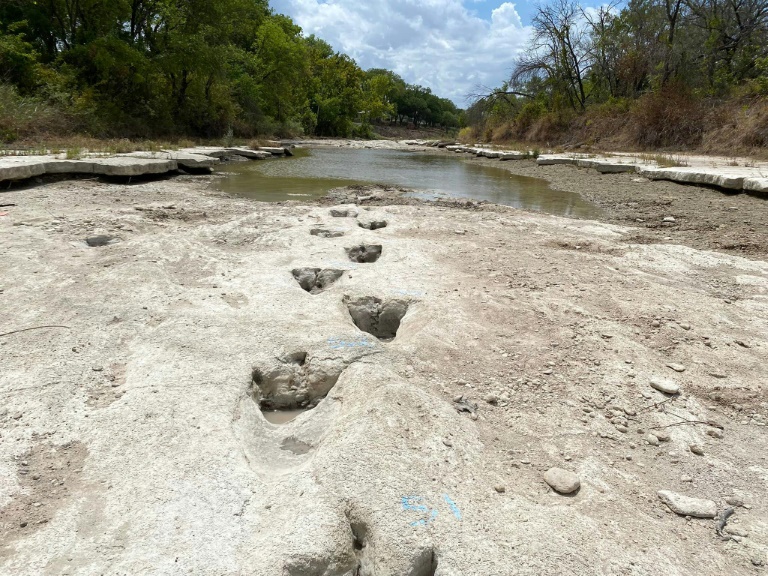
A drought in Texas dried up a river flowing through Dinosaur Valley State Park, exposing tracks from giant reptiles that lived some 113 million years ago, an official said Tuesday.

Photos posted on Facebook show three-toed footprints leading down a dry tree-lined riverbed in the southern US state. It is “one of the longest dinosaur trackways in the world,” a caption accompanying the images says.

Stephanie Salinas Garcia of the Texas Parks and Wildlife Department said dry weather made the tracks visible.

“Due to the excessive drought conditions this past summer, the river dried up completely in most locations, allowing for more tracks to be uncovered here in the park,” she said.

“Under normal river conditions, these newer tracks are under water and are commonly filled in with sediment, making them buried and not as visible,” Garcia said.

Most of the recently revealed tracks were made by Acrocanthosaurus, which weighed nearly seven tons (6,350 kilograms) as an adult and stood 15 feet (4.5 meters) tall.

Another dinosaur, Sauroposeidon, also left tracks in the park. It measured 60 feet tall and weighed 44 tons in adulthood.

The state park — located in an inland area southwest of the city of Dallas — was once on the edge of an ancient ocean, and dinosaurs left footprints in the mud, its website says.

While drought revealed the tracks, rain is in the forecast, meaning they will likely be covered once more.

“While they will soon be buried again by the rain and the river, Dinosaur Valley State Park will continue to protect these 113 million-year-old tracks not only for present, but future generations,” Garcia said.

Germany, Canada partner on transatlantic hydrogen trade

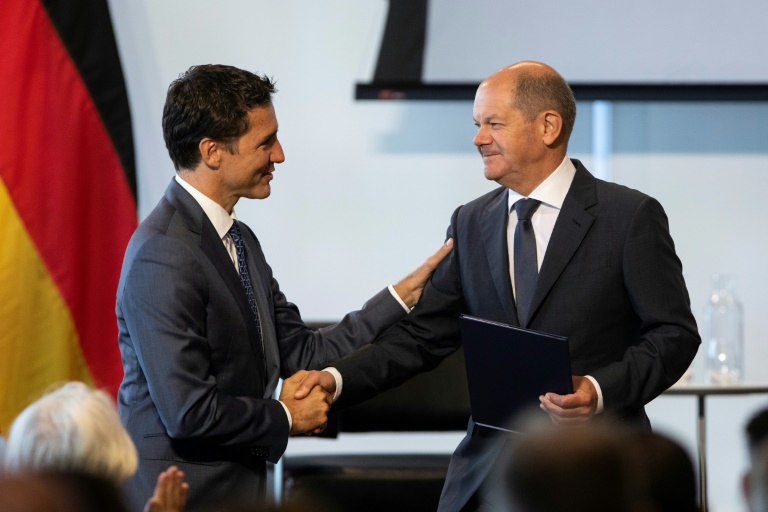
The leaders of Canada and Germany signed a green hydrogen deal on Tuesday, laying a path for a transatlantic supply chain as Europe seeks to lessen its dependence on Russian energy.

“It’s a vote of confidence for Canada as a leader in clean energy,” Prime Minister Justin Trudeau said during a joint press conference with visiting German Chancellor Olaf Scholz.

“We cannot as a world continue to rely on authoritarian countries that will weaponize energy policy, as Russia is, that don’t concern themselves with environmental outcomes or labor rights or even human rights,” Trudeau added.

Moscow has slashed its energy exports to Europe in response to punishing Western sanctions over Moscow’s invasion of Ukraine, forcing countries to scramble for alternatives.

Scholz said there was a need to discuss “short-term constraints and LNG (liquefied natural gas) but in the long run, the real potential lies in green hydrogen from the wind-rich, thinly populated Atlantic provinces.”

Canada aims to become a major producer and exporter of hydrogen and other related clean technologies to displace climate-warming fossil fuels, with Germany lined up to become a first customer.

In a joint declaration, Trudeau and Scholz outlined plans to “kickstart the hydrogen economy and to create a transatlantic supply chain for hydrogen.”

The plan is to make the first deliveries of Canadian hydrogen to Germany as early as 2025, the statement said.

Canada said it would also export hydrogen to the broader European market — “contributing to European energy security,” as the bloc looks to end its reliance on Russian energy — as well as to Asia.

The two leaders, with a sizeable German business delegation in tow, toured a site in Stephenville, Newfoundland, where US-based World Energy GH2 Inc. is looking to build a hydrogen production facility powered by a 164-turbine, one-gigawatt wind farm on the Port au Port Peninsula.

The former pulp mill boasts substantial wind resources, access to the power distribution grid and a port that can ship product to Europe.

The project is one of a dozen under consideration by the Newfoundland government since it lifted a moratorium on new wind farms, and in July issued a call for proposals to put turbines on government lands.

With an estimated $10 billion price tag, it would be the largest single investment ever made in Canada’s Atlantic region.

Germany, Canada partner on transatlantic hydrogen trade

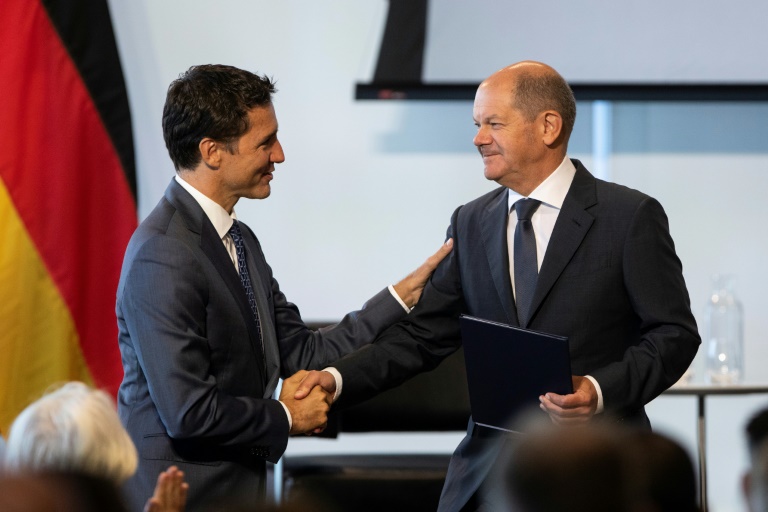
The leaders of Canada and Germany signed a green hydrogen deal on Tuesday, laying a path for a transatlantic supply chain as Europe seeks to lessen its dependence on Russian energy.

“It’s a vote of confidence for Canada as a leader in clean energy,” Prime Minister Justin Trudeau said during a joint press conference with visiting German Chancellor Olaf Scholz.

“We cannot as a world continue to rely on authoritarian countries that will weaponize energy policy, as Russia is, that don’t concern themselves with environmental outcomes or labor rights or even human rights,” Trudeau added.

Moscow has slashed its energy exports to Europe in response to punishing Western sanctions over Moscow’s invasion of Ukraine, forcing countries to scramble for alternatives.

Scholz said there was a need to discuss “short-term constraints and LNG (liquefied natural gas) but in the long run, the real potential lies in green hydrogen from the wind-rich, thinly populated Atlantic provinces.”

Canada aims to become a major producer and exporter of hydrogen and other related clean technologies to displace climate-warming fossil fuels, with Germany lined up to become a first customer.

In a joint declaration, Trudeau and Scholz outlined plans to “kickstart the hydrogen economy and to create a transatlantic supply chain for hydrogen.”

The plan is to make the first deliveries of Canadian hydrogen to Germany as early as 2025, the statement said.

Canada said it would also export hydrogen to the broader European market — “contributing to European energy security,” as the bloc looks to end its reliance on Russian energy — as well as to Asia.

The two leaders, with a sizeable German business delegation in tow, toured a site in Stephenville, Newfoundland, where US-based World Energy GH2 Inc. is looking to build a hydrogen production facility powered by a 164-turbine, one-gigawatt wind farm on the Port au Port Peninsula.

The former pulp mill boasts substantial wind resources, access to the power distribution grid and a port that can ship product to Europe.

The project is one of a dozen under consideration by the Newfoundland government since it lifted a moratorium on new wind farms, and in July issued a call for proposals to put turbines on government lands.

With an estimated $10 billion price tag, it would be the largest single investment ever made in Canada’s Atlantic region.

US says Iran eased demands for nuclear deal

The United States said Tuesday that Iran has agreed to ease key demands that had held up the revival of a 2015 nuclear deal, with all eyes on what President Joe Biden in turn is offering.

The United States is expected shortly to respond to Iran through European Union mediators, after a year and a half of indirect diplomacy that just weeks ago looked on the verge of collapsing.

US officials said Iran dropped demands to block some UN nuclear inspections after also relaxing on insistence on a key sticking point — that Washington remove its powerful Revolutionary Guards from a terrorism blacklist.

“Gaps still remain, but should we reach an agreement to return to the deal, Iran would have to take many significant steps to dismantle its nuclear program,” a senior official in the Biden administration said.

Biden has supported returning to the accord trashed by former president Donald Trump and Iran has pressed hard in negotiations in Vienna. But with Iran also claiming diplomatic wins, the US official insisted that Tehran ultimately “made concessions on critical issues.”

Iran had sought to shut down a probe by the International Atomic Energy Agency (IAEA) into three undeclared nuclear sites where the watchdog says it has questions related to nuclear work that has since ended.

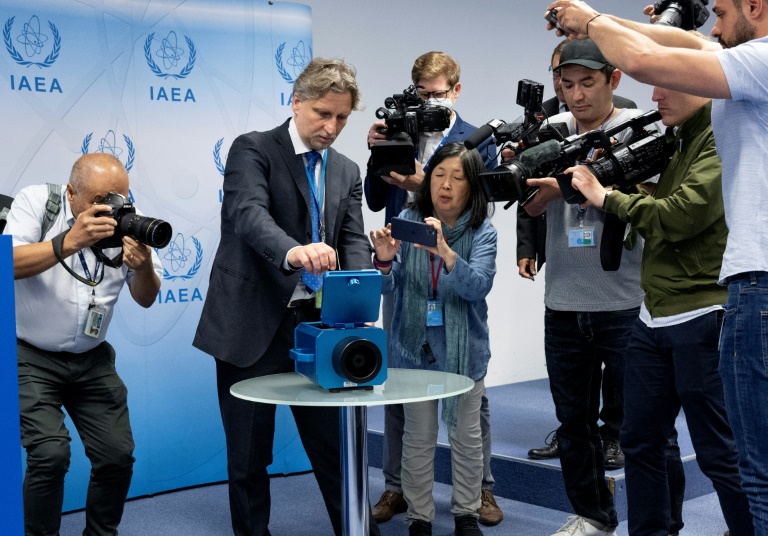
In June, Iran disconnected a number of IAEA cameras after the UN body’s board censured Tehran for not adequately explaining previous traces of uranium.

The senior US official said Iran would again face “the most comprehensive inspections regime ever negotiated” with monitoring “for an unlimited amount of time.”

But Henry Rome, deputy head of research at the Eurasia Group, said that Iran has not conceded on the undeclared sites.

“I don’t think anyone should be surprised if this issue comes up again at a later stage of these negotiations,” Rome said.

The recent progress came after the European Union put forward a draft agreement to Iran. EU foreign policy chief Josep Borrell told Spanish public television TVE that Iran sought adjustments to it but that “most” countries agreed.

Britain, China, France, Germany and Russia are also party to the agreement, formerly known as the Joint Comprehensive Plan of Action.

– ‘Tough compromises’ inevitable –

The US official insisted that accounts of new compromises by the Biden administration were “categorically false.”

But Suzanne DiMaggio, a senior fellow at the Carnegie Endowment for International Peace, said both sides have had to show flexibility to come as far as they have.

“Neither side will want to admit that, but the reality is that in a high-stakes negotiation, especially between adversaries, making tough compromises is the only way to get to an agreement,” she said.

“If both sides feel confident that they can frame the outcome as a win, chances are the JCPOA will be restored. If not, the road ahead looks rocky.”  

She said Biden was in a strong position after legislative wins and had an incentive, amid high tensions with Russia and China, to avoid a nuclear crisis with Iran.

But Biden faces heated opposition from Trump’s Republican Party as well as Israel, which campaigned against the agreement when it was reached under former president Barack Obama.

Trump imposed sweeping sanctions on Iran in hopes of bringing the US adversary to its knees. Its economy suffered but the Biden administration contends the main result was to accelerate Iran’s nuclear work.

In a letter to Biden, the top Republican on the House Foreign Affairs Committee complained that the administration has left Congress in the dark.

“The only logical conclusion to draw is that Iran’s negotiators are pleased with the outcome of negotiations, while US negotiators are still determining how to make further compromises and best sell a bad deal to the American people,” Representative Mike McCaul wrote.

A EU official earlier said that Iran has agreed to defer discussion on ending Trump’s terrorist blacklisting of the Islamic Revolutionary Guard Corps, the clerical regime’s elite ideological unit.

Among ideas reportedly under consideration are for the United States to maintain the terrorist designation but not to punish dealings with the Revolutionary Guards, who have wide interests across the Iranian economy.

The return of the United States to the accord would mean an end to Trump’s unilateral sanctions on Iran selling its oil, potentially easing further energy prices that had soared after Russia’s invasion of Ukraine.

Russia, Ukraine spar at UN over nuclear plant dangers

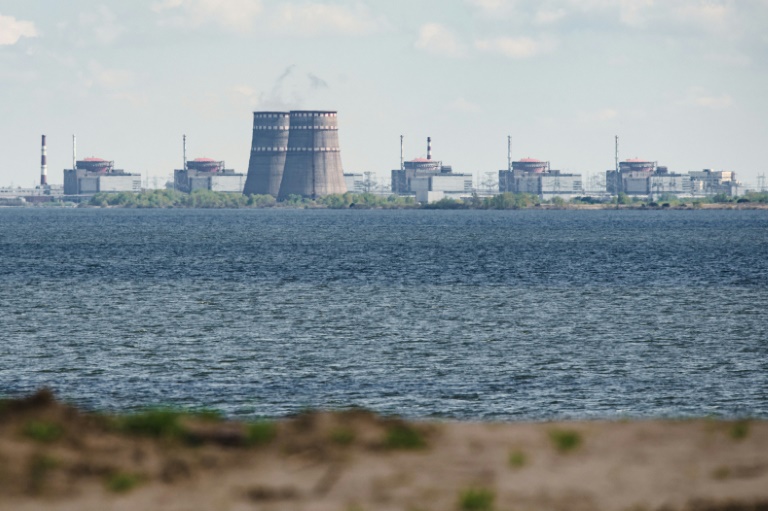
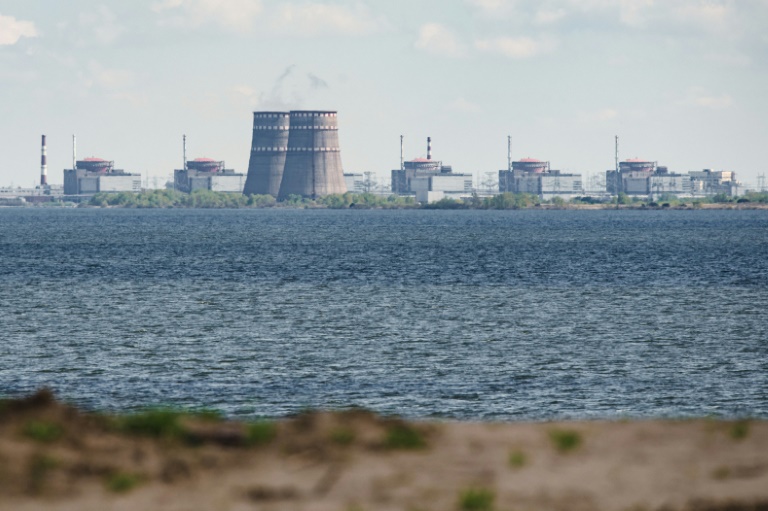
Russia and Ukraine traded accusations Tuesday over who was endangering the Zaporizhzhia nuclear plant, as the United Nations urged both sides to insulate the Ukrainian facility from the ongoing war.

Russia called the meeting at the UN Security Council to discuss the dangers that close shelling and a military presence posed to the power plant in southern Ukraine, amid fears that a damaged reactor could leak radiation across the region.

Russian troops have controlled the plant for weeks and allegedly have placed arms and war supplies there, something that Moscow denies.

Russian Ambassador to the United Nations Vasily Nebenzya accused Ukrainian forces of shelling the plant, heightening the danger of a nuclear disaster.

Since the Security Council last discussed the issue nearly two weeks ago, “the nuclear safety situation has further deteriorated,” Nebenzya said.

“The armed forces of Ukraine continue basically every day to shell the territory of the nuclear power plant (NPP) and the town of Enerhodar, and this creates a real risk of a radiation accident,” he said.

Sergiy Kyslytsya, Ukraine’s ambassador, countered that Russia is responsible for the risk and must pull its troops away and allow inspectors of the International Atomic Energy Agency into the plant.

“The only thing that the entire world wants to hear . . .  is a statement that Russia demilitarizes the Zaporizhzhia NPP, withdraws its troops, and hands it over to the government of Ukraine,” he said.

Kyslytsya said Kyiv supports a proposal for the IAEA to send a mission to inspect the plant, and hoped it would create a permanent presence inside to monitor it fulltime.

“It is really important to conduct the mission in a way that will allow the international community to see the real situation and not a Russian theatrical show,” he said.

Speaking at the beginning of the meeting, UN Undersecretary Rosemary DiCarlo said both sides need to agree on demilitarizing the plant even as the war continues.

“The facility must not be used as part of any military operation, and an agreement on a safe perimeter of demilitarization to ensure the safety of the area should be reached,” she said. 

“We once again urge the parties to provide the IAEA mission with immediate, secure and unfettered access to the site,” she said.

Russia, Ukraine spar at UN over nuclear plant dangers

Russia and Ukraine traded accusations Tuesday over who was endangering the Zaporizhzhia nuclear plant, as the United Nations urged both sides to insulate the Ukrainian facility from the ongoing war.

Russia called the meeting at the UN Security Council to discuss the dangers that close shelling and a military presence posed to the power plant in southern Ukraine, amid fears that a damaged reactor could leak radiation across the region.

Russian troops have controlled the plant for weeks and allegedly have placed arms and war supplies there, something that Moscow denies.

Russian Ambassador to the United Nations Vasily Nebenzya accused Ukrainian forces of shelling the plant, heightening the danger of a nuclear disaster.

Since the Security Council last discussed the issue nearly two weeks ago, “the nuclear safety situation has further deteriorated,” Nebenzya said.

“The armed forces of Ukraine continue basically every day to shell the territory of the nuclear power plant (NPP) and the town of Enerhodar, and this creates a real risk of a radiation accident,” he said.

Sergiy Kyslytsya, Ukraine’s ambassador, countered that Russia is responsible for the risk and must pull its troops away and allow inspectors of the International Atomic Energy Agency into the plant.

“The only thing that the entire world wants to hear . . .  is a statement that Russia demilitarizes the Zaporizhzhia NPP, withdraws its troops, and hands it over to the government of Ukraine,” he said.

Kyslytsya said Kyiv supports a proposal for the IAEA to send a mission to inspect the plant, and hoped it would create a permanent presence inside to monitor it fulltime.

“It is really important to conduct the mission in a way that will allow the international community to see the real situation and not a Russian theatrical show,” he said.

Speaking at the beginning of the meeting, UN Undersecretary Rosemary DiCarlo said both sides need to agree on demilitarizing the plant even as the war continues.

“The facility must not be used as part of any military operation, and an agreement on a safe perimeter of demilitarization to ensure the safety of the area should be reached,” she said. 

“We once again urge the parties to provide the IAEA mission with immediate, secure and unfettered access to the site,” she said.

Global stocks fall as Euro hits new 20-year low

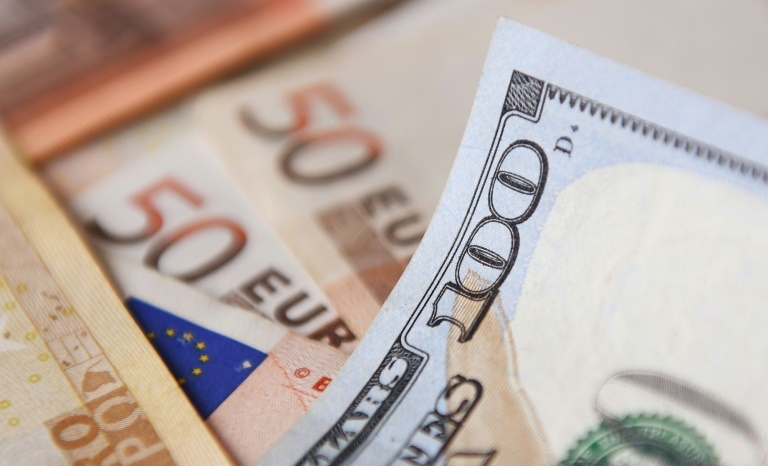
Global stocks were down Tuesday as the euro dove to a new two-decade low against the dollar and traders waited nervously for news on the next US interest rate hikes.

The single currency tumbled to $0.9901, but later clawed back losses as the greenback was hit by poor US economic data.

The dollar had strengthened this week against other currencies ahead of a speech Friday by US Federal Reserve chief Jerome Powell, as markets speculate that the central bank will continue tighten its monetary policy.

Higher interest rates boost the American currency as they make dollar-denominated debt more attractive to investors.

But the euro also has been weighed down by a gloomy outlook for the eurozone economy as Russia’s war in Ukraine has sent energy prices soaring.

The unit plunged below parity with the dollar Monday on recession fears to plumb the lowest levels since 2002, when it first came into physical circulation.

In the latest blow, S&P Global’s closely watched monthly composite purchasing managers’ index (PMI) showed that eurozone economic activity fell for the second month in a row in August.

– ‘Investors are bracing’ –

Wall Street indices ended mostly lower, with the Dow Jones falling 0.5 percent.

With the Jackson Hole central banking symposium this week, the focus is on what Fed chief Powell says about plans to tackle high prices, with many fearing officials could send the economy into recession.

“I think that investors are bracing for some hawkish commentary from Fed chair Powell this coming week,” said Jack Ablin of Cresset Capital.

European equities and Asian markets also slid amid stubborn worries about the Fed’s movements.

US natural gas prices meanwhile hit a fresh 14-year high on Tuesday at $10.028.

But across the Atlantic, European natural gas prices fell, although they remain elevated on fears of a halt to Russia’s gas deliveries. The Dutch TTF Gas Futures contract stood at 268.45 euros down from Monday.

Gas had spiked to record peaks in March after key producer Russia launched its invasion of neighboring Ukraine.

That has sparked surging domestic energy bills, fueling decades-high inflation that has prompted tighter monetary policy around the world.

Moscow’s maneuvers have hit the single currency hard because the bloc relies heavily on imported Russian gas, said Societe Generale analyst Kit Juckes. 

Fears increased after Russia’s Gazprom said Friday the Nord Stream pipeline would be closed for maintenance at the end of the month, cutting Europe’s crucial gas deliveries.

“The euro’s problem is… the threat from continued squeezing of gas supplies and the cost of replacing Russian gas,” Juckes said.

Oil prices — which have fallen for weeks as recession worries hit demand expectations — rebounded after Saudi Arabia suggested OPEC and other major producers could cut output citing “volatility” in crude markets.

– Key figures at around 2030 GMT –

New York – Dow: DOWN 0.5 percent at 32,909.59 points (close)

New York – S&P 500: DOWN 0.2 percent at 4,128.73 (close)

New York – Nasdaq: UNCH at 12,381.30 (close)

EURO STOXX 50: DOWN 0.2 percent at 3,652.52 (close)

London – FTSE 100: DOWN 0.6 percent at 7,488.11 (close)

Frankfurt – DAX: DOWN 0.3 percent at 13,194.23 (close)

Paris – CAC 40: DOWN 0.3 percent at 6,362.02 (close)

Tokyo – Nikkei 225: DOWN 1.2 percent at 28,452.75 (close)

Hong Kong – Hang Seng Index: DOWN 0.8 percent at 19,503.25 (close)

Shanghai – Composite: DOWN 0.1 percent at 3,276.22 (close)

Euro/dollar: UP at $0.9973 from $0.9943 Monday

Pound/dollar: UP at $1.1835 from $1.1767

Euro/pound: DOWN at 84.25 pence from 84.98 pence

Dollar/yen: DOWN at 136.7710 yen from 137.48 yen

West Texas Intermediate: UP 3.7 percent at $93.74 per barrel

Brent North Sea crude: UP 3.9 percent at $100.22

burs-rl-bfm/hs

US says Ukraine grain exports near pre-war levels

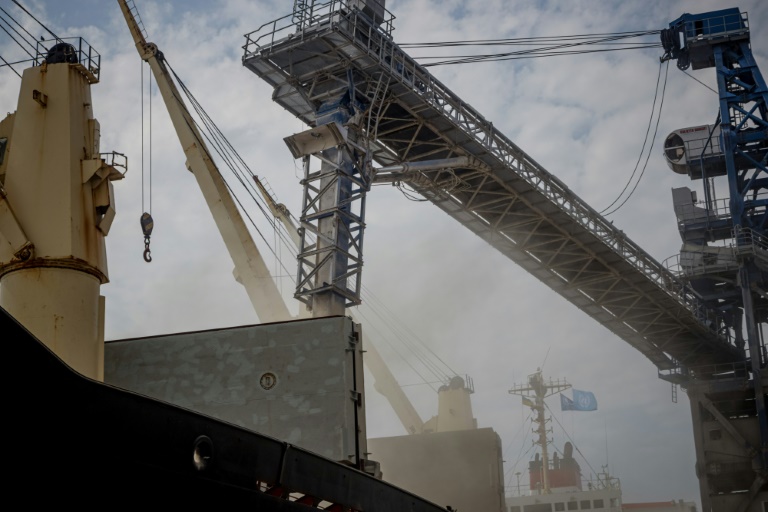
Ukraine is on course to ship nearly as much grain this month as it did before the Russian invasion, in a triumph for international efforts to ease food shortages, a US official said Tuesday.

Ukraine is one of the world’s largest exporters of wheat, corn, barley and sunflower oil, shipping around five million metric tons of grain each month before the war.

Its exports ground to a trickle after the February 24 invasion, contributing to a spike in global food prices that has hit poor nations especially hard.

“Thanks to intensive international cooperation, Ukraine is on track to export as much as four million metric tons of agricultural products in August,” a senior US State Department official told AFP.

Ukraine and Russia in July reached a first wartime agreement through the mediation of Turkey and UN Secretary-General Antonio Guterres, with guarantees for ships to sail out of Ukraine’s Black Sea ports.

The State Department official said that the efforts have moved out more than 720,000 tons of grain from the ports through 33 ships over the past several weeks.

More significant so far has been a European initiative to ship Ukrainian grain by river, rail and road routes.

The so-called “Solidarity Lanes” established by the European Union rushed additional vehicles including trucks to the border, addressing hurdles including Ukrainian wagons’ incompatibility with European rail gauges.

The European effort is shipping 2.5-3 million tons of produce into the European Union and beyond to international markets each month, the official said.

As part of the agreement negotiated in Istanbul, Russia will also be guaranteed shipment of food and fertilizer without being subject to sanctions.

Guterres recently appealed for “unimpeded access,” saying that the world could face dangerous agricultural shortfalls next year unless Russian fertilizer reaches international markets.

The United States says that its sweeping sanctions on Russia over the Ukraine war have exempted agricultural products and accuses Moscow of seeking to distract the world from its own responsibility for shortages.

Last week the United States said it was contributing another $68 million to the World Food Programme to buy 150,000 metric tons of Ukrainian wheat to address food insecurity.

The UN agency warned on Friday that some 22 million people face starvation in Horn of Africa countries where the rising costs of imported food have exacerbated the effects of climate change.

Kenya, Ethiopia and Somalia have suffered the unprecedented failure of four straight rainy seasons.

Israel unveils 1,200 year-old desert mansion

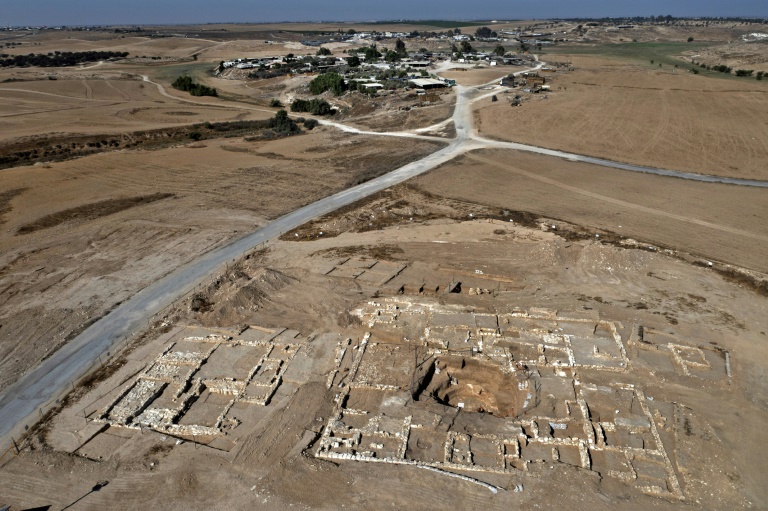
Israeli archaeologists unveiled a 1,200 year-old mansion on Tuesday, broadening knowledge of the southern desert region where a mosque was recently discovered.

Described as a “luxurious rural estate” by the Israel Antiquities Authority, the home boasted a marble-paved hallway and walls decorated with frescoes.

The first building of its kind to be found in the southern Negev desert, according to the IAA, it contained vaulted rooms around a central courtyard.

The remains of oil lamps were unearthed in storage rooms underground, along with a cistern.

“The luxurious estate and the unique impressive underground vaults are evidence of the owners’ means,” said a statement from the archaeologists leading the excavations.

“Their high status and wealth allowed them to build a luxurious mansion that served as a residence and for entertaining,” added Oren Shmueli, Elena Kogan-Zehavi and Noe D. Michael.

“We assume whoever lived here was some local ruler,” Michael told AFP, adding that such estates had been “totally unknown in the Negev until today”.

The site in the Bedouin city of Rahat is due to be opened to the public on Thursday.

The estate is close to a rare mosque dating back to the same period, which Israeli archaeologists unveiled in June.

A few dozens Muslims likely worshipped at the site at one time, the IAA said.

The Muslim conquest of the region occurred in the first half of the seventh century.

“After we finish the excavation (of the mansion), it is planned that this place will be preserved”, alongside other discoveries like the mosque, Michael added.

Iraq's Sadr supporters hold sit-in outside judicial body

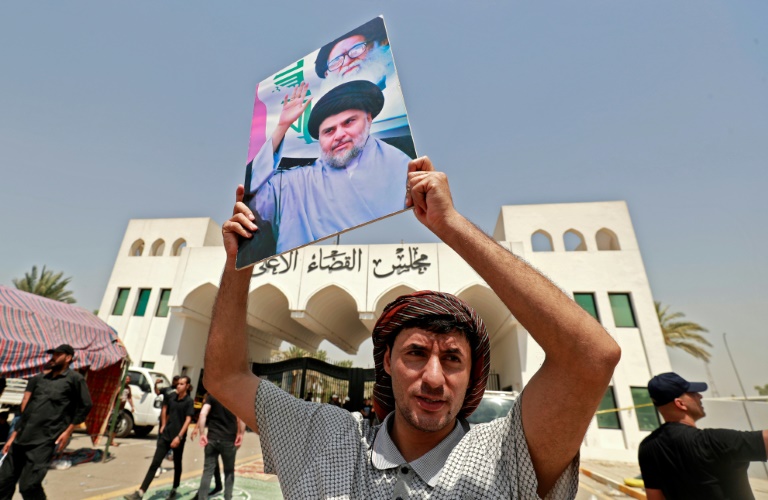
Supporters of Iraqi Shiite cleric Moqtada Sadr held a sit-in outside the top judicial body for several hours on Tuesday, ratcheting up tensions in a showdown with a rival Shiite alliance.

Caretaker Prime Minister Mustafa al-Kadhemi cut short a visit to Egypt where he had been due to take part in a five-nation summit, to return home to monitor developments in his country, which has been mired in political deadlock for months.

Kadhemi “called on all political parties to calm down and to take advantage of the opportunity for national dialogue to get the country out of its current crisis”, his office said.

The standoff between the Sadrists and their rivals in the pro-Iran Coordination Framework has triggered an intensifying war of words, but so far no violence.

The Sadrists, who have already been camped outside parliament for the past three weeks, pitched tents outside the gates of the judicial body’s headquarters in Baghdad on Tuesday morning.

They carried placards demanding the dissolution of parliament and new elections, 10 months after an inconclusive poll failed to deliver a majority government.

The country is still waiting for a new government, premier and president.

But the sit-in began to draw down in the evening after a close associate of Sadr’s, Saleh Mohamed al-Iraqi, called on protesters to pull back.

About 10 hours after it began, demonstrators were encouraged to withdraw “while keeping tents up”, but were told they could “continue the sit-in in front of parliament” if they wished.

An AFP journalist saw protesters leaving the area.

– ‘Stamp out corruption’ –

Though Sadr’s political bloc has taken part in previous administrations, securing top jobs in government ministries, Sadr himself has managed to largely keep above the political fray.

He is lionised by his supporters as an outsider dedicated to the fight against a corrupt elite.

“We want to stamp out corruption,” said Abu Karar al-Alyawi, a Sadr supporter among those demonstrating.

“The judicial system is being blackmailed, or maybe it’s corrupt too.” 

On August 10, Sadr gave the Supreme Judicial Council one week to dissolve parliament to end the political deadlock, but the council ruled it lacked the authority to do so.

The council had initially announced it was suspending operations amid the protest, but as it calmed, judges said they would resume work on Wednesday.

The UN mission in Iraq said it respected the right to “peaceful protest”, while urging “respect for state institutions”.

– Talks boycotted by Sadrists –

Police deployed in numbers around the headquarters, which unlike parliament, lies outside Baghdad’s high-security Green Zone government and diplomatic compound.

Following the start of the sit-in, the Coordination Framework said it would “refuse any call for direct dialogue” with the Sadrists, until they put an end to “the occupation of institutions”.

The Coordination Framework, which has been holding a sit-in of its own just outside the Green Zone, wants a transitional government before new polls are held.

The alliance includes former paramilitaries of the Tehran-backed Hashed al-Shaabi network, and the party of ex-prime minister Nuri al-Maliki, a longtime Sadr foe.

The Hashed late Tuesday said it was ready to “defend state institutions”.

Kadhemi, the prime minister, last week convened crisis talks with party leaders, but they were boycotted by the Sadrists.

Since the aftermath of the US-led invasion of 2003, Iraq has been governed under a sectarian power-sharing system that reserves the premiership for the country’s Shiite majority community.

The Sadrists insist that after emerging from 2021 elections as the largest bloc in parliament — but not an absolute majority — the constitution be amended to give it the right to nominate the prime minister, something their opponents strongly oppose.

The persistent failure of the rival Shiite factions to form a government in a country blighted by ailing infrastructure and crumbling public services has sparked mounting public frustration.

Iraqis grown used to daily power cuts lasting much of the day now also face water shortages as drought ravages swathes of the country.

Despite its oil wealth, many Iraqis are mired in poverty, and some 35 percent of young people are unemployed, according to the United Nations.

ak-gde/lg/pjm

Close Bitnami banner
Bitnami