World

Volkswagen and Mercedes sign EV battery accords with Canada

Canada announced Tuesday tentative deals with Volkswagen and Mercedes-Benz that would see the two European automakers tap into burgeoning North American supply chains as they seek to challenge Tesla in the electric vehicle market.

The memorandums of understanding were signed during a visit to Canada by German Chancellor Olaf Scholz, who is seeking to firm up access to new energy supplies for Germany and deepen bilateral trade ties.

The agreements “will help us meet growing demand, both here at home and around the world, for electric vehicles,” Canadian Prime Minister Justin Trudeau tweeted.

Scholz commented in a statement that the cooperation, notably in the securing of critical battery inputs such as lithium, nickel and cobalt, “may encourage other companies to follow.”

Mercedes-Benz said it envisages partnering with Canadian companies across the electric vehicle and battery supply chains, including Rock Tech Lithium for the supply of up to 10,000 tonnes of lithium hydroxide annually, starting in 2026.

The Volkswagen agreement specifically focuses on the production of battery precursor and cathode materials. Volkswagen’s newly-formed battery company PowerCo will also open a Canadian office.

“Working hand in hand with governments around the world is an absolute prerequisite to meet our climate goals,” Volkswagen chief executive Herbert Diess said in a statement.

“The supply of battery raw materials and the production of precursor and cathode materials with a low carbon footprint will allow for a fast and sustainable ramp-up of battery capacity — a key lever for our growth strategy in North America,” he added.

The deals come on the heels of several other agreements announced by the sector, including by Stellantis in March to manufacture batteries for electric vehicles in Canada.

Ottawa meanwhile has boosted its support of domestic exploration for critical minerals used to make electric vehicle batteries.

Najib sent to jail after Malaysia top court upholds sentence in 1MDB scandal

Malaysia’s highest court Tuesday upheld former prime minister Najib Razak’s 12-year jail sentence for corruption in the 1MDB financial scandal, a decision analysts said could slam the door to a political comeback.

Najib’s daughter-in-law Nur Sharmila Shaheen said the family was told he was sent to Kajang Prison, located south of the capital Kuala Lumpur.

“My father-in-law asked us to take care of the family. He remained strong and calm,” she said.

Federal Court chief justice Maimun Tuan Mat, speaking on behalf of a five-judge panel, said the tribunal found Najib’s “complaints as contained in the petition of appeal devoid of any merit”.

“On the totality of the evidence, we find the conviction of the appellant on all seven charges safe. We also find that the sentence imposed is not manifestly excessive,” she added.

The appeals are “unanimously dismissed and the conviction and sentence are affirmed”, Maimun said.

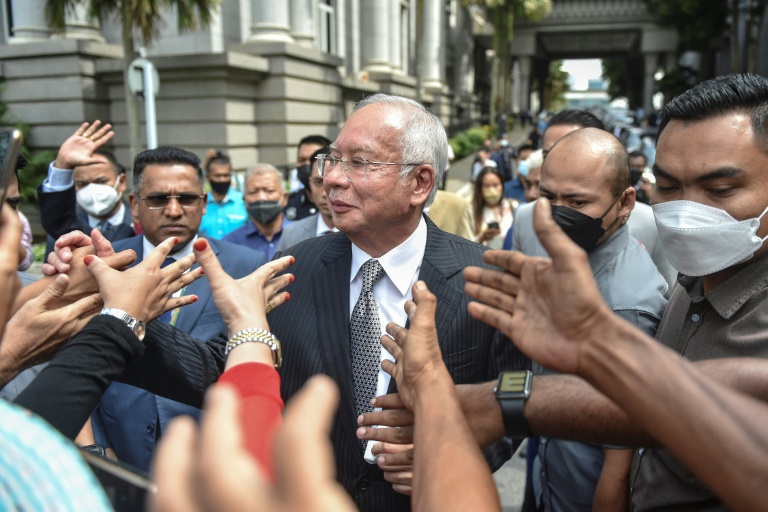
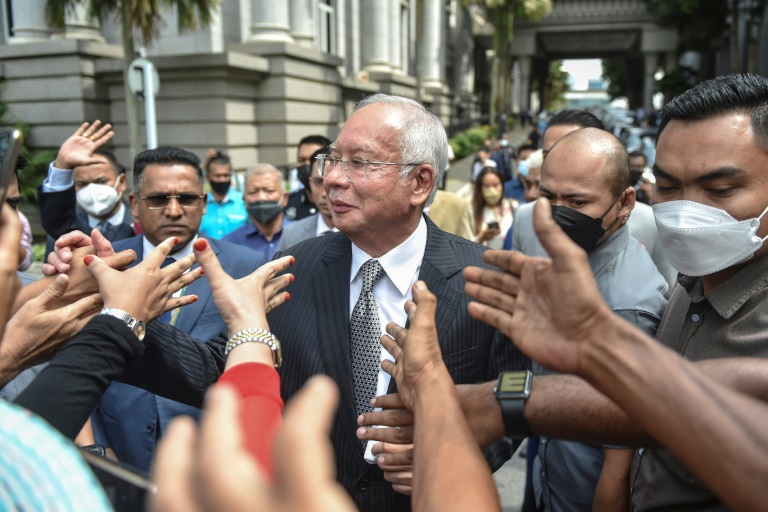
The 69-year-old former prime minister looked somber and dejected, seated by his wife Rosmah and two children as the verdict was read.

Journalists who were in an adjacent room watching the proceedings through video link saw Najib surrounded by family members, friends and party mates before the connection was cut off.

Outside the court, teary-eyed family members and supporters hugged each other.

Earlier in the day when Najib arrived in court, around 300 supporters mobbed his car chanting “bossku” — “my boss” in Malay — a rallying cry among his defenders.

Just before the verdict was read, Najib, who had said he received an unfair trial, made an impassioned plea asking for a two-month adjournment so he can adequately prepare for a defence.

During a break in the proceedings, he spoke to supporters, telling them “if I am guilty, please forgive me”.

– Barred from elections –

Najib is the UK-educated son of one of Malaysia’s founding fathers who had been groomed for the prime minister’s post from a young age.

The final ruling on the jail sentence also came four years after his long-ruling party’s shock election defeat in 2018, during which allegations he and his friends embezzled billions of dollars from state fund 1MDB were key campaign issues.

A lower court in July 2020 found Najib guilty of abuse of power, money laundering and criminal breach of trust over the transfer of 42 million ringgit ($10 million) from SRC International, a former unit of state fund 1MDB, to his personal bank account.

An appellate court in December denied his appeal, prompting him to go to the Federal Court for a final recourse.

Some analysts said the decision will likely derail any plans by Najib for a political comeback.

“Under Malaysian law, Najib cannot stand for this election and the next election (if found guilty),” James Chin, a professor of Asian studies at the University of Tasmania, told AFP before the verdict was announced.

“Obviously, his political career is gone.” 

There has been speculation that polls may be held this year, though elections are not due until September 2023.

But Oh Ei Sun, principal adviser for think-tank Pacific Research Center of Malaysia, said one way out for Najib is to get the king’s pardon.

“He could still apply for clemency (from the king),” he told AFP. “And if pardoned, as many expect, he could easily mount a comeback as his feudalistically minded supporters are numerous in number.”

Oh said, however, that the current Prime Minister Ismail Sabri Yaakob — who belongs to the same United Malays National Organisation party — must recommend a pardon.

Najib and his ruling party were voted out in 2018 following allegations of their involvement in a multibillion-dollar financial scandal at 1MDB.

He and his associates were accused of stealing billions of dollars from the country’s investment vehicle and spending it on everything from high-end real estate to pricey art.

US new home sales fall to six-year low

US new home sales fell sharply in July to their lowest rate since early 2016, the government reported Tuesday, as rising lending rates cool demand.

Americans reduced their new home purchases by 12.6 percent compared to June, to an annual rate of 511,000, seasonally adjusted, continuing a downward trend, the Commerce Department reported.

The results were far weaker than the consensus among economists, who expected to see a much smaller decline. 

After low borrowing costs spurred a boom in homebuying during the pandemic, the sales pace has fallen 29.6 percent from July 2021, the data showed.

“July’s drop continues the steep downtrend in sales since the start of the year,” said Ian Shepherdson of Pantheon Macroeconomics, noting that “new home sales have fallen below pre-pandemic levels.”

Sales last month declined throughout the country by double digits, except in the Northeast.

Mortgage rates have been climbing sharply in recent months as the Federal Reserve cranks up interest rates in its battle against surging inflation.

Central bankers hope the aggressive moves will cool overheated demand throughout the economy, including the housing market, where builders have struggled to keep up amid supply snarls and a labor shortage.

Those factors have contributed to a steady climb in home prices, and the median cost of a new home rose to $439,400 from $414,900 in June.

However, the sales data can be volatile.

“These data are wild month-to-month,” Shepherdson said.

“It’s reasonable to assume that the steepest declines in sales are behind us, though they likely will fall a bit further.”

James Webb telescope captures stunning images of Jupiter

NASA’s James Webb Space Telescope has captured stunning images of the planet Jupiter showing two tiny moons, faint rings and auroras at the northern and southern poles.

“We hadn’t really expected it to be this good, to be honest,” said planetary astronomer Imke de Pater of the University of California, Berkeley.

“It’s really remarkable that we can see details on Jupiter together with its rings, tiny satellites, and even galaxies in one image,” she said.

De Pater headed the observations of Jupiter, the largest planet in our solar system, with Thierry Fouchet of the Paris Observatory.

The composite images were taken with the observatory’s Near-Infrared Camera (NIRCam) and were artificially colored because infrared light is not visible to the human eye.

The auroras above the northern and southern poles of Jupiter have been mapped in redder colors while the Great Red Spot, a storm bigger than Earth, appears white.

One image shows Jupiter’s faint rings and its moons Amalthea and Adrastea.

Launched in December 2021 from French Guiana on an Ariane 5 rocket, Webb is orbiting the Sun at a distance of a million miles (1.6 million kilometers) from Earth, in a region of space called the second Lagrange point.

It took the spacecraft almost a month to reach the region, where it remains in a fixed position behind the Earth and Sun to give it a clear view of the cosmos.

The Webb telescope is an international collaboration between the US space agency NASA, the European Space Agency, and the Canadian Space Agency, involving more than 10,000 people.

Cyprus says major gas find could boost European supplies

A new gas discovery off Cyprus could speed up exploitation of untapped resources and help secure supplies to Europe, Cypriot Energy Minister Natasa Pilides said Tuesday.

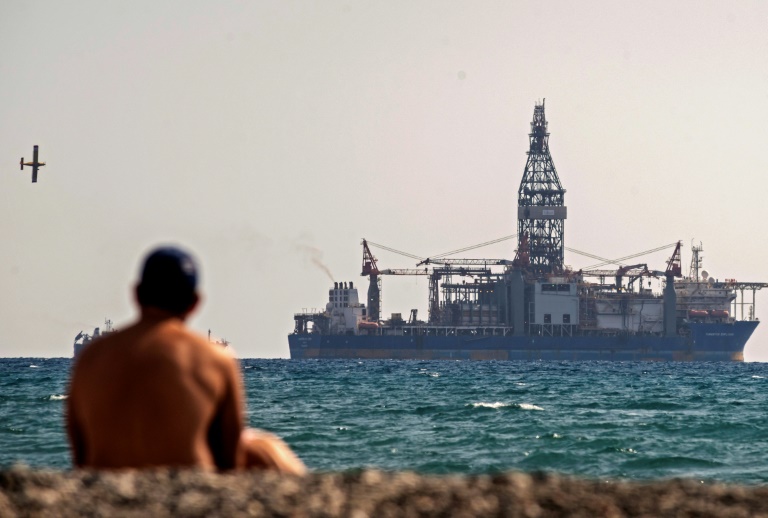
Italian giant Eni and France’s TotalEnergies announced on Monday a “significant gas discovery at the Cronos-1 well, in Block 6, offshore Cyprus”.

Cyprus’s energy ministry said preliminary estimates indicated the reservoir holds about 2.5 trillion cubic feet (70 billion cubic metres) of natural gas.

With Russia threatening to cut off gas supplies to the European Union, Nicosia was in talks with Brussels to become part of the bloc’s energy plan to reduce reliance on Moscow, Pilides told state radio.

The minister said she had contacted Eni and TotalEnergies to “find ways to optimally exploit this discovery”.

The gas find was located 165 kilometres (about 100 miles) off the southwest coast of Cyprus.

In 2018, Eni discovered the large Calypso-1 gas field in the same block, containing an estimated 4.5 trillion cubic feet of gas.

The Cypriot energy ministry said Monday more drilling had begun in a new well called Zeus-1 in Block 6, where additional quantities of gas could be discovered.

Nicosia has granted drilling licences for seven blocks to the Eni-Total consortium.

The latest discovery adds to three other major gas finds, including at the Aphrodite well in Block 12 of 4.5 trillion cubic feet, licensed to US firm Chevron, Britain’s Shell, as well as Israeli partners.

Pilides estimated it would take about three years to commercially exploit Aphrodite, with the gas likely to be exported to nearby Egypt.

In December, US giant ExxonMobil and Qatar Energy signed a contract for oil and gas exploration and production-sharing off Cyprus, angering Turkey.

Gas exploration in the eastern Mediterranean has been a sore spot for the two nations due to competing claims over rights to maritime zones.

In February 2019, ExxonMobil and Qatar Energy discovered a huge natural gas reserve off Cyprus in Block 10, the island’s largest find to date with an estimated five to eight trillion cubic feet.

Six months on, Russians divided on Ukraine conflict

For some it was “necessary”, for others it is a source of “sadness” — six months after Moscow launched its offensive in Ukraine, many Russians remain divided over the conflict.

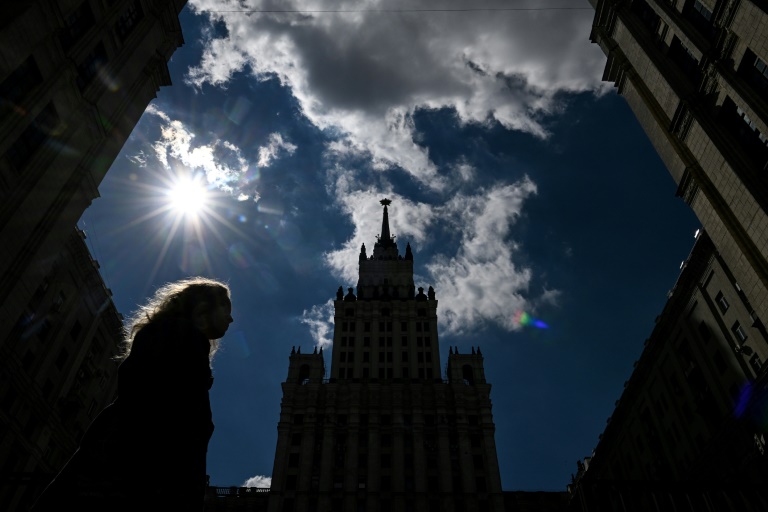
In and around Moscow ahead of the anniversary this week, some expressed support for what Russia calls its “special military operation” in its pro-Western neighbour, while others voiced deep regret at the suffering it had caused.

But all agreed they hoped the fighting would end soon.

“I am very sad for the Ukrainians. They are suffering for nothing, they did not do anything wrong,” Dmitry Romanenko, a 35-year-old IT specialist, told AFP on the streets of central Moscow.

Russian President Vladimir Putin’s decision to send troops into Ukraine on February 24 has turned the lives of many Russians upside-down. 

The country’s economy has fared better than some expected in the face of what were meant to be crippling Western sanctions, but many ordinary Russians have been hit hard by the exit of foreign firms and by galloping inflation.

Cut off from much of the rest of the world by travel and flight restrictions, many Russians are also feeling deeply isolated. 

There are signs of public support for Russia’s actions in Moscow, with stickers in the windows of some cars bearing the letter “Z” — the symbol of Russian forces fighting in Ukraine.

But in the centre of the Russian capital, generally considered less conservative than other parts of the country, most residents interviewed by AFP were critical of the conflict and its effects.

– ‘Everyone is suffering’ –

Romanenko, sporting a thick beard and with his arms and neck covered in tattoos, said the start of the military campaign marked the end of his livelihood in Russia.

“It destroyed everything I was doing, all my business. I was in start-ups and all of my eight projects were destroyed,” he said.

Walking nearby in a colourful patterned dress and white hat, 83-year-old retired art critic Valentina Byalik said it was clear that “everything has changed”.

“We are part of a generation whose childhood was spent at war. And it’s very sad that our old age is also spent at war,” she said.

“Even if we live far away from the military operations, we feel profound sadness for the people who are dying, no matter what their nationality.”

Byalik said the growing isolation of Russians was especially difficult.

“The fact that a great country is now isolated, that everyone hates this country…this is very bitter for us,” she said.

Dmitry Nalivayko, a 34-year-old waiter with a ribbon in the colours of the Russian flag attached to his backpack, said it was “wrong” for ordinary people to be caught up in the conflict.

“Let the politicians fight, not the people who are suffering from all this. Everyone is suffering,” he said.

Other Russians are ready to fiercely support the military campaign. 

Many of them turned up for a recent army forum on the outskirts of the capital where the country’s latest military hardware was being shown off.

– ‘Everything will be fine’ –

Strolling in front of a row of tanks wearing T-shirts emblazoned with white “Z”s, 33-year-old Vladimir Kosov and his 55-year-old mother Olga said it was Russia’s duty to support pro-Russian separatists in Ukraine’s eastern Donbas region.

“We have to help them, even at the cost of our lives,” she said, while Vladimir denounced what he described as “nationalism” in Ukraine as “the most dangerous threat of our times”.

“It was necessary,” Mikhail Nikitin, a 35-year-old IT specialist, said at the forum.

“Sooner or later we will be victorious anyway and everything will be fine after that.”

Even with the conflict dragging on far longer than many expected, those supporting Russian military action said they had no doubt about its outcome.

“I think our people will win after all. Peace will be restored between Russia and Ukraine, because we were friendly countries all our lives,” Nadezhda Josan, a 35-year-old manager of a cleaning company, said at the forum.

“We hope that everything will end soon. And everything will be fine.”

Malaysia's Najib Razak: from PM to prison

The son of one of Malaysia’s founding fathers, Najib Razak was groomed for the prime minister’s post from a young age.

But after running the country for nine years he now faces more than a decade in jail for corruption in a spectacular fall over his links to the misuse of billions in public money.

Malaysia’s highest court on Tuesday upheld Najib’s 12-year jail sentence over the theft of cash from state fund 1MDB, slamming shut the door on any further political ambitions the former leader may have held.

Since his shock election defeat in May 2018, Najib has faced a tightening noose as successive governments ramped up investigations into the allegations of graft that have hung over him and wife Rosmah Mansor.

Later that year Najib was found guilty of abuse of power, money laundering and criminal breach of trust over the 1MDB scandal.

The convictions relate to his role in diverting 42 million ringgit (about $10 million) from SRC International, a unit of 1MDB, into his personal bank accounts. 

Najib’s downfall is a far cry from 2009 when he first took office offering hope for many in Malaysia longing for an end to the repressive tactics deployed by a once-invincible coalition that ruled for six decades.

He initially espoused liberal political views and replaced security laws widely criticised as stifling dissent. 

But the British-educated Najib was seen by many Malaysians as an aloof elitist with little understanding of common people. 

That perception was accentuated by frequent tone-deaf gaffes as well as policies unpopular with the poor, such as a sales tax introduced in 2015 that is now set to be scrapped.

His wife Rosmah was also a constant lightning rod for critics due to her imperious manner and elaborately coiffed hair, which she once complained cost her 1,200 ringgit ($270) to style. Malaysia’s minimum monthly wage at the time was 900 ringgit.

– ‘Cash is king’ –

Then-prime minister Mahathir Mohamad has said Najib told him in 2015 that “cash is king” in maintaining political support in Malaysia, a phrase that opponents turned against Najib as a sign of his hubris and corruption.

Money and power appeared to act as a firewall protecting Najib through a scandal involving Malaysia’s 2002 purchase of French submarines while he was defence minister, a deal brokered by a close associate.

Allegations later emerged of huge kickbacks to Malaysian officials to secure the deal, and the murky episode was punctuated by the murder of a Mongolian woman involved in the negotiations.

Altantuya Shaariibuu was shot dead and her body blown up near Kuala Lumpur using military-grade explosives.

Two officers in a special unit that guarded Malaysian ministers were convicted of the killing, but suspicion that Najib and Rosmah were involved hovered for years, with Najib at one point forced to deny he had an affair with the 28-year-old Altantuya.

– Final straw –

The final straw was 1MDB, a fund Najib launched in 2009 to promote economic development.

Soon after he won a second term in 2013, 1MDB slid into a massive debt hole and allegations surfaced that money was missing.

Public disgust with reports that emerged around 2015 detailing the plunder of the sovereign wealth fund snowballed into a Mahathir-led electoral tsunami that left Najib in the crosshairs of police.

US authorities say Najib’s entourage used hundreds of millions in diverted 1MDB funds to purchase high-end real estate in Los Angeles, New York and London. 

Other spending on the public purse included a Monet painting for $35 million, a $5.5 million work by Van Gogh, a $35 million Bombardier jet and financing for the 2013 Hollywood film “The Wolf of Wall Street”, which was produced by Najib’s stepson Riza Aziz.

A 2015 investigative report by the New York Times also alleged that millions of dollars were used to purchase jewellery for Rosmah.

In a speech in December 2017, then-US attorney general Jeff Sessions said of the scandal: “This is kleptocracy at its worst.”

Najib steadfastly denied wrongdoing while persecuting his accusers and shutting down media outlets that reported on the affair.

In the end, the 69-year-old cut a dejected figure in court as the final verdict was read Tuesday.

“We were told he has been taken to Kajang Prison, south of the capital Kuala Lumpur,” Nur Sharmila Shaheen, his daughter-in-law, told AFP.

Malaysia's Najib Razak: from PM to prison

The son of one of Malaysia’s founding fathers, Najib Razak was groomed for the prime minister’s post from a young age.

But after running the country for nine years he now faces more than a decade in jail for corruption in a spectacular fall over his links to the misuse of billions in public money.

Malaysia’s highest court on Tuesday upheld Najib’s 12-year jail sentence over the theft of cash from state fund 1MDB, slamming shut the door on any further political ambitions the former leader may have held.

Since his shock election defeat in May 2018, Najib has faced a tightening noose as successive governments ramped up investigations into the allegations of graft that have hung over him and wife Rosmah Mansor.

Later that year Najib was found guilty of abuse of power, money laundering and criminal breach of trust over the 1MDB scandal.

The convictions relate to his role in diverting 42 million ringgit (about $10 million) from SRC International, a unit of 1MDB, into his personal bank accounts. 

Najib’s downfall is a far cry from 2009 when he first took office offering hope for many in Malaysia longing for an end to the repressive tactics deployed by a once-invincible coalition that ruled for six decades.

He initially espoused liberal political views and replaced security laws widely criticised as stifling dissent. 

But the British-educated Najib was seen by many Malaysians as an aloof elitist with little understanding of common people. 

That perception was accentuated by frequent tone-deaf gaffes as well as policies unpopular with the poor, such as a sales tax introduced in 2015 that is now set to be scrapped.

His wife Rosmah was also a constant lightning rod for critics due to her imperious manner and elaborately coiffed hair, which she once complained cost her 1,200 ringgit ($270) to style. Malaysia’s minimum monthly wage at the time was 900 ringgit.

– ‘Cash is king’ –

Then-prime minister Mahathir Mohamad has said Najib told him in 2015 that “cash is king” in maintaining political support in Malaysia, a phrase that opponents turned against Najib as a sign of his hubris and corruption.

Money and power appeared to act as a firewall protecting Najib through a scandal involving Malaysia’s 2002 purchase of French submarines while he was defence minister, a deal brokered by a close associate.

Allegations later emerged of huge kickbacks to Malaysian officials to secure the deal, and the murky episode was punctuated by the murder of a Mongolian woman involved in the negotiations.

Altantuya Shaariibuu was shot dead and her body blown up near Kuala Lumpur using military-grade explosives.

Two officers in a special unit that guarded Malaysian ministers were convicted of the killing, but suspicion that Najib and Rosmah were involved hovered for years, with Najib at one point forced to deny he had an affair with the 28-year-old Altantuya.

– Final straw –

The final straw was 1MDB, a fund Najib launched in 2009 to promote economic development.

Soon after he won a second term in 2013, 1MDB slid into a massive debt hole and allegations surfaced that money was missing.

Public disgust with reports that emerged around 2015 detailing the plunder of the sovereign wealth fund snowballed into a Mahathir-led electoral tsunami that left Najib in the crosshairs of police.

US authorities say Najib’s entourage used hundreds of millions in diverted 1MDB funds to purchase high-end real estate in Los Angeles, New York and London. 

Other spending on the public purse included a Monet painting for $35 million, a $5.5 million work by Van Gogh, a $35 million Bombardier jet and financing for the 2013 Hollywood film “The Wolf of Wall Street”, which was produced by Najib’s stepson Riza Aziz.

A 2015 investigative report by the New York Times also alleged that millions of dollars were used to purchase jewellery for Rosmah.

In a speech in December 2017, then-US attorney general Jeff Sessions said of the scandal: “This is kleptocracy at its worst.”

Najib steadfastly denied wrongdoing while persecuting his accusers and shutting down media outlets that reported on the affair.

In the end, the 69-year-old cut a dejected figure in court as the final verdict was read Tuesday.

“We were told he has been taken to Kajang Prison, south of the capital Kuala Lumpur,” Nur Sharmila Shaheen, his daughter-in-law, told AFP.

Ex-security chief accuses Twitter of hiding major flaws

Twitter misled users and federal regulators about glaring weaknesses in its ability to protect personal data, the platform’s former security chief claimed in whistleblower testimony likely to impact the company’s bitter legal battle over Elon Musk’s takeover bid.

In a complaint filed with the US Securities and Exchange Commission and published in part Tuesday by The Washington Post and CNN, Peiter Zatko also accused Twitter of significantly underestimating the number of automated bots on the platform — a key element in Musk’s argument for withdrawing his $44 billion buyout deal.

CNN quotes the disclosure by Zatko as accusing Twitter of “negligence, willful ignorance, and threats to national security and democracy.”

Zatko, who Twitter says it fired earlier this year for poor performance, warns of obsolete servers, software vulnerable to computer attacks and executives seeking to hide the number of hacking attempts, both to US authorities and to the company’s board of directors.

The hacker-turned-executive, who goes by the nickname “Mudge,” also claims that Twitter prioritizes growing its user base over fighting spam and bots, according to the reports.

In particular, according to The Washington Post, he accuses the platform’s boss Parag Agrawal of “lying” in a tweet in May.

In the tweet, Agrawal says Twitter is “strongly incentivized to detect and remove as much spam as we possibly can.”

Twitter has dismissed the allegations.

A company spokesperson told AFP Tuesday that Zatko was fired in January this year for “ineffective leadership and poor performance.”

“What we’ve seen so far is a false narrative about Twitter and our privacy and data security practices that is riddled with inconsistencies and inaccuracies and lacks important context,” the spokesperson said in a statement.

The “opportunistic timing” of the allegations appears “designed to capture attention and inflict harm on Twitter, its customers and its shareholders,” the statement continued.

“Security and privacy have long been company-wide priorities at Twitter and will continue to be.”

– Subpoena by Musk –

The issue of fake accounts is at the heart of the legal battle between Twitter and Tesla chief Musk. 

The billionaire has repeatedly accused the company of minimizing the number of fake accounts and spam on its platform. 

Musk is relying on the argument to justify abandoning his plan to buy Twitter for $44 billion and avoid paying severance.

CNN said Zatko had not been in contact with Musk, and that he had begun the whistleblower process before there was any sign of the billionaire’s involvement in Twitter.

“We have already issued a subpoena for Mr. Zatko, and we found his exit and that of other key employees curious in light of what we have been finding,” Musk’s lawyer Alex Spiro told AFP on Tuesday.

The Washington Post and CNN both reported that the US Senate Intelligence Committee wants to meet with Zatko to discuss his accusations.

Zatko was hired in late 2020 by the founder and former boss of Twitter, Jack Dorsey, after a massive hack which saw the accounts of major users including Joe Biden, Barack Obama, reality star Kim Kardashian and Musk himself compromised.

Hundreds mourn Russian nationalist's daughter killed in car bomb

Russia vowed “no mercy” for the killers of Daria Dugina, the daughter of an ultranationalist intellectual, as hundreds gathered for her funeral following her death in a car bomb blast over the weekend.

“I believe that this is a barbaric crime for which there is no forgiveness,” Russia’s Foreign Minister Sergei Lavrov told journalists on Tuesday, calling for “no mercy” for those responsible. 

Moscow says Ukrainian intelligence was behind the attack — a claim dismissed by Kyiv.

Alexander Dugin — a vocal supporter of the Kremlin’s military campaign who has claimed to be close to President Vladimir Putin — may have been the intended target of the attack that killed his 29-year-old daughter.

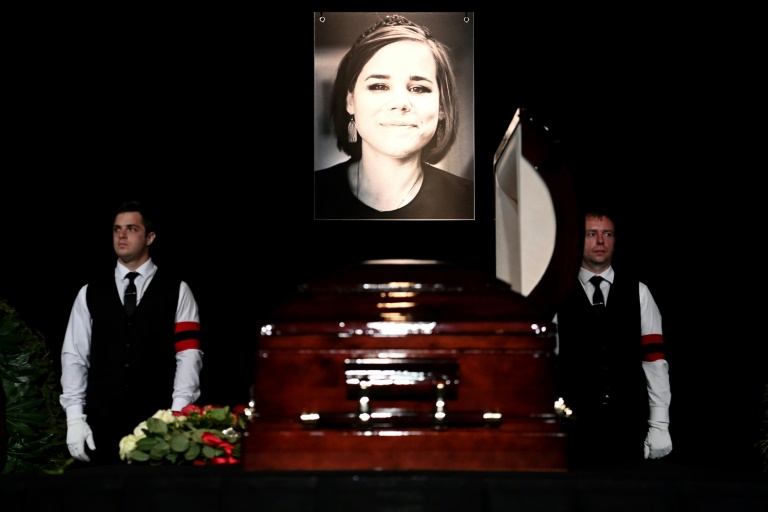
Mourners — many carrying flowers — paid their respects at a hall in Moscow’s Ostankino TV centre where her black-and-white portrait was displayed over an open casket.

Dugin and his wife, both dressed in black, sat next to their daughter’s coffin.

“She died for the people, for Russia, at the front. The front — it is here,” Dugin said at the ceremony.

“Since childhood, among her first words — that we taught her of course — were Russia, our state, our people, our empire,” he added. 

Dugina was killed Saturday when a bomb placed in her car went off as she drove on a highway outside Moscow.

– FSB accuses Ukraine –

Russia’s powerful FSB security agency said on Monday it had solved the crime — just two days after the incident — naming a Ukrainian woman as Dugina’s attacker.

It said the perpetrator had rented an apartment in the same building as Dugina and followed her in a car, suggesting that Dugina was the intended victim.

However, Russian media reported that Dugin and his daughter had had a last-minute change of plans, with Dugina driving her father’s car.

The US Department of State said on Monday that it condemned targeting civilians, while stating that Ukraine had denied any involvement.

“I have no doubt that the Russians will investigate this. I also have no doubt that the Russians will put forward certain conclusions,” State Department spokesman Ned Price said.

Russia’s foreign ministry retorted that Washington’s reaction “discredits the international activity” of the United States. 

“Washington has no moral right… to judge human rights in remote parts of the world, since the murder of a journalist is not even commented on from this angle,” foreign ministry spokeswoman Maria Zakharova said on social media. 

– Like father, like daughter –

Dugin, 60, gained prominence in the 1990s in the intellectual chaos that followed the break-up of the Soviet Union. He had been an anti-communist dissident in the last years of Soviet rule. 

He co-founded the opposition National Bolshevik Party but quit it to set up the Eurasian party which calls for Russia to reclaim its former territories and create an empire spanning from Europe to Asia.

Dugin backed Russia’s much-criticised 2014 annexation of Crimea, following which he called for a wider attack on Ukraine. He was then put on a Western sanctions list.

A regular on Russian television, the heavily bearded intellectual with the air of a prophet claimed he had an ideological influence on Putin.

Putin has become increasingly hostile towards the West, and some see Dugin’s hand in this, calling him “Putin’s Rasputin” or “Putin’s brain”. 

While Putin has never publicly supported him, on Monday the Kremlin released a message of condolences from the president, denouncing the “vile crime” that had led to Dugina’s death.

Putin posthumously awarded Dugina the “Order of Courage”. The medal was displayed near her coffin on the day of the funeral.

Dugina followed in her father’s footsteps, becoming a well-known media personality who worked for pro-Kremlin television channels including Russia Today and Tsargrad.

She covered the conflict in the Russian-backed separatist enclaves in eastern Ukraine, which she backed.

Like her father, Dugina came under US sanctions at the start of March.

Close Bitnami banner
Bitnami