World

Erdogan warns of 'another Chernobyl' after talks in Ukraine

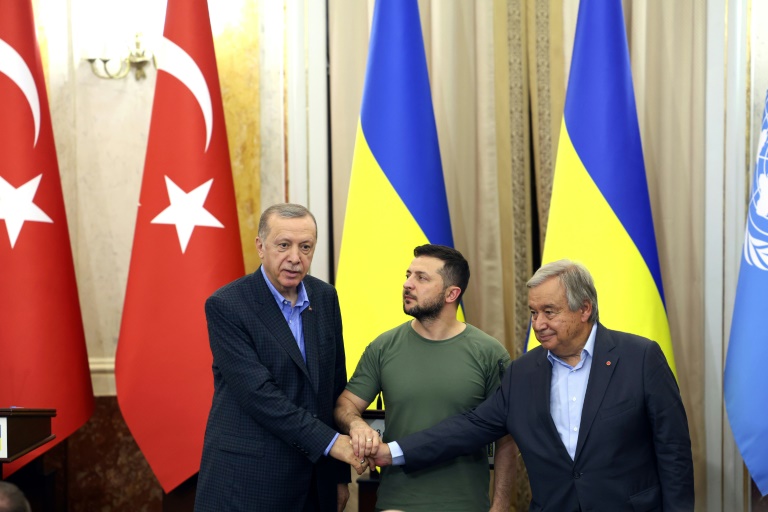
Turkish leader Recep Tayyip Erdogan warned Thursday of a nuclear disaster in Ukraine during his first face-to-face talks with President Volodymyr Zelensky since Russia’s invasion began, echoing pleas from the UN’s chief.

A flare-up in fighting around Europe’s largest nuclear facility in Russian-controlled southern Ukraine has sparked urgent warnings from world leaders, and UN chief Antonio Guterres cautioned during talks with Erdogan that any damage to the plant would be akin to “suicide”.

“We are worried. We don’t want another Chernobyl,” Erdogan said during a press conference in the eastern city of Lviv, during which he also assured the Ukrainian leader that Ankara was a firm ally.

“While continuing our efforts to find a solution, we remain on the side of our Ukraine friends,” Erdogan said.

Guterres said he was “gravely concerned” about the situation at the plant and that it had to be demilitarised, adding: “We must tell it like it is — any potential damage to Zaporizhzhia is suicide”.

Erdogan, who has major geopolitical rivalries with the Kremlin but maintains a close working relationship with President Vladimir Putin, met with the Russian leader less than two weeks ago in the Black Sea resort of Sochi.

The Turkish leader and Guterres were key brokers of a deal inked in Istanbul last month allowing for the resumption of grain exports from Ukraine after Russia’s invasion blocked essential global supplies.

Ahead of the press conference with Zelensky, Ukraine’s port authority announced that the 25th cargo ship under the deal had departed for Egypt carrying 33,000 tonnes of grain.

Ukraine and Russia are two of the world’s biggest grain exporters, and the halt in exports has seen grain prices soar and fears of a global food shortage mount.

Guterres said during the meeting with reporters that the sides hoped to intensify efforts to bolster operations at three southern ports designated to handle exports under the deal.

“We will do our best to scale up our operations to face… the coming winter,” he said.

Guterres continued his visit on Friday with a trip to Odessa, one of the ports involved, and was expected to later head to Turkey to visit the body tasked with overseeing the exports accord.

– ‘They should leave’ –

The success of the grain deal contrasts with failed peace talks early in the war, and Zelensky on Thursday ruled out peace with Russia unless it withdrew its troops from Ukraine.

He told reporters he was “very surprised” to hear from Erdogan that Russia was “ready for some kind of peace”, adding: “First they should leave our territory and then we’ll see”.

Fighting raged along the front on Thursday and early Friday.

Bombardments across the city of Kharkiv and nearby Krasnograd left at least six dead and 25 injured on Thursday, just one day after Russian bombardments killed 13 in the country’s second-largest urban centre.

Early-morning shelling on Friday also targeted the city of Nikopol, according to a local military official, while the mayor of Mykolayiv reported “massive explosions” there around the same time.

Meanwhile, two Russian villages in Belgorod province were evacuated on Thursday after a fire broke out at an ammunition depot near the Ukrainian border, local authorities said.

The blaze came amid a slew of blasts at Russian military installations near Ukraine, one of which Moscow has acknowledged to be an act of “sabotage”.

– ‘Provocation’ at Zaporizhzhia? –

Fighting in recent weeks has focused around the southern region of Zaporizhzhia and the nuclear facility there, and Zelensky called on the UN to ensure security at the plant after direct talks with Guterres, while also blaming Russia for “deliberate” attacks on the facility.

Russian forces took the plant in March and uncertainty surrounding it has fuelled fears of a nuclear incident.

Moscow dismissed Ukrainian allegations Thursday, saying its forces had not deployed heavy weapons at Zaporizhzhia and accusing Kyiv of preparing a “provocation” there that would see Russia “accused of creating a man-made disaster at the plant”.

Kyiv, however, insisted it was Moscow that was planning a “provocation” at the facility.

Ukrainian military intelligence said in a Facebook post on Thursday night that it had received reports that all but a “small part of operational personnel” at the plant had been ordered to stay home on Friday, while representatives of Russia’s state nuclear operator “actually left the territory” of the facility.

“Considering the number of weapons that are currently located on the territory of the nuclear plant, as well as repeated provocative shelling, there is a high probability of a large-scale terrorist attack at the nuclear facility,” it said.

NATO Secretary General Jens Stoltenberg has said Russia’s seizure of the plant “poses a serious threat”, and has called for a Russian withdrawal and inspections by the UN nuclear watchdog.

burs-jbr/dt/gw/smw/cwl

Asian markets drift as investors assess Fed outlook

Stocks swung in Asia on Friday as investors tried to assess the Federal Reserve’s plans for lifting interest rates to fight inflation, with mixed data and differing opinions by bank officials providing little clarity.

The rally across markets from their June lows appears to have run out of steam this week after minutes from the Fed’s most recent meeting showed it was determined to keep lifting borrowing costs until prices were brought under control. 

The gains have come in the face of a number of problems that have caused unease on trading floors, including China-US tensions, the Ukraine war, supply chain snarls and extreme weather across much of the northern hemisphere.

A statement by policymakers and comments from Fed boss Jerome Powell after last month’s board meeting suggested they could be considering slowing the pace of rate hikes as the economy slows.

That was followed by a drop in inflation, which lifted markets, but was followed by several officials reasserting the need to continue to tighten monetary policy to get inflation down from four-decade highs.

This week’s minutes and comments from a number of Fed top brass reinforced that view, with some pouring cold water on hopes for possible rate cuts in the new year.

All eyes are now on next week’s central bankers symposium in Jackson Hole, Wyoming, where finance chiefs and central bankers will speak with all attention on the utterances of Powell.

“We don’t see how the Fed can pivot when they haven’t achieved anything pretty much,” said Marco Pirondini, of Amundi US. “The market will have to become more realistic on this.”

Still, Wall Street’s three main indexes edged up after Wednesday’s losses.

But Asian traders moved a little more cautiously.

Tokyo, Hong Kong, Sydney, Taipei, Manila and Jakarta rose but Shanghai, Singapore, Seoul and Wellington were down.

The prospect of tighter US monetary policy for an extended period lifted the dollar back up to multi-year highs against its peers.

And OANDA’s Edward Moya warned that markets would remain wobbly for a while.

“Stocks will most likely struggle for direction for the rest of the summer as Wall Street is still uncertain with how aggressive the Fed will be in September,” he said in a note.

“Traders however will continue to pay close attention to developments with the war in Ukraine.

“Turkish President (Recep Tayyip) Erdogan noted that he discussed ways on ending the war with (Ukrainian) President (Volodymyr) Zelensky. An imminent end to the war seems unlikely, but any de-escalations or improved passages for Ukraine grain exports would be welcome news for risk appetite.

However, others remained optimistic that the recent gains could be maintained.

Lewis Grant, of Federated Hermes, added: “We remain optimistic that the current rally will build into a longer term bull market, but cognisant that geopolitical risks remain elevated and it is too early to dismiss the possibility that we are witnessing a bear market rally.

“Investor risk appetite remains fragile.”

– Key figures at around 0230 GMT –

Tokyo – Nikkei 225: UP 0.1 percent at 28,967.64 (break)

Hong Kong – Hang Seng Index: UP 0.4 percent at 19,834.61

Shanghai – Composite: DOWN 0.1 percent at 3,273.79

Euro/dollar: DOWN at $1.0078 from $1.0095 Thursday

Pound/dollar: DOWN at $1.1917 from $1.1937

Euro/pound: DOWN at 84.54 pence from 84.56 pence

Dollar/yen: UP at 136.16 yen from 135.88 yen

West Texas Intermediate: DOWN 0.2 percent at $90.34 per barrel

Brent North Sea crude: DOWN 0.2 percent at $96.40 per barrel

New York – Dow: UP 0.1 percent at 33,999.04 (close)

London – FTSE 100: UP 0.4 percent at 7,541.85 (close) 

— Bloomberg News contributed to this story —

New Zealand flood recovery estimated to take 'years'

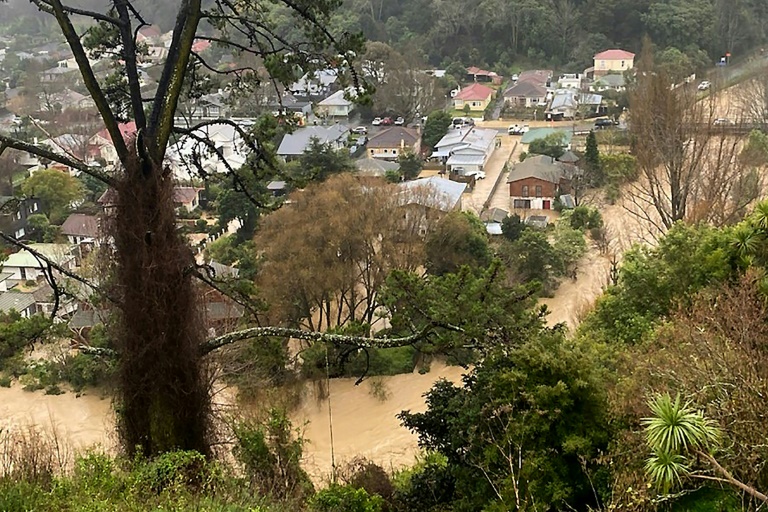
A New Zealand city devastated by flooding will take years to recover, the mayor said on Friday, as hundreds more homes were evacuated.

The Pacific nation has been lashed by wild weather with the Nelson-Tasman district on the South Island bearing the brunt after 75 centimetres (29 inches) of rain reportedly fell over three days.

Several streets in the city of Nelson were flooded after the local river, the Maitai, burst its banks.  

Nelson Mayor Rachel Reese said the damage to roads and the city’s infrastructure will “take years, not months” to repair.

She added that it was “critical” Nelson’s residents conserve water as the city’s supply was disrupted by a landslide that damaged the main line from the local reservoir.

On a visit to witness the damage, New Zealand’s Minister for Emergency Management Kieran McAnulty pledged $200,000 ($125,000) of aid and confirmed more than 400 homes have now been evacuated in Nelson, where a state of emergency remains in place.

He added that flooding and landslides have made 60 homes potentially uninhabitable.

McAnulty told reporters one of the most striking things he saw was a street on a housing development “where the road had just been washed out, (leaving) a crater deeper than I am tall”.

Nelson resident Paul Maskell said a neighbour alerted him to the rising water on his street.

“By the time I got back, it was a foot deep in water with boulders running down the road. It was surreal,” he told the New Zealand Herald.

An elderly resident recovering after an operation had to be winched to safety by firefighters late Thursday night, after his home was threatened by flooding.

New Zealand’s South Island was bracing for another lashing of heavy rain, but other regions did not escape the extreme weather.

The nearby city of New Plymouth endured it’s wettest August day since records began with 10 centimetres falling in 12 hours.

“More than a metre of rain has fallen causing significant flows down all rivers,” said Taranaki Civil Defence controller Todd Velvin with flooding, road closures and fallen trees creating problems.

Kaitaia, a town near the top of North Island, was cut off by flooding and landslides, and around 400 homes were left without power in the far north.

Experts say climate change driven by human activity is boosting the intensity and frequency of extreme weather events, such as heatwaves, droughts and flooding.

Daniel Kingston, senior geography lecturer at the University of Otago, attributed the heavy rain to an “atmospheric river” — a narrow band of water vapour high in the atmosphere over New Zealand.

“It’s safe to say that with respect to the influence of climate change, it is more than likely playing a role,” Kingston told AFP.

N Korea rejects Seoul's aid-for-denuclearisation offer

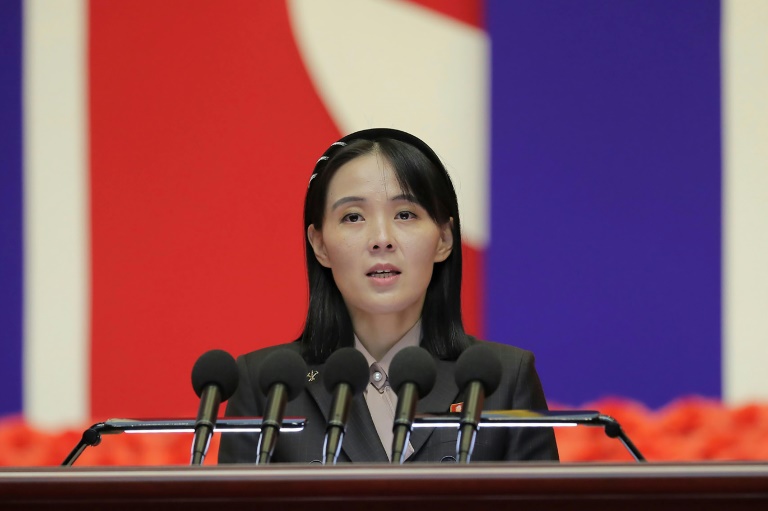
The powerful sister of North Korean leader Kim Jong Un on Friday rejected Seoul’s offer of economic assistance in return for denuclearisation steps, calling it the “height of absurdity”.

The statement follows South Korean President Yoon Suk-yeol this week putting forward an “audacious” aid plan that would include food, energy and infrastructure help in return for the North abandoning its nuclear weapons programme. 

Analysts previously said the chances of Pyongyang accepting such a deal — first floated during Yoon’s inaugural speech — were vanishingly slim, as the North, which invests a vast chunk of its GDP into weapons programmes, has long made it clear it will not make that trade.

Kim Jong Un’s sister, Yo Jong, on Friday called Yoon’s offer the “height of absurdity”, adding the entire premise that the North might willingly put its nuclear programme on the table was wrong.  

“To think that the plan to barter ‘economic cooperation’ for our honor, (our) nukes, is the great dream, hope and plan of Yoon, we came to realize that he is really simple and still childish,” she said in a statement carried by the official Korea Central News Agency.

“We make it clear that we will not sit face to face with him,” she added, saying “no one barters its destiny for corn cake”.

She further accused the South of recycling past proposals the North had already rejected, and compared Yoon to a barking dog. 

South Korea’s presidential office expressed “strong regret” over Yo Jong’s “rude” remarks, but added that the offer of economic aid remained in place. 

“North Korea’s attitude is in no way helpful to the peace and prosperity of the Korean peninsula, as well as its own future, and only promotes isolation from the international community,” it said in a statement. 

-‘Ready to mobilise’-

Pyongyang last week warned it would “wipe out” Seoul authorities over a recent Covid-19 outbreak, a threat that came less than a month after Kim Jong Un said his country was “ready to mobilise” its nuclear capability in any war with the United States and the South.

Yoon on Wednesday said his administration had no plans to pursue its own nuclear deterrent, even as Pyongyang test-fired two cruise missiles the same day.

Cheong Seong-chang, director of the Center for North Korean Studies at the Sejong Institute, said Yo Jong’s Friday statement “clearly reaffirms” that Pyongyang will never give up its nukes.

Accordingly, the Yoon administration’s policies on North Korean denuclearisation will inevitably need a “fundamental revision”, he told AFP. 

“The weight of North Korean nuclear threats that South Korea has to live with has already exceeded the level it can bear,” he said. 

North Korea has conducted a record-breaking blitz of weapons tests this year, including firing an intercontinental ballistic missile at full range for the first time since 2017.

Washington and South Korean officials have repeatedly warned that the North is preparing to carry out what would be its seventh nuclear test.

Dressing the dead: Indonesian villagers clean corpses in afterlife ritual

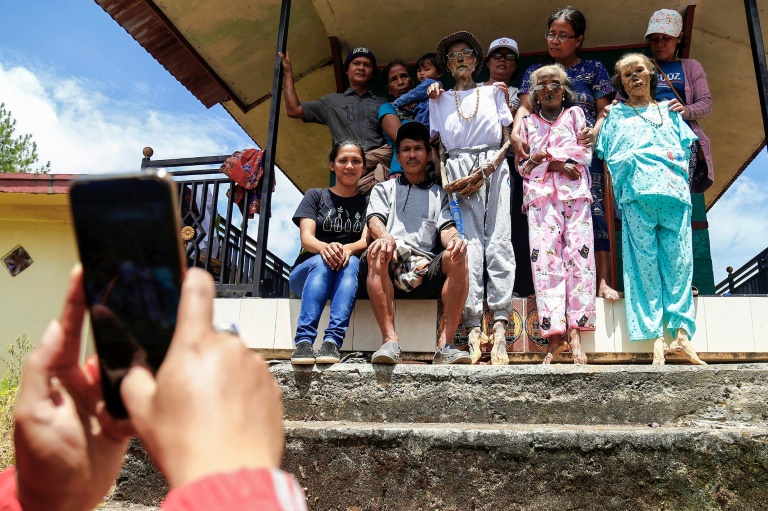
A family on an Indonesian island poses for a photo with an elderly relative no longer able to smile, while another clan tries to dress one of their eldest forebears in khakis and a shirt.

But the eldest generation isn’t stuck in a retirement home or harbouring a grudge against their younger kin — they are dead.

In two small towns on Indonesia’s Sulawesi island, residents are celebrating a days-long ceremony called the Manene. 

Hundreds of corpses are pulled out and dressed in the village of Torea as part of the ritual to honour their spirits and provide offerings.

“When we do Manene, we would start by opening the grave chamber and cleaning it and its surrounding area,” one of the family members, Sulle Tosae, told AFP. 

“Then, we would dry the bodies under the sun before [we] change their clothes,” he said.

Coffins holding the preserved bodies of their loved ones are pulled from a burial cave carved into the mountainside.

“The offerings are a symbol of gratitude from the children and grandchildren to the departed ones,” Torea village head Rahman Badus told AFP. 

They honour their spirits “so they can always bless the living with safety, peace and happiness,” he said.

One family offered their freshly exhumed relative a cigarette, while another affixed a pair of stylish sunglasses.

A few of the bodies remain relatively intact from the mummification process while others have deteriorated to skeleton remains.

– Spirits of the dead –

Torajans are an ethnic group that numbers about a million people on Sulawesi island. 

They have few qualms when it comes to talking with an embalmed corpse, dressing them up, brushing their hair or even taking pictures with a mummified relative.

Depending on the village, the Manene is usually held every few years in July or August.

The Torajans believe spirits of the dead will linger in the world before their funeral ceremonies and will begin their journey to the land of spirits after their souls are immortalised. 

The families will preserve the body until they have saved enough money for an elaborate funeral. 

The deceased were previously mummified through an embalming process using natural remedies such as sour vinegar and tea leaves. 

But many families now take the shortcut of injecting a formaldehyde solution into the corpse. 

The disinterring is a shocking and gruesome scene for onlooking Western tourists, yet residents are more than happy to clean out the bodies, take pictures and pray for their souls.

But the village chief says some locals have gone too far.

“The bodies must be treated with the utmost respect in the Manene ritual,” Badus said.

“Relatives are paying respect to their parents or ancestors and disrespect has consequences.”

Islamic State 'Beatle' faces life sentence for US hostage deaths

A member of the notorious Islamic State kidnap-and-murder cell known as the “Beatles,” is to be sentenced in a US court on Friday for the deaths of four American hostages in Syria.

El Shafee Elsheikh, 34, faces a mandatory sentence of life in prison after being convicted in Alexandria, Virginia, in April of hostage-taking, conspiracy to murder US citizens and supporting a terrorist organization.

The grueling two-week trial of the former British national, which featured emotional testimony from former hostages and parents of the victims, was the most significant prosecution of an IS militant in the United States.

The 12-person federal jury deliberated for less than six hours over two days before finding Elsheikh guilty for his role in the deaths of four Americans — journalists James Foley and Steven Sotloff and aid workers Peter Kassig and Kayla Mueller.

Elsheikh and another former “Beatle,” Alexanda Amon Kotey, were captured by a Kurdish militia in Syria in January 2018 and handed over to US forces in Iraq.

They were flown to the United States in 2020 to face trial.

Kotey, 38, pleaded guilty in September 2021 and was sentenced to life in prison in April by US District Court Judge T.S. Ellis, who will also deliver the sentence on Friday against Elsheikh.

Another alleged “Beatle,” Aine Davis, 38, was deported to Britain last week from Turkey and was remanded in custody on terrorism charges.

The fourth “Beatle,” executioner Mohammed Emwazi, was killed by a US drone in Syria in 2015.

The hostage-takers, who grew up and were radicalized in London, were nicknamed the “Beatles” by their captives because of their distinctive British accents.

Active in Syria from 2012 to 2015, they are accused of abducting more than two dozen journalists and relief workers from the United States and other countries.

Ten former European and Syrian hostages testified at Elsheikh’s trial accusing the “Beatles” of months of brutal treatment including beatings, electric shocks, waterboarding and mock executions.

Foley, Sotloff and Kassig were beheaded by Emwazi, and videos of their deaths were released by IS for propaganda purposes.

Mueller was initially held by the “Beatles” but was later turned over to IS leader Abu Bakr al-Baghdadi, who reportedly raped her repeatedly.

IS announced Mueller’s death in February 2015. The group said she was killed in a Jordanian airstrike, a claim disputed by US authorities.

Baghdadi died during a US special forces raid in 2019.

Ahead of Elsheikh’s sentencing, British police revealed details on Wednesday of the years-long effort to identify the hostage-takers and bring them to justice.

Richard Smith, the head of London police’s counter-terrorism unit, compared it to “putting together very small pieces of a jigsaw” and following a “trail of breadcrumbs.”

Danger part of job in Mexico's coal mining heartland

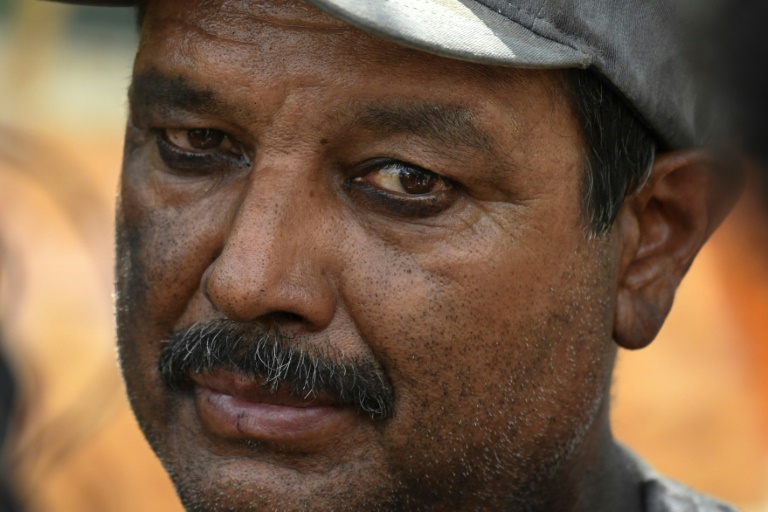
Water is the worst enemy of Mexican miner David Huerta, who once survived an accident similar to the one that has trapped 10 workers in a flooded tunnel for more than two weeks.

On the day of his own brush with death, Huerta saw the beam from a colleague’s head lamp coming quickly towards him and the cry of “water, water!”

He ran for his life, scratching his body against the rough mine walls and hitting his head against the wooden pilings.

“Water’s our worst enemy,” said Huerta, 35, who spent nearly 13 years working in mines in Sabinas in the northern state of Coahuila.

His brother-in-law, Sergio Cruz, is one of those missing in the roughly 60-meter (200 feet) deep El Pinabete mine, with no sign of life since it flooded on August 3.

Authorities presume the miners inadvertently made a hole that brought water gushing in from a bigger, abandoned mine nearby.

Water is the biggest challenge facing rescuers, who have been pumping it out around the clock as part of an operation involving hundreds of people, including soldiers.

Another obstacle is that access to the main tunnel is through narrow vertical shafts that authorities say have been blocked by debris.

A sharp increase in the water level over the weekend dealt a major setback to the rescue effort.

The government now hopes to seal the leak by injecting concrete.

– Grueling work –

The coal extracted in precarious conditions from small, crudely constructed mines with lax safety standards like El Pinabete help to keep Mexico’s power plants running.

There are some 67 small and mid-sized coal producers in Sabinas, according to official figures.

Between September 2020 and December 2021, the area yielded two million tons of coal for power plants operated by the state-owned Federal Electricity Commission (CFE) in Coahuila.

The fossil fuel has come at a high human cost for miners, who earn the equivalent of $150-200 a week.

According to the non-governmental organization Familia Pasta de Conchos — which campaigns for justice for 65 lives lost at a mine in Coahuila in 2006 — about 3,100 miners have died in the area since 1883.

Even today, miners work “almost naked” underground in temperatures of around 35 degrees Celsius (95 degrees Fahrenheit) without adequate ventilation, Huerta said.

They spend up to six hours a day — their bodies cannot cope with more — working bent over or kneeling in cramped conditions without proper safety equipment such as a mask.

“Their only equipment is a helmet and lamp,” said Cristina Auerbach, director of Familia Pasta de Conchos.

– ‘Owner doesn’t care’  –

Employers’ lack of knowledge about the geological conditions of the mines is another major risk factor, according to workers and experts.

“They don’t hire engineers. They don’t make calculations. They aren’t measuring production. They just take it out and sell it,” said Diego Martinez, a researcher at the Autonomous University of Coahuila.

One reason for the decision to keep mining at El Pinabete could have been its particularly thick coal seam, Huerta said.

“The owner doesn’t care as long as they get coal,” he said.

The mine’s registered concession holder has been silent about the accident and its ownership is opaque.

The government has halted activities at 27 mines in Coahuila for safety failures.

But political influence has prevented stricter controls that could have saved lives, according to Auerbach.

“The CFE exercises political control over the region because it controls all these politicians by giving them coal contracts,” she said.

President Andres Manuel Lopez Obrador, who has vowed to find the missing miners, has spoken of local political bosses who prevent miners unionizing.

It is also rare for miners to be enrolled in social security programs.

“Most of the mines are clandestine,” Huerta said.

While he no longer risks his life underground to earn a living, others feel they have no other choice.

“We’ve always worked in this and it’s very difficult to give it up,” said father-of-three Luis Armando Ontiveros, 48.

Lula keeps big lead over Bolsonaro in new Brazil presidential poll

A new poll ahead of Brazil’s presidential election in October shows former president Luiz Inacio Lula da Silva maintaining a significant lead over Jair Bolsonaro, but the right-wing incumbent is gaining ground.

Forty-seven percent of those surveyed by the Datafolha consulting firm said they intended to vote for Lula, the 76-year-old leftist leader, in the first round election on October 2, the same result as last month’s poll.

That represents a 15-point lead over the far-right Bolsonaro (32 percent), which is slightly narrower than the 18-point gap last month, but a significant jump over the 21-point spread in May.

Lula’s strong showing in the poll means there is a small chance he could ultimately receive over 50 percent in the first round, avoiding a runoff against 67-year-old Bolsonaro.

If the election does advance to a second round, on October 30, the poll shows Lula beating Bolsonaro with 54 percent of the vote.

The two candidates, running in the most polarized presidential race in decades, are far ahead of any third-party challengers — although center-left Ciro Gomes received seven percent in the poll.

Though the two front-runners have been campaigning for months, the official launch was on Tuesday.

Bolsonaro started with a rally in Juiz de Fora, where he was stabbed in 2018, while Lula, a former union leader, chose a car factory in Sao Bernardo do Campo as his symbolic backdrop.

Datafolha said it interviewed 5,744 people between last Tuesday and this Thursday in 281 Brazilian cities and its results include a margin of error of +/- 2 points.

Huge complex of 500 standing stones found in Spain

A huge megalithic complex of more than 500 standing stones has been discovered in southern Spain which could be one of the largest in Europe, archaeologists told AFP Thursday. 

The stones were discovered on a plot of land in Huelva, a province which flanks the southernmost part of Spain’s border with Portugal, near the Guadiana River. 

Spanning some 600 hectares (1,500 acres), the land had been earmarked for an avocado planation. 

But before granting the permit, the regional authorities requested a survey in light of the site’s possible archaeological significance — and revealed the presence of the stones. 

“This is the biggest and most diverse collection of standing stones grouped together in the Iberian peninsula,” said Jose Antonio Linares, a researcher at Huelva University and one of the project’s three directors. 

It is likely that the oldest standing stones at the La Torre-La Janera site were erected during the second half of the sixth or fifth millennium BC, he said. 

“It is a major megalithic site in Europe,” he said. 

At the site, they found a large number of various types of megaliths, including standing stones, dolmens, mounds, coffin-like stone boxes called cists and various enclosures. 

“Standing stones were the most common finding, with 526 of them still standing or lying on the ground,” said the researchers in an article published in Trabajos de Prehistoria, a prehistoric archaeology journal in the Iberian Peninsula.

The height of the stones was between one and three metres (3-10 feet). 

– ‘Excellently conserved’ –

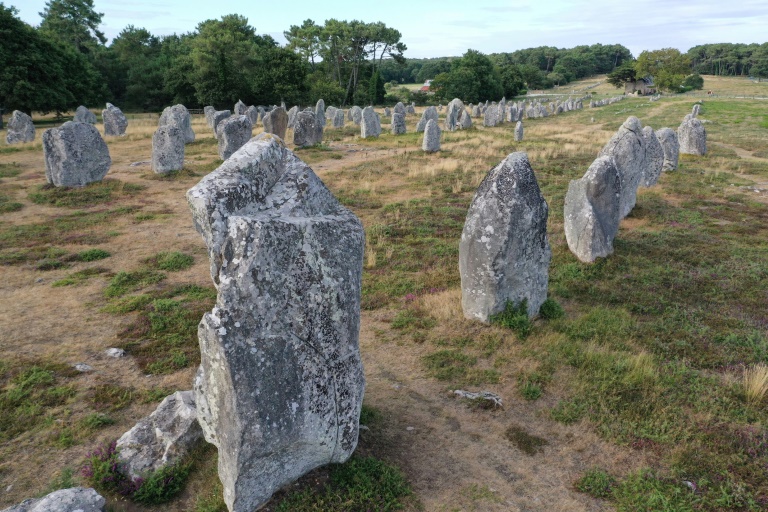
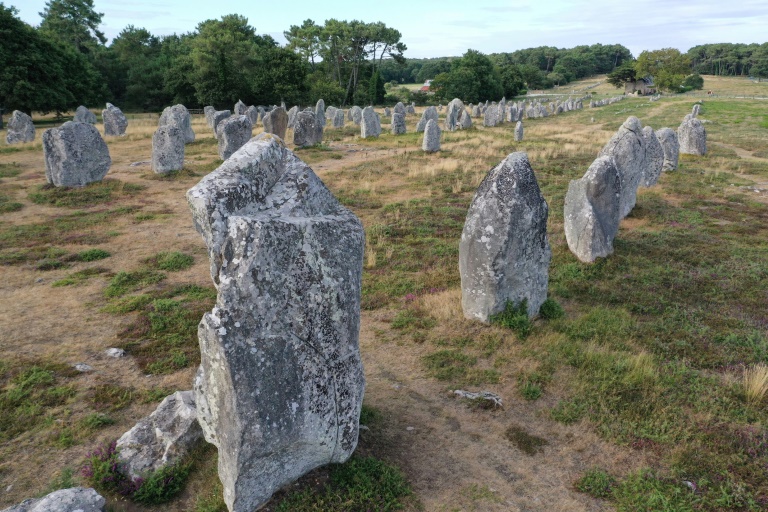
At Carnac in northwestern France, which is one of the most famous megalithic sites in the world, there are some 3,000 standing stones. 

One of the most striking things was finding such diverse megalithic elements grouped together in one location and how well preserved they were, said Primitiva Bueno, co-director of the project and a prehistory professor at Alcala University near Madrid. 

“Finding alignments and dolmens on one site is not very common,” she told AFP.

“Here you find everything all together: alignments, cromlechs and dolmens and that is very striking,” she said, hailing the site’s “excellent conservation”. 

An alignment is a linear arrangement of upright standing stones along a common axis, while a cromlech is a stone circle and a dolmen is a type of megalithic tomb usually made of two or more standing stones with a large flat ‘capstone’ on top. 

Most of the menhirs were grouped into 26 alignments and two cromlechs, both located on hilltops with a clear view to the east for viewing the sunrise during the summer and winter solstices and the spring and autumn equinoxes, the researchers said. 

Many of the stones are buried deep in the earth.

They will need to be carefully excavated with the work scheduled to run until 2026 but “between this year’s campaign and the start of next year’s, there will be a part of the site that can be visited”, Bueno said. 

Huge complex of 500 standing stones found in Spain

A huge megalithic complex of more than 500 standing stones has been discovered in southern Spain which could be one of the largest in Europe, archaeologists told AFP Thursday. 

The stones were discovered on a plot of land in Huelva, a province which flanks the southernmost part of Spain’s border with Portugal, near the Guadiana River. 

Spanning some 600 hectares (1,500 acres), the land had been earmarked for an avocado planation. 

But before granting the permit, the regional authorities requested a survey in light of the site’s possible archaeological significance — and revealed the presence of the stones. 

“This is the biggest and most diverse collection of standing stones grouped together in the Iberian peninsula,” said Jose Antonio Linares, a researcher at Huelva University and one of the project’s three directors. 

It is likely that the oldest standing stones at the La Torre-La Janera site were erected during the second half of the sixth or fifth millennium BC, he said. 

“It is a major megalithic site in Europe,” he said. 

At the site, they found a large number of various types of megaliths, including standing stones, dolmens, mounds, coffin-like stone boxes called cists and various enclosures. 

“Standing stones were the most common finding, with 526 of them still standing or lying on the ground,” said the researchers in an article published in Trabajos de Prehistoria, a prehistoric archaeology journal in the Iberian Peninsula.

The height of the stones was between one and three metres (3-10 feet). 

– ‘Excellently conserved’ –

At Carnac in northwestern France, which is one of the most famous megalithic sites in the world, there are some 3,000 standing stones. 

One of the most striking things was finding such diverse megalithic elements grouped together in one location and how well preserved they were, said Primitiva Bueno, co-director of the project and a prehistory professor at Alcala University near Madrid. 

“Finding alignments and dolmens on one site is not very common,” she told AFP.

“Here you find everything all together: alignments, cromlechs and dolmens and that is very striking,” she said, hailing the site’s “excellent conservation”. 

An alignment is a linear arrangement of upright standing stones along a common axis, while a cromlech is a stone circle and a dolmen is a type of megalithic tomb usually made of two or more standing stones with a large flat ‘capstone’ on top. 

Most of the menhirs were grouped into 26 alignments and two cromlechs, both located on hilltops with a clear view to the east for viewing the sunrise during the summer and winter solstices and the spring and autumn equinoxes, the researchers said. 

Many of the stones are buried deep in the earth.

They will need to be carefully excavated with the work scheduled to run until 2026 but “between this year’s campaign and the start of next year’s, there will be a part of the site that can be visited”, Bueno said. 

Close Bitnami banner
Bitnami