World

Crisis-hit Sri Lanka warns of record 8% economic contraction

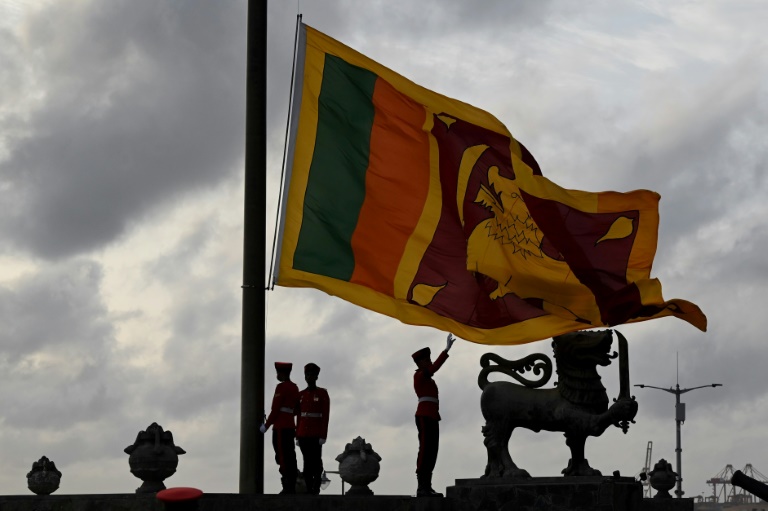
Sri Lanka’s economic meltdown will result in a record contraction of at least eight percent this year but the public could soon expect some relief from runaway inflation, the head of the country’s central bank said Thursday.

The island nation defaulted on its $51 billion foreign debt in April and is seeking an International Monetary Fund bailout after months of food, fuel and medicine shortages. 

Its 22 million people have also suffered through lengthy blackouts and spiralling cost-of-living pressures after scarcity and a currency crash drove up prices.

The Central Bank of Sri Lanka had already projected the economy could shrink a painful 7.5 percent for the calendar year, dwarfing the previous record 3.6 percent contraction in 2020 as the pandemic raged.

“But now we think it will exceed 8.0 percent,” governor Nandalal Weerasinghe told reporters in Colombo.

He said inflation — officially running at 60.8 percent — will peak at “about 65 percent” in September, followed by a gradual easing caused by lower demand and improvements in supplies.

The foreign exchange shortage that sparked the economic crisis had eased thanks to better currency inflows and lower imports, he added. 

“We are now able to finance the most essential imports such as petrol and diesel and medicines,” Weerasinghe said.

At the peak of Sri Lanka’s fuel shortages, motorists had to wait for days and sometimes weeks to top up, but strict fuel rationing has shortened queues.

Months of protests over the collapsing economy culminated in the resignation of president Gotabaya Rajapaksa, who was forced to flee his official residence after it was stormed by a huge crowd last month.

Rajapaksa is accused of mismanaging the island nation’s economy to the point where it was unable to finance even the most essential imports.

He has since travelled to Thailand and close associates have said he was desperate to return home, where he faces corruption charges that had been suspended because of his presidential immunity.

The political upheavals last month stalled talks with the IMF, but a delegation from the international lender of last resort is expected in Colombo before the end of August.

Weerasinghe said he was hopeful authorities would finalise a staff-level agreement with the Fund later this month ahead of a formal bailout deal.

US, Taiwan agree trade talks in face of 'growing China coercion'

Taiwan and the United States announced plans on Thursday for trade talks in the early autumn as a senior US diplomat warned Beijing will continue to squeeze the self-ruled democracy it claims as its own.

Tensions in the Taiwan Strait have soared to their highest in years after US House Speaker Nancy Pelosi visited Taipei, sparking a furious response from Beijing which launched its largest military drills around the island.

The negotiations would cover a variety of areas, including agriculture, digital trade, regulatory practices and removing trade barriers, the Office of the US Trade Representative said in a statement.

The talks “will deepen our trade and investment relationship, advance mutual trade priorities based on shared values, and promote innovation and inclusive economic growth for our workers and businesses,” said Deputy United States Trade Representative Sarah Bianchi. 

“We welcome this opportunity to deepen economic collaboration between our 2 freedom-loving countries while shaping a new model for trade cooperation in the Indo-Pacific,” Taiwan’s foreign ministry said in a tweet. 

Taipei’s representative in Washington Hsiao Bi-Khim wrote: “We welcome this announcement, and Taiwan’s ready to start!”

The United States and Taiwan share a longstanding trade and investment relationship. The island is also a crucial global supplier of some of the most advanced semiconductors, used in everything from mobile phones and laptops to cars and missiles. 

But Taiwan’s largest trading partner by far remains China, which bristled at the announcement and said it “firmly opposes this”.

“China has always opposed any official exchanges between any country and the Taiwan region of China,” Beijing’s commerce ministry spokeswoman Shu Jueting told reporters on Thursday, adding that the matter concerned China-US relations.

Beijing views Taiwan as its own territory to be seized one day, by force if necessary, and last year 42 percent of Taiwan’s exports went to China and Hong Kong compared with 15 percent for the United States.

Washington diplomatically recognises Beijing over Taipei, but maintains de facto relations with Taiwan and supports the island’s right to decide its future.

– ‘Intimidate and coerce’ –

The United States has said its position on Taiwan remains unchanged and has accused China of threatening peace in the Taiwan Strait and using the visit by Pelosi as a pretext for military exercises.

Its top envoy in East Asia on Thursday said Beijing will likely ramp up pressure on Taiwan in the coming months after the drills.

“While our policy has not changed, what has changed is Beijing’s growing coercion,” Daniel Kritenbrink, assistant secretary of state for East Asian and Pacific affairs, told reporters on a teleconference call.

“These actions are part of an intensified pressure campaign… to intimidate and coerce Taiwan and undermine its resilience,” he said.

The envoy said Washington would respond to China’s aggression with “calm, but resolute steps” to keep the Taiwan Strait open and peaceful.

His comments come after a top US naval commander said this week that Washington and its allies must contest China’s ballistic missile fire over Taiwan, which he called a “gorilla in the room”.

China’s exercises included firing multiple ballistic missiles into waters off Taiwan — some of the world’s busiest shipping routes — which was the first time China has taken such a step since the mid-1990s.

Taiwan has staged its own drills simulating a defence against invasion and on Wednesday displayed its most advanced fighter jet in a rare nighttime demonstration in the wake of China’s moves around the island.

“In the face of the threat from Chinese communist forces’ recent military exercises, we have stayed vigilant while establishing the concept of ‘battlefields everywhere and training anytime’… to ensure national security,” Taiwan’s air force said in a statement. 

In UK, workers strike as inflation crushes earnings

Railway and postal staff, dockers too. Britain’s workers are striking in vast numbers as decades-high inflation erodes the value of wages at a record pace.

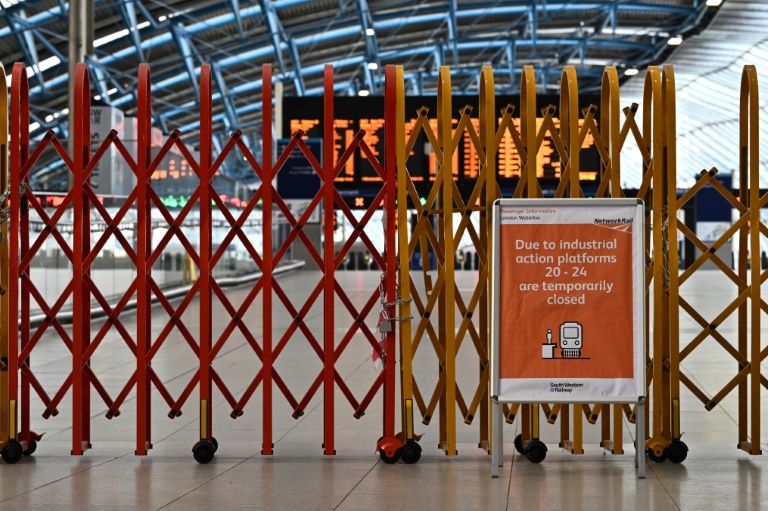
Britain’s train network faces further heavy disruption Thursday and Saturday in major walkouts that follow the sector’s biggest strike action for 30 years already this summer.

Tens of thousands of staff are expected to strike over the two days, leaving a skeleton train service that will hit holidaymakers and commuters, even if home-working continues for many office staff after Covid restrictions were lifted.

London’s underground railway, the Tube, will be hit by a strike Saturday, ahead of an eight-day stoppage starting Sunday by dockers at Felixstowe, Britain’s largest freight port that is situated in eastern England.

“We will continue to do whatever is necessary to defend jobs, pay and conditions during this cost-of-living crisis,” Sharon Graham, head of major British union, Unite, said this week.

Official data Wednesday showed UK inflation at a 40-year-high above 10 percent, as soaring food and energy prices hurt millions of Britons.

– Inflation to keep rising –

And the situation is set to worsen under a new prime minister, as under-fire Boris Johnson prepares to step down.

The Bank of England has forecast inflation to top 13 percent this year, tipping the British economy into a deep and long-lasting recession.

“This record fall in real wages demonstrates the vital need for unions like Unite to defend the value of workers’ pay,” Graham said, while hitting out at suggestions, including from BoE governor Andrew Bailey, that pay rises were fuelling inflation.

“Wages are not driving inflation,” she insisted ahead of the latest UK inflation data that showed rocketing food prices were the main factor behind July’s spike.

Inflation has soared worldwide this year also on surging energy prices, fuelled by the invasion of Ukraine by major oil and gas producer Russia.

– Pay deals –

Some proposed strikes planned for the British summer have been halted after unions and companies agreed pay deals at the eleventh hour.

But while British Airways ground staff and plane refuellers at Heathrow airport have scrapped proposed walkouts, other sectors are holding firm.

More than 115,000 British postal workers employed by former state-run Royal Mail plan a four-day strike from the end of August. 

Telecoms giant BT will face its first stoppage in 35 years and walkouts have recently taken place or are soon to occur by Amazon warehouse staff, criminal lawyers and refuse collectors.

Major UK business lobby group, the CBI, this week acknowledged workers’ ongoing “struggle with rising costs like energy prices” and said employers were “doing their level best to support staff”.

It also claimed, however, that “the vast majority” of companies “can’t afford large enough pay rises to keep up with inflation”.

Regarding the part-privatised British railway sector, unions accuse Transport Secretary Grant Shapps of not helping to resolve the impasse.

Shapps is part of the Conservative government that recently amended a law to allow agency staff to help fill gaps caused by strikes, further angering the RMT railway union.

According to Unite, London’s luxury department store Harrods has informed staff that it stands ready to use agency staff in the event of strike action by its workers.

Analysts are meanwhile forecasting sector-wide stoppages to last beyond the summer as inflation keeps on rising.

It comes as teachers and health workers have hinted at possible walkouts should they not receive new pay deals deemed acceptable.

China reconnects nuclear reactor after shutdown due to damage

A nuclear reactor in southern China has been reconnected to the electricity grid more than a year after it was shut down to repair damage, its operator said.

Part of Taishan nuclear power plant in Guangdong province was taken offline last July after Chinese authorities reported minor fuel rod damage and a build-up of radioactive gases at the plant.

Operators reconnected the damaged reactor after months of “inspection and maintenance”, China General Nuclear Power Group (CGN) said in a stock exchange filing late on Tuesday.

“The monitoring results of Taishan Nuclear Power Plant and its surrounding environment are normal,” CGN said in the filing, without giving further details.

The plant is operated in a partnership with French energy giant EDF and uses the European Pressurised Reactor (EPR) design, which was developed to relaunch nuclear power in Europe after the Chernobyl catastrophe of 1986.

The design is touted as offering higher power and better safety, but EPR projects in Finland, France and Britain have been plagued by delays and cost overruns.

There are more than 60,000 fuel rods in the reactor and the proportion of damaged rods was “less than 0.01 percent”, China’s environment ministry and nuclear regulator said before the reactor’s closure.

They called the damage “inevitable” due to factors including fuel manufacturing and transportation.

EDF also previously blamed the build-up of radioactive gases at the Taishan plant on deteriorating coating on some uranium fuel rods.

EDF on Wednesday confirmed that the reactor resumed production on Monday.

“After an in-depth investigation, the Chinese safety authority gave its agreement for the restart of EPR reactor 1 at Taishan,” EDF’s spokeswoman said.

Official environmental monitoring data last year showed a slight increase in radiation near Taishan compared with other nuclear plants in China, but within the normal range of environmental radiation levels in Guangdong.

Forced labour, possible 'enslavement' in China's Xinjiang: UN expert

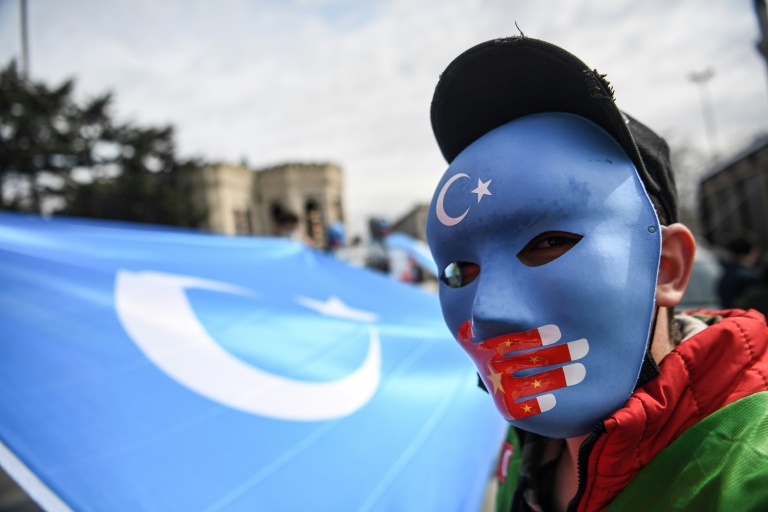
Minorities have been drafted into forced labour in China’s Xinjiang region in sectors such as agriculture and manufacturing, a report by an independent UN expert has concluded, in what it said could amount to “enslavement as a crime against humanity”.

Beijing has been accused of detaining over a million Uyghurs and other Muslim minorities in Xinjiang, as well as carrying out forced sterilisation of women and coerced labour.

The United States and lawmakers in other western countries have gone as far as accusing China of committing “genocide” against the minority groups, allegations that Beijing denies.

The report released Tuesday by UN special rapporteur on modern slavery Tomoya Obokata pointed to two “distinct state-mandated systems” in China in which forced labour has occurred, citing think tank and NGO reports as well as victims. 

One is a vocational skills education and training centre system in which minorities are detained and subject to work placements, while another involves attempts to reduce poverty through labour transfer, in which rural workers are moved into “secondary or tertiary work”.

“While these programmes may create employment opportunities for minorities and enhance their incomes… the special rapporteur considers that indicators of forced labour pointing to the involuntary nature of work rendered by affected communities have been present in many cases,” the report said.

The nature and extent of powers exercised over the workers — including excessive surveillance and abusive living and working conditions — could “amount to enslavement as a crime against humanity, meriting a further independent analysis”, it said.

The report noted a similar labour transfer system exists in Tibet, where the “programme has shifted mainly farmers, herders and other rural workers into low-skilled and low-paid employment”.

Special rapporteurs are independent experts appointed by the UN Human Rights Council, but who do not speak on behalf of the world body.

China’s foreign ministry spokesman Wang Wenbin on Wednesday accused Obokata of “choosing to believe lies and disinformation fabricated by the US… as well as anti-China forces”.

Insisting that minorities’ rights were protected, Wang slammed the UN special rapporteur for “viciously smearing China and acting as a political tool for anti-China forces.”

China has long claimed it was running vocational training centres in Xinjiang designed to counter extremism, with President Xi Jinping visiting the region last month and hailing the “great progress” made in reform and development.

In May, the United Nations human rights chief Michelle Bachelet concluded a rare six-day visit to China that also took her to Xinjiang.

Her trip was criticised by the United States and major rights groups for a lack of firmness towards Beijing, with critics saying she visited more as a diplomat rather than a human rights champion.

Bachelet is due to publish a long-awaited report on the issue before she steps down at the end of the month.

South Korean founder of failed Terra coin admits he was 'wrong'

The co-founder of the failed Terra cryptocurrency, which collapsed and wiped out about $40 billion of investors’ money in May, has admitted he was “wrong”, but said that he was not talking to South Korean investigators.

The dramatic disintegration of stablecoin TerraUSD and its sister token Luna — which both dropped to nearly zero in value — hit the wider crypto market, sparking over $500 billion in losses.

Stablecoins are designed to have a relatively stable price and are usually pegged to a real world commodity or currency.

Many retail investors lost their life savings when Luna and Terra entered a “death spiral” and collapsed, and South Korean authorities have opened multiple criminal probes into the crash.

In his first public comments since, Do Kwon, the 31-year-old South Korean founder of Terraform Labs, spoke to crypto media start-up Coinage from Singapore, saying the collapse had been “brutal”.

“I think in terms of healing wounds, the best that I can do is to just be upfront with everything that happened. You know, just admit that I was wrong,” Kwon said.

South Korean prosecutors last month raided the home of Do Kwon’s co-founder Daniel Shin as part of a probe into allegations of illegal activity behind Terra’s collapse.

Authorities have also banned key former and current employees of Terraform Labs from leaving the country — and have required Kwon to notify them when he returns.

But Kwon said in his interview that he had not been contacted by the prosecutors, and has not decided whether he would return to South Korea to cooperate.

“It’s kind of hard to make that decision, because we’ve never been in touch with the investigators,” he said, adding: “They’ve never charged us with anything.”

– ‘Cautionary tale’ –

Do Kwon and Terra are a cautionary tale for the crypto market.

TerraUSD was once the fourth-largest stablecoin and the 10th-largest cryptocurrency by market value, according to CoinMarketCap.

Unlike other stablecoins backed by real world assets like cash, TerraUSD was algorithmic — using code to maintain its price at around one US dollar based on a complex system of minting and burning.

A TerraUSD token was created by destroying some of the sister cryptocurrency Luna to maintain the dollar peg.

To maintain demand for Terra, Terraform Labs started offering eye-watering interest rates, which many critics derided as a Ponzi scheme.

When the TerraUSD crashed, investors panicked and tried to pull out their money, causing a vicious, self-perpetuating bank run.

Many experts had predicted precisely this eventuality, saying the model was fundamentally flawed.

“If demand falls away, then the price will go to zero,” Hilary Allen, a professor of financial regulation at the US-based American University, told AFP.

“This is a characteristic of almost all cryptoassets, and so Terra/Luna should be seen as a cautionary tale for all crypto investors.”

– Ponzi scheme –

Prior to the May crisis, Kwon had two starkly different reputations, depending on who you asked: he was either a genius mastermind, or the head of a Ponzi scheme.

A Stanford graduate from South Korea who had done stints at Microsoft and Apple, Kwon frequently belittled critics online who expressed doubt over his algorithmic stablecoin model.

When British economist Frances Coppola tweeted that self-correction mechanisms — used by TerraUSD — will fail when panicking investors are stampeding for the exit, Kwon tweeted back: “I don’t debate the poor on Twitter.”

Cory Klippsten, CEO of crypto trading app Swan.com said the structure of the Terra system “constituted an actual Ponzi scheme”.

“I believe Do Kwon and Terraform Labs committed fraud and should be prosecuted in multiple jurisdictions,” he told AFP.

In the interview in Singapore, Kwon said he still believes in Terra.

Just weeks after the coin failed he launched a fresh iteration dubbed Terra 2.0, but its value dropped quickly from as high as $11 to $2.

“I’m always going to be doing things on Terra and for the Terra community,” Kwon said. “This is my home and this is where I feel like there’s the brightest future.”

But with multiple lawsuits and investigations pending, analysts say Kwon’s next projects are unlikely to succeed.

“Do Kwon’s name basically now carries negative goodwill,” said Kelvin Low, a law professor at the National University of Singapore. 

“His involvement in a project hurts rather than helps it.”

Forced labour, possible 'enslavement' in China's Xinjiang: UN expert

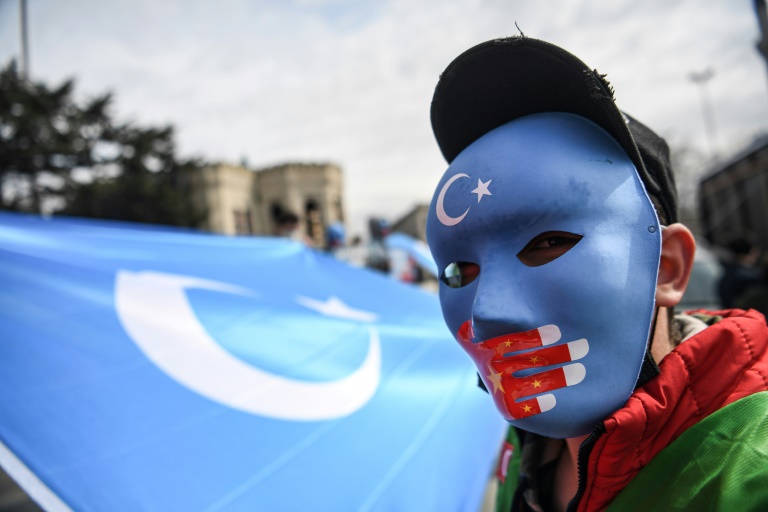
Minorities have been drafted into forced labour in China’s Xinjiang region in sectors such as agriculture and manufacturing, a report by an independent UN expert has concluded, in what it said could amount to “enslavement as a crime against humanity”.

Beijing has been accused of detaining over a million Uyghurs and other Muslim minorities in Xinjiang, as well as carrying out forced sterilisation of women and coerced labour.

The United States and lawmakers in other western countries have gone as far as accusing China of committing “genocide” against the minority groups, allegations that Beijing denies.

The report released Tuesday by UN special rapporteur on modern slavery Tomoya Obokata pointed to two “distinct state-mandated systems” in China in which forced labour has occurred, citing think tank and NGO reports as well as victims. 

One is a vocational skills education and training centre system in which minorities are detained and subject to work placements, while another involves attempts to reduce poverty through labour transfer, in which rural workers are moved into “secondary or tertiary work”.

“While these programmes may create employment opportunities for minorities and enhance their incomes… the special rapporteur considers that indicators of forced labour pointing to the involuntary nature of work rendered by affected communities have been present in many cases,” the report said.

The nature and extent of powers exercised over the workers — including excessive surveillance and abusive living and working conditions — could “amount to enslavement as a crime against humanity, meriting a further independent analysis”, it said.

The report noted a similar labour transfer system exists in Tibet, where the “programme has shifted mainly farmers, herders and other rural workers into low-skilled and low-paid employment”.

Special rapporteurs are independent experts appointed by the UN Human Rights Council, but who do not speak on behalf of the world body.

China has long insisted it was running vocational training centres in Xinjiang designed to counter extremism, with President Xi Jinping visiting the region last month and hailing the “great progress” made in reform and development.

In May, the United Nations human rights chief Michelle Bachelet concluded a rare six-day visit to China that also took her to Xinjiang.

Her trip was criticised by the United States and major rights groups for a lack of firmness towards Beijing, with critics saying she visited more as a diplomat rather than a human rights champion.

Bachelet is due to publish a long-awaited report on the issue before she steps down at the end of the month.

Forced labour, possible 'enslavement' in China's Xinjiang: UN expert

Minorities have been drafted into forced labour in China’s Xinjiang region in sectors such as agriculture and manufacturing, a report by an independent UN expert has concluded, in what it said could amount to “enslavement as a crime against humanity”.

Beijing has been accused of detaining over a million Uyghurs and other Muslim minorities in Xinjiang, as well as carrying out forced sterilisation of women and coerced labour.

The United States and lawmakers in other western countries have gone as far as accusing China of committing “genocide” against the minority groups, allegations that Beijing denies.

The report released Tuesday by UN special rapporteur on modern slavery Tomoya Obokata pointed to two “distinct state-mandated systems” in China in which forced labour has occurred, citing think tank and NGO reports as well as victims. 

One is a vocational skills education and training centre system in which minorities are detained and subject to work placements, while another involves attempts to reduce poverty through labour transfer, in which rural workers are moved into “secondary or tertiary work”.

“While these programmes may create employment opportunities for minorities and enhance their incomes… the special rapporteur considers that indicators of forced labour pointing to the involuntary nature of work rendered by affected communities have been present in many cases,” the report said.

The nature and extent of powers exercised over the workers — including excessive surveillance and abusive living and working conditions — could “amount to enslavement as a crime against humanity, meriting a further independent analysis”, it said.

The report noted a similar labour transfer system exists in Tibet, where the “programme has shifted mainly farmers, herders and other rural workers into low-skilled and low-paid employment”.

Special rapporteurs are independent experts appointed by the UN Human Rights Council, but who do not speak on behalf of the world body.

China has long insisted it was running vocational training centres in Xinjiang designed to counter extremism, with President Xi Jinping visiting the region last month and hailing the “great progress” made in reform and development.

In May, the United Nations human rights chief Michelle Bachelet concluded a rare six-day visit to China that also took her to Xinjiang.

Her trip was criticised by the United States and major rights groups for a lack of firmness towards Beijing, with critics saying she visited more as a diplomat rather than a human rights champion.

Bachelet is due to publish a long-awaited report on the issue before she steps down at the end of the month.

Tokyo Olympics exec arrested over bribery allegations

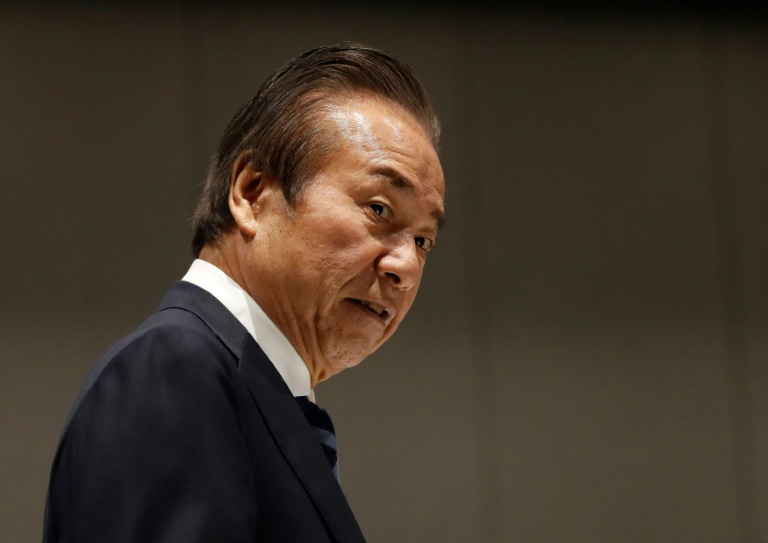
A board member for the Tokyo Olympics was arrested Wednesday on suspicion of taking bribes, prosecutors said, along with three other men connected to the scandal.

Haruyuki Takahashi allegedly received $380,000 from high-street business suit retailer Aoki Holdings, an official partner of last year’s pandemic-delayed 2020 Games.

The 78-year-old was arrested along with Aoki chairman Hironori Aoki, 83, and two other executives from the retailer, according to Tokyo Prosecutors Office documents seen by AFP.

They accuse Takahashi of accepting bribes “with the understanding they were meant as thank-you money for the beneficial and preferential treatment” he bestowed on Aoki.

According to the prosecutors, Takahashi had a total of 51 million yen ($380,000 at today’s rates) transferred to the bank account of a company he runs, in more than 50 transactions between October 2017 and March 2022.

The arrests came after Takahashi’s Tokyo home was raided last month by investigators, according to Japanese media, with searches also conducted at the Aoki chairman’s home and the disbanded Tokyo 2020 organising committee office.

Takahashi, a former executive at Japan’s biggest advertising agency, Dentsu, served on the Tokyo 2020 board from June 2014.

During that time he was reportedly considered a quasi-civil servant who was not permitted to accept money or gifts related to his position.

The Tokyo 2020 organising committee wound down operations last month, but it maintains a presence to deal with assets and liabilities.

The Tokyo Olympics were held in 2021 after an unprecedented one-year delay because of the Covid-19 pandemic. Stadiums were largely empty with fans banned over surging virus infections in Japan.

Jihadists spread from the Sahel to coastal West Africa

Their campaign began in northern Mali a decade ago, advanced into the country’s powder-keg centre and from there into neighbouring Niger and Burkina Faso.

Now, fears are growing that the ruthless jihadists wreaking havoc in the Sahel are heading towards coastal West Africa.

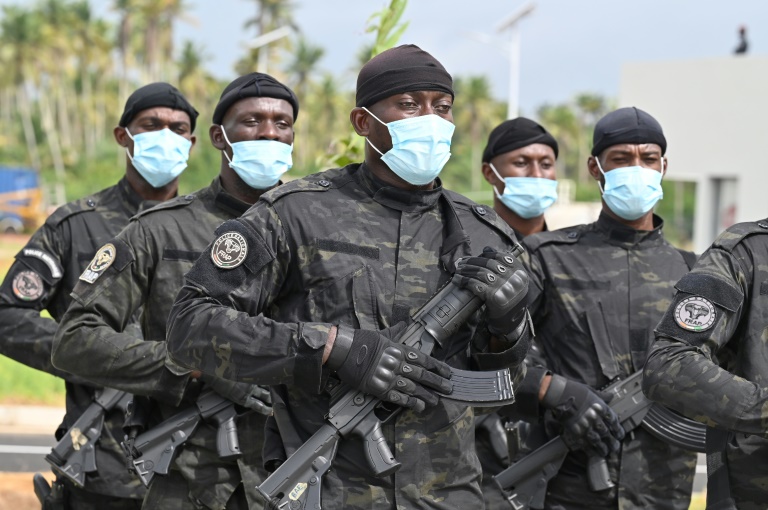
Following multiple incursions including deadly attacks in the northern regions of Benin, Ivory Coast and Togo, governments in the Gulf of Guinea are reviewing their strategy. 

Their chief concerns, say analysts: how to avoid replicating the mistakes of their neighbours in the Sahel, and how best to muster foreign support.

After Mali’s junta took power in August 2020, the country’s ties with Paris went into a downward spiral, triggering a withdrawal of French troops that was completed on Monday. 

Last month, Benin President Patrice Talon told his French counterpart Emmanuel Macron that his country needed more equipment, especially drones. 

Among coastal states, northern Benin has been the most affected by the expanding jihadist threat, with around 20 attacks against security forces since late 2021.

“What we are going through is terrifying,” a Beninese officer deployed at the border with Burkina Faso told AFP, speaking under condition of anonymity. 

“We wake up every morning without knowing if we will survive the day,” he added.

Macron has said that France, despite its exit from Mali, is committed to the “fight against terrorism” in West Africa. 

He said he is ready to participate in meetings of the “Accra Initiative” — a body set up in 2017 to boost security cooperation between countries in the region. 

– Recruitment –

“The deteriorating security situation in Burkina Faso and Mali has made the north of the coastal countries the new front line against armed groups operating in the Sahel,” the Konrad Adenauer Foundation, a German think tank, said in a report in April.

Countries in the region have beefed up security in vulnerable areas, including Ghana, which so far has been spared attacks.

But whether this will work is the big question.

Shoring up border security will be “ineffective, (just) as it was in the Sahel,” the Moroccan Policy Center for the New South think tank warned this month. 

Jihadist groups in the Sahel “are not traditional armies,” it said. “They spread ideas and exploit the grievances of target populations.”

Jeannine Ella Abatan at the pan-African Institute for Security Studies in Senegal described the rash of recent attacks as “the tip of the iceberg.”

“Since 2019, studies on the Sahel show that extremist groups were already connected to coastal states, either for logistical or operational support, but also for financing,” she told AFP. 

Militants do not occupy territory in the coastal countries but instead infiltrate northern regions where they conduct sophisticated attacks, Abatan said.

Togo first experienced a jihadist attack in May 2021. Benin’s first known fatal attack was last December, when two soldiers were killed near the border with Burkina Faso. In Ivory Coast, four members of the security forces died in 2021, after 14 in 2020.

Such attacks, said Abatan, are only possible thanks to good intelligence-gathering capabilities and the “complicity” of locals.

Increased recruitment among border populations is a major threat, she said. 

“The difficult living conditions can easily encourage desperate people into the camps of terrorists,” a Beninese police officer in the troubled region told AFP. 

Last week, a widely-shared propaganda video featuring two jihadists speaking Bariba, the local language in northern Benin, called on people to join them and threatening those who collaborate with the state. 

– Investment –

“The state must urgently respond to the needs of these people — make them feel protected by the presence of security forces instead of letting them seek protection from these groups,” Abatan said.

Amnesty International has warned of alleged human rights violations committed by security forces in Benin and Togo, as well as arbitrary detentions. 

Coastal countries seem to have accepted the argument that poverty and other sources of resentment create a potential pool for recruitment.

In Benin, the government has launched development projects, building schools and hospitals in some underdeveloped areas, and millions of dollars have been invested in Ivory Coast.

But much more needs to be done, says the Moroccan think tank, which also gives a specific warning against militarisation of the border areas.

“Without an immediate and dramatic change of approach,” it warned, residents in these border areas will “collaborate with extremists to keep themselves alive as best they can.”

Close Bitnami banner
Bitnami