World

European stocks dip as high inflation concerns linger

European stock markets eased on Thursday as investors took profit from the gains notched up the previous day on better-than-expected inflation data in the US.

But while overall sentiment was positive, investors remain on edge as officials at the US Federal Reserve seek to temper expectations of a possible end to the monetary policy tightening cycle, traders said.

The head of the Minneapolis Federal Reserve Bank, Neel Kashkari, warned: “We are a long way away from saying that we’re anywhere close to declaring victory”.

And according to the chief of the Chicago Federal Reserve Bank, Charles Evans, rates will continue to rise for “the rest of this year and into next year”.

“Investors are certainly in a more upbeat mood as the relief from the US inflation data ripples through the markets,” said OANDA analyst, Craig Erlam. 

However, “Fed policymakers remain keen to stress that the tightening cycle is far from done and a policy U-turn early next year is highly unlikely,” Erlam said.

Investors will therefore be watching out for further comments from policymakers over the next weeks to better gauge the likely pace of further rate hikes, as strong jobs growth shows how resilient the economy remains in face of higher borrowing costs and inflation.

“Inflation has been expected to peak over the summer for some time, so it was reassuring for markets that there are clear signs that this looks to be happening,” said Oliver Blackbourn, of Janus Henderson Investors.

“However, the Fed will doubtless be focused on the signs about underlying inflation, particularly against a very tight-looking labour market.”

On the oil market, crude prices climbed as US recession fears eased — but remained around six-month lows and below the levels seen before the Ukraine war.

– Key figures at around 1100 GMT –

London – FTSE 100: DOWN 0.4 percent at 7,479.08 points

Frankfurt – DAX: DOWN 0.1 percent at 13,686.67

Paris – CAC 40: DOWN 0.3 percent at 6,503.48

EURO STOXX 50: DOWN 0.2 percent at 3,742.36

Hong Kong – Hang Seng Index: UP 2.4 percent at 20,082.43 (close)

Shanghai – Composite: UP 1.6 percent at 3,281.67 (close)

Tokyo – Nikkei 225: Closed for a holiday

New York – Dow: UP 1.5 percent at 33,309.51 (close)

Euro/dollar: UP at $1.0336 from $1.0299 Wednesday

Pound/dollar: DOWN at $1.2206 from $1.2213

Euro/pound: UP at 84.69 pence from 84.29 pence

Dollar/yen: DOWN at 132.59 yen from 132.89 yen 

Brent North Sea crude: UP 0.8 percent at $98.16 per barrel

West Texas Intermediate: UP 0.8 percent at $92.67 per barrel
Norwegian woman climber on track to break 'super peaks' record

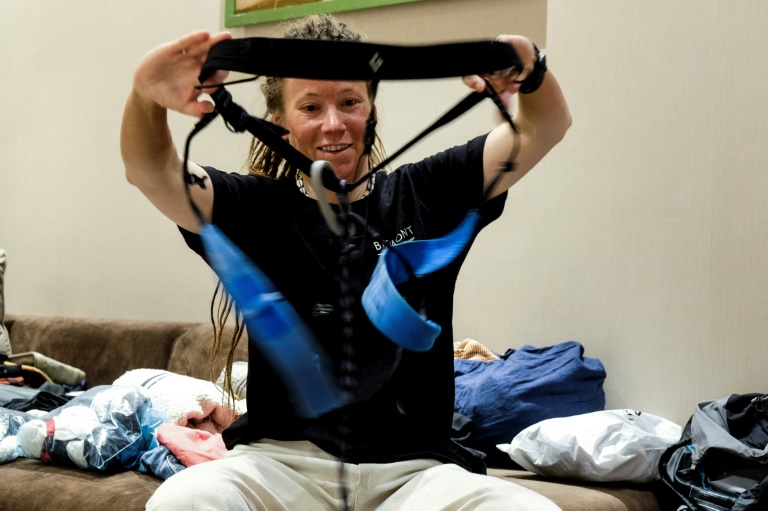
Norwegian climber Kristin Harila has just three mountains left in her bid to climb the world’s 14 “super peaks” in record time after successfully summiting Pakistan’s Gasherbrum I, officials said Thursday.

Nepali Nirmal Purja holds the record for climbing the world’s 8,000 metre-plus (26,000 feet) mountains — six months and six days — but Harila now has until early November to complete her quest and beat his time.

Harila’s latest successful summit was reported on her official social media pages and confirmed by Karrar Hadri, secretary of Pakistan’s Alpine Club.

“The second phase in Pakistan was very challenging and dangerous: ever-changing weather conditions, being hit by a rock, illness and a very tight schedule,” read a message on Harila’s Instagram page.

“But here we are with only three peaks left.”

Five of the 14 super peaks are in Pakistan — including K2, the world’s second highest mountain — and the country has enjoyed a record-breaking climbing season this year.

Sajid Hussain, head of the tourism department in Gilgit Baltistan, told AFP they had issued about 1,780 permits for the top peaks.

“It has boosted our tourism and has increased our foreign exchange,” he said.

Only around 40 people in history have summited all 14 of the super peaks, but none have come close to Purja’s 2019 expedition.

He demolished the previous record for accomplishing the feat with supplemental oxygen, set by Poland’s Jerzy Kukuczka in the 1980s at seven years, 11 months and 14 days.

In an interview with AFP earlier this year, 36-year-old Harila said she was inspired to show women were as capable as men of achieving great mountaineering feats.

“In history and until now, it has been the strong macho men going out climbing mountains,” she said.

“When I talk to people that are not in this sport, they believe that men are more capable than women… If we are going to change, we need to get attention and show that women are just as capable.”

The three remaining mountains for Harila are Cho Oyu (sixth highest, in Nepal/China), Manaslu (eighth, Nepal) and Shishapangma (14th, China).

Blinken raises 'serious concerns' on rights in Rwanda talks

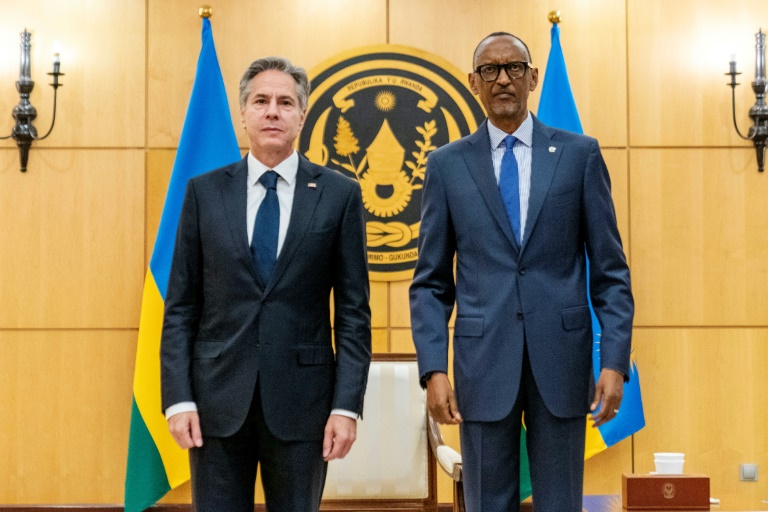
US Secretary of State Antony Blinken said he voiced “serious concerns” about human rights during talks on Thursday with Rwandan President Paul Kagame.

In particular, he said he raised the case of “Hotel Rwanda” hero Paul Rusesabagina, a fierce Kagame critic who was sentenced to a 25-year prison term last year on terrorism charges.

Blinken is in Rwanda on the final stop of a three-nation tour of Africa, as Washington seeks to counter a Kremlin charm offensive following a trip to the continent in July by Russian Foreign Minister Sergei Lavrov.

“As I told President Kagame, we believe people in every country should be able to express their views without fear of intimidation, imprisonment, violence or any other forms of repression,” Blinken told a joint press conference with Rwandan Foreign Minister Vincent Biruta.

Blinken also said he “underscored our concerns about the lack of fair trial guarantees provided to (Rusesabagina)”.

In May, the US State Department said Rusesabagina — who has US permanent residency — had been “wrongfully detained” by Kigali.

Rusesabagina, then a Kigali hotel manager, is credited with saving hundreds of lives during the 1994 genocide. His actions inspired the Hollywood film “Hotel Rwanda.”

The 68-year-old has been behind bars for more than 700 days since his arrest in August 2020 when a plane he believed was bound for Burundi landed instead in Kigali.

In a statement issued to coincide with Blinken’s visit, Rusesabagina’s family said his health was deteriorating, with a weak left arm and facial paralysis indicating that he may have had one or more strokes.

“We trust that if the US relationship with Rwanda is strong enough to be deserving of financial and trusted cooperation, then it is strong enough to push for the release of our father on humanitarian grounds,” it said.

– ‘Endangers regional stability’ –

Meanwhile, Blinken said he also discussed with Kagame “credible reports” that Rwanda continues to support the M23 rebel group and has its own forces inside the neighbouring Democratic Republic of Congo, claims repeatedly denied by Kigali.

“Any support or cooperation with any armed group in eastern DRC endangers local communities and regional stability and every country in the region must respect the territorial integrity of the others,” he added.

An unpublished independent investigation for the UN, seen by AFP last week, said Rwandan troops had attacked soldiers inside the DRC and aided M23 rebels, a primarily Tutsi Congolese rebel group.

The M23 has captured swathes of territory in eastern DRC in recent months, stoking tensions between Kigali and Kinshasa.

Ties between the two nations have been strained since the mass arrival in the eastern DRC of Rwandan Hutus accused of slaughtering Tutsis during the 1994 genocide, although there was a thaw after DRC President Felix Tshisekedi took office in 2019.

In a statement released Monday, Human Rights Watch had called on Blinken to “urgently signal that there will be consequences for the government’s repression and abuse in Rwanda and beyond its borders”.

“Failing to address Rwanda’s abysmal human rights record has emboldened its officials to continue to commit abuse, even beyond its borders,” said Lewis Mudge, HRW’s Central Africa director.

The rights watchdog urged Blinken “to highlight systematic human rights violations, including crackdowns on opponents and civil society, both within and across Rwanda’s borders.”

Rwandan opposition leader Victoire Ingabire echoed HRW’s calls, telling AFP that Blinken should raise the issue of journalists and politicians she said were in prison for challenging Kagame’s government.

“Blinken has to ask our government to open up political space to everyone who wants to be active in politics,” said Ingabire, who spent six years in jail on terrorism charges.

New wildfire outbreaks feared as blazes rage in France

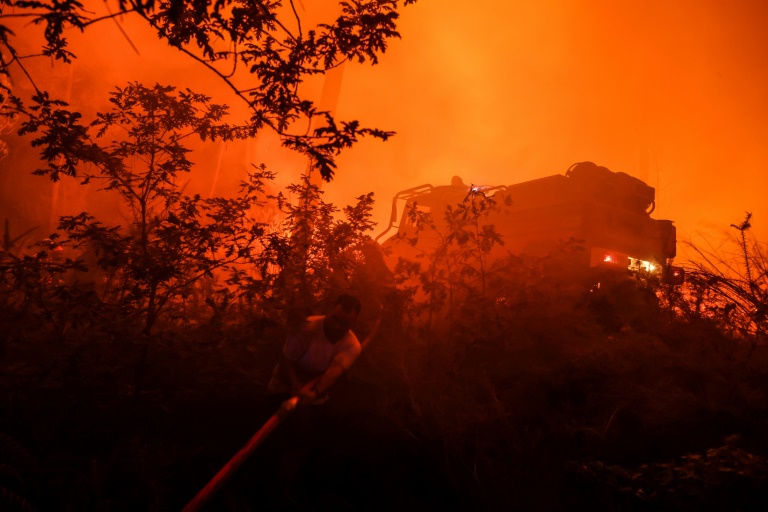
Officials warned Thursday that flare-ups could cause a massive wildfire to further spread in France’s parched southwest, site of the most intense blazes that have blackened swaths of the country this week.

Prime Minister Elisabeth Borne was to meet with authorities battling the Landiras fire south of Bordeaux, and further reinforcements are expected for the 1,100 firefighters on site, the prefecture of the Gironde department said.

France has been buffeted this summer by the historic drought that has forced water-use restrictions nationwide, as well as a series of heatwaves that experts say are being driven by climate change.

“Conditions are particularly difficult: the vegetation and soil are exceptionally dry,” the prefecture said in a statement, warning that extreme dry heat is likely until at least Sunday.

“There is a very serious risk of new outbreaks.”

Temperatures in the region could top 40 Celsius (104 Fahrenheit) on Thursday, weather forecasters predicted.

The Landiras blaze erupted in July — the driest month seen in France since 1961 — destroying 14,000 hectares and forcing thousands of people to evacuate before it was contained.

But it continued to smoulder in the tinder-dry pine forests and peat-rich soil, and officials suspect arson may have played a role in the latest flare-up, which has burned 6,800 hectares (17,000 acres) since Tuesday.  

Currently eight major wildfires are raging in France and Interior Minister Gerald Darmanin, who was also heading to meet Gironde officials Thursday, said Sweden and Italy were sending fire-fighting aircraft to help.

President Emmanuel Macron added on Twitter that Germany, Greece, Poland, Romania and Austria are also providing help.

“Across the country over 10,000 firefighters and security forces are mobilised against the flames… These soldiers of fire are our heroes,” he said.

– ‘Battled all night’ –

“You’d think we’re in California, it’s gigantic… And they’re used to forest fires here but we’re being overwhelmed on all sides — nobody could have expected this,” Remy Lahay, a firefighter deployed near Hostens in the Landes de Gascogne natural park, told AFP. 

On several nearby houses, people hung out white sheets saying “Thank you for saving our homes” and other messages of support for the weary fire battalions.

“We battled all night to stop the fire from spreading, notably to defend the village of Belin-Beliet,” Lieutenant Colonel Arnaud Mendousse of the Gironde fire and rescue service told journalists in Hostens.

Seventeen homes have been destroyed or damaged since Tuesday, and nearly 10,000 people evacuated, but no further orders to leave the area are expected “for the time being”, Mendousse said.

Acrid smoke has spread across much of the southwestern Atlantic coast and its beaches that draw huge crowds of tourists each summer, with the regional ARS health agency “strongly” urging people to wear protective face masks.

The smoke also forced the closing of the A63 motorway, a major artery toward Spain, between Bordeaux and Bayonne.

Study on serotonin and depression sparks fierce debate

A controversy in the scientific community over recent claims anti-depressants can be ineffective at treating depression has highlighted the difficulties in understanding mental health conditions.

One of the prevailing theories currently focuses on serotonin. Depression has been linked to a lack of the molecule, which is involved in transmitting emotions to the brain. 

Claims that depression has no link to a chemical imbalance in the brain related to serotonin, casting doubt on the need for anti-depressants, have sparked fierce reaction.

A study by psychiatrists Joanna Moncrieff and Mark Horowitz in the journal Molecular Psychiatry in July concluded that there was no proven link between a lack of serotonin and depression.

The authors said it queried the underlying assumption behind the use of anti-depressants, which are mostly developed to alter serotonin levels, undoing a theory that for decades acted as a framework for research.

The study is based on several previous publications, but it quickly attracted criticism — particularly its presentation by Moncrieff, known for her scepticism towards biological explanations of depression and her radical stance against the pharmaceutical industry.

“I’m broadly in agreement with the authors’ conclusions about our current efforts, though I lack their adamantine certainty,” psychiatrist Phil Cowen said on the Science Media Centre website.

“No mental health professional” would endorse the view that a complex condition like depression “stems from a deficiency in a single neurotransmitter”, Cowen added.

– ‘Mainstream’ psychiatry –

Some peers have questioned the methodology, which measured an indirect trace of serotonin rather than taking direct measurements of the molecule.

Moncrieff, who wants to break with what she calls “mainstream” psychiatry, believes the serotonin theory still occupies an important, albeit less prominent, place in the profession.

“Even if leading psychiatrists were beginning to doubt the evidence for depression being related to low serotonin, no one told the public,” the British psychiatrist wrote on her blog.

The connection between depression and serotonin is firmly rooted in the popular imagination. French author Michel Houellebecq gave the title “Serotonin” to his 2019 novel in which the main character is depressed.

Moncrieff’s undermining of the serotonin theory to argue against current anti-depressants, going beyond the conclusions of her own study, has sparked the most vehement criticism.

Swiss psychiatrist Michel Hofmann told AFP her study was “serious” and contributed to expert debates about depression.

“But I don’t think it is an article that should have any impact in the short term on the prescription of anti-depressants,” he said.

Moncrieff has warned that anti-depressant treatment should not be suddenly interrupted. But for her, the benefits of a course of anti-depressants are doubtful if it is based on a discredited theory.

But many stress that the effectiveness of the treatments has been scientifically assessed, irrespective of the primary cause of depression.

The medicines used to treat depression “are usually many and ultimately, in most cases, we don’t know what exactly makes a treatment effective”, Hofmann added.

Debates on the role of serotonin only illustrate how difficult it is to understand the biological and social workings of an illness as complex as depression.

The challenges are forcing researchers to move away from  models that are incomplete by their very nature.

“We are still at theories and we continue to search and test models against each other,” Hofmann said.

Low Rhine deepens Germany's energy crisis

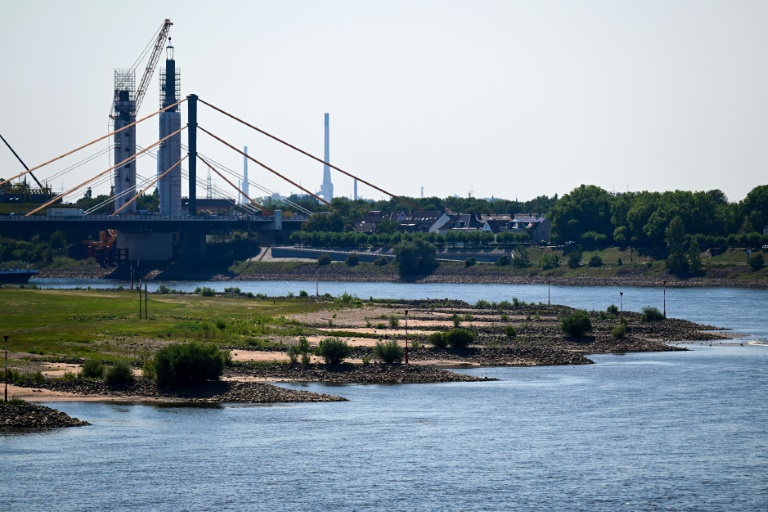
A hot, dry July made worse by climate change has raised the risk that the German economy could run aground as sinking Rhine waters make shipping along the river harder.

The prospect of severe, longer-term limits to traffic spells a new headache for the industries lined up on the river’s banks and threatens to further strain Germany’s efforts to wean itself off Russian energy imports as coal counts among key cargo moved on the waterway.

Roberto Spranzi, boss of DTG, a shipping cooperative, says the volumes that his fleet can carry are already limited by the unusually low water levels.

“At the moment we have a capacity where, we have to use three or four vessels where we would normally need one,” Spranzi tells AFP. 

Pointing at the worrying ebb at the entrance to the inland port of Duisburg in western Germany, Spranzi notes that “currently it’s at 1.70 metres (5.6 feet) In theory, the normal water level is over two metres”.

Further up the river in Kaub, a noted bottleneck for shipping where the Rhine runs narrow and shallow, the reference level is forecast to go below 40 centimetres by the end of the week and squeeze traffic further.

“We supply factories on the Rhine with their raw materials. When that’s not possible any more — or less often — that’s a threat to German industry, too,” Spranzi says.

– Coal power – 

Around four percent of freight in Germany is carried via its waterways, including the Rhine, which winds its way from Switzerland, along the border with France, through Germany’s industrial heartland and the Netherlands to the sea.

As Berlin turns to mothballed coal power capacity to plug the gap after Russia curtailed its energy deliveries, the Rhine has taken on added significance as a key artery for coal transport.

But the sinking water level has already led energy providers to warn they may have to limit output.

Uniper has said the low level of the Rhine may lead to the “irregular operation” of two of its coal plants into September.

EnBW, which runs sites in the southwestern region of Baden-Wurttermberg, has warned that deliveries of the fuel could be restricted.

The dwindling waters have seen “transport costs per tonne rise”, EnBW said in a statement, adding that it had preemptively built stocks of coal earlier in the year.

Alternative routes were available — either by road or rail — but capacity was “tight”, EnBW said.

The Rhine freight restrictions have added to the supply chain disruption seen by industry and increased the risk of scarcity. 

Across southern Germany, a shortage of fuel at the pump has been traced back to the dry weather, among other factors.

“Low water levels on the Rhine mean that in this area very important transportation of oil products, such as petrol, diesel or heating oil can’t operate as normal,” says Alexander von Gersdorff, spokesman for the German energy and fuel industry lobby.

– ‘Much earlier’ – 

A 2018 drought, which saw the Rhine’s reference depth at Kaub fall as low as 25 centimetres in October, shaved 0.2 percent off German GDP that year, according to Deutsche Bank Research.

“The low levels have come much earlier this time,” Deutsche Bank Research economist Marc Schattenberg tells AFP.

“If the problems we are now observing last longer (than in 2018), the loss of economic value becomes all the more serious.” 

Industrial heavyweights stationed along the Rhine rely on the waterway to ferry goods to and from their sites.

Duisburg-based conglomerate ThyssenKrupp said in a statement it had “taken measures” to assure its supplies of raw materials.

The chemical giant BASF, whose Ludwigshafen base sits south of the Kaub choke-point, said its production had not yet been limited by the low water levels, but warned that it could not rule out “reductions for specific units in the coming weeks”.

Low Rhine deepens Germany's energy crisis

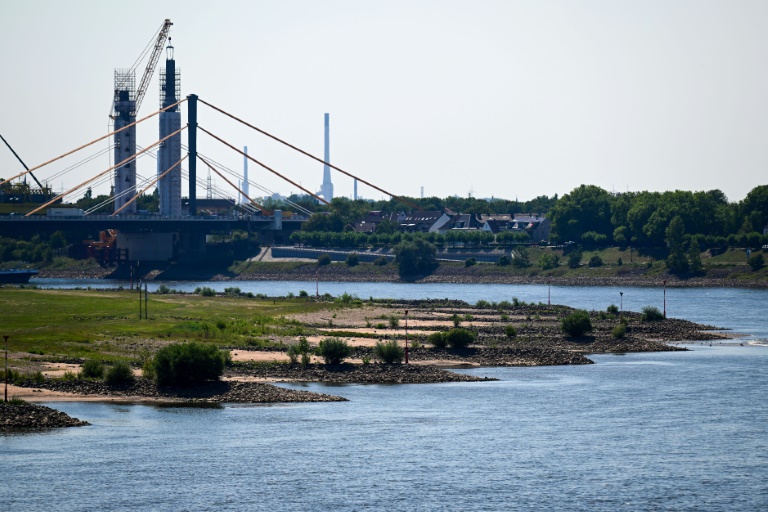
A hot, dry July made worse by climate change has raised the risk that the German economy could run aground as sinking Rhine waters make shipping along the river harder.

The prospect of severe, longer-term limits to traffic spells a new headache for the industries lined up on the river’s banks and threatens to further strain Germany’s efforts to wean itself off Russian energy imports as coal counts among key cargo moved on the waterway.

Roberto Spranzi, boss of DTG, a shipping cooperative, says the volumes that his fleet can carry are already limited by the unusually low water levels.

“At the moment we have a capacity where, we have to use three or four vessels where we would normally need one,” Spranzi tells AFP. 

Pointing at the worrying ebb at the entrance to the inland port of Duisburg in western Germany, Spranzi notes that “currently it’s at 1.70 metres (5.6 feet) In theory, the normal water level is over two metres”.

Further up the river in Kaub, a noted bottleneck for shipping where the Rhine runs narrow and shallow, the reference level is forecast to go below 40 centimetres by the end of the week and squeeze traffic further.

“We supply factories on the Rhine with their raw materials. When that’s not possible any more — or less often — that’s a threat to German industry, too,” Spranzi says.

– Coal power – 

Around four percent of freight in Germany is carried via its waterways, including the Rhine, which winds its way from Switzerland, along the border with France, through Germany’s industrial heartland and the Netherlands to the sea.

As Berlin turns to mothballed coal power capacity to plug the gap after Russia curtailed its energy deliveries, the Rhine has taken on added significance as a key artery for coal transport.

But the sinking water level has already led energy providers to warn they may have to limit output.

Uniper has said the low level of the Rhine may lead to the “irregular operation” of two of its coal plants into September.

EnBW, which runs sites in the southwestern region of Baden-Wurttermberg, has warned that deliveries of the fuel could be restricted.

The dwindling waters have seen “transport costs per tonne rise”, EnBW said in a statement, adding that it had preemptively built stocks of coal earlier in the year.

Alternative routes were available — either by road or rail — but capacity was “tight”, EnBW said.

The Rhine freight restrictions have added to the supply chain disruption seen by industry and increased the risk of scarcity. 

Across southern Germany, a shortage of fuel at the pump has been traced back to the dry weather, among other factors.

“Low water levels on the Rhine mean that in this area very important transportation of oil products, such as petrol, diesel or heating oil can’t operate as normal,” says Alexander von Gersdorff, spokesman for the German energy and fuel industry lobby.

– ‘Much earlier’ – 

A 2018 drought, which saw the Rhine’s reference depth at Kaub fall as low as 25 centimetres in October, shaved 0.2 percent off German GDP that year, according to Deutsche Bank Research.

“The low levels have come much earlier this time,” Deutsche Bank Research economist Marc Schattenberg tells AFP.

“If the problems we are now observing last longer (than in 2018), the loss of economic value becomes all the more serious.” 

Industrial heavyweights stationed along the Rhine rely on the waterway to ferry goods to and from their sites.

Duisburg-based conglomerate ThyssenKrupp said in a statement it had “taken measures” to assure its supplies of raw materials.

The chemical giant BASF, whose Ludwigshafen base sits south of the Kaub choke-point, said its production had not yet been limited by the low water levels, but warned that it could not rule out “reductions for specific units in the coming weeks”.

Iran rejects US claim of plot to kill ex-official Bolton

Iran dismissed as “fiction” Thursday US allegations it had plotted to kill former White House national security adviser John Bolton in retaliation for the assassination of one of its top commanders.

The US claim comes at a crunch moment in talks on reviving a nuclear deal between Iran and major powers that Washington had abandoned in 2018 but has said it wants to rejoin, with Iran now considering what European Union mediators have called a “final” text. 

“The US Justice Department has made allegations without providing valid evidence, creating a new work of fiction,” Iran’s foreign ministry spokesman Nasser Kanani said.

“This time they have come up with a plot involving individuals like Bolton whose political career has failed,” Kanani scoffed.

“The Islamic republic warns against any action that targets Iranian citizens by resorting to ridiculous accusations.”

The US Justice Department said Wednesday that it had indicted a member of Iran’s Revolutionary Guards over allegations he had offered to pay an individual in the United States $300,000 to kill Bolton.

The plan was likely set in retaliation for the US killing of top Guards commander Qasem Soleimani in Iraq in January 2020, the department said.

Guards member Shahram Poursafi is also alleged to have dangled the possibility of a second target he said would earn the ostensible assassin $1 million. 

The court papers did not identify that alleged target, but according to US media outlet Axios, it was former secretary of state and CIA director Mike Pompeo.

– ‘Severe consequences’ –


The person Poursafi was dealing with was actually an informant for the US Federal Bureau of Investigation, according to the court filings.

Poursafi was charged with the use of interstate commerce facilities in the commission of murder-for-hire, which carries up to 10 years in prison; and with providing and attempting to provide material support to a transnational murder plot, which carries a 15-year sentence.

The Justice Department said Poursafi remains at large and is believed to be in Iran.

“Should Iran attack any of our citizens, to include those who continue to serve the United States or those who formerly served, Iran will face severe consequences,” current White House national security adviser Jake Sullivan warned after the charges were announced.

Soleimani, a revered figure in Iran, was killed in a US drone strike just after he landed at Baghdad’s airport on January 7, 2020.

Since his death, Tehran has vowed to take revenge, and the United States has ramped up security for prominent current and former officials, including Pompeo, who was leading the State Department when Soleimani was killed.

Bolton, like Pompeo a strong critic of Iran, was national security advisor in the White House of former president Donald Trump from April 2018 to September 2019.

He was strongly opposed to the 2015 deal putting limits on Iran’s nuclear programme, and supported the Trump administration’s unilateral pullout from the pact in May 2018.

Bolton blasted Iran’s government as “liars, terrorists and enemies of the United States” in a statement on Wednesday.

Kanani said the US Justice Department’s “baseless claims” were a smokescreen to “avoid being held to account for the numerous crimes in which the US government has been directly implicated, like the cowardly assassination” of Soleimani.

Living underground on the spearhead of Russia's offensive

Svitlana Klymenko is restless with rage but has nowhere to go.

Most of her life has been devoted to working at a salt mine in Ukraine’s eastern Donbas region.

But now — in her retirement — she has been forced to make a home underground in the city of Soledar, besieged by Russian forces and under unrelenting shelling.

“I just want to live, to grow old in a normal way, die a normal death, not be killed by a missile,” the 62-year-old told AFP.

But her meagre pension means she does not have the funds to escape the battleground and start a new life.

“How should I live? On humanitarian aid? Asking for food with an outstretched hand?” she asks, pacing the dank lair beneath an apartment block where she now spends three quarters of her time.

“We hope for the best, but every day it turns out worse and worse,” she lamented, her gold teeth catching the meagre light in her makeshift home.

– ‘How should I feel?’ –

Russia called off its offensive on the Ukrainian capital in late March and refocussed its efforts on Donbas, where the Kremlin has been backing separatists since 2014.

The battle has been gruelling, devolving into an artillery duel between troops dug in around strategic settlements and cached in hedgerows and forests fringing vast swathes of farmland.

There are signs Russia is once again regrouping its forces, this time to fight off a rumoured Ukrainian counteroffensive along the southern coast.

However, the assault on Soledar — near the larger city of Bakhmut — “has been its most successful axis in the Donbas” over the past month, according to Britain’s ministry of defence.

White and black smoke smear the horizon above Soledar and the road into the city is dappled with tread marks from tank tracks, as Ukrainian vehicles pour in and out from the north and the west.

Every few moments, the eerie urban silence is broken by the chest-thumping thud of cluster bombs and incoming artillery, casting dust into the searing summer sky.

Though the industrial sector of the city is bombarded constantly, the gold and blue Ukrainian flag still defiantly flutters on its highest point.

To escape the deadly contest above, Klymenko lives below, in a semi-subterranean cellar.

Around 60 people lived here — some for as long as three months — but last week a shell hit, killing one man, and almost everyone fled, she said.

Now it has been left to Klymenko, her husband and another man — 59-year-old Oleg Makeev — as well as a caged parrot and a wandering cat.

The rooms are installed with slim beds, dangling head torches and crudely improvised kitchens stacked with tinned food, bottled water and instant coffee.

“You can’t cook anything normally here, you can’t wash yourself. How am I supposed to feel?” Makeev trails off.

– Face of freedom –

Outside the city limits, Ukrainian soldiers mill around at the roadside, their vehicles parked in the shade, hidden from Russian aerial reconnaissance.

The locals no longer stop to stare at the smoke on the horizon, nor do they flinch at the wrenching sound of blast impacts.

There are rumours the Russians may already be inside the city limits, and both Bakhmut and the nearby larger city of Kramatorsk bear signs the defenders are preparing for urban warfare there.

One soldier, 27-year-old Mykhailo, wanders down the road leading towards Soledar carrying his rifle.

Above one eye the word “Freedom” is etched in cursive tattoo ink.

But the soldiers too have been forced into life underground.

“We are sitting in the trenches,” says Mykhailo. “There is a lot of their artillery, mortars, and we cannot react, we have nothing.”

“They will advance further,” he suspects. “We hide more than do anything useful.”

North Korea declares 'victory' over Covid, says Kim had fever

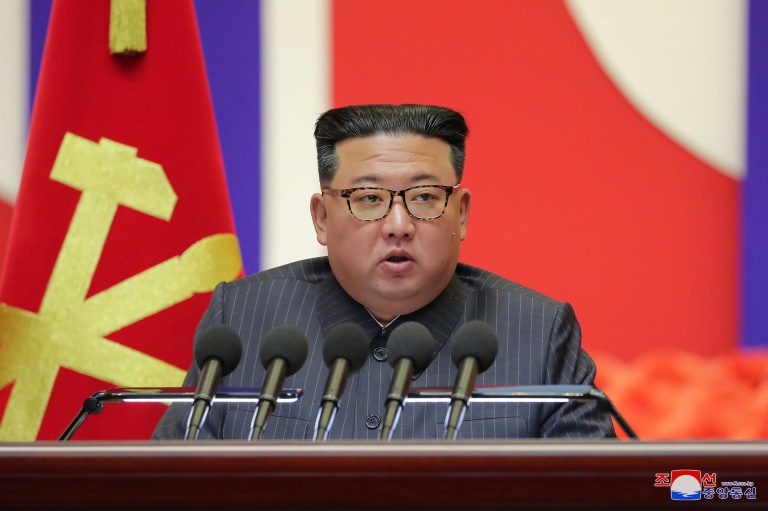
North Korean leader Kim Jong Un declared a “shining victory” over Covid-19 as his sister revealed he had fallen ill during the outbreak, which she blamed on Seoul, state media said Thursday.

Addressing a meeting of health workers and scientists, Kim announced a “victory… in the war against the malignant pandemic disease”, according to the official Korean Central News Agency.

Kim fell ill with a “high fever” but refused to rest while the country battled the virus, his powerful sister Kim Yo Jong told the meeting as officials in the audience wept, a KCTV broadcast showed.

The isolated nation, which has maintained a rigid blockade since the start of the pandemic, confirmed an Omicron outbreak in the capital Pyongyang in May and activated a “maximum emergency epidemic prevention system”.

North Korea refers to “fever patients” rather than “Covid patients” in case reports, apparently due to a lack of testing capacity.

It has recorded nearly 4.8 million “fever” infections and just 74 deaths for an official fatality rate of 0.002 percent, according to state media. It has reported no new cases since July 29.

This handling of the pandemic “is a miracle unprecedented in the world’s public health history,” Kim said to thunderous applause, according to KCNA.

“The victory gained by our people is a historic event.”

– Kim’s ‘high fever’ –

KCTV had never before aired a speech by “first sister” Kim Yo Jong, who made an impassioned address, the broadcast showed.

Kim Jong Un “was suffering from high fever during the days of this anti-epidemic war, but he could not lie down for a moment as he was thinking about the people he was responsible for”, his sister said.

This is the first time North Korea has indicated its leader — whose health is the subject of extraordinarily close scrutiny by analysts — had been infected by the coronavirus.

As Kim Yo Jong talked about her brother’s health, the camera cut to uniformed officials in the audience wiping away tears or openly weeping.

She also claimed the country’s Covid outbreak was caused by South Korea, warning of “retaliation”.

North Korea has previously said that “alien things” near the border with the South caused the isolated country’s Covid outbreak, a claim Seoul has rejected.

Despite a ban that took effect in 2021, South Korean activists have for years flown balloons containing propaganda leaflets and US dollars over the border, which Pyongyang has long protested against.

Kim Yo Jong said such actions were a “crime against humanity” and that Pyongyang was considering “a strong retaliatory response”.

Seoul’s Unification Ministry on Thursday said North Korea was repeating a “groundless claim” and expressed regret that Pyongyang was making “rude and threatening remarks”.

– Nuclear test? –

Analysts said that the victory declaration indicated North Korea was looking to move on to other priorities “such as boosting the economy or conducting a nuclear test,” said Leif-Eric Easley, a professor at Ewha University in Seoul.

“Kim Yo Jong’s bellicose rhetoric is concerning because not only will she try to blame any Covid resurgence on South Korea, she is also looking to justify North Korea’s next military provocation,” he added.

Experts, including the World Health Organization, have long questioned Pyongyang’s Covid statistics and claims to have brought the outbreak under control.

The country has one of the world’s worst healthcare systems, with poorly equipped hospitals, few intensive care units and no Covid treatment drugs, experts say.

It is not believed to have vaccinated any of its 25 million population, although it may have received some vaccines from China, Seoul-based specialist site NK News has reported.

South Korea — with its advanced healthcare and highly vaccinated population — has a coronavirus fatality rate of 0.12 percent, according to official data — significantly higher than that reported in the North.

Close Bitnami banner
Bitnami