World

Oil prices tumble on possible Iran deal, stuttering China economy

Oil prices fell Monday on the prospects of a return of Iranian oil to the market and data showing China’s economic recovery stuttering under Covid-19 restrictions.

Stock markets were broadly steady and the dollar traded mixed as investors digested the latest developments, including the surprise move by China’s central bank Monday to slash interest rates as a raft of data showed industrial production and retail sales growth for July came in lower than expected. 

“The risk of stagflation in the world economy is rising, and the foundation for domestic economic recovery is not yet solid,” China’s National Bureau of Statistics warned.

Stagflation refers to long-running high inflation combined with rising unemployment and weak growth.

Beijing’s rigid adherence to a zero-Covid strategy has held back economic recovery as snap lockdowns and long quarantines batter business activity and a recovery in consumption.

Wall Street stocks initially fell following the Chinese data and a gloomy reading from the New York Federal Reserve Bank on regional manufacturing activity. But stocks had turned around by midday.

“The risk of a global recession is pretty high at the moment,” said FHN Financial’s Chris Low, adding that a silver lining of the weakening outlook is the expectation that the Federal Reserve could pivot more quickly and slow its efforts to raise interest rates to quell red-hot prices.

“The Fed will stop sooner if inflation goes away and it’s more likely to go away sooner with the global economy slowing,” Low said.

But the weakened Chinese economy weighed on oil prices, as did speculation that a revived nuclear deal could add Iranian crude to global markets.

US oil futures dropped nearly three percent to finish below $90 a barrel.

Iran’s foreign minister said Tehran would deliver its “final” proposal later Monday on talks to revive its 2015 nuclear accord with world powers, after Washington had accepted key demands.

A deal would mean that Iran’s crude output of 2.5 million barrels per day would no longer be subject to international sanctions, which would help relieve supply constraints that have been pushing up prices.

“Iran would flood the market,” said analyst Aditya Saraswat at energy research firm Rystad, who added the country could ramp up production by another million barrels per day. 

– Key figures at around 2030 GMT –

Brent North Sea crude: DOWN 3.1 percent at $95.10 per barrel

West Texas Intermediate: DOWN 2.9 percent at $89.41 per barrel

New York – Dow: UP 0.5 percent at 33,912.44 (close)

New York – S&P 500: UP 0.4 percent at 4,297.14 (close)

New York – Nasdaq: UP 0.6 percent at 13,128.05 (close)

London – FTSE 100: UP 0.1 percent at 7,509.15 (close)

Frankfurt – DAX: UP 0.2 percent at 13,816.61 (close)

Paris – CAC 40: UP 0.3 percent at 6,569.95 (close)

EURO STOXX 50: UP 0.3 percent at 3,789.62 (close) 

Tokyo – Nikkei 225: UP 1.1 percent at 28,871.78 (close)

Hong Kong – Hang Seng Index: DOWN 0.7 percent at 20,040.86 (close)

Shanghai – Composite: FLAT at 3,276.09 (close)

Euro/dollar: DOWN at $1.0166 from $1.0259 Friday

Pound/dollar: DOWN at $1.2055 from $1.2138 

Euro/pound: DOWN at 84.29 pence from 84.53 pence

Dollar/yen: DOWN at 133.33 yen from 133.42 yen

burs-jmb/hs
Global business travel won't see full recovery until 2026: report

Inflation, supply chain problems and ongoing Covid-19 lockdowns in China are among the factors conspiring to delay a full recovery in business travel to its pre-pandemic level, according to an industry forecast released Monday.

The Global Business Travel Association now projects business travel will regain its 2019 level of $1.43 trillion in mid-2026, 18 months later than predicted in the group’s last forecast in November.

“Recovery has hit some headwinds,” GBTA said in a statement that outlined a gradual improvement from a 2020 low of $661 billion until reaching $1.47 trillion in 2026.

“The factors impacting many industries around the world are also anticipated to impact global business travel recovery into 2025,” said Suzanne Neufang, the association’s chief executive. 

The group said recovery was “short-circuited” in late 2021 and early 2022 by the Omicron variant of Covid-19, but that trips surged after that once Covid cases fell. 

Major obstacles to a full recovery include high energy prices, labor shortages, Covid lockdowns, regional impacts due to the war in Ukraine and sustainability concerns.

Greek phone-hacking scandal: investigative media's key role

Investigative journalism has emerged as a powerful force during Greece’s phone-hacking scandal, rocking a government that tries to “control” the media landscape, experts say.

The long-rumbling “Predatorgate” affair reignited at the end of July when Nikos Androulakis, leader of the opposition Socialists, told journalists about the attempted surveillance of his mobile phone via spyware Predator, having filed a legal complaint.

The spyware can hack into a target’s phone and access messages and conversations.

Greek Prime Minister Kyriakos Mitsotakis acknowledged last week that the intelligence service’s surveillance had been “politically unacceptable”, claiming he had not been informed.

He was speaking three days after two key members of his conservative government resigned over the matter.

Earlier this year two Greek journalists launched legal action, saying they had fallen prey to similar attacks on their phones.

Months-long probes by Greek investigative media have played a crucial part in shedding light on the phone-hacking.

Eliza Triantafyllou, a journalist with the Inside Story website, began investigating the case in January after the publication of two reports by the University of Toronto’s Citizen Lab and Meta (Facebook) referring to a new spyware, Predator, with clients and targets in Greece. 

“These reports went unnoticed by the (mainstream) Greek media at the time, though they revealed that the Greek government had probably bought Predator,” she wrote in a recent article.

Last April, Inside Story published “the first confirmed case of Predator use in 2021 against a European citizen” — Greek journalist Thanasis Koukakis, who specialises in reporting on corruption.

Online investigative news site Reporters United followed up by reporting that the journalist’s phone was monitored by the Greek intelligence service, EYP, in 2020.

Stories first published online by investigative journalists are now making headlines in Greek newspapers.

The country’s media landscape is marked by the connivance of traditional media groups with public authorities in line with political and financial interests. 

The Reporters Without Borders (RSF) non-profit gives Greece the lowest press freedom rank in Europe. 

RSF and the Media Freedom Rapid Response NGO have said the ruling party is “obsessed with controlling the message” and “minimising critical and dissenting voices”.

But investigative outlets are “a hope for freedom of expression” in Greece, according to Katerina Batzeli, a member of the Pasok-Kinal central committee, former minister and MEP.

“These innovative media have taken risks and done an extraordinary job” she said.

Greek investigative media, including Inside Story, Solomon and Reporters United, have been on the rise in recent years, using subscriptions to promote “independent and analytical information”.

With disinformation rife, “investigative media dare to control the power”, said media analyst Georges Tzogopoulos. 

He said investigative sites had played a “key role” and called for support through crowdfunding.

Germans face big energy levy but government vows aid

German households face an energy surcharge reaching hundreds of euros in the wake of the Ukraine war, according to the rate published Monday, prompting the government to promise relief measures.

The charge has been set at 2.419 cents per kilowatt hour, said Trading Hub Europe, a non-profit company of energy network operators in Germany.

For a family of four with an annual average energy usage of 20,000 kwh, this would come to about 483.80 euros ($493.70) before goods and services taxes.

The surcharge is aimed at sharing out the soaring costs borne by energy importers after Russia drastically curtailed gas supplies to Germany following its invasion of Ukraine.

Gas importers have so far taken on the additional costs themselves, but a new rule agreed by the government allows them to pass on ballooning costs via the levy to households from October 1.

“It is by no means an easy step to take, but it is necessary to maintain the heating and energy supply in households and the economy,” said Economy Minister Robert Habeck.

He promised that the “levy will be accompanied by another relief package”, details of which are still being discussed.

Germany has been scrambling to find alternative energy sources to plug the gap left by Russia.

Europe’s export giant had based its economic model on “dependence on cheap Russian gas”, noted Habeck.

“It is a political mistake to make oneself dependent on a potentate who tramples on people and citizens … and to free oneself from this and regain” control is worthwhile, stressed the minister. 

The Kiel Institute for the World Economy estimates that the surcharge will send Germany’s already soaring inflation rate up by another 0.9 percentage points. 

Chemical and pharmaceutical companies would have to fork out three billion euros more for the levy, said industry association VCI, which acknowledged it as a necessary but “extremely bitter pill” to swallow. 

The state has had to inject billions of euros in energy giant Uniper to prevent it from going under after it was hit by Russia’s energy cuts.

Major energy group RWE has however said that as a “financially strong and robust company”, it will waive the surcharge and continue to bear the additional import costs itself.

The group last week reported profits reaching 1.57 billion euros for the first half of the year.

Tens of thousands trek rugged trail to glimpse Iceland volcano

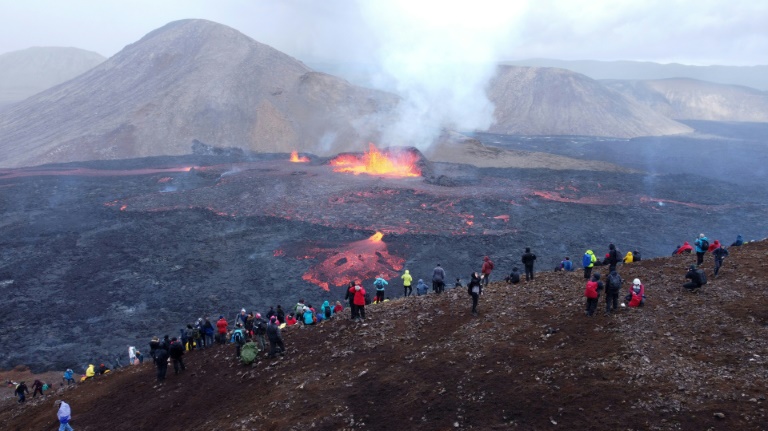
Tens of thousands of people have braved a steep, rugged trail in Iceland to catch a rare glimpse of an active volcano after it erupted last week, spewing red-hot lava into the sky.  

Tourism officials said Thursday that almost 23,000 people had made the difficult, hours-long trek to spot the volcano in the Meradalir valley, just 40 kilometres (25 miles) from the capital. 

“We’ve been here for three, four hours and we never get tired of it, it’s always moving”, said Jean-Paul Couturier, a French pensioner on vacation in Iceland.

The hike to the newly-formed crater is a 14 kilometres round-trip across tough terrain, with a 300-metre (985-foot) ascent. The walk takes about two hours from the nearest car park.

Strong winds and rain have done little to deter crowds.

On Wednesday alone — when authorities reopened the site following a three-day closure — more than 4,600 people took in the mesmerising views of the red-hot magma. 

The volcano is located in the Meradalir valley, an uninhabited area that would normally not attract more than a few visitors.

Known as the land of fire and ice, Iceland has 32 volcanic systems currently considered active, the highest number in Europe. It had an eruption every five years on average.

The latest volcano erupted in the Meradalir valley on August 3 and has continued at a fairly stable rate since, the Icelandic Meteorological Office said. 

– ‘Nature’s power’ –

“It would be very easy for it to last as long as the previous one”, vulcanologist Thorvaldur Thordarson told AFP.

Last year, lava spewed from the nearby Mount Fagradalsfjall volcano for six months, the longest eruption in Iceland in more than 50 years.

Hikers making the trek on Wednesday were well-equipped with walking sticks, hiking boots and rain gear. 

It was a sharp contrast from the shorts and flip flops worn by some of the first curious onlookers who initially rushed to the scene. 

Observers watch from a safe distance the red-orange lava fountains spurting as high as 70 meters before falling back to the ground, forming a large blanket of magma and a volcanic semi-cone as it solidified.

The lava reaches temperatures of 1,200 degrees Celsius (2,192 Fahrenheit), the hottest lava produced on Earth, and has so far flowed almost two kilometres to the south across the valley.

“The hot rock shooting out of the earth is really the first most impressive thing that you see,” American tourist James Maniscalco said.

For French tourist Clemence Ernoult, the experience was as rare as it gets. 

“You really see Nature’s power,” she said.  

“It’s something you’ll probably only see once in your life”.

Tens of thousands trek rugged trail to glimpse Iceland volcano

Tens of thousands of people have braved a steep, rugged trail in Iceland to catch a rare glimpse of an active volcano after it erupted last week, spewing red-hot lava into the sky.  

Tourism officials said Thursday that almost 23,000 people had made the difficult, hours-long trek to spot the volcano in the Meradalir valley, just 40 kilometres (25 miles) from the capital. 

“We’ve been here for three, four hours and we never get tired of it, it’s always moving”, said Jean-Paul Couturier, a French pensioner on vacation in Iceland.

The hike to the newly-formed crater is a 14 kilometres round-trip across tough terrain, with a 300-metre (985-foot) ascent. The walk takes about two hours from the nearest car park.

Strong winds and rain have done little to deter crowds.

On Wednesday alone — when authorities reopened the site following a three-day closure — more than 4,600 people took in the mesmerising views of the red-hot magma. 

The volcano is located in the Meradalir valley, an uninhabited area that would normally not attract more than a few visitors.

Known as the land of fire and ice, Iceland has 32 volcanic systems currently considered active, the highest number in Europe. It had an eruption every five years on average.

The latest volcano erupted in the Meradalir valley on August 3 and has continued at a fairly stable rate since, the Icelandic Meteorological Office said. 

– ‘Nature’s power’ –

“It would be very easy for it to last as long as the previous one”, vulcanologist Thorvaldur Thordarson told AFP.

Last year, lava spewed from the nearby Mount Fagradalsfjall volcano for six months, the longest eruption in Iceland in more than 50 years.

Hikers making the trek on Wednesday were well-equipped with walking sticks, hiking boots and rain gear. 

It was a sharp contrast from the shorts and flip flops worn by some of the first curious onlookers who initially rushed to the scene. 

Observers watch from a safe distance the red-orange lava fountains spurting as high as 70 meters before falling back to the ground, forming a large blanket of magma and a volcanic semi-cone as it solidified.

The lava reaches temperatures of 1,200 degrees Celsius (2,192 Fahrenheit), the hottest lava produced on Earth, and has so far flowed almost two kilometres to the south across the valley.

“The hot rock shooting out of the earth is really the first most impressive thing that you see,” American tourist James Maniscalco said.

For French tourist Clemence Ernoult, the experience was as rare as it gets. 

“You really see Nature’s power,” she said.  

“It’s something you’ll probably only see once in your life”.

Taiwan holds military drill after China repeats threats

Taiwan’s army held another live-fire drill Thursday after Beijing ended its largest-ever military exercises around the island and repeated threats to bring the self-ruled democracy under its control.

Beijing has raged at a trip to Taiwan last week by US House Speaker Nancy Pelosi — the highest-ranking elected American official to visit in decades — staging days of air and sea drills that raised tensions to their highest level in years.

Taiwan has accused China of using the Pelosi visit as an excuse to kickstart drills that would allow it to rehearse for an invasion.

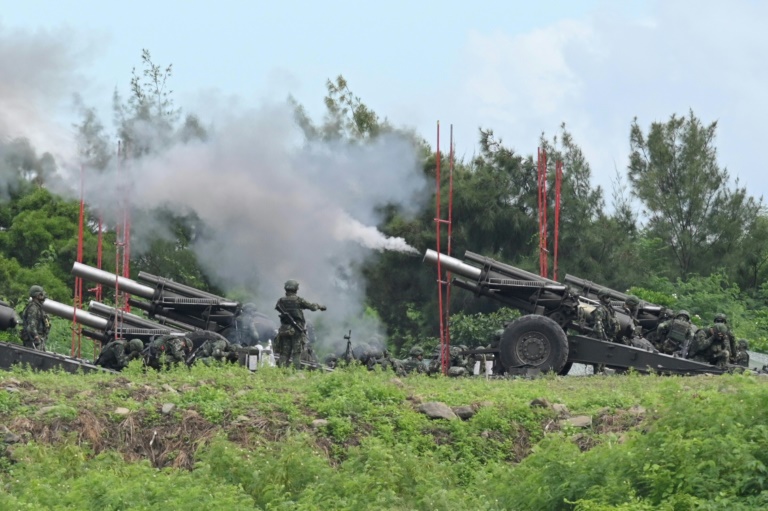
Lou Woei-jye, spokesman for Taiwan’s Eighth Army Corps, told AFP its forces fired howitzers and target flares as part of the defensive drill on Thursday.

The exercise in Taiwan’s southernmost county Pingtung began at 08:30 am (0030 GMT) and lasted about an hour, he said.

Artillery tucked in from the coast was lined up side by side, with armed soldiers in units firing the howitzers out to sea one after the other, a live stream showed.

Taiwan held a similar drill on Tuesday in Pingtung. Both involved hundreds of troops, the military said.

The military has played down the exercises’ significance, saying they were already scheduled and were not in response to China’s war games. 

“We have two goals for the drills, the first is to certify the proper condition of the artillery and their maintenance condition and the second is to confirm the results of last year,” Lou said, referring to annual drills.

Taiwan routinely stages military drills simulating defence against a Chinese invasion.

On Thursday, Taipei’s army said it detected 21 Chinese planes and six ships operating in the Taiwan Strait, without specifying if they were conducting operations.

Of those, 11 planes crossed the median line, an unofficial demarcation between China and Taiwan that Beijing does not recognise.

– ‘Prepare for war’ –

Taiwan’s president Tsai Ing-wen thanked troops in a visit to an air force command headquarters on Thursday.

“Right now, China’s military threat has not lessened,” she said in a statement posted on her Facebook page.

“I will reiterate, we will not escalate the conflict or cause disputes, we will firmly defend our sovereignty and national security, and defend the front line of democracy and freedom.”

Taiwan’s latest exercise came after China’s military indicated its own drills had come to an end Wednesday, saying its forces “successfully completed various tasks” in the Taiwan Strait while vowing to continue patrolling its waters.

But in the same announcement, China said that it would “continue to carry out military training and prepare for war”.

In a white paper published the same day, China’s Taiwan Affairs Office said Beijing would “not renounce the use of force” against its neighbour and reserved “the option of taking all necessary measures”.

“We are ready to create vast space for peaceful reunification, but we will leave no room for separatist activities in any form,” it said in the paper.

China last issued a white paper on Taiwan in 2000.

Taiwan’s Mainland Affairs Council, the island’s top policymaking body on China, rejected the paper and said the document was “full of lies that are ‘wishful thinking and disregarding the facts'”.

Taiwan’s foreign ministry on Thursday joined the council in rebuffing the “one country, two systems” model that Beijing has proposed for the island. 

“China’s whole statement absolutely goes against the cross-strait status quo and its reality,” ministry spokesperson Joanne Ou told a press conference.

“China is using US House Speaker Nancy Pelosi’s visit as an excuse to destroy the status quo and taking the opportunity to make trouble, attempting to create a new normal to intimidate the Taiwanese people.”

The Chinese Communist Party’s Taiwan Affairs Office said in a statement Thursday that Taipei’s “rebellious actions are just a slap in the face and cannot stop the historical trend of reunification” with mainland China.

Pelosi has stood by her visit, saying Wednesday she was “very proud” of her delegation and believed China had used her visit as a “pretext” to launch its military exercises.

“We will not allow China to isolate Taiwan,” Pelosi told reporters in Washington.

In response to the Chinese military revealing it was bringing drills to an end, Taiwan’s army said it would “adjust how we deploy our forces… without letting our guard down”.

Observers voice concern about Kenya vote disinformation

International observers expressed concern Thursday about the spread of disinformation during the long wait for results from Kenya’s election, as provisional counts point to a tight presidential race.

Preliminary results broadcast by local media indicate that Deputy President William Ruto and Raila Odinga, the veteran opposition leader now backed by the ruling party, are neck-and-neck, raising the likelihood of a challenge by the losing candidate.

No presidential poll outcome has gone uncontested in Kenya since 2002, and the disputes have led to bloodshed in the past, either involving ethnic clashes or police violence.

The Independent Electoral and Boundaries Commission (IEBC) is under pressure to deliver a free and fair poll after 2017 presidential vote was annulled due to irregularities in the counting process and mismanagement by the election body. 

But with the complex process of verifying and tallying votes expected to take days, social media is swamped with disinformation about the results, with rights campaigners and civil society groups accusing both candidates’ camps of sharing misleading posts.

Observers from the Commonwealth warned on Thursday that the delay in releasing the results was allowing disinformation to spread rapidly online.

“The time lag between the announcement of the official results by the IEBC and the provisional, and at times conflicting, results announced by the media is an area of concern,” Bruce Golding, chairman of the Commonwealth Observer Group, told a press conference in Nairobi.

– ‘Need trust in the system’ –

At a separate briefing, observers from the United States also voiced concern about misinformation spreading as the counting process entered its third day.

“It is important that there is timely and accurate information and that all the citizens have access to that information,” said Donna Brazile of the National Democratic Institute.

“It is about the citizens having trust in the system and that is working properly. It is not about the continuation of campaigns — campaigns have ended, and results must be tabulated accurately to ensure confidence in the system.”

The remarks echoed concerns shared by Amnesty International and several Kenyan civil society groups on Wednesday about “rising levels of false or misleading information” being shared on social media.

They said in a statement that several posts by candidates and their supporters in the rival camps had “intentionally sought to misinform the electorate and the public” on the electoral process and election results.

“These include distortion, false information shared without malicious intent (misinformation) and those shared to deliberately deceive people (disinformation).”

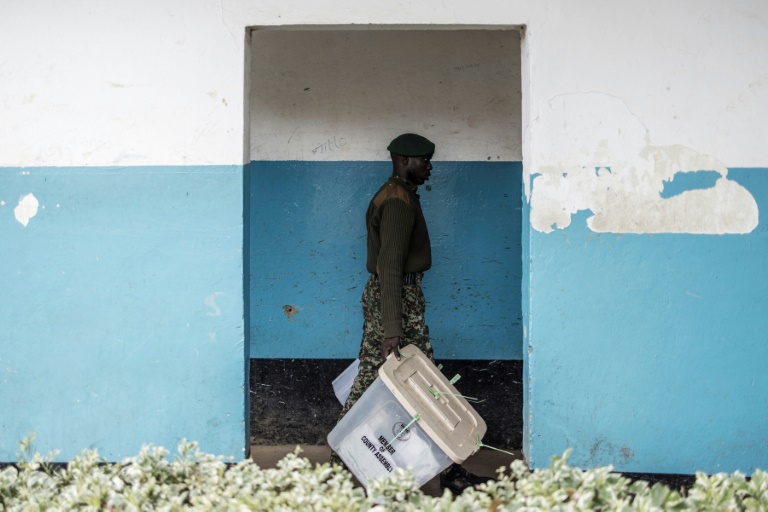
Kenyans voted in six elections on Tuesday, choosing a new president as well as senators, governors, lawmakers, woman representatives and some 1,500 county officials in polls that were largely peaceful.

The IEBC has yet to publish a final turnout figure but as of Wednesday, turnout was just over 65 percent.

That compares with a final turnout of 78 percent in the disputed August 2017 election.

Observers from the East African Community (EAC) said the lower turnout, especially among Kenyans aged under 35, was worrying.

“This should concern everyone that young people are not participating in the process,” said Jakaya Kikwete, head of the bloc’s observation mission.

As economic pressures have mounted in the country of 50 million, with food and fuel costs shooting up, many Kenyans said they were fed up with electing leaders who had done little to ease their troubles.

“I have voted twice in my life and after the last election I decided I won’t even vote because it is a waste of time,” Ruth Musyoki, 40, told AFP in Nairobi.

Seoul seeks to ban basement flats after flooding deaths

South Korea’s capital has moved to ban the cramped basement flats made famous by Oscar-winning movie “Parasite” after four people drowned in subterranean dwellings during flooding caused by record-breaking rains this week.

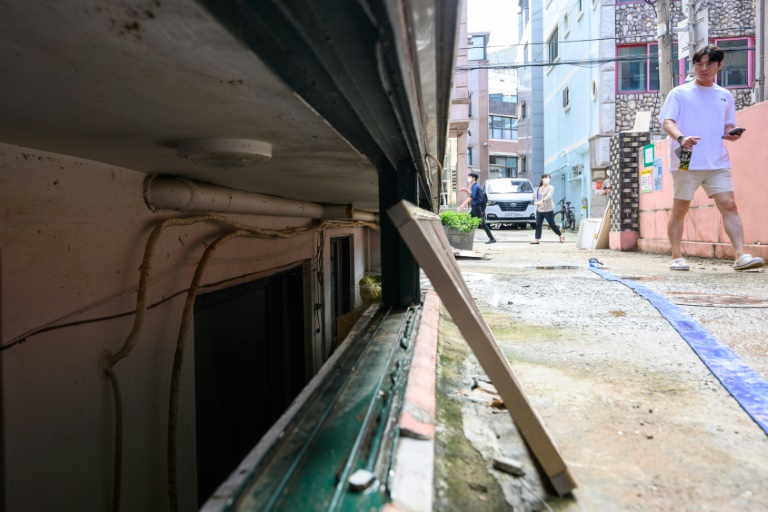
Soldiers and relief workers were clearing debris Thursday from waterlogged, mud-covered homes in Gwanak district, an AFP reporter saw, where three tenants, including a disabled woman and a teenager, died Monday.

Their deaths — trapped by floodwater in their basement apartment — have caused public outrage, with President Yoon Suk-yeol visiting their destroyed home this week before calling on officials to do more to help the poor and vulnerable during natural disasters.

The Seoul Metropolitan Government has announced they want to get rid of tiny, cramped basement flats — known as “banjiha” — which are typically cheap to rent but prone to damp and flooding.

Around 200,000 households live in such flats, which make up around five percent of housing stock in the South Korean capital, according to official figures.

Seoul said in a press release Wednesday that it will stop issuing permits to construct such homes, while pushing to gradually phase out existing basement and semi-basement flats.

The city plans to begin discussions with the national government to ban the use of basements or semi-basement spaces for residential purposes, it added.

Four out of 11 people killed in this week’s record downpours drowned after their basement flats were inundated with floodwater, officials have said.

Such abodes received global attention due to Bong Joon Ho’s “Parasite”, which won the 2020 Best Picture Oscar and features a poor family living in a dank basement home.

Activists blamed the “banjiha” deaths this week on the government’s housing policies, saying they were preventable disasters.

“We condemn the government’s negligence regarding those marginalised people in this housing,” said the Citizens’ Coalition for Economic Justice in a statement.

“As rainfall becomes stronger and more frequent under the influence of climate change, (Seoul) must embark on a fundamental change of its approach to basement residents,” it added.

Yoon has also blamed climate change for the rains and flooding, which he said were the worst since weather records began over a century ago.

“Those who struggle financially or with physical difficulties are bound to be more vulnerable to natural disasters,” he said.

Seoul seeks to ban basement flats after flooding deaths

South Korea’s capital has moved to ban the cramped basement flats made famous by Oscar-winning movie “Parasite” after four people drowned in subterranean dwellings during flooding caused by record-breaking rains this week.

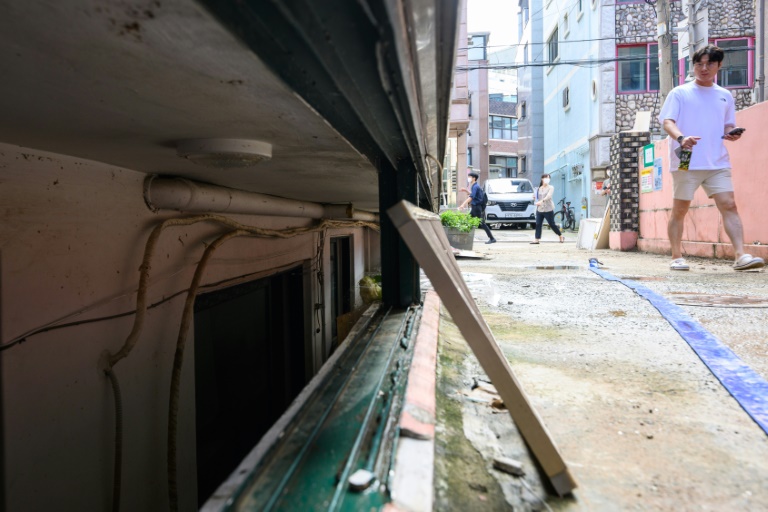
Soldiers and relief workers were clearing debris Thursday from waterlogged, mud-covered homes in Gwanak district, an AFP reporter saw, where three tenants, including a disabled woman and a teenager, died Monday.

Their deaths — trapped by floodwater in their basement apartment — have caused public outrage, with President Yoon Suk-yeol visiting their destroyed home this week before calling on officials to do more to help the poor and vulnerable during natural disasters.

The Seoul Metropolitan Government has announced they want to get rid of tiny, cramped basement flats — known as “banjiha” — which are typically cheap to rent but prone to damp and flooding.

Around 200,000 households live in such flats, which make up around five percent of housing stock in the South Korean capital, according to official figures.

Seoul said in a press release Wednesday that it will stop issuing permits to construct such homes, while pushing to gradually phase out existing basement and semi-basement flats.

The city plans to begin discussions with the national government to ban the use of basements or semi-basement spaces for residential purposes, it added.

Four out of 11 people killed in this week’s record downpours drowned after their basement flats were inundated with floodwater, officials have said.

Such abodes received global attention due to Bong Joon Ho’s “Parasite”, which won the 2020 Best Picture Oscar and features a poor family living in a dank basement home.

Activists blamed the “banjiha” deaths this week on the government’s housing policies, saying they were preventable disasters.

“We condemn the government’s negligence regarding those marginalised people in this housing,” said the Citizens’ Coalition for Economic Justice in a statement.

“As rainfall becomes stronger and more frequent under the influence of climate change, (Seoul) must embark on a fundamental change of its approach to basement residents,” it added.

Yoon has also blamed climate change for the rains and flooding, which he said were the worst since weather records began over a century ago.

“Those who struggle financially or with physical difficulties are bound to be more vulnerable to natural disasters,” he said.

Close Bitnami banner
Bitnami