World

Going once, going twice… Pakistan lions up for auction

A Pakistan zoo is auctioning off a dozen lions to private collectors next week to free up space for a pride that won’t stop growing.

Lahore Safari Zoo now has so many big cats that their lions and tigers have to take it in turns to access the paddocks, said Tanvir Ahmed Janjua, the zoo’s deputy director.

“Not only will we free up more space here, but our expenses for meat to feed them will also decrease,” he told AFP.

The zoo is currently home to 29 lions, and officials plan an auction on August 11 to sell 12 of them, aged between two and five years old.

There are also six resident tigers and two jaguars.

Conservationists are opposed to the sale, with the environmental group WWF saying the creatures should be moved to other established zoos, or breeding females sterilised or given contraceptives.

“Animal exchanges and donations between zoos are a widely accepted practice,” the organisation’s Uzma Khan told AFP.

“Once an institution such as a zoo places a price tag on a wildlife species it is promoting trade — which is counterproductive to conservation,” she added.

Keeping lions, tigers and other exotic wildlife as pets is not uncommon in Pakistan, and is seen as a status symbol.

Wealthy owners post images and video clips of their big cats on social media, and rent them out as props for movies and photoshoots.

Zoo officials have set a reserve of 150,000 Pakistan rupees ($700) per cat, but hope each will fetch around two million rupees.

Not just anyone can take part in the auction, however.

Janjua said buyers will have to be registered with provincial authorities and show they have the means to provide proper care and shelter for the creatures.

Zoo veterinary officer Muhammad Rizwan Khan told AFP an initial attempt last year to auction lions fell through as potential buyers lacked the necessary documentation or licences.

Nouman Hassan, who fell foul of authorities in the past when he was filmed walking his pet tiger on a leash in Lahore, plans to take part.

“I will try to buy two to three lions for sure,” he told AFP, adding the auction was a good way to diversify the gene pool for private collectors who already owned a big cat.

With little legislation to safeguard animal welfare, zoos across Pakistan are notorious for their poor facilities, but the Lahore Safari Zoo is considered one of the best, set over 200 acres.

In April 2020 a court ordered the only zoo in the country’s capital to shut after poor facilities and mistreatment of the animals there were revealed.

The facility had drawn international condemnation for its treatment of an Asian elephant named Kaavan, who was later airlifted to retirement in Cambodia in a jumbo project spearheaded by US popstar and actress Cher. 

Veterinarian Khan said the animals at Lahore Safari Zoo were being given the best possible care — something reflected in their fecundity.

“They are experiencing a good life in captivity with us,” he said.
Taiwan accuses China of simulating invasion as US relations nosedive

Taiwan accused the Chinese army of simulating an attack on its main island Saturday, as Beijing doubled down on its retaliation for US House Speaker Nancy Pelosi’s visit to Taipei after announcing a suspension of cooperation with Washington on key issues.

Relations between the two superpowers have nosedived in the wake of Pelosi’s trip to China’s self-ruled neighbour — which it claims as its territory — prompting calls from the UN for an urgent de-escalation of tensions.

And Friday saw the environment become the latest victim of the geopolitical jousting, as Beiing said it would withdraw from a series of talks and cooperation agreements with Washington — most notably on climate change and defence cooperation. 

The world’s two largest polluters had pledged to work together to accelerate climate action this decade and vowed to meet regularly to tackle the crisis — a deal that now looks shaky.

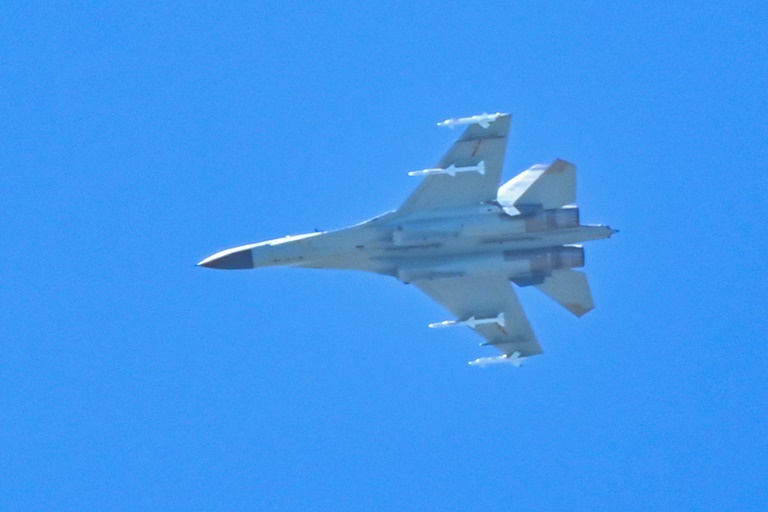
Beijing on Saturday continued some of its largest-ever military drills around Taiwan — exercises aimed at practicising a blockade and ultimate invasion of the island, analysts say. 

Taipei said it observed “multiple” Chinese planes and ships operating in the Taiwan Strait, believing them to be simulating an attack on the self-ruled democracy’s main island.

“Multiple batches of Communist planes and ships conducting activities around the Taiwan Strait, some of which crossed the median line,” its defence ministry said in a statement, referring to a demarcation line that runs down the Taiwan Strait which Beijing does not recognise.

In a bid to show just how close China’s forces have been getting to Taiwan’s shores, Beijing’s military overnight released a video of an air force pilot filming the island’s coastline and mountains from his cockpit.

China’s state broadcaster, CCTV, has reported that Chinese missiles have flown directly over Taiwan during the exercises — a major escalation if confirmed.

But Taipei has remained defiant, insisting it would not be cowed by its “evil neighbour”.

– ‘Punishing the whole world’ –

The scale and intensity of China’s drills have triggered outrage in the United States and other democracies, with the White House summoning China’s ambassador to Washington on Friday to rebuke him over Beijing’s actions.

And Beijing’s decision to withdraw from hard-won cooperation on climate change has now sparked wider fears about the future of the planet.

“It’s obviously worrying and raises concerns,” Alden Meyer, a senior associate at E3G, a climate-focused think tank, told AFP.

It’s “impossible to address the climate emergency if the world’s number one and number two economies and number one and number two emitters are not taking action,” he said. 

“And it’s always preferable that they do that in a collaborative way.”

National Security Council spokesman John Kirby told reporters in Washington the decision was “fundamentally irresponsible.”

“They’re actually punishing the whole world, because the climate crisis doesn’t recognize geographic boundaries and borders,” Kirby said.

“The world’s largest emitter now is refusing to engage on critical steps necessary to combat the climate crisis.”

UN Secretary-General Antonio Guterres warned the two superpowers must continue to work together — for the world’s sake.

“For the secretary-general, there is no way to solve the most pressing problems of all the world without an effective dialogue and cooperation between the two countries,” his spokesman Stephane Dujarric said.

– ‘The new normal’ – 

But with tensions over Taiwan having risen to their highest level in nearly 30 years with an elevated risk of military conflict, experts told AFP the latest downturn in relations between the two superpowers could be deep and long-lasting.

“The relationship is in a very bad place right now,” said Bonnie Glaser, a China expert at the German Marshall Fund.

The suspension Friday of bilateral military and maritime dialogue while China continues its military exercises was “particularly worrisome,” she said. 

“We don’t know what else they will do,” she said. “We just don’t know if this is just a temporary thing.”

John Culver, a former CIA Asia analyst, said in a discussion hosted by the Center for Strategic and International Studies that Beijing’s main purpose with its military exercises was to change that status quo.

“I think that this is the new normal,” Culver said. 

“The Chinese want to show… that a line has been crossed by the speaker’s visit.”

Blinken hails 'strong' US-Philippine alliance in talks with Marcos

US Secretary of State Antony Blinken met with Philippine President Ferdinand Marcos Jr Saturday in a bid to bolster the countries’ “strong” alliance, as China conducts military drills around nearby Taiwan. 

Blinken is the most senior US official to visit the Southeast Asian nation — a treaty-bound ally of the United States — since Marcos took office on June 30.

“The alliance is strong and I believe can grow even stronger,” Blinken told Marcos as they met at the presidential palace in the capital Manila.

Marcos hailed the “special relationship” between the two countries.

The United States has a security pact with the Philippines and has backed its former colony in increasingly heated disputes in the South China Sea with Beijing.

Blinken’s meeting with Marcos came after China launched a series of huge military exercises around Taiwan that have been condemned by the United States and other Western allies.

During drills on Thursday and Friday, China fired ballistic missiles and deployed fighter jets and warships around Taiwan, about 400 kilometres north of the Philippines. The war games are to continue Saturday.

The People’s Liberation Army also declared multiple no-go danger zones around Taiwan, straddling major shipping lanes and coming within 20 kilometres (12 miles) of the island’s shores at some points.

The moves came in response to a visit to Taiwan by US House Speaker Nancy Pelosi, which prompted fury in China.

Marcos said Pelosi’s visit only demonstrated the existing “intensity” of the conflict, rather than adding to tensions.

Blinken arrived in Manila late Friday after attending an Association of Southeast Asian Nations summit in Cambodia.

There, he condemned China’s military drills as “a significant escalation”.

Like other members of ASEAN, the Philippines does not formally recognise Taiwan and has shown no appetite for backing Taipei against China. 

The Philippine Department of Foreign Affairs said Thursday it was “concerned with the rising tensions” to its north and urged “restraint by all parties”.

“Diplomacy and dialogue must prevail,” it said in a statement.

The United States has a complex relationship with the Philippines — and the Marcos family.

After ruling the former US colony for two decades with the support of Washington, which saw him as a Cold War ally, Ferdinand Marcos Senior went into exile in Hawaii in the face of mass protests and with the nudging of the United States in 1986.

As regional tensions rise, Washington is keen to preserve its security alliance with Manila, which includes a mutual defence treaty and permission for the US military to store defence equipment and supplies on several Philippine bases.

It also allows US troops to access certain military bases in the country.

Marcos has indicated he will strike a balance between China and the United States, which are vying to have the closest ties with his administration.

US relations rebounded with Manila toward the end of the tenure of Marcos’ predecessor Rodrigo Duterte, who waged a brutal war on drugs that rights groups say left tens of thousands of dead.

Israel strikes kill top Gaza militant, triggering rocket barrage

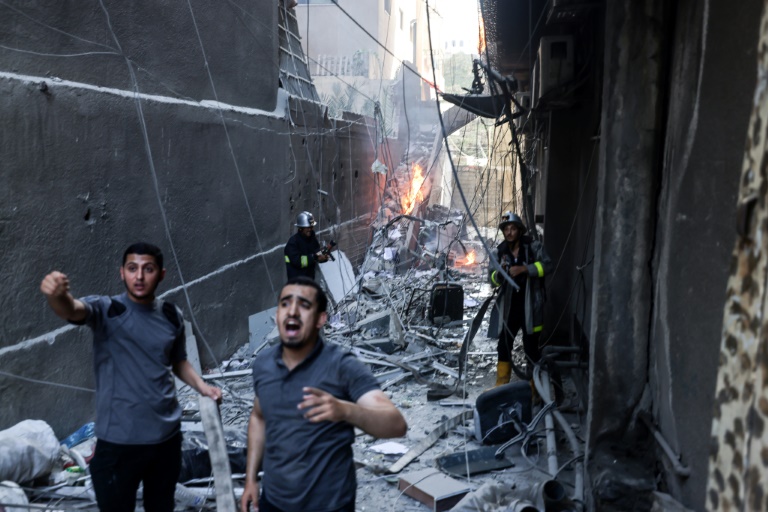
Israel pounded Gaza with air strikes on Saturday and a Palestinian militant group retaliated with a barrage of rocket fire, in the territory’s worst escalation of violence since a war last year.

Health authorities in the enclave controlled by Hamas Islamists said 10 people have been killed by Israel’s bombardment, including a five-year-old girl, with 79 others injured. Israel’s army estimated that its operation has killed 15 militants. 

Israeli Prime Minister Yair Lapid said the Jewish state was forced to launch a “pre-emptive counter-terror operation against an immediate threat” posed by the Islamic Jihad group, following days of tensions along the Gaza border.

Israel and Islamic Jihad have both confirmed the killing of a top leader with the militant group, Taysir al-Jabari, in a Friday strike on a building in the west of Gaza city. 

Islamic Jihad said the initial Israeli bombardment amounted to a “declaration of war”, before it unleashed a flurry of more than 100 rockets towards Israel.

The rocket fire and Israeli strikes continued overnight, risking a repeat of an 11-day conflict in May 2021 that devastated Gaza and forced countless Israelis to rush to bomb shelters.

“Israel isn’t interested in a wider conflict in Gaza, but will not shy away from one either,” Lapid said in a nationally televised address.

Air raid sirens sounded overnight across several spots in southern and central Israel, but there were no immediate reports of casualties. 

Officials in border areas urged people to stay close to shelters, which were also being opened in the commercial capital of Tel Aviv.

The army had initially confirmed at least 70 rocket launches from Gaza, saying 11 had fallen inside the strip, with dozens intercepted by the Iron Dome air defence system, and that others had landed in open areas.

Air raid warnings and Israeli strikes had at least temporarily abated by 4:30 am (0130 GMT).

Egypt, a historic broker between Israel and armed groups in Gaza, was seeking to mediate and may host an Islamic Jihad delegation later Saturday, Egyptian officials told AFP in Gaza.

– Escalation, mediation –

Hamas has fought four wars with Israel since seizing control of Gaza in 2007, including the conflict last May. Islamic Jihad is a separate group, aligned with Hamas, but that also acts independently.

A flare up with Islamic Jihad came in 2019, following Israel’s killing of Baha Abu al-Ata, Jabari’s predecessor.

The sides exchanged fire for several days without Hamas joining the fray.

Hamas’s moves amid the current violence could prove crucial in determining its severity, with the group facing pressure from some to maintain calm in order to improve economic conditions in the territory.

Gaza City resident Abdullah al-Arayshi said the situation was “very tense”. “The country is ravaged. We’ve had enough of wars. Our generation has lost its future,” he told AFP.

Hamas said Israel has “committed a new crime for which it must pay the price”.

Both Hamas and Islamic Jihad are considered terrorist organisations by much of the West. 

– Five-year-old girl –

Flames poured out of a building in Gaza City following the first round of strikes, while wounded Palestinians were evacuated by medics.

Gaza’s health ministry reported “a five-year-old girl, targeted by the Israeli occupation” was among nine people killed. 

Five-year-old Alaa Kaddum had a pink bow in her hair and a wound on her forehead, as her body was carried by her father at her funeral.

Hundreds of mourners gathered in Gaza City for the funerals of Jabari and others killed in the air strikes.

Israeli military spokesman Richard Hecht said “we are assuming about 15 killed in action” in Gaza, referring to Palestinian combatants.

Israeli tanks were lined up along the border and the military said Thursday it was reinforcing its troops. 

UN Middle East peace envoy Tor Wennesland said he was “deeply concerned”, warning that the escalation was “very dangerous”.

– ‘West Bank’ –

The strikes come four days after Israel closed its two border crossings with Gaza and restricted the movement of Israeli civilians living near the frontier, citing security concerns.

The measures followed the arrest in the occupied West Bank of two senior members of Islamic Jihad, including Bassem al-Saadi, who Israel accuses of orchestrating recent attacks. 

Israel has been conducted a near relentless wave of raids inside the West Bank since mid-March in response to deadly attacks on Israeli citizens. 

Islamic Jihad did not launch rockets after Saadi’s arrest, but Israel has insisted through the week that the group was committed to seeking revenge. 

Palestinians including patients and those with Israeli work permits have been prevented from leaving the Gaza Strip since Tuesday, while the goods crossing has also been shut.

In New York, a native tribe fights to save its land from climate change

In the Hamptons, New York’s playground for the rich and famous, a Native American tribe is battling with the latest threat to what’s left of its traditional land: climate change.

The Shinnecock, whose name means “people of the stony shore,” have lived on Long Island for 13,000 years.

Their villages stretched along the island’s eastern end before land grabs by European settlers and later US authorities reduced their territory to an 800-acre (1.25 square-mile) peninsula.

That low-lying land is now shrinking due to rising sea levels and coastal erosion, and making it increasingly vulnerable to more powerful storms.

“You’re looking at a situation where an entire nation of people who have been here for essentially forever are faced with a devastating reality that we may have to relocate,” Tela Troge, a Shinnecock attorney, told AFP.

The Shinnecock Indian Nation is a self-governing, federally recognized tribe of approximately 1,600 members.

Roughly half live on its reservation, which juts out into Shinnecock Bay beside Southampton, where multi-million-dollar mansions sit behind electric gates.

Also next door is the hamlet of Shinnecock Hills and its famous eponymous golf club, land the tribe says was stolen from them in 1859.

Warming temperatures are causing seas to expand and rise, eating away at the reservation’s coastline.

– Flooding –

Ed Terry, who makes traditional Shinnecock jewelry out of shells found on the beach, remembers the sand going out much further when he was a boy.

“You can see the erosion. Where the land was is now water. It’s like the sea is coming to us,” the 78-year-old told AFP, as he sculpted a mussel shell to be worn as earrings.

Some parts of the shoreline have already receded 150 feet (45 meters), according to studies cited by Shavonne Smith, the nation’s environment director.

She says 57 homes may have to be relocated soon and bodies possibly disinterred from the tribe’s coastal cemetery and moved elsewhere.

“If you’re talking about taking a people that are so dependent on the water — for spiritual health, recreational and sustenance — and now moving them further inland, you’re talking about a very huge, stressful, emotional, dynamic shift in who we are,” Smith told AFP.

The nation estimates its sea levels will rise by up to 4.4 feet (1.3 meters) by the end of the century. Coupled with more intense storms, this would mean frequent devastating floods.

Hurricane Sandy gave a foretaste in 2012, washing away bluffs on the shore, ripping off roofs and flooding basements and the burial grounds.

“There are studies that show by the year 2040 there’s a 100 percent chance the entire Shinnecock Nation region will get inundated by a storm,” said Scott Mandia, a climate change professor at Suffolk County Community College.

– ‘We will survive’ –

In an attempt to preserve their homeland and way of life, which includes fishing and farming, the nation is taking a nature-based approach towards tackling global warming.

It has built an oyster shell reef and placed boulders to try to hold back waves, as well as planted sea and beach grass in a bid to stop sand from shifting.

Tribe members are doing their bit too.

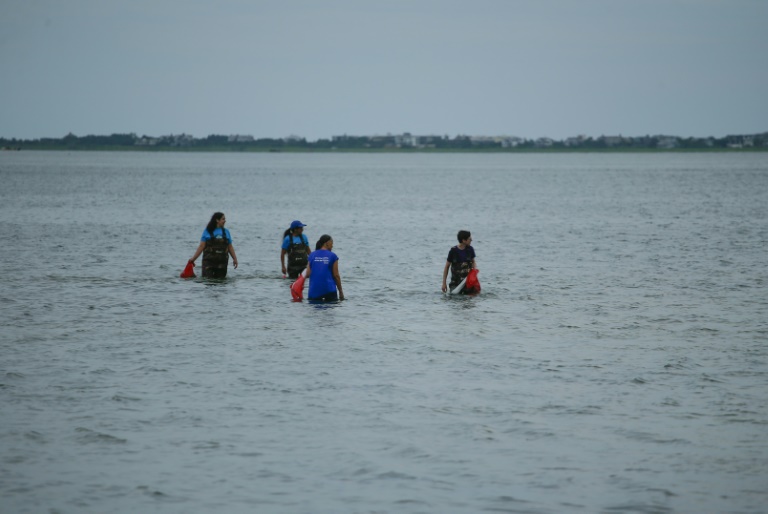
Troge, 35, is director of Shinnecock Kelp Farmers — a group of six Indigenous women who harvest sugar kelp and sell it as a non-chemical fertilizer.

The seaweed helps clean up water pollution, fueled by neighboring development, by absorbing carbon and nitrates that cause toxic algae blooms, which damage marine life.

Wading into the bay waist-high, farmer Donna Collins-Smith says she is inspired by previous Shinnecock generations “and what they have preserved for us.”

“We are maintaining that and bringing it back from a state of near dead,” the 65-year-old told AFP.

Mandia, co-author of a book about rising sea levels, laments that marginalized communities “who are least responsible for” climate change are those “who are going to feel the pain the most.”

He applauds the tribe’s efforts but says they are “just buying time” before their land becomes uninhabitable.

Terry, the septuagenarian jeweler, wonders where future Shinnecock will go, since tribal boundaries are fixed. 

“We have no higher ground,” he says.

Nevertheless, Terry adds, “We are a strong people. We will survive.”

Nuclear weapons a 'loaded gun', UN chief warns in Hiroshima

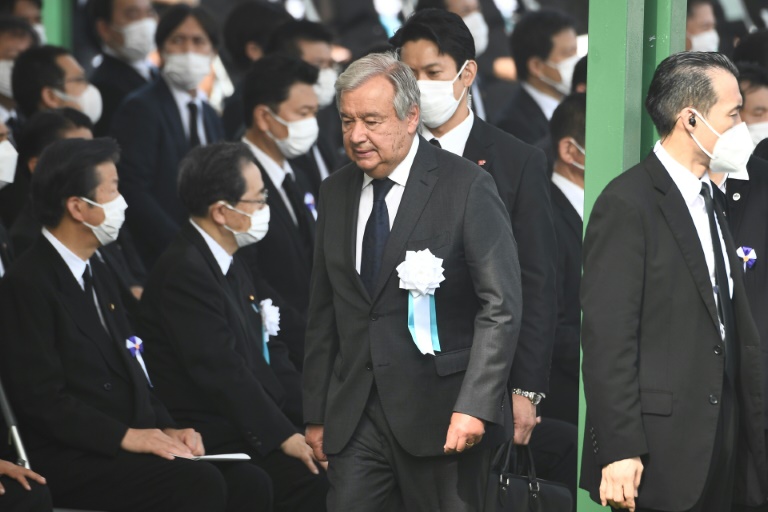
“Humanity is playing with a loaded gun” as crises with the potential for nuclear disaster proliferate worldwide, UN head Antonio Guterres said in Hiroshima on Saturday, the 77th anniversary of the first atomic bomb attack.

At an annual memorial, Guterres warned of the risk posed by crises in Ukraine, the Middle East and the Korean peninsula as he described the horrors endured by the Japanese city.

“Tens of thousands of people were killed in this city in the blink of an eye. Women, children and men were incinerated in a hellish fire,” he said.

Survivors were “cursed with a radioactive legacy” of cancer and other health problems.

“We must ask: What have we learned from the mushroom cloud that swelled above this city?”

Around 140,000 people died when Hiroshima was bombed by the United States on August 6, 1945 — a toll that includes those who perished after the blast from radiation exposure.

Today, “crises with grave nuclear undertones are spreading fast — the Middle East, to the Korean peninsula, to Russia’s invasion of Ukraine”, Guterres said, repeating warnings he made this week at a nuclear Non-Proliferation Treaty conference in New York.

“Humanity is playing with a loaded gun.”

Before dawn, survivors and their relatives began to gather at Hiroshima’s Peace Memorial Park to offer flowers and prayers.

A silent prayer was held at 8.15 am, the moment the bomb was dropped.

The Russian ambassador was not invited to the ceremony, but visited Hiroshima on Thursday to lay flowers at the memorial site.

Since Russia invaded Ukraine in February, President Vladimir Putin has made thinly veiled threats hinting at a willingness to deploy tactical nuclear weapons.

In a speech on Saturday, Hiroshima mayor Kazumi Matsui cited Leo Tolstoy, the Russian author of “War and Peace”, saying: “Never build your happiness on the misfortune of others, for only in their happiness can you find your own.”

Three days after the Hiroshima bombing, Washington dropped a plutonium bomb on the Japanese port city of Nagasaki, killing about 74,000 people and leading to the end of World War II.

The United States remains the only country ever to have used nuclear weapons in conflict.

But around 13,000 are now held in state arsenals worldwide, the UN head said.

Saturday was the first time Guterres attended the Hiroshima memorial in person, with a visit last year cancelled because of the Covid-19 pandemic.

In high-level US visit to Solomon Islands, China looms large

A high-ranking US delegation lands in the Solomon Islands Saturday, as Washington wrestles with Beijing for influence in the region months after the Pacific nation signed a secretive security pact with China.

China’s growing might in the Asia-Pacific will be on display this weekend as it continues to stage military drills encircling Taiwan in a show of force following US House Speaker Nancy Pelosi’s visit to the self-ruled island.

Deputy Secretary of State Wendy Sherman heads the US delegation visiting the Solomons for three days to mark the 80th anniversary of the World War II Battle of Guadalcanal.

Sherman’s father was a Marine who was seriously injured in the battle, a major offensive over six months in 1942 and 1943 that triggered a Japanese withdrawal and marked the start of major Allied operations in the Pacific.

The United States announced this year it plans to re-establish an embassy in the Solomons nearly 30 years after closing its last mission.

China, which has an embassy in the Solomons with close ties to its government, alarmed Western rivals by signing an undisclosed security pact with the island in April. 

The deal, which critics fear could lead to China gaining a military foothold in the South Pacific, is likely high on the agenda for the US visit. 

– ‘Double-edged sword’ –

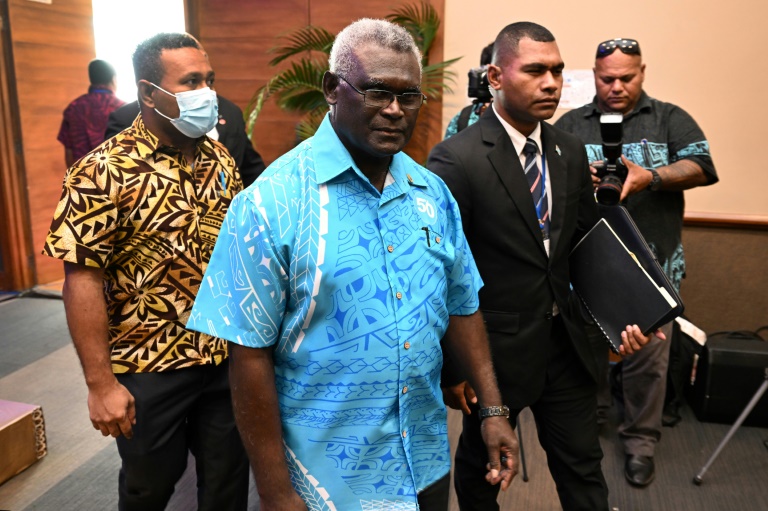
“It’s a difficult path for the US to tread in a sense that, obviously, Prime Minister Manasseh Sogavare really values his country’s relationship with China,” Mihai Sora, a research fellow in the Pacific Islands Program at the Sydney-based Lowy Institute, told AFP.

“The notion that he would have to pick between the US and China would not be welcomed. He will be looking for a way to work with both the US and China.”

But not everyone in the Solomons supports growing security ties with China, he added: “It’s a double-edged sword.”

The Solomons severed ties with Taiwan in September 2019 in favour of diplomatic relations with China, a switch that unlocked investment but stoked inter-island rivalries.

Last November, protests against Sogavare’s rule escalated into riots in the capital Honiara, during which much of the city’s Chinatown was torched before Australia led an international peacekeeping mission to help restore calm.

On the home front, the Solomons prime minister is being accused by the opposition of undermining democracy.

Sogavare has reiterated his government’s intention to defer general elections from next April until after the Pacific Games, which the Solomons hosts in November 2023.

China is financing a national stadium complex reportedly worth $53 million to host the Games. 

– ‘War on media freedom’ –

The Solomons leader has also drawn flak for attacking the public broadcaster, Solomon Islands Broadcasting Corporation.

This week, Sogavare’s office accused the broadcaster of propagating “lies and misinformation”, saying it had neglected its duty to “practice, fair, responsible and ethical journalism”.

The prime minister’s office said standards in local media had “decayed over the years to a point where pretty much anything gets published just to make a buck”.

In response, the International Federation of Journalists warned against “an assault on press freedom and an unacceptable development for… the democratic political process”. 

The federation had already raised concerns when Chinese Foreign Minister Wang Yi visited the Solomon Islands in May.

The tour featured heavily restricted press conferences, with local journalists collectively confined to one question for Wang.

Frozen US-China cooperation presents new hitch for global warming

Beijing is freezing its cooperation with Washington on global warming, but experts are hoping that, for the sake of humanity, the cold spell between the world’s two largest emitters is only temporary.

The unraveling relationship comes not long after China and the United States announced a surprise agreement to strengthen climate action at the UN COP26 climate conference in Glasgow in 2021.

US House of Representatives Speaker Nancy Pelosi’s visit to Taiwan this week, however, has prompted Beijing to end cooperation with the United States on several key issues.

“It’s obviously worrying and raises concerns,” Alden Meyer, a senior associate at the E3G think tank told AFP.

It’s “impossible to address the climate emergency if the world’s number one and number two economies and number one and number two emitters are not taking action,” he said. “And it’s always preferable that they do that in a collaborative way.”

Cooperation between the two countries is essential on all of the world’s “most pressing problems,” UN Secretary-General Antonio Guterres’ press secretary told reporters on Friday.

Above all, China’s announcement raises questions, including what the consequences will be for the COP27 climate conference in Egypt in November.

“What are the conditions to re-open dialogues? Are these conditions climate or geopolitical?” Greenpeace’s Li Shuo asked on Twitter.

“Is this a tactical move or is it a longer term strategic move?” questioned Meyer. “Is China saying the cooperation is impossible as long as there are tensions between the US and China?”

– ‘Total disaster’ – 

Earth’s temperature has risen by an average of nearly 1.2 degrees Celsius from pre-industrial levels, multiplying heat waves, droughts, floods and storms on all continents.

However, the mercury could rise by 2.8 degrees Celsius by 2100 even if countries abide by their commitments, according to UN climate experts at the Intergovernmental Panel on Climate Change (IPCC).

Apart from the US-China spat, commitments have already been weakened by the economic crises stemming from the Covid-19 pandemic and Russia’s invasion of Ukraine, which notably led to the relaunch of coal-fired power stations.

IPCC author Francois Gemenne called China’s decision a “total disaster for the climate… comparable to the US withdrawal from the Paris agreement,” which aims to limit end-of-century warming to well below two degrees Celsius above pre-industrial levels — and preferably not beyond 1.5 degrees.

Former president Donald Trump withdrew the United States from the agreement, but his successor Joe Biden returned the country to the accord in 2021.

The temporary US withdrawal has nonetheless been accompanied by backtracking on domestic and foreign climate policy, experts say.

China’s announcement, on the other hand, is “certainly not a withdrawal from the world stage on climate issues or a rejection of climate action,” David Waskow, director of the World Resources Institute’s international climate initiative, told AFP.

Mohamed Adow, founder of the Power Shift Africa energy think tank echoed that sentiment, adding that “breaking off diplomacy doesn’t mean China is backtracking on its commitments,” particularly as, “in many respects, China is way ahead of the US when it comes to action on climate change.”

Biden has pledged to cut US emissions by 50 to 52 percent by 2030, compared with 2005 levels, and achieve carbon neutrality by 2050. 

But his ambitions have been thwarted by failure to push green energy projects and climate initiatives through Congress, although some progress has been made in recent days.

For its part, China, which is the leading emitter of greenhouse gases in absolute value but far behind the US in emissions per capita, has committed to reaching peak emissions in 2030 and carbon neutrality in 2060.

Meanwhile, even if it’s not cooperating with the United States, “there will be pressure on China from others including the EU, including vulnerable countries,” Meyer said.

Amazon to buy Roomba-maker iRobot in $1.7 bn deal

Amazon on Friday announced a $1.7 billion deal to buy the maker of robotic vacuum Roomba in a merger that would play into the tech giant’s artificial intelligence and smart home ambitions.

US-based iRobot is a global company that builds robots and “intelligent home” innovations, having introduced Roomba self-operating vacuums a decade ago, Amazon said in a release.

“Over many years, the iRobot team has proven its ability to reinvent how people clean with products that are incredibly practical and inventive,” said Amazon senior vice president of devices Dave Limp.

Amazon’s deal to buy iRobot for $61 per share along with acquiring the company’s debt is subject to approval of shareholders and regulators.

Colin Angle is to remain chief executive of iRobot after the purchase.

The acquisition “reinforces Amazon’s interest and market position in robotics and home automation, and underscores the strategic value of AI,” Baird analyst Colin Sebastian said in a note to investors.

The Massachusetts-based company has a 30-year track record in robotics, and underlying software such as mapping and navigation, Sebastian said.

Amazon has been investing in smart home and automation technologies with acquisitions such as Ring doorbells, Kiva warehouse robots and self-driving startup Zoox.

“With Alexa and Amazon.com at the core, Amazon continues to prioritize opportunities to develop the smart home,” Sebastian said.

“MGM even fits as it powers more Prime Video on home entertainment devices.”

Amazon earlier this year closed an $8.45 billion deal to buy the storied MGM studios, boosting its streaming ambitions with a catalog including the James Bond and Rocky film franchises.

Kyiv, Moscow trade blame over nuclear plant

Kyiv and Moscow accused each other of striking Europe’s largest nuclear site on Friday, causing a reactor stoppage as three grain ships departed Ukraine under a deal to avert food shortages.

Russian troops have occupied the Zaporizhzhia nuclear plant in southern Ukraine since the early days of their invasion and Kyiv has accused them of storing heavy weapons there. Moscow, in turn, has accused Ukrainian forces of targeting the plant.

“Three strikes were recorded on the site of the plant, near one of the power blocks where the nuclear reactor is located,” Ukraine’s state-run nuclear power plant operator Energoatom said in a statement.

“There are risks of hydrogen leakage and radioactive spraying. The fire danger is high,” Energoatom said. It did not report any casualties.

It said staff of Russian nuclear operator Rosatom had hastily left the plant before the attacks, which damaged a power cable and forced one of the reactors to stop working.

Ukraine President Volodymyr Zelensky in his daily video address said Russia should “take responsibility for the very fact of creating a threat to a nuclear plant”. 

“Today, the occupiers have created another extremely risky situation for all of Europe: they struck the Zaporizhzhia nuclear power plant twice. Any bombing of this site is a shameless crime, an act of terror,” he said.

The Ukrainian foreign ministry earlier said the “possible consequences of hitting a working reactor are equivalent to using an atomic bomb”.

The defence ministry in Moscow denied the reports.

“Ukrainian armed units carried out three artillery strikes on the territory of the Zaporizhzhia nuclear power plant and the city of Energodar,” it said. 

The new spike in tensions came as Russian President Vladimir Putin was meeting his Turkish counterpart Recep Tayyip Erdogan in the Russian Black Sea resort of Sochi.

Putin thanked Erdogan for helping orchestrate the resumption of Ukrainian grain shipments, the first of which is due to arrive in Lebanon on Sunday according to Ukraine’s embassy in Beirut.

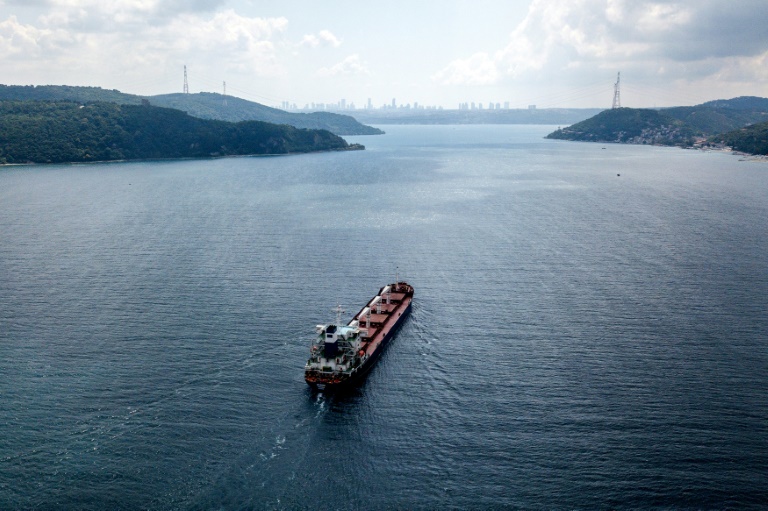
The Sierra Leone-flagged bulk carrier Razoni set sail from the Ukrainian port of Odessa on Monday carrying 26,000 tonnes of corn — the first departure under a UN-backed deal, brokered with Turkish help, to ease the global food crisis.

Kyiv said another three ships loaded with grain set sail from Ukraine on Friday, heading for Turkey and markets in Ireland and Britain. A further 13 are waiting to depart.

“Deliveries have already begun. I want to thank you, both for this and for the fact that at the same time an accompanying decision was made on uninterrupted supplies of Russian food and fertilisers to world markets,” Putin told Erdogan in Sochi.

Asli Aydintasbas, a fellow at the European Council on Foreign Relations, wrote in a report last week that the war in Ukraine had “restored Turkey’s self-image as a key geopolitical player” and given Erdogan a higher profile than at any time in recent years.

The Turkish leader wants to translate the success into truce talks in Istanbul between Putin and Zelensky.

– Extensive investigations –

Moscow meanwhile announced on Friday that it was imposing entry bans on 62 Canadian citizens including government officials.

The Russian foreign ministry said the list included figures known for “their malicious activity in the fight against the ‘Russian world’ and our traditional values”.

In Ukraine, a controversy has flared over accusations that it is violating international law and endangering civilians in its fight against the Russian invasion.

Amnesty International released a report on Thursday listing incidents in 19 cities and towns where Ukrainian forces appeared to have put civilians in harm’s way by establishing bases in residential areas.

President Zelensky equated the accusations to victim-blaming. In his evening address on Thursday, he said the rights group had sought to offer “amnesty (to) the terrorist state and shift the responsibility from the aggressor to the victim”.  

“There is no condition, even hypothetically, under which any Russian strike on Ukraine becomes justified. Aggression against our state is unprovoked, invasive and terrorist,” he added.  

“If someone makes a report in which the victim and the aggressor are supposedly equal in some way… then this cannot be tolerated.”  

Amnesty said a four-month investigation had found that the Ukrainian military had established bases in schools and hospitals, and launched attacks from populated areas. 

It said the tactics violated international humanitarian law and rebuffed criticism of its report.

“The findings… were based on evidence gathered during extensive investigations, which were subject to the same rigorous standards and due diligence processes as all of Amnesty International’s work,” secretary general Agnes Callamard told AFP in emailed comments.

– Counter-offensive –

On Friday, Zelensky’s office and local authorities reported overnight Russian bombardments targeting the southern city of Mykolaiv with widely-banned cluster bombs and heavy artillery — wounding 20 people, including a 14-year-old boy.

Mykolaiv is on the main route to Odessa, Ukraine’s biggest port on the Black Sea, and is the closest city to the southern front. 

Several missiles struck the city of Zaporizhzhia overnight and there was heavy bombardment of Ukraine’s second city Kharkiv, in the northeast.

Ukrainian forces are conducting a counter-offensive in the south, where they claim to have retaken more than 50 villages previously controlled by Moscow.

Close Bitnami banner
Bitnami