World

Nicaragua bishop under police siege at home

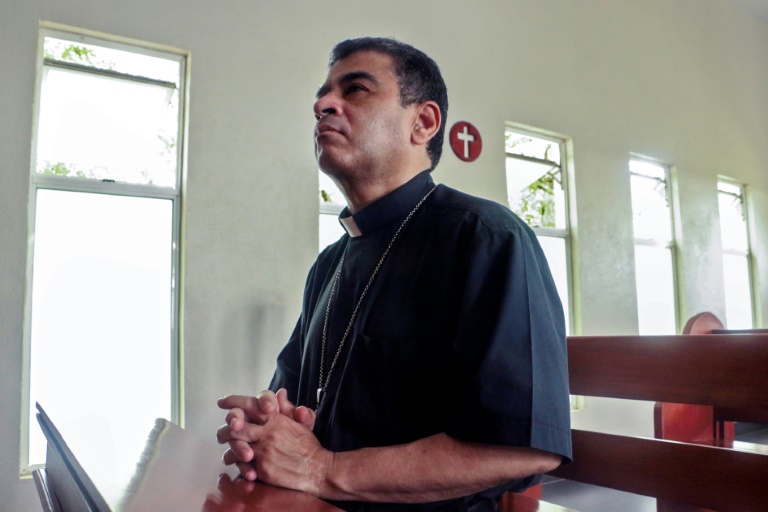
A Nicaraguan bishop critical of the regime has been confined to his home by police in a fast-worsening standoff between civil society and a government widely accused of authoritarianism.

Rolando Alvarez has been holed up at the bishop’s residence in the northern city of Matagalpa since Thursday, when police prevented him from leaving to say mass.

He had not been allowed to leave by Friday, and police remained at the scene, according to an AFP photographer and video journalist there.

The Cenidh human rights watchdog said on Twitter Thursday that “armed police have erected a barrier preventing him (Alvarez) from leaving his house.”

And in a video also posted online, Alvarez said that “I wanted to go to the cathedral to do holy mass but obviously the authorities… did not give permission; we are here locked up” at the bishop’s residence.

He denounced official “harassment” and urged the government to respect religious freedom.

The Church in Nicaragua has been under increasing government pressure since opposition protests in 2018 met with repression that resulted in 355 deaths, according to the Inter-American Commission on Human Rights.

Ortega, who maintains the protests were part of a Washington-backed opposition plot to unseat him, has also accused bishops of complicity and said protesters used church buildings as “barracks.”

Churches sheltered protesters who were injured or went into hiding.

– ‘Violation of freedom’ –

On Monday, Alvarez denounced the closure by authorities of five radio stations in his diocese in Matagalpa.

This followed the closure in June of several Catholic television channels.

The European Union on Thursday condemned the “arbitrary” closure of Catholic and community broadcasters, and said “excessive police force was used to occupy the installations and to intimidate and dispersed unarmed protesters.”

This amounted to “yet another violation of freedom of expression and freedom of religion or belief,” EU spokesman Peter Stano said in a statement.

Ortega, a 76-year-old former guerrilla, has governed Nicaragua since 2007, winning three successive reelections.

The last vote took place in November 2021 with several of Ortega’s main rivals joining other government opponents and critics in jail.

According to EU, Nicaragua has more than 180 “political prisoners.”

In the first half of 2022, said the EU, Nicaraguan authorities closed down over 1,200 civil society organizations.

According to the Vatican, Nicaragua expelled its ambassador to the country in March.

A charity organization established by Mother Teresa was outlawed in July, and its nuns forced to leave the country.

Other, non-religious media have also accused Ortega’s government of harassment that has forced media personnel to flee abroad. 

Last month, the Committee for the Protection of Journalists called for Nicaragua to “stop raiding journalists’ homes and allow the media to work freely.”
War in Ukraine: latest developments

Here are the latest developments in the war in Ukraine:

– Putin, Erdogan pledge to boost cooperation –


Russian President Vladimir Putin and Turkish leader Recep Tayyip Erdogan pledge to boost political and economic cooperation, including in energy and trade, in a statement adopted following their second talks in 17 days.

“Despite the current regional and global challenges, the leaders reaffirmed their common will to further develop Russian-Turkish relations,” the Kremlin says in a statement.

At the start of the meeting in Russia’s Black Sea city of Sochi, Erdogan told Putin he hopes to open a “different page” in ties between Ankara and Moscow. 

NATO member Turkey has sought to remain neutral in the face of Moscow’s historic stand-off with the West over Ukraine.

It has hosted peace talks between Russia and Ukraine, and in late July brokered a UN-backed agreement to resume grain deliveries from Ukrainian ports.

– Russia accused of strikes on nuclear site –

Ukraine accuses Russian forces of strikes near a nuclear reactor at Europe’s biggest power plant at Zaporizhzhia in the country’s south, which has been occupied since the early days of the invasion. 

“Three strikes were recorded on the site of the plant, near one of the power blocks where the nuclear reactor is located,” Energoatom, Ukraine’s state-run operator of the country’s nuclear power plants, says.

“There are risks of hydrogen leakage and radioactive spraying. The fire danger is high,” it said, adding that initially there were no casualties.

The global nuclear watchdog IAEA has been trying for weeks to send a team to inspect the plant. Ukraine has so far rejected the efforts, which it says would legitimise Russia’s occupation of the site in the eyes of the international community.

– Three more grain ships leave Ukraine –

Three ships loaded with grain for world markets leave Ukraine, the second departure under the deal struck in Istanbul in July between Moscow and Kyiv to lift Russia’s blockade of the Black Sea.

Ukraine is one of the world’s top grain exporters and the halt of almost all of its deliveries after Russia’s invasion on February 24 has sent global food prices soaring, making imports prohibitively expensive for some of the world’s poorest nations.

“Our main goal is to increase the transhipment volume in our ports. We have to process 100 carriers per month to be able to export the necessary amount of foodstuffs,” Ukrainian Infrastructure Minister Oleksandr Kubrakov says. 

– Amnesty stands by report –

Rights group Amnesty International tells AFP it “fully stands by” its accusations that Ukraine is endangering civilians by establishing bases in residential areas to counter the Russian invasion.

In Thursday’s report, which prompted a furious response from Kyiv, Amnesty listed incidents in 19 cities and towns where Ukrainian forces appeared to have put civilians in harm’s way.

Ukrainian President Volodymyr Zelensky equated the accusations to victim blaming. In his evening address on Thursday, he said the rights group had sought to offer “amnesty (to) the terrorist state and shift the responsibility from the aggressor to the victim”.

– Curfew, as Mykolaiv pounded –

Ukraine’s southern city of Mykolaiv is placed under curfew by the local authorities from 11:00 pm (2000 GMT) on Friday until 5:00 am (0200 GMT) on Monday following Russian bombardments overnight with widely-banned cluster bombs and heavy artillery.

Mykolaiv — which has been attacked frequently — is on the main route to Odessa, Ukraine’s biggest port on the Black Sea, and is the closest city to the southern front. 

Shelling also continues in several towns and villages in the east, including Nikopol and Kryvyi Rig, in Zaporizhzhia, and Ukraine’s second city Kharkiv, in the northeast. 

burs-jmy/gw

Seeking water, Brazil indigenous group finds new home

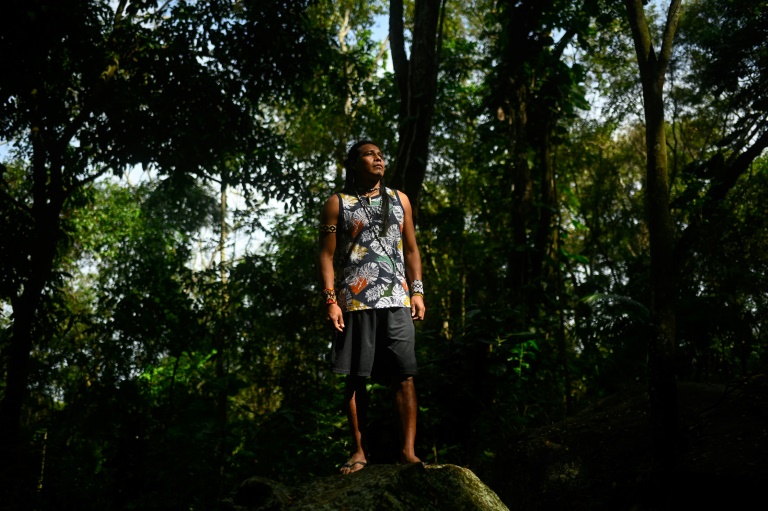
Clutching a machete and a cell phone, indigenous leader Vanderlei Weraxunu tours his community’s future home, a swathe of tropical forest land north of Rio de Janeiro where his people will finally have water.

Weraxunu is one of around 50 members of the Mbya Guarani people who will soon establish a new home in the middle of what will be Brazil’s first municipal nature reserve, where they plan to live according to their ancestral lifestyle.

The project promises to transform the lives of community members, who have been living in a settlement with no access to potable water in Marica county, in Rio de Janeiro state.

Hailing from different regions of Brazil, the community of Mbya Guarani moved there a decade ago and founded a village, Ceu Azul (Blue Sky) on a plot of land donated by a businessman.

But the land, a former coffee plantation, is too degraded to farm crops, and the village has to have water trucked in by the municipal government.

“A river ran through it 150 years ago. But then the former owner turned it into a coffee plantation and it was devastated,” says the youthful, chiseled Weraxunu, sporting a beaded armband, traditional face paint and long black hair.

“They cut down the forest and that caused the river to dry up,” he adds, as a black- and bronze-furred monkey playfully performs acrobatics on his arms and shoulders.

South America is home to an estimated 280,000 Guarani, divided into several subgroups including the Mbya.

They have a long history of conflicts with non-native farmers, who had often forced them from their ancestral land.

– ‘Guardians of nature’ –

After years of negotiations with the government, Weraxunu’s community is now set to move in the coming months to a 50-hectare (125-acre) plot of public land about 35 kilometers (20 miles) away, donated by the municipality.

“We’ll have more resources, we’ll be able to plant (manioc and sweet potato) and gather medicinal herbs,” says Weraxunu.

They also plan to bring back native crops such as Guarani maize, which they hold sacred, as well as bamboo for the handcrafts that are an important source of the community’s income.

“Until now, we’ve had to bring in bamboo from other places” to make traditional baskets, says Maria Helena Jaxuka, a Guarani cacique, or chief.

The local government has pledged to provide houses, a school, health care and a cultural center for the new village — plus official ownership of the land.

“It will allow us to preserve nature, as well as our culture and way of life,” says Weraxunu.

“The Guarani and all indigenous peoples are the guardians of nature, which gives us life.”

Seeking water, Brazil indigenous group finds new home

Clutching a machete and a cell phone, indigenous leader Vanderlei Weraxunu tours his community’s future home, a swathe of tropical forest land north of Rio de Janeiro where his people will finally have water.

Weraxunu is one of around 50 members of the Mbya Guarani people who will soon establish a new home in the middle of what will be Brazil’s first municipal nature reserve, where they plan to live according to their ancestral lifestyle.

The project promises to transform the lives of community members, who have been living in a settlement with no access to potable water in Marica county, in Rio de Janeiro state.

Hailing from different regions of Brazil, the community of Mbya Guarani moved there a decade ago and founded a village, Ceu Azul (Blue Sky) on a plot of land donated by a businessman.

But the land, a former coffee plantation, is too degraded to farm crops, and the village has to have water trucked in by the municipal government.

“A river ran through it 150 years ago. But then the former owner turned it into a coffee plantation and it was devastated,” says the youthful, chiseled Weraxunu, sporting a beaded armband, traditional face paint and long black hair.

“They cut down the forest and that caused the river to dry up,” he adds, as a black- and bronze-furred monkey playfully performs acrobatics on his arms and shoulders.

South America is home to an estimated 280,000 Guarani, divided into several subgroups including the Mbya.

They have a long history of conflicts with non-native farmers, who had often forced them from their ancestral land.

– ‘Guardians of nature’ –

After years of negotiations with the government, Weraxunu’s community is now set to move in the coming months to a 50-hectare (125-acre) plot of public land about 35 kilometers (20 miles) away, donated by the municipality.

“We’ll have more resources, we’ll be able to plant (manioc and sweet potato) and gather medicinal herbs,” says Weraxunu.

They also plan to bring back native crops such as Guarani maize, which they hold sacred, as well as bamboo for the handcrafts that are an important source of the community’s income.

“Until now, we’ve had to bring in bamboo from other places” to make traditional baskets, says Maria Helena Jaxuka, a Guarani cacique, or chief.

The local government has pledged to provide houses, a school, health care and a cultural center for the new village — plus official ownership of the land.

“It will allow us to preserve nature, as well as our culture and way of life,” says Weraxunu.

“The Guarani and all indigenous peoples are the guardians of nature, which gives us life.”

China scraps cooperation with US over Taiwan spat

China said Friday it was ending cooperation with the United States on a litany of key issues including climate change, anti-drug efforts and military talks, as relations between the two superpowers nosedive over Taiwan.

Beijing has reacted furiously to a visit by US House Speaker Nancy Pelosi to Taiwan, which it claims as its territory and has vowed to retake — by force if necessary.

It has since Thursday encircled the self-ruled, democratic island with a series of huge military drills that have been roundly condemned by the United States and other Western allies.

And Friday saw its foreign ministry hit back further against the United States, suspending talks and cooperation on multiple agreements between the two — including on climate change.

The world’s two largest polluters last year pledged to work together to accelerate climate action this decade, and vowed to meet regularly to “address the climate crisis”.

But that deal now looks shaky in light of China’s latest move.

Raising the alarm, UN Secretary-General Antonio Guterres warned the two superpowers must continue to work together — for the world’s sake.

“For the secretary-general there is no way to solve the most pressing problems of all the world without an effective dialogue and cooperation between the two countries,” Guterres’ spokesman Stephane Dujarric told reporters.

In Washington, the White House summoned China’s ambassador to condemn Beijing’s “irresponsible” behaviour over Taiwan, a senior US official said Friday.

Taiwan has also condemned Beijing’s response to the visit, with premier Su Tseng-chang calling for allies to push for de-escalation.

“(We) didn’t expect that the evil neighbour next door would show off its power at our door and arbitrarily jeopardise the busiest waterways in the world with its military exercises,” he told reporters.

Pelosi — who Beijing also hit with sanctions — has defended her trip to Taiwan, saying Friday that Washington would “not allow” China to isolate the island.

– ‘Our motherland is powerful’ –

Beijing has said its military exercises will continue until midday Sunday, and Taipei reported that 68 Chinese planes and 13 warships crossed the “median line” that runs down the Taiwan Strait on Friday.

AFP journalists on the Chinese island of Pingtan saw a fighter jet flying overhead, prompting tourists to snap photos.

A Chinese military vessel sailing through the Taiwan Strait was also visible, they added.

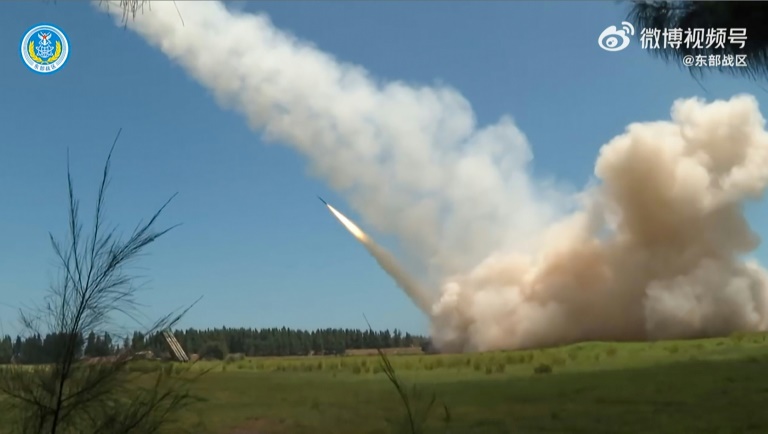
China’s drills involved a “conventional missile firepower assault” in waters east of Taiwan, the Chinese military said. 

And state broadcaster CCTV reported that Chinese missiles flew directly over Taiwan — a major escalation if confirmed.

On Pingtan, local tourists proudly extolled Beijing’s military might against its much smaller neighbour.

“Our motherland is powerful. We are not afraid of having war with Taiwan, the US or any country in the world,” Liu, a 40-year-old tourist from Zhejiang province, told AFP.

“We hope to unify Taiwan soon,” he added. “We don’t want to start a war, but we are not afraid of others.”

Wang, a businesswoman, was more sanguine about prospects for cross-strait ties.

“I hope China can unify Taiwan, but I don’t want war,” she said. “I hope this issue can be solved in a peaceful way.”

– ‘Significant escalation’ –

The scale and intensity of China’s drills have triggered outrage in the United States and other democracies.

“These provocative actions are a significant escalation,” US Secretary of State Antony Blinken said after talks with Southeast Asian foreign ministers at an ASEAN summit in Phnom Penh.

“The fact is, the speaker’s visit was peaceful. There is no justification for this extreme, disproportionate and escalatory military response,” he added.

China’s foreign minister countered by warning Washington not to escalate tensions.

“America’s habit is to create a problem and then use this problem to achieve its goals. But this approach will not work with China,” Wang Yi told a press conference on the summit sidelines.

“We want to issue a warning to the US not to act rashly and not to create a bigger crisis.”

Japan has lodged a formal diplomatic complaint against Beijing, with five of China’s missiles believed to have landed in its exclusive economic zone. 

On Friday, Japan’s foreign ministry said China cancelled a planned bilateral meeting on the ASEAN summit sidelines. 

And Australia — which has a troubled relationship with China, its largest trading partner — condemned the drills as “disproportionate and destabilising”.

The manoeuvres are taking place along some of the world’s busiest shipping routes, used to disseminate the global supply of vital semiconductors and electronic equipment produced in East Asia.

Stocks fall after US jobs growth surges

Stock markets slid Friday as a much stronger-than-expected US jobs report raised the prospect that the Federal Reserve will maintain its aggressive monetary policy to combat inflation.

Official data published Friday showed the US economy added 528,000 positions, defying all expectations of a slowdown.

Friday’s data also showed US wages jumped, which will add to inflation concerns and likely push the Fed to raise rates aggressively again next month.

The Fed has previously said its decision will be guided by data.

Markets fell after the “absolutely monster” jobs report “with wages also up strongly” leaves “the Fed with all the ammo it needs to keep on hiking a lot more”, Markets.com analyst Neil Wilson told AFP.

“Those betting on the Fed relenting soon have been caught out by today’s report,” he added.

Wall Street stocks were lower with the Dow and S&P falling 0.4 percent and 0.8 percent respectively, while the tech-heavy Nasdaq Composite was down nearly 1.3 percent after 1530 GMT.

The dollar gained against other major currencies.

Officials have said the US economy remains healthy despite four-decade high inflation and a sharp lift in borrowing costs.

The jobs data “make a mockery of claims that the economy is on the brink of recession”, said Michael Pearce, senior US economist at Capital Economics, said.

“All the details appear to support continued aggressive rate hikes from the Fed,” he said in a note.

In Europe, London equities ended the day down 0.1 percent one day after the Bank of England unveiled a half-point interest rate hike and forecast UK inflation topping 13 percent on surging domestic energy bills.

The BoE’s rate increase followed more aggressive monetary policy from the European Central Bank and the Fed as authorities crack down on rampant inflation in the wake of Russia’s invasion of Ukraine.

Back in the eurozone, Frankfurt stocks slipped 0.6 percent and Paris also sank 0.6 percent at the close of trading.

– ‘Stagflation awaits’ –

“The dire warnings from the BoE are impossible to ignore as other central banks desperately try to avoid a similar fate,” OANDA analyst Craig Erlam told AFP.

“It seems only a matter of time until others are forced to accept that a recession is the price to pay for getting inflation under control.”

He added: “A period of stagflation now awaits the UK — and others may not be far behind as the crushing impact of energy prices wreaks havoc on living standards and saps demand.”

Stagflation is a toxic mixture of stubbornly high consumer prices and low economic growth.

India’s central bank on Friday lifted borrowing costs for the third time in four months to the highest level since summer 2019.

Asian equities mostly rose Friday, with Taipei surging on easing concerns over a conflict with Beijing — even as China conducts its largest-ever military exercises around Taiwan in response to US House Speaker Nancy Pelosi’s visit earlier this week.

Oil prices rose later Friday, one day after WTI crude fell to the level where it had stood before the Ukraine conflict sent the market soaring. 

– Key figures at around 1530 GMT –

New York – Dow: DOWN 0.4 percent at 32,592.91 points

EURO STOXX 50: DOWN 0.5 percent at 3,641.20

London – FTSE 100: DOWN 0.1 percent at 7,439.74 (close)

Frankfurt – DAX: DOWN 0.6 percent at 13,573.93 (close)

Paris – CAC 40: DOWN 0.6 percent at 6,472.35 (close)

Tokyo – Nikkei 225: UP 0.9 percent at 28,175.87 (close)

Hong Kong – Hang Seng Index: UP 0.1 percent at 20,201.94 (close)

Shanghai – Composite: UP 1.2 percent at 3,227.03 (close)

Euro/dollar: DOWN at $1.0154 from $1.0246 Thursday

Pound/dollar: DOWN at $1.2045 from $1.2160

Euro/pound: UP at 84.28 pence from 84.26 pence

Dollar/yen: UP at 135.38 yen from 132.89 yen

Brent North Sea crude: UP 1.7 percent at $95.75 per barrel

West Texas Intermediate: UP 1.7 percent at $90.05 per barrel

burs-raz/pvh

Senior militant among more than 15 dead as Israel strikes Gaza

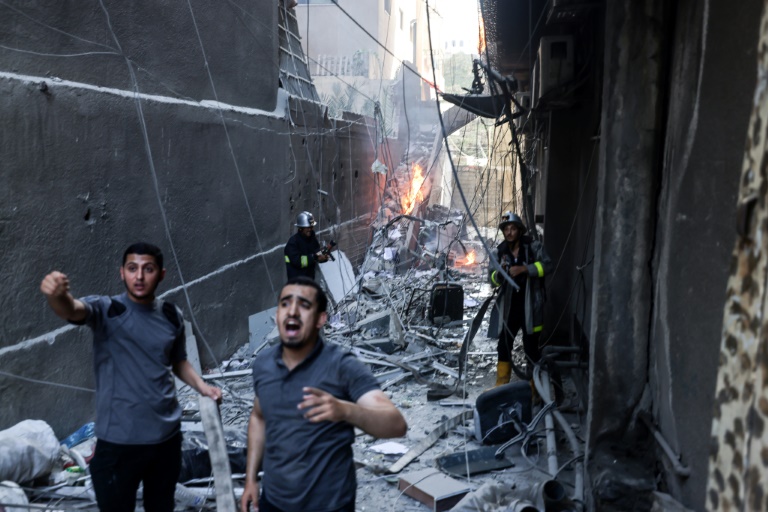
A senior militant from Islamic Jihad was among more than 15 people killed in Israeli air strikes on the Gaza Strip Friday, prompting the militant group to warn Israel has made a “declaration of war”.

A child was among those killed in the strikes, the enclave’s health ministry said, while Israel’s military estimated 15 combatants were killed.

The Israeli army said the bombardment was part of an operation “against targets in the Palestinian Islamic Jihad” group.

Flames poured out of a building in Gaza City following the air strikes, while wounded Palestinians were evacuated by medics.

Islamic Jihad said the Israeli strikes amounted to a “declaration of war”.

“We call on all the resistance forces and their military wings to respond in a unified front to this aggression,” the group said in a statement.

Gaza’s health ministry reported “a five-year-old girl, targeted by the Israeli occupation” was among nine people killed. A further 55 Palestinians were wounded, the ministry said.

Islamic Jihad said several members of its military wing were among those killed, including “the great fighter Taysir al-Jabari ‘Abu Mahmoud’, the commander of the Al-Quds Brigade in the northern region of the Gaza Strip.”

Israeli tanks were lined up along the border and the military said Thursday it was reinforcing its troops.

An Israeli military spokesman said “we are assuming about 15 killed in action” in Gaza, referring to Palestinian combatants.

“We haven’t finished yet,” spokesman Richard Hecht told journalists, adding that the military expected retaliatory rocket fire against Israel by Gaza militants.

Islamic Jihad leader Ziad al-Nakhala, who is visiting key backer Iran, told Lebanon’s Al-Mayadeen television that “Tel Aviv will… be one of the targets of the resistance’s missiles… as will all Zionist cities.”

– ‘Pay the price’ –

The strikes come four days after Israel closed its two border crossings with Gaza and restricted the movement of Israeli civilians living near the frontier, citing security concerns.

The measures follow the arrest in the occupied West Bank of two senior members of Islamic Jihad, which has a strong presence in Gaza.

Hamas, the militant group which rules Gaza, said Israel has “committed a new crime for which it must pay the price”.

“The resistance in all its military arms and factions is united in this struggle and will speak loudly… All fronts must open fire on the enemy,” Hamas said in a statement.

Israeli Prime Minister Yair Lapid was due to hold talks with Defence Minister Benny Gantz on Friday evening.

“Anyone who tries to harm Israel should know: we will find you. The security forces will act against Islamic Jihad terrorists to eliminate the threat they pose to the citizens of Israel,” Lapid said.

Islamic Jihad is blacklisted as a terrorist organisation by the European Union and the United States.

The office of Palestinian president Mahmud Abbas said the Israeli military action amounted to a “dangerous escalation”.

“The presidency called on the international community to force Israel to stop this aggression against our people everywhere,” said a statement published by the official Palestinian news agency Wafa.

On Friday afternoon, the Israeli military banned large gatherings in communities within 80 kilometres (50 miles) of the Gaza frontier, until Saturday evening. 

The measures follow four days of road closures and other restrictions on movement in the border area.

Palestinians including patients and those with Israeli work permits have been prevented from leaving the Gaza Strip since Tuesday, while the goods crossing has also been shut.

Gaza’s only power station is at risk of imminent outage due to a lack of fuel supplies through Israel, its manager warned on Thursday.

This week’s shutdown of the border area follows a raid by security forces in the northern West Bank district of Jenin.

Israeli forces detained Bassem al-Saadi and another senior member of Islamic Jihad. A 17-year-old member of the group was shot dead by Israeli forces during the raid.

Relatives of trapped Mexican miners pray for miracle

Relatives of 10 workers trapped in a flooded coal mine in northern Mexico clung to hope they were still alive Friday, nearly 48 hours after a cave-in sparked a major rescue operation.

Family members spent a second night waiting anxiously for news after the latest disaster to strike Mexico’s main coal-producing region in Coahuila state.

“I feel desperate, not knowing what’s happening and when I’ll see him again,” said Jesus Mireles Romo, whose father was among the missing.

“But I have faith that it will turn out well, that they will all get out,” he told AFP, his eyes red from crying.

The 24-year-old rushed to the mine in Agujita in the municipality of Sabinas with his two brothers on Wednesday to try to help the victims before the authorities took over, and has not left since.

“It’s painful to see your children who don’t lose hope of seeing their father again,” said his mother Claudia Romo, 45.

Five miners managed to escape in the initial aftermath of the cave-in Wednesday, but since then no survivors have been found.

Around 230 army and other government personnel were sent to the site, about 1,130 kilometers (700 miles) north of Mexico City, the defense ministry said.

– ‘Working tirelessly’ –

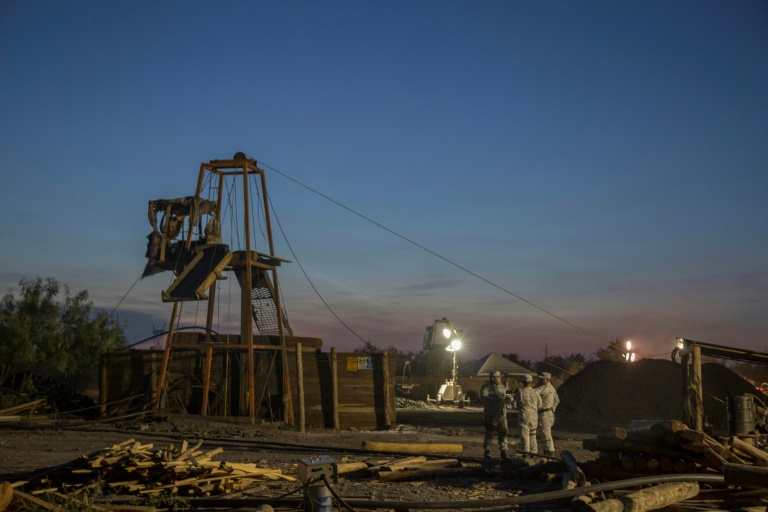
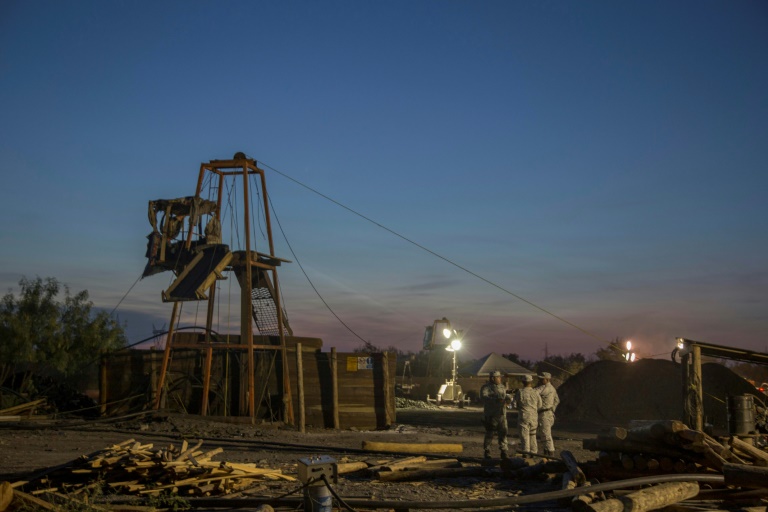
Soldiers and emergency workers worked through the night under floodlights pumping out water from the mine to try to make it safe enough to enter.

Authorities said the three mine shafts descended 60 meters (200 feet) and the floodwater inside was 30 meters deep — slightly lower than the day before.

“It’s essential to reduce the water level … to allow the safe entry of specialized search and rescue personnel,” civil defense national coordinator Laura Velazquez said.

“We’re working tirelessly to rescue the 10 trapped miners,” she said.

Family members cried and comforted each other while hopes of finding survivors dimmed with each passing hour.

“What we want is for them to retrieve the bodies,” Angelica Montelongo said with a sad and tired look, before summoning up new hope that her brother Jaime would be rescued.

“But hey, God willing, right? You have to have faith that they’re alive,” she said.

Experts and relatives painted a picture of a precarious profession fraught with risks extracting coal from the mines with lax safety standards.

“There’s always job insecurity… and danger,” said Blasa Maribel Navarro, whose cousin Sergio Cruz has mined coal for several years to support his two daughters.

Navarro said she was still hopeful of seeing him alive “because we trust in God.”

– History of accidents –

Crudely constructed mines like the one that collapsed lack concrete reinforcements to protect workers from a cave-in, engineering expert Guillermo Iglesias said.

The miners “dig a shaft two meters in circumference and keep digging until they reach a small layer of coal,” he told local radio.

The only thing supporting the surrounding earth is usually a large plastic tube through which the workers enter, he added.

Coahuila’s state government said the miners had been carrying out excavation work when they hit an adjoining area full of water, causing the shaft to collapse and flood.

Coahuila has seen a series of fatal mining accidents over the years.

Last year, seven miners died when they were trapped in the region.

The worst accident was an explosion that claimed 65 lives at the Pasta de Conchos mine in 2006.

Only two bodies were retrieved after that tragedy and the families have repeatedly urged the Mexican authorities to recover them.

Relatives of trapped Mexican miners pray for miracle

Relatives of 10 workers trapped in a flooded coal mine in northern Mexico clung to hope they were still alive Friday, nearly 48 hours after a cave-in sparked a major rescue operation.

Family members spent a second night waiting anxiously for news after the latest disaster to strike Mexico’s main coal-producing region in Coahuila state.

“I feel desperate, not knowing what’s happening and when I’ll see him again,” said Jesus Mireles Romo, whose father was among the missing.

“But I have faith that it will turn out well, that they will all get out,” he told AFP, his eyes red from crying.

The 24-year-old rushed to the mine in Agujita in the municipality of Sabinas with his two brothers on Wednesday to try to help the victims before the authorities took over, and has not left since.

“It’s painful to see your children who don’t lose hope of seeing their father again,” said his mother Claudia Romo, 45.

Five miners managed to escape in the initial aftermath of the cave-in Wednesday, but since then no survivors have been found.

Around 230 army and other government personnel were sent to the site, about 1,130 kilometers (700 miles) north of Mexico City, the defense ministry said.

– ‘Working tirelessly’ –

Soldiers and emergency workers worked through the night under floodlights pumping out water from the mine to try to make it safe enough to enter.

Authorities said the three mine shafts descended 60 meters (200 feet) and the floodwater inside was 30 meters deep — slightly lower than the day before.

“It’s essential to reduce the water level … to allow the safe entry of specialized search and rescue personnel,” civil defense national coordinator Laura Velazquez said.

“We’re working tirelessly to rescue the 10 trapped miners,” she said.

Family members cried and comforted each other while hopes of finding survivors dimmed with each passing hour.

“What we want is for them to retrieve the bodies,” Angelica Montelongo said with a sad and tired look, before summoning up new hope that her brother Jaime would be rescued.

“But hey, God willing, right? You have to have faith that they’re alive,” she said.

Experts and relatives painted a picture of a precarious profession fraught with risks extracting coal from the mines with lax safety standards.

“There’s always job insecurity… and danger,” said Blasa Maribel Navarro, whose cousin Sergio Cruz has mined coal for several years to support his two daughters.

Navarro said she was still hopeful of seeing him alive “because we trust in God.”

– History of accidents –

Crudely constructed mines like the one that collapsed lack concrete reinforcements to protect workers from a cave-in, engineering expert Guillermo Iglesias said.

The miners “dig a shaft two meters in circumference and keep digging until they reach a small layer of coal,” he told local radio.

The only thing supporting the surrounding earth is usually a large plastic tube through which the workers enter, he added.

Coahuila’s state government said the miners had been carrying out excavation work when they hit an adjoining area full of water, causing the shaft to collapse and flood.

Coahuila has seen a series of fatal mining accidents over the years.

Last year, seven miners died when they were trapped in the region.

The worst accident was an explosion that claimed 65 lives at the Pasta de Conchos mine in 2006.

Only two bodies were retrieved after that tragedy and the families have repeatedly urged the Mexican authorities to recover them.

Greek government rocked by resignations over phone spying claims

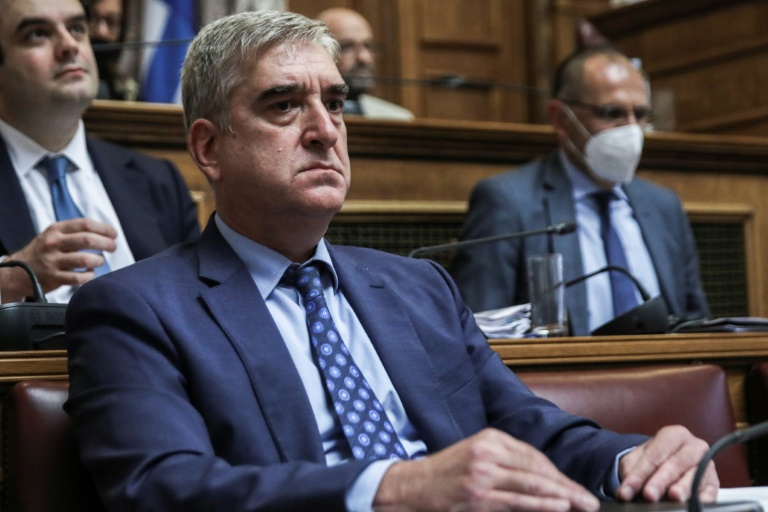
Greece’s conservative government was rocked Friday by a long-simmering surveillance scandal after its intelligence chief and a close aide to Prime Minister Kyriakos Mitsotakis resigned in the space of an hour.

Panagiotis Kontoleon offered his resignation due to management “errors” during his time in the role, Mitsotakis’ office said in a statement.

The announcement that Kontoleon had resigned from his position at the head of national intelligence service EYP came less than an hour after the secretary general of the prime minister’s office, Grigoris Dimitriadis, also quit.

The resignations came a week after the leader of the country’s Socialist opposition party, Nikos Androulakis, filed a complaint with the supreme court over “attempted” spying on his mobile phone using Predator malware.

Two Greek journalists have also taken legal action this year after they claimed to have been victims of surveillance.

Androulakis on Friday called for a special investigation by parliament into the incident.

“I never expected the Greek government to spy on me using the darkest practices,” he said.

The government has consistently denied any state involvement, saying it had not bought software of that type, but the rows have sparked an outcry in the country.

Government spokesman Yiannis Economou has said it was “plausible” that individuals used Predator to spy and that all of Europe faced surveillance threats.

In November, Greek minister of state George Gerapetritis had insisted to AFP that there is “no surveillance of journalists in Greece” by the state.

“Greece fully adheres to the values of democratic society and rule of law, especially pluralism and the freedom of the press,” Gerapetritis said.

As such, he argued there was “no need for further action” to verify the alleged monitoring of investigative journalist Stavros Malichudis.

Kontoleon, who was appointed EYP head in 2019 after Mitsotakis’s conservative party won power that year, had implied while in that role that the journalists had been targeted on the order of foreign intelligence services.

Investigative websites Reporters United and Inside Story have accused Dimitriadis — a nephew of Mitsotakis — of being linked to the alleged spying scandals involving Androulakis and Greek financial journalist Thanasis Koukakis.

Dimitriadis on Friday threatened to sue Reporters United and leftist daily Efsyn unless they withdraw a story on the case. Koukakis was also warned to refrain from retweeting the story.

In one of his first acts upon assuming power in 2019, Mitsotakis raised eyebrows by attaching the national intelligence service to his office.

The main opposition party, the left-wing Syriza, called the affair “a huge scandal”. Its leader, former premier Alexis Tsipras, said the resignation of Dimitriadis was “an admission of guilt” and that Mitsotakis himself bore some of the responsibility.

“Mr Mitsotakis must give explanations to the Greek people over his own Watergate,” Tsipras said.

– ‘A dystopian, Orwellian reality’ –

Experts note that Predator, originally developed in North Macedonia and subsequently in Israel, can access both messages and conversations.

“A few days ago I was informed by the European Parliament that there was an attempt to bug my mobile phone with Predator surveillance software,” Androulakis told the media as he left a court in Athens on July 26.

“Finding out who is behind these harmful practices is not a personal matter but a democratic duty,” he added.

The European Parliament set up a special service for MEPs to check their phones for illegal surveillance software following hacks using a spyware similar to Predator called Pegasus.

Androulakis used the service for “a precautionary check of his phone on June 28, 2022”. 

“From the first check, a suspicious link related to the Predator surveillance tool was detected,” his PASOK party said in a statement.

The software can infiltrate mobile phones to extract data or activate a camera or microphone to spy on their owners.

“Predator is among the most expensive spyware and is out of reach for individuals,” cybersecurity specialist Anastasios Arampatzis told AFP, saying only a state would need its sophisticated security features.

“Security and the protection of one’s private life must be guaranteed by any democratic regime. If a state spies on its citizens, we’re heading towards a dystopian, Orwellian reality.”

Spain’s intelligence chief was sacked earlier this year after it emerged that top politicians — including Prime Minister Pedro Sanchez and Catalan separatists — had been targeted by phone hacking.

Close Bitnami banner
Bitnami